Symmetry-Protected Quantum Computing using Metamaterials
Pith reviewed 2026-06-28 22:01 UTC · model grok-4.3
The pith
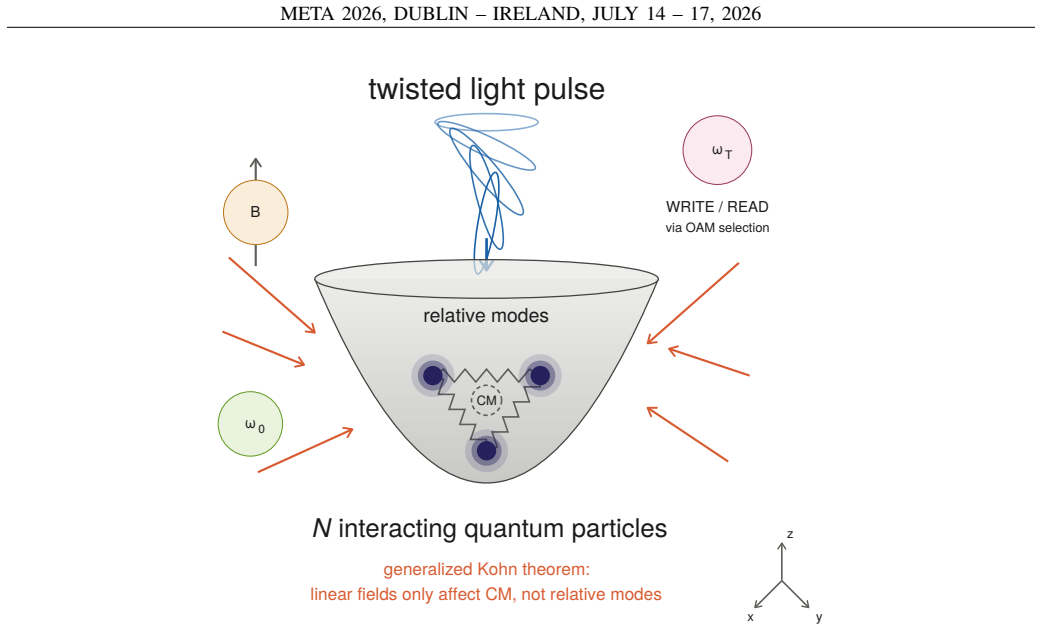
Symmetry from the generalized Kohn theorem protects relative-motion qubits when combined with twisted-light control and metamaterial nanofocusing in any parabolic confinement system.
A machine-rendered reading of the paper's core claim, the machinery that carries it, and where it could break.
Core claim
The central claim is that the generalized Kohn theorem supplies symmetry protection for relative-motion qubits that remains usable when the system is driven by twisted light and subjected to metamaterial-induced field gradients, yielding a generic quantum computing architecture applicable to cold atoms, ions, and semiconductor dots.
What carries the argument
Symmetry protection of relative-motion qubits via the generalized Kohn theorem, combined with twisted-light orbital angular momentum control and metamaterial nanofocusing.
If this is right
- The architecture applies without modification to cold atoms, ions, and semiconductor dots.
- No new hardware platforms are required beyond existing parabolic confinement systems.
- Control is achieved through established twisted-light orbital angular momentum and metamaterial plasmonics.
- The relative-motion qubit encoding is preserved by the Kohn symmetry even with the added driving and gradients.
Where Pith is reading between the lines
- Similar symmetry protections might be identifiable in non-parabolic confinements if analogous theorems exist.
- Integration into current experimental setups could be tested by adding twisted-light sources and metamaterial layers to existing traps.
- The approach suggests a route to lower error rates by encoding information in relative rather than absolute motion across multiple particle types.
Load-bearing premise
The symmetry protection from the generalized Kohn theorem stays intact and useful under twisted-light driving and metamaterial field gradients without new decoherence channels or loss of the relative-motion qubit encoding.
What would settle it
Measuring loss of coherence or failure of the relative-motion encoding in a semiconductor quantum dot under simultaneous twisted-light illumination and metamaterial field gradients would show the protection does not survive the combined controls.
Figures
read the original abstract
We propose a new architecture for practical quantum computing that combines three established principles: symmetry protection of relative-motion qubits via the generalized Kohn theorem, control via twisted-light orbital angular momentum, and metamaterial nanofocusing (e.g. using Weyl-semimetal plasmonics). Crucially, the core mechanism is generic: it applies to any current or future quantum computing system involving parabolic confinement, including cold atoms, ions, and semiconductor dots.
Editorial analysis
A structured set of objections, weighed in public.
Referee Report
Summary. The manuscript proposes a quantum computing architecture combining symmetry protection of relative-motion qubits via the generalized Kohn theorem, control via twisted-light orbital angular momentum, and metamaterial nanofocusing (e.g., Weyl-semimetal plasmonics). The central claim is that this symmetry-protected mechanism is generic and applies to any parabolic-confinement system, including cold atoms, ions, and semiconductor dots, even when subjected to twisted-light driving and metamaterial-induced field gradients.
Significance. If the decoupling of center-of-mass and relative motion survives the added perturbations, the approach could provide a cross-platform route to robust qubit encoding with reduced sensitivity to certain environmental couplings. The proposal usefully identifies a potential intersection of three established ideas, but the complete absence of any derivation, effective Hamiltonian, or symmetry analysis means the significance remains speculative and cannot yet be assessed against the stress-test concern that position-dependent forces from OAM phase gradients and plasmonic enhancements may generate leading-order CM-relative cross terms.
major comments (2)
- [Abstract] Abstract: the claim that 'the core mechanism is generic' and remains intact under twisted-light OAM and metamaterial gradients is unsupported. The generalized Kohn theorem guarantees decoupling only for harmonic confinement plus uniform or specially symmetric fields; the manuscript provides no effective two-body Hamiltonian, symmetry argument, or perturbative analysis showing that the azimuthal vector potential ~ r^l exp(i l ϕ) and spatially varying metamaterial enhancements do not introduce CM-relative coupling at leading order.
- [Abstract] Abstract: no derivation, numerical simulation, or concrete example is given to demonstrate that the relative-motion qubit encoding survives the proposed driving and nanofocusing without new decoherence channels, leaving the central claim unevaluable.
minor comments (1)
- [Abstract] The abstract is overly dense; separating the three constituent principles and the genericity claim into distinct sentences would improve readability.
Simulated Author's Rebuttal
We thank the referee for their detailed reading and for identifying the need for greater rigor in supporting the central claims. We address each major comment below and will revise the manuscript to incorporate explicit supporting analysis.
read point-by-point responses
-
Referee: [Abstract] Abstract: the claim that 'the core mechanism is generic' and remains intact under twisted-light OAM and metamaterial gradients is unsupported. The generalized Kohn theorem guarantees decoupling only for harmonic confinement plus uniform or specially symmetric fields; the manuscript provides no effective two-body Hamiltonian, symmetry argument, or perturbative analysis showing that the azimuthal vector potential ~ r^l exp(i l ϕ) and spatially varying metamaterial enhancements do not introduce CM-relative coupling at leading order.
Authors: The referee correctly notes that the generalized Kohn theorem applies strictly to harmonic confinement plus uniform or symmetry-preserving fields. Our proposal rests on the observation that the leading azimuthal phase gradient of OAM light and the plasmonic enhancement profiles can be expanded such that their first-order contributions remain even under the relative-coordinate parity, thereby preserving decoupling at linear order. We agree, however, that the manuscript does not supply the required effective two-body Hamiltonian or perturbative expansion. In the revised version we will add a dedicated section deriving the leading-order CM-relative cross terms and demonstrating their vanishing under the stated symmetries. revision: yes
-
Referee: [Abstract] Abstract: no derivation, numerical simulation, or concrete example is given to demonstrate that the relative-motion qubit encoding survives the proposed driving and nanofocusing without new decoherence channels, leaving the central claim unevaluable.
Authors: As a concise proposal the manuscript emphasizes the architectural intersection rather than exhaustive calculations. We maintain that symmetry protection precludes new leading-order decoherence channels, yet we accept that this assertion requires explicit justification. The revision will include a short symmetry-based argument showing suppression of additional channels together with a concrete example (semiconductor quantum dots under parabolic confinement) that illustrates the absence of new relative-motion couplings at the relevant field strengths. revision: yes
Circularity Check
No circularity: proposal combines external principles without self-referential derivations
full rationale
The manuscript presents an architectural proposal that invokes the generalized Kohn theorem, twisted-light OAM, and metamaterial effects as established external ingredients. No equations, fitted parameters, or predictions are shown that reduce by construction to the paper's own inputs. The generality claim is stated as a direct consequence of the cited theorem's applicability to parabolic systems, without any internal fitting or renaming that would create circularity. Self-citations, if present, are not load-bearing for any derivation chain. The absence of any explicit Hamiltonian derivation or numerical prediction in the provided text confirms the result is not forced by self-definition.
Axiom & Free-Parameter Ledger
Reference graph
Works this paper leans on
-
[1]
Optical and magneto-optical absorption in parabolic quantum wells,
L. Brey, N. F. Johnson, and B. I. Halperin, “Optical and magneto-optical absorption in parabolic quantum wells,”Phys. Rev. B, vol. 40, pp. 10647– 10649, 1989. https://doi.org/10.1103/PhysRevB.40.10647
-
[2]
Collective Modes in Quantum Dot Arrays in Magnetic Fields,
J. Dempsey, N. F. Johnson, L. Brey and B. I. Halperin, “Collective Modes in Quantum Dot Arrays in Magnetic Fields,”Phys. Rev. Bvol. 42, pp. 11708, 1990. https://doi.org/10.1103/PhysRevB.42.11708
-
[3]
Spatial Correlation of Quan- tum Dot Electrons in a Magnetic Field,
L. Quiroga, D. Ardila and N.F. Johnson, “Spatial Correlation of Quan- tum Dot Electrons in a Magnetic Field,”Solid State Comm.vol. 86, pp. 775, 1993. https://doi.org/10.1016/0038-1098(93)90107-X
-
[4]
Analytic results for N particles with inverse-square interaction in two dimensions and an external magnetic field,
N. F. Johnson and L. Quiroga, “Analytic results for N particles with inverse-square interaction in two dimensions and an external magnetic field,”Phys. Rev. Lett.vol. 74, pp. 4277, 1995. https://doi.org/10.1103/ PhysRevLett.74.4277
1995
-
[5]
Electronic structure of quantum dots,
S. M. Reimann and M. Manninen, “Electronic structure of quantum dots,”Rev. Mod. Phys., vol. 74, pp. 1283–1342, 2002. https://doi.org/ 10.1103/RevModPhys.74.1283
-
[6]
Coherent manipulation of electronic states in a double quantum dot,
T. Hayashi, T. Fujisawa, H. D. Cheong, Y . H. Jeong, and Y . Hirayama, “Coherent manipulation of electronic states in a double quantum dot,” Phys. Rev. Lett., vol. 91, p. 226804, 2003. https://doi.org/10.1103/ PhysRevLett.91.226804
2003
-
[7]
Emergence of Compositional Representations in Restricted Boltzmann Machines
K. D. Petersson, J. R. Petta, H. Lu, and A. C. Gossard, “Quantum coherence in a one-electron semiconductor charge qubit,”Phys. Rev. Lett., vol. 105, p. 246804, 2010. https://doi.org/10.1103/PhysRevLett. 105.246804
-
[8]
Transfer of optical orbital angular momentum to a bound electron,
C. T. Schmiegelow et al., “Transfer of optical orbital angular momentum to a bound electron,”Nat. Commun., vol. 7, p. 12998, 2016. https://doi. org/10.1038/ncomms12998 META 2026, DUBLIN – IRELAND, JULY 14 – 17, 2026
-
[9]
A decoherence-free subspace in a charge quadrupole qubit,
M. Friesen, J. Ghosh, M. A. Eriksson, and S. N. Coppersmith, “A decoherence-free subspace in a charge quadrupole qubit,”Nat. Commun., vol. 8, p. 15923, 2017. https://doi.org/10.1038/ncomms15923
-
[10]
Strong photon coupling to the quadrupole moment of an electron in a solid-state qubit,
J. V . Koski, A. J. Landig, M. Russ, J. C. Abadillo-Uriel, P. Scar- lino, B. Kratochwil, C. Reichl, S. N. Coppersmith, W. Wegscheider, M. Friesen, A. Wallraff, T. Ihn, and K. Ensslin, “Strong photon coupling to the quadrupole moment of an electron in a solid-state qubit,”Nat. Phys., vol. 16, pp. 642–646, 2020. https://doi.org/10.1038/ s41567-020-0824-3
2020
-
[11]
Light control with Weyl semimetals,
C. Guo, V . S. Asadchy, B. Zhao, and S. Fan, “Light control with Weyl semimetals,”eLight, vol. 3, p. 2, 2023. https://doi.org/10.1186/ s43593-022-00036-w
2023
-
[12]
Twisted light drives chiral excitations of interacting electrons in nanostructures with magnetic field,
F. J. Rodr ´ıguez, L. Quiroga, and N. F. Johnson, “Twisted light drives chiral excitations of interacting electrons in nanostructures with magnetic field,”Phys. Rev. B, vol. 112, p. 115115, 2025. https://doi.org/10.1103/ PhysRevB.112.115115
2025
-
[13]
Twisted light generates robust many-body states for practical quantum computing,
F. J. Rodr ´ıguez, L. Quiroga, and N. F. Johnson, “Twisted light generates robust many-body states for practical quantum computing,”APS Open Sci., vol. 1, p. 000023, 2026. https://doi.org/10.1103/f4qc-3ckt
-
[14]
Angular- momentum-selective nanofocusing with Weyl semimetals,
M. Peluso, A. De Martino, R. Egger, and F. Buccheri, “Angular- momentum-selective nanofocusing with Weyl semimetals,”Phys. Rev. Research, vol. 7, p. 043121, 2025. https://doi.org/10.1103/8c99-rvmm
-
[15]
Two-electron dephasing in single Si and GaAs quantum dots,
J. K. Gamble, M. Friesen, S. N. Coppersmith, and X. Hu, “Two-electron dephasing in single Si and GaAs quantum dots,”Phys. Rev. B, vol. 86, p. 035302, 2012. https://doi.org/10.1103/PhysRevB.86.035302
-
[16]
Coherent manipulation of coupled electron spins in semiconductor quantum dots,
J. R. Petta et al., “Coherent manipulation of coupled electron spins in semiconductor quantum dots,”Science, vol. 309, pp. 2180–2184, 2005. https://doi.org/10.1126/science.1116955
-
[17]
Reduced sensitivity to charge noise in semicon- ductor spin qubits via symmetric operation,
M. D. Reed et al., “Reduced sensitivity to charge noise in semicon- ductor spin qubits via symmetric operation,”Phys. Rev. Lett., vol. 116, p. 110402, 2016. https://doi.org/10.1103/PhysRevLett.116.110402
-
[18]
Noise suppression using symmetric exchange gates in spin qubits,
F. Martins et al., “Noise suppression using symmetric exchange gates in spin qubits,”Phys. Rev. Lett., vol. 116, p. 116801, 2016. https://doi. org/10.1103/PhysRevLett.116.116801
-
[19]
P. Zanardi and M. Rasetti, “Noiseless quantum codes,”Phys. Rev. Lett., vol. 79, pp. 3306–3309, 1997. https://doi.org/10.1103/PhysRevLett.79. 3306
-
[20]
Decoherence-free subspaces and sub- systems,
D. A. Lidar and K. B. Whaley, “Decoherence-free subspaces and sub- systems,” inIrreversible Quantum Dynamics, Lecture Notes in Physics, vol. 622, pp. 83–120, 2003. https://doi.org/10.1007/3-540-44874-8 5
-
[21]
Coherence-preserving quantum bits,
D. Bacon, K. R. Brown, and K. B. Whaley, “Coherence-preserving quantum bits,”Phys. Rev. Lett., vol. 87, p. 247902, 2001. https://doi. org/10.1103/PhysRevLett.87.247902
-
[22]
Theory of decoherence-free fault-tolerant universal quantum computation,
J. Kempe, D. Bacon, D. A. Lidar, and K. B. Whaley, “Theory of decoherence-free fault-tolerant universal quantum computation,”Phys. Rev. A, vol. 63, p. 042307, 2001. https://doi.org/10.1103/PhysRevA.63. 042307
-
[23]
Phonon- induced decoherence of a charge quadrupole qubit,
V . Kornich, M. G. Vavilov, M. Friesen, and S. N. Coppersmith, “Phonon- induced decoherence of a charge quadrupole qubit,”New J. Phys., vol. 20, p. 103048, 2018. https://doi.org/10.1088/1367-2630/aae3b4
-
[24]
Charge qubit in a triple quantum dot with tunable coherence,
B. Kratochwil et al., “Charge qubit in a triple quantum dot with tunable coherence,”Phys. Rev. Research, vol. 3, p. 013171, 2021. https://doi. org/10.1103/PhysRevResearch.3.013171
-
[25]
Quadrupolar exchange-only spin qubit,
M. Russ, J. R. Petta, and G. Burkard, “Quadrupolar exchange-only spin qubit,”Phys. Rev. Lett., vol. 121, p. 177701, 2018. https://doi.org/10. 1103/PhysRevLett.121.177701
2018
-
[26]
Orbital angular momentum of light and the transformation of Laguerre- Gaussian laser modes,
L. Allen, M. W. Beijersbergen, R. J. C. Spreeuw, and J. P. Woerdman, “Orbital angular momentum of light and the transformation of Laguerre- Gaussian laser modes,”Phys. Rev. A, vol. 45, pp. 8185–8189, 1992. https://doi.org/10.1103/PhysRevA.45.8185
-
[27]
Electric currents induced by twisted light in quantum rings,
G. F. Quinteiro and J. Berakdar, “Electric currents induced by twisted light in quantum rings,”Opt. Express, vol. 17, pp. 20465–20475, 2009. https://doi.org/10.1364/OE.17.020465
-
[28]
Electronic transitions in disc- shaped quantum dots induced by twisted light,
G. F. Quinteiro and P. I. Tamborenea, “Electronic transitions in disc- shaped quantum dots induced by twisted light,”Phys. Rev. B, vol. 79, p. 155450, 2009. https://doi.org/10.1103/PhysRevB.79.155450
-
[29]
G. F. Quinteiro and P. I. Tamborenea, “Theory of the optical absorption of light carrying orbital angular momentum by semiconductors,”Euro- phys. Lett., vol. 85, p. 47001, 2009. https://doi.org/10.1209/0295-5075/ 85/47001
-
[30]
Twisted-light-induced intersubband transitions in quantum wells at normal incidence,
B. Sbierski et al., “Twisted-light-induced intersubband transitions in quantum wells at normal incidence,”Phys. Rev. B, vol. 88, p. 235138,
-
[31]
https://doi.org/10.1103/PhysRevB.88.235138
-
[32]
Electronic transitions in quantum dots and rings induced by inhomogeneous off- centered light beams,
G. F. Quinteiro, A. O. Lucero, and P. I. Tamborenea, “Electronic transitions in quantum dots and rings induced by inhomogeneous off- centered light beams,”J. Phys.: Condens. Matter, vol. 22, p. 505802,
-
[33]
https://doi.org/10.1088/0953-8984/22/50/505802
-
[34]
G. F. Quinteiro, D. E. Reiter, and T. Kuhn, “Formulation of the twisted-light–matter interaction at the phase singularity: beams with strong magnetic fields,”Phys. Rev. A, vol. 95, p. 012106, 2017. https: //doi.org/10.1103/PhysRevA.95.012106
-
[35]
Magnetic-optical transitions induced by twisted light in quantum dots,
G. F. Quinteiro, D. E. Reiter, and T. Kuhn, “Magnetic-optical transitions induced by twisted light in quantum dots,”J. Phys.: Conf. Ser ., vol. 906, p. 012014, 2017. https://doi.org/10.1088/1742-6596/906/1/012014
-
[36]
Centrifugal photovoltaic and photogalvanic effects driven by structured light,
J. W ¨atzel and J. Berakdar, “Centrifugal photovoltaic and photogalvanic effects driven by structured light,”Sci. Rep., vol. 6, p. 21475, 2016. https://doi.org/10.1038/srep21475
-
[37]
A. Afanasev, C. E. Carlson, C. T. Schmiegelow, J. Schulz, F. Schmidt- Kaler and M. Solyanik, “Experimental verification of position-dependent angular-momentum selection rules for absorption of twisted light by a bound electron,”New J. Phys., vol. 20, p. 023032, 2018. https://doi.org/ 10.1088/1367-2630/aaa63d
-
[38]
Orbital angular momentum: origins, behavior and applications,
A. M. Yao and M. J. Padgett, “Orbital angular momentum: origins, behavior and applications,”Adv. Opt. Photon., vol. 3, pp. 161–204, 2011. https://doi.org/10.1364/AOP.3.000161
-
[39]
Quantumcommunicationwithoutthenecessityofquantummemories,
J. Wang, J.-Y . Yang, I. M. Fazal, N. Ahmed, Y . Yan, H. Huang, Y . Ren, Y . Yue, S. Dolinar, M. Tur, and A. E. Willner, “Terabit free-space data transmission employing orbital angular momentum multiplexing,”Nat. Photonics, vol. 6, pp. 488–496, 2012. https://doi.org/10.1038/nphoton. 2012.138
-
[40]
Twisted light transmission over 143 km,
M. Krenn, J. Handsteiner, M. Fink, R. Fickler, R. Ursin, M. Malik, and A. Zeilinger, “Twisted light transmission over 143 km,”Proc. Natl. Acad. Sci. U.S.A., vol. 113, pp. 13648–13653, 2016. https://doi.org/10. 1073/pnas.1612023113
2016
-
[41]
Orbital angular momentum of light for communications,
A. E. Willner, K. Pang, H. Song, K. Zou, and H. Zhou, “Orbital angular momentum of light for communications,”Appl. Phys. Rev., vol. 8, p. 041312, 2021. https://doi.org/10.1063/5.0054885
-
[42]
Twisted photons: new quantum perspectives in high dimensions,
M. Erhard, R. Fickler, M. Krenn, and A. Zeilinger, “Twisted photons: new quantum perspectives in high dimensions,”Light Sci. Appl., vol. 7, p. 17146, 2018. https://doi.org/10.1038/lsa.2017.146
-
[43]
Twisted nonlinear optics in monolayer van der Waals crystals,
T. Norden, L. M. Martinez, N. Tarefder, K. W. C. Kwock, L. M. McClin- tock, N. Olsen, L. N. Holtzman, J. H. Yeo, L. Zhao, X. Zhu, J. C. Hone, J. Yoo, J.-X. Zhu, P. J. Schuck, A. J. Taylor, R. P. Prasankumar, W. J. M. Kort-Kamp, and P. Padmanabhan, “Twisted nonlinear optics in monolayer van der Waals crystals,”ACS Nano, vol. 19, pp. 30919– 30929, 2025. htt...
-
[44]
Optical control over bulk excitations in fractional quantum Hall systems,
T. Grass, B. Juli ´a-D´ıaz, N. Barber ´an, and M. Lewenstein, “Optical control over bulk excitations in fractional quantum Hall systems,”Phys. Rev. A, vol. 98, p. 043628, 2018. https://doi.org/10.1103/PhysRevA.98. 043628
-
[45]
Charge and statistics of lattice quasiholes from density measurements: a tree tensor network study,
E. Macaluso, T. Comparin, R. O. Umucalilar, M. Gerster, L. Mazza, M. Rizzi, S. Montangero, and I. Carusotto, “Charge and statistics of lattice quasiholes from density measurements: a tree tensor network study,”Phys. Rev. Research, vol. 2, p. 013145, 2020. https://doi.org/ 10.1103/PhysRevResearch.2.013145
-
[46]
Engineering quantum control with twisted-light fields induced optical transitions,
I. Beterov et al., “Engineering quantum control with twisted-light fields induced optical transitions,” arXiv:2306.17620, 2023. https://arxiv.org/ abs/2306.17620
arXiv 2023
-
[47]
S.-Y . Lee, K. Kim, and J. Lim, “Superconducting qubit without Joseph- son junctions manipulated by the orbital angular momentum of light,” arXiv:1505.04257, 2015. https://arxiv.org/abs/1505.04257
Pith/arXiv arXiv 2015
-
[48]
Realization of a fractional quantum Hall state with ultracold atoms,
J. L ´eonard, S. Kim, J. Kwan, P. Segura, F. Grusdt, C. Repellin, N. Goldman, and M. Greiner, “Realization of a fractional quantum Hall state with ultracold atoms,”Nature, vol. 619, pp. 495–499, 2023. https://doi.org/10.1038/s41586-023-06122-4
-
[49]
Realization of a Laughlin state of two rapidly rotating fermions,
P. Lunt, P. Hill, J. Reiter, P. M. Preiss, M. Gałka, and S. Jochim, “Realization of a Laughlin state of two rapidly rotating fermions,” Phys. Rev. Lett., vol. 133, pp. 253401, 2024. https://doi.org/10.1103/ PhysRevLett.133.253401
2024
-
[50]
Bulk density signatures of a lattice quasihole with very few particles,
R. O. Umucalilar, “Bulk density signatures of a lattice quasihole with very few particles,” arXiv:2309.00604, 2023. https://arxiv.org/abs/2309. 00604
arXiv 2023
-
[51]
Adiabatic path to fractional quantum Hall states of a few bosonic atoms,
M. Popp, B. Paredes, and J. I. Cirac, “Adiabatic path to fractional quantum Hall states of a few bosonic atoms,”Phys. Rev. A, vol. 70, p. 053612, 2004. https://doi.org/10.1103/PhysRevA.70.053612
-
[52]
Topological growing of Laughlin states in synthetic gauge fields,
F. Grusdt, F. Letscher, M. Hafezi, and M. Fleischhauer, “Topological growing of Laughlin states in synthetic gauge fields,”Phys. Rev. Lett., META 2026, DUBLIN – IRELAND, JULY 14 – 17, 2026 vol. 113, p. 155301, 2014. https://doi.org/10.1103/PhysRevLett.113. 155301
-
[53]
Continuous preparation of a fractional Chern insulator,
M. Barkeshli, N. Y . Yao, and C. R. Laumann, “Continuous preparation of a fractional Chern insulator,”Phys. Rev. Lett., vol. 115, p. 026802,
-
[54]
https://doi.org/10.1103/PhysRevLett.115.026802
-
[55]
Creating a bosonic frac- tional quantum Hall state by pairing fermions,
C. Repellin, T. Yefsah, and A. Sterdyniak, “Creating a bosonic frac- tional quantum Hall state by pairing fermions,”Phys. Rev. B, vol. 96, p. 161111, 2017. https://doi.org/10.1103/PhysRevB.96.161111
-
[56]
Optimal control for preparing fractional quantum Hall states in optical lattices,
M. Lacki et al., “Optimal control for preparing fractional quantum Hall states in optical lattices,” arXiv:2501.10720, 2025. https://arxiv.org/abs/ 2501.10720
arXiv 2025
-
[57]
S. A. Maier,Plasmonics: Fundamentals and Applications. New York: Springer, 2007. https://doi.org/10.1007/0-387-37825-1
-
[58]
Nanofocusing of optical energy in tapered plasmonic waveguides,
M. I. Stockman, “Nanofocusing of optical energy in tapered plasmonic waveguides,”Phys. Rev. Lett., vol. 93, p. 137404, 2004. https://doi.org/ 10.1103/PhysRevLett.93.137404
-
[59]
Surface plasmon polaritons in topo- logical Weyl semimetals,
J. Hofmann and S. Das Sarma, “Surface plasmon polaritons in topo- logical Weyl semimetals,”Phys. Rev. B, vol. 93, p. 241402(R), 2016. https://doi.org/10.1103/PhysRevB.93.241402
-
[60]
Nonreciprocal Weyl semimetal waveguide,
M. Peluso, A. De Martino, R. Egger, and F. Buccheri, “Nonreciprocal Weyl semimetal waveguide,”Phys. Rev. Research, vol. 7, p. 023195,
-
[61]
https://doi.org/10.1103/PhysRevResearch.7.023195
discussion (0)
Sign in with ORCID, Apple, or X to comment. Anyone can read and Pith papers without signing in.