Software compensation of trigger-synchronous control-frame errors in qubits and qudits
Pith reviewed 2026-06-28 21:48 UTC · model grok-4.3
The pith
Reproducible disturbances in quantum control that repeat with a trigger signal can be compensated by software updates to frequency and phase.
A machine-rendered reading of the paper's core claim, the machinery that carries it, and where it could break.
Core claim
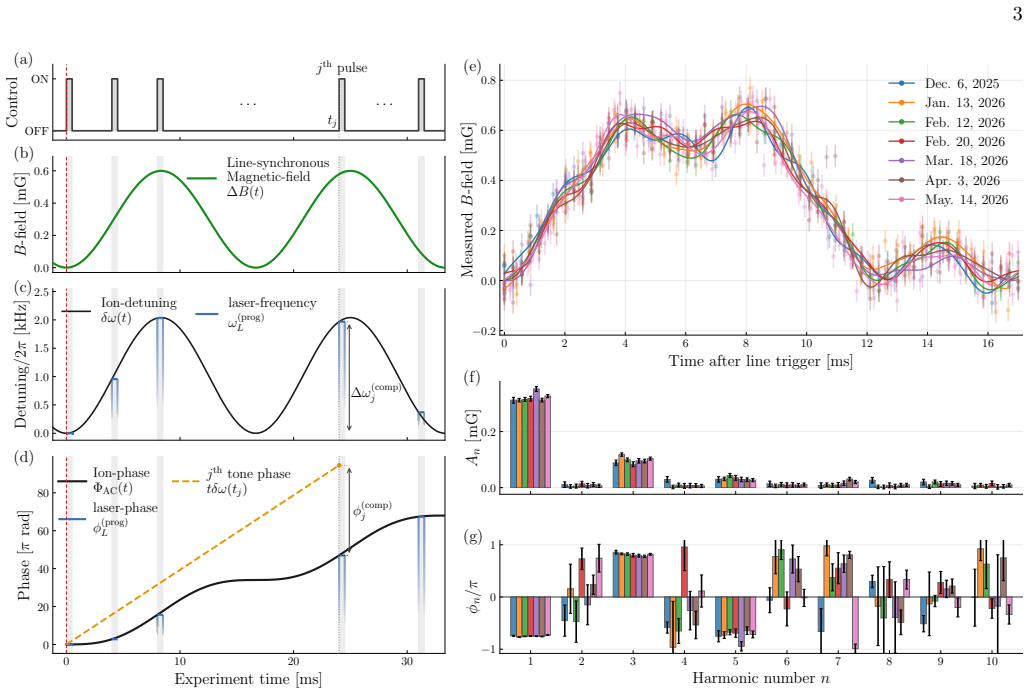
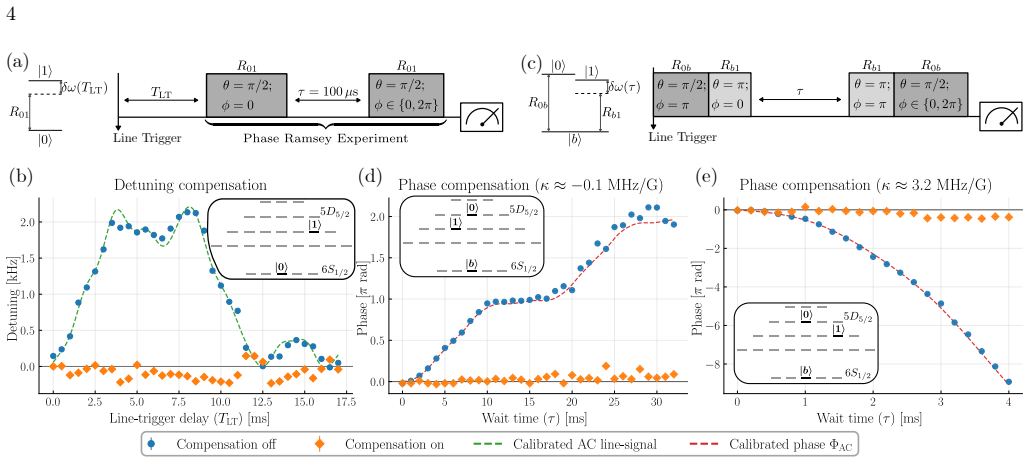
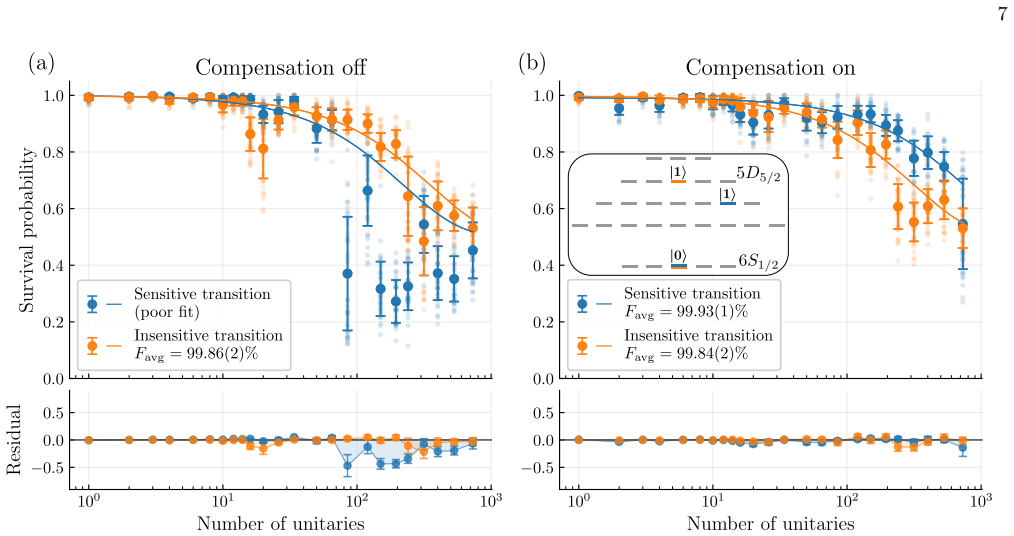
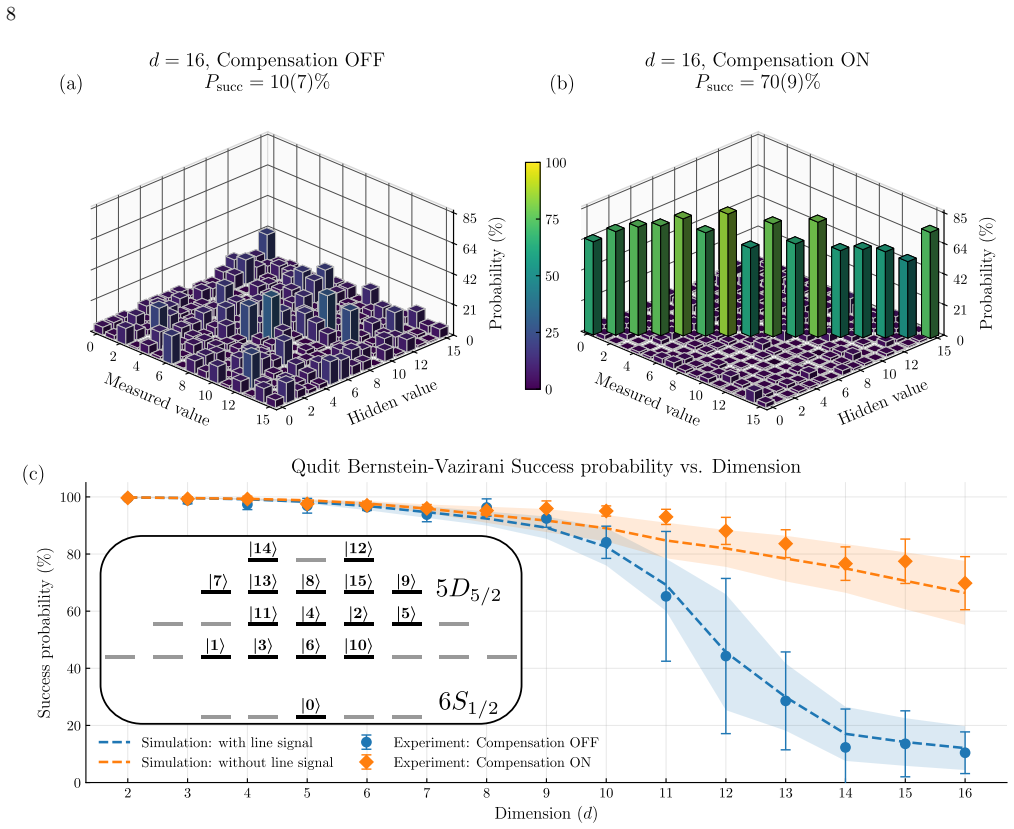
When disturbances are reproducible with respect to a trigger signal, their effect can be measured and compensated through software-defined updates to the control frequency and phase. This is verified experimentally using a trapped 137Ba+ ion experiencing magnetic-field-induced energy shifts synchronous with the laboratory AC mains power. The calibrated AC line contribution to the instantaneous oscillator detuning is reduced by 21(9)×, the fitted AC-induced phase amplitude falls below measurement uncertainty, randomized benchmarking gives an average single-qubit gate fidelity of 99.93(1)%, and the Bernstein-Vazirani success probability in a 16-level qudit rises from 10(7)% to 70(9)%.
What carries the argument
Software-defined updates to the control frequency and phase that turn measured trigger-synchronous disturbances into fixed corrections for control-frame errors.
If this is right
- The calibrated AC line contribution to instantaneous oscillator detuning is reduced by 21(9)×.
- The fitted AC-induced phase amplitude is reduced below measurement uncertainty.
- Randomized benchmarking recovers an average single-qubit gate fidelity of 99.93(1)% on a magnetic-field-sensitive qubit.
- The Bernstein-Vazirani success probability in a 16-level qudit system rises from 10(7)% to 70(9)%.
Where Pith is reading between the lines
- The same one-time measurement and software correction could be applied in any quantum platform where noise repeats with an external trigger or clock.
- The technique may combine with existing pulse-shaping methods to address both trigger-locked and non-periodic errors in the same sequence.
- Because the correction is applied at the control-frame level, it could be ported to multi-qubit devices if the shared disturbance can be calibrated on one qubit.
Load-bearing premise
The disturbances must be reproducible with respect to a trigger signal so that a one-time measurement yields a fixed correction valid for all later runs.
What would settle it
A post-correction measurement in which the AC-induced phase amplitude remains above the reported uncertainty level would show that the software updates do not achieve the claimed compensation.
Figures
read the original abstract
Quantum control experiments are often subject to coherent, time-dependent disturbances that vary over timescales comparable to the experiment duration. We show that when such disturbances are reproducible with respect to a trigger signal, their effect can be measured and compensated through software-defined updates to the control frequency and phase. We experimentally verify the performance of our protocol using a trapped $^{137}$Ba$^+$ ion experiencing magnetic-field-induced energy shifts synchronous with the laboratory AC mains power. Using this compensation technique, the calibrated AC line contribution to the instantaneous oscillator detuning is reduced by $21(9)\times$, and the fitted AC-induced phase amplitude is reduced below the measurement uncertainty. We use randomized benchmarking to validate the compensation performance in quantum gate sequences, recovering an average single-qubit gate fidelity of 99.93(1)\% with a magnetic-field-sensitive qubit. Finally, we extend the compensation framework to multi-level qudit control. Using the Bernstein-Vazirani algorithm as a benchmark, we increase the algorithm's success probability from 10(7)\% to 70(9)\% in a 16 level system when compensation is enabled. Our results demonstrate that trigger-synchronized coherent errors can be reframed as deterministic control-frame errors and corrected in software.
Editorial analysis
A structured set of objections, weighed in public.
Referee Report
Summary. The paper claims that coherent time-dependent disturbances reproducible with respect to a trigger signal can be measured on a qubit/qudit and compensated via software updates to control frequency and phase. In a trapped 137Ba+ ion subject to AC-mains-synchronous magnetic shifts, the protocol reduces the calibrated AC contribution to instantaneous detuning by 21(9)×, brings the fitted AC-induced phase amplitude below measurement uncertainty, yields 99.93(1)% average single-qubit gate fidelity via randomized benchmarking, and raises 16-level Bernstein-Vazirani success probability from 10(7)% to 70(9)%.
Significance. If the experimental results hold, the work supplies a practical, hardware-agnostic route to suppress trigger-synchronous coherent errors that are common in laboratory settings. The explicit demonstration on both qubit randomized benchmarking and a multi-level qudit algorithm, together with the reported numerical improvements, indicates immediate utility for fidelity-limited experiments. The approach reframes a class of deterministic control-frame errors as correctable in software without additional hardware.
major comments (1)
- Experimental Methods / Results: The manuscript reports quantitative improvements (21(9)× detuning reduction, 99.93(1)% fidelity, 70(9)% success probability) with error bars, yet the full methods, data-exclusion criteria, fitting procedures, and raw datasets are not supplied. This directly affects the ability to verify the central experimental claims that support the compensation protocol.
Simulated Author's Rebuttal
We thank the referee for their positive evaluation of the work and the recommendation for minor revision. We appreciate the recognition that the protocol offers a practical, hardware-agnostic approach to suppressing trigger-synchronous coherent errors. We address the single major comment below.
read point-by-point responses
-
Referee: Experimental Methods / Results: The manuscript reports quantitative improvements (21(9)× detuning reduction, 99.93(1)% fidelity, 70(9)% success probability) with error bars, yet the full methods, data-exclusion criteria, fitting procedures, and raw datasets are not supplied. This directly affects the ability to verify the central experimental claims that support the compensation protocol.
Authors: We agree that expanded documentation of the experimental and analysis procedures would strengthen reproducibility. In the revised manuscript we will add a dedicated supplementary section that details the full data-acquisition sequence, explicit data-exclusion criteria (e.g., outlier rejection thresholds based on fluorescence histograms), the precise functional forms and fitting routines used to extract instantaneous detuning and AC-induced phase amplitude, and the statistical methods underlying the reported uncertainties. We will also deposit the raw time-tagged fluorescence records and control-waveform files in a public repository (with DOI) and reference this deposit in the main text. These additions directly address the referee’s concern while preserving the manuscript’s focus on the compensation protocol itself. revision: yes
Circularity Check
No significant circularity identified
full rationale
The manuscript presents an experimental compensation protocol for trigger-synchronous disturbances, verified through direct measurements of detuning reduction, phase amplitude, randomized benchmarking fidelity, and qudit algorithm success probability. The central results are empirical outcomes of applying the described software updates; they do not reduce by the paper's equations or self-citations to quantities defined in terms of parameters fitted to the same reported data. The reproducibility premise is stated explicitly as an assumption and tested experimentally rather than derived circularly. No load-bearing self-citation chains, self-definitional steps, or ansatz smuggling are present.
Axiom & Free-Parameter Ledger
free parameters (1)
- frequency and phase correction values
axioms (1)
- domain assumption Disturbances are reproducible with respect to a trigger signal
Reference graph
Works this paper leans on
-
[1]
Further technical information about the ion trapping ap- 10 paratus is described in [41]
Experimental setup We employ a two-step, isotope selective ablation load- ing scheme using 554 nm and 389 nm excitation [39, 40] to confine single ions in our custom-built four-rod linear Paul trap, with secular frequencies of (1.3, 1.5, 0.2) MHz. Further technical information about the ion trapping ap- 10 paratus is described in [41]. In this work, the l...
-
[2]
Measurement of the line-synchronous waveform To measure the instantaneous line-synchronous detun- ing, each experimental shot is synchronized to the line trigger and followed by a variable delayTLT, as shown in Fig. 2(a). After this delay, we apply a Ramsey sequence with fixed free-evolution timeτ= 100µsand measure the final population for two analyzer ph...
-
[3]
In a frame referenced to the line trigger, this perturbation is de- scribed by a time-dependent adiabatic angular-frequency shiftδ AC(t)
Rotating-frame derivation of the compensation condition Wederivethecompensationconditionforadriventwo- level transition whose resonance frequency is shifted by a deterministic line-synchronous perturbation. In a frame referenced to the line trigger, this perturbation is de- scribed by a time-dependent adiabatic angular-frequency shiftδ AC(t). The goal is ...
-
[4]
Extension of compensation framework to qudits For a multilevel system, it is useful to view the line- synchronous perturbation as producing state-dependent phase accumulation. Consider a qudit state |ψ(0)⟩= d−1X i=0 ci|i⟩.(A.34) If the energy of state|i⟩is shifted byδEi(t), then in the absence of compensation the state evolves as |ψ(t)⟩= d−1X i=0 ci exp −...
-
[5]
Quantifying suppression of line-synchronous effects a. Matched-filter projection of the calibrated AC waveform Matched filtering is a standard signal-processing tech- nique for detecting or estimating the amplitude of a known waveform in noisy data [45]. It is commonly used when the expected time dependence of a signal is known in advance, and the goal is...
-
[6]
transition-aware
Unitary gate decomposition algorithm All unitary gates applied in the randomized bench- marking experiments and Bernstein–Vazirani algorithms are implemented via sequences of quadrupole transitions coupling the6S 1/2 ↔5D 5/2 manifolds, as mentioned throughout the text. In order to implement a target uni- tary gateU t in this context, we use an efficient p...
-
[7]
pulled through
Randomized benchmarking methods a. Generating Haar-random matrices Starting from a general input dimensiond, we first generate a complex matrix given by Z= X+iY√ 2 ,(A.53) whereXandYare reald×dmatrices with indepen- dent and identically distributed (i.i.d.) standard normal entries. Each entry ofZis therefore an i.i.d. complex normal random variable such t...
-
[8]
star-topology
Qudit-native Bernstein–Vazirani algorithm a. State selection The encoding scheme for multi-level measurements fol- lows the method outlined in [43] in which the mutual co- herence and connectivity of a set of states are the most important qualities to optimise over. For this work, we confine the search for states to those in5D5/2 with di- rect quadrupole ...
-
[9]
For smoothly varying phase data, we use a trend-aware unwrapping procedure rather than choosing the branch closest only to the previous point
Phase unwrapping Measured phases are first returned modulo2πand are therefore unwrapped before extracting phase trends. For smoothly varying phase data, we use a trend-aware unwrapping procedure rather than choosing the branch closest only to the previous point. For the first few points, the phase branch is chosen by ordinary local con- tinuity. After thi...
2025
-
[10]
Wang, C.-Y
P. Wang, C.-Y. Luan, M. Qiao, M. Um, J. Zhang, Y. Wang, X. Yuan, M. Gu, J. Zhang, and K. Kim, Nature Communications12, 233 (2021)
2021
- [11]
-
[12]
Helios: A 98-qubit trapped-ion quantum computer
A. Ransford, M. S. Allman, J. Arkinstall, J. P. C. III, S. F. Cooper, R. D. Delaney, J. M. Dreiling, B. Estey, C. Figgatt, A. Hall, A. A. Husain, A. Isanaka, C. J. Kennedy, N. Kotibhaskar, I. S. Madjarov, K. Mayer, A. R. Milne, A. J. Park, A. P. Reed, R. Ancona, M. P. Andersen, P. Andres-Martinez, W. Angenent, L. Ar- gueta, B. Arkin, L. Ascarrunz, W. Bake...
work page internal anchor Pith review Pith/arXiv arXiv 2025
- [13]
-
[14]
Chen and C
Y.-H. Chen and C. H. Baldwin, Physical Review Re- search7, 043065 (2025)
2025
-
[15]
D. Sannamoth, K. Boone, A. Carignan-Dugas, A. Hashim, I. Siddiqi, K. Mayer, and J. Emerson, Cornell Public arXiv (2025), arXiv:2512.24744v1 [quant-ph]
-
[16]
Gu, W.-F
Y. Gu, W.-F. Zhuang, X. Chai, and D. E. Liu, Nature Communications14, 5880 (2023)
2023
-
[17]
Wright, K
K. Wright, K. M. Beck, S. Debnath, J. M. Amini, Y. Nam, N. Grzesiak, J.-S. Chen, N. C. Pisenti, M. Chmielewski, C. Collins, K. M. Hudek, J. Mizrahi, J. D. Wong-Campos, S. Allen, J. Apisdorf, P. Solomon, M. Williams, A. M. Ducore, A. Blinov, S. M. Kreike- meier, V. Chaplin, M. Keesan, C. Monroe, and J. Kim, Nature Communications10, 5464 (2019)
2019
-
[18]
Ringbauer, M
M. Ringbauer, M. Meth, L. Postler, R. Stricker, R. Blatt, P. Schindler, and T. Monz, Nature Physics18, 1053 (2022)
2022
-
[19]
S. J. Devitt, W. J. Munro, and K. Nemoto, Reports on Progress in Physics76, 076001 (2013)
2013
-
[20]
K. R. Brown, A. W. Harrow, and I. L. Chuang, Physical Review A70, 052318 (2004)
2004
-
[21]
H. Hu, Y. Xie, M. chao Zhang, Q. qing Qin, J. Zhang, W. bo Su, T. xiang Zhan, C. wang Wu, P. xing Chen, and W. Wu, Applied Physics B129, 163 (2023)
2023
-
[22]
W. Wei, P. Hao, Z. Ma, H. Zhang, L. Pang, F. Wu, K. Deng, J. Zhang, and Z. Lu, Journal of Physics B: Atomic, Molecular and Optical Physics55, 075001 (2022)
2022
-
[23]
Laraoui, J
A. Laraoui, J. S. Hodges, and C. A. Meriles, Applied Physics Letters97, 143104 (2010)
2010
-
[24]
Merkel, K
B. Merkel, K. Thirumalai, J. E. Tarlton, V. M. Schäfer, C. J. Ballance, T. P. Harty, and D. M. Lucas, Review of Scientific Instruments90, 044702 (2019)
2019
-
[25]
J. You, J. Kang, K. Kim, W. Choi, and T. Kim, Cornell Public arXiv (2026), arXiv:2602.19588v1 [quant-ph]
work page internal anchor Pith review Pith/arXiv arXiv 2026
-
[26]
Pagano, P
G. Pagano, P. W. Hess, H. B. Kaplan, W. L. Tan, P. Richerme, P. Becker, A. Kyprianidis, J. Zhang, E. Bir- ckelbaw, M.R.Hernandez, Y.Wu,andC.Monroe,Quan- tum Science and Technology4, 014004 (2019)
2019
-
[27]
S. Kono, J. Pan, M. Chegnizadeh, X. Wang, A. Youssefi, M. Scigliuzzo, and T. J. Kippenberg, Nature Communi- cations15, 3950 (2024)
2024
-
[28]
Kalra, A
R. Kalra, A. Laucht, J. P. Dehollain, D. Bar, S. Freer, S. Simmons, J. T. Muhonen, and A. Morello, Review of Scientific Instruments87, 073905 (2016)
2016
-
[29]
Kellermann, G
M. Kellermann, G. Angloher, M. R. Bharadawj, M. Cababie, I. Dafinei, N. D. Marco, L. Einfalt, F. Fer- roni, S. Fichtinger, A. Filipponi, T. Frank, M. Friedl, Z. Ge, M. Heikinheimo, M. N. Hughes, K. Huitu, R. Maji, M. Mancuso, L. Pagnanini, F. Petricca, S. Pirro, F. Pröbst, G. Profeta, A. Puiu, F. Reindl, K. Schäffner, J. Schieck, D. Schmiedmayer, P. Schre...
2024
-
[30]
Ruster, C
T. Ruster, C. T. Schmiegelow, H. Kaufmann, C. Warschburger, F. Schmidt-Kaler, and U. G. Poschinger, Applied Physics B122, 254 (2016)
2016
-
[31]
M. Rowe, A. Ben-Kish, B. DeMarco, D. Leibfried, V.Meyer, J.Beall, J.Britton, J.Hughes, W.Itano, B.Je- lenkovic, C. Langer, T. Rosenband, and D. Wineland, Quantum Information and Computation2, 257 (2002)
2002
-
[32]
Haffner, C
H. Haffner, C. Roos, and R. Blatt, Physics Reports469, 155 (2008)
2008
-
[33]
C. D. Bruzewicz, J. Chiaverini, R. McConnell, and J. M. Sage, Applied Physics Reviews6, 021314 (2019)
2019
-
[34]
Kranzl, M
F. Kranzl, M. K. Joshi, C. Maier, T. Brydges, J. Franke, R. Blatt, and C. F. Roos, Physical Review A105, 052426 (2022)
2022
-
[35]
M. F. Brandl, M. W. van Mourik, L. Postler, A. Nolf, K. Lakhmanskiy, R. R. Paiva, S. Möller, N. Daniilidis, H. Häffner, V. Kaushal, T. Ruster, C. Warschburger, H. Kaufmann, U. G. Poschinger, F. Schmidt-Kaler, P. Schindler, T. Monz, and R. Blatt, Review of Scien- tific Instruments87, 113103 (2016)
2016
-
[36]
Vepsäläinen, R
A. Vepsäläinen, R. Winik, A. H. Karamlou, J. Braumüller, A. D. Paolo, Y. Sung, B. Kannan, M. Kjaergaard, D. K. Kim, A. J. Melville, B. M. Niedzielski, J. L. Yoder, S. Gustavsson, and W. D. Oliver, Nature Communications13, 1932 (2022)
1932
-
[37]
Proctor, M
T. Proctor, M. Revelle, E. Nielsen, K. Rudinger, D. Lob- ser, P. Maunz, R. Blume-Kohout, and K. Young, Nature Communications11, 5396 (2020)
2020
-
[38]
Arkin, B
B. Arkin, B. J. Bjork, G. Chambers, C. FIGGATT, P. Lee, D. Lucchetti, and J. A. Walker, Quantum com- puter phase tracking and correction (2022)
2022
-
[39]
S. A. Moses, C. H. Baldwin, M. S. Allman, R. An- cona, L. Ascarrunz, C. Barnes, J. Bartolotta, B. Bjork, P. Blanchard, M. Bohn, J. G. Bohnet, N. C. Brown, N. Q. Burdick, W. C. Burton, S. L. Campbell, J. P. Campora, C. Carron, J. Chambers, J. W. Chan, Y. H. Chen, A. Chernoguzov, E. Chertkov, J. Colina, J. P. Curtis, R. Daniel, M. DeCross, D. Deen, C. Delan...
2023
-
[40]
Figgatt,Building and Programming a Universal Ion Trap Quantum Computer, Ph.D
C. Figgatt,Building and Programming a Universal Ion Trap Quantum Computer, Ph.D. thesis, University of Maryland (2018)
2018
-
[41]
Kielpinski, C
D. Kielpinski, C. Monroe, and D. J. Wineland, Nature 417, 709 (2002)
2002
-
[42]
Bramman,Ablation loading and qudit measurements with barium ions, Ph.D
B. Bramman,Ablation loading and qudit measurements with barium ions, Ph.D. thesis, University of Waterloo (2023)
2023
-
[43]
Emerson, R
J. Emerson, R. Alicki, and K. Życzkowski, Journal of Op- tics B: Quantum and Semiclassical Optics7, S347 (2005)
2005
-
[44]
Knill, D
E. Knill, D. Leibfried, R. Reichle, J. Britton, R. B. Blakestad, J. D. Jost, C. Langer, R. Ozeri, S. Seidelin, and D. J. Wineland, Physical Review A77, 012307 (2008). 18
2008
-
[45]
Magesan, J
E. Magesan, J. M. Gambetta, B. R. Johnson, C. A. Ryan, J. M. Chow, S. T. Merkel, M. P. da Silva, G. A. Keefe, M. B. Rothwell, T. A. Ohki, M. B. Ketchen, and M. Stef- fen, Physical Review Letters109, 080505 (2012)
2012
-
[46]
Y. Wang, Z. Hu, B. C. Sanders, and S. Kais, Frontiers in Physics8, nil (2020)
2020
-
[47]
A.M.J.denHaan, G.H.C.J.Wijts, F.Galli, O.Usenko, G. J. C. van Baarle, D. J. van der Zalm, and T. H. Oosterkamp, Review of Scientific Instruments85, 035112 (2014)
2014
-
[48]
B. M. White, P. J. Low, Y. de Sereville, M. L. Day, N. Greenberg, R. Rademacher, and C. Senko, Physical Review A105, 033102 (2022)
2022
-
[49]
Greenberg, B
N. Greenberg, B. M. White, P. J. Low, and C. Senko, Quantum Science and Technology9, 035023 (2024)
2024
-
[50]
P. J. Low, B. White, and C. Senko, npj Quantum Infor- mation11, 85 (2025)
2025
-
[51]
F. A. An, A. Ransford, A. Schaffer, L. R. Sletten, J. Gae- bler, J. Hostetter, and G. Vittorini, Physical Review Let- ters129, 130501 (2022)
2022
-
[52]
P. J. Low, N. C. F. Zutt, G. A. Tathed, and C. Senko, Nature Communications 10.1038/s41467-026- 72662-8 (2026)
-
[53]
G. A. Tathed,Actualizing High-Dimensional Qudits on a Trapped-Ion Quantum Computer, Master’s thesis, Uni- versity of Waterloo (2025)
2025
-
[54]
Turin, IEEE Transactions on Information Theory6, 311 (1960)
G. Turin, IEEE Transactions on Information Theory6, 311 (1960)
1960
-
[55]
Allen, W
B. Allen, W. G. Anderson, P. R. Brady, D. A. Brown, and J. D. E. Creighton, Physical Review D85, 122006 (2012)
2012
-
[56]
S. J. Gibbons and F. Ringdal, Geophysical Journal In- ternational165, 149 (2006)
2006
-
[57]
D. A. Drozhzhin, E. O. Kiktenko, A. K. Fedorov, and A. S. Nikolaeva, Entropy28, 56 (2025)
2025
-
[58]
How to generate random matrices from the classical compact groups
F. Mezzadri, Cornell Public arXiv 10.48550/ARXIV.MATH-PH/0609050 (2006)
work page internal anchor Pith review doi:10.48550/arxiv.math-ph/0609050 2006
-
[59]
Edelman and N
A. Edelman and N. R. Rao, Acta Numerica14, 233 (2005)
2005
-
[60]
Tathed, N
G. Tathed, N. C. F. Zutt, C. Epstein, and C. Senko, Code and data: Software-based compensation of ac-line- induced control errors in qubits and qudits (2026)
2026
discussion (0)
Sign in with ORCID, Apple, or X to comment. Anyone can read and Pith papers without signing in.