REVIEW 2 major objections 2 minor 39 references
A stochastic score matching procedure reduces Torus Graph inference cost from O(d^6) to O(d^2) for thousands of phase variables.
Reviewed by Pith at T0; open to challenge. T0 means a machine referee read the full paper against a public rubric. the ladder, T0–T4 →
T0 review · grok-4.3
2026-06-28 19:06 UTC pith:Y6XJDODR
load-bearing objection Stochastic score matching scales torus graphs to thousands of variables, but the approximation's effect on estimate quality needs direct checks. the 2 major comments →
Torus Graphs for Large Scale Neural Phase Analysis
The pith
A machine-rendered reading of the paper's core claim, the machinery that carries it, and where it could break.
Core claim
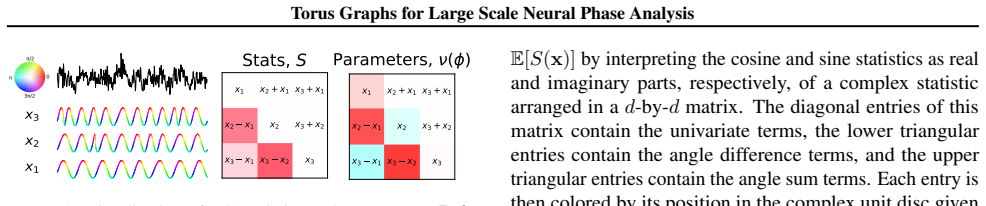
We introduce a stochastic score matching procedure that reduces the per-iteration cost to O(d^2), enabling inference on datasets with thousands of variables. This scalable foundation supports analyses of 1,860 frequency-phase features from multi-electrode LFPs and enables two extensions previously inaccessible to TGs or classical circular statistics: (i) a TG Hidden Markov Model capturing state-dependent phase-coupling changes (e.g., spindle-related states during sleep) and (ii) an autoregressive TG inferring directional interactions via transfer-entropy estimation. Applied to LFP recordings, these models reveal state-dependent phase-interaction patterns between wakefulness and NREM sleep.
What carries the argument
The stochastic score matching procedure that approximates the full score matching objective for the exponential-family Torus Graph distribution over phases in O(d^2) time per iteration.
Load-bearing premise
Neural phase data fits the exponential-family Torus Graph model well enough that the stochastic approximation does not introduce substantial errors in the estimated parameters.
What would settle it
A side-by-side run of the original O(d^6) score matching and the new stochastic version on a dataset of roughly 100 variables that yields substantially different parameter values or fails to recover known structure would show the approximation is inaccurate.
If this is right
- Inference on datasets with thousands of variables becomes computationally practical.
- A Torus Graph Hidden Markov Model can capture state-dependent changes in phase coupling.
- An autoregressive Torus Graph can estimate directional interactions through transfer entropy.
- Systematic mapping of dynamic and directional phase relationships across brain states is enabled.
Where Pith is reading between the lines
- The reduced cost may open Torus Graph modeling for other high-dimensional circular data outside neural recordings.
- The hidden Markov and autoregressive extensions could be combined into a single model of evolving directional phase networks.
- Validation on simulated phase data with known ground-truth couplings would test whether the stochastic procedure recovers accurate structure.
Editorial analysis
A structured set of objections, weighed in public.
Referee Report
Summary. The paper claims that Torus Graph (TG) models for undirected phase dependencies can be scaled via a new stochastic score-matching procedure (reducing per-iteration cost from O(d^6) to O(d^2)) to handle thousands of variables, here applied to 1,860 frequency-phase features from multi-electrode LFPs; the same scalable foundation then supports two extensions (TG-HMM for state-dependent coupling and autoregressive TG for directional transfer-entropy inference) that reveal wake/NREM differences in phase interactions.
Significance. If the stochastic estimator is shown to preserve the statistical properties of the original score-matching estimator and the TG family is demonstrated to be an adequate model for the phase data, the work would remove a long-standing computational barrier and open systematic large-scale mapping of both dynamic and directed phase relationships in neuroscience.
major comments (2)
- [Abstract (description of stochastic score matching) and method sections] The central scalability claim rests on the stochastic score-matching procedure yielding parameter estimates whose consistency, bias, and downstream quantities (edge selection, transfer entropy) remain close to those of the O(d^6) full estimator. No theoretical argument establishing that the Monte-Carlo approximation of the score (or its Hessian) converges to the same population objective, nor any empirical comparison on regimes where both estimators can be run, is supplied; for circular data the variance of the trigonometric moments grows with the number of pairwise terms, so the approximation error is not obviously bounded independently of d.
- [Applications and results paragraphs] The two extensions (TG-HMM and autoregressive TG) and the biological conclusions drawn from the 1,860-feature LFP analysis presuppose that the exponential-family TG model fits the neural phase data sufficiently well. No goodness-of-fit diagnostics, residual analysis, or comparison against simpler circular baselines are reported, leaving open whether the observed state-dependent patterns could be artifacts of model misspecification.
minor comments (2)
- The abstract states that the procedure 'enables inference on datasets with thousands of variables' but supplies no concrete timing or memory figures on the 1,860-feature dataset; adding these would strengthen the scalability claim.
- Notation for the univariate and pairwise potentials is introduced without an explicit reference to the original TG definition; a short recap equation would aid readers unfamiliar with the 2023 TG paper.
Simulated Author's Rebuttal
We thank the referee for the constructive comments. We respond point-by-point to the two major concerns below.
read point-by-point responses
-
Referee: [Abstract (description of stochastic score matching) and method sections] The central scalability claim rests on the stochastic score-matching procedure yielding parameter estimates whose consistency, bias, and downstream quantities (edge selection, transfer entropy) remain close to those of the O(d^6) full estimator. No theoretical argument establishing that the Monte-Carlo approximation of the score (or its Hessian) converges to the same population objective, nor any empirical comparison on regimes where both estimators can be run, is supplied; for circular data the variance of the trigonometric moments grows with the number of pairwise terms, so the approximation error is not obviously bounded independently of d.
Authors: We acknowledge that the manuscript provides neither a theoretical convergence argument for the Monte-Carlo score approximation nor empirical head-to-head comparisons against the full O(d^6) estimator. In revision we will add an empirical validation subsection that runs both estimators on synthetic torus-graph data for d ≤ 50 (where the full estimator remains tractable) and reports agreement on parameter recovery, edge selection, and transfer-entropy values. A rigorous theoretical bound on approximation error for growing d remains an open question outside the present scope. revision: partial
-
Referee: [Applications and results paragraphs] The two extensions (TG-HMM and autoregressive TG) and the biological conclusions drawn from the 1,860-feature LFP analysis presuppose that the exponential-family TG model fits the neural phase data sufficiently well. No goodness-of-fit diagnostics, residual analysis, or comparison against simpler circular baselines are reported, leaving open whether the observed state-dependent patterns could be artifacts of model misspecification.
Authors: We agree that explicit goodness-of-fit assessment is required to support the reported biological findings. The revised manuscript will include (i) likelihood comparisons of the fitted TG model against an independent von Mises baseline on the LFP data and (ii) residual checks that verify reproduction of observed pairwise trigonometric moments. These diagnostics will be presented before the state-dependent and directional analyses. revision: yes
- A complete theoretical analysis establishing convergence of the Monte-Carlo score approximation for the torus graph model as d increases.
Circularity Check
No circularity: stochastic score matching is an independent algorithmic scaling technique
full rationale
The paper's central contribution is an algorithmic reduction of score-matching inference for torus graphs from O(d^6) to O(d^2) via stochastic approximation. This step is derived from standard stochastic gradient techniques applied to the existing score-matching objective and does not reduce to any fitted parameter, self-defined quantity, or self-citation chain within the present work. The subsequent TG-HMM and autoregressive extensions are enabled by the new scalability but are not used to justify the core procedure itself. No load-bearing claim equates a prediction or uniqueness result to its own inputs by construction; the derivation chain remains externally verifiable through standard optimization theory and is therefore self-contained.
Axiom & Free-Parameter Ledger
free parameters (1)
- univariate and pairwise potential parameters
axioms (1)
- domain assumption Phases follow an exponential-family distribution whose univariate and pairwise potentials generalize von Mises distributions
read the original abstract
Oscillatory neural signals such as electroencephalography (EEG) and local field potentials (LFPs) show phase relationships that coordinate communication across brain regions. Modern recordings capture hundreds of channels across many frequency bins, yet standard phase analyses are restricted to only a few variables. The Torus Graph (TG) model, an exponential-family distribution over phases whose univariate and pairwise potentials generalize von Mises distributions, infers principled structure among oscillations but models only static, undirected dependencies and is limited to $\sim \! 100$ variables because its score matching inference scales as $\mathcal{O}(d^{6})$. We introduce a stochastic score matching procedure that reduces the per-iteration cost to $\mathcal{O}(d^{2})$, enabling inference on datasets with thousands of variables. This scalable foundation supports analyses of 1,860 frequency-phase features from multi-electrode LFPs and enables two extensions previously inaccessible to TGs or classical circular statistics: (i) a TG Hidden Markov Model capturing state-dependent phase-coupling changes (e.g., spindle-related states during sleep) and (ii) an autoregressive TG inferring directional interactions via transfer-entropy estimation. Applied to LFP recordings, these models reveal state-dependent phase-interaction patterns between wakefulness and NREM sleep. Together, they enable systematic, large-scale mapping of dynamic and directional phase relationships across brain and cognitive states.
Figures


Reference graph
Works this paper leans on
-
[1]
The annals of applied statistics , volume=
Torus graphs for multivariate phase coupling analysis , author=. The annals of applied statistics , volume=
-
[2]
2006 , publisher=
Rhythms of the Brain , author=. 2006 , publisher=
2006
-
[3]
The phase of ongoing
Busch, Niko A and Dubois, Julien and VanRullen, Rufin , journal=. The phase of ongoing. 2009 , publisher=
2009
-
[4]
Proceedings of the thirteenth international conference on artificial intelligence and statistics , pages=
Noise-contrastive estimation: A new estimation principle for unnormalized statistical models , author=. Proceedings of the thirteenth international conference on artificial intelligence and statistics , pages=. 2010 , organization=
2010
-
[5]
Human brain mapping , volume=
Measuring phase synchrony in brain signals , author=. Human brain mapping , volume=. 1999 , publisher=
1999
-
[6]
Science , volume=
Neuropixels 2.0: A miniaturized high-density probe for stable, long-term brain recordings , author=. Science , volume=. 2021 , publisher=
2021
-
[7]
Science , volume=
Spontaneous behaviors drive multidimensional, brainwide activity , author=. Science , volume=. 2019 , publisher=
2019
-
[8]
science , volume=
Neuronal oscillations in cortical networks , author=. science , volume=. 2004 , publisher=
2004
-
[9]
Science , volume=
Modulation of oscillatory neuronal synchronization by selective visual attention , author=. Science , volume=. 2001 , publisher=
2001
-
[10]
Journal of Neuroscience , volume=
Gamma oscillations in the entorhinal cortex of the freely behaving rat , author=. Journal of Neuroscience , volume=. 1998 , publisher=
1998
-
[11]
Physiological reviews , volume=
Neurophysiological and computational principles of cortical rhythms in cognition , author=. Physiological reviews , volume=. 2010 , publisher=
2010
-
[12]
Phase relationship between hippocampal place units and the
O'Keefe, John and Recce, Michael L , journal=. Phase relationship between hippocampal place units and the. 1993 , publisher=
1993
-
[13]
arXiv preprint arXiv:1910.04375 , year=
Estimating transfer entropy via copula entropy , author=. arXiv preprint arXiv:1910.04375 , year=
-
[14]
International Conference on Learning Representations (ICLR) , year =
Adam: A Method for Stochastic Optimization , author =. International Conference on Learning Representations (ICLR) , year =
-
[15]
James Bradbury and Roy Frostig and Peter Hawkins and Matthew James Johnson and Chris Leary and Dougal Maclaurin and George Necula and Adam Paszke and Jake Vander
-
[16]
Granger causality and transfer entropy are equivalent for
Barnett, Lionel and Barrett, Adam B and Seth, Anil K , journal=. Granger causality and transfer entropy are equivalent for. 2009 , publisher=
2009
-
[17]
Molecular Neurobiology , volume=
Dopaminergic projection from ventral tegmental area to substantia nigra pars reticulata mediates chronic social defeat stress--induced hypolocomotion , author=. Molecular Neurobiology , volume=. 2021 , publisher=
2021
-
[18]
Alberto Cabezas and Adrien Corenflos and Junpeng Lao and Rémi Louf , year=. BlackJAX: Composable. 2402.10797 , archivePrefix=
-
[19]
Protein bioinformatics and mixtures of bivariate
Mardia, Kanti V and Taylor, Charles C and Subramaniam, Ganesh K , journal=. Protein bioinformatics and mixtures of bivariate. 2007 , publisher=
2007
-
[20]
Neural computation , volume=
Phase coupling estimation from multivariate phase statistics , author=. Neural computation , volume=. 2010 , publisher=
2010
-
[21]
Directional-unit
Zemel, Richard and Williams, Christopher and Mozer, Michael C , journal=. Directional-unit
-
[22]
Science , volume=
A common hub for sleep and motor control in the substantia nigra , author=. Science , volume=. 2020 , publisher=
2020
-
[23]
Nature communications , volume=
Bi-directional regulation of cognitive control by distinct prefrontal cortical output neurons to thalamus and striatum , author=. Nature communications , volume=. 2021 , publisher=
2021
-
[24]
Current Biology , volume=
The bilateral prefronto-striatal pathway is necessary for learning new goal-directed actions , author=. Current Biology , volume=. 2018 , publisher=
2018
-
[25]
Physical review letters , volume=
Measuring information transfer , author=. Physical review letters , volume=. 2000 , publisher=
2000
-
[26]
Mathematical Programming , volume=
An exact duality theory for semidefinite programming and its complexity implications , author=. Mathematical Programming , volume=. 1997 , publisher=
1997
-
[27]
, author=
Estimation of non-normalized statistical models by score matching. , author=. Journal of Machine Learning Research , volume=
-
[28]
Wollstadt, Patricia and Lizier, Joseph T and Vicente, Raul and Finn, Conor and Martinez-Zarzuela, Mario and Mediano, Pedro and Novelli, Leonardo and Wibral, Michael , journal=
-
[29]
International Conference on Learning Representations (ICLR) , year=
Self-Supervised Graph Neural Networks for Improved Electroencephalographic Seizure Analysis , author=. International Conference on Learning Representations (ICLR) , year=
-
[30]
Proceedings of the 30th ACM SIGKDD Conference on Knowledge Discovery and Data Mining , pages=
Eeg2rep: enhancing self-supervised eeg representation through informative masked inputs , author=. Proceedings of the 30th ACM SIGKDD Conference on Knowledge Discovery and Data Mining , pages=
-
[31]
EvoBrain: Dynamic Multi-Channel EEG Graph Modeling for Time-Evolving Brain Networks , volume =
Kotoge, Rikuto and Chen, Zheng and Kimura, Tasuku and Matsubara, Yasuko and Yanagisawa, Takufumi and Kishima, Haruhiko and Sakurai, Yasushi , journal =. EvoBrain: Dynamic Multi-Channel EEG Graph Modeling for Time-Evolving Brain Networks , volume =
-
[32]
Scientific Reports , volume=
infomeasure: a comprehensive Python package for information theory measures and estimators , author=. Scientific Reports , volume=. 2025 , publisher=
2025
-
[33]
Statsmodels: econometric and statistical modeling with
Seabold, Skipper and Perktold, Josef and others , journal=. Statsmodels: econometric and statistical modeling with
-
[34]
1984 , publisher =
Chemical Oscillations, Waves, and Turbulence , author =. 1984 , publisher =
1984
-
[35]
Generative models of cortical oscillations: neurobiological implications of the
Breakspear, Michael and Heitmann, Stewart and Daffertshofer, Andreas , journal=. Generative models of cortical oscillations: neurobiological implications of the. 2010 , publisher=
2010
-
[36]
1980 , publisher=
The geometry of biological time , author=. 1980 , publisher=
1980
-
[37]
Neuron , volume=
Traveling electrical waves in cortex: insights from phase dynamics and speculation on a computational role , author=. Neuron , volume=. 2001 , publisher=
2001
-
[38]
The Journal of Mathematical Neuroscience , volume=
Understanding the dynamics of biological and neural oscillator networks through exact mean-field reductions: a review , author=. The Journal of Mathematical Neuroscience , volume=. 2020 , publisher=
2020
-
[39]
Journal of neurophysiology , volume=
Effect of amplitude correlations on coherence in the local field potential , author=. Journal of neurophysiology , volume=. 2014 , publisher=
2014
discussion (0)
Sign in with ORCID, Apple, or X to comment. Anyone can read and Pith papers without signing in.