Supersymmetric quantum criticality with discrete symmetry
Pith reviewed 2026-06-28 18:13 UTC · model grok-4.3
The pith
For n>3 the Z_n anisotropy is irrelevant at the fixed point of (2+1)D Gross-Neveu-Yukawa theories, recovering an N=2 Wess-Zumino supersymmetric critical point.
A machine-rendered reading of the paper's core claim, the machinery that carries it, and where it could break.
Core claim
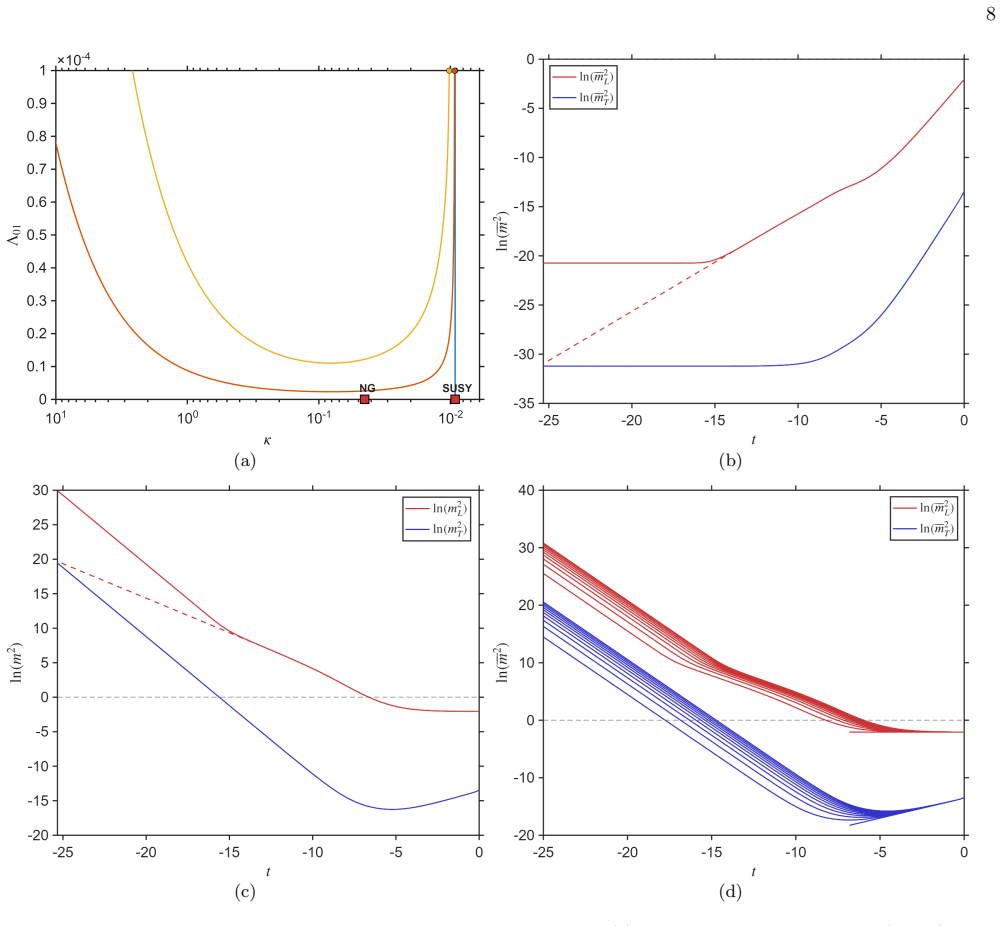
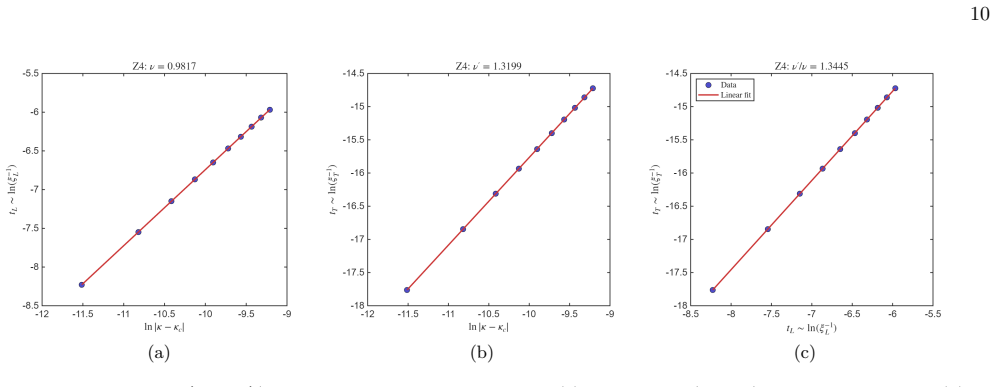
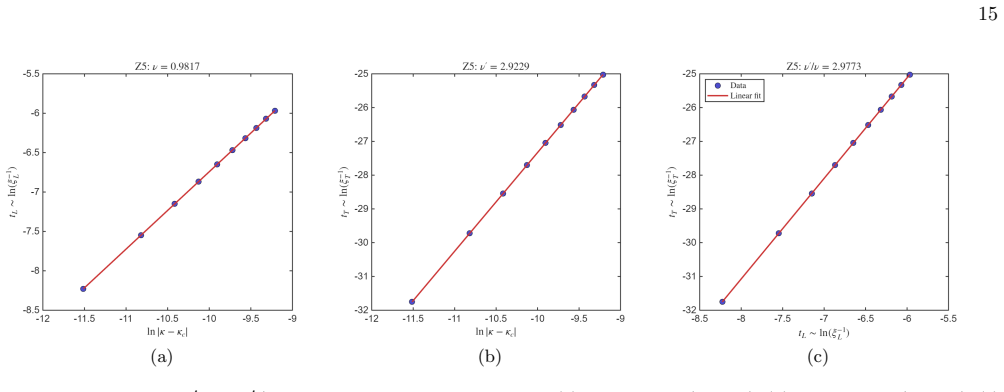
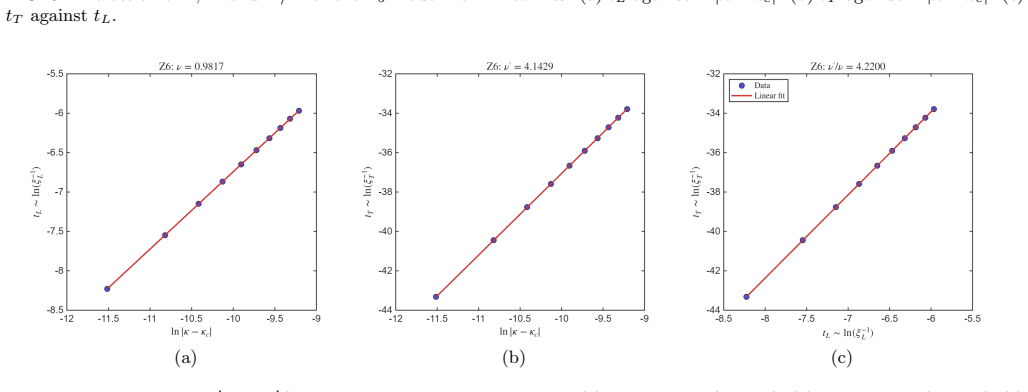
Using the functional renormalization group, the authors show that anisotropic perturbations with Z_n symmetry for n>3 flow to zero at the interacting fixed point, so the critical theory is the N=2 Wess-Zumino supersymmetric model. In the ordered phase the same operator remains dangerously irrelevant and produces a second length scale ξ' in addition to the usual correlation length ξ. By tracking mass thresholds along symmetry-broken trajectories the authors extract the exponents ν' and ν without prior scaling assumptions and confirm that they obey ν'/ν = 1 + |y_n|/2 for the Z_4, Z_5 and Z_6 cases.
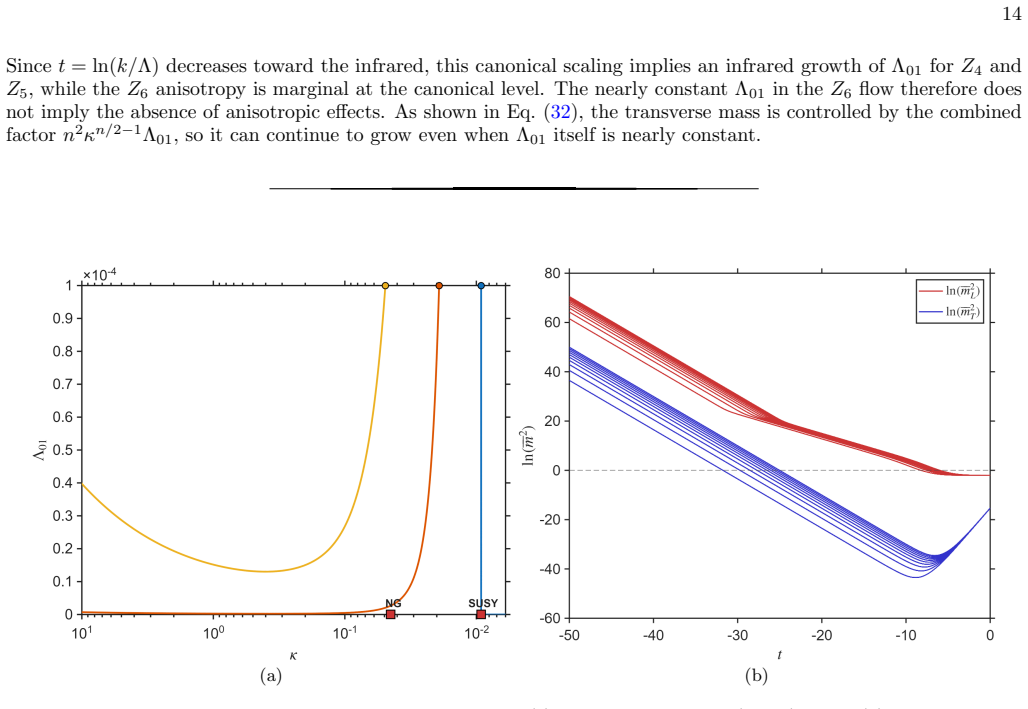
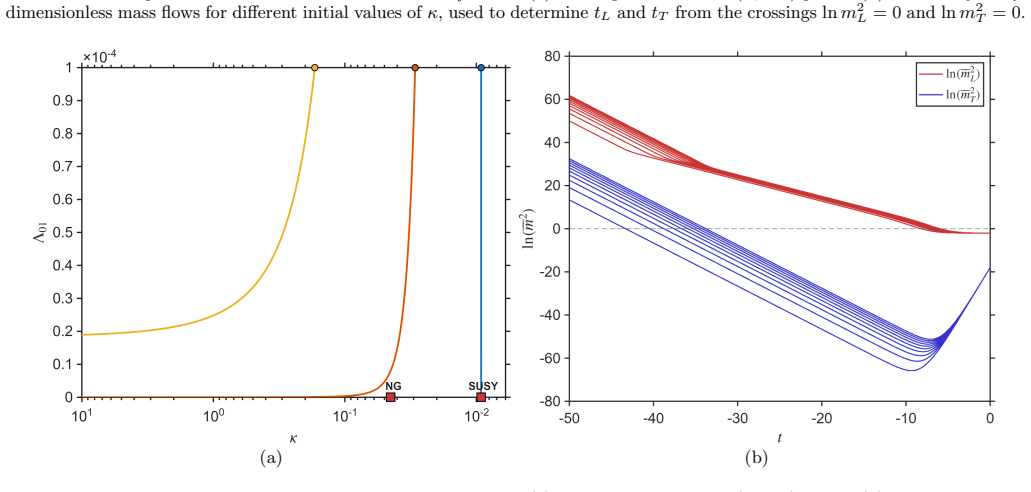
What carries the argument
Functional renormalization group flow of the effective potential for the Gross-Neveu-Yukawa model with explicit Z_n anisotropy, used to classify operator relevance and to locate mass thresholds along broken-symmetry trajectories.
If this is right
- The critical theory is controlled by the N=2 Wess-Zumino model whenever n>3.
- A second length scale ξ' appears in the ordered phase due to the dangerously irrelevant anisotropy.
- The exponent ratio obeys ν'/ν = 1 + |y_n|/2 for Z_4, Z_5 and Z_6.
- Supersymmetry emerges at the critical point even though the microscopic symmetry is only discrete.
Where Pith is reading between the lines
- Similar discrete-symmetry models in other dimensions or with different fermion representations may also admit emergent supersymmetry.
- Neutron scattering or thermodynamic measurements could detect the second length scale ξ' as an additional crossover in the ordered phase.
- The result supplies a concrete target for sign-problem-free lattice simulations of discrete-symmetry Gross-Neveu-Yukawa models.
Load-bearing premise
The chosen functional renormalization group truncation correctly determines whether the Z_n anisotropy is relevant or irrelevant and accurately tracks the mass thresholds without missing operators or introducing uncontrolled errors.
What would settle it
A lattice Monte Carlo simulation of the Z_4 Gross-Neveu-Yukawa model that measures both correlation lengths and finds the ratio ν'/ν differing from 1 + |y_n|/2 by more than numerical uncertainty would falsify the scaling relation.
Figures
read the original abstract
Supersymmetry, originally proposed in high-energy physics, can emerge as a remarkable low-energy structure in condensed matter systems. While emergent supersymmetry at quantum critical points is widely discussed in models with continuous symmetries, real materials are constrained by microscopic discrete symmetries. To address this, we investigate (2+1)-dimensional Gross-Neveu-Yukawa theories coupling Dirac fermions to a complex order parameter with discrete $Z_n$ anisotropy. Using the functional renormalization group, we find that for $n>3$, the anisotropic perturbations are irrelevant at the fixed point, yielding a $\mathcal{N}=2$ Wess-Zumino supersymmetric critical point. In the ordered phase, this dangerously irrelevant anisotropy gives rise to a second characteristic length scale, $\xi'$, alongside the usual correlation length, $\xi$. By tracking mass thresholds along symmetry-broken renormalization group trajectories, we extract the exponents $\nu'$ and $\nu$ without imposing prior scaling assumptions. For the $Z_4$, $Z_5$, and $Z_6$ models, our results support the scaling relation $\nu'/\nu = 1+|y_n|/p$ with $p=2$ in the isotropic framework used here.
Editorial analysis
A structured set of objections, weighed in public.
Referee Report
Summary. The manuscript studies (2+1)-dimensional Gross-Neveu-Yukawa theories with Dirac fermions coupled to a complex order parameter subject to discrete Z_n anisotropy. Using functional renormalization group (FRG) methods, it claims that for n>3 the Z_n anisotropy is irrelevant at the fixed point, producing an emergent N=2 Wess-Zumino supersymmetric quantum critical point. In the ordered phase the dangerously irrelevant anisotropy generates a second length scale ξ' in addition to the usual correlation length ξ; by tracking mass thresholds along symmetry-broken trajectories the authors extract ν' and ν without prior scaling assumptions and report that the ratio satisfies ν'/ν = 1 + |y_n|/p with p=2 for the Z_4, Z_5 and Z_6 cases.
Significance. If the FRG results prove robust, the work would be significant because it extends the discussion of emergent supersymmetry from continuous-symmetry models to the discrete symmetries that constrain real materials. The identification of a second length scale arising from a dangerously irrelevant operator and the direct numerical extraction of the associated scaling relation constitute concrete, testable predictions for future lattice or experimental studies.
major comments (3)
- [FRG truncation and fixed-point analysis] The central claim that the Z_n anisotropy is irrelevant for n>3 (and therefore that the fixed point is the N=2 Wess-Zumino theory) rests entirely on the sign of the eigenvalue y_n obtained from the linearized FRG flow around the putative supersymmetric fixed point. The manuscript provides no convergence test against an enlarged truncation that includes additional four-fermion or higher-derivative operators that could mix into the anisotropy channel; without such a check the sign of y_n remains truncation-dependent.
- [Ordered-phase analysis and exponent extraction] The extraction of ν' and ν by tracking mass thresholds along symmetry-broken RG trajectories, and the subsequent verification of the relation ν'/ν = 1 + |y_n|/p, likewise depends on the same truncation. The paper reports support for the relation but does not tabulate the individual numerical values of y_n, ν and ν' or demonstrate regulator independence, so it is impossible to judge whether cutoff artifacts in the broken-phase flow could alter the reported ratio.
- [Fixed-point stability] The statement that the scaling relation holds 'in the isotropic framework used here' (abstract) appears to presuppose that the isotropic fixed point remains stable once the anisotropy is declared irrelevant; a quantitative check that the isotropic fixed-point coordinates themselves are stable against the inclusion of the anisotropy operator at higher truncation order is missing.
minor comments (1)
- [Abstract] The abstract would be clearer if it stated the precise range of n for which results are presented and the number of independent runs or regulator choices employed.
Simulated Author's Rebuttal
We thank the referee for the positive evaluation of the significance of our work and for the detailed, constructive comments. We address each major comment below.
read point-by-point responses
-
Referee: [FRG truncation and fixed-point analysis] The central claim that the Z_n anisotropy is irrelevant for n>3 (and therefore that the fixed point is the N=2 Wess-Zumino theory) rests entirely on the sign of the eigenvalue y_n obtained from the linearized FRG flow around the putative supersymmetric fixed point. The manuscript provides no convergence test against an enlarged truncation that includes additional four-fermion or higher-derivative operators that could mix into the anisotropy channel; without such a check the sign of y_n remains truncation-dependent.
Authors: We agree that an explicit convergence test with a systematically enlarged truncation would strengthen the result. Our truncation includes all symmetry-allowed operators up to fourth order in the fields within the derivative expansion, which is the standard level used in FRG studies of Gross-Neveu-Yukawa models. Within this controlled truncation the sign of y_n is robustly negative for n>3 and remains unchanged under moderate regulator variations. We will add an explicit discussion of the truncation scheme, its limitations, and the regulator checks in the revised manuscript. revision: partial
-
Referee: [Ordered-phase analysis and exponent extraction] The extraction of ν' and ν by tracking mass thresholds along symmetry-broken RG trajectories, and the subsequent verification of the relation ν'/ν = 1 + |y_n|/p, likewise depends on the same truncation. The paper reports support for the relation but does not tabulate the individual numerical values of y_n, ν and ν' or demonstrate regulator independence, so it is impossible to judge whether cutoff artifacts in the broken-phase flow could alter the reported ratio.
Authors: We will include a new table in the revised manuscript that lists the individual numerical values of y_n, ν and ν' for the Z_4, Z_5 and Z_6 cases together with the resulting ratios. We will also add a short paragraph on regulator dependence in the broken-phase flows, confirming that the reported ratio remains stable under the regulator variations we have performed. revision: yes
-
Referee: [Fixed-point stability] The statement that the scaling relation holds 'in the isotropic framework used here' (abstract) appears to presuppose that the isotropic fixed point remains stable once the anisotropy is declared irrelevant; a quantitative check that the isotropic fixed-point coordinates themselves are stable against the inclusion of the anisotropy operator at higher truncation order is missing.
Authors: The isotropic fixed point is obtained in the absence of anisotropy; the relevance of the anisotropy operator is then assessed by linearization around that point. To address the stability concern we have performed additional flows in which a small anisotropy is retained from the ultraviolet and the fixed-point coordinates are tracked; they remain consistent with the isotropic values to linear order in the anisotropy. We will clarify this procedure and include the quantitative comparison in the revised manuscript. revision: yes
Circularity Check
No circularity; exponents extracted independently and relation checked post-hoc
full rationale
The abstract states that exponents ν' and ν are extracted by tracking mass thresholds along symmetry-broken RG trajectories without imposing prior scaling assumptions. The relation ν'/ν = 1+|y_n|/p is then reported as supported by those results for specific n, rather than imposed as a fit or definition. No quoted equation reduces the extracted quantities to the same inputs by construction, and the provided text contains no self-citation chains, ansatz smuggling, or renaming of known results that would force the central claims. The derivation chain is therefore self-contained against the paper's own stated procedure.
Axiom & Free-Parameter Ledger
free parameters (1)
- FRG truncation order and regulator parameters
axioms (2)
- domain assumption The (2+1)D Gross-Neveu-Yukawa action with Z_n anisotropy is the correct low-energy description of the microscopic lattice model.
- standard math Standard mathematical properties of the functional renormalization group flow equation hold without additional anomalies or non-perturbative effects.
Reference graph
Works this paper leans on
-
[1]
(11) onto a constant bosonic background gives V ∂tUk = 1 2STr Γ(2) k +R k −1 ∂tRk ,(23) whereVis the total volume
Flow Equation for the Effective Potential By definition of the effective potential, the projection of Eq. (11) onto a constant bosonic background gives V ∂tUk = 1 2STr Γ(2) k +R k −1 ∂tRk ,(23) whereVis the total volume. The quantum correction to the flow equation for the effective potential has the same structure for different Zn anisotropies, while the ...
-
[2]
(26) The form of this flow is independent of the explicit choice of n; the Zn dependence enters through ωijk and m2 L/T
Flow Equation for the Yukawa Coupling The Yukawa coupling is projected from the fermion- boson three-point vertex: ∂th=− i Nf dγ Tr γ5 δ δ∆ϕ2 δ δψ δ δψ ∂tΓk ∆ϕi=0 p=0 .(25) Evaluating this projection yields ∂th2 =(D−4 +η ϕ + 2ηψ)h2 + 8vDh4 l(F B1) 11 −l (F B2) 11 −16v D √ 2κh4ω221l(F B1B2) 111 . (26) The form of this flow is independent of the explicit ch...
-
[3]
Anomalous Dimensions The anomalous dimensions are obtained from the mo- mentum dependence of the two-point functions. The wave-function renormalization flows are projected as ∂tZϕ = ∂ ∂p2 Z dDp1 (2π)D δ δϕ1(−p) δ δϕ1(p1) ∂tΓk ψ=ψ=0 ∆ϕ1=∆ϕ2=0 p=0 , (27) ∂tZψ =− i Nf dγ Tr " γµ ∂ ∂pµ Z dDp1 (2π)D × δ δψ(p1) δ δψ(p) ∂tΓk # ∆ϕi=0 p=0 . (28) Evaluating these p...
-
[4]
To approximate the effective potential, a Taylor expansion is performed around the symmetric point ( ρ, τ) = (0, 0) and truncated 6 at a finite order N [34, 48, 51]
Symmetric Expansion The fixed-point analysis in this subsection is carried out in the symmetric (SYM) expansion. To approximate the effective potential, a Taylor expansion is performed around the symmetric point ( ρ, τ) = (0, 0) and truncated 6 at a finite order N [34, 48, 51]. For a Zn invariant, the expansion is written as u(ρ, τ) = 2i+nj=NX i+j=1 1 i!j...
-
[5]
The corresponding dimensionless couplings and anoma- lous dimensions at these fixed points are summarized in Table I
SUSY Critical Point We find three fixed points with zero anisotropy: the Nambu-Goldstone (NG) fixed point lies in the ordered phase, the Dirac semimetal (DSM) fixed point in the dis- ordered phase, and the SUSY fixed point between them. The corresponding dimensionless couplings and anoma- lous dimensions at these fixed points are summarized in Table I. TA...
-
[6]
The effective potential is expanded around ( ρ, τ) = (κ, 0), with κ = κk depending on the RG scale
Symmetry-Broken Expansion To investigate the ordered side of the phase transition, it is more convenient to use a SSB expansion, in which the running minimum is kept explicitly. The effective potential is expanded around ( ρ, τ) = (κ, 0), with κ = κk depending on the RG scale. For a Zn invariant, this expansion takes the form u(ρ, τ) = Λ0,1;kτ+ 2i+nj=NX i...
-
[7]
Other Zn models with n > 3 exhibit similar behavior, with the corresponding Z5 and Z6 results shown in Appendix C
RG Flow We use the Z4 model with Nf = 0.5 to illustrate the ordered-phase RG flow and the underlying mechanisms. Other Zn models with n > 3 exhibit similar behavior, with the corresponding Z5 and Z6 results shown in Appendix C. We first consider RG trajectories initialized near the SUSY fixed point with a small but nonzero anisotropic coupling Λ01. By var...
-
[8]
The second length scale, denoted as ξ′, introduces an additional exponent, ν′, which plays a significant role in both theoretical and numerical studies [32–35, 40]
Numerical Values ofν ′ and Scaling Law As discussed in the previous section, the presence of dangerously irrelevant couplings in discrete symmetry models gives rise to two length scales. The second length scale, denoted as ξ′, introduces an additional exponent, ν′, which plays a significant role in both theoretical and numerical studies [32–35, 40]. Howev...
-
[9]
The bosonic fields are decomposed as ϕi =ϕ i,0 + ∆ϕi, i= 1,2,(A1) where ϕi,0 denotes the background value and ∆ϕi denotes the fluctuation
Notation for the SSB Phase To perform the expansion, the notation needs to be clarified. The bosonic fields are decomposed as ϕi =ϕ i,0 + ∆ϕi, i= 1,2,(A1) where ϕi,0 denotes the background value and ∆ϕi denotes the fluctuation. At the end of the calculation, we will set all fluctuations and fermion fields to zero. We will also choose coordinates such that...
-
[10]
(A5) 12 Substituting Eq
Flow Equations forλs andΛs In the SSB expansion, the flow equations for the vertices of the effective potential can be extracted in this manner: ∂tΛi,j = " ∂t ∂i+ju ∂ρi∂τ j + ∂ ∂κ ∂i+ju ∂ρi∂τ j ∂tκ # ρ=κ,τ=0 . (A5) 12 Substituting Eq. (24) into Eq. (A5) and denoting ΣB = 1 1+m2 L + 1 1+m2 T , ΣF = 1 1+2h2ρ, we obtain: ∂tΛi,j = −D+ 1 2(D−2 +η ϕ)(2i+nj) Λi,...
-
[11]
Weinberg,The Quantum Theory of Fields, Volume 3: Supersymmetry(Cambridge University Press, Cambridge, 2000)
S. Weinberg,The Quantum Theory of Fields, Volume 3: Supersymmetry(Cambridge University Press, Cambridge, 2000)
2000
-
[12]
Wess and J
J. Wess and J. Bagger,Supersymmetry and Supergravity (Princeton University Press, Princeton, 1992)
1992
-
[13]
H. P. Nilles, Supersymmetry, supergravity and particle physics, Phys. Rep.110, 1 (1984)
1984
-
[14]
H. E. Haber and G. L. Kane, The search for supersymme- try: Probing physics beyond the standard model, Phys. Rep.117, 75 (1985)
1985
-
[15]
Wess and B
J. Wess and B. Zumino, Supergauge transformations in four dimensions, Nucl. Phys. B70, 39 (1974). 15 (a) (b) (c) FIG. 5. Extraction of ν, ν′ and ν′/ν for the Z5 model from linear fits. (a) tL against ln|κ−κ c|. (b) tT against ln|κ−κ c|. (c) tT againstt L. (a) (b) (c) FIG. 6. Extraction of ν, ν′ and ν′/ν for the Z6 model from linear fits. (a) tL against ln...
1974
-
[16]
Gervais and B
J.-L. Gervais and B. Sakita, Field theory interpretation of supergauges in dual models, Nucl. Phys. B34, 632 (1971)
1971
-
[17]
Dimopoulos and H
S. Dimopoulos and H. Georgi, Softly broken supersymme- try and SU(5), Nucl. Phys. B193, 150 (1981)
1981
-
[18]
T. Grover and A. Vishwanath, Quantum criticality in topological insulators and superconductors: Emergence of strongly coupled Majoranas and supersymmetry (2012), arXiv:1206.1332
Pith/arXiv arXiv 2012
-
[19]
T. Grover, D. N. Sheng, and A. Vishwanath, Emergent space-time supersymmetry at the boundary of a topologi- cal phase, Science344, 280 (2014), arXiv:1301.7449
Pith/arXiv arXiv 2014
-
[20]
Ponte and S.-S
P. Ponte and S.-S. Lee, Emergence of supersymmetry on the surface of three-dimensional topological insulators, New J. Phys.16, 013044 (2014)
2014
-
[21]
Jian, Y.-F
S.-K. Jian, Y.-F. Jiang, and H. Yao, Emergent space- time supersymmetry in 3d Weyl semimetals and 2d Dirac semimetals, Phys. Rev. Lett.114, 237001 (2015)
2015
-
[22]
Z.-X. Li, A. Vaezi, C. B. Mendl, and H. Yao, Observation of emergent spacetime supersymmetry at superconduct- ing quantum criticality, Sci. Adv.4, eaau1463 (2018), arXiv:1711.04772
Pith/arXiv arXiv 2018
-
[23]
Zerf, C.-H
N. Zerf, C.-H. Lin, and J. Maciejko, Superconducting quantum criticality of topological surface states at three loops, Phys. Rev. B94, 205106 (2016)
2016
-
[24]
S. Yin and Z.-Y. Zuo, Fermion-induced quantum critical point in the Landau-Devonshire model, Phys. Rev. B101, 155136 (2020), arXiv:2001.05823
arXiv 2020
-
[25]
Huijse, B
L. Huijse, B. Bauer, and E. Berg, Emergent supersymme- try at the Ising-Berezinskii-Kosterlitz-Thouless multicriti- cal point, Phys. Rev. Lett.114, 090404 (2015)
2015
-
[26]
Jian, C.-H
S.-K. Jian, C.-H. Lin, J. Maciejko, and H. Yao, Emergence of supersymmetric quantum electrodynamics, Phys. Rev. Lett.118, 166802 (2017)
2017
-
[27]
Z.-X. Li, Y.-F. Jiang, and H. Yao, Edge quantum critical- ity and emergent supersymmetry in topological phases, Phys. Rev. Lett.119, 107202 (2017), arXiv:1610.04616
Pith/arXiv arXiv 2017
-
[28]
J. Yu, R. Roiban, S.-K. Jian, and C.-X. Liu, Finite-scale emergence of 2+1 D supersymmetry at first-order quan- tum phase transition, Phys. Rev. B100, 075153 (2019)
2019
- [29]
-
[30]
C. Li, S. Liu, H. Wang, W. Zhang, Z.-X. Li, H. Zhai, and Y. Gu, Uncovering emergent spacetime supersymmetry with Rydberg atom arrays, Phys. Rev. Lett.133, 223401 (2024), arXiv:2407.08194
arXiv 2024
-
[31]
P. Fendley, K. Schoutens, and J. de Boer, Lattice models 16 with N = 2 supersymmetry, Phys. Rev. Lett.90, 120402 (2003), arXiv:hep-th/0210161
Pith/arXiv arXiv 2003
-
[32]
Y. Yu and K. Yang, Simulating Wess-Zumino supersym- metry model in optical lattices, Phys. Rev. Lett.105, 150605 (2010), arXiv:1005.1399
Pith/arXiv arXiv 2010
-
[33]
Bauer, L
B. Bauer, L. Huijse, E. Berg, M. Troyer, and K. Schoutens, Supersymmetric multicritical point in a model of lattice fermions, Phys. Rev. B87, 165145 (2013)
2013
-
[34]
A. Rahmani, X. Zhu, M. Franz, and I. Affleck, Emer- gent supersymmetry from strongly interacting Majo- rana zero modes, Phys. Rev. Lett.115, 166401 (2015), arXiv:1504.05192
Pith/arXiv arXiv 2015
-
[35]
C. Li, ´E. Lantagne-Hurtubise, and M. Franz, Supersym- metry in an interacting Majorana model on the kagome lattice, Phys. Rev. B100, 195146 (2019)
2019
-
[36]
K. K. W. Ma, R. Wang, and K. Yang, Realization of supersymmetry and its spontaneous breaking in quantum Hall edges, Phys. Rev. Lett.126, 206801 (2021)
2021
-
[37]
Kaviraj, S
A. Kaviraj, S. Rychkov, and E. Trevisani, Parisi-Sourlas supersymmetry in random field models, Phys. Rev. Lett. 129, 045701 (2022)
2022
-
[38]
Z. Zeng, Y.-K. Yu, Z.-X. Li, and S. Yin, Nonequilibrium critical dynamics with emergent supersymmetry, Phys. Rev. B112, L060301 (2025), arXiv:2408.06138
arXiv 2025
-
[39]
Aharony, A
O. Aharony, A. Hanany, K. Intriligator, N. Seiberg, and M. J. Strassler, Aspects of N = 2 supersymmetric gauge theories in three dimensions, Nucl. Phys. B499, 67 (1997)
1997
-
[40]
Lee, Emergence of supersymmetry at a critical point of a lattice model, Phys
S.-S. Lee, Emergence of supersymmetry at a critical point of a lattice model, Phys. Rev. B76, 075103 (2007)
2007
-
[41]
M. E. Fisher, Renormalization group in critical phe- nomena and quantum field theory, inRenormalization Group in Critical Phenomena and Quantum Field Theory, edited by J. Gunton and M. S. Green (Temple University, Philadelphia, 1975)
1975
-
[42]
D. R. Nelson, Coexistence-curve singularities in isotropic ferromagnets, Phys. Rev. B13, 2222 (1976)
1976
-
[43]
D. J. Amit and L. Peliti, On dangerous irrelevant opera- tors, Ann. Phys.140, 207 (1982)
1982
-
[44]
L´ eonard and B
F. L´ eonard and B. Delamotte, Critical exponents can be different on the two sides of a transition: A generic mechanism, Phys. Rev. Lett.115, 200601 (2015)
2015
-
[45]
T. Okubo, K. Oshikawa, H. Watanabe, and N. Kawashima, A scaling relation for dangerously irrelevant symmetry- breaking fields, Phys. Rev. B91, 174417 (2015), arXiv:1411.1872
Pith/arXiv arXiv 2015
-
[46]
A. V. Chubukov, S. Sachdev, and J. Ye, Theory of two- dimensional quantum Heisenberg antiferromagnets with a nearly critical ground state, Phys. Rev. B49, 11919 (1994)
1994
-
[47]
M. Oshikawa, Ordered phase and scaling in Zn models and the three-state antiferromagnetic Potts model in three dimensions, Phys. Rev. B61, 3430 (2000), arXiv:cond- mat/9907388
arXiv 2000
-
[48]
J. Lou, A. W. Sandvik, and L. Balents, Emergence of U(1) symmetry in the 3d XY model with Zq anisotropy, Phys. Rev. Lett.99, 207203 (2007), arXiv:0704.1472
Pith/arXiv arXiv 2007
-
[49]
H. Shao, W. Guo, and A. W. Sandvik, Quantum criti- cality with two length scales, Science352, 213 (2016), arXiv:1603.02171
Pith/arXiv arXiv 2016
- [50]
-
[51]
A. H. Castro Neto, F. Guinea, N. M. R. Peres, K. S. Novoselov, and A. K. Geim, The electronic properties of graphene, Rev. Mod. Phys.81, 109 (2009)
2009
-
[52]
C.-Y. Hou, C. Chamon, and C. Mudry, Electron fractional- ization in two-dimensional graphenelike structures, Phys. Rev. Lett.98, 186809 (2007), arXiv:cond-mat/0609740
Pith/arXiv arXiv 2007
-
[53]
S. Ryu, C. Mudry, C.-Y. Hou, and C. Chamon, Masses in graphene-like two-dimensional electronic systems: Topo- logical defects in order parameters and their fractional exchange statistics, Phys. Rev. B80, 205319 (2009), arXiv:0908.3054
Pith/arXiv arXiv 2009
-
[54]
Guti´ errez, C.-J
C. Guti´ errez, C.-J. Kim, L. Brown, T. Schiros, D. Nord- lund, E. B. Lochocki, K. M. Shen, J. Park, and A. N. Pa- supathy, Imaging chiral symmetry breaking from Kekul´ e bond order in graphene, Nat. Phys.12, 950 (2016)
2016
-
[55]
Classen, I
L. Classen, I. F. Herbut, and M. M. Scherer, Fluctuation- induced continuous transition and quantum criticality in Dirac semimetals, Phys. Rev. B96, 115132 (2017)
2017
-
[56]
Jian and H
S.-K. Jian and H. Yao, Fermion-induced quantum critical points in two-dimensional Dirac semimetals, Phys. Rev. B96, 195162 (2017)
2017
-
[57]
Li, Y.-F
Z.-X. Li, Y.-F. Jiang, S.-K. Jian, and H. Yao, Fermion- induced quantum critical points, Nat. Commun.8, 314 (2017)
2017
-
[58]
Torres, L
E. Torres, L. Classen, I. F. Herbut, and M. M. Scherer, Fermion-induced quantum criticality with two length scales in Dirac systems, Phys. Rev. B97, 125137 (2018)
2018
- [59]
-
[60]
S.-K. Jian and H. Yao, Fermion-induced quantum critical points in three-dimensional Weyl semimetals, Phys. Rev. B96, 155112 (2017), arXiv:1609.06313
Pith/arXiv arXiv 2017
-
[61]
Dupuis, L
N. Dupuis, L. Canet, A. Eichhorn, W. Metzner, J. M. Pawlowski, M. Tissier, and N. Wschebor, The nonpertur- bative functional renormalization group and its applica- tions, Phys. Rep.910, 1 (2021)
2021
-
[62]
Berges, N
J. Berges, N. Tetradis, and C. Wetterich, Non- perturbative renormalization flow in quantum field theory and statistical physics, Phys. Rep.363, 223 (2002)
2002
-
[63]
Janssen and I
L. Janssen and I. F. Herbut, Antiferromagnetic critical point on graphene’s honeycomb lattice: A functional renormalization group approach, Phys. Rev. B89, 205403 (2014)
2014
-
[64]
H. Gies, T. Hellwig, A. Wipf, and O. Zanusso, A functional perspective on emergent supersymmetry, J. High Energy Phys.2017(12), 132
2017
-
[65]
Feldmann, A
P. Feldmann, A. Wipf, and L. Zambelli, Critical Wess- Zumino models with four supercharges in the functional renormalization group approach, Phys. Rev. D98, 096005 (2018)
2018
-
[66]
O. Vafek and A. Vishwanath, Dirac fermions in solids - from high Tc cuprates and graphene to topological insula- tors and Weyl semimetals, Annu. Rev. Condens. Matter Phys.5, 83 (2014), arXiv:1306.2272
Pith/arXiv arXiv 2014
-
[67]
T. O. Wehling, A. M. Black-Schaffer, and A. V. Balatsky, Dirac materials, Adv. Phys.63, 1 (2014), arXiv:1405.5774
Pith/arXiv arXiv 2014
-
[68]
K. S. Novoselov, A. K. Geim, S. V. Morozov, D. Jiang, M. I. Katsnelson, I. V. Grigorieva, S. V. Dubonos, and A. A. Firsov, Two-dimensional gas of massless Dirac fermions in graphene, Nature438, 197 (2005)
2005
-
[69]
G. W. Semenoff, Condensed-matter simulation of a three- dimensional anomaly, Phys. Rev. Lett.53, 2449 (1984)
1984
-
[70]
I. F. Herbut, Interactions and phase transitions on 17 graphene’s honeycomb lattice, Phys. Rev. Lett.97, 146401 (2006)
2006
-
[71]
Honerkamp, Density waves and Cooper pairing on the honeycomb lattice, Phys
C. Honerkamp, Density waves and Cooper pairing on the honeycomb lattice, Phys. Rev. Lett.100, 146404 (2008)
2008
-
[72]
I. F. Herbut, V. Juriˇ ci´ c, and B. Roy, Theory of interacting electrons on the honeycomb lattice, Phys. Rev. B79, 085116 (2009)
2009
-
[73]
Weeks and M
C. Weeks and M. Franz, Interaction-driven instabilities of a Dirac semimetal, Phys. Rev. B81, 085105 (2010)
2010
-
[74]
B. Roy and I. F. Herbut, Unconventional superconduc- tivity on honeycomb lattice: The theory of Kekul´ e order parameter, Phys. Rev. B82, 035429 (2010), arXiv:1005.3563
Pith/arXiv arXiv 2010
-
[75]
K. K. Gomes, W. Mar, W. Ko, F. Guinea, and H. C. Manoharan, Designer Dirac fermions and topological phases in molecular graphene, Nature483, 306 (2012)
2012
-
[76]
M. Hasenbusch and E. Vicari, Anisotropic perturbations in three-dimensional O(N)-symmetric vector models, Phys. Rev. B84, 125136 (2011), arXiv:1108.0491
Pith/arXiv arXiv 2011
-
[77]
Hasenbusch, Monte Carlo study of an improved clock model in three dimensions, Phys
M. Hasenbusch, Monte Carlo study of an improved clock model in three dimensions, Phys. Rev. B100, 224517 (2019), arXiv:1910.05916
arXiv 2019
-
[78]
N. Todoroki, Y. Ueno, and S. Miyashita, Ordered phase and phase transitions in the three-dimensional generalized six-state clock model, Phys. Rev. B66, 214405 (2002), arXiv:cond-mat/0207665
Pith/arXiv arXiv 2002
-
[79]
M. E. Zhitomirsky, P. C. W. Holdsworth, and R. Moess- ner, Nature of finite-temperature transition in anisotropic pyrochlore Er 2Ti2O7, Phys. Rev. B89, 140403 (2014), arXiv:1402.4689
Pith/arXiv arXiv 2014
-
[80]
G. R. Golner, Investigation of the Potts model using renormalization-group techniques, Phys. Rev. B8, 3419 (1973)
1973
discussion (0)
Sign in with ORCID, Apple, or X to comment. Anyone can read and Pith papers without signing in.