Medication-Aware Financial Exploitation Detection for Alzheimer's Patients Using Edge-Aware Interaction Risk Modeling
Pith reviewed 2026-06-28 18:38 UTC · model grok-4.3
The pith
Medication adherence data, when used as a contextual modifier in an interaction-aware model, improves recall of financial exploitation risks in Alzheimer's patients from 0.7442 to 0.9070 during vulnerable windows.
A machine-rendered reading of the paper's core claim, the machinery that carries it, and where it could break.
Core claim
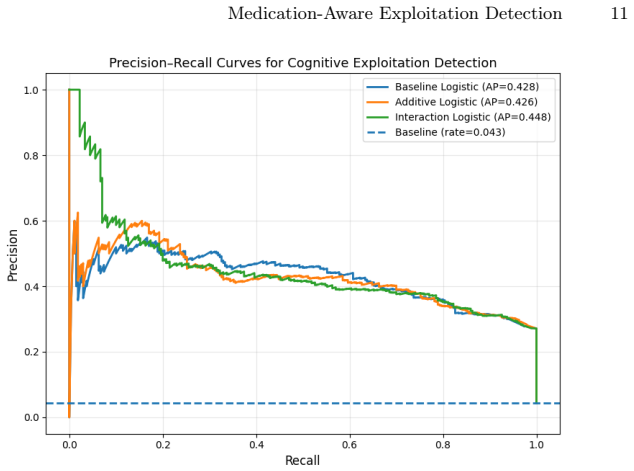
The interaction-aware logistic model that treats medication adherence as a modifier of financial features such as amount anomaly, vendor novelty, transaction frequency, and time deviation improves recall during medication-induced vulnerability windows from 0.7442 to 0.9070 while achieving the highest average precision for ranked high-risk cases; the financial-only baseline reaches the highest global F1-score of 0.5000. The findings indicate that medication adherence functions most effectively as a contextual modifier of financial risk rather than as an isolated predictor.
What carries the argument
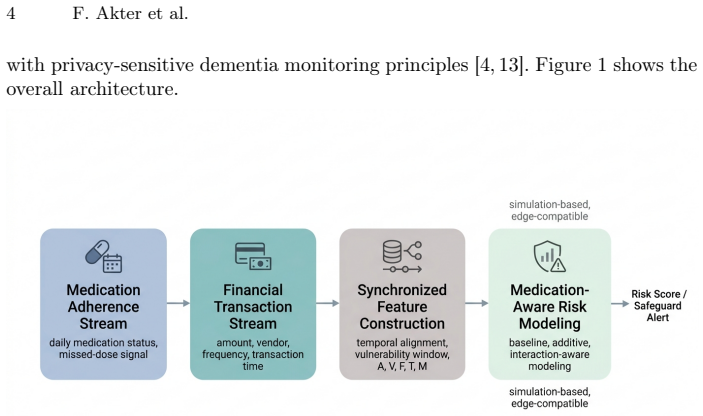
The interaction-aware logistic model that combines transaction features with medication adherence to capture how medication alters financial risk patterns.
If this is right
- The interaction-aware model delivers higher recall than baselines inside medication-linked vulnerability windows.
- Medication adherence data improves ranking of high-risk financial cases when treated as a risk modifier.
- Financial-only models miss periods of elevated exploitation risk tied to medication effects.
- The framework can evaluate model variants on simulated data without requiring real combined records.
Where Pith is reading between the lines
- Banking systems could incorporate pharmacy adherence feeds to trigger alerts only during predicted high-vulnerability intervals.
- The same modifier approach might extend to other temporary cognitive states such as post-surgical medication effects.
- Deployment would require privacy-preserving linkage between clinical and financial data sources.
- Adding dosage timing or specific drug classes could sharpen the vulnerability windows further.
Load-bearing premise
The hybrid simulation dataset accurately reflects the real relationships between medication adherence and financial vulnerability windows in Alzheimer's patients.
What would settle it
A validation study on actual patient transaction and medication records that finds no recall or precision gain from the interaction terms would show the claimed advantage does not hold.
Figures
read the original abstract
Financial exploitation is a growing concern for people with Alzheimer's disease, especially during periods of reduced cognitive stability. Conventional fraud detection systems usually rely on financial behavior alone and ignore clinically relevant factors that may alter vulnerability. This paper proposes a medication-aware framework that synchronizes medication adherence with transaction-level monitoring to improve detection of cognitively risky financial events. A hybrid simulation dataset was constructed for 180 patients across 45 days, producing 8,100 medication records and 30,855 transactions. The framework evaluates amount anomaly, vendor novelty, transaction frequency, time deviation, and medication adherence through financial-only, additive medication-aware, and interaction-aware logistic models. Results show that the financial-only baseline obtained the highest global F1-score of 0.5000, but the interaction-aware model improved recall during medication-induced vulnerability windows from 0.7442 to 0.9070 and achieved the highest average precision for ranked high-risk cases. The findings suggest that medication adherence is most useful as a contextual modifier of financial risk rather than as an isolated predictor.
Editorial analysis
A structured set of objections, weighed in public.
Referee Report
Summary. The paper proposes a medication-aware framework for detecting financial exploitation in Alzheimer's patients by synchronizing medication adherence data with transaction monitoring. It constructs a hybrid simulation dataset for 180 patients over 45 days (8,100 medication records, 30,855 transactions) and compares three logistic regression models—financial-only, additive medication-aware, and interaction-aware—on features including amount anomaly, vendor novelty, transaction frequency, time deviation, and medication adherence. The central claim is that the interaction-aware model improves recall during medication-induced vulnerability windows from 0.7442 to 0.9070 and achieves the highest average precision for ranked high-risk cases, while the financial-only baseline has the highest global F1 of 0.5000; medication adherence is positioned as a contextual modifier rather than an isolated predictor.
Significance. If the simulation's generative rules for medication-vulnerability interactions can be shown to be realistic and non-circular, the result would indicate that clinical factors can usefully modulate financial risk models for cognitively vulnerable populations, supporting more targeted fraud detection in healthcare-adjacent financial systems.
major comments (3)
- [Abstract] Abstract and results paragraph: the hybrid simulation is described only as 'constructed' for 180 patients; no equations, parameters, generative rules, or validation steps are supplied for mapping medication adherence onto transaction patterns or ground-truth vulnerability labels. Without these, the reported recall lift (0.7442 → 0.9070) cannot be distinguished from an artifact of the data-generation process that directly encodes the interaction signal the model is designed to exploit.
- [Results paragraph] Results paragraph: all metrics (recall, average precision, F1) are obtained from logistic models whose coefficients were fitted to the identical simulated dataset that produced the vulnerability windows and labels; no train-test split, cross-validation procedure, or external hold-out cohort is mentioned, so the numeric improvements are tied directly to the fitted quantities rather than to generalization.
- [Abstract] Abstract: the financial-only baseline reports the highest global F1-score (0.5000), yet emphasis is placed on subset performance within medication-induced windows; this selective focus requires explicit justification of why overall utility is not the primary evaluation criterion when claiming practical value for exploitation detection.
minor comments (1)
- The abstract lists features (amount anomaly, vendor novelty, etc.) but does not define their exact computation or how they enter the three logistic models; adding a methods subsection with feature definitions would improve reproducibility.
Simulated Author's Rebuttal
Thank you for the referee's constructive comments, which identify key areas where the manuscript requires greater transparency on the simulation process, evaluation methodology, and metric prioritization. We address each point below and commit to revisions that strengthen the paper without altering its core claims.
read point-by-point responses
-
Referee: [Abstract] Abstract and results paragraph: the hybrid simulation is described only as 'constructed' for 180 patients; no equations, parameters, generative rules, or validation steps are supplied for mapping medication adherence onto transaction patterns or ground-truth vulnerability labels. Without these, the reported recall lift (0.7442 → 0.9070) cannot be distinguished from an artifact of the data-generation process that directly encodes the interaction signal the model is designed to exploit.
Authors: We agree that the current description of the simulation is insufficient. The revised manuscript will include the full generative equations, all parameter values, the precise rules linking medication adherence to vulnerability windows and transaction anomalies, and any validation steps used to ensure the labels reflect the intended interactions. This addition will enable readers to assess whether the reported improvements arise from non-circular modeling choices. revision: yes
-
Referee: [Results paragraph] Results paragraph: all metrics (recall, average precision, F1) are obtained from logistic models whose coefficients were fitted to the identical simulated dataset that produced the vulnerability windows and labels; no train-test split, cross-validation procedure, or external hold-out cohort is mentioned, so the numeric improvements are tied directly to the fitted quantities rather than to generalization.
Authors: The referee is correct that no train-test split or cross-validation procedure is described. The current results reflect in-sample fitting. In the revision we will add an explicit hold-out evaluation (e.g., 70/30 split or k-fold cross-validation) and report performance on unseen data to demonstrate generalization. revision: yes
-
Referee: [Abstract] Abstract: the financial-only baseline reports the highest global F1-score (0.5000), yet emphasis is placed on subset performance within medication-induced windows; this selective focus requires explicit justification of why overall utility is not the primary evaluation criterion when claiming practical value for exploitation detection.
Authors: We will expand the abstract and add a dedicated paragraph in the discussion to justify the focus on vulnerability-window recall. The justification rests on the clinical priority of minimizing missed exploitation events during periods of elevated risk, where the cost of false negatives is disproportionately high; global F1 will remain reported as a secondary metric for overall system comparison. revision: yes
Axiom & Free-Parameter Ledger
free parameters (1)
- logistic regression coefficients
axioms (1)
- domain assumption Logistic regression is an appropriate model for binary financial-exploitation risk given the chosen features
Reference graph
Works this paper leans on
-
[1]
In: SoutheastCon 2026
Akter, F., Hossain, R., Toushi, D.K.R., Khan, M.M., Amin, S., Al Amin, L.: Hybrid federated and split learning for privacy preserving clinical prediction and treatment optimization. In: SoutheastCon 2026. pp. 1–8. IEEE (2026)
2026
-
[2]
IEEE Access11, 396–409 (2022)
Al Amin, L., Mukta, M.S.H., Saikat, M.S.M., Hossain, M.I., Islam, M.A., Ahmed, M., Azam, S.: Data driven classification of opioid patients using machine learning– an investigation. IEEE Access11, 396–409 (2022)
2022
-
[3]
In: 2025 IEEE International Conference on Data Mining Workshops (ICDMW)
Al Mamun, S., Hossain, R., Rahman, M.J., Devnath, M.K., Afroz, F., Al Amin, L.: Bayesian modeling for uncertainty management in financial risk forecasting and compliance. In: 2025 IEEE International Conference on Data Mining Workshops (ICDMW). pp. 178–186. IEEE (2025)
2025
-
[4]
https://doi.org/10.4108/eetpht.11.6170
Anik, F.I., Hasan, M.M., Rodriguez-Cardenas, J., Beiswanger, R., Tasnim, M., Ramos,M.,Sakib,N.:IoMTanddataprivacyinalzheimer’scareforolderadults:A systematicreview.EAIEndorsedTransactionsonPervasiveHealthandTechnology 11(1) (2025). https://doi.org/10.4108/eetpht.11.6170
- [5]
-
[6]
Elec- tronics14(17), 3516 (2025)
Dall’Ora, N., Felli, L., Aldegheri, S., Vicino, N., Giuliano, R.: Lumicare: A context- aware mobile system for alzheimer’s patients integrating AI agents and 6G. Elec- tronics14(17), 3516 (2025). https://doi.org/10.3390/electronics14173516
-
[7]
Advances in Geriatric Medicine and Research5(3), e230007 (2023)
Ebner, N.C., Pehlivanoglu, D., Shoenfelt, A.: Financial fraud and deception in aging. Advances in Geriatric Medicine and Research5(3), e230007 (2023). https://doi.org/10.20900/agmr20230007
-
[8]
Brain Sci- ences14(11), 1113 (2024)
Giannouli, V.: Can changes in financial performance be used in the diagnosis of neurocognitive disorders? a systematic review of findings from greece. Brain Sci- ences14(11), 1113 (2024). https://doi.org/10.3390/brainsci14111113
-
[9]
Frontiers in Aging Neuroscience17, 1735892 (2026)
Grammenos, G., Vrahatis, A.G., Lazaros, K., Exarchos, T.P., Vlamos, P., Krokidis, M.G.: Ai agents in alzheimer’s disease management: Challenges and future directions. Frontiers in Aging Neuroscience17, 1735892 (2026). https://doi.org/10.3389/fnagi.2025.1735892
-
[10]
In: 2025 40th International Conference on Image and Vision Computing New Zealand (IVCNZ)
Hossain,R.,Ali,L.E.,Ripon,K.S.N.:Risk-controlledmultimodalemotioncoaching for autism support using self-supervised vision and speech encoders. In: 2025 40th International Conference on Image and Vision Computing New Zealand (IVCNZ). pp. 1–7. IEEE (2025)
2025
-
[11]
In: 2025 28th International Conference on Computer and Information Technology (ICCIT)
Hossain, R., Ali, L.E., Ripon, K.S.N., Bulbul, M.F., Tonmoy, M.M.H.: Profit- optimal machine learning for purchase intent prediction: Calibration, temporal validation, and economic constraints. In: 2025 28th International Conference on Computer and Information Technology (ICCIT). pp. 3087–3092. IEEE (2025)
2025
-
[12]
Journal of Political Economy132(6), 1793–1830 (2024)
Mazzonna, F., Peracchi, F.: Are older people aware of their cognitive decline? misperception and financial decision-making. Journal of Political Economy132(6), 1793–1830 (2024). https://doi.org/10.1086/728697
-
[13]
BioMedical Engineering OnLine22(1), 4 (2023)
Mishra, P.K., Iaboni, A., Ye, B., Newman, K., Mihailidis, A., Khan, S.S.: Privacy- protecting behaviours of risk detection in people with dementia using videos. BioMedical Engineering OnLine22(1), 4 (2023). https://doi.org/10.1186/s12938- 023-01065-3 14 F. Akter et al
-
[14]
Alzheimer’s & Dementia19(4), 1184–1193 (2023)
Olchanski, N., Daly, A.T., Zhu, Y., Breslau, R., Cohen, J.T., Neumann, P.J., et al.: Alzheimer’s disease medication use and adherence patterns by race and ethnicity. Alzheimer’s & Dementia19(4), 1184–1193 (2023). https://doi.org/10.1002/alz.12753
-
[15]
Shaik, M.A., Anik, F.I., Hasan, M.M., Chakravarty, S., Ramos, M.D., Rahman, M.A., Ahamed, S.I., Sakib, N.: Advancing remote monitoring for patients with alzheimer disease and related dementias: Systematic review. JMIR Aging8, e69175 (2025). https://doi.org/10.2196/69175
-
[16]
JAMA Network Open8(6), e2515894 (2025)
Trendl, A., Anwyl-Irvine, A., Vomfell, L., Abbey, E., Stewart, N., Atkins, D., Llewellyn, D.J., Gathergood, J., Leake, D.: Early behavioral markers of loss of financial capacity. JAMA Network Open8(6), e2515894 (2025). https://doi.org/10.1001/jamanetworkopen.2025.15894
-
[17]
BioMedInformatics5(3), 49 (2025)
UdDin,F.,Giri,N.,Shetty,N.,Hilton,T.,Shafiabady,N.,Tully,P.J.:Co-designing a DSM-5-based AI-powered smart assistant for monitoring dementia and ongoing neurocognitive decline: Development study. BioMedInformatics5(3), 49 (2025). https://doi.org/10.3390/biomedinformatics5030049
-
[18]
Trauma, Violence, & Abuse (2025)
Wei, W., Balser, S.: A scoping review: Financial exploitation among older people living with dementia. Trauma, Violence, & Abuse (2025). https://doi.org/10.1177/15248380251383930
-
[19]
Yang, Z., Xu, X., Yao, B., Rogers, E., Zhang, S., Intille, S.S., Shara, N., Gao, G.G., Wang, D.: Talk2care: An LLM-based voice assistant for communication be- tween healthcare providers and older adults. Proceedings of the ACM on Inter- active, Mobile, Wearable and Ubiquitous Technologies8(2), 73:1–73:35 (2024). https://doi.org/10.1145/3659625
-
[20]
Proceedings of the 2025 CHI Conference on Human Factors in Computing Systems pp
Zhai, Y., Xue, X., Guo, Z., Jin, T., Diao, Y., Jeung, J.: Hear us, then protect us: Navigating deepfake scams and safeguard interventions with older adults through participatory design. Proceedings of the 2025 CHI Conference on Human Factors in Computing Systems pp. 1–19 (2025). https://doi.org/10.1145/3706598.3714423
-
[21]
Zhang, K., Kang, Y., Zhao, F., Liu, X.: LLM-based medical assistant personal- ization with short- and long-term memory coordination. In: Proceedings of the 2024 Conference of the North American Chapter of the Association for Compu- tational Linguistics: Human Language Technologies (Volume 1: Long Papers). pp. 2386–2398.AssociationforComputationalLinguisti...
discussion (0)
Sign in with ORCID, Apple, or X to comment. Anyone can read and Pith papers without signing in.