A Visible-Frequency Excitonic Reststrahlen Band in (PEA)₂PbI₄ Slabs
Pith reviewed 2026-06-28 18:30 UTC · model grok-4.3
The pith
Bare (PEA)₂PbI₄ slabs reach negative real permittivity at visible frequencies via intralayer excitons, opening a reflective Reststrahlen band.
A machine-rendered reading of the paper's core claim, the machinery that carries it, and where it could break.
Core claim
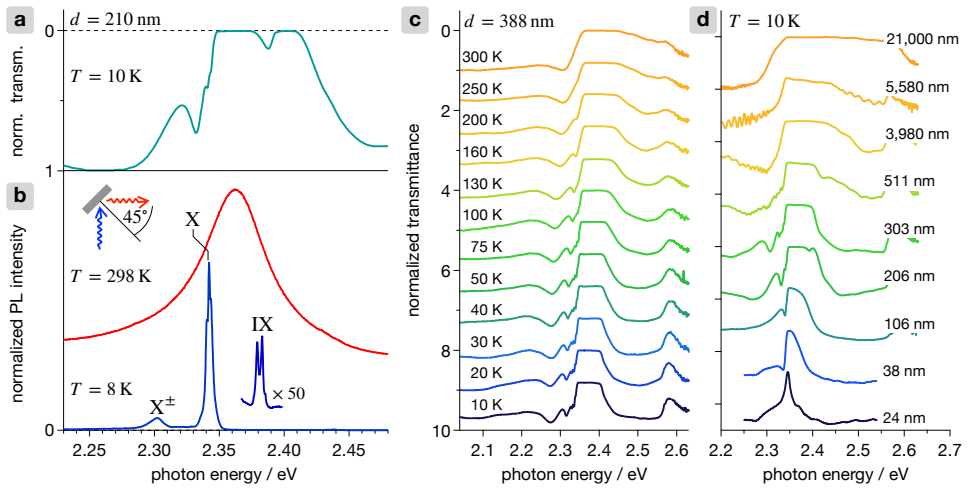
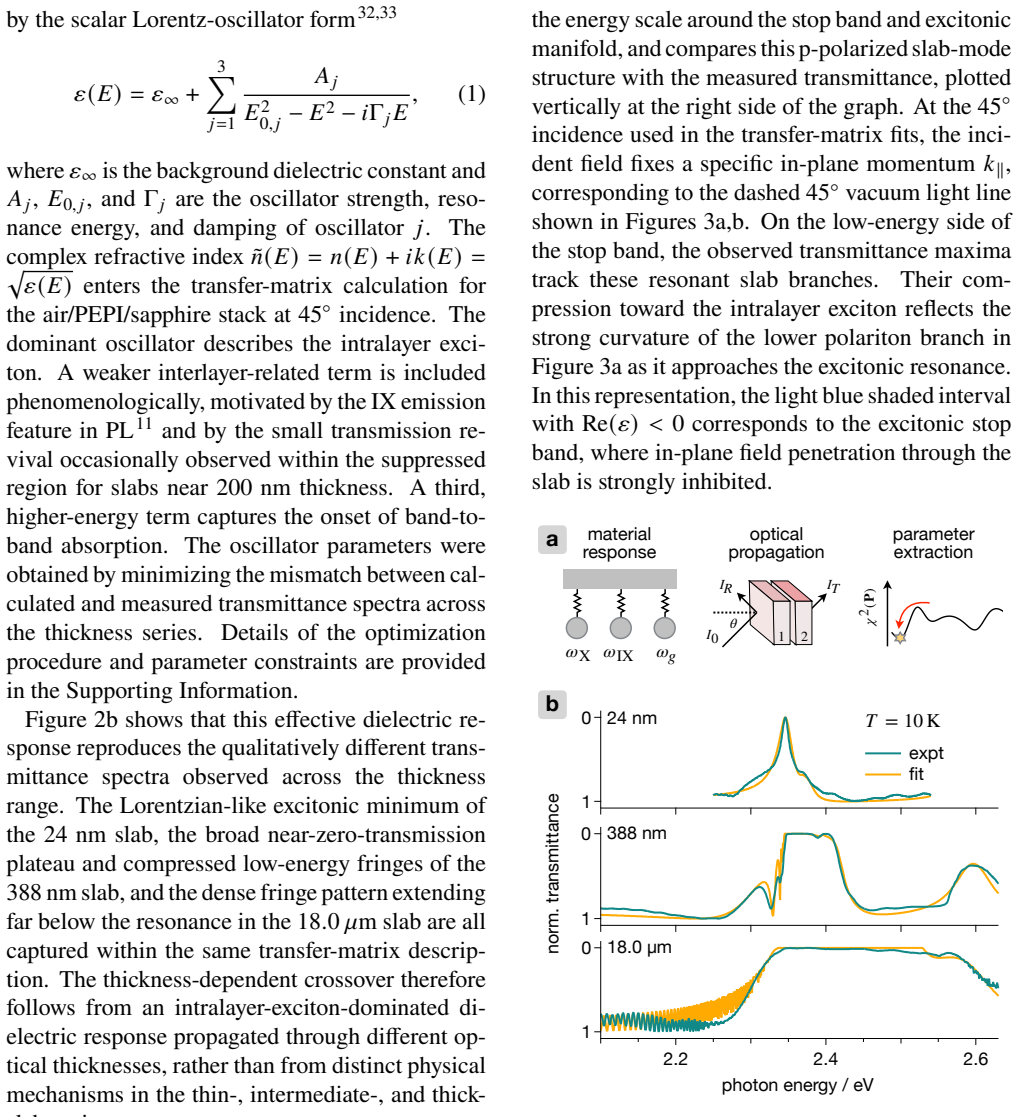
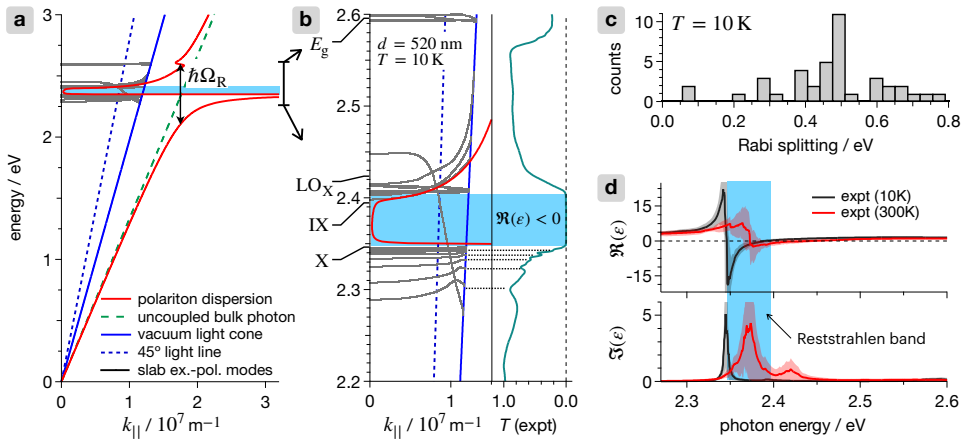
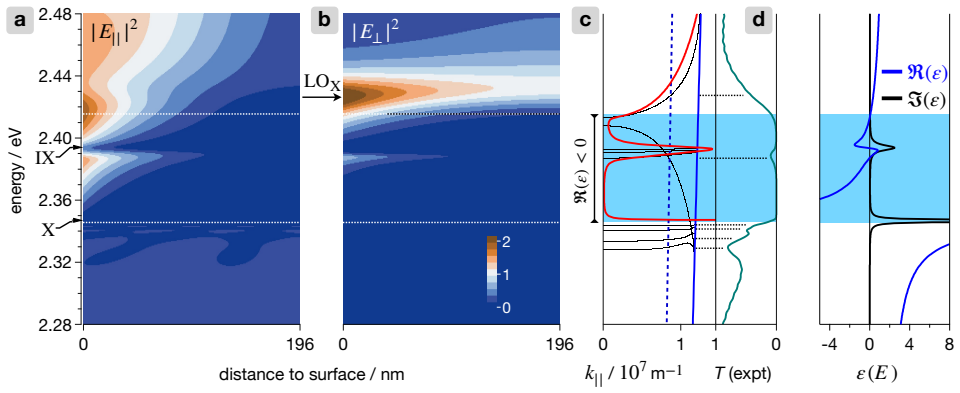
Low-temperature transmission of (PEA)₂PbI₄ slabs, driven by the intralayer-exciton manifold, evolves with increasing thickness from an excitonic dip into a broad near-zero-transmission interval with compressed Fabry-Pérot-like fringes. Transfer-matrix analysis with an effective Lorentz-oscillator dielectric response reproduces this crossover, reconstructs a finite negative-Re(ε) window, and implies near-ultrastrong exciton-photon coupling. Calculated field maps show suppressed in-plane field penetration within this interval and a driven longitudinal response near the high-energy (ε=0) edge. These results identify (PEA)₂PbI₄ slabs as a cavity-free visible-frequency excitonic Reststrahlen mate
What carries the argument
Effective Lorentz-oscillator dielectric response of the intralayer-exciton manifold, used inside transfer-matrix calculations to model thickness-dependent transmission and recover the negative real-permittivity window.
If this is right
- Transmission changes from a narrow excitonic dip to a broad near-zero interval as slab thickness grows.
- A finite frequency window of negative real permittivity appears inside the exciton manifold.
- The model implies near-ultrastrong exciton-photon coupling.
- In-plane electromagnetic field penetration is suppressed throughout the negative-permittivity interval.
- A longitudinal response is driven near the high-energy edge where real permittivity crosses zero.
Where Pith is reading between the lines
- Other layered perovskites that host comparably strong intralayer excitons may display analogous visible Reststrahlen bands.
- The thickness dependence offers a route to thickness-tunable reflective coatings at visible wavelengths without external cavities.
- The same negative-permittivity window could support polariton-related phenomena or modified spontaneous emission rates in simple slab geometries.
Load-bearing premise
The slabs' optical response is fully captured by one effective Lorentz-oscillator dielectric function whose parameters, when fed into transfer-matrix calculations, match the observed thickness-dependent transmission crossover without extra scattering, inhomogeneity, or surface terms.
What would settle it
Direct measurement of the complex dielectric function on the same slabs that shows no negative real permittivity inside the claimed frequency window would falsify the reconstruction.
Figures
read the original abstract
Layered halide perovskites host exceptionally strong excitons, whose optical signatures are usually interpreted as absorptive resonances on a smooth dielectric background. Strong excitons, however, can also reshape the dielectric response itself and drive the real permittivity negative, opening a reflective band: the visible, excitonic analogue of an infrared Reststrahlen band. Whether bare (PEA)$_2$PbI$_4$ slabs reach this regime has remained unclear. Here we show that low-temperature transmission of (PEA)$_2$PbI$_4$ slabs, driven by the intralayer-exciton manifold, evolves with increasing thickness from an excitonic dip into a broad near-zero-transmission interval with compressed Fabry-P\'erot-like fringes. Transfer-matrix analysis with an effective Lorentz-oscillator dielectric response reproduces this crossover, reconstructs a finite negative-Re($\varepsilon$) window, and implies near-ultrastrong exciton-photon coupling. Calculated field maps show suppressed in-plane field penetration within this interval and a driven longitudinal response near the high-energy ($\varepsilon=0$) edge. These results identify (PEA)$_2$PbI$_4$ slabs as a cavity-free visible-frequency excitonic Reststrahlen material.
Editorial analysis
A structured set of objections, weighed in public.
Referee Report
Summary. The manuscript claims that bare (PEA)₂PbI₄ slabs host a visible-frequency excitonic Reststrahlen band arising from a negative real-permittivity window driven by the intralayer-exciton manifold. Low-temperature transmission spectra evolve with slab thickness from an excitonic dip to a broad near-zero-transmission interval with compressed Fabry-Pérot fringes; transfer-matrix calculations employing a single effective Lorentz-oscillator dielectric function reproduce this crossover, extract a finite negative-Re(ε) interval, and imply near-ultrastrong exciton-photon coupling, with field maps showing suppressed in-plane penetration inside the band.
Significance. If the central claim is upheld by independent verification, the result would establish (PEA)₂PbI₄ as a cavity-free visible Reststrahlen material, extending the classic infrared phenomenon to excitonic resonances in layered perovskites and opening routes to strong light-matter coupling without external cavities. The thickness-dependent transmission trend itself is a clear experimental observation that would remain valuable even if the dielectric-function interpretation requires refinement.
major comments (2)
- [Abstract] Abstract: the negative-Re(ε) window is obtained by fitting a single Lorentz-oscillator dielectric function to the same thickness-dependent transmission spectra whose shape the model is then said to explain; no independent measurement (ellipsometry, reflection, or Kramers-Kronig analysis on a separate data set) is described that would falsify or corroborate the extracted negative interval.
- [Abstract] Abstract: the manuscript does not demonstrate that the observed crossover from dip to near-zero transmission cannot be reproduced by positive-ε models that incorporate weak scattering, surface roughness, or the multi-peak structure of the intralayer exciton manifold; the single-oscillator assumption is therefore load-bearing for the Reststrahlen interpretation but remains untested against these alternatives.
Simulated Author's Rebuttal
We thank the referee for the careful and constructive review of our manuscript. Below we respond point-by-point to the major comments, indicating where revisions have been or will be made to address the concerns raised.
read point-by-point responses
-
Referee: [Abstract] Abstract: the negative-Re(ε) window is obtained by fitting a single Lorentz-oscillator dielectric function to the same thickness-dependent transmission spectra whose shape the model is then said to explain; no independent measurement (ellipsometry, reflection, or Kramers-Kronig analysis on a separate data set) is described that would falsify or corroborate the extracted negative interval.
Authors: The referee is correct that the effective Lorentz-oscillator parameters are determined from the transmission data themselves. The central supporting evidence is that a single parameter set reproduces the full thickness series, including the emergence of the broad near-zero-transmission interval only when the negative-Re(ε) window is present. This multi-thickness consistency constitutes a non-trivial validation. We acknowledge that independent measurements (e.g., ellipsometry or reflection on separate samples) are not reported and would provide stronger corroboration. In the revised manuscript we have added an explicit discussion of this limitation together with a quantitative assessment of fit robustness across the thickness series. revision: partial
-
Referee: [Abstract] Abstract: the manuscript does not demonstrate that the observed crossover from dip to near-zero transmission cannot be reproduced by positive-ε models that incorporate weak scattering, surface roughness, or the multi-peak structure of the intralayer exciton manifold; the single-oscillator assumption is therefore load-bearing for the Reststrahlen interpretation but remains untested against these alternatives.
Authors: We agree that direct comparison against positive-ε alternatives would strengthen the claim. The original analysis emphasized the effective single-oscillator description because it captures the dominant intralayer-exciton response. Positive-ε models with added scattering or roughness typically produce gradual attenuation rather than the observed sharp suppression accompanied by compressed Fabry-Pérot fringes. Nevertheless, to address the concern we have performed additional transfer-matrix simulations using both multi-oscillator positive-ε models and models that include phenomenological scattering/roughness; these calculations, now included in the supplementary information, fail to reproduce the thickness-dependent crossover without invoking a negative-Re(ε) interval. This comparison is discussed in the revised text. revision: yes
Circularity Check
Fitted single Lorentz-oscillator model to transmission data reconstructs negative-Re(ε) window by construction
specific steps
-
fitted input called prediction
[Abstract]
"Transfer-matrix analysis with an effective Lorentz-oscillator dielectric response reproduces this crossover, reconstructs a finite negative-Re(ε) window, and implies near-ultrastrong exciton-photon coupling."
The Lorentz-oscillator parameters are determined by fitting to the thickness-dependent transmission data; the negative-Re(ε) interval is then extracted from those fitted parameters and said to 'reproduce' the same data. The negative window is therefore a direct consequence of the model choice and fit rather than a separate prediction or measurement.
full rationale
The observed thickness-dependent transmission crossover (excitonic dip to near-zero transmission with compressed fringes) is an independent experimental fact. However, the central claim of a finite negative-Re(ε) Reststrahlen window is obtained by fitting an effective single Lorentz-oscillator dielectric function to those same spectra and inserting the resulting parameters into transfer-matrix calculations. The reconstruction of negative Re(ε) is therefore a direct output of the chosen model and its fit rather than an independent verification; no alternative positive-ε models (with scattering, surface terms, or multi-oscillator structure) are shown to fail. This matches the 'fitted_input_called_prediction' pattern with partial circularity.
Axiom & Free-Parameter Ledger
free parameters (1)
- Lorentz-oscillator parameters (resonance frequency, oscillator strength, damping)
axioms (1)
- domain assumption The optical response of the (PEA)₂PbI₄ slab can be represented by an effective single Lorentz-oscillator dielectric function
Reference graph
Works this paper leans on
-
[1]
and Takahashi, J
Ishihara, T. and Takahashi, J. and Goto, T. , title =. Phys. Rev. B , year =
-
[2]
and Takahashi, T
Tanaka, K. and Takahashi, T. and Kondo, T. and Umeda, K. and Ema, K. and Umebayashi, T. and Asai, K. and Uchida, K. and Miura, N. , title =. Jpn. J. Appl. Phys. , year =
-
[3]
and Mercier, N
Katan, C. and Mercier, N. and Even, J. , title =. Chem. Rev. , year =
-
[4]
and Stier, A
Blancon, J.-C. and Stier, A. V. and Tsai, H. and Nie, W. and Stoumpos, C. C. and Traor. Scaling Law for Excitons in. Nat. Commun. , year =
-
[5]
Mauck, C. M. and Tisdale, W. A. , title =. Trends Chem. , year =
-
[6]
and Janke, S
Steger, M. and Janke, S. M. and Sercel, P. C. and Larson, B. W. and Lu, H. and Qin, X. and Yu, V. W.-z. and Blum, V. and Blackburn, J. L. , title =. Nanoscale , year =
-
[7]
and Arai, Y
Tamaki, R. and Arai, Y. and Ichikawa, D. and Inoue, M. and Kunugita, H. and Ema, K. , title =. J. Lumin. , year =
-
[8]
and Oohata, G
Yamamoto, Y. and Oohata, G. and Mizoguchi, K. and Ichida, H. and Kanematsu, Y. , title =. Phys. Status Solidi C , year =
-
[9]
Straus, D. B. and Kagan, C. R. , title =. J. Phys. Chem. Lett. , year =
-
[10]
and Lauret, J.-S
Gauthron, K. and Lauret, J.-S. and Doyennette, L. and Lanty, G. and Al Choueiry, A. and Zhang, S. and Br. Optical Spectroscopy of Two-Dimensional Layered. Opt. Express , year =
-
[11]
and Lie, F
Grenzer, P. and Lie, F. and Eckstein, K. H. and Hertel, T. and Leppert, L. , title =. 2026 , eprint =
2026
-
[12]
and Su, R
Wang, J. and Su, R. and Xing, J. and Bao, D. and Diederichs, C. and Liu, S. and Liew, T. C. H. and Chen, Z. and Xiong, Q. , title =. ACS Nano , year =
-
[13]
and Kaplan, A
Laitz, M. and Kaplan, A. E. K. and Deschamps, J. and Barotov, U. and Proppe, A. H. and Garc. Uncovering Temperature-Dependent Exciton-Polariton Relaxation Mechanisms in Hybrid Organic-Inorganic Perovskites , journal =. 2023 , volume =
2023
-
[14]
Anantharaman, S. B. and Stevens, C. E. and Lynch, J. and Song, B. and Hou, J. and Zhang, H. and Jo, K. and Kumar, P. and Blancon, J.-C. and Mohite, A. D. and Hendrickson, J. R. and Jariwala, D. , title =. Nano Lett. , year =
-
[15]
and Asadi, M
Black, M. and Asadi, M. and Darman, P. and Se. Long-Range Self-Hybridized Exciton-Polaritons in Two-Dimensional Ruddlesden--Popper Perovskites , journal =. 2024 , volume =
2024
-
[16]
and Zawadzka, N
Posmyk, K. and Zawadzka, N. and Dyksik, M. and Surrente, A. and Maude, D. K. and Kazimierczuk, T. and Babi. Quantification of Exciton Fine Structure Splitting in a Two-Dimensional Perovskite Compound , journal =. 2022 , volume =
2022
-
[17]
and Dyksik, M
Posmyk, K. and Dyksik, M. and Surrente, A. and Maude, D. K. and Zawadzka, N. and Babi. Exciton Fine Structure in. Adv. Opt. Mater. , year =
-
[18]
and Dyksik, M
Posmyk, K. and Dyksik, M. and Surrente, A. and Zalewska, K. and. Fine Structure Splitting of Phonon-Assisted Excitonic Transition in. Nanomaterials , year =
-
[19]
and Zawadzka, N
Posmyk, K. and Zawadzka, N. and Kipczak,. Bright Excitonic Fine Structure in Metal-Halide Perovskites: From Two-Dimensional to Bulk , journal =. 2024 , volume =
2024
-
[20]
and Beret, D
Dyksik, M. and Beret, D. and Baranowski, M. and Duim, H. and Moyano, S. and Posmyk, K. and Mlayah, A. and Adjokatse, S. and Maude, D. K. and Loi, M. A. and Puech, P. and P. Polaron Vibronic Progression Shapes the Optical Response of. Adv. Sci. , year =
-
[21]
Berreman, D. W. , title =. Phys. Rev. , year =
-
[22]
and Hugonin, J.-P
Vassant, S. and Hugonin, J.-P. and Marquier, F. and Greffet, J.-J. , title =. Opt. Express , year =
-
[23]
Do, T. T. H. and. Bright Exciton Fine-Structure in Two-Dimensional Lead Halide Perovskites , journal =. 2020 , volume =
2020
-
[24]
Nanomaterials (Basel, Switzerland) , doi =
Posmyk, Katarzyna and Dyksik, Mateusz and Surrente, Alessandro and Zalewska, Katarzyna and. Nanomaterials (Basel, Switzerland) , doi =. 2023 , title =
2023
-
[25]
Mak, K. F. and Lee, C. and Hone, J. and Shan, J. and Heinz, T. F. , title =. Phys. Rev. Lett. , year =
-
[26]
and Chernikov, A
Li, Y. and Chernikov, A. and Zhang, X. and Rigosi, A. and Hill, H. M. and van der Zande, A. M. and Chenet, D. A. and Shih, E.-M. and Hone, J. and Heinz, T. F. , title =. Phys. Rev. B , year =
-
[27]
and Berkelbach, T
Chernikov, A. and Berkelbach, T. C. and Hill, H. M. and Rigosi, A. and Li, Y. and Aslan, O. B. and Reichman, D. R. and Hybertsen, M. S. and Heinz, T. F. , title =. Phys. Rev. Lett. , year =
-
[28]
Caldwell, J. D. and Lindsay, L. and Giannini, V. and Vurgaftman, I. and Reinecke, T. L. and Maier, S. A. and Glembocki, O. J. , title =. Nanophotonics , year =
-
[29]
Ma, E. Y. and Hu, J. and Waldecker, L. and Watanabe, K. and Taniguchi, T. and Liu, F. and Heinz, T. F. , title =. Nano Lett. , year =
-
[30]
and Perea-Caus
Feldstein, D. and Perea-Caus. Microscopic Picture of Electron--Phonon Interaction in Two-Dimensional Halide Perovskites , journal =. 2020 , volume =
2020
-
[31]
and Li, Y
Kaiser, M. and Li, Y. and Schwenzer, J. and Jakoby, M. and Allegro, I. and Gerhard, M. and Koch, M. and Ducinskas, A. and Richards, B. S. and Graetzel, M. and Mili. How Free Exciton--Exciton Annihilation Lets Bound Exciton Emission Dominate the Photoluminescence of. J. Appl. Phys. , year =
-
[32]
and Wolf, E
Born, M. and Wolf, E. , title =
-
[33]
Ultrastrong Coupling Regimes of Light--Matter Interaction , journal =
Forn-D. Ultrastrong Coupling Regimes of Light--Matter Interaction , journal =. 2019 , volume =
2019
-
[34]
Kockum, A. F. and Miranowicz, A. and De Liberato, S. and Savasta, S. and Nori, F. , title =. Nat. Rev. Phys. , year =
-
[35]
Generalized 4 4 Matrix Formalism for Light Propagation in Anisotropic Stratified Media: Study of Surface Phonon Polaritons in Polar Dielectric Heterostructures , journal =
Pa. Generalized 4 4 Matrix Formalism for Light Propagation in Anisotropic Stratified Media: Study of Surface Phonon Polaritons in Polar Dielectric Heterostructures , journal =. 2017 , volume =
2017
-
[36]
Anantharaman, S. B. and Lynch, J. and Stevens, C. E. and Munley, C. and Li, C. and Hou, J. and Zhang, H. and Torma, A. and Darlington, T. and Coen, F. and Li, K. and Majumdar, A. and Schuck, P. J. and Mohite, A. and Harutyunyan, H. and Hendrickson, J. R. and Jariwala, D. , title =. Light Sci. Appl. , year =
-
[37]
and Hou, J
Song, B. and Hou, J. and Wang, H. and Sidhik, S. and Miao, J. and Gu, H. and Zhang, H. and Liu, S. and Fakhraai, Z. and Even, J. and Blancon, J.-C. and Mohite, A. D. and Jariwala, D. , title =. ACS Mater. Lett. , year =
-
[38]
and Huang, W
Guo, P. and Huang, W. and Stoumpos, C. C. and Mao, L. and Gong, J. and Zeng, L. and Diroll, B. T. and Xia, Y. and Ma, X. and Gosztola, D. J. and Xu, T. and Ketterson, J. B. and Bedzyk, M. J. and Facchetti, A. and Marks, T. J. and Kanatzidis, M. G. and Schaller, R. D. , title =. Phys. Rev. Lett. , year =
-
[39]
and Ma, J
Li, J. and Ma, J. and Cheng, X. and Liu, Z. and Chen, Y. and Li, D. , title =. ACS Nano , year =
discussion (0)
Sign in with ORCID, Apple, or X to comment. Anyone can read and Pith papers without signing in.