Wasserstein-2 gradient flows and the geometry of entropy production in classical and quantum stochastic thermodynamics
Pith reviewed 2026-06-28 18:16 UTC · model grok-4.3
The pith
Generalized Wasserstein-2 metrics exactly characterize minimal entropy production when conservative dynamics are added to classical and quantum systems.
A machine-rendered reading of the paper's core claim, the machinery that carries it, and where it could break.
Core claim
Relaxation to equilibrium is a gradient flow of free energy whose associated Wasserstein-2 distance bounds entropy production; generalized Wasserstein-2 metrics that incorporate conservative Hamiltonian dynamics produce intrinsic distances that exactly equal minimal entropy production under fixed dissipative mobilities, with explicit equivalence bounds between purely dissipative and Hamiltonian-dissipative geometries, and reduction to thermodynamic length at equilibrium.
What carries the argument
Generalized Wasserstein-2 metrics on the space of states that combine dissipative and conservative (Hamiltonian) contributions to measure minimal entropy production.
If this is right
- The Wasserstein-2 distance supplies a finite-time geometric refinement of the second law.
- Equivalence bounds quantify the reduction in dissipation that inertial or coherent dynamics can produce relative to purely dissipative evolution.
- Restriction to equilibrium distributions recovers the thermodynamic length, including its quantum version.
- Optimal transport, thermodynamic length, and counterdiabatic protocols become instances of one geometric construction.
Where Pith is reading between the lines
- Geodesics in the generalized metric could be used to construct explicit low-dissipation protocols that balance Hamiltonian and dissipative parts.
- The same distance might furnish new efficiency bounds for systems whose dynamics are only approximately Markovian.
- Numerical approximation of these distances could serve as a design tool for low-waste quantum operations or engines.
Load-bearing premise
Thermodynamic relaxation can be expressed exactly as a gradient flow of free energy with respect to a Wasserstein structure built from the dissipative mobilities.
What would settle it
A concrete classical inertial system or open quantum system in which the minimal entropy production achievable with given mobilities exceeds the length of the shortest path under the generalized Wasserstein-2 metric.
Figures



read the original abstract
The second law does more than set the direction of thermodynamic evolution: it endows nonequilibrium transformations with an underlying geometry. In this work, we provide a unified geometric description of entropy production in classical and quantum thermodynamics based on Wasserstein-2 structures arising from gradient flows of free energy. We review how relaxation to equilibrium, in overdamped diffusions, discrete detailed-balanced Markov chains, and dissipative Lindblad dynamics, can be formulated as a gradient flow on the space of states. The associated Wasserstein-2 distance bounds entropy production, yielding a finite-time refinement of the second law. We extend this framework beyond purely dissipative dynamics by introducing generalized Wasserstein-2 metrics that incorporate conservative (Hamiltonian) dynamics in both classical inertial systems and open quantum systems, yielding intrinsic distances that exactly characterize minimal entropy production under fixed dissipative mobilities. We establish equivalence bounds between purely dissipative and Hamiltonian-dissipative geometries, explicitly quantifying how inertial or coherent dynamics can reduce dissipation. Finally, when restricted to equilibrium distributions, we recover the thermodynamic length of linear response-including the quantum thermodynamic length-thereby linking optimal transport, thermodynamic length, and counterdiabatic protocols within a single geometric framework. All in all, our results extend the Riemannian program of thermodynamics further from equilibrium and provide a geometric foundation for optimal protocols beyond the overdamped setting.
Editorial analysis
A structured set of objections, weighed in public.
Referee Report
Summary. The paper claims to unify the geometric description of entropy production in classical and quantum stochastic thermodynamics via Wasserstein-2 gradient flows of free energy. It reviews the formulation of relaxation to equilibrium as gradient flows in overdamped diffusions, detailed-balanced Markov chains, and dissipative Lindblad dynamics, where the associated W2 distance provides a finite-time bound on entropy production. The central extension introduces generalized W2 metrics that incorporate conservative Hamiltonian dynamics for classical inertial systems and open quantum systems; these yield intrinsic distances exactly characterizing minimal entropy production at fixed dissipative mobilities. Equivalence bounds between purely dissipative and Hamiltonian-dissipative geometries are derived, and restriction to equilibrium recovers the thermodynamic length (including its quantum version), linking optimal transport to counterdiabatic protocols.
Significance. If the constructions and bounds hold, the work meaningfully extends the Riemannian geometry of thermodynamics beyond the overdamped regime by incorporating inertial and coherent contributions while preserving exact variational characterizations of dissipation. It provides a single framework connecting optimal transport, thermodynamic length, and quantum control, with potential to inform optimal protocol design in both classical and quantum settings.
minor comments (2)
- The abstract and introduction refer to 'generalized Wasserstein-2 metrics' without an immediate notational distinction from the standard W2 distance; a dedicated subsection or equation block early in the manuscript would improve readability.
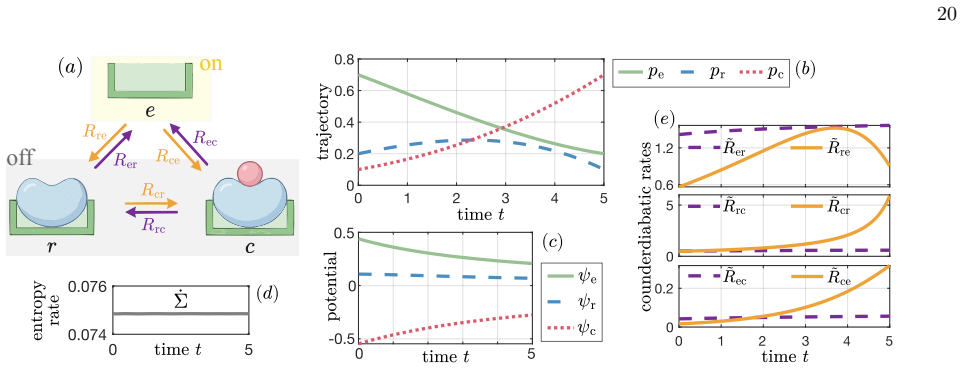
- Figure captions and axis labels should explicitly indicate whether plotted quantities are normalized or scaled by mobility parameters to avoid ambiguity when comparing dissipative and Hamiltonian-dissipative cases.
Simulated Author's Rebuttal
We thank the referee for their thorough reading, positive summary, and recommendation to accept the manuscript. No major comments were raised.
Circularity Check
No significant circularity detected
full rationale
The derivation chain extends established Wasserstein-2 gradient flow formulations (for overdamped diffusions, detailed-balanced Markov chains, and Lindblad dynamics) by introducing generalized metrics that incorporate Hamiltonian terms. The abstract and structure present this as a modification of the Riemannian structure on state space, with equivalence bounds and recovery of thermodynamic length arising as consistency checks from the same variational principles. No self-definitional reductions, fitted inputs renamed as predictions, or load-bearing self-citations are exhibited in the provided text; the framework remains self-contained against external benchmarks in optimal transport and stochastic thermodynamics.
Axiom & Free-Parameter Ledger
axioms (1)
- domain assumption Relaxation dynamics in the listed classical and quantum systems admit a gradient-flow formulation on state space equipped with a Wasserstein-2 metric that bounds entropy production.
Reference graph
Works this paper leans on
-
[1]
Weinhold, Metric geometry of equilibrium thermo- dynamics, The Journal of Chemical Physics63, 2479 (1975)
F. Weinhold, Metric geometry of equilibrium thermo- dynamics, The Journal of Chemical Physics63, 2479 (1975)
1975
-
[2]
Ruppeiner, Thermodynamics: A riemannian geomet- ric model, Physical Review A20, 1608 (1979)
G. Ruppeiner, Thermodynamics: A riemannian geomet- ric model, Physical Review A20, 1608 (1979)
1979
-
[3]
Salamon and R
P. Salamon and R. S. Berry, Thermodynamic length and dissipated availability, Physical Review Letters51, 1127 (1983)
1983
-
[4]
G. E. Crooks, Measuring Thermodynamic Length, Phys- ical Review Letters99(2007)
2007
-
[5]
D. A. Sivak and G. E. Crooks, Thermodynamic metrics and optimal paths, Physical review letters108, 190602 (2012)
2012
-
[6]
Aurell, C
E. Aurell, C. Mej´ ıa-Monasterio, and P. Muratore- Ginanneschi, Optimal protocols and optimal transport in stochastic thermodynamics, Physical review letters106, 250601 (2011)
2011
-
[7]
Aurell, K
E. Aurell, K. Gaw¸ edzki, C. Mej´ ıa-Monasterio, R. Mo- hayaee, and P. Muratore-Ginanneschi, Refined second law of thermodynamics for fast random processes, Jour- nal of statistical physics147, 487 (2012)
2012
-
[8]
Nakazato and S
M. Nakazato and S. Ito, Geometrical aspects of en- tropy production in stochastic thermodynamics based on wasserstein distance, Physical Review Research3, 043093 (2021)
2021
-
[9]
A. Dechant and Y. Sakurai, Thermodynamic in- terpretation of wasserstein distance, arXiv preprint arXiv:1912.08405 (2019)
-
[10]
Sabbagh, O
R. Sabbagh, O. Movilla Miangolarra, and T. T. Georgiou, Wasserstein speed limits for langevin systems, Physical Review Research6, 033308 (2024)
2024
-
[11]
Van Vu and Y
T. Van Vu and Y. Hasegawa, Geometrical bounds of the irreversibility in markovian systems, Physical Review Letters126, 010601 (2021)
2021
-
[12]
A. Dechant, Minimum entropy production, detailed balance and wasserstein distance for continuous-time markov processes, Journal of Physics A: Mathematical and Theoretical55, 094001 (2022)
2022
-
[13]
Van Vu and K
T. Van Vu and K. Saito, Thermodynamic unification of optimal transport: Thermodynamic uncertainty relation, minimum dissipation, and thermodynamic speed limits, Physical Review X13, 011013 (2023)
2023
-
[14]
Yoshimura, A
K. Yoshimura, A. Kolchinsky, A. Dechant, and S. Ito, Housekeeping and excess entropy production for general nonlinear dynamics, Physical Review Research5, 013017 (2023)
2023
-
[15]
Kolchinsky, A
A. Kolchinsky, A. Dechant, K. Yoshimura, and S. Ito, Generalized free energy and excess/housekeeping decom- position in nonequilibrium systems: From large devia- tions to thermodynamic speed limits, Physical Review Research8, 023025 (2026)
2026
-
[16]
Yoshimura, Y
K. Yoshimura, Y. Maekawa, R. Nagayama, and S. Ito, Force-current structure in markovian open quantum sys- tems and its applications: Geometric housekeeping- excess decomposition and thermodynamic trade-off re- lations, Physical Review Research7, 013244 (2025)
2025
-
[17]
Nagayama, K
R. Nagayama, K. Yoshimura, A. Kolchinsky, and S. Ito, Geometric thermodynamics of reaction-diffusion sys- tems: Thermodynamic trade-off relations and optimal transport for pattern formation, Physical Review Re- search7, 033011 (2025)
2025
-
[18]
Maes and K
C. Maes and K. Netoˇ cn` y, A nonequilibrium extension of the clausius heat theorem, Journal of Statistical Physics 154, 188 (2014)
2014
-
[19]
Dechant, S.-i
A. Dechant, S.-i. Sasa, and S. Ito, Geometric decomposi- tion of entropy production into excess, housekeeping, and coupling parts, Physical Review E106, 024125 (2022)
2022
-
[20]
Movilla Miangolarra, A
O. Movilla Miangolarra, A. Taghvaei, and T. T. Geor- giou, Minimal entropy production in the presence of anisotropic fluctuations, IEEE Transactions on Auto- matic Control (2024)
2024
-
[21]
Movilla Miangolarra, A
O. Movilla Miangolarra, A. Taghvaei, R. Fu, Y. Chen, and T. T. Georgiou, Energy harvesting from anisotropic fluctuations, Physical Review E104, 044101 (2021)
2021
-
[22]
R. Fu, A. Taghvaei, Y. Chen, and T. T. Georgiou, Maxi- mal power output of a stochastic thermodynamic engine, Automatica123, 109366 (2021)
2021
-
[23]
Taghvaei, O
A. Taghvaei, O. Movilla Miangolarra, R. Fu, Y. Chen, and T. T. Georgiou, On the relation between information and power in stochastic thermodynamic engines, IEEE Control Systems Letters6, 434 (2021)
2021
-
[24]
Nagase and T
R. Nagase and T. Sagawa, Thermodynamically optimal information gain in finite-time measurement, Physical Review Research6, 033239 (2024)
2024
-
[25]
Oikawa, Y
S. Oikawa, Y. Nakayama, S. Ito, T. Sagawa, and S. Toy- abe, Experimentally achieving minimal dissipation via thermodynamically optimal transport, Nature Commu- nications16, 10424 (2025)
2025
-
[26]
Kamijima, K
T. Kamijima, K. Funo, and T. Sagawa, Finite-time ther- modynamic bounds and trade-off relations for informa- tion processing, Physical Review Research7, 013329 (2025)
2025
-
[27]
Blaber and D
S. Blaber and D. A. Sivak, Optimal control in stochastic thermodynamics, Journal of Physics Communications7, 033001 (2023)
2023
-
[28]
Delvenne and G
J.-C. Delvenne and G. Falasco, Thermokinetic relations, Physical Review E109, 014109 (2024)
2024
-
[29]
Nagayama, K
R. Nagayama, K. Yoshimura, and S. Ito, Infinite variety of thermodynamic speed limits with general activities, Physical Review Research7, 013307 (2025)
2025
-
[30]
Scandi and M
M. Scandi and M. Perarnau-Llobet, Thermodynamic length in open quantum systems, Quantum3, 197 (2019)
2019
-
[31]
Zhong and M
A. Zhong and M. R. DeWeese, Beyond linear response: Equivalence between thermodynamic geometry and op- timal transport, Physical Review Letters133, 057102 (2024)
2024
- [32]
-
[33]
Disser and M
K. Disser and M. Liero, On gradient structures for markov chains and the passage to wasserstein gradient 24 flows., Networks Heterog. Media10, 233 (2015)
2015
-
[34]
That is,G= ♭∶TM→T∗M∶v↦g(v,⋅)is the flat map and its inverse,K= ♯∶T∗M→TM∶g(v,⋅)↦v, is the sharp map, whereTMandT ∗Mdenote the tangent and cotangent bundles ofM, respectively
In the context of Riemannian geometry, the mapGis simply the musical isomorphism induced by the metric g. That is,G= ♭∶TM→T∗M∶v↦g(v,⋅)is the flat map and its inverse,K= ♯∶T∗M→TM∶g(v,⋅)↦v, is the sharp map, whereTMandT ∗Mdenote the tangent and cotangent bundles ofM, respectively
-
[35]
Therefore,⟪K −1 x ∇gFx, v⟫=⟪dF x, v⟫, implying that ∇gFx =K x(dFx)
The gradient ofFin the metricgis defined, for allv∈ TxM,by gx(∇gFx, v)=⟪dF x, v⟫. Therefore,⟪K −1 x ∇gFx, v⟫=⟪dF x, v⟫, implying that ∇gFx =K x(dFx)
-
[36]
Up to a normalization factor, the optimal velocity isv= −Kx(dFx)
The steepest descent direction is given by the velocity v∈TxMwith norm 1, i.e.,g x(v, v)=1, that minimizes d dt F(x+tv)=⟪dF x, v⟫. Up to a normalization factor, the optimal velocity isv= −Kx(dFx)
-
[37]
Jordan, D
R. Jordan, D. Kinderlehrer, and F. Otto, The variational formulation of the fokker–planck equation, SIAM Journal on Mathematical Analysis29, 1 (1998)
1998
-
[38]
Maas, Gradient flows of the entropy for finite markov chains, Journal of Functional Analysis261, 2250 (2011)
J. Maas, Gradient flows of the entropy for finite markov chains, Journal of Functional Analysis261, 2250 (2011)
2011
-
[39]
Mielke, A gradient structure for reaction–diffusion sys- tems and for energy-drift-diffusion systems, Nonlinearity 24, 1329 (2011)
A. Mielke, A gradient structure for reaction–diffusion sys- tems and for energy-drift-diffusion systems, Nonlinearity 24, 1329 (2011)
2011
-
[40]
S.-N. Chow, W. Huang, Y. Li, and H. Zhou, Fokker– planck equations for a free energy functional or markov process on a graph, Archive for Rational Mechanics and Analysis203, 969 (2012)
2012
-
[41]
E. A. Carlen and J. Maas, Gradient flow and entropy in- equalities for quantum markov semigroups with detailed balance, Journal of Functional Analysis273, 1810 (2017)
2017
-
[42]
Y. Chen, T. T. Georgiou, and A. Tannenbaum, Ma- trix optimal mass transport: a quantum mechanical ap- proach, IEEE Transactions on Automatic Control63, 2612 (2017)
2017
-
[43]
Mittnenzweig and A
M. Mittnenzweig and A. Mielke, An entropic gradient structure for lindblad equations and couplings of quan- tum systems to macroscopic models, Journal of Statisti- cal Physics167, 205 (2017)
2017
-
[44]
That is, there exists a constantC<∞such that ∫ Rd φ2ρdx≤C ∫ Rd ∇φ⊺D∇φρdx, for all sufficiently smooth functionsφ∈C ∞ c (Rd)with zeroρ-mean
Specifically,P 2 ∗(Rd)is the space of finite-second-moment probability measures onR d that are absolutely contin- uous with respect to the Lebesgue measure and have a strictly positive densityρthat satisfies a Poincar´ e in- equality. That is, there exists a constantC<∞such that ∫ Rd φ2ρdx≤C ∫ Rd ∇φ⊺D∇φρdx, for all sufficiently smooth functionsφ∈C ∞ c (Rd...
-
[45]
A sufficient condition is to assume a Gibbs densityρ∝e−βV withVuniformly convex outside a compact set
OnR d, the weighted Poisson equation∇⋅(D ρ∇φ)=˙µ has a (weak) solution, unique up to an additive constant, for admissible zero-mass tangent vectors ˙µ, provided that ρis strictly positive and satisfies a Poincar´ e inequality. A sufficient condition is to assume a Gibbs densityρ∝e−βV withVuniformly convex outside a compact set. Since only∇φenters the dyna...
-
[46]
Benamou and Y
J.-D. Benamou and Y. Brenier, A computational fluid mechanics solution to the monge-kantorovich mass trans- fer problem, Numerische Mathematik84, 375 (2000)
2000
-
[47]
Ambrosio, N
L. Ambrosio, N. Gigli, and G. Savar´ e,Gradient flows: in metric spaces and in the space of probability measures (Springer, 2005)
2005
-
[48]
Uniqueness up to an additive constant is ensured by the strict positivity ofp[38, Prop. 3.26]
-
[49]
Lindblad, On the generators of quantum dynamical semigroups, Communications in mathematical physics 48, 119 (1976)
G. Lindblad, On the generators of quantum dynamical semigroups, Communications in mathematical physics 48, 119 (1976)
1976
-
[50]
Gorini, A
V. Gorini, A. Kossakowski, and E. C. G. Sudarshan, Completely positive dynamical semigroups of n-level sys- tems, Journal of Mathematical Physics17, 821 (1976)
1976
-
[51]
In particular, ifH∣m⟩=Hm∣m⟩, thenH Lk∣m⟩=(Hm+ω k)L k∣m⟩,so Lk maps an energy eigenstate∣m⟩with energyHm to an eigenstate with energyH m+ω k
The commutation relation[L k, H]=−ωkLk is the state- ment thatL k is an eigenoperator of the adjoint action ofH, i.e., ad H(Lk)=[L k, H]=−ω kLk. In particular, ifH∣m⟩=Hm∣m⟩, thenH Lk∣m⟩=(Hm+ω k)L k∣m⟩,so Lk maps an energy eigenstate∣m⟩with energyHm to an eigenstate with energyH m+ω k. Thus the operatorsL k act as energy ladder (jump) operators implementin...
-
[52]
The assumption that[L k, A]=0 for allkimpliesA=cId means that the commutant A′={A∶[A, X]=0∀X∈A}is trivial, i.e.,A ′=CId
Formally, letAbe the∗-algebra generated by the jump operators{L k}k∈K. The assumption that[L k, A]=0 for allkimpliesA=cId means that the commutant A′={A∶[A, X]=0∀X∈A}is trivial, i.e.,A ′=CId. Equivalently, the representation ofAonC d is irreducible, in the sense of Schur’s Lemma
-
[53]
Forβ=0, equation (28) readsM k ϱ(∂klogϱ)= γk 2 ∂kϱ
-
[54]
E. A. Carlen and J. Maas, Non-commutative calculus, optimal transport and functional inequalities in dissipa- tive quantum systems, Journal of Statistical Physics178, 319 (2020)
2020
-
[55]
Sekimoto, Stochastic energetics (2010)
K. Sekimoto, Stochastic energetics (2010)
2010
-
[56]
Y. Chen, T. T. Georgiou, and A. Tannenbaum, Stochas- tic control and nonequilibrium thermodynamics: Funda- mental limits, IEEE transactions on automatic control 65, 2979 (2019)
2019
-
[57]
Ito, Geometric thermodynamics for the fokker–planck equation: stochastic thermodynamic links between in- formation geometry and optimal transport, Information geometry7, 441 (2024)
S. Ito, Geometric thermodynamics for the fokker–planck equation: stochastic thermodynamic links between in- formation geometry and optimal transport, Information geometry7, 441 (2024)
2024
-
[58]
Otsubo, S
S. Otsubo, S. Ito, A. Dechant, and T. Sagawa, Esti- mating entropy production by machine learning of short- time fluctuating currents, Physical Review E101, 062106 (2020)
2020
-
[59]
Dechant, S.-i
A. Dechant, S.-i. Sasa, and S. Ito, Geometric decomposi- tion of entropy production in out-of-equilibrium systems, Physical Review Research4, L012034 (2022)
2022
-
[60]
Watabe and K
F. Watabe and K. Okuda, Lower bound of entropy pro- duction in an underdamped langevin system with normal distributions, Physical Review E111, 054139 (2025)
2025
-
[61]
Van Vu and K
T. Van Vu and K. Saito, Topological speed limit, Physical review letters130, 010402 (2023)
2023
-
[62]
Specifically,−(Jρ+Kρ)(φ)=˙µhas a unique weak solution forφprovided that ∫ ˙µ=0 andρis strictly positive and satisfies a Poincar´ e inequality
-
[63]
A natural route would be to regularizeDasD ε =diag(ε1 d,1 d)and study the sin- gular limitε→0, which may lead to a hypoelliptic or sub-Riemannian analog of the metric
Extending the present construction to that regime would require handling the degeneracy of the dissipation oper- ator, since the uniqueness result used above relies onD being strictly positive definite. A natural route would be to regularizeDasD ε =diag(ε1 d,1 d)and study the sin- gular limitε→0, which may lead to a hypoelliptic or sub-Riemannian analog o...
-
[64]
Chennakesavalu and G
S. Chennakesavalu and G. M. Rotskoff, Unified, geomet- ric framework for nonequilibrium protocol optimization, 25 Physical Review Letters130, 107101 (2023)
2023
-
[65]
Mandal and C
D. Mandal and C. Jarzynski, Analysis of slow transitions between nonequilibrium steady states, Journal of Statis- tical Mechanics: Theory and Experiment2016, 063204 (2016)
2016
-
[66]
However, a finite- dimensional example is the Gaussian submanifold, where any two points are connected byW 2 geodesics that stay within the submanifold
This may require the parametrization (λ-space) to be infinite-dimensional in general. However, a finite- dimensional example is the Gaussian submanifold, where any two points are connected byW 2 geodesics that stay within the submanifold
-
[67]
Ilker, ¨O
E. Ilker, ¨O. G¨ ung¨ or, B. Kuznets-Speck, J. Chiel, S. Deffner, and M. Hinczewski, Shortcuts in stochastic systems and control of biophysical processes, Physical Review X12, 021048 (2022)
2022
-
[68]
S. Iram, E. Dolson, J. Chiel, J. Pelesko, N. Krishnan, ¨O. G¨ ung¨ or, B. Kuznets-Speck, S. Deffner, E. Ilker, J. G. Scott,et al., Controlling the speed and trajectory of evo- lution with counterdiabatic driving, Nature Physics17, 135 (2021)
2021
-
[69]
M. A. Schumacher, K. Y. Choi, F. Lu, H. Zalkin, and R. G. Brennan, Mechanism of corepressor-mediated spe- cific dna binding by the purine repressor, Cell83, 147 (1995)
1995
-
[70]
H. Xu, M. Moraitis, R. J. Reedstrom, and K. S. Matthews, Kinetic and thermodynamic studies of purine repressor binding to corepressor and operator dna, Jour- nal of Biological Chemistry273, 8958 (1998)
1998
-
[71]
Kamijima, A
T. Kamijima, A. Takatsu, K. Funo, and T. Sagawa, Op- timal finite-time maxwell’s demons in langevin systems, Physical Review Research7, 023159 (2025)
2025
-
[72]
Optimal active engines obey the thermodynamic Lorentz force law
A. Zhong, A. G. Frim, and M. R. DeWeese, Optimal ac- tive engines obey the thermodynamic lorentz force law, arXiv preprint arXiv:2512.17087 (2025)
work page internal anchor Pith review Pith/arXiv arXiv 2025
-
[73]
Huang and P
Y. Huang and P. Krishnaprasad, Optimal control of a stochastic oscillator in non-equilibrium thermodynamics, in2016 IEEE 55th Conference on Decision and Control (CDC)(IEEE, 2016) pp. 197–202
2016
-
[74]
Huang and P
Y. Huang and P. Krishnaprasad, Sub-riemannian ge- ometry and finite time thermodynamics part 1: The stochastic oscillator., Discrete & Continuous Dynamical Systems-Series S13(2020)
2020
-
[75]
A. G. Frim and M. R. DeWeese, Geometric bound on the efficiency of irreversible thermodynamic cycles, Physical Review Letters128, 230601 (2022)
2022
-
[76]
Adams, N
S. Adams, N. Dirr, M. A. Peletier, and J. Zimmer, From a large-deviations principle to the wasserstein gradient flow: a new micro-macro passage, Communications in Mathematical Physics307, 791 (2011)
2011
-
[77]
Mielke, M
A. Mielke, M. A. Peletier, and D. M. Renger, On the relation between gradient flows and the large-deviation principle, with applications to markov chains and diffu- sion, Potential Analysis41, 1293 (2014)
2014
-
[78]
Mielke, R
A. Mielke, R. I. Patterson, M. A. Peletier, and D. Michiel Renger, Non-equilibrium thermodynamical principles for chemical reactions with mass-action kinet- ics, SIAM Journal on Applied Mathematics77, 1562 (2017)
2017
-
[79]
E. A. Carlen and J. Maas, An analog of the 2-wasserstein metric in non-commutative probability under which the fermionic fokker–planck equation is gradient flow for the entropy, Communications in mathematical physics331, 887 (2014). Appendix A: System-independent quantum formulation Here we show that the optimal transport problem (35) can be written throu...
2014
-
[80]
Optimality conditions for the discrete problem Consider the discrete optimal transport problem (22) in the convex flux formulation, namely, inf p∈P∗(X),J τ ∑ n,m∈X ∫ τ 0 J 2 nm anm(p) dt(B1) s.t. ˙pn = ∑ m∈X (Jmn−Jnm), p(0)=p 0, p(τ)=p τ , where anm(p)= 1 2 Rnmpeq m θ( pn peq n , pm peq m ), with the ratesR nm satisfying detailed balance with re- spect to...
discussion (0)
Sign in with ORCID, Apple, or X to comment. Anyone can read and Pith papers without signing in.