Quantum Tunneling-Aware Machine Learning: Physics-Derived Noise Models for Robust Deployment
Pith reviewed 2026-06-28 18:55 UTC · model grok-4.3
The pith
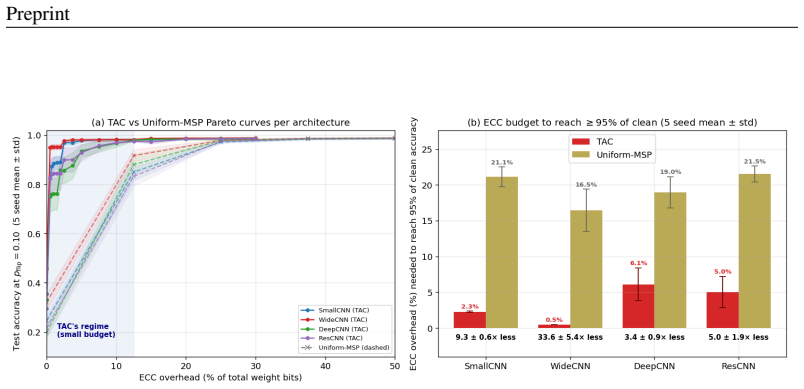
A WKB-derived error model lets neural networks retain 95 percent clean accuracy under quantum tunneling with 3 to 33 times less error-correction overhead.
A machine-rendered reading of the paper's core claim, the machinery that carries it, and where it could break.
Core claim
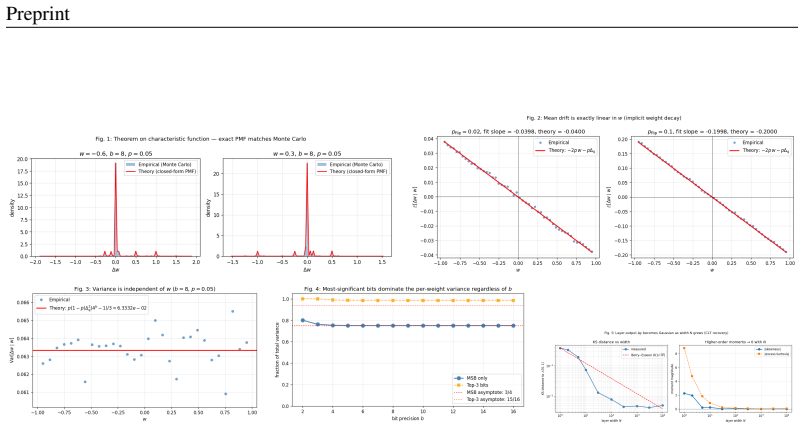
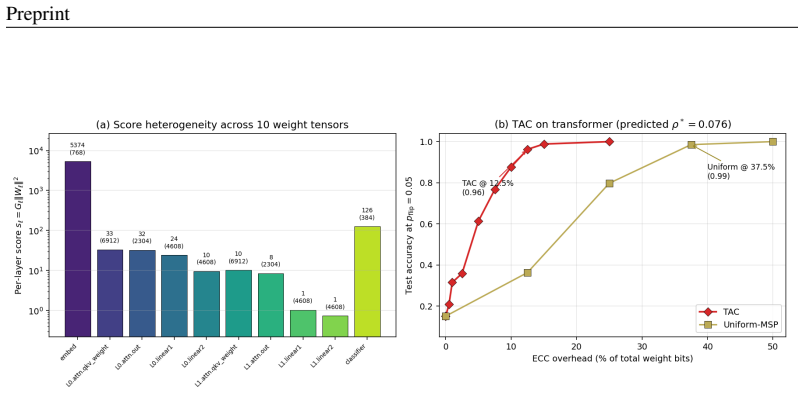
The deployment-time weight-error distribution obtained from the WKB approximation exhibits an exact affine mean drift, a per-bit variance hierarchy dominated by the MSB, and a per-layer dependence on the infinity norm of the weights and the trained-network Jacobian; packaging these three properties into TAC yields a deployment-time procedure that reaches 95 percent of clean accuracy at p_flip = 0.10 (CNNs) and 0.05 (transformers) with 3.4× to 33.6× lower ECC overhead than Uniform-MSP while requiring no retraining.
What carries the argument
Tunneling-Aware Compensation (TAC) algorithm, which performs closed-form mean correction together with optimal layer-adaptive bit-budget allocation derived from the WKB variance decomposition.
If this is right
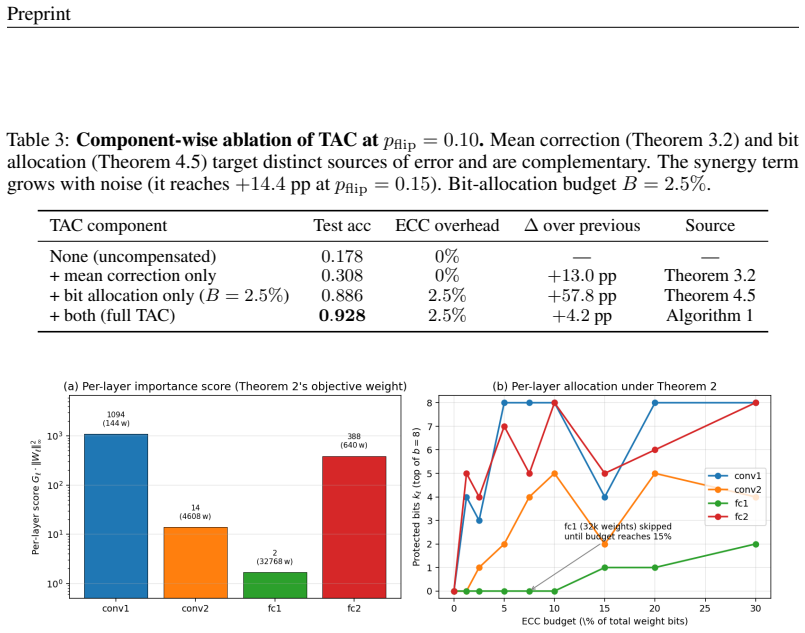
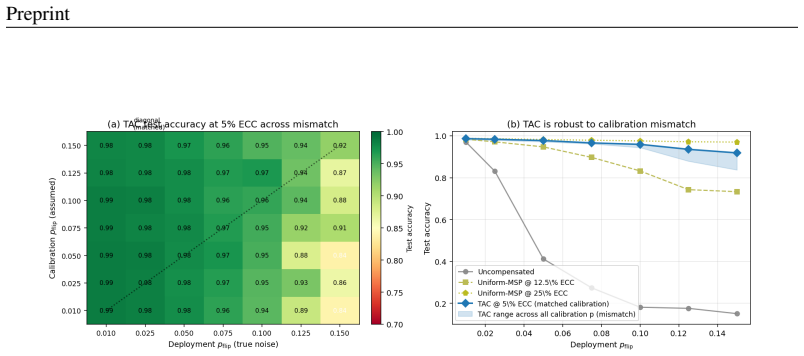
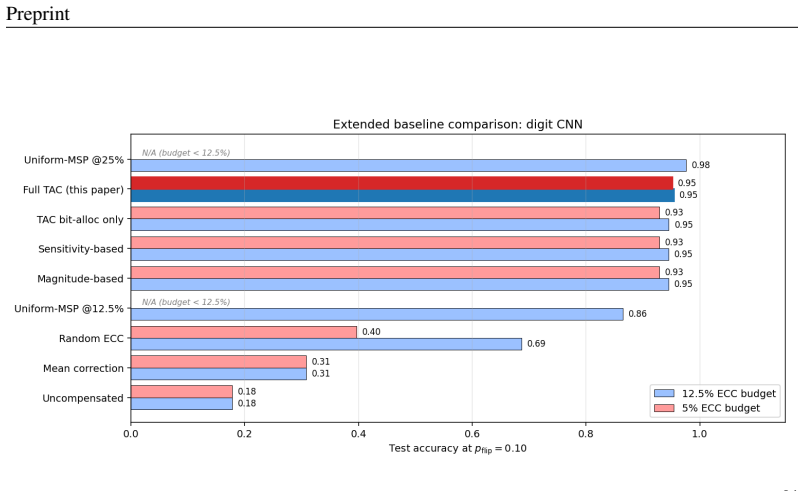
- At p_flip=0.10 for four CNN architectures and p_flip=0.05 for a transformer encoder, TAC reaches 95 percent of clean accuracy with 3.4× to 33.6× less ECC overhead than Uniform-MSP.
- The closed-form saturation ratio ρ* predicts the observed ECC savings in advance.
- On heterogeneous architectures, WKB-derived scoring outperforms magnitude-based allocation by up to 24 percentage points at small budgets.
- The algorithm requires no retraining, no labels, and adds no inference-time overhead.
- The three WKB-derived distributional theorems are verified to Monte Carlo precision.
Where Pith is reading between the lines
- The same structural properties could be used to set per-layer error budgets during hardware fabrication rather than only at deployment.
- The affine-drift and MSB-variance signatures may appear in other quantum or leakage-dominated noise sources beyond tunneling.
- Because the correction is closed-form and label-free, it could be combined with existing post-training quantization pipelines without additional data.
Load-bearing premise
The WKB approximation produces an accurate deployment-time weight-error distribution that has an exact affine mean drift, MSB-dominated per-bit variance hierarchy, and per-layer dependence on weight infinity norm and Jacobian.
What would settle it
Direct measurement of bit-flip statistics on a fabricated transistor array dominated by quantum tunneling that deviates from the predicted affine mean drift or from the MSB-dominated variance hierarchy.
Figures



read the original abstract
Transistor scaling is approaching a quantum-mechanical limit, as thin gate oxides induce electron leakage through quantum tunneling. Unlike conventional digital systems, AI inference can tolerate such errors provided their structure is modeled correctly. In this paper, we introduce quantum tunneling-aware machine learning (QTAML). We derive the deployment-time weight-error distribution from first principles using the Wentzel-Kramers-Brillouin (WKB) approximation and show that it has structure that generic Gaussian noise models miss: an exact affine mean drift, a per-bit variance hierarchy dominated by the most-significant bit, and a per-layer dependence on $\|W_\ell\|_\infty$ and the trained-network Jacobian. We package these three structural properties into a single deployment-time algorithm, Tunneling-Aware Compensation (TAC), that combines closed-form mean correction with an optimal layer-adaptive bit-budget allocation derived from the WKB variance decomposition. Across four convolutional architectures at $p_\mathrm{flip}$=0.10 and a transformer encoder at $p_\mathrm{flip}$=0.05, TAC reaches $95\%$ of clean accuracy with 3.4$\times$ to 33.6$\times$ less ECC overhead than Uniform-MSP, the natural baseline derived from the same physics. The closed-form saturation ratio $\rho^*$ predicts these gains in advance, and on heterogeneous architectures WKB-derived scoring outperforms magnitude-based allocation by up to 24 percentage points at small budgets. The algorithm requires no retraining, no labels, and no inference-time overhead. We also verify the WKB-derived distributional theorems to Monte Carlo precision. These results connect WKB tunneling physics with noise-aware deep learning and suggest a principled path toward hardware--software co-design beyond conventional scaling limits.
Editorial analysis
A structured set of objections, weighed in public.
Referee Report
Summary. The paper introduces quantum tunneling-aware machine learning (QTAML) by deriving the deployment-time weight-error distribution from the WKB approximation for electron tunneling through thin gate oxides. It identifies three structural properties—an exact affine mean drift, MSB-dominated per-bit variance hierarchy, and per-layer dependence on ||W_ℓ||_∞ and the Jacobian—and packages them into the Tunneling-Aware Compensation (TAC) algorithm combining closed-form mean correction with layer-adaptive ECC allocation. Across CNNs at p_flip=0.10 and a transformer at p_flip=0.05, TAC is reported to reach 95% of clean accuracy using 3.4×–33.6× less ECC overhead than Uniform-MSP, with a closed-form saturation ratio ρ* predicting gains and Monte Carlo verification of the distributional claims.
Significance. If the WKB-derived distributional structure holds for real hardware, the work supplies a first-principles route to hardware–software co-design that reduces ECC overhead while preserving accuracy, without retraining or inference overhead. The closed-form expressions, Monte Carlo verification of internal theorems, and parameter-free prediction via ρ* are concrete strengths that distinguish it from purely empirical noise-robustness methods.
major comments (2)
- [Abstract] Abstract (and the paragraph on structural properties): the central claim that the WKB approximation produces an accurate deployment-time weight-error distribution exhibiting exact affine mean drift, MSB variance hierarchy, and per-layer Jacobian dependence rests on modeling assumptions whose fidelity to measured bit-error statistics from scaled transistors with thin gate oxides is not demonstrated; Monte Carlo verification only confirms internal consistency of the idealized model, leaving the load-bearing link to hardware untested.
- [Abstract] Abstract: the closed-form saturation ratio ρ* is presented as predicting the observed ECC gains in advance, yet no derivation is supplied showing whether ρ* is independent of fitted parameters or reduces by construction to quantities already defined by the same WKB fit; this circularity risk directly affects the claim that the method is predictive rather than post-hoc.
minor comments (2)
- Notation for p_flip and the precise definition of Uniform-MSP should be introduced earlier and used consistently to avoid ambiguity when comparing to the physics-derived baseline.
- The manuscript would benefit from an explicit statement of the WKB validity regime (oxide thickness, voltage range) to clarify the scope of the first-principles derivation.
Simulated Author's Rebuttal
We thank the referee for the constructive feedback. We respond to each major comment below, clarifying the theoretical scope of the WKB derivation and committing to add the missing derivation for ρ*.
read point-by-point responses
-
Referee: [Abstract] Abstract (and the paragraph on structural properties): the central claim that the WKB approximation produces an accurate deployment-time weight-error distribution exhibiting exact affine mean drift, MSB variance hierarchy, and per-layer Jacobian dependence rests on modeling assumptions whose fidelity to measured bit-error statistics from scaled transistors with thin gate oxides is not demonstrated; Monte Carlo verification only confirms internal consistency of the idealized model, leaving the load-bearing link to hardware untested.
Authors: The manuscript presents a first-principles derivation of the weight-error distribution under the WKB approximation for tunneling through thin gate oxides, using standard physical constants from the device-physics literature. The three structural properties (affine drift, MSB-dominated variance hierarchy, Jacobian dependence) are shown to follow directly from the WKB integral and the bit-position encoding; Monte Carlo sampling then verifies that the simulated error histograms match the closed-form expressions to numerical precision. The paper does not claim or demonstrate empirical match to measured bit-error rates on specific fabricated devices; its contribution is the analytic structure that generic noise models lack and its use inside TAC. We can add an expanded discussion of the WKB modeling assumptions and their prior use in CMOS leakage studies. revision: partial
-
Referee: [Abstract] Abstract: the closed-form saturation ratio ρ* is presented as predicting the observed ECC gains in advance, yet no derivation is supplied showing whether ρ* is independent of fitted parameters or reduces by construction to quantities already defined by the same WKB fit; this circularity risk directly affects the claim that the method is predictive rather than post-hoc.
Authors: We agree that the derivation of ρ* was omitted for brevity. In the revision we will insert the explicit steps: ρ* is obtained by setting the derivative of the expected accuracy loss (expressed via the WKB per-bit variances and the layer-wise ||W_ℓ||_∞·||J_ℓ|| terms) with respect to the ECC budget to zero and solving the resulting closed-form expression. All quantities entering ρ* are either physical constants taken from the WKB model or network statistics already required by TAC; no additional fitting parameters are introduced. This establishes that ρ* is predictive from the model rather than post-hoc. revision: yes
- Empirical validation of the WKB-derived error distribution against measured bit-error statistics on real scaled transistors with thin gate oxides (requires specialized device-characterization hardware not available to the authors).
Circularity Check
No circularity: derivation rests on external WKB physics and internal Monte Carlo checks
full rationale
The paper derives the weight-error distribution and its three structural properties (affine drift, MSB variance hierarchy, layer dependence) directly from the WKB approximation as a first-principles physics model. TAC and the closed-form saturation ratio ρ* are constructed from those derived properties. Monte Carlo verification is performed on the idealized model for internal consistency only. No equations are shown that reduce ρ* or the performance predictions to fitted parameters by construction, no self-citations are load-bearing, and no ansatz is smuggled via prior work. The chain is self-contained against the stated external benchmark (WKB) and does not collapse to tautology.
Axiom & Free-Parameter Ledger
Reference graph
Works this paper leans on
-
[1]
Training with noise is equivalent to
Bishop, Christopher M , journal=. Training with noise is equivalent to
-
[2]
Nature Communications , volume=
Accurate deep neural network inference using computational phase-change memory , author=. Nature Communications , volume=
-
[3]
Nature communications , volume=
Hardware-aware training for large-scale and diverse deep learning inference workloads using in-memory computing-based accelerators , author=. Nature communications , volume=. 2023 , publisher=
2023
-
[4]
2023 Design, Automation & Test in Europe Conference & Exhibition (DATE) , pages=
Correctnet: Robustness enhancement of analog in-memory computing for neural networks by error suppression and compensation , author=. 2023 Design, Automation & Test in Europe Conference & Exhibition (DATE) , pages=. 2023 , organization=
2023
-
[5]
IEEE Micro , volume=
Ml-hw co-design of noise-robust tinyml models and always-on analog compute-in-memory edge accelerator , author=. IEEE Micro , volume=. 2022 , publisher=
2022
-
[6]
arXiv preprint arXiv:2306.03076 , year=
Sensitivity-Aware Finetuning for Accuracy Recovery on Deep Learning Hardware , author=. arXiv preprint arXiv:2306.03076 , year=
-
[7]
ACM SIGARCH Computer Architecture News , volume=
Minerva: Enabling low-power, highly-accurate deep neural network accelerators , author=. ACM SIGARCH Computer Architecture News , volume=. 2016 , publisher=
2016
-
[8]
IEEE Transactions on Computer-Aided Design of Integrated Circuits and Systems , volume=
Mors: An approximate fault modeling framework for reduced-voltage srams , author=. IEEE Transactions on Computer-Aided Design of Integrated Circuits and Systems , volume=. 2021 , publisher=
2021
-
[9]
32nd USENIX Security Symposium (USENIX Security 23) , pages=
Aegis: Mitigating targeted bit-flip attacks against deep neural networks , author=. 32nd USENIX Security Symposium (USENIX Security 23) , pages=
-
[10]
arXiv preprint arXiv:2103.13813 , year=
Ra-bnn: Constructing robust & accurate binary neural network to simultaneously defend adversarial bit-flip attack and improve accuracy , author=. arXiv preprint arXiv:2103.13813 , year=
-
[11]
Proceedings of Machine Learning and Systems , volume=
Bit error robustness for energy-efficient dnn accelerators , author=. Proceedings of Machine Learning and Systems , volume=
-
[12]
arXiv preprint arXiv:2501.05564 , year=
Analog Bayesian neural networks are insensitive to the shape of the weight distribution , author=. arXiv preprint arXiv:2501.05564 , year=
-
[13]
Physical Review Research , volume=
Universal scaling laws of absorbing phase transitions in artificial deep neural networks , author=. Physical Review Research , volume=. 2025 , publisher=
2025
-
[14]
APL Machine Learning , volume=
Quantum-tunneling deep neural network for optical illusion recognition , author=. APL Machine Learning , volume=. 2024 , publisher=
2024
-
[15]
arXiv e-prints , pages=
Neuromorphic quantum neural networks with tunnel-diode activation functions , author=. arXiv e-prints , pages=
-
[16]
arXiv preprint arXiv:2411.18993 , year=
Harden Deep Neural Networks Against Fault Injections Through Weight Scaling , author=. arXiv preprint arXiv:2411.18993 , year=
-
[17]
Evaluating prediction-time batch normalization for robustness under covariate shift , author=. arXiv preprint arXiv:2006.10963 , year=
-
[18]
Eine verallgemeinerung der quantenbedingungen f
Wentzel, Gregor , journal=. Eine verallgemeinerung der quantenbedingungen f. 1926 , publisher=
1926
-
[19]
Zeitschrift f
Wellenmechanik und halbzahlige Quantisierung , author=. Zeitschrift f. 1926 , publisher=
1926
-
[20]
Brillouin, L. La m. CR Acad. Sci , volume=
discussion (0)
Sign in with ORCID, Apple, or X to comment. Anyone can read and Pith papers without signing in.