Generative Diffusion Priors for 3D Mapping of the Dark Universe
Pith reviewed 2026-06-28 17:59 UTC · model grok-4.3
The pith
A diffusion model prior trained on cosmological simulations enables accurate 3D reconstruction of dark matter from weak lensing data.
A machine-rendered reading of the paper's core claim, the machinery that carries it, and where it could break.
Core claim
We leverage high-resolution simulations to create the Conicus3D dataset and train a diffusion-model prior that encodes the full nonlinear 3D distribution of dark matter across cosmic time; this prior is then inserted into a plug-and-play diffusion posterior sampler paired with a differentiable weak-lensing forward model, producing improved 2D and 3D reconstructions whose sample statistics closely match the simulations and remain robust to moderate cosmological shifts.
What carries the argument
A generative diffusion model prior learned from the Conicus3D simulation dataset, integrated into a modified diffusion-based posterior sampling scheme with a differentiable weak-lensing forward model.
If this is right
- Substantially higher accuracy in both projected 2D and full 3D dark-matter reconstructions compared with handcrafted priors or neural ensembles.
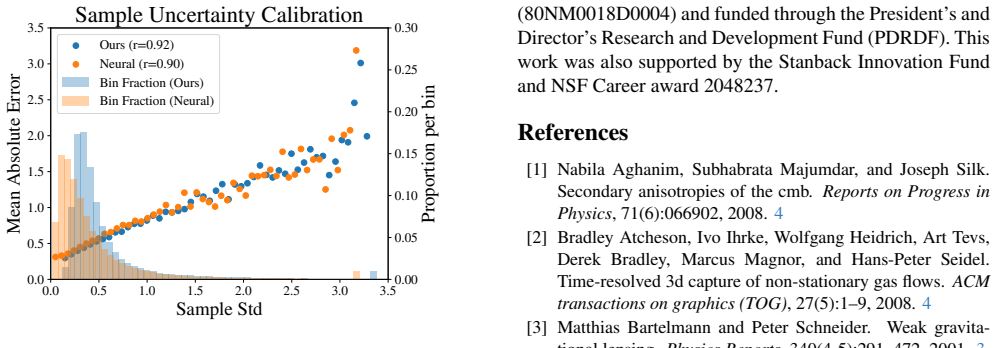
- Posterior samples whose higher-order statistics closely reproduce those of the underlying simulations.
- Robustness of the recovered maps to moderate changes in cosmological parameters.
- Ability to recover non-Gaussian filamentary features of the cosmic web that analytic priors miss.
Where Pith is reading between the lines
- The same simulation-trained prior could be tested for transfer to real data by comparing reconstructed maps against cross-correlations with galaxy positions or CMB lensing.
- If the prior generalizes, the method supplies a route to full Bayesian inference on the 3D matter field for next-generation surveys without requiring new analytic prescriptions for each cosmology.
- Extending the forward model to include baryonic feedback or intrinsic alignments would constitute a direct test of whether the learned prior remains dominant when additional physics are present.
Load-bearing premise
The diffusion model trained on Conicus3D simulations supplies an accurate enough prior for the unknown true dark-matter distribution even when real observations contain different noise, selection effects, or physical processes absent from the simulations.
What would settle it
Generate posterior samples from actual weak-lensing survey data and check whether their three-point correlation functions or filamentary morphology statistics deviate systematically from those measured in independent simulations that include the same cosmology and survey mask.
Figures

read the original abstract
Reconstructing the three-dimensional distribution of dark matter from weak-lensing observations is a central but highly ill-posed inverse problem in cosmology. Unlike standard 3D reconstruction with multiple viewpoints, we observe the universe from a single line of sight, through noisy shape distortions of galaxies with uncertain distances, so meaningful recovery of the 3D matter field requires strong prior assumptions. Existing methods either produce point estimates with handcrafted priors or use neural ensembles for approximate Bayesian uncertainty, and struggle to capture the non-Gaussian, filamentary structure of the cosmic web. With the advent of new high-resolution cosmological simulations, we now have an alternative source of prior knowledge that captures the nonlinear statistics of structure formation with far greater fidelity than analytic prescriptions. We leverage these simulations to build a new dataset $\texttt{Conicus3D}$, which enables us to learn a data-driven diffusion-model prior capturing the full 3D distribution of dark matter structure across cosmic time. Building on recent plug-and-play approaches, we modify a diffusion-based posterior sampling scheme to the 3D weak-lensing setting, combining the learned prior with a differentiable physical forward model. On realistic simulations targeting a modern weak lensing survey, our approach yields substantially improved 2D and 3D reconstruction accuracy over baseline methods. Moreover, it produces posterior samples whose statistics closely track the underlying simulations, while remaining robust to moderate shifts in cosmology.
Editorial analysis
A structured set of objections, weighed in public.
Referee Report
Summary. The paper proposes learning a 3D diffusion-model prior on the Conicus3D dataset derived from cosmological simulations, then using plug-and-play posterior sampling that combines this prior with a differentiable weak-lensing forward model. On realistic simulations matching a modern survey, the method is claimed to deliver substantially higher 2D and 3D reconstruction accuracy than baselines, to produce posterior samples whose statistics track the training simulations, and to remain robust under moderate cosmological shifts.
Significance. If the quantitative gains and simulation-matching statistics hold under proper controls, the work supplies a concrete demonstration that simulation-trained diffusion priors can capture non-Gaussian filamentary structure better than analytic or ensemble baselines in a realistic weak-lensing setting. The explicit robustness test to cosmology shifts and the construction of the Conicus3D dataset are positive contributions that could be reused by the community.
major comments (2)
- [§4, Table 2] §4 (Results), Table 2: the reported improvement in 3D reconstruction accuracy is stated relative to an unspecified 'baseline'; the table must define the exact baseline architecture, training procedure, and hyper-parameters so that the gain can be reproduced and attributed to the diffusion prior rather than to differences in optimization or regularization.
- [§3.2] §3.2 (Posterior sampling): the modification of the plug-and-play scheme for the 3D lensing geometry is described at a high level; the precise form of the likelihood gradient and the number of diffusion steps used at inference must be given explicitly, because these choices directly affect whether the reported posterior statistics are unbiased with respect to the forward model.
minor comments (2)
- [Abstract] Abstract: the phrase 'substantially improved' is used without accompanying numerical values or error bars; adding the key metrics (e.g., RMSE or power-spectrum residuals) would make the central claim immediately verifiable.
- [Figure 3] Figure 3 caption: the cosmology-shift experiment is shown for only two parameter directions; a brief statement of the explored range and the number of realizations would clarify the scope of the robustness claim.
Simulated Author's Rebuttal
We thank the referee for the positive evaluation and the specific suggestions that will improve the reproducibility of the manuscript. We address each major comment below.
read point-by-point responses
-
Referee: [§4, Table 2] §4 (Results), Table 2: the reported improvement in 3D reconstruction accuracy is stated relative to an unspecified 'baseline'; the table must define the exact baseline architecture, training procedure, and hyper-parameters so that the gain can be reproduced and attributed to the diffusion prior rather than to differences in optimization or regularization.
Authors: We agree that the baseline must be specified in full detail. In the revised manuscript we have expanded Table 2 and the text of Section 4 to state the precise architecture (a 3D U-Net with the same number of channels and residual blocks as the diffusion model), the identical training procedure on Conicus3D, the optimizer, learning-rate schedule, and all regularization hyperparameters. revision: yes
-
Referee: [§3.2] §3.2 (Posterior sampling): the modification of the plug-and-play scheme for the 3D lensing geometry is described at a high level; the precise form of the likelihood gradient and the number of diffusion steps used at inference must be given explicitly, because these choices directly affect whether the reported posterior statistics are unbiased with respect to the forward model.
Authors: We have revised Section 3.2 to include the explicit expression for the likelihood gradient under the 3D weak-lensing forward model and to state the exact number of diffusion steps (and the corresponding noise schedule) used at inference. These additions make the sampling procedure fully reproducible and allow direct verification that the reported posterior statistics are consistent with the forward model. revision: yes
Circularity Check
No significant circularity detected
full rationale
The paper constructs its diffusion prior from the external Conicus3D simulation dataset and evaluates all performance claims (improved 2D/3D accuracy, posterior statistics matching simulations, robustness to moderate cosmology shifts) on held-out realizations drawn from the same simulation suite. These steps rely on independent external data rather than any internal fit, self-definition, or self-citation chain; the forward model and sampling procedure are standard plug-and-play adaptations whose correctness is not presupposed by the target results. No load-bearing equation or claim reduces to its own inputs by construction.
Axiom & Free-Parameter Ledger
axioms (2)
- domain assumption The forward model mapping 3D matter to observed galaxy shapes is differentiable and accurately known.
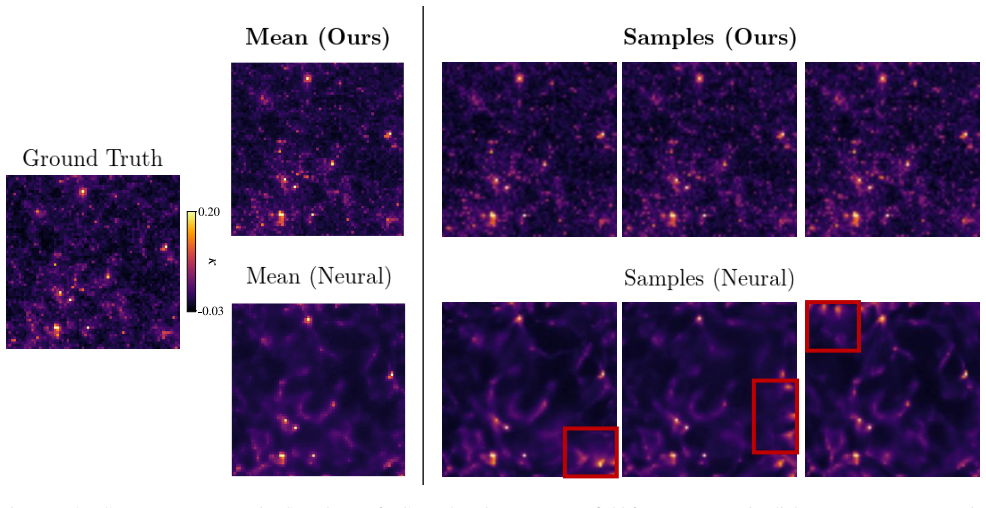
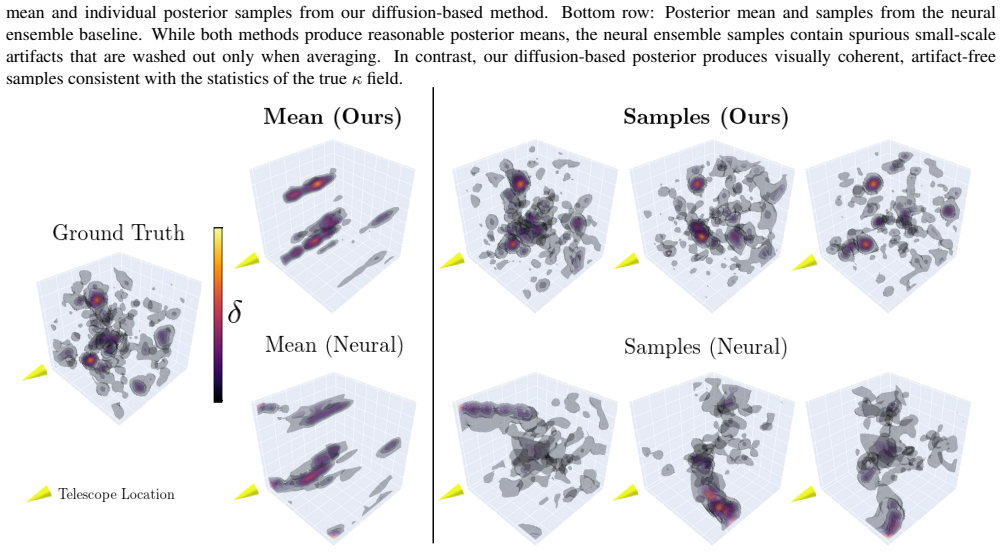
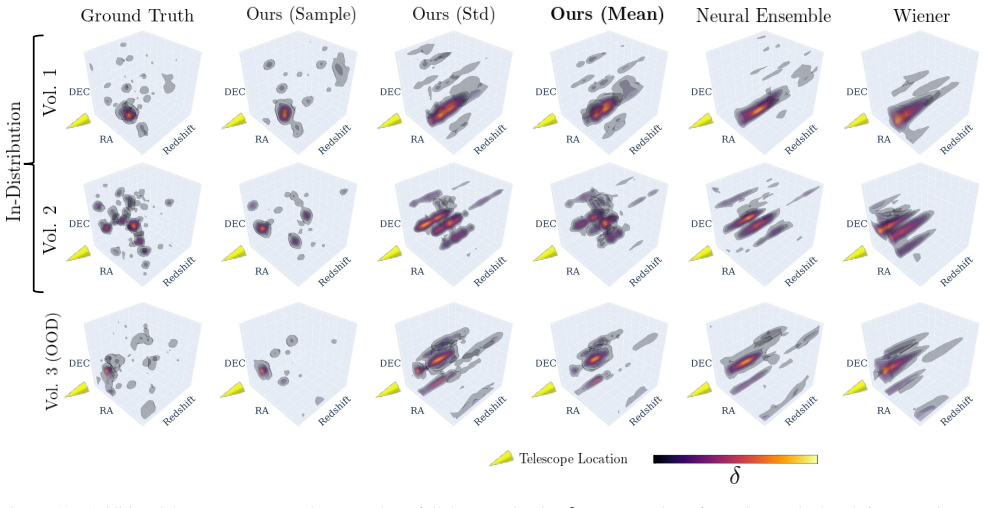
- domain assumption The statistics of structure formation in the training simulations are representative of the true universe within the range of cosmologies considered.
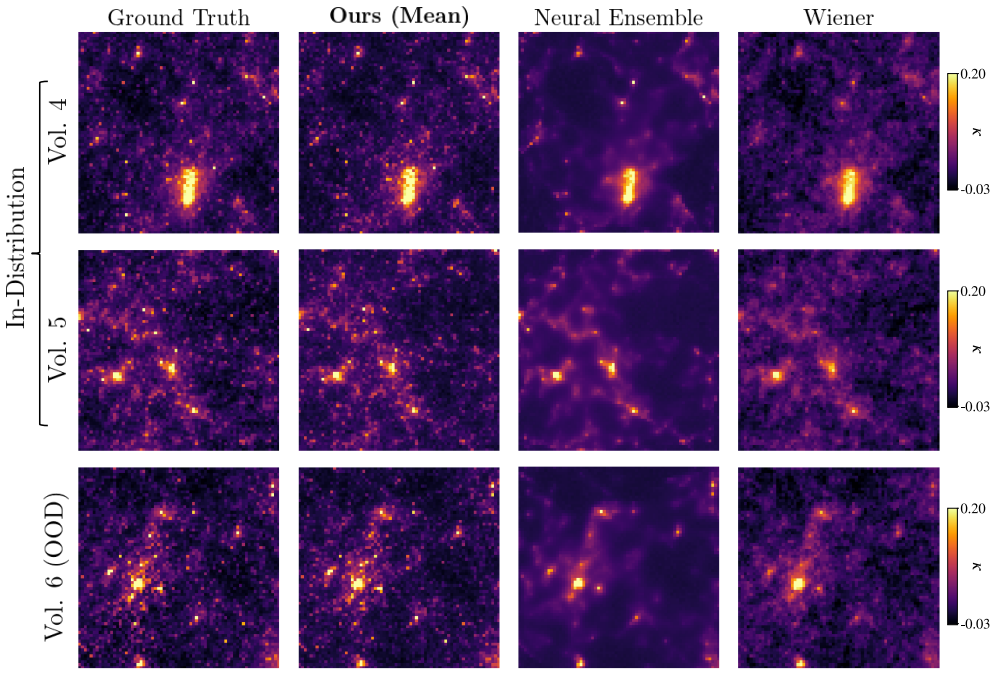
Reference graph
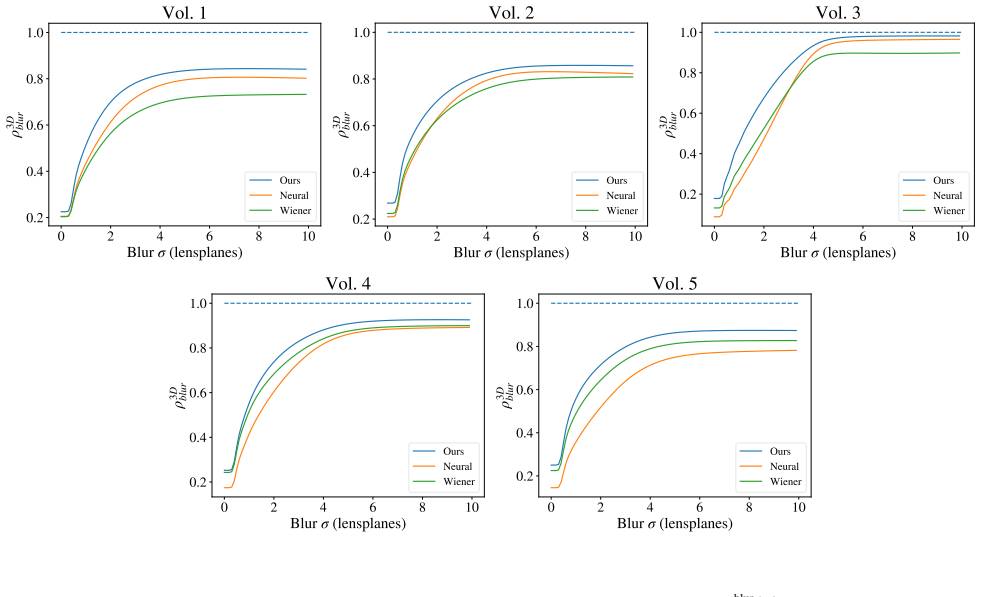
Works this paper leans on
-
[1]
Secondary anisotropies of the cmb.Reports on Progress in Physics, 71(6):066902, 2008
Nabila Aghanim, Subhabrata Majumdar, and Joseph Silk. Secondary anisotropies of the cmb.Reports on Progress in Physics, 71(6):066902, 2008. 4
2008
-
[2]
Time-resolved 3d capture of non-stationary gas flows.ACM transactions on graphics (TOG), 27(5):1–9, 2008
Bradley Atcheson, Ivo Ihrke, Wolfgang Heidrich, Art Tevs, Derek Bradley, Marcus Magnor, and Hans-Peter Seidel. Time-resolved 3d capture of non-stationary gas flows.ACM transactions on graphics (TOG), 27(5):1–9, 2008. 4
2008
-
[3]
Weak gravita- tional lensing.Physics Reports, 340(4-5):291–472, 2001
Matthias Bartelmann and Peter Schneider. Weak gravita- tional lensing.Physics Reports, 340(4-5):291–472, 2001. 3, 4
2001
-
[4]
Elsevier, 2013
Max Born and Emil Wolf.Principles of optics: electromag- netic theory of propagation, interference and diffraction of light. Elsevier, 2013. 4
2013
-
[5]
Diffusion-based mass map reconstruction from weak lensing data.Physical Review D, 111(8):083542, 2025
Supranta S Boruah, Michael Jacob, and Bhuvnesh Jain. Diffusion-based mass map reconstruction from weak lensing data.Physical Review D, 111(8):083542, 2025. 3
2025
-
[6]
Supranta S Boruah, Michael Jacob, Bhuvnesh Jain, Riya Maiya, and Raghav Venkataramanan. High-resolution weak lensing mass mapping from des-y3 data using diffusion- based prior.arXiv preprint arXiv:2511.14667, 2025. 3
-
[7]
Late-time cosmology with 21 cm intensity mapping ex- periments.The Astrophysical Journal, 803(1):21, 2015
Philip Bull, Pedro G Ferreira, Prina Patel, and Mario G San- tos. Late-time cosmology with 21 cm intensity mapping ex- periments.The Astrophysical Journal, 803(1):21, 2015. 4
2015
-
[8]
Cos- mology with the sunyaev-zel’dovich effect.Annual Review of Astronomy and Astrophysics, 40(1):643–680, 2002
John E Carlstrom, Gilbert P Holder, and Erik D Reese. Cos- mology with the sunyaev-zel’dovich effect.Annual Review of Astronomy and Astrophysics, 40(1):643–680, 2002. 4
2002
-
[9]
Cosmos-web: an overview of the jwst cosmic origins survey.The Astrophysical Journal, 954(1): 31, 2023
Caitlin M Casey, Jeyhan S Kartaltepe, Nicole E Drakos, Maximilien Franco, Santosh Harish, Louise Paquereau, Olivier Ilbert, Caitlin Rose, Isabella G Cox, James W Nightingale, et al. Cosmos-web: an overview of the jwst cosmic origins survey.The Astrophysical Journal, 954(1): 31, 2023. 1, 6
2023
-
[10]
Wide-field lensing mass maps from dark energy survey science verification data.Physical review letters, 115 (5):051301, 2015
Chihway Chang, Vinu Vikram, Bhuvnesh Jain, David Bacon, A Amara, MR Becker, G Bernstein, C Bonnett, S Bridle, D Brout, et al. Wide-field lensing mass maps from dark energy survey science verification data.Physical review letters, 115 (5):051301, 2015. 8
2015
-
[11]
Diffusion Posterior Sampling for General Noisy Inverse Problems
Hyungjin Chung, Jeongsol Kim, Michael T Mccann, Marc L Klasky, and Jong Chul Ye. Diffusion posterior sam- pling for general noisy inverse problems.arXiv preprint arXiv:2209.14687, 2022. 3
work page internal anchor Pith review Pith/arXiv arXiv 2022
-
[12]
Weak gravitational lensing bispectrum.The Astrophysical Journal, 548(1):7, 2001
Asantha Cooray and Wayne Hu. Weak gravitational lensing bispectrum.The Astrophysical Journal, 548(1):7, 2001. 8
2001
-
[13]
Efficient Wiener fil- tering without preconditioning.Astronomy & Astrophysics, 549:A111, 2013
Franz Elsner and Benjamin D Wandelt. Efficient Wiener fil- tering without preconditioning.Astronomy & Astrophysics, 549:A111, 2013. 5, 7
2013
-
[14]
American mathematical society, 2022
Lawrence C Evans.Partial differential equations. American mathematical society, 2022. 5
2022
-
[15]
The abacus cos- mological n-body code.Monthly Notices of the Royal Astro- nomical Society, 508(1):575–596, 2021
Lehman H Garrison, Daniel J Eisenstein, Douglas Ferrer, Nina A Maksimova, and Philip A Pinto. The abacus cos- mological n-body code.Monthly Notices of the Royal Astro- nomical Society, 508(1):575–596, 2021. 2, 3, 5
2021
-
[16]
Synthetic light-cone catalogues of modern redshift and weak lensing surveys with abacussummit.Monthly Notices of the Royal Astronomical Society, 525(3):4367–4387, 2023
Boryana Hadzhiyska, Sihan Yuan, Chris Blake, Daniel J Eisenstein, J Aguilar, Steven Ahlen, David Brooks, Todd Claybaugh, Axel de la Macorra, Peter Doel, et al. Synthetic light-cone catalogues of modern redshift and weak lensing surveys with abacussummit.Monthly Notices of the Royal Astronomical Society, 525(3):4367–4387, 2023. 5, 6
2023
-
[17]
First measurement of the cross-correlation of cmb lensing and galaxy lensing.Physical Review D, 91(6):062001, 2015
Nick Hand, Alexie Leauthaud, Sudeep Das, Blake D Sher- win, Graeme E Addison, J Richard Bond, Erminia Calabrese, Aldee Charbonnier, Mark J Devlin, Joanna Dunkley, et al. First measurement of the cross-correlation of cmb lensing and galaxy lensing.Physical Review D, 91(6):062001, 2015. 8
2015
-
[18]
Linear inverse Gaussian theory and geostatistics.Geophysics, 71(6):R101–R111, 2006
Thomas Mejer Hansen, Andre G Journel, Albert Tarantola, and Klaus Mosegaard. Linear inverse Gaussian theory and geostatistics.Geophysics, 71(6):R101–R111, 2006. 5, 7
2006
-
[19]
Deep learning dark matter map reconstructions from des sv weak lensing data.Monthly Notices of the Royal As- tronomical Society, 492(4):5023–5029, 2020
Niall Jeffrey, Franc ¸ois Lanusse, Ofer Lahav, and Jean-Luc Starck. Deep learning dark matter map reconstructions from des sv weak lensing data.Monthly Notices of the Royal As- tronomical Society, 492(4):5023–5029, 2020. 3
2020
-
[20]
Mapping the dark matter with weak gravitational lensing.Astrophysical Journal, Part 1 (ISSN 0004-637X), vol
Nick Kaiser and Gordon Squires. Mapping the dark matter with weak gravitational lensing.Astrophysical Journal, Part 1 (ISSN 0004-637X), vol. 404, no. 2, p. 441-450., 404:441– 450, 1993. 2, 5
1993
-
[21]
Haloes gone mad: the halo-finder com- parison project.Monthly Notices of the Royal Astronomical Society, 415(3):2293–2318, 2011
Alexander Knebe, Steffen R Knollmann, Stuart I Muldrew, Frazer R Pearce, Miguel Angel Aragon-Calvo, Yago Ascasi- bar, Peter S Behroozi, Daniel Ceverino, Stephane Colombi, Juerg Diemand, et al. Haloes gone mad: the halo-finder com- parison project.Monthly Notices of the Royal Astronomical Society, 415(3):2293–2318, 2011. 8
2011
-
[22]
Prob- ing cosmology with weak lensing peak counts.Physical Re- view D—Particles, Fields, Gravitation, and Cosmology, 81 (4):043519, 2010
Jan M Kratochvil, Zolt ´an Haiman, and Morgan May. Prob- ing cosmology with weak lensing peak counts.Physical Re- view D—Particles, Fields, Gravitation, and Cosmology, 81 (4):043519, 2010. 8
2010
-
[23]
Probing cosmology with weak lensing minkowski functionals.Phys- ical Review D—Particles, Fields, Gravitation, and Cosmol- ogy, 85(10):103513, 2012
Jan M Kratochvil, Eugene A Lim, Sheng Wang, Zolt ´an Haiman, Morgan May, and Kevin Huffenberger. Probing cosmology with weak lensing minkowski functionals.Phys- ical Review D—Particles, Fields, Gravitation, and Cosmol- ogy, 85(10):103513, 2012. 8
2012
-
[24]
Simulation of a Kolmogorov phase screen.Waves in Random Media, 2(3):209–224, 1992
Richard G Lane, Andreas Glindemann, and John C Dainty. Simulation of a Kolmogorov phase screen.Waves in Random Media, 2(3):209–224, 1992. 5, 7
1992
-
[25]
High resolution weak lensing mass mapping combining shear and flexion.Astronomy & Astrophysics, 591:A2, 2016
Francois Lanusse, J-L Starck, Adrienne Leonard, and San- drine Pires. High resolution weak lensing mass mapping combining shear and flexion.Astronomy & Astrophysics, 591:A2, 2016. 3
2016
-
[26]
Glimpse: accurate 3d weak lensing reconstructions using sparsity.Monthly Notices of the Royal Astronomical Soci- ety, 440(2):1281–1294, 2014
Adrienne Leonard, Franc ¸ois Lanusse, and Jean-Luc Starck. Glimpse: accurate 3d weak lensing reconstructions using sparsity.Monthly Notices of the Royal Astronomical Soci- ety, 440(2):1281–1294, 2014. 3, 5
2014
-
[27]
Abacussummit: a massive set of high- accuracy, high-resolution n-body simulations.Monthly No- tices of the Royal Astronomical Society, 508(3):4017–4037,
Nina A Maksimova, Lehman H Garrison, Daniel J Eisen- stein, Boryana Hadzhiyska, Sownak Bose, and Thomas P Satterthwaite. Abacussummit: a massive set of high- accuracy, high-resolution n-body simulations.Monthly No- tices of the Royal Astronomical Society, 508(3):4017–4037,
-
[28]
Dark matter maps reveal cosmic scaffolding.Nature, 445(7125):286– 290, 2007
Richard Massey, Jason Rhodes, Richard Ellis, Nick Scoville, Alexie Leauthaud, Alexis Finoguenov, Peter Capak, David Bacon, Herv ´e Aussel, Jean-Paul Kneib, et al. Dark matter maps reveal cosmic scaffolding.Nature, 445(7125):286– 290, 2007. 3
2007
-
[29]
Cosmological field emulation and parameter inference with diffusion models
Nayantara Mudur, Carolina Cuesta-Lazaro, and Douglas P Finkbeiner. Cosmological field emulation and param- eter inference with diffusion models.arXiv preprint arXiv:2312.07534, 2023. 3
-
[30]
Diffusion-hmc: Parameter inference with diffusion-model-driven hamiltonian monte carlo.The Astro- physical Journal, 978(1):64, 2025
Nayantara Mudur, Carolina Cuesta-Lazaro, and Douglas P Finkbeiner. Diffusion-hmc: Parameter inference with diffusion-model-driven hamiltonian monte carlo.The Astro- physical Journal, 978(1):64, 2025. 3
2025
-
[31]
The illustristng simulations: public data release
Dylan Nelson, V olker Springel, Annalisa Pillepich, Vicente Rodriguez-Gomez, Paul Torrey, Shy Genel, Mark V ogels- berger, Ruediger Pakmor, Federico Marinacci, Rainer Wein- berger, et al. The illustristng simulations: public data release. Computational Astrophysics and Cosmology, 6(1):2, 2019. 1
2019
-
[32]
Debiasing with diffusion: Probabilistic reconstruc- tion of dark matter fields from galaxies with camels.The Astrophysical Journal, 970(2):174, 2024
Victoria Ono, Core Francisco Park, Nayantara Mudur, Yuey- ing Ni, Carolina Cuesta-Lazaro, and Francisco Villaescusa- Navarro. Debiasing with diffusion: Probabilistic reconstruc- tion of dark matter fields from galaxies with camels.The Astrophysical Journal, 970(2):174, 2024. 3
2024
-
[33]
Cosmological n-body simulations: a challenge for scalable generative models.Computational Astrophysics and Cosmology, 6(1):5, 2019
Nathana ¨el Perraudin, Ankit Srivastava, Aurelien Luc- chi, Tomasz Kacprzak, Thomas Hofmann, and Alexandre R´efr´egier. Cosmological n-body simulations: a challenge for scalable generative models.Computational Astrophysics and Cosmology, 6(1):5, 2019. 1
2019
-
[34]
Fast radio bursts.The Astronomy and Astrophysics Review, 27(1):4,
Emily Petroff, JWT Hessels, and DR Lorimer. Fast radio bursts.The Astronomy and Astrophysics Review, 27(1):4,
-
[35]
Bayesian forward modelling of cosmic shear data.Monthly Notices of the Royal Astronomical Soci- ety, 502(2):3035–3044, 2021
Natalia Porqueres, Alan Heavens, Daniel Mortlock, and Guilhem Lavaux. Bayesian forward modelling of cosmic shear data.Monthly Notices of the Royal Astronomical Soci- ety, 502(2):3035–3044, 2021. 3
2021
-
[36]
Lifting weak lensing degeneracies with a field-based likelihood.Monthly Notices of the Royal Astro- nomical Society, 509(3):3194–3202, 2022
Natalia Porqueres, Alan Heavens, Daniel Mortlock, and Guilhem Lavaux. Lifting weak lensing degeneracies with a field-based likelihood.Monthly Notices of the Royal Astro- nomical Society, 509(3):3194–3202, 2022. 3
2022
-
[37]
Probabilistic mass- mapping with neural score estimation.Astronomy & Astro- physics, 672:A51, 2023
Benjamin Remy, Francois Lanusse, Niall Jeffrey, Jia Liu, J-L Starck, Ken Osato, and Tim Schrabback. Probabilistic mass- mapping with neural score estimation.Astronomy & Astro- physics, 672:A51, 2023. 3
2023
-
[38]
Weak gravitational lensing
Peter Schneider. Weak gravitational lensing. InGravi- tational lensing: strong, weak and micro, pages 269–451. Springer, 2006. 4, 5, 3
2006
-
[39]
The highest resolution map of (dark) matter.accepted for Nature Astronomy, 2025
Diana Scognamiglio et al. The highest resolution map of (dark) matter.accepted for Nature Astronomy, 2025. 6, 5
2025
-
[40]
Weak lensing reconstruction and power spec- trum estimation: minimum variance methods.The Astro- physical Journal, 506(1):64, 1998
Uro ˇs Seljak. Weak lensing reconstruction and power spec- trum estimation: minimum variance methods.The Astro- physical Journal, 506(1):64, 1998. 3
1998
-
[41]
Marko Shuntov, Hollis B Akins, Louise Paquereau, Caitlin M Casey, Olivier Ilbert, Rafael C Arango-Toro, Henry Joy McCracken, Maximilien Franco, Santosh Harish, Jeyhan S Kartaltepe, et al. Cosmos2025: The cosmos-web galaxy catalog of photometry, morphology, redshifts, and physical parameters from jwst, hst, and ground-based imag- ing.arXiv preprint arXiv:2...
-
[42]
Unfolding the matter distribution using three-dimensional weak grav- itational lensing.Monthly Notices of the Royal Astronomical Society, 399(1):48–68, 2009
Patrick Simon, AN Taylor, and Jan Hartlap. Unfolding the matter distribution using three-dimensional weak grav- itational lensing.Monthly Notices of the Royal Astronomical Society, 399(1):48–68, 2009. 1, 3, 5, 6, 7, 8
2009
-
[43]
The persistent cosmic web and its filamen- tary structure–i
Thierry Sousbie. The persistent cosmic web and its filamen- tary structure–i. theory and implementation.Monthly notices of the royal astronomical society, 414(1):350–383, 2011. 8
2011
-
[44]
Three-dimensional reconstruction of the density field: An svd approach to weak-lensing tomography.The Astro- physical Journal, 727(2):118, 2011
JT VanderPlas, AJ Connolly, Bhuvnesh Jain, and Mike Jarvis. Three-dimensional reconstruction of the density field: An svd approach to weak-lensing tomography.The Astro- physical Journal, 727(2):118, 2011. 3
2011
-
[45]
Plug-and-play priors for model based re- construction
Singanallur V Venkatakrishnan, Charles A Bouman, and Brendt Wohlberg. Plug-and-play priors for model based re- construction. In2013 IEEE global conference on signal and information processing, pages 945–948. IEEE, 2013. 3
2013
-
[46]
Wide-field lens- ing mass maps from dark energy survey science verification data: Methodology and detailed analysis.Physical Review D, 92(2):022006, 2015
Vinu Vikram, Chihway Chang, Bhuvnesh Jain, D Bacon, Adam Amara, Matthew R Becker, G Bernstein, Christopher Bonnett, Sarah Bridle, Dillon Brout, et al. Wide-field lens- ing mass maps from dark energy survey science verification data: Methodology and detailed analysis.Physical Review D, 92(2):022006, 2015. 8
2015
-
[47]
The quijote simulations.The Astrophysical Jour- nal Supplement Series, 250(1):2, 2020
Francisco Villaescusa-Navarro, ChangHoon Hahn, Elena Massara, Arka Banerjee, Ana Maria Delgado, Doogesh Kodi Ramanah, Tom Charnock, Elena Giusarma, Yin Li, Erwan Allys, et al. The quijote simulations.The Astrophysical Jour- nal Supplement Series, 250(1):2, 2020. 1
2020
-
[48]
Improving diffusion inverse problem solving with decoupled noise annealing
Bingliang Zhang, Wenda Chu, Julius Berner, Chenlin Meng, Anima Anandkumar, and Yang Song. Improving diffusion inverse problem solving with decoupled noise annealing. In Proceedings of the Computer Vision and Pattern Recognition Conference, pages 20895–20905, 2025. 5, 7
2025
-
[49]
Revealing the 3d cosmic web through gravitationally constrained neural fields
Brandon Zhao, Aviad Levis, Liam Connor, Pratul P Srini- vasan, and Katherine Bouman. Revealing the 3d cosmic web through gravitationally constrained neural fields. InThe Thirteenth International Conference on Learning Represen- tations. 1, 3, 4, 6, 7, 8, 9
-
[50]
Single view refractive index tomography with neural fields
Brandon Zhao, Aviad Levis, Liam Connor, Pratul P Srini- vasan, and Katherine L Bouman. Single view refractive index tomography with neural fields. InProceedings of the IEEE/CVF Conference on Computer Vision and Pattern Recognition, pages 25358–25367, 2024. 3
2024
-
[51]
Hongkai Zheng, Wenda Chu, Bingliang Zhang, Zihui Wu, Austin Wang, Berthy T Feng, Caifeng Zou, Yu Sun, Nikola Kovachki, Zachary E Ross, et al. Inversebench: Benchmark- ing plug-and-play diffusion priors for inverse problems in physical sciences.arXiv preprint arXiv:2503.11043, 2025. 1, 3 Generative Diffusion Priors for 3D Mapping of the Dark Universe Suppl...
-
[52]
In this section, we provide qualitative visualizations of 2D and 3D samples (Figs
Visualization of Sample Quality A central goal of our diffusion-based posterior sampler is not only to produce a high-fidelityposterior meanas a point estimate of the mass distribution, but also to generatereal- istic posterior samplesthat reflect the variability and statis- tical structure of the underlying dark matter field. In this section, we provide ...
-
[53]
Simi- lar to the reconstruction results in the main text, volumes 4 and 5 correspond to the in-distribution cosmology of V ol
Additional Recovery Results To further validate the robustness of our method, we present recovery results for three additional simulated lightcones (V olumes 4, 5 and 6), expanding upon the qualitative and quantitative comparisons shown in the main paper. Simi- lar to the reconstruction results in the main text, volumes 4 and 5 correspond to the in-distri...
-
[54]
Detailed Resolution Analysis In the main paper, we evaluated 3D reconstruction fidelity using a single Gaussian blur scale (σ= 4lensplanes) as a summary metric for radial resolution. Figure 11 shows the blurred 3D cross-correlationρ blur 3D (σ)between each re- construction and the ground-truth volume as a function of σ, where both volumes are convolved wi...
-
[55]
source”) whose image is being weakly lensed by an extended 3D mass distribution (“lens
Weak Gravitational Lensing Formalism 12.1. Deflection and Shape Distortion A more explicit derivation of Eq. (3)–Eq. (5) is presented below. Further details can be found in [3, 38]. Consider a background galaxy (“source”) whose image is being weakly lensed by an extended 3D mass distribution (“lens”). The source is observed at angular positionθon the sky,...
-
[56]
DAPS constructs a sequence of noise-annealed posteriorsp(δ t |γ)indexed by a decreasing noise scaleσ t
Decoupled Annealing Posterior Sampling To draw samples from the posterior distributionp(δ|γ), we use a modified version of Decoupled Annealing Poste- rior Sampling (DAPS) [48]. DAPS constructs a sequence of noise-annealed posteriorsp(δ t |γ)indexed by a decreasing noise scaleσ t. Sampling proceeds from a high-noise initial distribution toward the target p...
-
[57]
7) is diago- nalized in Fourier space by the power spectrum, a struc- ture that arises naturally whenever the field of interest is ap- proximately translation-invariant
Broader Applicability of the Spectral Co- variance Formulation The prior covariance in our formulation (Eq. 7) is diago- nalized in Fourier space by the power spectrum, a struc- ture that arises naturally whenever the field of interest is ap- proximately translation-invariant. This property is common across scientific inverse problems. In adaptive optics,...
discussion (0)
Sign in with ORCID, Apple, or X to comment. Anyone can read and Pith papers without signing in.