Interaction-Centered Intelligence: Toward an Interaction-Based Theory of Human-AI Co-Creation
Pith reviewed 2026-06-28 18:35 UTC · model grok-4.3
The pith
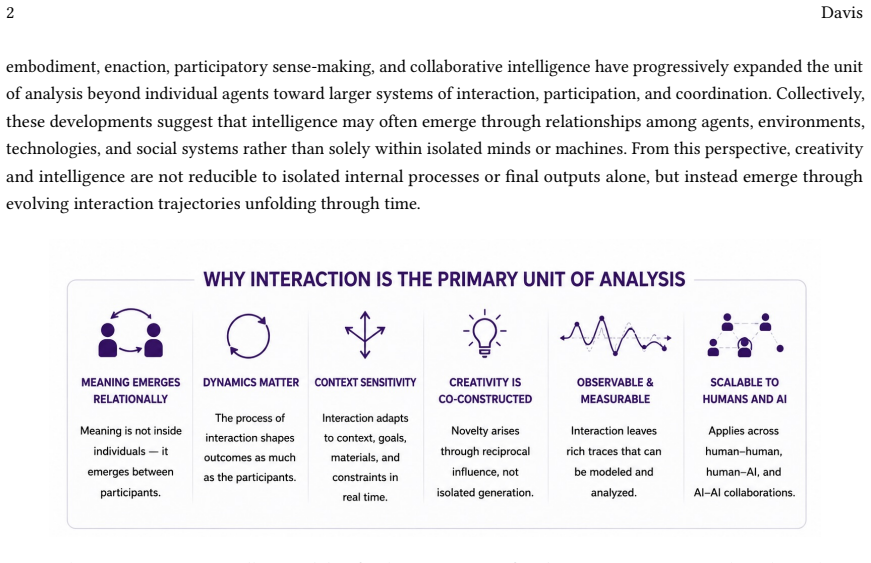
Intelligence emerges through evolving interaction dynamics among agents and systems rather than internal computation alone.
A machine-rendered reading of the paper's core claim, the machinery that carries it, and where it could break.
Core claim
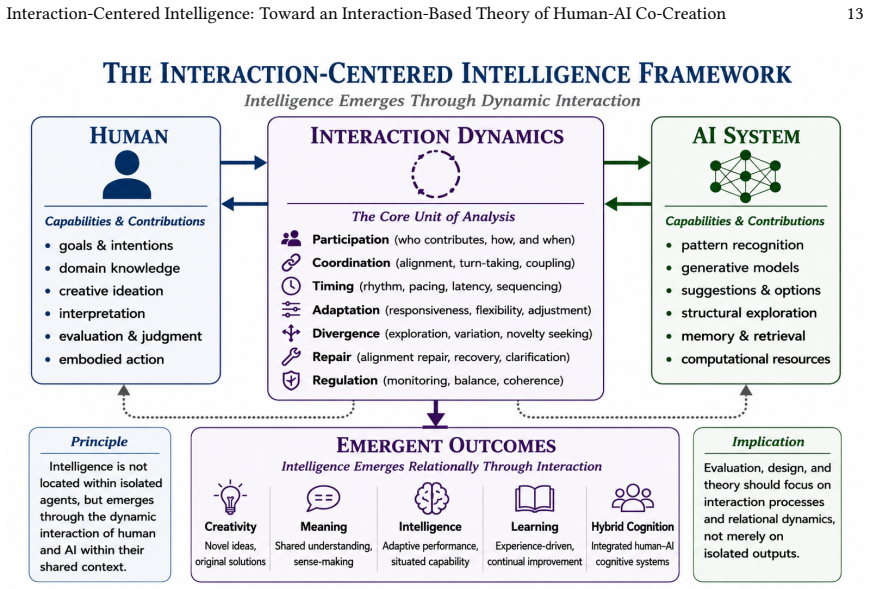
The paper claims that intelligence emerges through evolving interaction dynamics among agents, environments, and socio-technical systems rather than solely through internal computation. It introduces Interaction-Centered Intelligence as a framework for human-AI co-creation that centers interaction trajectories, coordination patterns, participatory engagement, adaptive regulation, and interactional drift instead of generated outputs or optimization performance.
What carries the argument
Interaction-Centered Intelligence, the framework that positions interaction as the primary unit of analysis for understanding collaborative emergence and adaptive participation in human-AI systems.
If this is right
- Evaluation of intelligence in co-creative systems must track interaction trajectories and coordination patterns over time rather than outputs alone.
- Design of human-AI systems should prioritize support for participatory engagement and adaptive regulation.
- Explainable co-creative AI and hybrid intelligence will need to account for interactional dynamics and drift.
- Future enactive AI approaches will treat ongoing participation in sense-making as central to the emergence of intelligence.
Where Pith is reading between the lines
- This perspective suggests new ways to measure co-creation success by quantifying how interaction patterns change across sessions.
- It could connect to multi-agent robotics problems by treating coordination drift as a predictor of team-level performance.
- Testable extensions include comparing interaction-based training protocols against standard benchmarks in creative collaboration tasks.
Load-bearing premise
Interaction can and should serve as the primary unit of analysis for intelligence and co-creation without a specified measurement protocol or validation method.
What would settle it
An experiment in which co-creative outcomes, creativity levels, and adaptive behaviors stay equivalent when interaction dynamics are minimized or removed, leaving only internal model computation.
Figures
read the original abstract
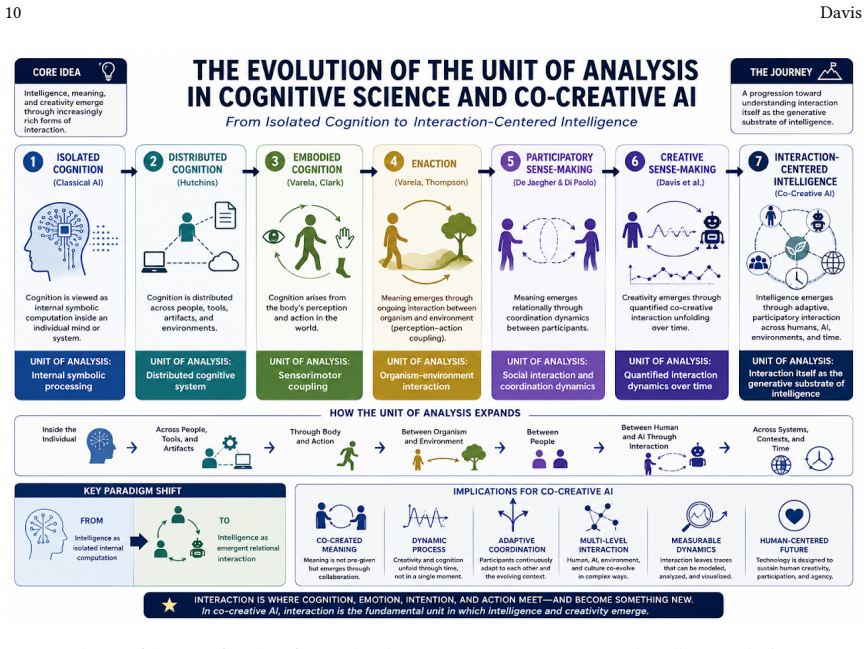
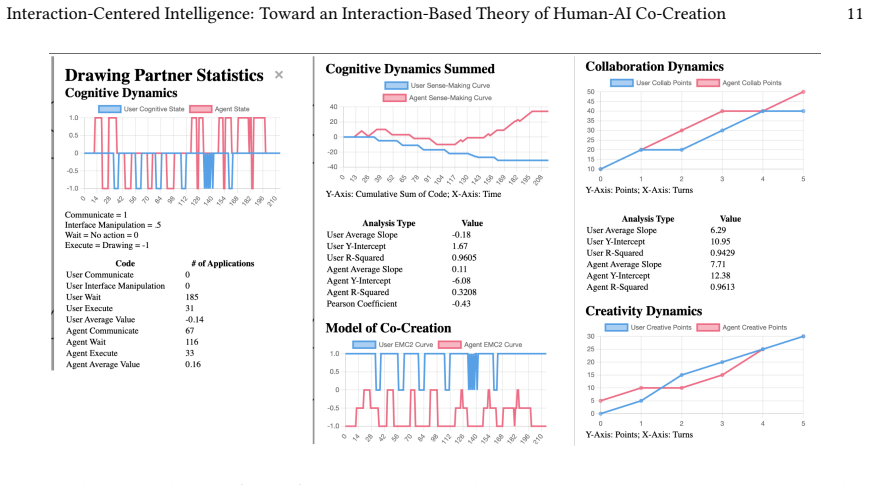
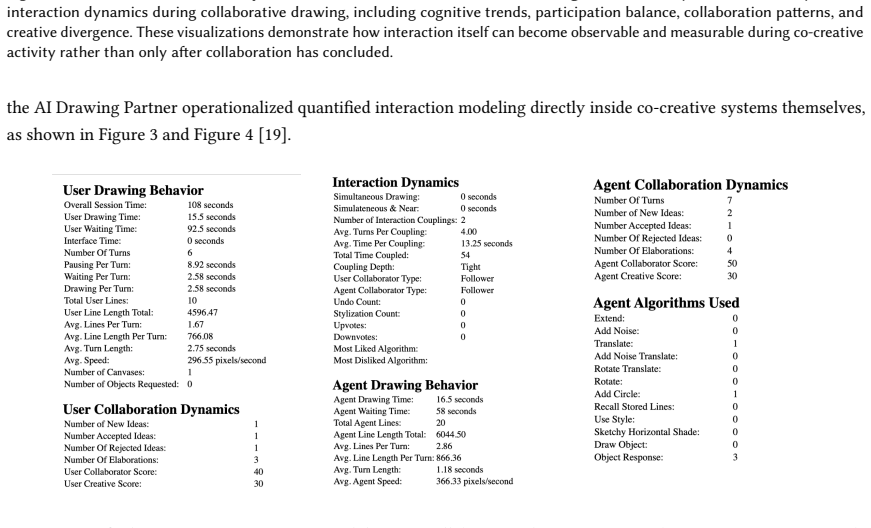
Traditional artificial intelligence has largely conceptualized intelligence as isolated computation occurring within bounded agents. Across classical AI, machine learning, and many generative systems, the dominant unit of analysis remains the individual model or autonomous system evaluated through outputs, benchmarks, prediction accuracy, or optimization performance. While these approaches have produced major advances, they often under-theorize the role of interaction in the emergence of intelligence, creativity, meaning, and adaptive behavior. This paper proposes interaction as the primary unit of analysis for co-creative AI and interaction-centered intelligence more broadly. Drawing from distributed cognition, embodied cognition, enaction, participatory sense-making, human-computer interaction, and computational creativity, the paper traces a historical progression toward increasingly relational accounts of intelligence. Building upon prior work in Creative Sense-Making, quantified co-creation, and co-creative systems such as the Drawing Apprentice and AI Drawing Partner, it argues that intelligence emerges through evolving interaction dynamics among agents, environments, and socio-technical systems rather than solely through internal computation. The paper introduces Interaction-Centered Intelligence as a framework for understanding human-AI co-creation, collaborative emergence, adaptive participation, and interactional dynamics. Rather than evaluating intelligence solely through generated outputs, the framework emphasizes interaction trajectories, coordination patterns, participatory engagement, adaptive regulation, and interactional drift unfolding through time. Implications for explainable co-creative AI, hybrid intelligence, enactive AI, and future human-AI systems are discussed.
Editorial analysis
A structured set of objections, weighed in public.
Referee Report
Summary. The paper proposes Interaction-Centered Intelligence as a framework for human-AI co-creation, arguing that intelligence emerges through evolving interaction dynamics among agents, environments, and socio-technical systems rather than solely through internal computation. It synthesizes ideas from distributed cognition, embodied cognition, enaction, participatory sense-making, HCI, and computational creativity, building on the author's prior work in Creative Sense-Making, quantified co-creation, and systems such as the Drawing Apprentice and AI Drawing Partner. The framework emphasizes evaluating co-creation via interaction trajectories, coordination patterns, participatory engagement, adaptive regulation, and interactional drift instead of outputs or benchmarks alone, with implications for explainable co-creative AI, hybrid intelligence, and enactive AI.
Significance. If the proposed shift in unit of analysis can be made operational, the framework could usefully reorient evaluation practices in co-creative systems toward longitudinal interaction metrics. The synthesis of historical relational accounts provides a coherent narrative, but the absence of any formal definitions, measurement protocols, or independent empirical tests limits the work to a perspective piece rather than a contribution that generates new, falsifiable predictions.
major comments (2)
- [Abstract] Abstract: The assertion that intelligence 'emerges through evolving interaction dynamics' rather than internal computation is load-bearing for the central claim, yet the manuscript supplies no operational definition of interaction dynamics, coordination patterns, or interactional drift, nor any procedure for isolating these quantities from agent-internal baselines or testing their explanatory power against observed outcomes.
- [Abstract] Abstract: The framework is presented as building upon prior work in Creative Sense-Making and quantified co-creation, but no independent external benchmarks, falsifiable predictions, or validation methods separate from those references are provided; this circularity undermines the claim of a distinct shift in unit of analysis.
Simulated Author's Rebuttal
We thank the referee for their constructive review and for identifying key areas where the scope and claims of this theoretical framework paper can be clarified. We address each major comment below, maintaining the manuscript's positioning as a conceptual synthesis while indicating targeted revisions where appropriate.
read point-by-point responses
-
Referee: [Abstract] Abstract: The assertion that intelligence 'emerges through evolving interaction dynamics' rather than internal computation is load-bearing for the central claim, yet the manuscript supplies no operational definition of interaction dynamics, coordination patterns, or interactional drift, nor any procedure for isolating these quantities from agent-internal baselines or testing their explanatory power against observed outcomes.
Authors: We agree that the manuscript does not supply formal operational definitions or isolation procedures, as its contribution is a high-level theoretical reframing rather than an empirical or formalization paper. The load-bearing claim is advanced conceptually through synthesis of distributed cognition, enaction, and related fields, with references to prior systems (e.g., Drawing Apprentice) serving as illustrative anchors. To strengthen clarity, we will add a short subsection in the discussion outlining candidate operationalization directions (e.g., longitudinal metrics of coordination and drift drawn from HCI and participatory sense-making literature) and explicitly state that full measurement protocols and comparative tests against internal baselines remain future work. This addresses the concern without converting the paper into an empirical study. revision: partial
-
Referee: [Abstract] Abstract: The framework is presented as building upon prior work in Creative Sense-Making and quantified co-creation, but no independent external benchmarks, falsifiable predictions, or validation methods separate from those references are provided; this circularity undermines the claim of a distinct shift in unit of analysis.
Authors: The manuscript positions the shift in unit of analysis as the primary contribution: moving from agent-internal computation to interaction trajectories as the evaluative lens. While it necessarily draws on the authors' earlier empirical systems and Creative Sense-Making work for grounding, the novelty resides in the integrated relational account and its implications for evaluation practices across HCI, computational creativity, and enactive AI. We do not claim new falsifiable predictions or independent benchmarks in this paper; the work is framed as a perspective that synthesizes and reorients. We therefore see no circularity that requires correction and will not revise this aspect. revision: no
Circularity Check
Central claim that interaction is primary unit of intelligence relies on self-citation to author's prior work without new operationalization or external benchmarks
specific steps
-
self citation load bearing
[Abstract]
"Building upon prior work in Creative Sense-Making, quantified co-creation, and co-creative systems such as the Drawing Apprentice and AI Drawing Partner, it argues that intelligence emerges through evolving interaction dynamics among agents, environments, and socio-technical systems rather than solely through internal computation."
The paper's strongest claim (interaction as primary unit of analysis for intelligence and co-creation) is justified solely by reference to the same author's earlier contributions; the abstract supplies no separate definition, metric, or validation method for isolating interaction trajectories or testing them against internal-computation baselines.
full rationale
The manuscript's load-bearing premise—that intelligence emerges through interaction dynamics rather than internal computation—is explicitly introduced as building upon the author's own prior publications on Creative Sense-Making and quantified co-creation. No equations, measurement protocols, or falsifiable predictions independent of those references appear in the provided text. This matches self-citation load-bearing but does not reduce the entire framework to a tautology; the historical tracing and implications sections retain independent conceptual content.
Axiom & Free-Parameter Ledger
axioms (2)
- domain assumption Interaction is the primary unit of analysis for intelligence and creativity
- domain assumption Intelligence emerges through interaction dynamics rather than internal computation
invented entities (1)
-
Interaction-Centered Intelligence
no independent evidence
Forward citations
Cited by 1 Pith paper
-
Cognitive Trajectory Modeling: Quantifying Human-AI Co-Creation through Cognitively Grounded Interaction Trajectories
Cognitive Trajectory Modeling offers a new conceptual framework for representing co-creative interaction dynamics as temporally organized trajectories in attractor landscapes, generalizing concepts from the Enactive M...
Reference graph
Works this paper leans on
-
[1]
https: //doi.org/10.1145/3290605.3300233 .https://doi.org/10.1145/3290605.3300233
Saleema Amershi, Dan Weld, Mihaela Vorvoreanu, Adam Fourney, Besmira Nushi, Penny Collisson, Jina Suh, Shamsi Iqbal, Paul N. Bennett, Kori Inkpen, Jaime Teevan, Ruth Kikin-Gil, and Eric Horvitz. 2019. Guidelines for Human-AI Interaction. InProceedings of the 2019 CHI Conference on Human Factors in Computing Systems. ACM, 1–13. doi:10.1145/3290605.3300233
-
[2]
Michel Beaudouin-Lafon. 2004. Designing Interaction, Not Interfaces. InProceedings of the Working Conference on Advanced Visual Interfaces. ACM, 15–22. doi:10.1145/989863.989865
-
[3]
Michel Beaudouin-Lafon, Susanne Bødker, and Wendy E. Mackay. 2021. Generative Theories of Interaction.ACM Transactions on Computer-Human Interaction28, 6, Article 45 (2021), 54 pages. doi:10.1145/3468505
-
[4]
Margaret A. Boden. 2004.The Creative Mind: Myths and Mechanisms(2 ed.). Routledge, London. Interaction-Centered Intelligence: Toward an Interaction-Based Theory of Human-AI Co-Creation 21
2004
-
[5]
Rishi Bommasani, Drew A Hudson, Ehsan Adeli, Russ Altman, Simran Arora, Sydney von Arx, Michael S Bernstein, Jeannette Bohg, Antoine Bosselut, Emma Brunskill, et al. 2021. On the opportunities and risks of foundation models
2021
-
[6]
Rodney A. Brooks. 1991. Intelligence Without Representation.Artificial Intelligence47, 1–3 (1991), 139–159. doi:10.1016/0004-3702(91)90053-M
-
[7]
Tom Brown, Benjamin Mann, Nick Ryder, Melanie Subbiah, Jared D Kaplan, Prafulla Dhariwal, Arvind Neelakantan, Pranav Shyam, Girish Sastry, Amanda Askell, et al. 2020. Language models are few-shot learners.Advances in neural information processing systems33 (2020), 1877–1901
2020
-
[8]
1997.Being There: Putting Brain, Body, and World Together Again
Andy Clark. 1997.Being There: Putting Brain, Body, and World Together Again. MIT Press, Cambridge, MA
1997
-
[9]
Andy Clark and David J. Chalmers. 1998. The Extended Mind.Analysis58, 1 (1998), 7–19. doi:10.1093/analys/58.1.7
-
[10]
Simon Colton and Geraint A. Wiggins. 2012. Computational Creativity: The Final Frontier?. InECAI 2012: 20th European Conference on Artificial Intelligence (Frontiers in Artificial Intelligence and Applications, Vol. 242). IOS Press, 21–26. doi:10.3233/978-1-61499-098-7-21
-
[11]
Nicholas Davis. 2013. Human-Computer Co-Creativity: Blending Human and Computational Creativity. InProceedings of the AAAI Conference on Artificial Intelligence and Interactive Digital Entertainment, Vol. 9. 9–12. doi:10.1609/aiide.v9i6.12596
-
[12]
2017.Creative Sense-Making: A Cognitive Framework for Quantifying Interaction Dynamics in Co-Creation
Nicholas Davis. 2017.Creative Sense-Making: A Cognitive Framework for Quantifying Interaction Dynamics in Co-Creation. Ph. D. Dissertation. Georgia Institute of Technology. https://hdl.handle.net/1853/58501
2017
-
[13]
Nicholas Davis. 2024. Creative Sense-Making: A Cognitive Framework for Modeling Interaction Dynamics in Co-Creative AI. InArtificial Intelligence, Co-Creation and Creativity. Routledge
2024
-
[14]
Nicholas Davis, Michael Clemens, Elizabeth Browne, and Jeba Rezwana. 2025. Unlocking the Black Box of Artificial Media with Quantified and Explainable Co-Creative AI Systems. InArtificial Media: Emerging Trends in Narratives, Education and Creative Practice. Springer Nature Switzerland, Cham, 21–48
2025
-
[15]
Nicholas Davis, Chih-Pin Hsiao, Yanna Popova, and Brian Magerko. 2015. An Enactive Model of Creativity for Computational Collaboration and Co-Creation. InCreativity in the Digital Age, Ernest A. Edmonds and Linda Candy (Eds.). Springer London, London, 109–133. doi:10.1007/978-1- 4471-6681-8_7
-
[16]
Nicholas Davis, Chih-Pin Hsiao, Karthik Yashraj Singh, Lingyu Li, Sai Moningi, and Brian Magerko. 2015. Drawing Apprentice: An Enactive Co-Creative Agent for Artistic Collaboration. InProceedings of the 2015 ACM SIGCHI Conference on Creativity and Cognition. ACM, 185–186. doi:10.1145/2757226.2757623
-
[17]
Nicholas Davis, Chih-Pin Hsiao, Kunwar Yashraj Singh, Brenda Lin, and Brian Magerko. 2017. Creative sense-making: Quantifying interaction dynamics in co-creation. InProceedings of the 2017 ACM SIGCHI Conference on Creativity and Cognition. 356–366
2017
-
[18]
Nicholas Davis, Chih-PIn Hsiao, Kunwar Yashraj Singh, Lisa Li, and Brian Magerko. 2016. Empirically studying participatory sense-making in abstract drawing with a co-creative cognitive agent. InProceedings of the 21st international conference on intelligent user interfaces. 196–207
2016
-
[19]
Nicholas Davis and Janet Rafner. 2025. AI Drawing Partner: Co-Creative Drawing Agent and Research Platform to Model Co-Creation. arXiv:2501.06607 [cs.HC] doi:10.48550/arXiv.2501.06607
-
[20]
Hanne De Jaegher and Ezequiel Di Paolo. 2007. Participatory Sense-Making: An Enactive Approach to Social Cognition.Phenomenology and the Cognitive Sciences6, 4 (2007), 485–507. doi:10.1007/s11097-007-9076-9
-
[21]
Fernando Delgado, Stephen Yang, Michael Madaio, and Qian Yang. 2023. The participatory turn in ai design: Theoretical foundations and the current state of practice. InProceedings of the 3rd ACM Conference on Equity and Access in Algorithms, Mechanisms, and Optimization. 1–23
2023
-
[22]
Dominik Dellermann, Philipp Ebel, Matthias Söllner, and Jan Marco Leimeister. 2019. Hybrid intelligence.Business & information systems engineering 61, 5 (2019), 637–643
2019
-
[23]
Sebastian Deterding, Jonathan Hook, Rebecca Fiebrink, Marco Gillies, Jeremy Gow, Memo Akten, Gillian Smith, Antonios Liapis, and Kate Compton
-
[24]
InProceedings of the 2017 CHI conference extended abstracts on human factors in computing systems
Mixed-initiative creative interfaces. InProceedings of the 2017 CHI conference extended abstracts on human factors in computing systems. 628–635
2017
-
[25]
Ezequiel A Di Paolo. 2005. Autopoiesis, adaptivity, teleology, agency.Phenomenology and the cognitive sciences4, 4 (2005), 429–452
2005
-
[26]
2001.Where the action is: the foundations of embodied interaction
Paul Dourish. 2001.Where the action is: the foundations of embodied interaction. MIT press
2001
-
[27]
Gerhard Fischer. 2005. Distances and diversity: sources for social creativity. InProceedings of the 5th Conference on Creativity & Cognition. 128–136
2005
-
[28]
James J. Gibson. 1979.The Ecological Approach to Visual Perception. Houghton Mifflin, Boston, MA
1979
-
[29]
Matthew Guzdial and Mark Riedl. 2019. An Interaction Framework for Studying Co-Creative AI.arXiv preprint arXiv:1903.09709(2019)
work page internal anchor Pith review Pith/arXiv arXiv 2019
-
[30]
1995.Cognition in the Wild
Edwin Hutchins. 1995.Cognition in the Wild. MIT Press, Cambridge, MA
1995
-
[31]
Harang Ju and Sinan Aral. 2025. Collaborating with ai agents: Field experiments on teamwork, productivity, and performance
2025
-
[32]
Pegah Karimi, Nicholas Davis, Kazjon Grace, and Mary Lou Maher. 2018. Deep learning for identifying potential conceptual shifts for co-creative drawing.arXiv preprint arXiv:1801.00723(2018)
work page internal anchor Pith review Pith/arXiv arXiv 2018
-
[33]
Pegah Karimi, Mary Lou Maher, Nicholas Davis, and Kazjon Grace. 2019. Deep learning in a computational model for conceptual shifts in a co-creative design system.arXiv preprint arXiv:1906.10188(2019)
work page internal anchor Pith review Pith/arXiv arXiv 2019
-
[34]
1999.Philosophy in the Flesh: The Embodied Mind and Its Challenge to Western Thought
George Lakoff and Mark Johnson. 1999.Philosophy in the Flesh: The Embodied Mind and Its Challenge to Western Thought. Basic Books, New York, NY
1999
-
[35]
Yann LeCun, Yoshua Bengio, and Geoffrey Hinton. 2015. Deep learning.nature521, 7553 (2015), 436–444
2015
-
[36]
Joseph CR Licklider. 1960. Man-computer symbiosis.IRE transactions on human factors in electronics1 (1960), 4–11
1960
-
[37]
Todd Lubart. 2005. How can computers be partners in the creative process: classification and commentary on the special issue.International journal of human-computer studies63, 4-5 (2005), 365–369. 22 Davis
2005
-
[38]
Tim Miller. 2019. Explanation in artificial intelligence: Insights from the social sciences.Artificial intelligence267 (2019), 1–38
2019
-
[39]
Allen Newell and Herbert A Simon. 1975. Computer science as empirical inquiry: Symbols and search. InACM Turing award lectures
1975
-
[40]
Nils J. Nilsson. 2009.The Quest for Artificial Intelligence: A History of Ideas and Achievements. Cambridge University Press, Cambridge
2009
-
[41]
Jeba Rezwana and Mary Lou Maher. 2023. Designing Creative AI Partners with COFI: A Framework for Modeling Interaction in Human-AI Co-Creative Systems.ACM Transactions on Computer-Human Interaction30, 5, Article 67 (2023), 28 pages
2023
-
[42]
Russell and Peter Norvig
Stuart J. Russell and Peter Norvig. 2021.Artificial Intelligence: A Modern Approach(4 ed.). Pearson, Hoboken, NJ
2021
-
[43]
Ben Shneiderman. 2007. Creativity Support Tools: Accelerating Discovery and Innovation.Commun. ACM50, 12 (2007), 20–32
2007
-
[44]
Ben Shneiderman. 2020. Human-centered artificial intelligence: Reliable, safe & trustworthy.International Journal of Human–Computer Interaction 36, 6 (2020), 495–504
2020
-
[45]
2022.Human-Centered AI
Ben Shneiderman. 2022.Human-Centered AI. Oxford University Press, New York, NY
2022
-
[46]
Lucy A. Suchman. 1987.Plans and Situated Actions: The Problem of Human-Machine Communication. Cambridge University Press, Cambridge
1987
- [47]
-
[48]
Varela, Evan Thompson, and Eleanor Rosch
Francisco J. Varela, Evan Thompson, and Eleanor Rosch. 1991.The Embodied Mind: Cognitive Science and Human Experience. MIT Press, Cambridge, MA
1991
- [49]
-
[50]
Yannakakis, Antonios Liapis, and Constantine Alexopoulos
Georgios N. Yannakakis, Antonios Liapis, and Constantine Alexopoulos. 2014. Mixed-Initiative Co-Creativity. InProceedings of the 9th International Conference on the Foundations of Digital Games
2014
-
[51]
Shao Zhang, Xihuai Wang, Wenhao Zhang, Yongshan Chen, Landi Gao, Dakuo Wang, Weinan Zhang, Xinbing Wang, and Ying Wen. 2024. Mutual theory of mind in human-ai collaboration: An empirical study with llm-driven ai agents in a real-time shared workspace task.arXiv preprint arXiv:2409.08811(2024)
discussion (0)
Sign in with ORCID, Apple, or X to comment. Anyone can read and Pith papers without signing in.