Partial Fairness Awareness: Belief-Guided Strategic Mechanism for Strategic Agents
Pith reviewed 2026-06-28 19:11 UTC · model grok-4.3
The pith
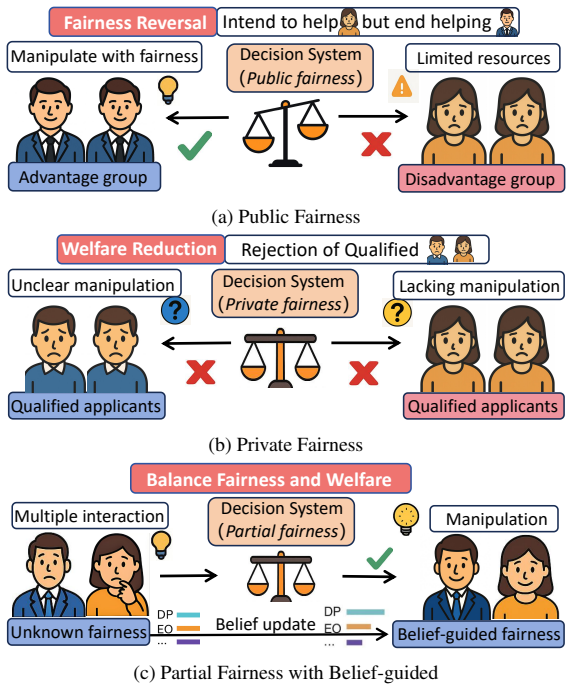
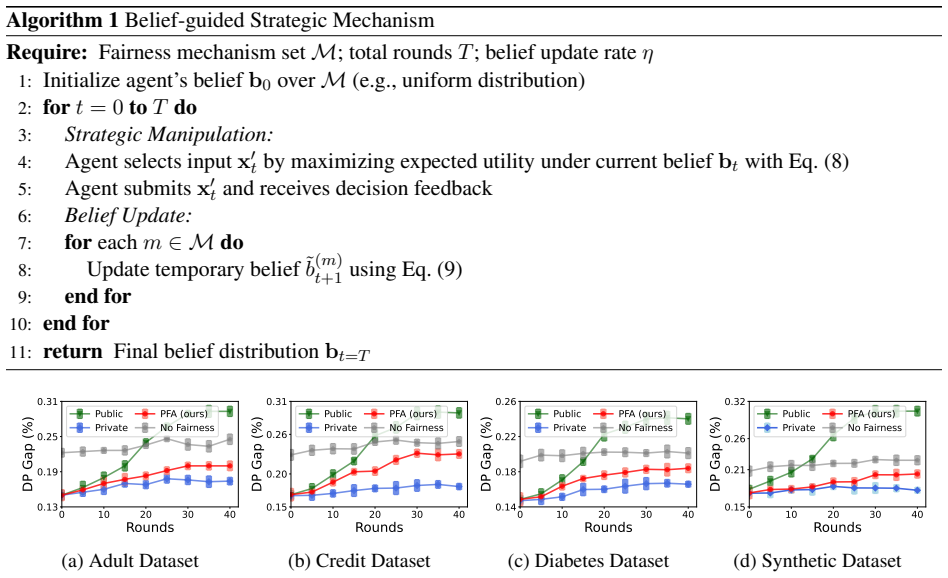
Releasing candidate fairness constraints while concealing the true one allows agents to align beliefs through feedback and reduces fairness manipulation.
A machine-rendered reading of the paper's core claim, the machinery that carries it, and where it could break.
Core claim
Releasing the candidate set of fairness constraints and concealing the grounding constraint mitigates the fairness exposure dilemma, and the belief-guided mechanism enables agents to gradually align their belief with the grounding fairness constraint through iterative interaction and feedback.
What carries the argument
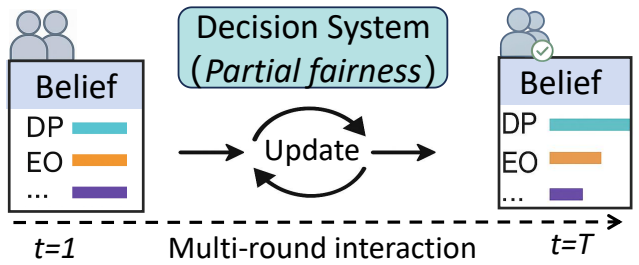
The belief-guided strategic mechanism, wherein agents iteratively interact with the decision system and maintain a belief distribution over the candidate set of fairness constraints to gradually align with the grounding constraint.
If this is right
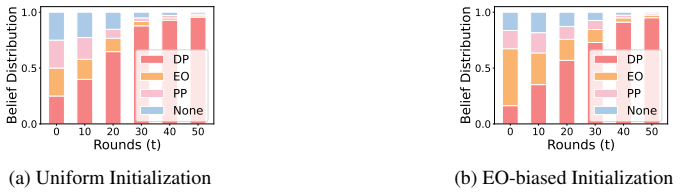
- Agents gradually align their beliefs with the true fairness constraint through interaction.
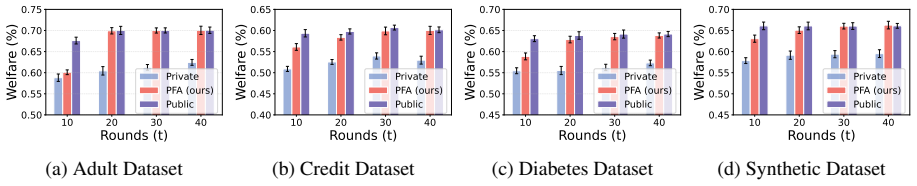
- The approach achieves lower group fairness gaps than fully public or private regimes.
- Higher acceptance rates for truly qualified individuals are observed.
- Outcomes are more stable compared to alternative fairness regimes.
Where Pith is reading between the lines
- This mechanism could extend to other strategic decision settings where policies are partially revealed.
- The size of the candidate set may affect the speed and accuracy of belief alignment.
- If belief updates fail to converge, the fairness benefits may not hold.
Load-bearing premise
That agents will update their beliefs based on feedback in a manner that produces lower group fairness gaps and higher acceptance of qualified individuals.
What would settle it
An experiment demonstrating that the group fairness gaps do not decrease when the belief-guided mechanism is used, or that qualified individual acceptance rates do not improve relative to baselines.
Figures
read the original abstract
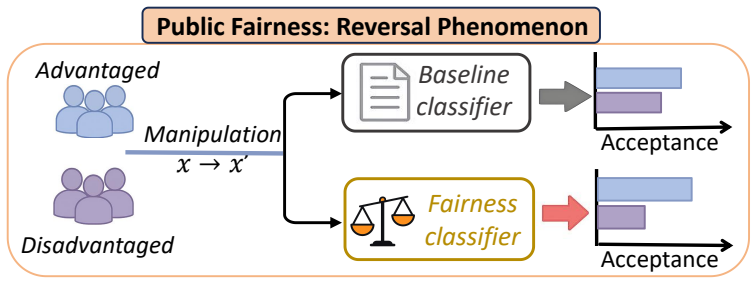
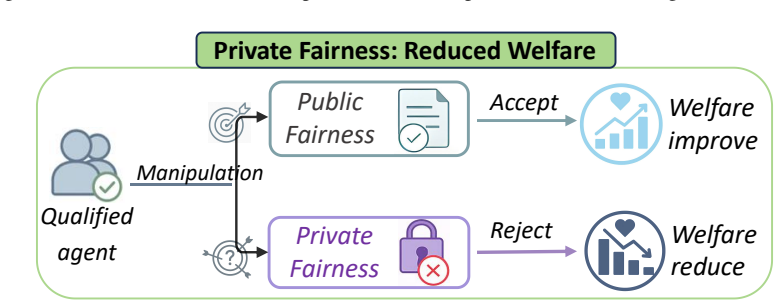
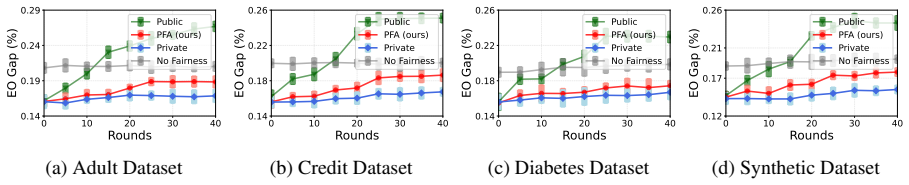
Strategic machine learning investigates scenarios where agents manipulate their features to receive favorable decisions from predictive models. To address fairness concerns intrinsic to strategic classification, recent work has introduced group-specific fairness constraints. However, current fairness-aware approaches face a fundamental dilemma in the issue of fairness exposure: making these constraints public enables strategic manipulation and can lead to fairness reversal, while keeping them hidden may reduce social welfare and discourage genuine improvement. To fill this gap, we subsequently propose the problem of partial fairness awareness (PFA), as our theoretical analysis informs that such a dilemma can be mitigated by releasing the candidate set of fairness constraints and concealing the grounding constraint. To be specific, we introduce a belief-guided strategic mechanism, wherein agents iteratively interact with the decision system and maintain a belief distribution over the candidate set of fairness constraints. This belief-guided process enables agents, through iterative interaction and feedback, to update their belief distribution over the candidate set, thereby gradually aligning their belief with the grounding fairness constraint employed by the system. Extensive experiments on real-world and synthetic datasets demonstrate that PFA achieves lower group fairness gaps, higher acceptance of truly qualified individuals, and more stable outcomes compared to fully public or private fairness regimes.
Editorial analysis
A structured set of objections, weighed in public.
Referee Report
Summary. The paper introduces Partial Fairness Awareness (PFA) to address the fairness exposure dilemma in strategic classification: releasing group-specific fairness constraints publicly risks manipulation and reversal, while keeping them fully private reduces welfare. The proposed solution releases a candidate set of constraints while concealing the grounding constraint, and introduces a belief-guided strategic mechanism in which agents maintain a belief distribution over the candidate set and update it iteratively via interaction and feedback to align with the hidden grounding constraint. Experiments on real-world and synthetic datasets are reported to yield lower group fairness gaps, higher acceptance of qualified individuals, and more stable outcomes than fully public or private regimes.
Significance. If the belief-update dynamics and convergence properties can be rigorously specified and verified, the work would provide a concrete mechanism for mitigating a recognized tension between transparency and strategic manipulation in fairness-aware ML. The partial-awareness framing is novel relative to existing public/private regimes and could inform deployment choices when full concealment is impractical.
major comments (3)
- [mechanism description / abstract] The description of the belief-guided mechanism (abstract and mechanism section) supplies no explicit belief-update rule (Bayesian, multiplicative-weights, or otherwise), no interaction/feedback protocol, and no convergence theorem or guarantee under strategic manipulation; without these the central claim that agents 'gradually align their belief with the grounding fairness constraint' is unverifiable and the experimental improvements rest on an untested behavioral assumption.
- [experiments / abstract] Experimental claims (abstract) assert lower fairness gaps and more stable outcomes on real-world and synthetic datasets, yet provide no model specification, error bars, data-exclusion criteria, or statistical tests; this renders the quantitative support for the PFA regime uninspectable and load-bearing for the paper's empirical contribution.
- [theoretical analysis / abstract] The alignment claim is defined in terms of the outcome it is supposed to produce ('aligning their belief with the grounding fairness constraint employed by the system'), creating a risk that the result is tautological once the belief model is specified; a concrete test (e.g., distance to grounding constraint under best-response dynamics) is needed to establish non-circularity.
minor comments (1)
- Notation for the candidate set, grounding constraint, and belief distribution should be introduced with explicit symbols and updated consistently across sections.
Simulated Author's Rebuttal
We thank the referee for the constructive feedback on our manuscript. We address each major comment point by point below, indicating where revisions will be incorporated to strengthen the presentation of the belief-guided mechanism, experimental reporting, and theoretical claims.
read point-by-point responses
-
Referee: The description of the belief-guided mechanism (abstract and mechanism section) supplies no explicit belief-update rule (Bayesian, multiplicative-weights, or otherwise), no interaction/feedback protocol, and no convergence theorem or guarantee under strategic manipulation; without these the central claim that agents 'gradually align their belief with the grounding fairness constraint' is unverifiable and the experimental improvements rest on an untested behavioral assumption.
Authors: The abstract summarizes the high-level idea of iterative interaction and belief updating. The mechanism section describes agents maintaining a distribution over the candidate set and revising it based on observed decision outcomes. To make the central claim verifiable, we will add an explicit multiplicative-weights update rule, a precise description of the feedback protocol (including what information is revealed after each interaction), and a convergence analysis under strategic best-response dynamics in the revised version. revision: yes
-
Referee: Experimental claims (abstract) assert lower fairness gaps and more stable outcomes on real-world and synthetic datasets, yet provide no model specification, error bars, data-exclusion criteria, or statistical tests; this renders the quantitative support for the PFA regime uninspectable and load-bearing for the paper's empirical contribution.
Authors: The experiments section specifies the datasets, models, and reports quantitative results across multiple runs. To improve inspectability of the claims made in the abstract, we will revise the abstract to briefly note the experimental protocol and add explicit error bars, data-exclusion criteria, and statistical tests (e.g., paired t-tests) to the experiments section. revision: partial
-
Referee: The alignment claim is defined in terms of the outcome it is supposed to produce ('aligning their belief with the grounding fairness constraint employed by the system'), creating a risk that the result is tautological once the belief model is specified; a concrete test (e.g., distance to grounding constraint under best-response dynamics) is needed to establish non-circularity.
Authors: Alignment is defined with respect to a fixed, system-chosen grounding constraint that is independent of any agent's belief model. We will add a formal non-circular definition of alignment using a divergence metric between the agent's belief and the grounding constraint, together with an analysis of this distance under best-response dynamics, to be included in the theoretical analysis section. revision: yes
Circularity Check
No circularity identified; claims rest on unspecified mechanism without self-referential reduction
full rationale
The provided abstract and description contain no equations, no fitted parameters renamed as predictions, and no self-citations that bear the load of the central claim. The belief-alignment outcome is asserted as resulting from the iterative process, but the text supplies neither an explicit update rule nor a derivation that reduces the result to its own definition by construction. Without load-bearing mathematical steps or self-citation chains in the given text, the derivation cannot be shown to collapse into its inputs.
Axiom & Free-Parameter Ledger
Reference graph
Works this paper leans on
-
[1]
Proceedings of the 2020 conference on fairness, accountability, and transparency , pages=
What does it mean to'solve'the problem of discrimination in hiring? Social, technical and legal perspectives from the UK on automated hiring systems , author=. Proceedings of the 2020 conference on fairness, accountability, and transparency , pages=
2020
-
[2]
Information Systems Research , year=
Strategic Best-Response Fairness Framework for Fair Machine Learning , author=. Information Systems Research , year=
-
[3]
2021 , eprint=
Optimal Recovery of Precision Matrix for Mahalanobis Distance from High Dimensional Noisy Observations in Manifold Learning , author=. 2021 , eprint=
2021
-
[4]
Is algorithmic affirmative action legal , author=. Geo. LJ , volume=. 2019 , publisher=
2019
-
[5]
Improving ratings: Audit in the British university system.European Review, 5(3):305–321, 1997
‘Improving ratings’: audit in the British University system , volume=. European Review , author=. 1997 , pages=. doi:10.1002/(SICI)1234-981X(199707)5:3<305::AID-EURO184>3.0.CO;2-4 , number=
-
[6]
Proceedings of the 2022 AAAI/ACM Conference on AI, Ethics, and Society , pages=
Contrastive counterfactual fairness in algorithmic decision-making , author=. Proceedings of the 2022 AAAI/ACM Conference on AI, Ethics, and Society , pages=
2022
-
[7]
Race-aware algorithms: Fairness, nondiscrimination and affirmative action , author=. Cal. L. Rev. , volume=. 2022 , publisher=
2022
-
[8]
Frontiers in artificial intelligence , volume=
Addressing fairness, bias, and appropriate use of artificial intelligence and machine learning in global health , author=. Frontiers in artificial intelligence , volume=. 2021 , publisher=
2021
-
[9]
2015 , url =
Alex Teboul , title =. 2015 , url =
2015
-
[10]
Estornell, Andrew and Das, Sanmay and Liu, Yang and Vorobeychik, Yevgeniy , title =. 2023 , isbn =. doi:10.1145/3593013.3594006 , booktitle =
-
[11]
When Tabular Foundation Models Meet Strategic Tabular Data: A Prior Alignment Approach
When Tabular Foundation Models Meet Strategic Tabular Data: A Prior Alignment Approach , author=. arXiv preprint arXiv:2605.19662 , year=
work page internal anchor Pith review Pith/arXiv arXiv
-
[12]
Advances in Neural Information Processing Systems , volume=
Breaking the Gradient Barrier: Unveiling Large Language Models for Strategic Classification , author=. Advances in Neural Information Processing Systems , volume=
-
[13]
Beyond Rational Illusion: Behaviorally Realistic Strategic Classification
Beyond Rational Illusion: Behaviorally Realistic Strategic Classification , author=. arXiv preprint arXiv:2605.19674 , year=
work page internal anchor Pith review Pith/arXiv arXiv
-
[14]
, author=
MACHINE LEARNING IN EDUCATION-A SURVEY OF CURRENT RESEARCH TRENDS. , author=. Annals of DAAAM & Proceedings , volume=
-
[15]
Proceedings of the Conference on Fairness, Accountability, and Transparency , pages=
The disparate effects of strategic manipulation , author=. Proceedings of the Conference on Fairness, Accountability, and Transparency , pages=
-
[16]
2017 , eprint=
Strategic Classification from Revealed Preferences , author=. 2017 , eprint=
2017
-
[17]
Advances in Neural Information Processing Systems , volume=
Learning strategy-aware linear classifiers , author=. Advances in Neural Information Processing Systems , volume=
-
[18]
Financial Management , volume=
The roles of alternative data and machine learning in fintech lending: evidence from the LendingClub consumer platform , author=. Financial Management , volume=. 2019 , publisher=
2019
-
[19]
international conference on machine learning , pages=
Recommendations as treatments: Debiasing learning and evaluation , author=. international conference on machine learning , pages=. 2016 , organization=
2016
-
[20]
, booktitle =
Harris, Keegan and Heidari, Hoda and Wu, Steven Z. , booktitle =. Stateful Strategic Regression , url =
-
[21]
Advances in Neural Information Processing Systems , volume=
From predictions to decisions: Using lookahead regularization , author=. Advances in Neural Information Processing Systems , volume=
-
[22]
Nature Machine Intelligence , volume=
Stable learning establishes some common ground between causal inference and machine learning , author=. Nature Machine Intelligence , volume=. 2022 , publisher=
2022
-
[23]
arXiv preprint arXiv:2203.00124 , year=
On classification of strategic agents who can both game and improve , author=. arXiv preprint arXiv:2203.00124 , year=
-
[24]
arXiv preprint arXiv:2310.16608 , year=
Performative prediction: Past and future , author=. arXiv preprint arXiv:2310.16608 , year=
-
[25]
Forecasting , volume=
Evaluating state-of-the-art, forecasting ensembles and meta-learning strategies for model fusion , author=. Forecasting , volume=. 2022 , publisher=
2022
-
[26]
Proceedings of the AAAI Conference on Artificial Intelligence , volume=
Stable prediction with model misspecification and agnostic distribution shift , author=. Proceedings of the AAAI Conference on Artificial Intelligence , volume=
-
[27]
Proceedings of the IEEE/CVF Conference on Computer Vision and Pattern Recognition , pages=
Deep stable learning for out-of-distribution generalization , author=. Proceedings of the IEEE/CVF Conference on Computer Vision and Pattern Recognition , pages=
-
[28]
The Role of Randomness and Noise in Strategic Classification. arXiv e-prints , keywords =. doi:10.48550/arXiv.2005.08377 , archivePrefix =. 2005.08377 , primaryClass =
-
[29]
Nature Communications , volume=
Adaptive bias correction for improved subseasonal forecasting , author=. Nature Communications , volume=. 2023 , publisher=
2023
-
[30]
IEEE Transactions on Knowledge and Data Engineering , volume=
Stable prediction with leveraging seed variable , author=. IEEE Transactions on Knowledge and Data Engineering , volume=. 2022 , publisher=
2022
-
[31]
Journal of the Royal Statistical Society Series B: Statistical Methodology , volume=
Causal inference by using invariant prediction: identification and confidence intervals , author=. Journal of the Royal Statistical Society Series B: Statistical Methodology , volume=. 2016 , publisher=
2016
-
[32]
Journal of Causal Inference , doi =
Confounding Equivalence in Causal Inference , author =. Journal of Causal Inference , doi =. 2014 , lastchecked =
2014
-
[33]
International Conference on Machine Learning , pages=
An investigation of why overparameterization exacerbates spurious correlations , author=. International Conference on Machine Learning , pages=. 2020 , organization=
2020
-
[34]
Causality: objectives and assessment , pages=
Causal inference , author=. Causality: objectives and assessment , pages=. 2010 , publisher=
2010
-
[35]
International Conference on Machine Learning , pages=
Performative prediction , author=. International Conference on Machine Learning , pages=. 2020 , organization=
2020
-
[36]
Advances in Neural Information Processing Systems , volume=
Performative power , author=. Advances in Neural Information Processing Systems , volume=
-
[37]
Advances in Neural Information Processing Systems , volume=
Stochastic optimization for performative prediction , author=. Advances in Neural Information Processing Systems , volume=
-
[38]
Journal of engineering , volume=
Conceptual framework for the strategic management: a literature review—descriptive , author=. Journal of engineering , volume=. 2020 , publisher=
2020
-
[39]
Journal of Human Resources , volume=
Admissions policies, cohort composition, and academic success: Evidence from California , author=. Journal of Human Resources , volume=. 2023 , publisher=
2023
-
[40]
Expert Systems with Applications , volume=
Bagging supervised autoencoder classifier for credit scoring , author=. Expert Systems with Applications , volume=. 2023 , publisher=
2023
-
[41]
Frontiers of Information Technology & Electronic Engineering , volume=
Moving from exascale to zettascale computing: challenges and techniques , author=. Frontiers of Information Technology & Electronic Engineering , volume=. 2018 , publisher=
2018
-
[42]
CCF Transactions on High Performance Computing , volume=
Parallel programming models for heterogeneous many-cores: a comprehensive survey , author=. CCF Transactions on High Performance Computing , volume=. 2020 , publisher=
2020
-
[43]
Proceedings of the 2016 ACM conference on innovations in theoretical computer science , pages=
Strategic classification , author=. Proceedings of the 2016 ACM conference on innovations in theoretical computer science , pages=
2016
-
[44]
Journal of Legal Analysis , volume=
Discrimination in the Age of Algorithms , author=. Journal of Legal Analysis , volume=. 2018 , publisher=
2018
-
[45]
Proceedings of the 23rd acm sigkdd international conference on knowledge discovery and data mining , pages=
Algorithmic decision making and the cost of fairness , author=. Proceedings of the 23rd acm sigkdd international conference on knowledge discovery and data mining , pages=
-
[46]
Proceedings of the Conference on Fairness, Accountability, and Transparency , pages=
The social cost of strategic classification , author=. Proceedings of the Conference on Fairness, Accountability, and Transparency , pages=
-
[47]
International Conference on Machine Learning , pages=
Strategic classification is causal modeling in disguise , author=. International Conference on Machine Learning , pages=. 2020 , organization=
2020
-
[48]
International Conference on Machine Learning , pages=
Strategic instrumental variable regression: Recovering causal relationships from strategic responses , author=. International Conference on Machine Learning , pages=. 2022 , organization=
2022
-
[49]
Advances in neural information processing systems , volume=
Anticipating performativity by predicting from predictions , author=. Advances in neural information processing systems , volume=
-
[50]
arXiv preprint arXiv:2011.01956 , year=
Maximizing welfare with incentive-aware evaluation mechanisms , author=. arXiv preprint arXiv:2011.01956 , year=
-
[51]
Advances in Neural Information Processing Systems , volume=
Who leads and who follows in strategic classification? , author=. Advances in Neural Information Processing Systems , volume=
-
[52]
Proceedings of the 23rd ACM Conference on Economics and Computation , pages=
Incentive mechanisms for strategic classification and regression problems , author=. Proceedings of the 23rd ACM Conference on Economics and Computation , pages=
-
[53]
IEEE Transactions on Systems, Man, and Cybernetics: Systems , volume=
Consensus reaching and strategic manipulation in group decision making with trust relationships , author=. IEEE Transactions on Systems, Man, and Cybernetics: Systems , volume=. 2020 , publisher=
2020
-
[54]
Keswani, Vijay and Celis, L. Elisa , title =. Proceedings of the 3rd ACM Conference on Equity and Access in Algorithms, Mechanisms, and Optimization , articleno =. 2023 , isbn =. doi:10.1145/3617694.3623252 , abstract =
-
[55]
Journal of the Royal Statistical Society Series B: Statistical Methodology , volume=
Approximate residual balancing: debiased inference of average treatment effects in high dimensions , author=. Journal of the Royal Statistical Society Series B: Statistical Methodology , volume=. 2018 , publisher=
2018
-
[56]
International Journal of Economics and Finance , volume=
Audit independence and expectation gap: Empirical evidences from Iran , author=. International Journal of Economics and Finance , volume=
-
[57]
Statistics & Probability Letters , year=2006, volume=
Bisgaard, Torben Maack and Sasvári, Zoltán , title=. Statistics & Probability Letters , year=2006, volume=. doi:, abstract=
2006
-
[58]
International Conference on Artificial Intelligence and Statistics , pages=
Gaming helps! learning from strategic interactions in natural dynamics , author=. International Conference on Artificial Intelligence and Statistics , pages=. 2021 , organization=
2021
-
[59]
Proceedings of the AAAI conference on artificial intelligence , volume=
Testing independence between linear combinations for causal discovery , author=. Proceedings of the AAAI conference on artificial intelligence , volume=
-
[60]
Proceedings of the 2020 conference on fairness, accountability, and transparency , pages=
Mitigating bias in algorithmic hiring: Evaluating claims and practices , author=. Proceedings of the 2020 conference on fairness, accountability, and transparency , pages=
2020
-
[61]
Transactions on Machine Learning Research , issn=
Learning to Incentivize Improvements from Strategic Agents , author=. Transactions on Machine Learning Research , issn=. 2023 , url=
2023
-
[62]
, author=
Learning a Mahalanobis metric from equivalence constraints. , author=. Journal of machine learning research , volume=
-
[63]
Nick, Todd G.and Campbell, Kathleen M. Logistic Regression. Topics in Biostatistics. 2007. doi:10.1007/978-1-59745-530-5_14
-
[64]
2016 , howpublished =
Yeh,I-Cheng , title =. 2016 , howpublished =
2016
-
[65]
2014 , howpublished =
Cortez,Paulo , title =. 2014 , howpublished =
2014
-
[66]
ACM Transactions on Economics and Computation (TEAC) , volume=
How do classifiers induce agents to invest effort strategically? , author=. ACM Transactions on Economics and Computation (TEAC) , volume=. 2020 , publisher=
2020
-
[67]
Noise reduction in speech processing , pages=
Pearson correlation coefficient , author=. Noise reduction in speech processing , pages=. 2009 , publisher=
2009
-
[68]
Educational research review , volume=
Eta squared and partial eta squared as measures of effect size in educational research , author=. Educational research review , volume=. 2011 , publisher=
2011
-
[69]
Invariant risk minimization , author=. arXiv preprint arXiv:1907.02893 , year=
work page internal anchor Pith review Pith/arXiv arXiv 1907
-
[70]
International conference on artificial intelligence and statistics , pages=
Variational autoencoders and nonlinear ica: A unifying framework , author=. International conference on artificial intelligence and statistics , pages=. 2020 , organization=
2020
-
[71]
European Conference on Computer Vision , pages=
Discriminative decorrelation for clustering and classification , author=. European Conference on Computer Vision , pages=. 2012 , organization=
2012
-
[72]
Proceedings of the AAAI Conference on Artificial Intelligence , volume=
Treatment effect estimation with data-driven variable decomposition , author=. Proceedings of the AAAI Conference on Artificial Intelligence , volume=
-
[73]
Handbook of income distribution , volume=
Equality of opportunity , author=. Handbook of income distribution , volume=. 2015 , publisher=
2015
-
[74]
Northpointe Inc , volume=
COMPAS risk scales: Demonstrating accuracy equity and predictive parity , author=. Northpointe Inc , volume=
-
[75]
International Conference on Machine Learning , pages=
Learning Fair Representations , author=. International Conference on Machine Learning , pages=
-
[76]
Advances in Neural Information Processing Systems , volume=
Equality of Opportunity in Supervised Learning , author=. Advances in Neural Information Processing Systems , volume=
-
[77]
When does E (Xk
Bisgaard, Torben Maack and Sasv. When does E (Xk. Statistics & probability letters , volume=. 2006 , publisher=
2006
-
[78]
International Conference on Learning Representations , year=
Generalized demographic parity for group fairness , author=. International Conference on Learning Representations , year=
-
[79]
Advances in Neural Information Processing Systems , volume=
Strategic classification under unknown personalized manipulation , author=. Advances in Neural Information Processing Systems , volume=
-
[80]
Journal of Theoretical Probability , volume=
How close is the sample covariance matrix to the actual covariance matrix? , author=. Journal of Theoretical Probability , volume=. 2012 , publisher=
2012
discussion (0)
Sign in with ORCID, Apple, or X to comment. Anyone can read and Pith papers without signing in.