Beyond Independent Manipulation: Individual Fairness-aware Strategic Classification with Peer Imitation
Pith reviewed 2026-06-28 19:09 UTC · model grok-4.3
The pith
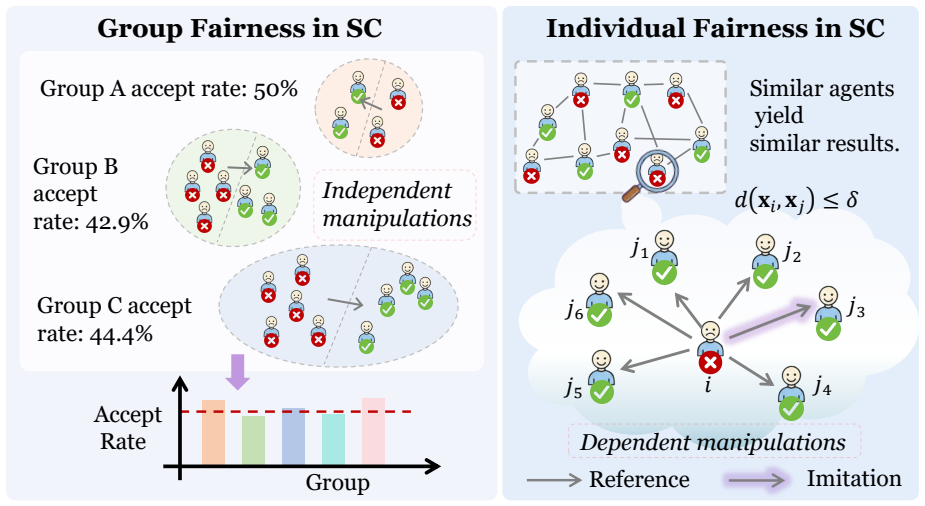
When classifiers enforce individual fairness, strategic agents imitate nearby successful peers instead of manipulating features independently.
A machine-rendered reading of the paper's core claim, the machinery that carries it, and where it could break.
Core claim
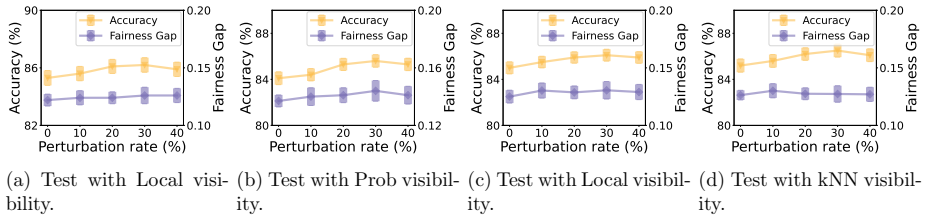
IFSC characterizes strategic manipulation as similarity-based imitation toward visible accepted peers and learns classifiers under the resulting post-manipulation distributions. To account for uncertainty in peer observability, IFSC employs a robust learning process that introduces stochastic perturbations during manipulation simulation.
What carries the argument
The IFSC framework, which models manipulation as similarity-based imitation of positively decided peers and trains under the induced post-manipulation distributions with stochastic perturbations for observability uncertainty.
If this is right
- Classifiers trained under IFSC produce decisions that remain consistent for similar individuals after agents have manipulated.
- Imitation-induced shifts in the feature distribution are reduced compared with independent-manipulation models.
- Robust training with stochastic perturbations improves performance when agents cannot perfectly observe all peers.
- The same framework applies to both synthetic data and real-world datasets without requiring separate group-fairness terms.
Where Pith is reading between the lines
- If imitation spreads quickly, small initial differences in acceptance can create self-reinforcing clusters of similar agents, an effect the paper does not quantify.
- The interdependence may extend to other strategic settings where decisions are public, such as pricing or recommendation systems.
- A natural test would measure whether real agents on platforms with visible decisions actually copy neighbors more than they would under private decisions.
Load-bearing premise
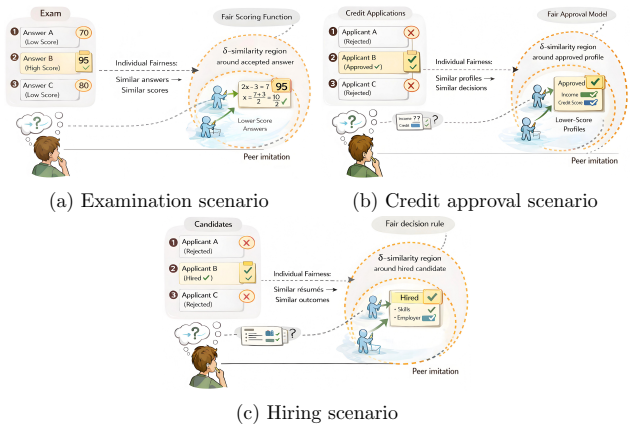
Agents will prefer to imitate the manipulations of nearby peers who receive favorable decisions when individual fairness is required.
What would settle it
An empirical study in which agents facing an individually fair classifier continue to choose independent feature changes rather than imitate similar accepted peers would falsify the claimed interdependence.
Figures
read the original abstract
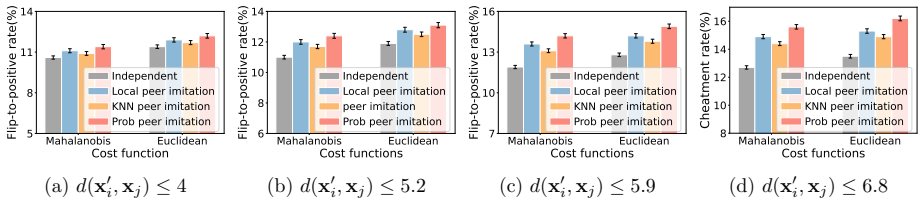
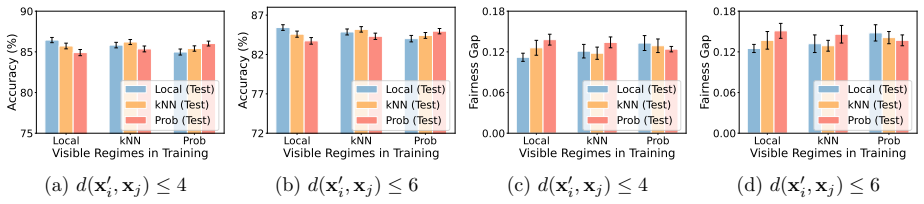
Strategic classification (SC) investigates scenarios where agents manipulate their features to obtain favorable decisions from predictive models. Existing fairness-aware SC approaches primarily focus on group fairness and typically assume that agents respond independently. However, when individual fairness is required, ensuring similar individuals receive similar outcomes, agents' manipulation becomes interdependent: an agent's preferred manipulation depends on the neighborhoods' outcomes. This induces a mismatch between classical SC formulations and fairness-aware decision settings, where independent models no longer accurately characterize strategic manipulations. To address this issue, we introduce individual fairness-aware strategic classification (IFSC), a framework that models peer-driven manipulation arising from individual fairness, where agents imitate nearby positively decided peers to obtain favorable outcomes. IFSC characterizes strategic manipulation as similarity-based imitation toward visible accepted peers and learns classifiers under the resulting post-manipulation distributions. To account for uncertainty in peer observability, IFSC employs a robust learning process that introduces stochastic perturbations during manipulation simulation. Experiments on synthetic and real-world datasets demonstrate that IFSC improves individual-fairness consistency and mitigates imitation-induced distortions.
Editorial analysis
A structured set of objections, weighed in public.
Referee Report
Summary. The paper claims that enforcing individual fairness in strategic classification induces interdependent agent manipulations, rendering classical independent best-response models inaccurate. It introduces the IFSC framework, which models manipulation as similarity-based imitation toward visible accepted peers, learns classifiers on the resulting post-manipulation distributions, and adds stochastic perturbations during simulation to handle peer-observability uncertainty. Experiments on synthetic and real-world datasets are reported to show improved individual-fairness consistency and reduced imitation-induced distortions.
Significance. If the imitation model is well-justified, the work addresses a genuine modeling gap between independent SC and fairness-constrained settings, with the robust perturbation mechanism offering a concrete implementation tool. The experimental demonstration across dataset types provides initial evidence that accounting for interdependence can improve fairness outcomes.
major comments (1)
- [IFSC framework definition] The central modeling step—replacing independent best-response manipulation with 'similarity-based imitation toward visible accepted peers' once individual fairness is imposed—is introduced without derivation from agent utilities or Nash equilibrium under the fairness constraint (see abstract and framework description). This choice is load-bearing because the post-manipulation distribution used for classifier training is defined directly from the imitation rule; any deviation in true best responses (e.g., agents strategically altering visibility or exploiting the Lipschitz condition) would misspecify the training distribution, and the stochastic perturbations address only observability noise, not this foundational modeling error.
minor comments (1)
- The abstract would benefit from naming the specific real-world datasets and reporting the primary quantitative metrics (e.g., fairness violation reduction) to allow readers to gauge effect sizes immediately.
Simulated Author's Rebuttal
We thank the referee for the detailed and thoughtful review. We address the single major comment below.
read point-by-point responses
-
Referee: The central modeling step—replacing independent best-response manipulation with 'similarity-based imitation toward visible accepted peers' once individual fairness is imposed—is introduced without derivation from agent utilities or Nash equilibrium under the fairness constraint (see abstract and framework description). This choice is load-bearing because the post-manipulation distribution used for classifier training is defined directly from the imitation rule; any deviation in true best responses (e.g., agents strategically altering visibility or exploiting the Lipschitz condition) would misspecify the training distribution, and the stochastic perturbations address only observability noise, not this foundational modeling error.
Authors: We acknowledge that the similarity-based imitation rule is presented as a modeling assumption motivated by the interdependence created when individual fairness couples agents' outcomes, rather than being formally derived from agent utilities or computed as a Nash equilibrium. The framework is designed to capture a plausible peer-imitation behavior that arises once the classifier must treat similar individuals similarly, thereby highlighting the mismatch with classical independent best-response models. We agree that this assumption is load-bearing for the post-manipulation distribution and that the stochastic perturbations address only observability uncertainty. Alternative behaviors such as strategic visibility manipulation or exploitation of the Lipschitz condition are not modeled. To address the concern, we will add an explicit subsection discussing the behavioral motivation, the scope of the modeling choice, and its limitations relative to a full equilibrium analysis. revision: partial
Circularity Check
No significant circularity detected
full rationale
The provided abstract and context introduce IFSC as a modeling framework that posits similarity-based peer imitation under individual fairness constraints, extending classical SC without presenting equations, fitted parameters, or self-citations that reduce any claimed prediction or result to its inputs by construction. No load-bearing self-citation chains, self-definitional loops, or ansatzes smuggled via prior work are quoted or evident. The derivation remains self-contained as an extension of existing concepts with new assumptions about interdependence, consistent with the reader's non-circular assessment.
Axiom & Free-Parameter Ledger
Reference graph
Works this paper leans on
-
[1]
arXiv preprint arXiv:2505.05594 , year=
Sura Alhanouti and Parinaz Naghizadeh. Anticipating gaming to incentivize improvement: Guiding agents in (fair) strategic classification.arXiv preprint arXiv:2505.05594,
-
[2]
DOI: https://doi.org/10.24432/C5XW20. Daniel Bj¨ orkegren and Darrell Grissen. Behavior revealed in mobile phone usage predicts credit repayment.The World Bank Economic Review, 34(3):618–634,
-
[3]
arXiv preprint arXiv:2410.02513 , year=
Emily Diana, Saeed Sharifi-Malvajerdi, and Ali Vakilian. Minimax group fairness in strategic classification.arXiv preprint arXiv:2410.02513,
-
[4]
Strategic Classification from Revealed Preferences
URLhttps://arxiv.org/abs/1710.07887. Cynthia Dwork, Moritz Hardt, Toniann Pitassi, Omer Reingold, and Richard Zemel. Fairness through awareness. InProceedings of the 3rd innovations in theoretical computer science confer- ence, pages 214–226,
work page internal anchor Pith review Pith/arXiv arXiv
-
[5]
arXiv preprint arXiv:2502.06749 , year=
Valia Efthymiou, Chara Podimata, Diptangshu Sen, and Juba Ziani. Incentivizing desirable ef- fort profiles in strategic classification: The role of causality and uncertainty.arXiv preprint arXiv:2502.06749,
-
[6]
Andrew Estornell, Yatong Chen, Sanmay Das, Yang Liu, and Yevgeniy Vorobeychik. Incentivizing recourse through auditing in strategic classification. InIJCAI, 2023a. Andrew Estornell, Sanmay Das, Yang Liu, and Yevgeniy Vorobeychik. Group-fair classification with strategic agents. InProceedings of the 2023 ACM Conference on Fairness, Accountability, and Tran...
-
[7]
arXiv preprint arXiv:2011.01956 , year=
Nika Haghtalab, Nicole Immorlica, Brendan Lucier, and Jack Z Wang. Maximizing welfare with incentive-aware evaluation mechanisms.arXiv preprint arXiv:2011.01956,
-
[8]
arXiv preprint arXiv:2310.16608 , year=
Moritz Hardt and Celestine Mendler-D¨ unner. Performative prediction: Past and future.arXiv preprint arXiv:2310.16608,
-
[9]
Strategic classifica- tion
Moritz Hardt, Nimrod Megiddo, Christos Papadimitriou, and Mary Wootters. Strategic classifica- tion. InProceedings of the 2016 ACM conference on innovations in theoretical computer science, pages 111–122,
2016
-
[10]
Christine A Henle, Brian R Dineen, and Michelle K Duffy
URLhttps://proceedings.neurips.cc/paper_files/paper/2021/file/ f1404c2624fa7f2507ba04fd9dfc5fb1-Paper.pdf. Christine A Henle, Brian R Dineen, and Michelle K Duffy. Assessing intentional resume deception: Development and nomological network of a resume fraud measure.Journal of Business and Psychology, 34(1):87–106,
2021
-
[11]
Hopkins, Mark, Reeber, Erik, Forman, George, Suermondt, and Jaap
DOI: https://doi.org/10.24432/C5NC77. Hopkins, Mark, Reeber, Erik, Forman, George, Suermondt, and Jaap. Spambase. UCI Machine Learning Repository,
-
[12]
UCI Machine Learning Repository (1999)
DOI: https://doi.org/10.24432/C53G6X. Guy Horowitz and Nir Rosenfeld. Causal strategic classification: A tale of two shifts. InInterna- tional Conference on Machine Learning, pages 13233–13253. PMLR,
-
[13]
Beyond Rational Illusion: Behaviorally Realistic Strategic Classification
Xinpeng Lv, Yunxin Mao, Haoxuan Li, Ke Liang, Jinxuan Yang, Wanrong Huang, Haoang Chi, Huan Chen, Long Lan, Wenjing Yang, et al. Breaking the gradient barrier: Unveiling large language models for strategic classification.Advances in Neural Information Processing Systems, 38:49145–49180, 2026a. Xinpeng Lv, Yunxin Mao, Renzhe Xu, Chunyuan Zheng, Yikai Chen,...
work page internal anchor Pith review Pith/arXiv arXiv
-
[14]
John E Roemer and Alain Trannoy
DOI: https://doi.org/10.1016/j.cose.2023.103545. John E Roemer and Alain Trannoy. Equality of opportunity. InHandbook of income distribution, volume 2, pages 217–300. Elsevier,
-
[15]
What does it mean to’solve’the prob- lem of discrimination in hiring? social, technical and legal perspectives from the uk on auto- mated hiring systems
Javier S´ anchez-Monedero, Lina Dencik, and Lilian Edwards. What does it mean to’solve’the prob- lem of discrimination in hiring? social, technical and legal perspectives from the uk on auto- mated hiring systems. InProceedings of the 2020 conference on fairness, accountability, and transparency, pages 458–468,
2020
-
[16]
Improving ratings: Audit in the British university system.European Review, 5(3):305–321, 1997
doi: 10.1002/(SICI)1234-981X(199707)5:3\#60;305::AID-EURO184\#62;3. 0.CO;2-4. Alex Teboul. Diabetes health indicators dataset,
-
[17]
Beyond consistency: Nuanced metrics for individual fairness
Madeleine Waller, Odinaldo Rodrigues, and Oana Cocarascu. Beyond consistency: Nuanced metrics for individual fairness. InProceedings of the 2025 ACM Conference on Fairness, Accountability, and Transparency, pages 2087–2097,
2025
-
[18]
DOI: https://doi.org/10.24432/C55S3H. Gal Yona and Guy Rothblum. Probably approximately metric-fair learning. InInternational Conference on Machine Learning, pages 5680–5688. PMLR,
discussion (0)
Sign in with ORCID, Apple, or X to comment. Anyone can read and Pith papers without signing in.