Rossi-alpha Benchmark Validation of a Static Alpha Eigenvalue Capability in OpenMC
Pith reviewed 2026-06-28 17:34 UTC · model grok-4.3
The pith
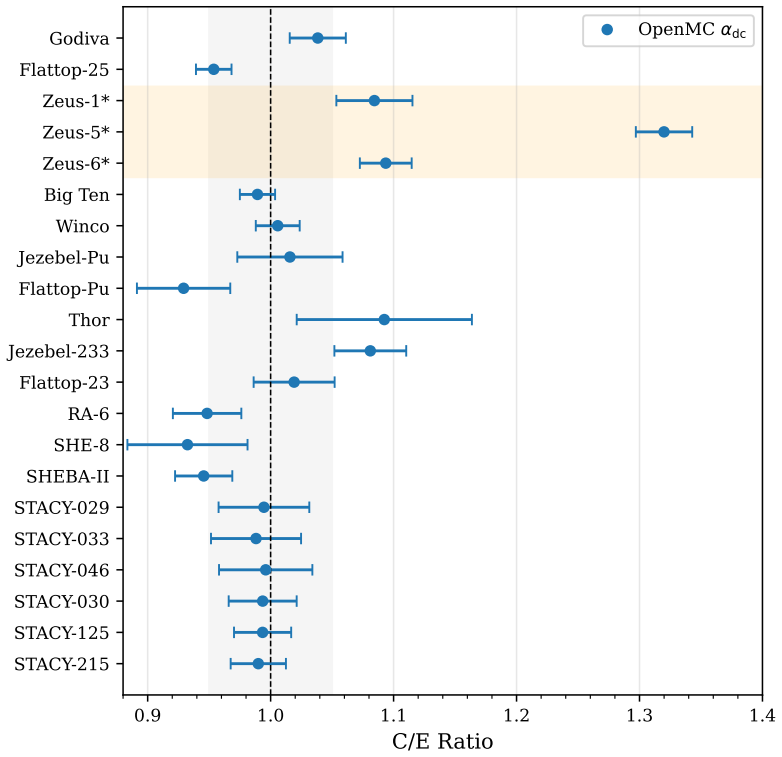
OpenMC computes delayed-critical alpha eigenvalues from standard k-eigenvalue runs that match Rossi-alpha measurements within 5-10 percent.
A machine-rendered reading of the paper's core claim, the machinery that carries it, and where it could break.
Core claim
A static alpha eigenvalue capability was implemented in a modified version of OpenMC and validated against Rossi-alpha measurements from 21 delayed-critical benchmark experiments and 33 subcritical configurations spanning fast, intermediate, and thermal systems with U-233, HEU, IEU, LEU, and plutonium fuels. The effective delayed neutron fraction was calculated using the k-prompt method, and the prompt neutron lifetime was calculated using the iterated fission probability method, both evaluated within the standard k-eigenvalue power iteration. The delayed-critical alpha eigenvalue was calculated from these quantities using the point kinetics equation alpha_dc = -beta_eff / ell_p. Agreement w
What carries the argument
The point-kinetics relation alpha_dc = -beta_eff / ell_p, with beta_eff obtained from the k-prompt method and ell_p from the iterated-fission method inside ordinary k-eigenvalue power iteration.
If this is right
- The same alpha_dc value can be obtained for both delayed-critical and subcritical states without changing the computational procedure.
- The method applies across fast metal, intermediate, and thermal solution systems and across U-233, HEU, IEU, LEU, and plutonium fuels.
- Agreement is tighter for thermal solution systems than for fast metal systems.
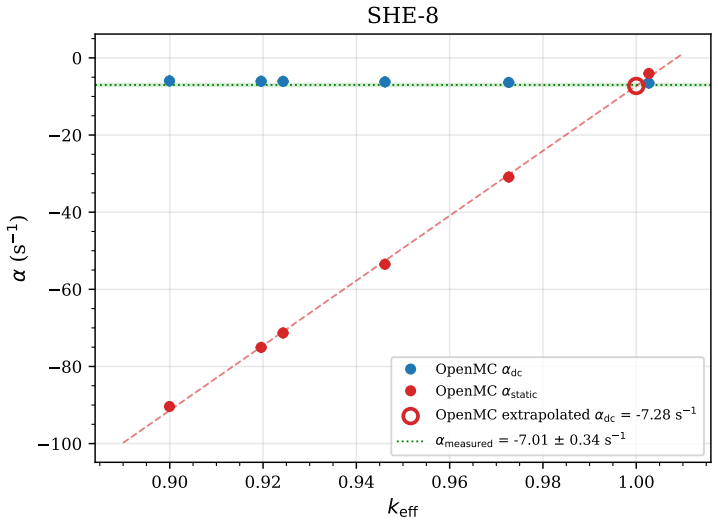
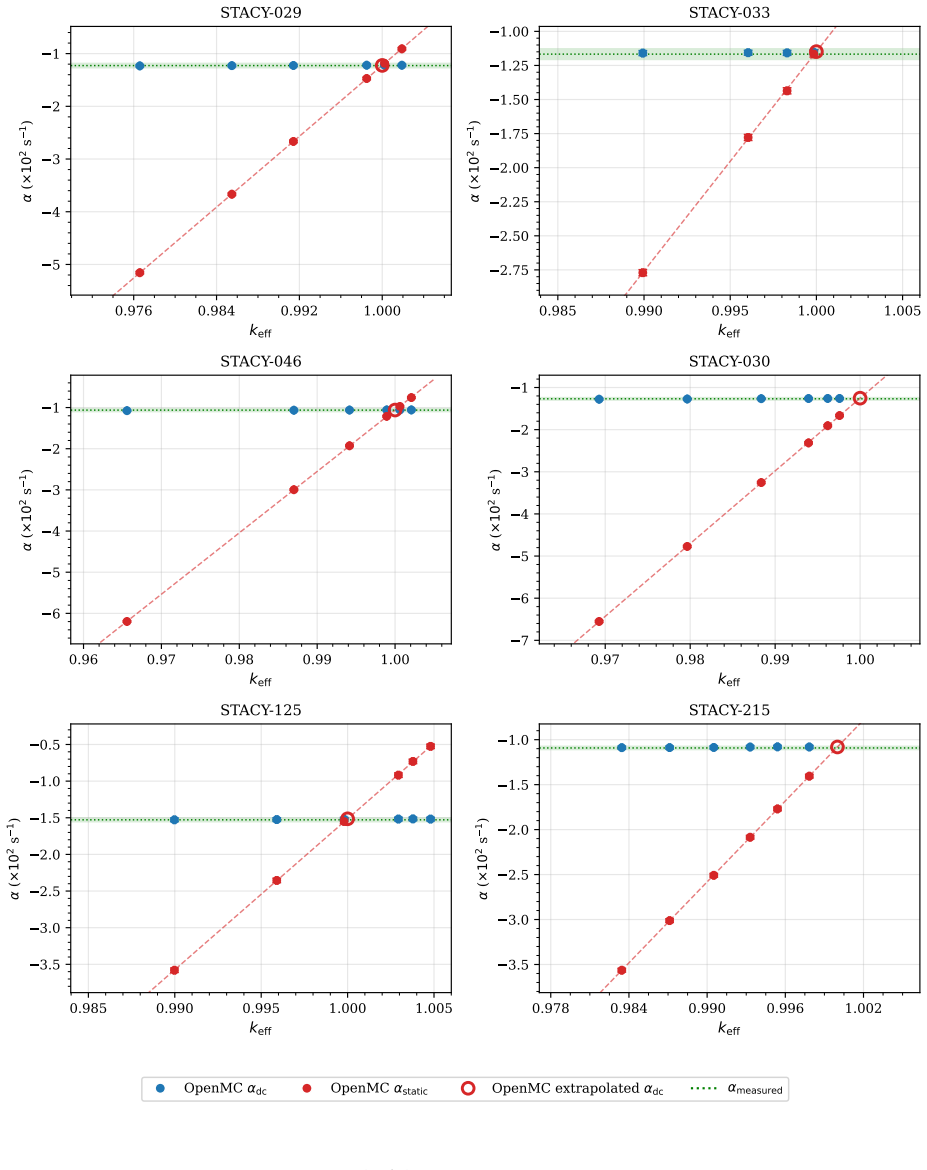
- Alpha_dc remains stable under subcritical extrapolation from the SHE-8 and STACY families.
Where Pith is reading between the lines
- The approach could be ported to other Monte Carlo codes that already support k-prompt and iterated-fission tallies.
- The reported stability under subcritical extrapolation suggests the quantity could serve as a fixed reference point for interpreting pulsed-neutron or noise measurements in operating facilities.
- Because the calculation re-uses existing k-eigenvalue infrastructure, it may reduce the computational cost of generating alpha-eigenvalue libraries for criticality-safety analysis.
Load-bearing premise
The point-kinetics relation accurately captures the delayed-critical eigenvalue for the benchmark systems when beta_eff and ell_p are obtained from the k-prompt and iterated-fission methods inside standard k-eigenvalue power iteration.
What would settle it
A new Rossi-alpha measurement on one of the fast-metal benchmark systems in which the computed alpha_dc differs from experiment by more than 10 percent would falsify the reported level of agreement.
Figures
read the original abstract
A static alpha eigenvalue capability was implemented in a modified version of the open-source Monte Carlo radiation transport code OpenMC and validated against Rossi-alpha measurements from 21 delayed-critical benchmark experiments and 33 subcritical configurations spanning fast, intermediate, and thermal systems with U-233, HEU, IEU, LEU, and plutonium fuels. The effective delayed neutron fraction was calculated using the k-prompt method, and the prompt neutron lifetime was calculated using the iterated fission probability method, both evaluated within the standard k-eigenvalue power iteration. The delayed-critical alpha eigenvalue was calculated from these quantities using the point kinetics equation alpha_dc = -beta_eff / ell_p. Agreement was generally within 10% for fast metal systems and within 5% for thermal solution systems. Subcritical extrapolation studies derived from the SHE-8 and STACY benchmark families show that alpha_dc remains stable as the system is driven subcritical.
Editorial analysis
A structured set of objections, weighed in public.
Referee Report
Summary. The manuscript reports implementation of a static alpha eigenvalue capability in a modified version of OpenMC. The delayed-critical alpha eigenvalue alpha_dc is obtained exclusively via the point-kinetics relation alpha_dc = -beta_eff / ell_p, where beta_eff is computed by the k-prompt method and ell_p by the iterated-fission-probability method, both inside ordinary k-eigenvalue power iteration. Validation is performed against Rossi-alpha data from 21 delayed-critical benchmarks and 33 subcritical configurations across fast, intermediate, and thermal systems; reported agreement is within 10% for fast-metal systems and 5% for thermal-solution systems. Subcritical extrapolation studies on the SHE-8 and STACY families are used to show that the derived alpha_dc remains stable as the system is driven subcritical.
Significance. If the point-kinetics mapping is numerically equivalent to a direct alpha-eigenvalue solve on these benchmarks, the work supplies a useful set of Monte Carlo benchmark comparisons for subcritical alpha predictions across multiple fuel types. The breadth of the benchmark suite (U-233, HEU, IEU, LEU, plutonium; fast to thermal) adds practical value for criticality-safety applications. The absence of a direct alpha solver or independent verification of the mapping, however, limits the strength of the claimed capability validation.
major comments (3)
- [Abstract] Abstract: the manuscript states that a 'static alpha eigenvalue capability was implemented' yet describes only post-processing of beta_eff and ell_p obtained from standard k-eigenvalue iteration via the point-kinetics formula; this makes the reported Rossi-alpha agreement a test of the approximation rather than of a direct alpha-eigenvalue solver.
- [Abstract] Abstract: the subcritical extrapolation studies demonstrate only that the derived alpha_dc is invariant under the point-kinetics mapping; they supply no independent comparison to experimental alpha values or to a direct alpha-eigenvalue calculation once the system departs from delayed criticality.
- [Abstract] Abstract: summary agreement percentages (within 10% fast metal, 5% thermal) are given without error bars, per-case discrepancies, or sensitivity studies, preventing quantitative assessment of whether the observed differences are statistically significant or systematic.
minor comments (2)
- The manuscript should include a table listing individual benchmark names, measured Rossi-alpha values, computed alpha_dc, and relative differences to allow readers to inspect outliers.
- A brief description of how the modified OpenMC version was verified (unit tests, comparison to analytic problems, or cross-checks against another code) would strengthen the methods section.
Simulated Author's Rebuttal
We thank the referee for their constructive comments on our manuscript. We provide point-by-point responses below and will make revisions to address the concerns raised.
read point-by-point responses
-
Referee: [Abstract] Abstract: the manuscript states that a 'static alpha eigenvalue capability was implemented' yet describes only post-processing of beta_eff and ell_p obtained from standard k-eigenvalue iteration via the point-kinetics formula; this makes the reported Rossi-alpha agreement a test of the approximation rather than of a direct alpha-eigenvalue solver.
Authors: The manuscript implements the calculation of the static alpha eigenvalue in OpenMC by leveraging the point-kinetics formula applied to beta_eff and ell_p computed during standard k-eigenvalue power iteration. This approach is explicitly described in the methods section. The validation against Rossi-alpha benchmarks therefore evaluates the performance of this approximation. We will revise the abstract to more precisely describe the implementation as the addition of a point-kinetics-based static alpha capability rather than implying a direct solver. revision: yes
-
Referee: [Abstract] Abstract: the subcritical extrapolation studies demonstrate only that the derived alpha_dc is invariant under the point-kinetics mapping; they supply no independent comparison to experimental alpha values or to a direct alpha-eigenvalue calculation once the system departs from delayed criticality.
Authors: The extrapolation studies on the SHE-8 and STACY families are presented to illustrate that the alpha_dc value obtained from the point-kinetics relation does not vary significantly as the system is adjusted to subcritical states. The validation for the 33 subcritical configurations involves direct comparison to available Rossi-alpha experimental data for those cases. We recognize that this does not constitute an independent verification using a direct alpha solver for subcritical systems. We will add clarifying text in the revised manuscript regarding the scope of the subcritical results. revision: partial
-
Referee: [Abstract] Abstract: summary agreement percentages (within 10% fast metal, 5% thermal) are given without error bars, per-case discrepancies, or sensitivity studies, preventing quantitative assessment of whether the observed differences are statistically significant or systematic.
Authors: The abstract summarizes the overall agreement for conciseness, while the body of the manuscript provides detailed per-benchmark results, including figures and tables that allow assessment of individual cases. Monte Carlo uncertainties are reported in the results. To improve the abstract, we will include a statement referencing the detailed analysis or note the typical level of agreement with uncertainties where feasible. revision: yes
Circularity Check
No circularity detected; external benchmark validation against Rossi-alpha measurements
full rationale
The paper computes the delayed-critical alpha eigenvalue via the standard point-kinetics formula alpha_dc = -beta_eff / ell_p, with beta_eff and ell_p obtained from established k-eigenvalue methods (k-prompt and iterated-fission). These derived values are then compared directly to independent experimental Rossi-alpha data from 21 delayed-critical benchmarks and 33 subcritical configurations. This constitutes external validation against measured data rather than any reduction of a claimed result to its own fitted inputs or self-citations by construction. No load-bearing step equates a prediction to an input via definition, renaming, or imported uniqueness theorem. The subcritical extrapolation studies further test stability of the derived quantity but do not alter the external nature of the benchmark comparisons.
Axiom & Free-Parameter Ledger
axioms (1)
- domain assumption Point-kinetics equation alpha_dc = -beta_eff / ell_p holds for the benchmark configurations
Reference graph
Works this paper leans on
-
[1]
Prompt Neutron Periods of Metal Critical Assemblies
Orndoff, J. D. “Prompt Neutron Periods of Metal Critical Assemblies.”Nuclear Science and Engineering2, no. 4 (1957): 450–460
1957
-
[2]
Adjoint-Weighted Tallies for k-Eigenvalue Calculations with Continuous-Energy Monte Carlo
Kiedrowski, B. C., F. B. Brown, and P. P. H. Wilson. “Adjoint-Weighted Tallies for k-Eigenvalue Calculations with Continuous-Energy Monte Carlo.”Nuclear Science and Engineering168, no. 3 (2011): 226–241
2011
-
[3]
The Rossi Alpha Validation Suite for MCNP
Mosteller, R. D., and B. C. Kiedrowski. “The Rossi Alpha Validation Suite for MCNP.” Los Alamos National Laboratory, LA-UR-11-04409, 2011. 16
2011
-
[4]
Calculation of Effective Point Kinetics Parameters in the Serpent 2 Monte Carlo Code
Leppänen, J., M. Aufiero, E. Fridman, R. Rachamin, and S. van der Marck. “Calculation of Effective Point Kinetics Parameters in the Serpent 2 Monte Carlo Code.”Annals of Nuclear Energy65 (2014): 272–279
2014
-
[5]
Calculation of Kinetic Parametersβeff and Λwith Modified Open Source Monte Carlo Code OpenMC(TD)
Romero-Barrientos, J., J. I. Márquez Damián, F. Molina, M. Zambra, P. Aguilera, F. López-Usquiano, B. Parra, and A. Ruiz. “Calculation of Kinetic Parametersβeff and Λwith Modified Open Source Monte Carlo Code OpenMC(TD).”Nuclear Engineering and Technology54, no. 3 (2022): 811–816
2022
-
[6]
OpenMC with Static Alpha Eigenvalue Capability
Zywiec, W. J. “OpenMC with Static Alpha Eigenvalue Capability.” GitHub repository, 2026.https://github.com/willzywiec/openmc
2026
-
[7]
OpenMC: A State-of-the-Art Monte Carlo Code for Research and Development
Romano, P. K., N. E. Horelik, B. R. Herman, A. G. Nelson, B. Forget, and K. Smith. “OpenMC: A State-of-the-Art Monte Carlo Code for Research and Development.”An- nals of Nuclear Energy82 (2015): 90–97
2015
-
[8]
Calculating the Effective Delayed Neutron Fraction with Monte Carlo
Meulekamp, R. K., and S. C. van der Marck. “Calculating the Effective Delayed Neutron Fraction with Monte Carlo.”Nuclear Science and Engineering152, no. 2 (2006): 142– 148
2006
-
[9]
Development of Calculation Technique for Iterated Fission Probability and Reactor Kinetic Parameters Using Continuous-Energy Monte Carlo Method
Nauchi, Y., and T. Kameyama. “Development of Calculation Technique for Iterated Fission Probability and Reactor Kinetic Parameters Using Continuous-Energy Monte Carlo Method.”Journal of Nuclear Science and Technology47, no. 10 (2010): 977–990
2010
-
[10]
NEA/NSC/DOC(95)03, 2023 Edition
Nuclear Energy Agency.International Handbook of Evaluated Criticality Safety Bench- mark Experiments. NEA/NSC/DOC(95)03, 2023 Edition. Paris: OECD Nuclear Energy Agency
2023
-
[11]
BNL- 19302, ENDF-202
Cross Section Evaluation Working Group.CSEWG Benchmark Specifications. BNL- 19302, ENDF-202. Upton, NY: Brookhaven National Laboratory, 1986
1986
-
[12]
Kinetic Parameterβeff/ℓMea- surement on Low Enriched Uranyl Nitrate Solution with Single Unit Cores of STACY
Tonoike, K., Y. Miyoshi, T. Kikuchi, and T. Yamamoto. “Kinetic Parameterβeff/ℓMea- surement on Low Enriched Uranyl Nitrate Solution with Single Unit Cores of STACY.” Journal of Nuclear Science and Technology39, no. 11 (2002): 1227–1236
2002
-
[13]
AnalysisofSHECriticalExperimentsby Neutronic Design Codes for Experimental Very High Temperature
Takano, M., M.Hirano, R.Shindo, andT.Doi.“AnalysisofSHECriticalExperimentsby Neutronic Design Codes for Experimental Very High Temperature.”Journal of Nuclear Science and Technology22, no. 5 (1985): 358–370
1985
-
[14]
Neutron Noise Measurements of a Fast HEU Copper System
Kostelac, C., R. Weldon, N. Whitman, N. Thompson, T. Cutler, K. Amundson, and A. Alajo. “Neutron Noise Measurements of a Fast HEU Copper System.”Nuclear Science and Engineering200, Suppl. 1 (2026): S565–S573
2026
-
[15]
On the Definition of Neutron Lifetimes in Multiplying and Non-Multiplying Systems
Spriggs, G. D., K. L. Adams, and D. K. Parsons. “On the Definition of Neutron Lifetimes in Multiplying and Non-Multiplying Systems.” Los Alamos National Laboratory, LA- UR-97-1073, 1997
1997
-
[16]
An Unfolding Method for Estimating Kinetics Parameters from Rossi-αMeasurements
Spriggs, G. D., and J. M. Campbell. “An Unfolding Method for Estimating Kinetics Parameters from Rossi-αMeasurements.”Nuclear Science and Engineering131, no. 1 (1999): 97–105. 17
1999
discussion (0)
Sign in with ORCID, Apple, or X to comment. Anyone can read and Pith papers without signing in.