Reason, Retrieve, Re-rank: A Zero-Shot Reasoning-Aware Framework for Composed Video Retrieval
Pith reviewed 2026-06-28 18:42 UTC · model grok-4.3
The pith
A training-free pipeline reasons about edit effects then re-ranks to reach 91.9 percent R@1 on composed video retrieval.
A machine-rendered reading of the paper's core claim, the machinery that carries it, and where it could break.
Core claim
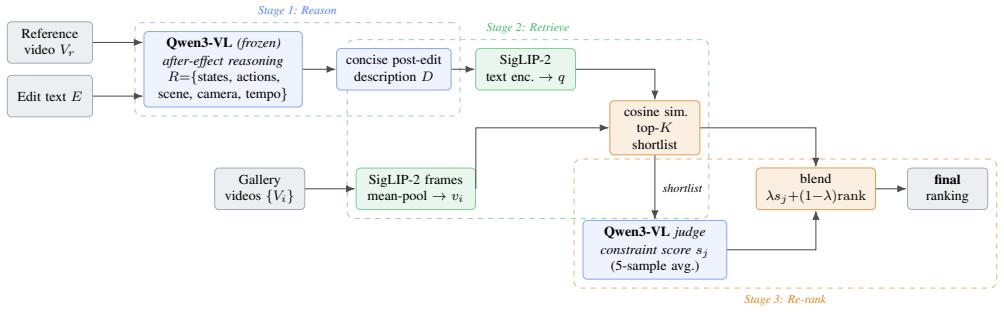
R3-CoVR attains 91.9 percent R@1 and 98.2 percent R@10 on the challenge test set by having Qwen3-VL-8B verbalize post-edit descriptions covering state transitions, actions, scene, camera and tempo, embedding those descriptions with SigLIP-2 for first-stage retrieval, and applying a constraint-aware re-ranker that scores shortlisted videos against the intended outcome, with the re-ranker providing the single largest gain from 72.7 to 91.9 percent R@1.
What carries the argument
The constraint-aware re-ranker that uses the same multimodal model as a judge to score each shortlisted candidate against the intended edited result.
If this is right
- Matching the generated description length to the contrastive encoder text window raises R@1 from 67.5 to 72.7 percent.
- The re-ranking stage on a shortlist delivers the largest single improvement in the pipeline.
- The full method operates with entirely frozen foundation models and requires no task-specific training.
- Performance depends on shortlist depth and the blend between initial retrieval and re-ranking scores.
Where Pith is reading between the lines
- Explicit verbalization of temporal and state changes may be a general route to improving zero-shot video tasks beyond retrieval.
- The retrieve-then-judge pattern could transfer to other domains where embedding similarity alone misses fine-grained constraints.
- If the judge stage generalizes across video domains, it offers a way to compensate for gaps in current contrastive video encoders.
Load-bearing premise
The frozen Qwen3-VL-8B model can reliably produce accurate post-edit descriptions of state transitions, actions and tempo and can correctly judge shortlisted candidates without any training or calibration.
What would settle it
Running the model on a held-out set of reference-edit pairs and finding that the generated post-edit descriptions mismatch the actual visual outcomes in more than half the cases, causing end-to-end R@1 to fall below 60 percent.
Figures
read the original abstract
Composed Video Retrieval (CoVR) seeks the target video that results from applying a free-form textual modification to a reference video. We address the \emph{Reason-Aware} CoVR (CoVR-R) challenge at the CVPR~2026 VidLLMs workshop, where retrieval is strictly zero-shot. We present \textbf{R3-CoVR} (\emph{Reason, Retrieve, Re-rank}), a training-free pipeline built entirely from frozen foundation models. A multimodal large language model (Qwen3-VL-8B) reasons about the \emph{after-effects} an edit implies -- state transitions, action phases, scene, camera and tempo -- and verbalises a concise post-edit description; a contrastive video--text encoder (SigLIP-2) embeds this description and the gallery for first-stage retrieval; finally a constraint-aware re-ranking stage uses the same multimodal model as a judge that scores each shortlisted candidate against the intended edited result. On the challenge test set, R3-CoVR attains \textbf{91.9\% R@1} and \textbf{98.2\% R@10}. Two findings drive these results: (i)~matching the description length to the contrastive encoder's text window lifts \Rk{1} from $67.5$ to $72.7$; and (ii)~the constraint-aware re-ranker, which reorders only the shortlist, lifts \Rk{1} from $72.7$ to $91.9$ -- the single largest gain. We analyse the re-ranker's behaviour, the retrieve/re-rank blend, and the shortlist depth, and we release a clean three-layer implementation.
Editorial analysis
A structured set of objections, weighed in public.
Referee Report
Summary. The manuscript presents R3-CoVR, a strictly zero-shot, training-free pipeline for Reason-Aware Composed Video Retrieval (CoVR-R). It uses frozen Qwen3-VL-8B to verbalize post-edit descriptions (state transitions, actions, tempo, camera) from a reference video plus edit text, SigLIP-2 for first-stage retrieval, and the same MLLM as a constraint-aware judge for re-ranking the shortlist. On the CVPR 2026 VidLLMs workshop challenge test set it reports 91.9% R@1 and 98.2% R@10, with ablations attributing the largest gain (72.7% → 91.9% R@1) to the re-ranker and a smaller gain to matching description length to the text encoder window. The implementation is released.
Significance. If the MLLM reasoning and judging steps prove reliable, the work supplies concrete evidence that a retrieve-then-re-rank pipeline built from off-the-shelf frozen models can achieve high recall on an external challenge benchmark without any task-specific training. The reported ablation numbers, the external test-set evaluation, and the public implementation are clear strengths that would advance zero-shot CoVR methods.
major comments (2)
- [Abstract and §4] Abstract and §4: the central performance claim (91.9% R@1 after re-ranking, 19.2-point lift) rests on the frozen Qwen3-VL-8B producing accurate post-edit descriptions and unbiased constraint-aware judgments. No human validation, error analysis, or inter-annotator agreement on the generated descriptions or judgments is reported; this directly affects whether the numbers reflect a general zero-shot framework or model-specific artifacts.
- [§4] §4 (re-ranker analysis): while the paper examines re-ranker behaviour, retrieve/re-rank blend, and shortlist depth, the absence of quantitative checks on description fidelity or judgment consistency leaves the load-bearing assumption about MLLM reliability untested.
minor comments (1)
- [Abstract] Abstract: notation \Rk{1} is non-standard; replace with R@1 for clarity.
Simulated Author's Rebuttal
We thank the referee for the constructive comments emphasizing the need to validate the MLLM reasoning and judgment steps. We address each point below and commit to targeted revisions that strengthen the manuscript without altering its core claims.
read point-by-point responses
-
Referee: [Abstract and §4] Abstract and §4: the central performance claim (91.9% R@1 after re-ranking, 19.2-point lift) rests on the frozen Qwen3-VL-8B producing accurate post-edit descriptions and unbiased constraint-aware judgments. No human validation, error analysis, or inter-annotator agreement on the generated descriptions or judgments is reported; this directly affects whether the numbers reflect a general zero-shot framework or model-specific artifacts.
Authors: We agree that the lack of direct human validation or inter-annotator agreement on the MLLM outputs is a limitation that leaves open whether the gains are fully general or partly model-specific. The external challenge test set and the 19.2-point R@1 lift from the re-ranker provide indirect evidence of effectiveness, but do not substitute for fidelity checks. In the revised manuscript we will add a dedicated qualitative analysis subsection containing representative examples of generated post-edit descriptions, successful and unsuccessful re-ranking judgments, and observed error patterns. This will allow readers to assess description quality and judgment consistency directly. A full-scale human annotation study with agreement metrics lies outside the scope and resources of the current work. revision: partial
-
Referee: [§4] §4 (re-ranker analysis): while the paper examines re-ranker behaviour, retrieve/re-rank blend, and shortlist depth, the absence of quantitative checks on description fidelity or judgment consistency leaves the load-bearing assumption about MLLM reliability untested.
Authors: The existing §4 analysis quantifies the re-ranker's contribution via retrieval metrics and shortlist depth but does not include direct fidelity or consistency metrics on the MLLM outputs themselves. We accept that this leaves the reliability assumption partially untested. In revision we will augment the re-ranker analysis with additional quantitative observations, such as the distribution of re-ranker scores across the shortlist and their correlation with final retrieval success, together with the qualitative examples mentioned above. These additions will provide concrete checks on judgment behavior while remaining within the zero-shot, training-free setting of the paper. revision: partial
Circularity Check
No circularity; zero-shot pipeline evaluated on external test set with no fitted parameters or self-referential derivations
full rationale
The paper describes a training-free pipeline that chains frozen external models (Qwen3-VL-8B for reasoning/judging and SigLIP-2 for retrieval) and reports retrieval metrics directly on the CVPR 2026 challenge test set. No equations, parameter fitting, or derivations appear in the provided text. The reported gains (e.g., re-ranker lift from 72.7 to 91.9 R@1) are measured outcomes on held-out data rather than quantities constructed from the method's own inputs. No self-citations are invoked as load-bearing premises, and the framework contains no self-definitional loops or renamed empirical patterns. The result is therefore self-contained against external benchmarks.
Axiom & Free-Parameter Ledger
axioms (1)
- domain assumption Frozen foundation models can produce reliable post-edit descriptions and candidate judgments for the CoVR task
Reference graph
Works this paper leans on
-
[1]
Thawakar, D
O. Thawakar, D. Demidov, V . Potlapalli, et al. CoVR-R: Reason-Aware Composed Video Retrieval.CVPR (Findings),
-
[2]
Ventura, A
L. Ventura, A. Yang, C. Schmid, G. Varol. CoVR: Learning Composed Video Retrieval from Web Video Captions.AAAI, 2024
2024
-
[3]
Composed Video Retrieval via Enriched Context and Discrim- inative Embeddings.CVPR, 2024
2024
-
[4]
Karthik, K
S. Karthik, K. Roth, M. Mancini, Z. Akata. Vision-by- Language for Training-Free Compositional Image Retrieval. ICLR, 2024
2024
-
[5]
CoTMR: Chain-of-Thought Multi-Scale Reasoning for Training-Free Zero-Shot Composed Image Retrieval. arXiv:2502.20826, 2025
-
[6]
Soft Filtering: Guiding Zero-shot Composed Image Retrieval with Prescriptive and Proscriptive Constraints. arXiv:2512.20781, 2025. 4
discussion (0)
Sign in with ORCID, Apple, or X to comment. Anyone can read and Pith papers without signing in.