Autonomous agentic design for photonics
Pith reviewed 2026-06-28 17:55 UTC · model grok-4.3
The pith
Large language model agents autonomously design photonic devices to state-of-the-art performance by running propose-simulate-evaluate-iterate loops.
A machine-rendered reading of the paper's core claim, the machinery that carries it, and where it could break.
Core claim
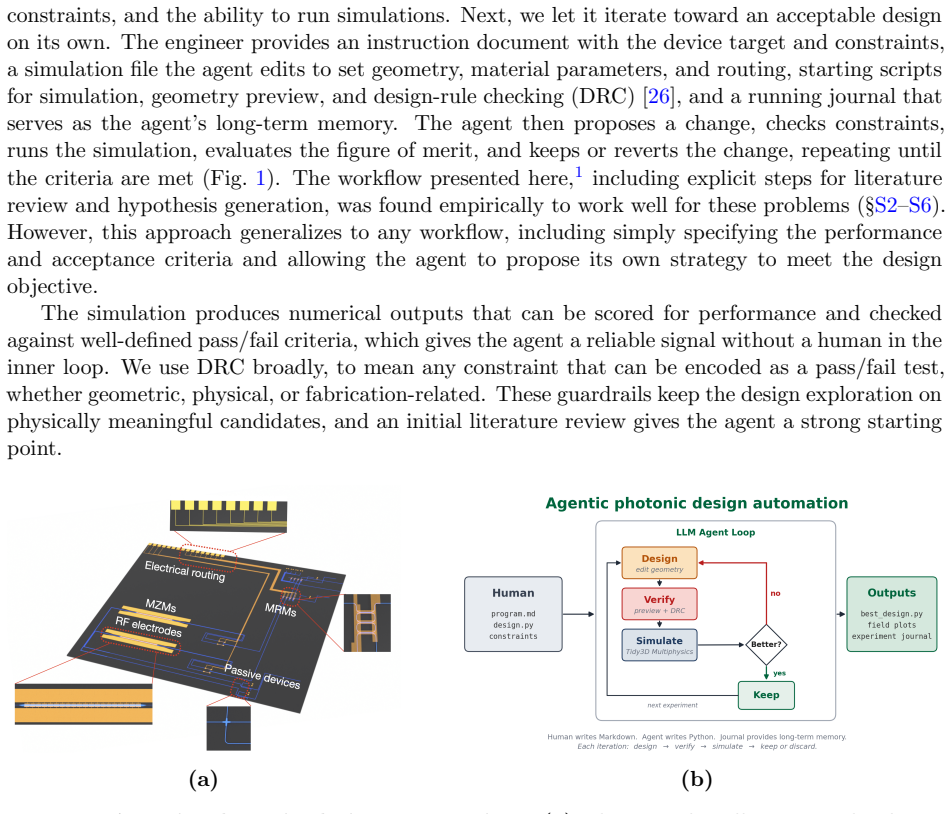
We introduce an automated, agent-driven approach to the design of photonic devices. We instruct large language models to solve photonic design problems, given access to software tools for performance evaluation through numerical simulations and quantitative acceptance criteria such as fabrication rules and physical-consistency checks. Within this context, agents run autonomous design loops of propose, simulate, evaluate, iterate and generate devices with state-of-the-art performance. We demonstrate this on passive components, active devices such as silicon microring modulators, RF devices such as traveling-wave electrodes, chip layout, and a combined silicon photonic modulator incorporating
What carries the argument
The autonomous agent design loop in which LLMs propose candidate devices, invoke simulation tools for performance evaluation, apply quantitative acceptance criteria, and iterate until targets are met.
If this is right
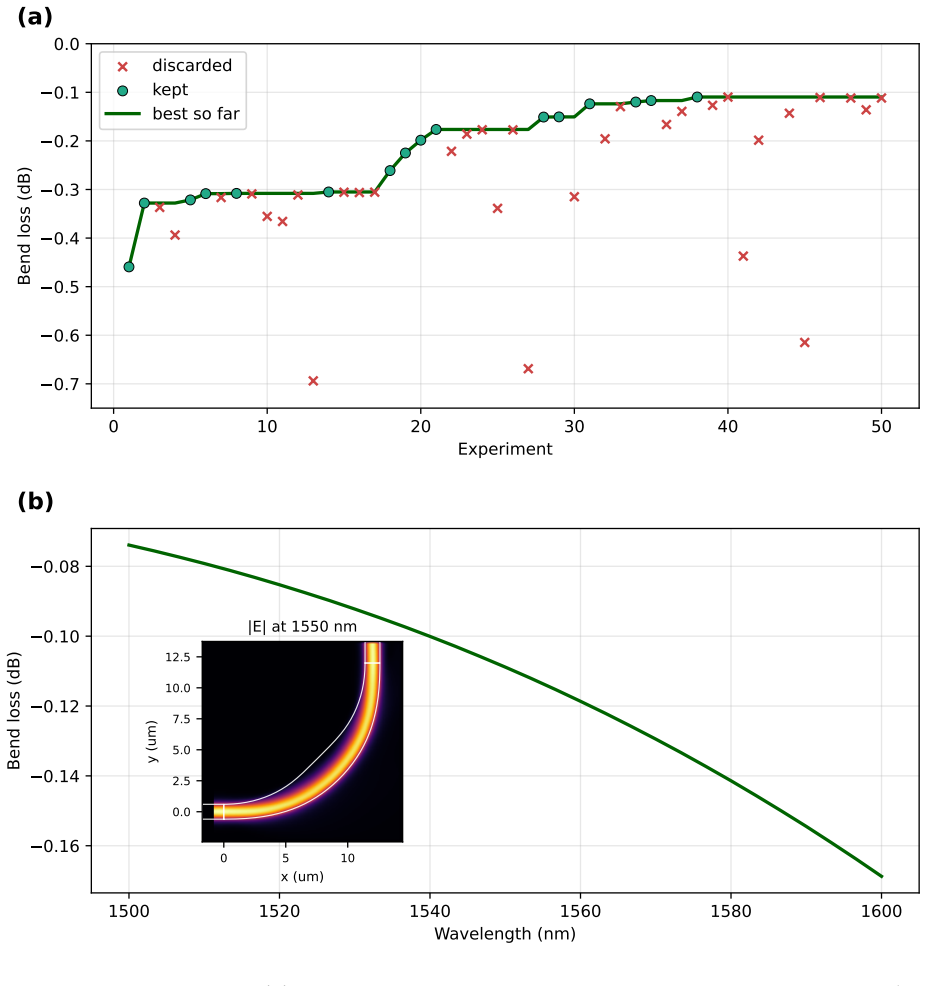
- Agents produce state-of-the-art passive photonic components such as waveguide bends, splitters, and crossings.
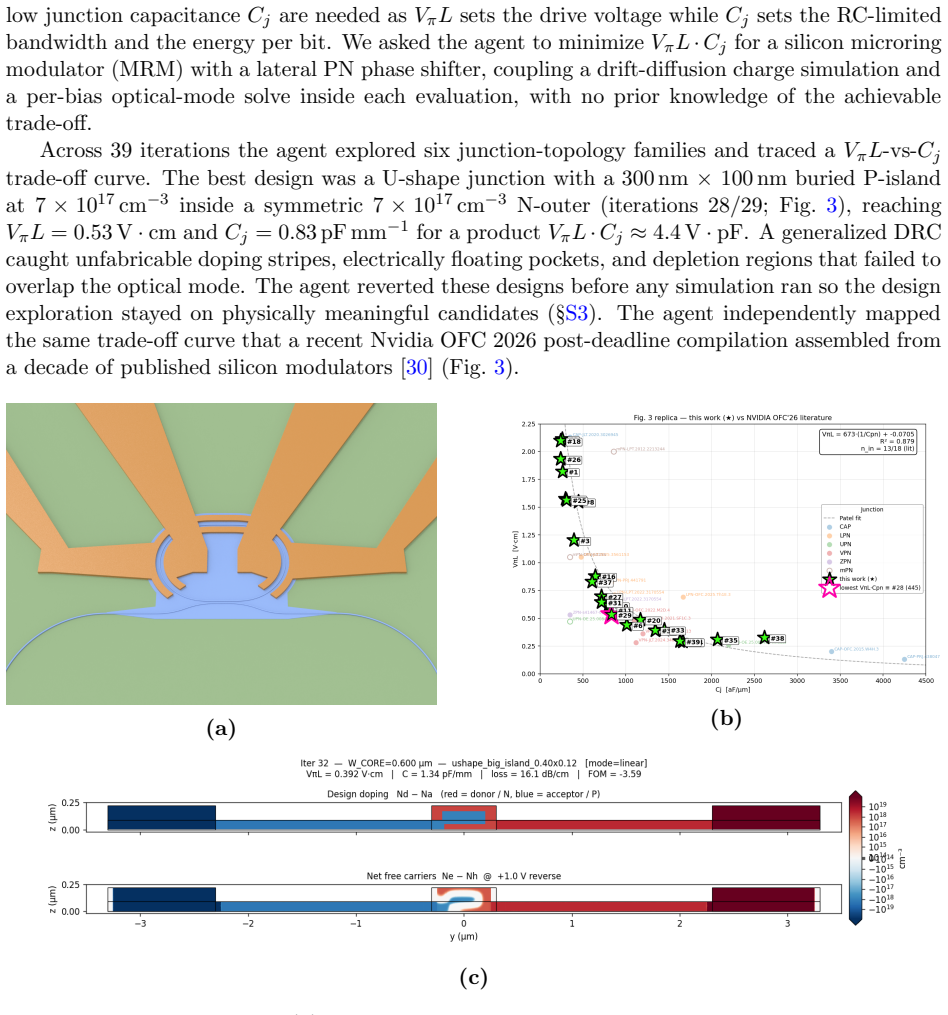
- Active devices including silicon microring modulators reach target performance through autonomous iteration.
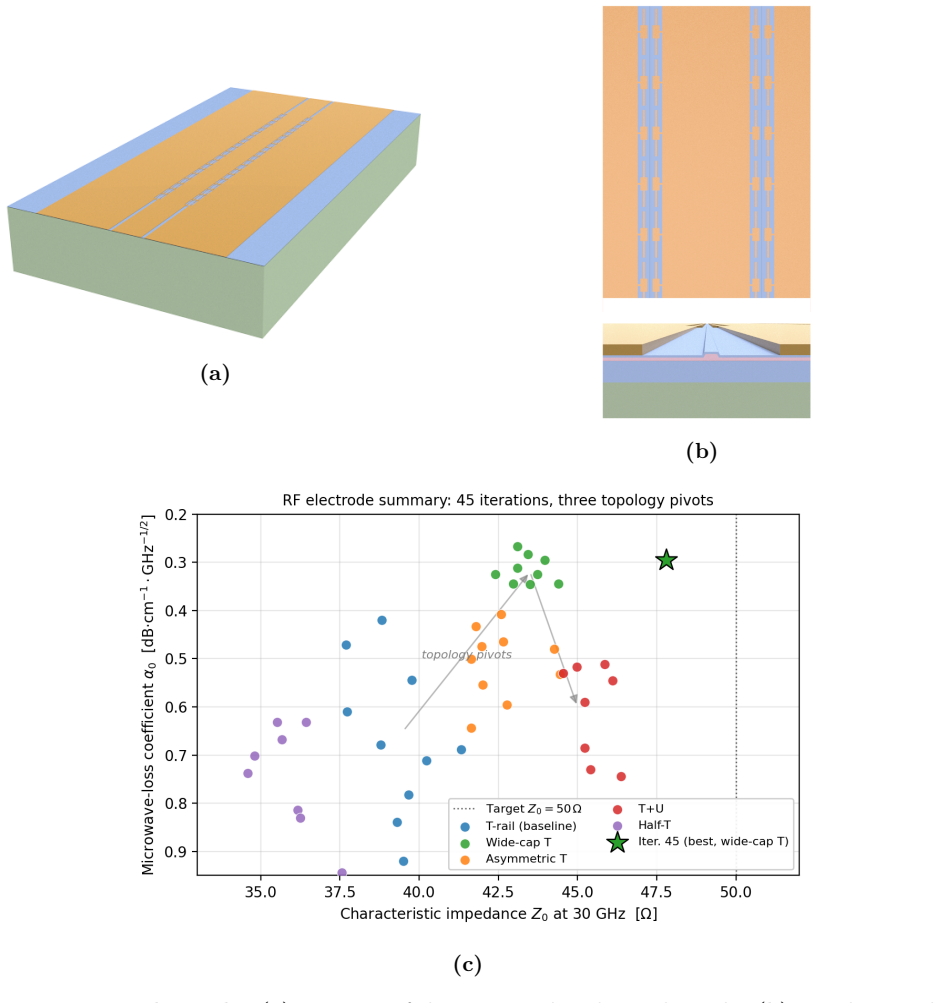
- RF devices such as traveling-wave electrodes for Mach-Zehnder modulators and electrical routing layouts are generated similarly.
- A complete silicon photonic modulator can be assembled by one agent process covering layout, charge transport, optical mode, and RF electrode design.
- The same loop applies to any design task that supplies a numerical simulator and criteria an LLM can evaluate.
Where Pith is reading between the lines
- The method could allow smaller teams to explore custom photonic designs that previously required large expert groups.
- Similar agent loops might transfer to other simulator-driven fields such as electronics or mechanics if equivalent evaluation tools are supplied.
- Performance gains would likely increase with improvements in the underlying simulators provided to the agents.
- The combined modulator example suggests agents can coordinate multi-physics constraints in a single workflow.
Load-bearing premise
LLM agents can reliably interpret simulation outputs and fabrication rules to produce designs that meet or exceed human-designed performance without hidden post-hoc selection or excessive unreported compute.
What would settle it
Applying the agent system to a held-out photonic design problem and observing that no generated device meets the stated performance criteria after a comparable number of iterations would falsify the claim.
Figures
read the original abstract
We introduce an automated, agent-driven approach to the design of photonic devices. We instruct large language models (LLMs) to solve photonic design problems, given access to software tools for performance evaluation (through numerical simulations) and quantitative acceptance criteria (e.g., fabrication rules, geometric constraints, physical-consistency checks). Within this context, agents run autonomous design loops (propose, simulate, evaluate, iterate) and generate devices with state-of-the-art performance. We demonstrate this approach in two stages: First, we run it individually on four canonical problem classes in photonic chip design: a) passive components (waveguide bends, splitters, crossings, etc.); b) active devices (silicon microring modulators (MRMs)); c) radio-frequency (RF) devices (traveling-wave electrodes for a Mach-Zehnder modulator (MZM)); d) chip layout (electrical routing). Then, we combine the previous studies in one demonstration to produce a silicon photonic modulator, incorporating layout, charge transport, optical mode, and RF electrode design. The approach generalizes to any problem that combines a numerical simulator with performance criteria that an LLM can evaluate.
Editorial analysis
A structured set of objections, weighed in public.
Referee Report
Summary. The manuscript introduces an agent-driven photonic design method in which LLMs are given access to numerical simulators and quantitative acceptance criteria (fabrication rules, geometric constraints, physical-consistency checks) and then run autonomous propose-simulate-evaluate-iterate loops. The approach is demonstrated first on four separate problem classes (passive components, silicon microring modulators, traveling-wave RF electrodes, and electrical routing) and then on a single integrated silicon photonic modulator that combines layout, charge transport, optical mode, and RF electrode design. The central claim is that the resulting devices achieve state-of-the-art performance and that the method generalizes to any simulator-plus-LLM-evaluable-criterion problem.
Significance. If the performance claims were quantitatively substantiated, the work would represent a notable step toward fully automated, multi-physics photonic design that could reduce reliance on expert-driven optimization loops. The integration of four distinct design domains into one modulator device is a non-trivial demonstration of the framework's scope. No machine-checked proofs, reproducible code releases, or parameter-free derivations are reported.
major comments (2)
- [Abstract] Abstract: the claim that agents 'generate devices with state-of-the-art performance' on four canonical classes plus an integrated modulator is unsupported by any quantitative metrics, error bars, baseline comparisons, success rates, iteration counts, or reporting of discarded runs. This absence is load-bearing for the central claim of autonomous superiority.
- [Abstract] Abstract / method description: the procedure is presented solely as an LLM-driven loop without equations, fitted parameters, or explicit description of how simulation outputs (mode profiles, S-parameters, charge transport, RF responses) are parsed and how fabrication constraints are enforced. This leaves the reliability of the LLM interpretation step unverified and prevents assessment of hidden post-hoc selection.
Simulated Author's Rebuttal
We thank the referee for their constructive comments. We address each major comment point by point below and indicate the revisions planned for the next version of the manuscript.
read point-by-point responses
-
Referee: [Abstract] Abstract: the claim that agents 'generate devices with state-of-the-art performance' on four canonical classes plus an integrated modulator is unsupported by any quantitative metrics, error bars, baseline comparisons, success rates, iteration counts, or reporting of discarded runs. This absence is load-bearing for the central claim of autonomous superiority.
Authors: We agree that the abstract's assertion of state-of-the-art performance requires quantitative substantiation that is not fully present in the current text. The revised manuscript will add specific performance metrics for each of the four problem classes and the integrated modulator, direct comparisons to published baselines or standard optimization approaches, error bars or statistical measures from repeated runs, success rates, iteration statistics, and a complete accounting of all runs including discarded designs. These additions will be placed in both the abstract and the results sections to support the central claim. revision: yes
-
Referee: [Abstract] Abstract / method description: the procedure is presented solely as an LLM-driven loop without equations, fitted parameters, or explicit description of how simulation outputs (mode profiles, S-parameters, charge transport, RF responses) are parsed and how fabrication constraints are enforced. This leaves the reliability of the LLM interpretation step unverified and prevents assessment of hidden post-hoc selection.
Authors: The manuscript currently describes the agentic loop at a conceptual level. We accept that greater detail is needed on output parsing and constraint enforcement. The revised version will include an expanded methods section specifying how simulation outputs are parsed into quantitative scores, how fabrication and physical-consistency constraints are encoded as evaluable criteria, the structure of the prompts and evaluation functions, and any post-processing steps. We will also document the full set of runs performed to allow assessment of selection effects. revision: yes
Circularity Check
No circularity: procedural demonstration without equations or self-referential reductions
full rationale
The paper presents an agent-driven procedural workflow for photonic device design using LLMs with simulation tools and acceptance criteria. No equations, fitted parameters, or mathematical derivations are described that could reduce to their own inputs by construction. The central claim is an empirical demonstration across device classes rather than a derivation chain. No self-citation load-bearing steps, uniqueness theorems, or ansatzes are invoked to justify core results. The method is self-contained as a description of autonomous loops; performance claims rest on reported outcomes rather than tautological redefinitions or fitted inputs renamed as predictions.
Axiom & Free-Parameter Ledger
Reference graph
Works this paper leans on
-
[1]
G. T. Reed, G. Mashanovich, F. Y. Gardes, and D. J. Thomson. Silicon optical modulators. Nature Photonics, 4(8):518–526, 2010. doi: 10.1038/nphoton.2010.179. 20 Figure S4: Agent-built parametric layout of the Zhuang T-rail MZM.(a)Top view of the T-loaded CPS with two push–pull ribs.(b)Annotated 50µm unit cell.(c)Vertical stack and rib cross- section with ...
-
[2]
\ volume 12 ,\ pages 1700237 ( year 2018 ) NoStop
Wim Bogaerts and Lukas Chrostowski. Silicon photonics circuit design: Methods, tools and challenges.Laser & Photonics Reviews, 12(4):1700237, 2018. doi: 10.1002/lpor.201700237
-
[3]
L. Torrijos-Mor´ an and D. P´ erez-L´ opez. Industry insight: photonics to scale AI data centers. npj Nanophotonics, 3:8, 2026. doi: 10.1038/s44310-025-00105-1
-
[4]
Nanxi Li, C. P. Ho, J. Xue, L. W. Lim, G. Chen, Y. H. Fu, and L. Y. T. Lee. A progress review on solid-state LiDAR and nanophotonics-based LiDAR sensors.Laser & Photonics Reviews, 16:2100511, 2022. doi: 10.1002/lpor.202100511
-
[5]
Jianghao Xiong, En-Lin Hsiang, Ziqian He, Tao Zhan, and Shin-Tson Wu. Augmented reality and virtual reality displays: emerging technologies and future perspectives.Light: Science & Applications, 10:216, 2021. doi: 10.1038/s41377-021-00658-8
-
[6]
Bowers, Alexis Bjorlin, Robert Blum, and John E
Near Margalit, Chao Xiang, Steven M. Bowers, Alexis Bjorlin, Robert Blum, and John E. Bowers. Perspective on the future of silicon photonics and electronics.Applied Physics Letters, 118(22):220501, 2021. doi: 10.1063/5.0050117
-
[7]
Nikolay L. Kazanskiy, Muhammad A. Butt, and Svetlana N. Khonina. Optical computing: Status and perspectives.Nanomaterials, 12(13):2171, 2022. doi: 10.3390/nano12132171
-
[8]
Hughes, Momchil Minkov, Victor Liu, Zongfu Yu, and Shanhui Fan
Tyler W. Hughes, Momchil Minkov, Victor Liu, Zongfu Yu, and Shanhui Fan. A perspective on the pathway toward full wave simulation of large area metalenses.Applied Physics Letters, 119(15):150502, 2021. doi: 10.1063/5.0071245. 25
-
[9]
Piggott, Weiliang Jin, Jelena Vuˇ ckovi´ c, and Alejandro W
Sean Molesky, Zin Lin, Alexander Y. Piggott, Weiliang Jin, Jelena Vuˇ ckovi´ c, and Alejandro W. Rodriguez. Inverse design in nanophotonics.Nature Photonics, 12(11):659–670, 2018. doi: 10.1038/s41566-018-0246-9
-
[10]
Tyler W. Hughes, Momchil Minkov, Ian A. D. Williamson, and Shanhui Fan. Adjoint method and inverse design for nonlinear nanophotonic devices.ACS Photonics, 5(12):4781–4787, 2018. doi: 10.1021/acsphotonics.8b01522
-
[11]
N. N. Shi, K. F. Chung, J. Tsai, Y. Augenstein, B. Zhang, T. W. Hughes, et al. Adjoint- optimized dual-layer grating couplers for low-loss, high-bandwidth optical interconnects. In Optical Fiber Communication Conference (OFC) 2026. Optica Publishing Group, 2026. Paper Tu2J.2
2026
-
[12]
Robert Lupoiu, Yixuan Shao, Tianxiang Dai, Chenkai Mao, Kofi Edee, and Jonathan A. Fan. A multi-agentic framework for real-time, autonomous freeform metasurface design.Science Advances, 11(44):eadx8006, 2025. doi: 10.1126/sciadv.adx8006. arXiv:2503.20479
- [13]
-
[14]
Agentic metasurface design with self-correcting language-model systems
Bei Wu, Bo Xiong, Haiyao Luo, Yaqi Li, Li Zhang, Qiaolu Chen, Hongsheng Chen, and Yihao Yang. Agentic metasurface design with self-correcting language-model systems.arXiv preprint arXiv:2605.22647, 2026
work page internal anchor Pith review Pith/arXiv arXiv 2026
-
[15]
Darui Lu, Jordan M. Malof, and Willie J. Padilla. An agentic framework for autonomous metamaterial modeling and inverse design.ACS Photonics, 12(11):6071–6080, 2025. doi: 10.1021/acsphotonics.5c01514
-
[16]
Nanophotonic device design based on large language models: multilayer and metasurface examples.Nanophotonics, 14(8):1273–1282,
Myungjoon Kim, Hyeonjin Park, and Jonghwa Shin. Nanophotonic device design based on large language models: multilayer and metasurface examples.Nanophotonics, 14(8):1273–1282,
-
[17]
doi: 10.1515/nanoph-2024-0674
-
[18]
Yannik Mahlau, Maximilian Schier, Christoph Reinders, Frederik Schubert, Marco B¨ ugling, and Bodo Rosenhahn. Multi-agent reinforcement learning for inverse design in photonic inte- grated circuits.arXiv preprint arXiv:2506.18627, 2025
-
[19]
Ankita Sharma, Yuqi Fu, Vahid Ansari, Rishabh Iyer, Fiona Kuang, Kashish Mistry, Raisa Is- lam Aishy, Sara Ahmad, Joaquin Matres, Dirk R. Englund, and Joyce K. S. Poon. AI agents for photonic integrated circuit design automation.APL Machine Learning, 3(4):046113, 2025. doi: 10.1063/5.0300741
-
[20]
PICBench: Bench- marking LLMs for photonic integrated circuits design
Yuchao Wu, Xiaofei Yu, Hao Chen, Yang Luo, Yeyu Tong, and Yuzhe Ma. PICBench: Bench- marking LLMs for photonic integrated circuits design. InProceedings of the Design, Automa- tion and Test in Europe Conference (DATE), 2025. doi: 10.23919/DATE64628.2025.10992854
- [21]
-
[22]
Series push-pull mach–zehnder modulator with slow-wave t-rail electrodes: Reference implementation, 2026
Amin Khavasi. Series push-pull mach–zehnder modulator with slow-wave t-rail electrodes: Reference implementation, 2026. This work, supplementary material. 26
2026
-
[23]
autoresearch: AI agents running research on single-GPU nanochat training automatically.https://github.com/karpathy/autoresearch, 2026
Andrej Karpathy. autoresearch: AI agents running research on single-GPU nanochat training automatically.https://github.com/karpathy/autoresearch, 2026
2026
-
[24]
Daniil A. Boiko, Robert MacKnight, Ben Kline, and Gabe Gomes. Autonomous chemical research with large language models.Nature, 624(7992):570–578, 2023. doi: 10.1038/s41586- 023-06792-0
-
[25]
N. J. Szymanski, B. Rendy, Y. Fei, R. E. Kumar, T. He, D. Milsted, M. J. McDermott, M. Gallant, E. D. Cubuk, A. Merchant, H. Kim, A. Jain, C. J. Bartel, K. Persson, Y. Zeng, and G. Ceder. An autonomous laboratory for the accelerated synthesis of inorganic materials. Nature, 624(7990):86–91, 2023. doi: 10.1038/s41586-023-06734-w
-
[26]
Pawan Kumar, Emilien Dupont, Francisco J
Bernardino Romera-Paredes, Mohammadamin Barekatain, Alexander Novikov, Matej Balog, M. Pawan Kumar, Emilien Dupont, Francisco J. R. Ruiz, Jordan S. Ellenberg, Pengming Wang, Omar Fawzi, Pushmeet Kohli, and Alhussein Fawzi. Mathematical discoveries from program search with large language models.Nature, 625(7995):468–475, 2024. doi: 10.1038/ s41586-023-06924-6
2024
-
[27]
Martin F. Schubert, Alfred K. C. Cheung, Ian A. D. Williamson, Aleksandra Spyra, and David H. Alexander. Inverse design of photonic devices with strict foundry fabrication con- straints.ACS Photonics, 9(7):2327–2336, 2022. doi: 10.1021/acsphotonics.2c00313
-
[28]
M. Cherchi, S. Ylinen, M. Harjanne, M. Kapulainen, and T. Aalto. Dramatic size reduction of waveguide bends on a micron-scale silicon photonic platform.Optics Express, 21(15):17814– 17823, 2013. doi: 10.1364/OE.21.017814
-
[29]
Analysis of silicon nitride partial Euler waveguide bends.Optics Express, 27(22):31394–31406, 2019
Florian Vogelbacher, Stefan Nevlacsil, Martin Sagmeister, Jochen Kraft, Karl Unterrainer, and Rainer Hainberger. Analysis of silicon nitride partial Euler waveguide bends.Optics Express, 27(22):31394–31406, 2019. doi: 10.1364/OE.27.031394
-
[30]
Meisam Bahadori, Mahdi Nikdast, Qixiang Cheng, and Keren Bergman. Universal design of waveguide bends in silicon-on-insulator photonics platform.Journal of Lightwave Technology, 37(13):3044–3054, 2019. doi: 10.1109/JLT.2019.2909983
-
[31]
Si microring resonator modulators at>200 Gb/s
David Patel. Si microring resonator modulators at>200 Gb/s. InOptical Fiber Communica- tion Conference (OFC) 2026. Optica Publishing Group, 2026. Paper M2A.7
2026
-
[32]
Prashanta Kharel, Christian Reimer, Kevin Luke, Lingyan He, and Mian Zhang. Breaking voltage–bandwidth limits in integrated lithium niobate modulators using micro-structured electrodes.Optica, 8(3):357–363, 2021. doi: 10.1364/OPTICA.416155
-
[33]
Dongwei Zhuang, Quanxin Na, Qijie Xie, Nan Zhang, Lanxuan Zhang, Xin Li, Guomeng Zuo, Hao Zhang, Lei Wang, Li Qin, and Junfeng Song. Equivalent circuit model of the carrier- depletion-based push–pull silicon optical modulators with T-rail slow wave electrodes.IEEE Photonics Journal, 16(4):5500809, 2024. doi: 10.1109/JPHOT.2024.3427830
-
[34]
FermiLink: A Unified Agent Framework for Multidomain Autonomous Scientific Simulations
Gang Meng, Andres Felipe Bocanegra Vargas, Xinwei Ji, Federico Garcia-Gaitan, Felipe Reyes- Osorio, Jalil Varela-Manjarres, Yafei Ren, Mohammadhasan Dinpajooh, Branislav K. Nikoli´ c, and Tao E. Li. FermiLink: A unified agent framework for multidomain autonomous scientific simulations.arXiv preprint arXiv:2604.03460, 2026
work page internal anchor Pith review Pith/arXiv arXiv 2026
-
[35]
Richard A. Soref and Brian R. Bennett. Electrooptical effects in silicon.IEEE Journal of Quantum Electronics, 23(1):123–129, 1987. doi: 10.1109/JQE.1987.1073206. 27
-
[36]
Design, analysis, and performance of a silicon photonic traveling wave Mach– Zehnder modulator
David Patel. Design, analysis, and performance of a silicon photonic traveling wave Mach– Zehnder modulator. Master of engineering thesis, McGill University, 2015. URLhttps:// escholarship.mcgill.ca/concern/theses/gm80hz52p
2015
-
[37]
Agentic photonic design: Designing ten modulators overnight with a multi- physics agent in the loop
Amin Khavasi. Agentic photonic design: Designing ten modulators overnight with a multi- physics agent in the loop. Flexcompute Engineering Blog,https://hs.flexcompute.com/ blog/designing-modulators; code, plan, operating rules, and append-only journals athttps: //github.com/aminkhavasi/modulator-autodesign, 2026. Published 2026-05-13. 28
2026
discussion (0)
Sign in with ORCID, Apple, or X to comment. Anyone can read and Pith papers without signing in.