Cellular Sheaf Neural Operators for Structure-Preserving Surrogate Modeling of Constrained PDEs
Pith reviewed 2026-06-28 18:05 UTC · model grok-4.3
The pith
Cellular Sheaf Neural Operators place PDE states on cell complexes so selected constraints arise from the architecture rather than loss terms.
A machine-rendered reading of the paper's core claim, the machinery that carries it, and where it could break.
Core claim
By representing PDE states on oriented cell complexes, coupling feature spaces with learned restriction maps, and routing messages with incidence and Hodge operators, the resulting neural operators produce updates that satisfy selected compatibility constraints from the cell-complex structure itself, as shown by face-centered magnetic-flux updates driven by edge electromotive fields and finite-volume fluid updates driven by learned face fluxes.
What carries the argument
Cellular sheaf on an oriented cell complex: states live on cells, edges, and faces; learned restriction maps link neighboring feature spaces; incidence and Hodge operators shape the message passing so that coboundary and flux relations are built into the forward pass.
If this is right
- Magnetic flux is updated on faces using electromotive fields defined on edges.
- Fluid quantities receive finite-volume updates driven by learned face fluxes and cell-centered sources.
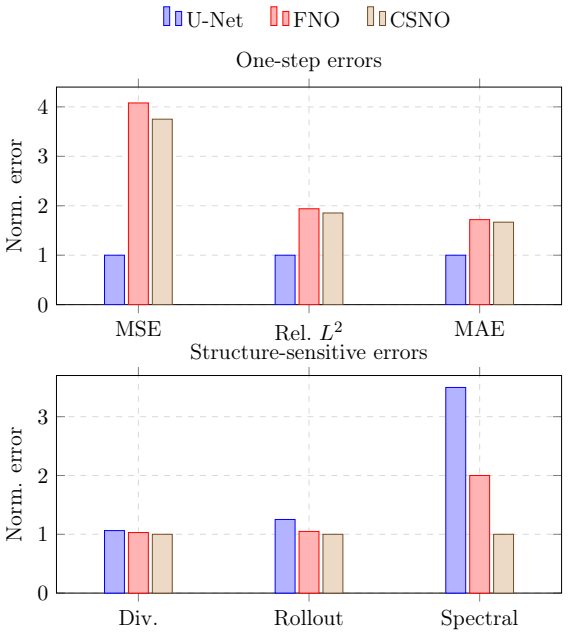
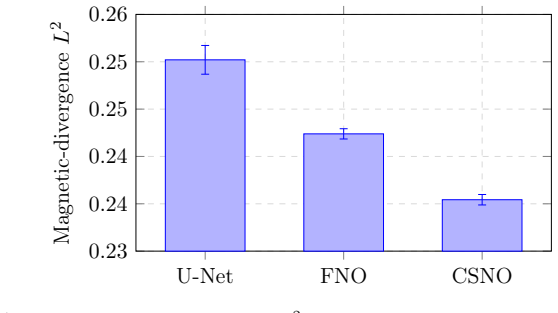
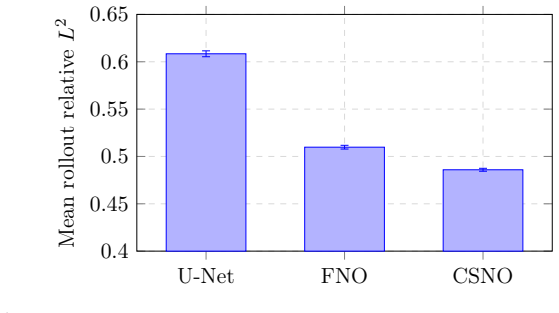
- Structure-sensitive metrics such as divergence control and equilibrium accuracy improve on turbulent MHD and fusion tasks.
- Constraints that are enforced by the cell-complex wiring do not require additional penalty terms during training.
Where Pith is reading between the lines
- The same sheaf wiring might transfer across different mesh resolutions or cell-complex refinements without retraining the restriction maps from scratch.
- The approach could apply to other constrained systems such as incompressible flow or Maxwell equations where similar incidence relations exist.
- Because the architecture encodes the geometry, the model may require fewer training samples to reach a given level of constraint satisfaction than purely data-driven operators.
Load-bearing premise
The cell-complex representation together with learned restriction maps and incidence-informed message passing can be chosen so that selected constraints arise from the architecture rather than solely from loss penalties.
What would settle it
Running the same MHD surrogate tasks with a standard neural operator baseline and finding no measurable gain in divergence error, spectral fidelity, or long-term rollout stability would show that the cellular-sheaf structure is not supplying the claimed inductive bias.
Figures
read the original abstract
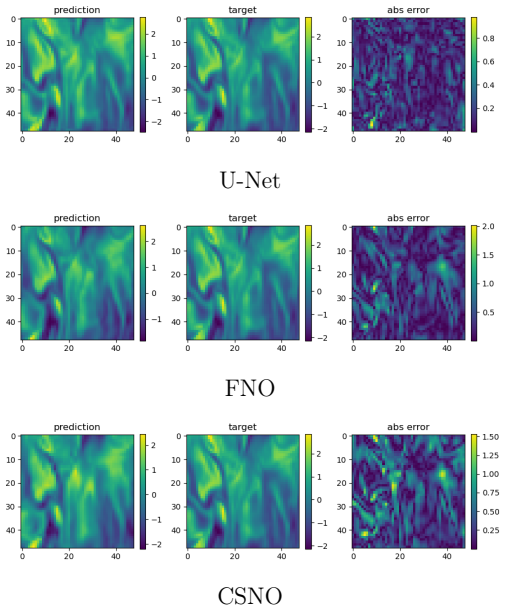
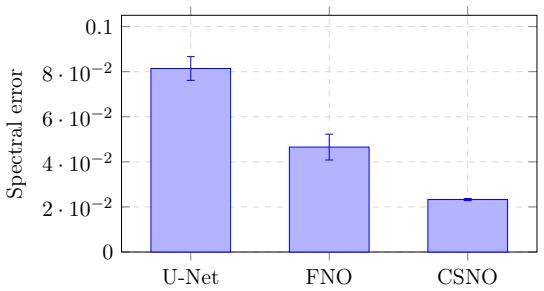
Neural operators provide fast surrogate models for PDE simulations, but standard architectures often treat geometry and discretization as secondary to field data. Physical states are usually represented as grid-channel stacks, even when different quantities naturally belong on vertices, edges, faces, cells, boundaries, or interfaces and must satisfy compatibility constraints. We propose Cellular Sheaf Neural Operators, a discretization-aware framework for structure-preserving neural PDE surrogates. The method represents PDE states on oriented cell complexes, couples local feature spaces through learned restriction maps, and uses incidence/Hodge-informed message passing to follow computational geometry. Learned update heads pass through coboundary or flux maps, allowing selected constraints to arise from cell-complex structure rather than only from loss penalties. For magnetohydrodynamics, this yields face-based magnetic-flux updates driven by edge electromotive fields and finite-volume-style fluid updates driven by learned face fluxes and cell sources. On turbulent MHD and fusion-equilibrium surrogate tasks, the method improves structure-sensitive diagnostics, including rollout behavior, divergence control, spectral error, and equilibrium-regression accuracy. These results indicate that cellular-sheaf structure is a useful inductive bias for neural PDE surrogates in constrained multiphysics systems.
Editorial analysis
A structured set of objections, weighed in public.
Referee Report
Summary. The manuscript proposes Cellular Sheaf Neural Operators (CSNO), a discretization-aware framework for structure-preserving neural PDE surrogates. Physical states are represented on oriented cell complexes, local feature spaces are coupled through learned restriction maps, and incidence/Hodge-informed message passing follows computational geometry. Learned update heads pass through coboundary or flux maps so that selected constraints (e.g., div B = 0) arise from the cell-complex structure rather than solely from loss penalties. For magnetohydrodynamics this yields face-based magnetic-flux updates driven by edge electromotive fields and finite-volume-style fluid updates. Experiments on turbulent MHD and fusion-equilibrium surrogate tasks report improvements in rollout behavior, divergence control, spectral error, and equilibrium-regression accuracy.
Significance. If the architecture demonstrably lets algebraic constraints emerge from the cell-complex representation and message passing, the work would supply a concrete inductive bias for neural operators on constrained multiphysics problems. The explicit use of sheaf-theoretic restriction maps and Hodge operators on cell complexes is a distinctive technical choice that could generalize beyond MHD.
major comments (2)
- [Abstract] Abstract and architecture description: the central claim that 'selected constraints arise from cell-complex structure rather than only from loss penalties' is load-bearing yet unsupported by any shown commutativity of the learned restriction maps with the coboundary operator or preservation of exact sequences. Without an explicit algebraic guarantee or ablation that isolates the architectural enforcement from auxiliary penalties, the structure-preserving property remains an empirical outcome rather than an architectural guarantee.
- [Abstract] The description of incidence/Hodge-informed message passing and update heads does not specify how the learned restriction maps are constrained (if at all) to ensure that the resulting discrete operators remain compatible with the underlying chain complex. This omission directly affects whether the claimed inductive bias is realized or whether the method still relies on loss terms for constraint satisfaction.
minor comments (2)
- [Abstract] The abstract refers to 'turbulent MHD and fusion-equilibrium surrogate tasks' but provides no quantitative tables, baseline comparisons, or error metrics; these details are needed to assess the magnitude of the reported improvements in structure-sensitive diagnostics.
- [Abstract] Notation for the restriction maps, coboundary operators, and Hodge star is introduced without a compact summary table or diagram relating them to standard discrete exterior calculus objects; this reduces readability for readers familiar with DEC.
Simulated Author's Rebuttal
We thank the referee for the detailed and constructive report. The comments correctly identify that the manuscript presents the structure-preserving behavior as arising from the cell-complex architecture but does not supply an algebraic proof of commutativity or exact-sequence preservation for the learned maps. We address both major comments below and indicate the revisions we will make.
read point-by-point responses
-
Referee: [Abstract] Abstract and architecture description: the central claim that 'selected constraints arise from cell-complex structure rather than only from loss penalties' is load-bearing yet unsupported by any shown commutativity of the learned restriction maps with the coboundary operator or preservation of exact sequences. Without an explicit algebraic guarantee or ablation that isolates the architectural enforcement from auxiliary penalties, the structure-preserving property remains an empirical outcome rather than an architectural guarantee.
Authors: We agree that the manuscript does not demonstrate commutativity of the learned restriction maps with the coboundary operator nor preservation of exact sequences. The claimed inductive bias is realized by routing the learned update heads through the fixed coboundary and flux maps of the cell complex; this construction places the output fields in the image of those operators by definition. Because the restriction maps themselves are learned without additional algebraic constraints, the overall constraint satisfaction remains an empirical outcome of the architecture plus training rather than a strict algebraic guarantee. In the revised version we will (i) rephrase the abstract to avoid implying a formal guarantee, (ii) add a short methods paragraph clarifying the distinction between the fixed coboundary maps and the learned restriction maps, and (iii) include an ablation that isolates the contribution of the structure-aware update heads from auxiliary divergence penalties. revision: yes
-
Referee: [Abstract] The description of incidence/Hodge-informed message passing and update heads does not specify how the learned restriction maps are constrained (if at all) to ensure that the resulting discrete operators remain compatible with the underlying chain complex. This omission directly affects whether the claimed inductive bias is realized or whether the method still relies on loss terms for constraint satisfaction.
Authors: The learned restriction maps are not explicitly constrained to commute with the coboundary or to preserve exact sequences; they are trained solely to approximate the local-to-global feature coupling on the given cell complex. Compatibility with the chain complex is enforced at the update stage, where predictions are composed with the fixed coboundary and flux maps, rather than through constraints imposed on the restriction maps. We will revise the abstract and the architecture description to state this explicitly, thereby clarifying that the inductive bias originates from the incidence/Hodge-informed message passing and the update-head composition rather than from algebraic constraints on the restriction maps themselves. revision: yes
Circularity Check
No circularity: proposal is a methodological architecture without derived predictions reducing to inputs
full rationale
The paper introduces Cellular Sheaf Neural Operators as a new discretization-aware framework. The abstract and description frame it as an inductive bias arising from cell-complex representation, learned restriction maps, and incidence/Hodge-informed message passing, with constraints claimed to arise from structure rather than solely loss penalties. No equations, derivations, or first-principles results are presented that reduce any claim to fitted parameters or self-citations by construction. The central claim is a design choice for surrogates in constrained PDEs, not a prediction extracted from data or prior self-referential results. This is a standard non-circular proposal of a neural architecture.
Axiom & Free-Parameter Ledger
free parameters (1)
- parameters of learned restriction maps
axioms (1)
- domain assumption Physical states in constrained PDEs can be represented on oriented cell complexes with local feature spaces coupled by restriction maps.
invented entities (1)
-
Cellular Sheaf Neural Operator
no independent evidence
Reference graph
Works this paper leans on
-
[1]
Kovachki, Z
N. Kovachki, Z. Li, B. Liu, K. Azizzadenesheli, K. Bhattacharya, A. Stu- art, A. Anandkumar, Neural operator: Learning maps between function spaces with applications to pdes, Journal of Machine Learning Research 24 (2023) 1–97
2023
-
[2]
Z. Li, N. B. Kovachki, K. Azizzadenesheli, B. liu, K. Bhattacharya, A. Stuart, A. Anandkumar, Fourier neural operator for parametric partial differential equations, in: International Conference on Learn- ing Representations, 2021. URL:https://openreview.net/forum?id= c8P9NQVtmnO
2021
-
[3]
L. Lu, P. Jin, G. Pang, Z. Zhang, G. E. Karniadakis, Learning nonlinear operators via deeponet based on the universal approxima- tion theorem of operators, Nature Machine Intelligence 3 (2021) 218–229. URL:http://dx.doi.org/10.1038/s42256-021-00302-5. doi:10.1038/s42256-021-00302-5
-
[4]
J. M. Hyman, M. Shashkov, The adjoint operators for the natural dis- cretizations of the divergence, gradient and curl on logically rectangular grids, Applied Numerical Mathematics 25 (1997) 413–442
1997
-
[5]
J. M. Hyman, M. Shashkov, The orthogonal decomposition theorems for mimetic finite difference methods, SIAM Journal on Numerical Analysis 36 (1999) 788–818
1999
-
[6]
M. Desbrun, A. N. Hirani, M. Leok, J. E. Marsden, Discrete ex- terior calculus, 2005. URL:https://arxiv.org/abs/math/0508341. arXiv:math/0508341
Pith/arXiv arXiv 2005
-
[7]
D. N. Arnold, R. S. Falk, R. Winther, Finite element exterior calculus, homological techniques, and applications, Acta Numerica 15 (2006) 1–
2006
-
[8]
doi:10.1017/S0962492906210018. 33
-
[9]
D. N. Arnold, R. S. Falk, R. Winther, Finite element exterior calculus: From hodge theory to numerical stability, Bulletin of the American Mathematical Society 47 (2010) 281–354
2010
-
[10]
Shikhman, Diagnosing failure modes of neural operators across di- verse PDE families, Transactions on Machine Learning Research (2026)
L. Shikhman, Diagnosing failure modes of neural operators across di- verse PDE families, Transactions on Machine Learning Research (2026). URL:https://openreview.net/forum?id=0S1LWZHQYn
2026
-
[11]
URL:https://www.sciencedirect.com/ science/article/pii/0021999180900790
J.Brackbill, D.Barnes, Theeffectofnonzero∇·Bonthenumericalsolu- tion of the magnetohydrodynamic equations, Journal of Computational Physics 35 (1980) 426–430. URL:https://www.sciencedirect.com/ science/article/pii/0021999180900790. doi:https://doi.org/10. 1016/0021-9991(80)90079-0
arXiv 1980
-
[12]
G. Tóth, The∇ ·B= 0constraint in shock-capturing magnetohydro- dynamics codes, Journal of Computational Physics 161 (2000) 605–652. doi:10.1006/jcph.2000.6519
-
[13]
R. Ohana, M. McCabe, L. Meyer, R. Morel, F. J. Agocs, M. Beneitez, M. Berger, B. Burkhart, S. B. Dalziel, D. B. Fielding, D. Fortunato, J. A. Goldberg, K. Hirashima, Y.-F. Jiang, R. R. Kerswell, S. Maddu, J. Miller, P. Mukhopadhyay, S. S. Nixon, J. Shen, R. Watteaux, B. R.-S. Blancard, F. Rozet, L. Parker, M. Cranmer, S. Ho, The well: a large-scale collec...
-
[14]
S. A. Cadena, A. Merlo, E. Laude, A. Bauer, A. Agrawal, M. Pascu, M.Savtchouk, E.Guiraud, L.Bonauer, S.Hudson, M.Kaiser, Constella- ration: A dataset of qi-like stellarator plasma boundaries and optimiza- tion benchmarks, 2025. URL:https://arxiv.org/abs/2506.19583. arXiv:2506.19583
arXiv 2025
-
[15]
R. J. LeVeque, Finite Volume Methods for Hyperbolic Problems, Cam- bridge University Press, Cambridge, 2002. 34
2002
-
[16]
Cockburn, C.-W
B. Cockburn, C.-W. Shu, Runge–kutta discontinuous galerkin methods for convection-dominated problems, Journal of Scientific Computing 16 (2001) 173–261
2001
-
[17]
J. S. Hesthaven, T. Warburton, Nodal Discontinuous Galerkin Methods: Algorithms, Analysis, and Applications, volume 54 ofTexts in Applied Mathematics, Springer, 2008
2008
-
[18]
J. Hyman, Mimetic finite difference methods for maxwell’s equations and the equations of magnetic diffusion, Progress In Electromagnetics Research 32 (2000). doi:10.2528/PIER00080104
-
[19]
Brezzi, K
F. Brezzi, K. Lipnikov, M. Shashkov, Convergence of the mimetic finite difference method for diffusion problems on polyhedral meshes, SIAM Journal on Numerical Analysis 43 (2005) 1872–1896
2005
-
[20]
A. N. Hirani, Discrete Exterior Calculus, Ph.D. thesis, California Insti- tute of Technology, 2003
2003
-
[21]
Bossavit, Computational Electromagnetism: Variational Formula- tions, Complementarity, Edge Elements, Academic Press, San Diego, 1998
A. Bossavit, Computational Electromagnetism: Variational Formula- tions, Complementarity, Edge Elements, Academic Press, San Diego, 1998
1998
-
[22]
C. R. Evans, J. F. Hawley, Simulation of magnetohydrodynamic flows: A constrained transport method, The Astrophysical Journal 332 (1988) 659–677
1988
-
[23]
D. S. Balsara, Divergence-free adaptive mesh refinement for magneto- hydrodynamics, Journal of Computational Physics 174 (2001) 614–648. URL:http://dx.doi.org/10.1006/jcph.2001.6917. doi:10.1006/ jcph.2001.6917
-
[24]
Dedner, F
A. Dedner, F. Kemm, D. Kröner, C.-D. Munz, T. Schnitzer, M. Wesen- berg, Hyperbolic divergence cleaning for the mhd equations, Journal of Computational Physics 175 (2002) 645–673
2002
-
[25]
Z. Li, N. Kovachki, K. Azizzadenesheli, B. Liu, K. Bhattacharya, A. Stu- art, A. Anandkumar, Neural operator: Graph kernel network for par- tial differential equations, 2020. URL:https://arxiv.org/abs/2003. 03485.arXiv:2003.03485. 35
Pith/arXiv arXiv 2020
-
[26]
Pfaff, M
T. Pfaff, M. Fortunato, A. Sanchez-Gonzalez, P. Battaglia, Learning mesh-based simulation with graph networks, in: International Confer- ence on Learning Representations, 2021. URL:https://openreview. net/forum?id=roNqYL0_XP
2021
-
[27]
Z. Li, D. Z. Huang, B. Liu, A. Anandkumar, Fourier neural operator with learned deformations for pdes on general geometries, Journal of Machine Learning Research 24 (2023) 1–26
2023
-
[28]
Z. Li, H. Zheng, N. Kovachki, D. Jin, H. Chen, B. Liu, K. Azizzade- nesheli, A. Anandkumar, Physics-informed neural operator for learning partial differential equations, ACM / IMS J. Data Sci. 1 (2024). URL: https://doi.org/10.1145/3648506. doi:10.1145/3648506
-
[29]
Takamoto, T
M. Takamoto, T. Praditia, R. Leiteritz, D. MacKinlay, F. Alesiani, D. Pflüger, M. Niepert, Pdebench: an extensive benchmark for scientific machine learning, in: Proceedings of the 36th International Conference on Neural Information Processing Systems, NIPS ’22, Curran Associates Inc., Red Hook, NY, USA, 2022
2022
-
[30]
Shikhman, One operator to rule them all? on boundary-indexed operator families in neural PDE solvers, in: AI&PDE: ICLR 2026 Workshop on AI and Partial Differential Equations, 2026
L. Shikhman, One operator to rule them all? on boundary-indexed operator families in neural PDE solvers, in: AI&PDE: ICLR 2026 Workshop on AI and Partial Differential Equations, 2026. URL:https: //openreview.net/forum?id=lDjWQ9UxRy
2026
-
[31]
M. M. Bronstein, J. Bruna, T. Cohen, P. Veličković, Geometric deep learning: Grids, groups, graphs, geodesics, and gauges, 2021. URL: https://arxiv.org/abs/2104.13478.arXiv:2104.13478
Pith/arXiv arXiv 2021
-
[32]
T. N. Kipf, M. Welling, Semi-supervised classification with graph convo- lutional networks, in: International Conference on Learning Represen- tations, 2017. URL:https://openreview.net/forum?id=SJU4ayYgl
2017
-
[33]
Gilmer, S
J. Gilmer, S. S. Schoenholz, P. F. Riley, O. Vinyals, G. E. Dahl, Neural message passing for quantum chemistry, in: International Conference on Machine Learning, PMLR, 2017, pp. 1263–1272
2017
-
[34]
Sanchez-Gonzalez, N
A. Sanchez-Gonzalez, N. Heess, J. T. Springenberg, J. Merel, M. Ried- miller, R. Hadsell, P. Battaglia, Graph networks as learnable physics en- gines for inference and control, in: J. Dy, A. Krause (Eds.), Proceedings 36 of the 35th International Conference on Machine Learning, volume 80 of Proceedings of Machine Learning Research, PMLR, 2018, pp. 4470–44...
2018
-
[35]
M. Hajij, G. Zamzmi, T. Papamarkou, N. Miolane, A. Guzmán-Sáenz, K. N. Ramamurthy, T. Birdal, T. K. Dey, S. Mukherjee, S. N. Samaga, N. Livesay, R. Walters, P. Rosen, M. T. Schaub, Topological deep learn- ing: Going beyond graph data, 2023. URL:https://arxiv.org/abs/ 2206.00606.arXiv:2206.00606
arXiv 2023
-
[36]
M. Papillon, S. Sanborn, M. Hajij, N. Miolane, Architectures of topological deep learning: A survey of message-passing topological neural networks, 2024. URL:https://arxiv.org/abs/2304.10031. arXiv:2304.10031
arXiv 2024
-
[37]
Papamarkou, T
T. Papamarkou, T. Birdal, M. M. Bronstein, G. E. Carlsson, J. Curry, Y. Gao, M. Hajij, R. Kwitt, P. Lio, P. Di Lorenzo, V. Maroulas, N. Mi- olane, F. Nasrin, K. Natesan Ramamurthy, B. Rieck, S. Scardapane, M. T. Schaub, P. Veličković, B. Wang, Y. Wang, G. Wei, G. Za- mzmi, Position: Topological deep learning is the new frontier for re- lational learning, ...
2024
-
[38]
S. Ebli, M. Defferrard, G. Spreemann, Simplicial neural networks, arXiv preprint arXiv:2010.03633 (2020)
arXiv 2010
-
[39]
Bodnar, F
C. Bodnar, F. Frasca, Y. Wang, N. Otter, G. F. Montufar, P. Lió, M. Bronstein, Weisfeiler and lehman go topological: Message passing simplicial networks, in: M. Meila, T. Zhang (Eds.), Proceedings of the 38th International Conference on Machine Learning, volume 139 ofPro- ceedings of Machine Learning Research, PMLR, 2021, pp. 1026–1037. URL:https://procee...
2021
-
[40]
Hajij, K
M. Hajij, K. Istvan, G. Zamzmi, Cell complex neural networks, in: TDA & Beyond, 2020. URL:https://openreview.net/forum?id= 6Tq18ySFpGU. 37
2020
-
[41]
Bodnar, F
C. Bodnar, F. Frasca, N. Otter, Y. G. Wang, P. Liò, G. Montu- far, M. M. Bronstein, Weisfeiler and lehman go cellular: CW net- works, in: A. Beygelzimer, Y. Dauphin, P. Liang, J. W. Vaughan (Eds.), Advances in Neural Information Processing Systems, 2021. URL: https://openreview.net/forum?id=uVPZCMVtsSG
2021
-
[42]
T. M. Roddenberry, S. Segarra, Hodgenet: Graph neural networks for edge data, 2019. doi:10.1109/IEEECONF44664.2019.9049000
-
[43]
T. M. Roddenberry, N. Glaze, S. Segarra, Principled simplicial neu- ral networks for trajectory prediction, in: M. Meila, T. Zhang (Eds.), Proceedings of the 38th International Conference on Machine Learn- ing, volume 139 ofProceedings of Machine Learning Research, PMLR, 2021, pp. 9020–9029. URL:https://proceedings.mlr.press/v139/ roddenberry21a.html
2021
-
[44]
M. T. Schaub, Y. Zhu, J.-B. Seby, T. M. Roddenberry, S. Segarra, Signal processing on higher-order networks: Livin’ on the edge... and beyond, Signal Processing 187 (2021) 108149. URL:https://www. sciencedirect.com/science/article/pii/S0165168421001870. doi:https://doi.org/10.1016/j.sigpro.2021.108149
-
[45]
J. Hansen, R. Ghrist, Toward a spectral theory of cellular sheaves, Journal of Applied and Computational Topology 3 (2019) 315–358. doi:10.1007/s41468-019-00038-7
-
[46]
Hansen, T
J. Hansen, T. Gebhart, Sheaf neural networks, in: TDA & Beyond,
-
[47]
URL:https://openreview.net/forum?id=GgcgIJsT8HD
-
[48]
Bodnar, F
C. Bodnar, F. Di Giovanni, B. Chamberlain, P. Lió, M. Bronstein, Neu- ral sheaf diffusion: A topological perspective on heterophily and over- smoothing in gnns, in: S. Koyejo, S. Mohamed, A. Agarwal, D. Bel- grave, K. Cho, A. Oh (Eds.), Advances in Neural Information Process- ing Systems, volume 35, Curran Associates, Inc., 2022, pp. 18527–18541. URL:http...
2022
-
[49]
Barbero, C
F. Barbero, C. Bodnar, H. Sáez de Ocáriz Borde, M. Bronstein, P. Veličković, P. Liò, Sheaf neural networks with connection lapla- cians, in: A. Cloninger, T. Doster, T. Emerson, M. Kaul, I. Ktena, 38 H. Kvinge, N. Miolane, B. Rieck, S. Tymochko, G. Wolf (Eds.), Pro- ceedings of Topological, Algebraic, and Geometric Learning Work- shops 2022, volume 196 of...
2022
-
[50]
J. P. Goedbloed, S. Poedts, Principles of Magnetohydrodynamics: With Applications to Laboratory and Astrophysical Plasmas, Cambridge Uni- versity Press, Cambridge, 2004
2004
-
[51]
J. P. Freidberg, Ideal MHD, Cambridge University Press, Cambridge, 2014
2014
-
[52]
K. D. Makwana, H. Yan, Properties of magnetohydrodynamic modes in compressively driven plasma turbulence, Phys. Rev. X 10 (2020) 031021. URL:https://link.aps.org/doi/10.1103/ PhysRevX.10.031021. doi:10.1103/PhysRevX.10.031021
-
[53]
K. G. Powell, P. L. Roe, T. J. Linde, T. I. Gombosi, D. L. De Zeeuw, A solution-adaptive upwind scheme for ideal magnetohydrodynamics, Journal of Computational Physics 154 (1999) 284–309. doi:10.1006/ jcph.1999.6299
arXiv 1999
-
[54]
T. Miyoshi, K. Kusano, A multi-state HLL approximate riemann solver for ideal magnetohydrodynamics, Journal of Computational Physics 208 (2005) 315–344. doi:10.1016/j.jcp.2005.02.017
-
[55]
T. A. Gardiner, J. M. Stone, An unsplit Godunov method for ideal MHD viaconstrained transport inthree dimensions, Journal ofComputational Physics 227 (2008) 4123–4141. doi:10.1016/j.jcp.2007.12.017
-
[56]
J. M. Stone, T. A. Gardiner, P. Teuben, J. F. Hawley, J. B. Simon, Athena: A new code for astrophysical MHD, The Astrophysical Journal Supplement Series 178 (2008) 137–177. doi:10.1086/588755
-
[57]
T. Kim, Y. Ha, M. Kang, Neural operators learn the lo- cal physics of magnetohydrodynamics, Computers & Fluids 297 (2025) 106661. URL:https://www.sciencedirect.com/science/ article/pii/S0045793025001215. doi:https://doi.org/10.1016/j. compfluid.2025.106661. 39
work page doi:10.1016/j 2025
-
[58]
Maggs, C
K. Maggs, C. Hacker, B. Rieck, Simplicial representation learning with neural $k$-forms, in: The Twelfth International Conference on Learn- ing Representations, 2024. URL:https://openreview.net/forum?id= Djw0XhjHZb
2024
-
[59]
Kova˘ c, E
V. Kova˘ c, E. Bekkers, P. Lió, F. Eijkelboom, E(n) equivariant message passing cellular networks, in: S. Vadgama, E. Bekkers, A. Pouplin, S.-O. Kaba, R. Walters, H. Lawrence, T. Emerson, H. Kvinge, J. Tomczak, S. Jegelka (Eds.), Proceedings of the Geometry-grounded Representa- tion Learning and Generative Modeling Workshop (GRaM), volume 251 ofProceeding...
2024
-
[60]
Burkhart, S
B. Burkhart, S. Appel, S. Bialy, J. Cho, A. Christensen, D. Collins, C. Federrath, D. Fielding, D. Finkbeiner, A. Hill, et al., The catalogue for astrophysical turbulence simulations (cats), The Astrophysical Jour- nal 905 (2020) 14
2020
-
[61]
Ronneberger, P
O. Ronneberger, P. Fischer, T. Brox, U-net: Convolutional networks for biomedical image segmentation, in: N. Navab, J. Hornegger, W. M. Wells, A. F. Frangi (Eds.), Medical Image Computing and Computer- Assisted Intervention – MICCAI 2015, Springer International Publish- ing, Cham, 2015, pp. 234–241
2015
-
[62]
Paszke, S
A. Paszke, S. Gross, F. Massa, A. Lerer, J. Bradbury, G. Chanan, T. Killeen, Z. Lin, N. Gimelshein, L. Antiga, A. Desmaison, A. Köpf, E. Yang, Z. DeVito, M. Raison, A. Tejani, S. Chilamkurthy, B. Steiner, L. Fang, J. Bai, S. Chintala, PyTorch: an imperative style, high- performance deep learning library, Curran Associates Inc., Red Hook, NY, USA, 2019
2019
-
[63]
B. D. Shaffer, S. Koohy, B. Kinch, M. A. Hsieh, N. Trask, Structure- preserving learning improves geometry generalization in neural pdes, 2026.URL:https://arxiv.org/abs/2602.02788.arXiv:2602.02788
Pith/arXiv arXiv 2026
- [64]
-
[65]
S. Lanthaler, S. Mishra, G. E. Karniadakis, Error estimates for deep- onets: a deep learning framework in infinite dimensions, Transactions of Mathematics and Its Applications 6 (2022) tnac001. URL:https: //doi.org/10.1093/imatrm/tnac001. doi:10.1093/imatrm/tnac001. arXiv:https://academic.oup.com/imatrm/article-pdf/6/1/tnac001/42785544/tnac001.pdf
- [66]
-
[67]
McCabe, P
M. McCabe, P. Harrington, S. Subramanian, J. Brown, Towards sta- bility of autoregressive neural operators, Transactions on Machine Learning Research (2023). URL:https://openreview.net/forum?id= RFfUUtKYOG. 41
2023
discussion (0)
Sign in with ORCID, Apple, or X to comment. Anyone can read and Pith papers without signing in.