Property Prediction of Stacked Bilayer Materials: A Multimodal Learning Approach
Pith reviewed 2026-06-28 17:28 UTC · model grok-4.3
The pith
A multimodal model predicts properties of new stacked 2D material bilayers from existing interface data.
A machine-rendered reading of the paper's core claim, the machinery that carries it, and where it could break.
Core claim
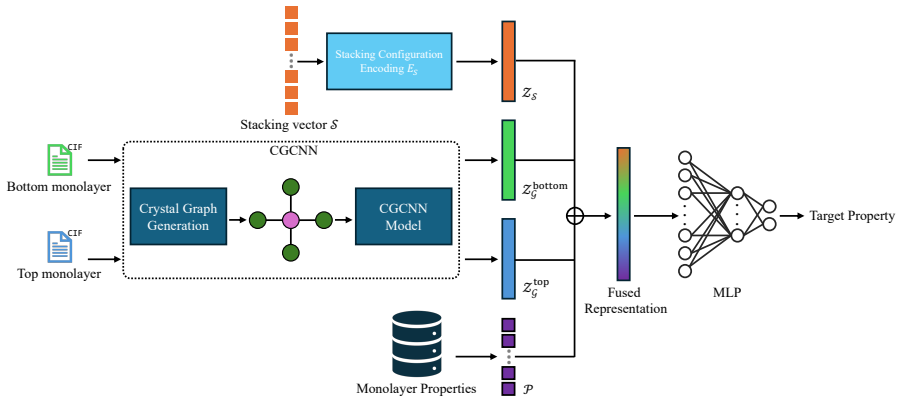
We propose a novel multimodal learning approach to study the interfaces between dissimilar materials that jointly enable new or multiple functions, and to predict new properties arising from the vertical integration (stacking) of different functional material layers under given configurations. Comprehensive experiments demonstrate the effectiveness and efficiency of our approach compared to baseline methods.
What carries the argument
Multimodal learning framework that fuses data representations from material composition, structure, and stacking configuration to capture interface effects.
If this is right
- New bilayer configurations can be screened for desired properties before any synthesis or detailed simulation occurs.
- Vertical stacking of functional layers becomes a more systematic design tool for creating materials with tailored interface phenomena.
- High-throughput computational databases can be supplemented or partially replaced by faster learned predictions for initial exploration.
- The method supports discovery of 2D materials that combine multiple functions through controlled layer integration.
Where Pith is reading between the lines
- The same fusion of modalities could be tested on trilayer or thicker stacks to check whether the approach scales beyond bilayers.
- Discrepancies between model outputs and physical calculations would highlight which stacking effects still require explicit physical modeling.
- If the model identifies reliable combinations, it could suggest experimental targets that prioritize interface stability or specific electronic responses.
Load-bearing premise
Patterns learned from existing bilayer stacks will generalize to predict properties of new, unsynthesized material combinations without extra physical constraints or first-principles checks.
What would settle it
Generate predictions for several previously unstudied bilayer combinations and compare them directly to density functional theory calculations or experimental measurements on those same stacks.
Figures
read the original abstract
AI for materials science is a critical topic within AI for science, aiming to accelerate materials discovery and produce accurate property predictions. Bilayer 2D material stacking is essential for exploring new materials with novel functions and inherent phenomena, enabling the creation of new 2D bilayers for diverse real-world applications. Research on bilayer vdWs materials has made significant progress from experimental and computational perspectives. Various bilayer materials have been successfully synthe sized experimentally and the increasing utilization of high-throughput computing technology has con structed several computational two-dimensional materials databases. However, the use of AI to model bilayer stacking and predict new properties remains underexplored, necessitating further research studies. In this work, we propose a novel multimodal learning approach to study the interfaces between dissimilar materials that jointly enable new or multiple functions, and to predict new properties arising from the vertical integration (stacking) of different functional material layers under given configurations. Comprehensive experiments demonstrate the effectiveness and efficiency of our approach compared to baseline methods. Our code is available at https://github.com/AnVuong123/bimat ml.
Editorial analysis
A structured set of objections, weighed in public.
Referee Report
Summary. The manuscript proposes a multimodal learning approach for modeling interfaces in dissimilar 2D materials and predicting emergent properties arising from vertical stacking of functional layers under given configurations. It reports comprehensive experiments demonstrating improved effectiveness and efficiency relative to baseline methods, with code released at the provided GitHub link.
Significance. If the multimodal representations reliably capture interface effects such as charge transfer and lattice mismatch for extrapolation, the method could accelerate screening of new bilayer stacks beyond existing databases. The public code release supports reproducibility.
major comments (2)
- [Abstract] Abstract: the central claim that the approach predicts 'new properties arising from the vertical integration' of unsynthesized stacks rests on generalization from training data; however, the described experiments compare only to ML baselines on (presumably) held-out splits from existing databases, with no first-principles DFT validation or experimental checks on truly novel configurations mentioned. This is load-bearing for the utility claim.
- [Abstract] The weakest assumption (generalization without additional physical constraints) is not addressed by any reported ablation or out-of-distribution test; superior in-distribution performance alone does not establish reliable prediction of emergent interface physics for new stacks.
minor comments (1)
- [Abstract] The abstract states 'comprehensive experiments' but provides no metrics, dataset sizes, or baseline details; these should be summarized with quantitative results.
Simulated Author's Rebuttal
We thank the referee for the constructive comments highlighting the scope of our claims and validation strategy. We address each point below and will revise the manuscript accordingly.
read point-by-point responses
-
Referee: [Abstract] Abstract: the central claim that the approach predicts 'new properties arising from the vertical integration' of unsynthesized stacks rests on generalization from training data; however, the described experiments compare only to ML baselines on (presumably) held-out splits from existing databases, with no first-principles DFT validation or experimental checks on truly novel configurations mentioned. This is load-bearing for the utility claim.
Authors: We agree that the abstract phrasing could overstate the direct evidence for unsynthesized stacks. The reported experiments use held-out splits from existing DFT-derived databases to evaluate prediction of stacking-induced properties. We will revise the abstract to clarify that performance is demonstrated on diverse held-out configurations from available data, and add a limitations paragraph noting the absence of new DFT or experimental checks on truly novel stacks. revision: yes
-
Referee: [Abstract] The weakest assumption (generalization without additional physical constraints) is not addressed by any reported ablation or out-of-distribution test; superior in-distribution performance alone does not establish reliable prediction of emergent interface physics for new stacks.
Authors: The observation is correct: the manuscript does not include dedicated OOD ablations or tests that isolate generalization to highly dissimilar material pairs. We will add such an evaluation (e.g., training on subsets of material families and testing on held-out families) in the revised version to better substantiate the multimodal representation's capture of interface effects. revision: yes
Circularity Check
No derivation chain; empirical ML evaluation on bilayer data
full rationale
The paper presents a multimodal neural network for predicting properties of stacked 2D bilayers, trained and tested on existing database entries with comparisons to ML baselines. No mathematical derivation, first-principles reduction, or self-referential prediction step is claimed or present; performance claims rest on held-out empirical splits rather than any constructed equivalence between inputs and outputs. No self-citation load-bearing steps or fitted-input-as-prediction patterns appear in the provided text.
Axiom & Free-Parameter Ledger
Reference graph
Works this paper leans on
-
[1]
High throughput calculations for a dataset of bilayer materials.Scientific Data, 10(1):232,
[Barik and Woods, 2023] Ranjan Kumar Barik and Lilia M Woods. High throughput calculations for a dataset of bilayer materials.Scientific Data, 10(1):232,
2023
-
[2]
Graph networks as a universal machine learning framework for molecules and crystals
[Chenet al., 2019 ] Chi Chen, Weike Ye, Yunxing Zuo, Chen Zheng, and Shyue Ping Ong. Graph networks as a universal machine learning framework for molecules and crystals. Chemistry of Materials, 31(9):3564–3572,
2019
-
[3]
Structural embedding methods for machine learning models accelerate research on stacked 2d materials.The Journal of Physical Chemistry C, 128(37):15512–15521,
[Chenet al., 2024 ] Xinyu Chen, Guoliang Ru, and Weihong Qi. Structural embedding methods for machine learning models accelerate research on stacked 2d materials.The Journal of Physical Chemistry C, 128(37):15512–15521,
2024
-
[4]
Atomistic line graph neural network for improved materials property predictions.npj Computational Materi- als, 7(1):185,
[Choudhary and DeCost, 2021] Kamal Choudhary and Brian DeCost. Atomistic line graph neural network for improved materials property predictions.npj Computational Materi- als, 7(1):185,
2021
-
[5]
[Gjerdinget al., 2021 ] M. N. Gjerding, A. Taghizadeh, A. Rasmussen, S. Ali, F. Bertoldo, T. Deilmann, N. R. Knøsgaard, M. Kruse, A. H. Larsen, S. Manti, T. G. Ped- ersen, U. Petralanda, T. Skovhus, M. K. Svendsen, J. J. Mortensen, T. Olsen, and K. S. Thygesen. Recent progress of the computational 2d materials database (c2db).2D Materials, 8(4):044002,
2021
-
[6]
Efficient iterative schemes for ab initio total- energy calculations using a plane-wave basis set.Physical review B, 54(16):11169,
[Kresse and Furthm¨uller, 1996] Georg Kresse and J ¨urgen Furthm¨uller. Efficient iterative schemes for ab initio total- energy calculations using a plane-wave basis set.Physical review B, 54(16):11169,
1996
-
[7]
Observation of van hove singularities in twisted graphene layers.Nature physics, 6(2):109–113,
[Liet al., 2010 ] Guohong Li, A Luican, JMB Lopes dos San- tos, AH Castro Neto, A Reina, J Kong, and EY Andrei. Observation of van hove singularities in twisted graphene layers.Nature physics, 6(2):109–113,
2010
-
[8]
Scaling deep learning for materials discovery.Nature, 624(7990):80–85,
[Merchantet al., 2023 ] Amil Merchant, Simon Batzner, Samuel S Schoenholz, Muratahan Aykol, Gowoon Cheon, and Ekin Dogus Cubuk. Scaling deep learning for materials discovery.Nature, 624(7990):80–85,
2023
-
[9]
Two-dimensional materials from high-throughput computational exfoliation of experimentally known compounds.Nature nanotechnol- ogy, 13(3):246–252,
[Mounetet al., 2018 ] Nicolas Mounet, Marco Gibertini, Philippe Schwaller, Davide Campi, Andrius Merkys, An- timo Marrazzo, Thibault Sohier, Ivano Eligio Castelli, An- drea Cepellotti, Giovanni Pizzi, et al. Two-dimensional materials from high-throughput computational exfoliation of experimentally known compounds.Nature nanotechnol- ogy, 13(3):246–252,
2018
-
[10]
High-throughput computational stacking reveals emergent properties in natural van der waals bilay- ers.Nature Communications, 15(1):932,
[Pakdelet al., 2024 ] Sahar Pakdel, Asbjørn Rasmussen, Alireza Taghizadeh, Mads Kruse, Thomas Olsen, and Kris- tian S Thygesen. High-throughput computational stacking reveals emergent properties in natural van der waals bilay- ers.Nature Communications, 15(1):932,
2024
-
[11]
[Saueret al., 2025 ] M. O. Sauer, P. M. Lyngby, and K. S. Thygesen. Dispersion-corrected machine learning poten- tials for 2d van der waals materials.Physical Review Mate- rials, 9(7),
2025
-
[12]
Equivariant message passing for the prediction of tensorial properties and molecular spectra
[Sch¨uttet al., 2023 ] Kristof T Sch ¨utt, Oliver T Unke, and Michael Gastegger. Equivariant message passing for the prediction of tensorial properties and molecular spectra. 2021.URL https://arxiv. org/abs/2102.03150,
arXiv 2023
-
[13]
[Vanet al., 2025 ] Minh-Hao Van, Prateek Verma, Chen Zhao, and Xintao Wu. A survey of ai for materials science: Foundation models, llm agents, datasets, and tools.arXiv preprint arXiv:2506.20743,
arXiv 2025
-
[14]
Stacking-engineered heterostructures in transition metal dichalcogenides.Advanced Materials, 33(16):2005735,
[Wanget al., 2021 ] Shixuan Wang, Xuehao Cui, Chang’e Jian, Haowei Cheng, Mengmeng Niu, Jia Yu, Jiaxu Yan, and Wei Huang. Stacking-engineered heterostructures in transition metal dichalcogenides.Advanced Materials, 33(16):2005735,
2021
-
[15]
Pyhtstack2d: A python package for high-throughput homo/hetero stacking of 2d materials.Computer Physics Communications, 312:109618,
[Zhanget al., 2025 ] Qian Zhang, Jinlong Yang, and Wei Hu. Pyhtstack2d: A python package for high-throughput homo/hetero stacking of 2d materials.Computer Physics Communications, 312:109618,
2025
-
[16]
2dmatpedia, an open computational database of two-dimensional materials from top-down and bottom-up approaches.Scientific data, 6(1):86, 2019
[Zhouet al., 2019 ] Jun Zhou, Lei Shen, Miguel Dias Costa, Kristin A Persson, Shyue Ping Ong, Patrick Huck, Yun- hao Lu, Xiaoyang Ma, Yiming Chen, Hanmei Tang, et al. 2dmatpedia, an open computational database of two-dimensional materials from top-down and bottom-up approaches.Scientific data, 6(1):86, 2019
2019
discussion (0)
Sign in with ORCID, Apple, or X to comment. Anyone can read and Pith papers without signing in.