REVIEW 2 major objections 2 minor 45 references
Interaction-Limited Safe Continuous-Time RL for Dynamical Medical Treatment
T0 review · 2 major / 2 minor · reviewed 2026-06-28 · grok-4.3
Pith's one-line read Suitably constructed constraints at clinical interaction times guarantee safety over the full continuous-time patient trajectory with high probability.
desk verdict The paper gives a concrete way to optimize both treatment and interaction timing in continuous-time medical RL with safety that transfers from discrete points to full trajectories, but the guarantees rest on the SMDP capturing all relevant dynamics. read the letter →
The pith
A machine-rendered reading of the paper's core claim, the machinery that carries it, and where it could break.
The reading
What carries the argument
The safety-tightening mechanism in the option-based semi-Markov decision process, where each option pairs a continuous-time treatment policy with a duration, transfers safety from discrete interaction points to the intervening trajectory.
What would settle it
Apply a learned policy in a continuous-time simulator containing adverse-event dynamics outside the semi-Markov model and check whether safety violations appear between interaction times despite satisfied discrete constraints.
Extended reading notes
Core claim
The central claim is that in an option-based semi-Markov decision process formulation of continuous-time medical treatment, suitably constructed constraints at interaction times guarantee safety over the full continuous-time trajectory with high probability, while finite-sample guarantees hold for policy learning from logged treatment trajectories and a data-driven conservative surrogate enables practical use.
Load-bearing premise
Continuous-time patient dynamics and adverse events between interactions are fully captured by the option-based semi-Markov formulation without unmodeled effects that break the safety transfer.
Editorial extensions
If this is right
- Joint optimization of treatment policies and interaction timings is possible under trajectory-level safety constraints.
- Finite-sample guarantees support policy learning directly from logged treatment trajectories.
- A data-driven conservative surrogate provides a practical way to enforce the safety tightening.
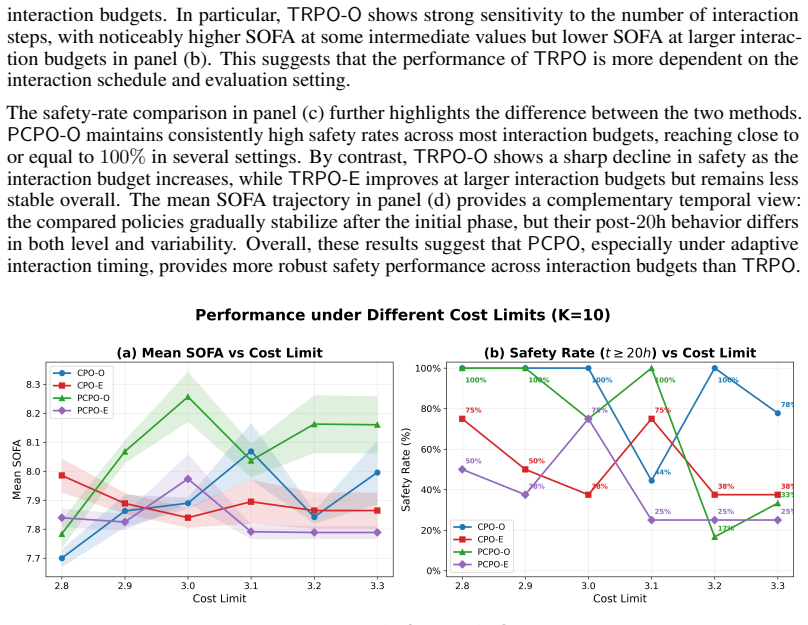
- Adaptive interaction timing improves both safety and treatment effectiveness compared with equidistant schemes.
Reading between the lines
- The approach could apply to other control settings with sparse observation opportunities and continuous underlying dynamics.
- Fewer but better-timed clinical visits might become feasible while preserving safety margins.
- Real-world deployment would need checks against patient dynamics that deviate from the semi-Markov assumption.
Editorial analysis
A structured set of objections, weighed in public.
Referee Report
Summary. The paper proposes Interaction-Limited Safe Continuous-Time Reinforcement Learning for dynamical medical treatment. It reformulates the problem as an option-based semi-Markov decision process (SMDP) where options encode continuous-time treatment policies and durations, introduces a safety-tightening mechanism asserting that suitably constructed constraints at interaction times ensure safety over the full continuous-time trajectory with high probability, provides finite-sample guarantees for policy learning from logged data, and presents a data-driven conservative surrogate. Experiments are claimed to demonstrate that adaptive interaction timing improves safety and effectiveness over equidistant schemes across safe policy optimization methods.
Significance. If the safety transfer and finite-sample results hold under the stated modeling assumptions, the work would address a practically relevant gap in continuous-time safe RL for settings with limited clinical interactions, such as medical treatment scheduling. The explicit handling of interaction timing alongside treatment intensity, combined with trajectory-level guarantees, would be a substantive contribution over discrete-time or fixed-schedule baselines.
major comments (2)
- [Safety-tightening mechanism (abstract and theoretical development)] The central safety claim—that constraints at interaction times guarantee full-trajectory safety with high probability—rests on the option-based SMDP accurately capturing all continuous-time patient dynamics and adverse-event hazards between interactions. The manuscript provides no formal statement of this modeling assumption, no robustness analysis to unmodeled continuous-time effects, and no verification that the semi-Markov structure suffices (see skeptic note on the weakest assumption).
- [Finite-sample guarantees] Finite-sample guarantees for policy learning are asserted in the abstract, yet the provided text contains no derivation details, proof sketches, or verification steps, preventing assessment of whether the bounds are non-vacuous or depend on additional unstated assumptions.
minor comments (2)
- [Abstract] The abstract states that experiments show improvement but reports neither quantitative metrics, baselines, nor statistical significance; these details should be summarized with effect sizes.
- [Method] Notation for the option-based SMDP (e.g., option duration distributions, safety constraint tightening operator) should be introduced with explicit definitions before the safety mechanism is described.
Simulated Author's Rebuttal
We thank the referee for the constructive feedback. We address the major comments point-by-point below, providing clarifications and committing to revisions that make the modeling assumptions and theoretical derivations explicit.
read point-by-point responses
-
Referee: [Safety-tightening mechanism (abstract and theoretical development)] The central safety claim—that constraints at interaction times guarantee full-trajectory safety with high probability—rests on the option-based SMDP accurately capturing all continuous-time patient dynamics and adverse-event hazards between interactions. The manuscript provides no formal statement of this modeling assumption, no robustness analysis to unmodeled continuous-time effects, and no verification that the semi-Markov structure suffices (see skeptic note on the weakest assumption).
Authors: We agree that the central modeling assumption requires an explicit formal statement. The assumption is that the continuous-time patient dynamics and adverse-event hazards between interactions are fully captured by the chosen option (treatment policy and duration) in the SMDP, with no unmodeled jumps or hazards outside this structure. We will add this as Assumption 3.1 in the revised manuscript. The safety-tightening mechanism then propagates the interaction-time constraints to the full trajectory via the option's continuous-time evolution. Regarding robustness, the high-probability guarantee is conditional on the model; we will add a dedicated limitations paragraph discussing potential misspecification. The semi-Markov structure is appropriate and sufficient because it directly encodes variable-duration continuous-time segments without requiring fixed discretization, which aligns with limited-interaction medical settings. The skeptic note referenced is not included in the report, but the structure holds under the standard Lipschitz and bounded-hazard conditions stated in Section 3. revision: yes
-
Referee: [Finite-sample guarantees] Finite-sample guarantees for policy learning are asserted in the abstract, yet the provided text contains no derivation details, proof sketches, or verification steps, preventing assessment of whether the bounds are non-vacuous or depend on additional unstated assumptions.
Authors: The finite-sample guarantees appear as Theorem 4.2, derived via concentration inequalities on the empirical conservative surrogate under the logged option trajectories. We acknowledge that the main text omitted the full derivation for space reasons. In the revision we will insert a concise proof sketch immediately after the theorem statement, outlining the application of vector-valued Hoeffding bounds to the SMDP value estimates, the dependence on trajectory count and option duration variance, and the role of the data-driven surrogate. This will make clear that the bounds are non-vacuous for moderate sample sizes and explicitly list all assumptions (e.g., bounded rewards, known option termination probabilities). revision: yes
Circularity Check
No significant circularity; safety guarantee rests on external modeling assumptions
full rationale
The paper's key result (safety transfer from interaction-time constraints to full continuous-time trajectories) is derived from the option-based SMDP reformulation and a safety-tightening mechanism. No quoted equations or text reduce this claim to a self-definition, a fitted parameter renamed as prediction, or a load-bearing self-citation chain. The derivation is self-contained once the SMDP modeling assumption is granted; that assumption is stated as a premise rather than derived within the paper. No patterns matching the enumerated circularity kinds are exhibited.
Assumptions & free parameters
assumptions (1)
- domain assumption Continuous-time treatment dynamics and adverse events can be represented via an option-based semi-Markov decision process.
Cite this review
Pith. "Pith review of Interaction-Limited Safe Continuous-Time RL for Dynamical Medical Treatment." pith.science (2026). https://pith.science/paper/Y4RC7XBV
@misc{pith2026260601051,
  author       = {Pith},
  title        = {Pith review of: Interaction-Limited Safe Continuous-Time RL for Dynamical Medical Treatment},
  year         = {2026},
  howpublished = {\url{https://pith.science/paper/Y4RC7XBV}},
  note         = {Machine review of arXiv:2606.01051}
}
read the original abstract
Dynamic medical treatment requires deciding treatment intensity and intervention timing, while patient states evolve continuously and adverse events may occur between clinical interactions. Most existing treatment learning methods assume fixed schedules or enforce safety only at discrete decision points. We propose Interaction-Limited Safe Continuous-Time Reinforcement Learning, a framework that jointly optimizes treatment administration and clinical interaction timing under trajectory-level safety constraints. Our key idea is to reformulate the continuous time treatment problem as an option-based semi-Markov decision process, where each option specifies a continuous-time treatment policy and its duration. We develop a safety-tightening mechanism showing that suitably constructed constraints at interaction times guarantee safety over the full continuous-time trajectory with high probability. We further establish finite-sample guarantees for policy learning from logged treatment trajectories and introduce a practical data-driven conservative surrogate. Experiments show that the proposed adaptive interaction-timing mechanism improves both safety and treatment effectiveness over equidistant interaction schemes across different safe policy optimization methods.
Figures


Figures from the paper (9 more)



Reference graph
Works this paper leans on
-
[1]
Constrained policy optimization
Joshua Achiam, David Held, Aviv Tamar, and Pieter Abbeel. Constrained policy optimization. In Proceedings of the 34th International Conference on Machine Learning - Volume 70, ICML’17, page 22–31. JMLR.org, 2017
2017
-
[2]
Routledge, 2021
Eitan Altman.Constrained Markov decision processes. Routledge, 2021
2021
-
[3]
The option-critic architecture
Pierre-Luc Bacon, Jean Harb, and Doina Precup. The option-critic architecture. InProceedings of the AAAI conference on artificial intelligence, volume 31, 2017
2017
-
[4]
Kellum, and Claudio Ronco
Rinaldo Bellomo, John A. Kellum, and Claudio Ronco. Acute kidney injury.The Lancet, 380 (9843):756–766, 2012
2012
-
[5]
R. S. Carbajo, J. Palma, and I. Martin-Loeches. The next frontier in sepsis: Connected icu data for real-world clinical decision making.Intensive Care Medicine, 52:301–308, 2026
2026
-
[6]
A lyapunov-based approach to safe reinforcement learning.Advances in neural information processing systems, 31, 2018
Yinlam Chow, Ofir Nachum, Edgar Duenez-Guzman, and Mohammad Ghavamzadeh. A lyapunov-based approach to safe reinforcement learning.Advances in neural information processing systems, 31, 2018
2018
-
[7]
Serum lactate is associated with mortality in severe sepsis independent of organ failure and shock.Critical Care Medicine, 37(5):1670–1677, 2009
Jason D Christie, Scarlett Bellamy, Chirag V Shah, Barry D Fuchs, Munish Goyal, David F Gaieski, Anne N Miltiades, and Mark E Mikkelsen. Serum lactate is associated with mortality in severe sepsis independent of organ failure and shock.Critical Care Medicine, 37(5):1670–1677, 2009
2009
-
[8]
Bonferroni inequalities.The Annals of Probability, 5(4):577–581, 1977
János Galambos. Bonferroni inequalities.The Annals of Probability, 5(4):577–581, 1977
1977
Show all 45 references
-
[9]
Ghossein, B
J. Ghossein, B. N. Hryciw, and K. Kyeremanteng. Redefining sepsis management: The comprehensive impact of artificial intelligence.Journal of Intensive Medicine, 5(2):134–136, September 2024
2024
-
[10]
Guidelines for reinforcement learning in healthcare.Nature medicine, 25(1):16–18, 2019
Omer Gottesman, Fredrik Johansson, Matthieu Komorowski, Aldo Faisal, David Sontag, Finale Doshi-Velez, and Leo Anthony Celi. Guidelines for reinforcement learning in healthcare.Nature medicine, 25(1):16–18, 2019
2019
-
[11]
Grönwall
Thomas H. Grönwall. Note on the derivatives with respect to a parameter of the solutions of a system of differential equations.Annals of Mathematics, 20(2):292–296, 1919
1919
-
[12]
Soft actor-critic: Off-policy maximum entropy deep reinforcement learning with a stochastic actor
Tuomas Haarnoja, Aurick Zhou, Pieter Abbeel, and Sergey Levine. Soft actor-critic: Off-policy maximum entropy deep reinforcement learning with a stochastic actor. InProceedings of the 35th International Conference on Machine Learning, volume 80 ofProceedings of Machine Learnin...
2018
-
[13]
Epicare: A reinforcement learning benchmark for dynamic treatment regimes
Mason Hargrave, Alex Spaeth, and Logan Grosenick. Epicare: A reinforcement learning benchmark for dynamic treatment regimes. InAdvances in Neural Information Processing Systems (NeurIPS), 2024
2024
-
[14]
S. Holt, A. Hüyük, and M. van der Schaar. Active observing in continuous-time control. In Advances in Neural Information Processing Systems (NeurIPS), 2023
2023
-
[15]
Reinforcement learning for sepsis treatment: A continuous action space solution
Yong Huang, Rui Cao, and Amir Rahmani. Reinforcement learning for sepsis treatment: A continuous action space solution. InProceedings of the 7th Machine Learning for Healthcare Conference, volume 182 ofProceedings of Machine Learning Research, pages 631–647. PMLR, 2022
2022
-
[16]
Hyndman, D
Rob J. Hyndman, D. M. Bashtannyk, and G. K. Grunwald. Estimating and visualizing condi- tional densities.Journal of Computational and Graphical Statistics, 5:315–336, 1996
1996
-
[17]
Optimal treatment strategies for critical patients with deep reinforcement learning.ACM Transactions on Intelligent Systems and Technology, 15(2):1–22, 2024
Simi Job, Xiaohui Tao, Lin Li, Haoran Xie, Taotao Cai, Jianming Yong, and Qing Li. Optimal treatment strategies for critical patients with deep reinforcement learning.ACM Transactions on Intelligent Systems and Technology, 15(2):1–22, 2024. 11
2024
-
[18]
Johnson, T.J
A.E.W. Johnson, T.J. Pollard, L. Shen, L.H. Hehman, M. Feng, M.Ghassemi, B. Moody, P. Szolovits, L.A. Celi, and R.G. Mark. Mimic-iii, a freely accessible critical care database. 3 (may. 2016), 2016. URLhttps://doi.org/10.1038/sdata.2016.35
2016 doi
-
[19]
Komorowski, L.A
M. Komorowski, L.A. Celi, O. Badawi, A.C. Gordon, and A.A. Faisal. The artificial intelligence clinician learns optimal treatment strategies for sepsis in intensive care.Nature Medicine, 24: 1716–1720, 2018
2018
-
[20]
Jedlicki, David Ouyang, Anthony Philippakis, David Sontag, and Ahmed M
Keying Kuang, Frances Dean, Jack B. Jedlicki, David Ouyang, Anthony Philippakis, David Sontag, and Ahmed M. Alaa. Med-real2sim: Non-invasive medical digital twins using physics- informed self-supervised learning. InAdvances in Neural Information Processing Systems 37 (NeurIPS ...
2024
-
[21]
Lingsch, Dana Grund, Siddhartha Mishra, and Georgios Kissas
Levi E. Lingsch, Dana Grund, Siddhartha Mishra, and Georgios Kissas. Fuse: Fast unified simulation and estimation for pdes. InAdvances in Neural Information Processing Systems 37 (NeurIPS 2024), 2024
2024
-
[22]
Time-regularized interrupting options (trio)
Timothy Mann, Daniel Mankowitz, and Shie Mannor. Time-regularized interrupting options (trio). InProceedings of the 31st International Conference on Machine Learning, volume 32 of Proceedings of Machine Learning Research, pages 1350–1358. PMLR, 2014
2014
-
[23]
Nambiar, S
M. Nambiar, S. Ghosh, P. Ong, Y . E. Chan, Y . M. Bee, and P. Krishnaswamy. Deep offline reinforcement learning for real-world treatment optimization applications. InProceedings of the 29th ACM SIGKDD Conference on Knowledge Discovery and Data Mining (KDD), pages 4673–4684. ACM, 2023
2023
-
[24]
Prescott, Massimo Antonelli, Waleed Alhazzani, Morten Hylander Møller, Fayez Alshamsi, Luciano C
Hallie C. Prescott, Massimo Antonelli, Waleed Alhazzani, Morten Hylander Møller, Fayez Alshamsi, Luciano C. P. Azevedo, et al. Surviving sepsis campaign: International guidelines for management of sepsis and septic shock 2026.Critical Care Medicine, 54(4):725–812, 2026
2026
-
[25]
Raissi, P
M. Raissi, P. Perdikaris, and G.E. Karniadakis. Physics-informed neural networks: A deep learning framework for solving forward and inverse problems involving nonlinear partial differential equations.Journal of Computational Physics, 378:686–707, 2019. doi: https: //doi.org/10...
2019 doi
-
[26]
Conservative continuous-time treatment optimization.arXiv preprint, 2026
Nora Schneider, Georg Manten, and Niki Kilbertus. Conservative continuous-time treatment optimization.arXiv preprint, 2026. doi: 10.48550/arXiv.2603.16789
2026 doi
-
[27]
Trust region policy optimization
John Schulman, Sergey Levine, Pieter Abbeel, Michael Jordan, and Philipp Moritz. Trust region policy optimization. InProceedings of the 32nd International Conference on Machine Learning, volume 37 ofProceedings of Machine Learning Research, pages 1889–1897. PMLR, 07–09 Jul 2015
2015
-
[28]
Probabilistic reachable sets of stochastic nonlinear systems with contextual uncertainties.Automatica, 176: 112237, 2025
Xun Shen, Ye Wang, Kazumune Hashimoto, Yuhu Wu, and Sebastien Gros. Probabilistic reachable sets of stochastic nonlinear systems with contextual uncertainties.Automatica, 176: 112237, 2025
2025
-
[29]
Deutschman, Christopher W
Mervyn Singer, Clifford S. Deutschman, Christopher W. Seymour, Manu Shankar-Hari, Djillali Annane, Michael Bauer, Rinaldo Bellomo, Gordon R. Bernard, Jean-Daniel Chiche, Craig M. Coopersmith, et al. The third international consensus definitions for sepsis and septic shock (sep...
2016
-
[30]
The spectrum of sepsis-associated encephalopathy: a clinical perspective.Critical Care, 27(1):386, 2023
Romain Sonneville, Sarah Benghanem, Lina Jeantin, Etienne de Montmollin, Marc Doman, Augustin Gaudemer, Michael Thy, and Jean-François Timsit. The spectrum of sepsis-associated encephalopathy: a clinical perspective.Critical Care, 27(1):386, 2023
2023
-
[31]
Between mdps and semi-mdps: A framework for temporal abstraction in reinforcement learning.Artificial intelligence, 112(1-2): 181–211, 1999
Richard S Sutton, Doina Precup, and Satinder Singh. Between mdps and semi-mdps: A framework for temporal abstraction in reinforcement learning.Artificial intelligence, 112(1-2): 181–211, 1999
1999
-
[32]
X. Tang, Y . Jia, J. Sun, and Y . Fan. Supervised reinforcement learning with recurrent neural network for dynamic treatment recommendation. InProceedings of the 24th ACM SIGKDD International Conference on Knowledge Discovery and Data Mining (KDD), pages 2447–2456. ACM, 2018. 12
2018
-
[33]
Efficient exploration in continuous-time model-based reinforcement learning
Lenart Treven, Jonas Hübotter, Bhavya Sukhija, Andreas Krause, and Florian Dörfler. Efficient exploration in continuous-time model-based reinforcement learning. InProceedings of the 37th International Conference on Neural Information Processing Systems, 2023
2023
-
[34]
When to sense and control? a time-adaptive approach for continuous-time reinforcement learning
Lenart Treven, Bhavya Sukhija, Yarden As, Florian Dörfler, and Andreas Krause. When to sense and control? a time-adaptive approach for continuous-time reinforcement learning. In Proceedings of the 38th International Conference on Neural Information Processing Systems (NeurIPS)...
-
[35]
Guardian-regularized safe offline reinforcement learning for smart weaning of mechanical circulatory devices
Aysin Tumay, Sophia Sun, Sonia Fereidooni, Aaron Dumas, Elise Jortberg, and Rose Yu. Guardian-regularized safe offline reinforcement learning for smart weaning of mechanical circulatory devices. InProceedings of Machine Learning for Health (ML4H), volume 297 of Proceedings of ...
2025
-
[36]
Cambridge University Press, 2018
Roman Vershynin.High-Dimensional Probability: An Introduction with Applications in Data Science. Cambridge University Press, 2018
2018
-
[37]
West and Andrew M
John B. West and Andrew M. Luks.Respiratory Physiology: The Essentials. Lippincott Williams & Wilkins, 11th edition, 2020
2020
-
[38]
Offline guarded safe reinforcement learning for medical treatment optimization strategies.Proceedings of the 39th Advances in Neural Information Processing Systems, 2025
Runze Yan*, Xun Shen*, Akifumi Wachi, Sebastien Gros, Anni Zhao, and Xiao Hu. Offline guarded safe reinforcement learning for medical treatment optimization strategies.Proceedings of the 39th Advances in Neural Information Processing Systems, 2025
2025
-
[39]
Tsung-Yen Yang, Justinian Rosca, Karthik Narasimhan, and Peter J. Ramadge. Projection-based constrained policy optimization. InInternational Conference on Learning Representations (ICLR), 2020
2020
-
[40]
Yildiz, M
C. Yildiz, M. Heinonen, and H. Lähdesmäki. Continuous-time model-based reinforcement learning. InProceedings of the 38th International Conference on Machine Learning (ICML), pages 12009–12018. PMLR, 2021
2021
-
[41]
H. Yu, W. Xu, and H. Zhang. Taac: Temporally abstract actor-critic for continuous control. In Advances in Neural Information Processing Systems (NeurIPS), volume 34, pages 29021–29033, 2021
2021
-
[42]
Continuous-time decision transformer for healthcare applications
Zhiyue Zhang, Hongyuan Mei, and Yanxun Xu. Continuous-time decision transformer for healthcare applications. InProceedings of the 26th International Conference on Artificial Intelligence and Statistics (AISTATS), volume 206, pages 6245–6262. PMLR, 2023
2023
-
[43]
estimated–ideal
X. Zhou, Y . Jiao, J. Liu, and J. Huang. A deep generative approach to conditional sampling. Journal of the American Statistical Association, 118(543):1837–1848, 2023. doi: 10.1080/ 01621459.2021.2016424. 13 A Limitations This work has several limitations that suggest importan...
2023
-
[44]
every feasible solution of(ECS)is a conservative surrogate ofh(x, δt)
-
[45]
35 Proof.SinceF(· |x, δt)is continuous and strictly increasing, the equation F(d s |x, δt) = 1−¯ϵ h has a unique solution
with probability at least 1−ρ h, the approximate solution ˜vNpr,Nre ¯ϵh (x, δt) is a conservative surrogate ofh(x, δt). 35 Proof.SinceF(· |x, δt)is continuous and strictly increasing, the equation F(d s |x, δt) = 1−¯ϵ h has a unique solution. Hence the minimization problem (EC...
Reviewed June 28, 2026 · model on record in the stance chip above.
Discussion (0). Continue with ORCID to comment.