Self-gravitating quantum stars with a globally relevant Bohm potential
Pith reviewed 2026-06-28 16:52 UTC · model grok-4.3
The pith
The Bohm potential supplies a species-dependent surface-energy correction that fixes the radius of self-gravitating dark-fermion stars once total mass and the single parameter m1 are given.
A machine-rendered reading of the paper's core claim, the machinery that carries it, and where it could break.
Core claim
Within the orbital-free density-functional framework the Bohm potential contributes a species-dependent surface-energy correction analogous to the nuclear liquid-drop model. The heavier fermion generates an outward quantum-pressure wall while the lighter species supplies inward surface tension, with degeneracy pressure furnishing bulk confinement. In the single-species Schrödinger-Poisson limit the ground state recovers M_dim ≃ 3.883 and x_T ≃ 2.562, giving M R_T ≃ 9.95 λ_B ħ²/(G m1²). For γ = 5/3 the mass-radius relation satisfies R ∝ M^{-1/3}; for γ = 4/3 a limiting mass emerges. The single parameter m1 then fixes the equilibrium radius for any prescribed total mass.
What carries the argument
The species-dependent Bohm potential term inside the orbital-free density functional, which supplies the surface-energy correction to the multi-component Schrödinger-Poisson-Yukawa system.
If this is right
- For polytropic index 5/3 the equilibrium radius scales inversely with the cube root of total mass.
- For polytropic index 4/3 a maximum stable mass appears beyond which no equilibrium configuration exists.
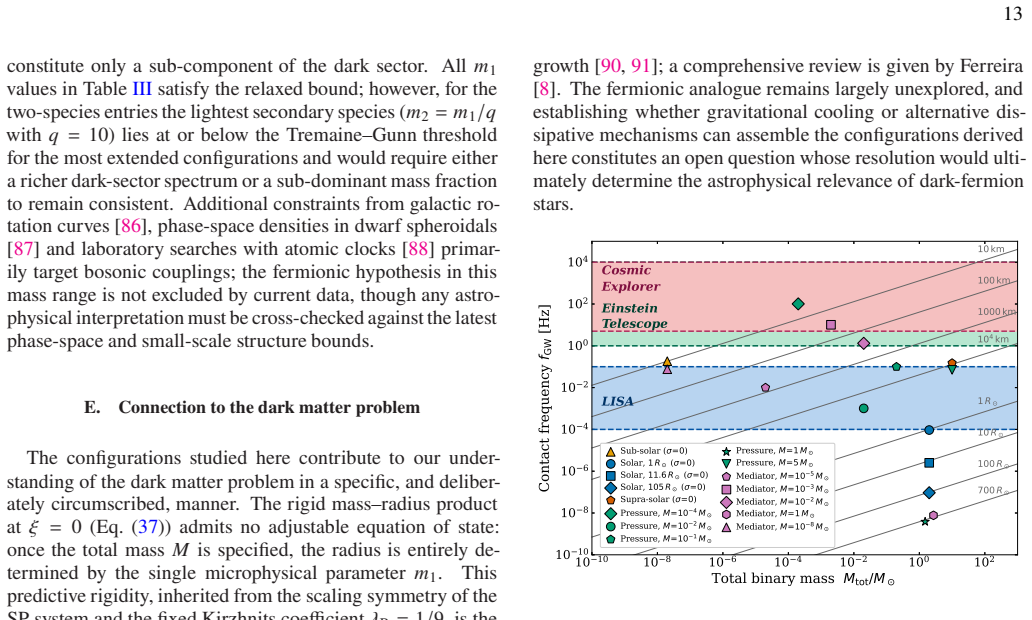
- Illustrative solutions span total masses 10^{-8} to 5 solar masses and fermion masses 10^{-14} to 10^{-6} eV, producing radii from a few km to roughly 10^3 solar radii.
- Contact frequencies of such objects fall inside the sensitivity bands of the Einstein Telescope and LISA.
- Microlensing signatures remain accessible to existing surveys.
Where Pith is reading between the lines
- The same rigid relation could be used to place upper bounds on the dark-fermion mass from any future detection of a dark-matter-dominated compact object whose radius is measured.
- If the Yukawa mediator mass introduces additional gradient corrections, the surface term would shift and the limiting mass would change, offering a testable signature of mediator properties.
- The model predicts that two-species configurations can produce radii intermediate between the pure heavy and pure light single-species limits, which could be searched for in microlensing event statistics.
Load-bearing premise
The orbital-free density-functional treatment with the fixed Kirzhnits coefficient 1/9 applies directly to these self-gravitating multi-species systems without further corrections from the Yukawa mediator or from gravitational effects on the gradient expansion.
What would settle it
A precise radius measurement for a compact object whose mass is independently known that lies outside the predicted R ∝ M^{-1/3} curve for the inferred m1 would falsify the claimed rigidity of the mass-radius relation.
Figures
read the original abstract
The microphysics underlying non-baryonic dark matter remains unknown. I derive the two-species Schr\"odinger-Poisson-Yukawa system for spin-1/2 dark-sector fermion fields, $\psi$ (mass $m_1$) and $\chi$ (mass $m_2$), coupled through a scalar mediator of mass $m_\phi$ via a universal Yukawa coupling, within an orbital-free density-functional framework with the Kirzhnits gradient coefficient $\lambda_B=1/9$. A central result is that the Bohm potential, far from being negligible in the Thomas-Fermi regime, contributes a species-dependent surface-energy correction analogous to the nuclear liquid-drop model: the heavier fermion species generates an outward quantum-pressure wall whilst the lighter species provides an inward surface tension, with degeneracy pressure furnishing the bulk confinement. In the single-species Schr\"odinger-Poisson limit the ground state recovers the benchmarked invariants $M_{\mathrm{dim}}\simeq 3.883$ and $x_T\simeq 2.562$, yielding $M R_T\simeq 9.95\,\lambda_B\hbar^2/(G m_1^2)$. For polytropic index $\gamma=5/3$ the mass-radius relation satisfies $R\propto M^{-1/3}$; for $\gamma=4/3$ a limiting mass emerges above which no stable equilibrium exists. Illustrative configurations span $M=10^{-8}$-$5\, M_\odot$, $m_1\sim 10^{-14}$-$10^{-6}\, eV$, and radii from a few~km to $\sim 10^3\, R_\odot$, with gravitational-wave contact frequencies in the Einstein Telescope and LISA bands and microlensing signatures accessible to current surveys. The predictive rigidity of the resulting mass-radius relation, in which the single microphysical parameter $m_1$ determines the equilibrium radius once the total mass is specified, furnishes a reproducible, first-principles reference for constraining the dark-fermion mass in multi-component dark sectors.
Editorial analysis
A structured set of objections, weighed in public.
Referee Report
Summary. The manuscript derives the two-species Schrödinger-Poisson-Yukawa system for spin-1/2 dark-sector fermions ψ (mass m1) and χ (mass m2) coupled via a scalar mediator of mass m_φ, formulated in an orbital-free density-functional framework that retains the fixed Kirzhnits coefficient λ_B=1/9 for the Bohm potential. It shows that the Bohm term supplies a species-dependent surface-energy correction (heavier species outward, lighter inward), recovers the single-species benchmarks M_dim ≃ 3.883 and x_T ≃ 2.562 together with the relation M R_T ≃ 9.95 λ_B ħ²/(G m1²), obtains polytropic mass-radius scalings (R ∝ M^{-1/3} for γ=5/3; limiting mass for γ=4/3), and asserts that the equilibrium radius for given total mass is fixed solely by the single microphysical parameter m1, furnishing a first-principles reference for multi-component dark sectors with illustrative configurations spanning 10^{-8}–5 M_⊙ and observable GW/microlensing signatures.
Significance. If the central claim holds, the work supplies a reproducible, first-principles mass-radius relation whose single-parameter rigidity (m1 alone) is explicitly grounded in the recovery of literature single-species invariants and the derivation of the M R_T scaling; this offers a concrete, falsifiable reference for constraining dark-fermion masses via Einstein Telescope/LISA contact frequencies and current microlensing surveys.
major comments (2)
- [Abstract] Abstract and the orbital-free DFT framework: the asserted single-parameter rigidity of the mass-radius relation (m1 alone fixes radius for given total mass) rests on the assumption that the effective energy functional retains exactly the Kirzhnits coefficient λ_B=1/9 with no additional gradient corrections. The non-local Yukawa interaction between the two fermion species can generate species- or coupling-dependent gradient terms at the same order as the Bohm potential; the manuscript applies the framework directly without deriving or bounding these corrections, so the claimed rigidity is not yet demonstrated.
- [two-species Schrödinger-Poisson-Yukawa system] The two-species extension: the density-functional treatment of the coupled ψ–χ system with Yukawa mediator is introduced without explicit validation (e.g., against the full many-body Schrödinger equation or checks that the fixed λ_B remains unmodified by m_φ), which is load-bearing for the claimed species-dependent surface-energy balance and the resulting M–R predictive power.
minor comments (1)
- [Abstract] The abstract states that the Bohm potential is 'far from being negligible in the Thomas-Fermi regime' yet provides no quantitative criterion (e.g., a dimensionless ratio involving the de Broglie wavelength and the Yukawa range) that delineates this regime for the two-species case.
Simulated Author's Rebuttal
We thank the referee for the careful reading and constructive comments. We respond point-by-point below, clarifying the scope and limitations of the orbital-free DFT framework while agreeing to strengthen the discussion of its assumptions.
read point-by-point responses
-
Referee: [Abstract] Abstract and the orbital-free DFT framework: the asserted single-parameter rigidity of the mass-radius relation (m1 alone fixes radius for given total mass) rests on the assumption that the effective energy functional retains exactly the Kirzhnits coefficient λ_B=1/9 with no additional gradient corrections. The non-local Yukawa interaction between the two fermion species can generate species- or coupling-dependent gradient terms at the same order as the Bohm potential; the manuscript applies the framework directly without deriving or bounding these corrections, so the claimed rigidity is not yet demonstrated.
Authors: The orbital-free DFT framework is the standard Kirzhnits expansion applied to the two-species system, with the Yukawa interaction entering solely as a mean-field potential. Additional gradient corrections from the non-local Yukawa term would enter at higher order in the density-gradient expansion and are parametrically suppressed when the mediator range is not much smaller than the surface thickness. The claimed rigidity follows from the structure of the Euler-Lagrange equations: once total mass is fixed, the equilibrium radius is set by the balance between the heavier species' degeneracy pressure plus outward Bohm wall and gravity, with m1 providing the only dimensionful scale. We acknowledge that an explicit bound on Yukawa-induced corrections is absent and will add a short paragraph with an order-of-magnitude estimate in the revised manuscript. revision: partial
-
Referee: [two-species Schrödinger-Poisson-Yukawa system] The two-species extension: the density-functional treatment of the coupled ψ–χ system with Yukawa mediator is introduced without explicit validation (e.g., against the full many-body Schrödinger equation or checks that the fixed λ_B remains unmodified by m_φ), which is load-bearing for the claimed species-dependent surface-energy balance and the resulting M–R predictive power.
Authors: The two-species system is constructed by direct generalization of the single-component orbital-free functional, with the Yukawa term added as the Hartree interaction between the two densities. Full many-body validation is intractable for macroscopic particle numbers and is not performed in the existing literature on self-gravitating fermion stars; consistency is instead checked by exact recovery of the single-species benchmarks. The Kirzhnits coefficient λ_B=1/9 originates from the free-fermion kinetic-energy expansion and is unmodified at leading order by the mean-field Yukawa term. We will insert a clarifying paragraph in the methods section stating the regime of applicability and the indirect validation provided by the single-species limits. revision: partial
Circularity Check
Derivation self-contained from model equations; no circular reduction
full rationale
The central mass-radius relation is obtained by solving the two-species Schrödinger-Poisson-Yukawa system in the orbital-free DFT framework with the standard fixed Kirzhnits coefficient λ_B=1/9. The single-species limit recovers independent, externally benchmarked invariants (M_dim ≃ 3.883, x_T ≃ 2.562) that are not fitted or redefined within the paper. No load-bearing self-citations, ansatz smuggling, or self-definitional steps appear; the claimed one-parameter rigidity follows directly from the stated equations and boundary conditions without reducing to input parameters by construction.
Axiom & Free-Parameter Ledger
free parameters (3)
- m1
- m2
- m_φ
axioms (2)
- domain assumption The orbital-free density-functional theory with Kirzhnits gradient coefficient λ_B=1/9 accurately captures the quantum kinetic energy including Bohm potential for these systems.
- domain assumption The Yukawa coupling between the two fermion species and the scalar mediator is universal.
invented entities (2)
-
Two-species dark-sector fermions ψ and χ
no independent evidence
-
Scalar mediator of mass m_φ
no independent evidence
Reference graph
Works this paper leans on
-
[1]
reduces to the linear Yukawa form [ 51], (∇ 2 − /u1D45A2 /u1D719) Φ = /u1D4542 /u1D719( /u1D45B1 + /u1D45B2) . (7) The inverse Compton wavenumber of the mediator, /u1D705/u1D719≡ /u1D45A/u1D719/u1D450 /uni210F.var, (8) sets the Yukawa screening length ℓ/u1D719 = /u1D705− 1 /u1D719 ; in natural units (/uni210F.var =/u1D450= 1) one has simply /u1D705/u1D719...
-
[2]
becomes 4 /u1D70B/u1D43A/u1D45A2 1( /u1D45B1 + /u1D45B2) for the mean-field potential Φ = /u1D454 /u1D719/u1D719 . Newtonian gravity, however, couples to mass density rather than to number density; the equivalence principle demands that each species contribut e to the gravitational source proportionally to /u1D45A/u1D456/u1D45B/u1D456[ 52, 53]. This distin...
-
[3]
In the massless-mediator limit /u1D705/u1D719 → 0, dividing Eq
identically. In the massless-mediator limit /u1D705/u1D719 → 0, dividing Eq. ( 10) by /u1D45A1 gives the standard Poisson equation for Φ /u1D454 , ∇ 2Φ /u1D454 = 4/u1D70B/u1D43A( /u1D45A1 /u1D45B1 + /u1D45A2 /u1D45B2) , (11) which is the Newtonian form used in the numerical calculations of Sec. V. III. HYDROSTATIC EQUILIBRIUM IN QHD FORM In this section I...
-
[4]
are recovered. C. Mass–radius relation The total dimensionless mass, accounting for both species with their respective gravitational couplings, is /u1D440 dim = 4/u1D70B /uni222B.dsp ∞ 0 ( /u1D7022 1 + /u1D7022 2 /u1D45E ) /u1D4652 /u1D451/u1D465, (32) where the weight 1 //u1D45E= /u1D45A2//u1D45A1 mirrors the Poisson source weighting of Eq. ( 25). The ph...
-
[5]
A physically meaningful radius is /u1D445 /u1D447 , defined as the sphere enclosing 99% of the total mass
883 ) × ( /u1D45A1 6 × 10− 14 eV ) − 2 ( /u1D440 1 /u1D440 ⊙ ) − 1 , (35) The physical radius /u1D445 /u1D447 ( /u1D709) = /u1D465/u1D447 ( /u1D709) /u1D45F0( /u1D709) depends on both the Yukawa screening and the two-species parameters ( /u1D45E, /u1D453) . A physically meaningful radius is /u1D445 /u1D447 , defined as the sphere enclosing 99% of the total...
-
[6]
( 17), divided by Φ 0
is verified by computing the dimensionless Bohm diagnostic, /u1D444 dim,/u1D456( /u1D465) ≡ /u1D700/u1D456− /u1D463/u1D450/u1D711 ( /u1D465) − /u1D70E/u1D456/u1D7022( /u1D6FE/u1D45D,/u1D456− 1) /u1D456 ( /u1D465) , /u1D456 ∈ { 1,2} , (45) which is the dimensionless form of the closure relation /u1D444 /u1D456= /u1D707/u1D456− Φ − /u1D448 /u1D443,/u1D456, E...
-
[7]
At /u1D709 = 0 the dimensionless invariants are /u1D440 dim( 0) ≃ 3
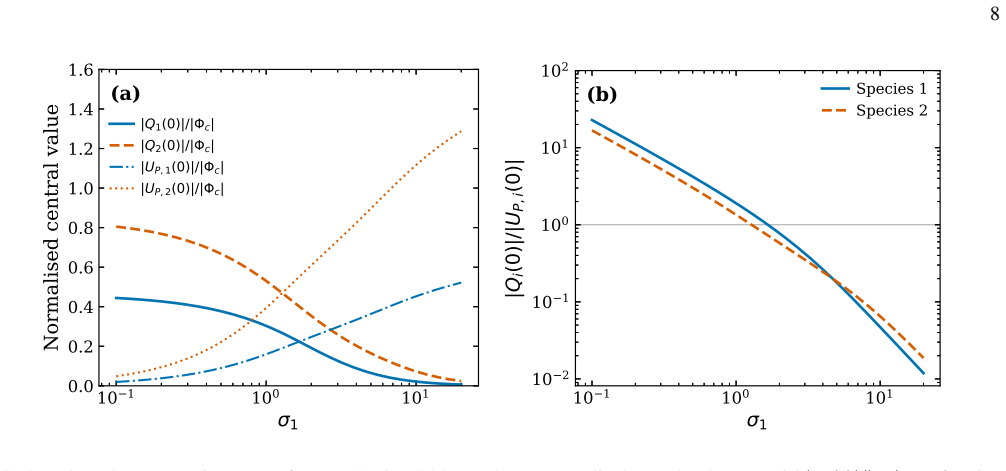
confirms that the closure relation ( 17) holds at ev- ery radius; increasing /u1D709 weakens the gravitational confinement, as one would expect. At /u1D709 = 0 the dimensionless invariants are /u1D440 dim( 0) ≃ 3. 883, /u1D465/u1D447 ( 0) ≃ 2. 562 and /u1D440 dim/u1D465/u1D447 ≃ 9. 95, 8 10 −1 10 0 10 1 σ 1 0.0 0.2 0.4 0.6 0.8 1.0 1.2 1.4 1.6 Normalised cen...
-
[8]
( 24) (Fig
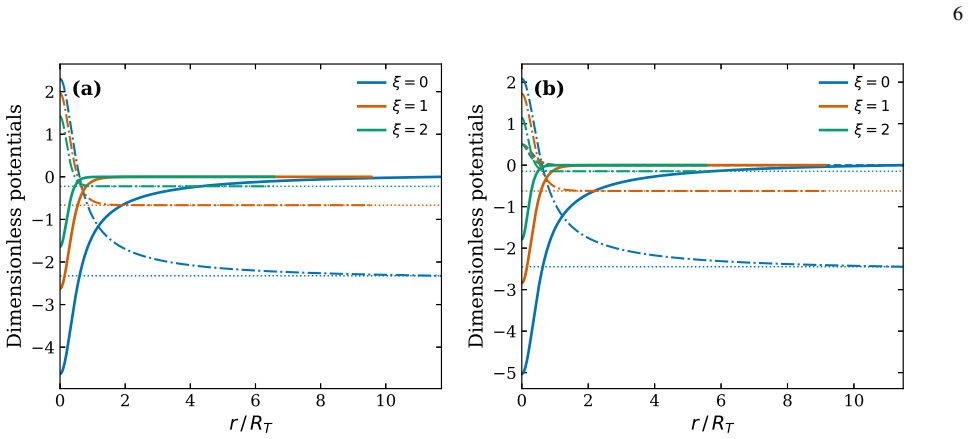
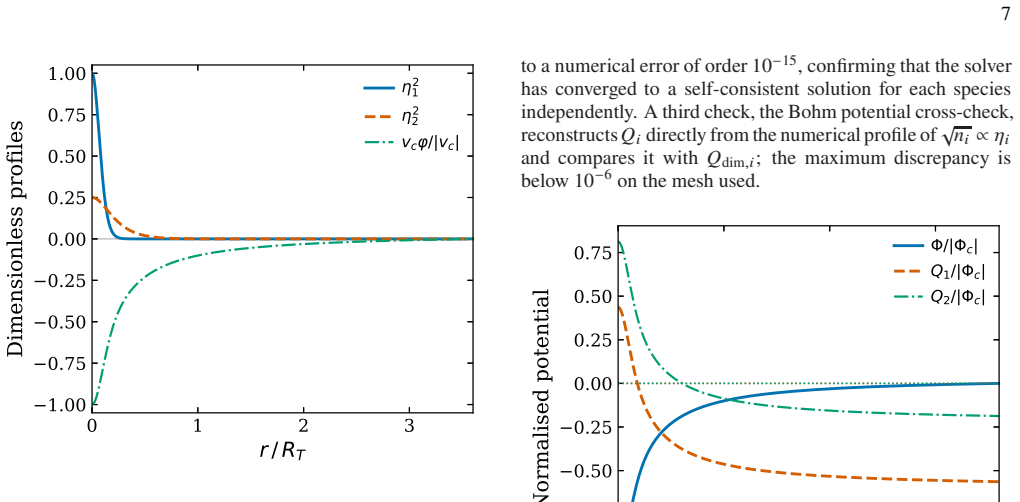
the heavier species ( /u1D7021) is centrally concentrated whilst the lighter species (/u1D7022) extends to larger radii, a direct consequence of the 1 //u1D45Efactor in Eq. ( 24) (Fig. 2). The solver yields /u1D7001 ≃ − 3. 035, /u1D7002 ≃ − 1. 008, /u1D463/u1D450≃ − 5. 383, /u1D440 dim ≃ 6. 232 and /u1D465/u1D447 ≃
-
[9]
4% of the gravitational mass (after 1 //u1D45Eweighting)
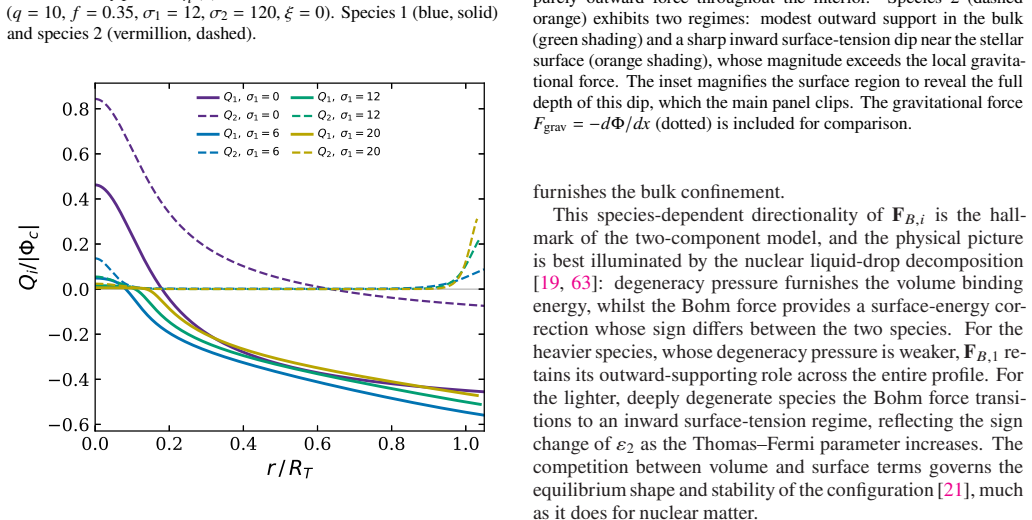
330, with species 2 contributing /u1D440 2, grav//u1D440 ≃ 40. 4% of the gravitational mass (after 1 //u1D45Eweighting). The Bohm potential provides global support for both species, | /u1D444 1|/| Φ | ∼ O( 1) and | /u1D444 2|/| Φ | ∼ /u1D45Ethroughout the interior (Fig. 3). B. Reference model: Thomas–Fermi regime with quantum surface correction I now turn...
-
[10]
(46) Figure 4 quantifies this crossover
Bohm–Thomas-Fermi crossover It is worth remarking that /u1D70E1 and /u1D70E2 are not independent parameters: for a non-relativistic degenerate Fermi gas (/u1D6FE/u1D45D,/u1D456 = 5/3) the polytropic constant scales as /u1D43E/u1D45D,/u1D456 ∝ /uni210F.var2//u1D45A/u1D456, whence /u1D70E2 /u1D70E1 = /u1D43E/u1D45D, 2 /u1D43E/u1D45D, 1 = /u1D45A1 /u1D45A2 =...
-
[11]
14) follows the standard Madelung–Bohm convention [ 44, 45] with the Kirzhnits co- efficient /u1D706B = 1/9 [47, 49, 59, 60]
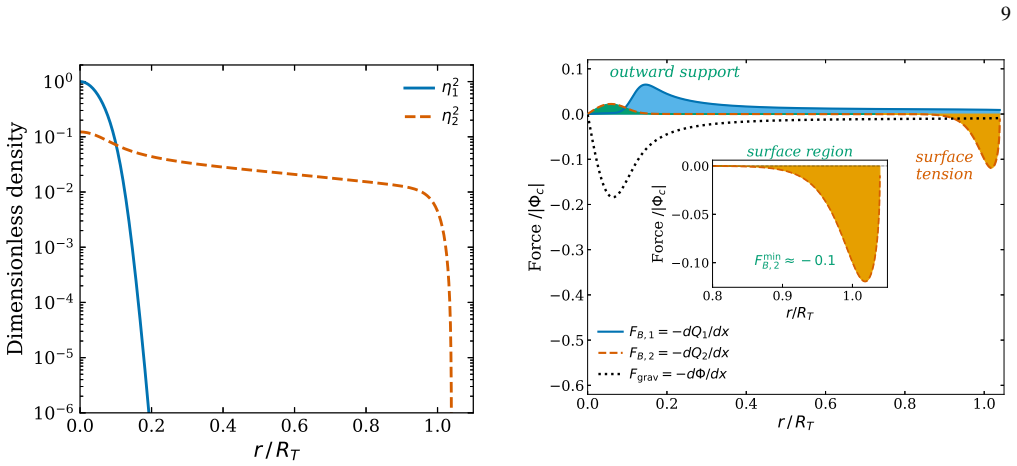
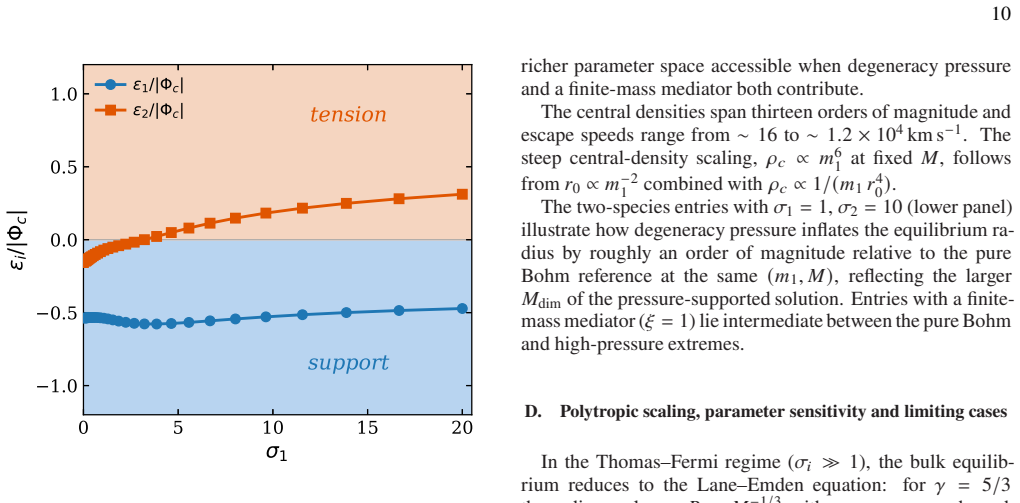
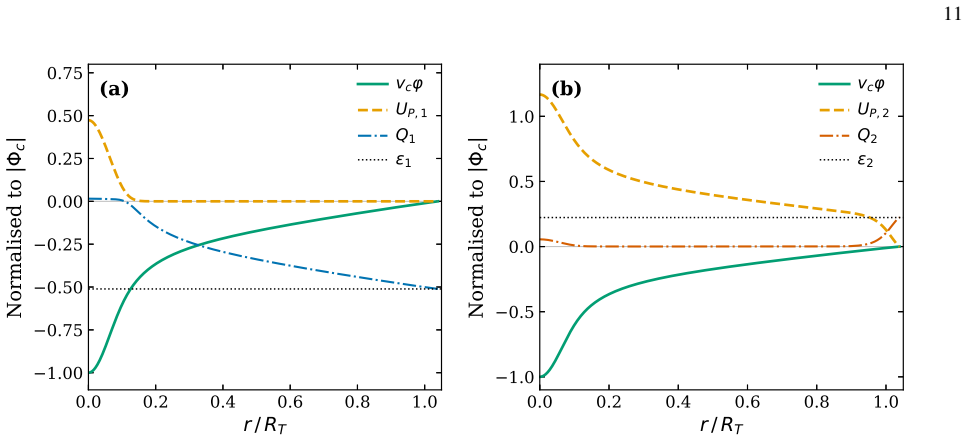
The Bohm force and the liquid-drop analogy The Bohm potential /u1D444 /u1D456 (Eq. 14) follows the standard Madelung–Bohm convention [ 44, 45] with the Kirzhnits co- efficient /u1D706B = 1/9 [47, 49, 59, 60]. The physically observable quantity is the Bohm force per unit mass, F/u1D435,/u1D456 = − 1 /u1D45A/u1D456 ∇ /u1D444 /u1D456, (47) which encodes the di...
-
[12]
35, /u1D70E2 = /u1D45E /u1D70E1
Full diagnostic of the reference model Figures 5– 9 present the complete diagnostic for /u1D45E= 10, /u1D453= 0. 35, /u1D70E2 = /u1D45E /u1D70E1. At /u1D70E1 = 12 ( /u1D70E2 = 120) the solver yields /u1D7001 ≃ − 13. 0, /u1D7002 ≃ 5. 7, /u1D463/u1D450 ≃ − 25. 4, /u1D440 dim ≃ 205. 0 and /u1D465/u1D447 ≃ 28. 9. The central Bohm potentials are small, | /u1D4...
-
[13]
The signed /u1D444 /u1D456( /u1D45F)/| Φ /u1D450| (Fig
decrease monotonically from their central values, as befits the nodeless ground stat e; species 1 is more centrally concentrated whilst species 2, b e- ing lighter, extends to larger radii. The signed /u1D444 /u1D456( /u1D45F)/| Φ /u1D450| (Fig. 6) exhibits progressive localisation to a thin shell around 10 0 5 10 15 20 σ 1 −1.0 −0.5 0.0 0.5 1.0 ε i /|Φ c ...
-
[14]
Entries with a finite- mass mediator (/u1D709 = 1) lie intermediate between the pure Bohm and high-pressure extremes
The two-species entries with /u1D70E1 = 1, /u1D70E2 = 10 (lower panel) illustrate how degeneracy pressure inflates the equilibriu m ra- dius by roughly an order of magnitude relative to the pure Bohm reference at the same ( /u1D45A1, /u1D440 ) , reflecting the larger /u1D440 dim of the pressure-supported solution. Entries with a finite- mass mediator (/u1D70...
-
[15]
and laboratory searches with atomic clocks [ 88] primar- ily target bosonic couplings; the fermionic hypothesis in t his mass range is not excluded by current data, though any astro- physical interpretation must be cross-checked against thelatest phase-space and small-scale structure bounds. E. Connection to the dark matter problem The configurations studi...
-
[16]
in the SP limit, is a noteworthy 14 feature, for it implies that a single microphysical paramet er, /u1D45A1, determines the equilibrium once the total mass is speci- fied, distinguishing these configurations from phenomenolo g- ical models with adjustable equations of state. The observational channels through which these objects might reveal themselves, gr...
-
[17]
Planck Collaboration, N. Aghanim, Y . Akrami, M. Ash- down, J. Aumont, C. Baccigalupi, M. Ballardini, A. J. Banday, R. B. Barreiro, N. Bartolo, et al. , Planck 2018 results. VI. Cosmological parameters, A&A 641, A6 (2020) , arXiv:1807.06209 [astro-ph.CO]
Pith/arXiv arXiv 2018
-
[18]
J. S. Bullock and M. Boylan-Kolchin, Small-Scale Chal- lenges to the Λ CDM Paradigm, ARA&A 55, 343 (2017) , arXiv:1707.04256 [astro-ph.CO]
arXiv 2017
-
[19]
J. F. Navarro, C. S. Frenk, and S. D. M. White, The Structure of Dark Matter Halos, ApJ 462, 563 (1996) , arXiv:astro-ph/9508025
Pith/arXiv arXiv 1996
-
[20]
Navaset al
S. Navaset al. (Particle Data Group), Review of Particle Physics, Phys. Rev. D 110, 030001 (2024)
2024
-
[21]
D. N. Spergel and P. J. Steinhardt, Observational Evidence for Self-Interacting Cold Dark Matter, Phys. Rev. Lett. 84, 3760 (2000) , arXiv:astro-ph/9909386
Pith/arXiv arXiv 2000
-
[22]
W. Hu, R. Barkana, and A. Gruzinov, Fuzzy Cold Dark Matter: The Wave Properties of Ul- tralight Particles, Phys. Rev. Lett. 85, 1158 (2000) , arXiv:astro-ph/0003365 [astro-ph]
Pith/arXiv arXiv 2000
-
[23]
D. J. E. Marsh, Axion cosmology, Phys. Rep. 643, 1 (2016) , arXiv:1510.07633 [astro-ph.CO]
Pith/arXiv arXiv 2016
-
[24]
E. G. M. Ferreira, Ultra-light dark mat- ter, Astron. Astrophys. Rev. 29, 7 (2021) , arXiv:2005.03254 [astro-ph.CO]
arXiv 2021
-
[25]
L. Hui, J. P. Ostriker, S. Tremaine, and E. Witten, Ultralight scalars as cosmologi- cal dark matter, Phys. Rev. D 95, 043541 (2017) , arXiv:1610.08297 [astro-ph.CO]
Pith/arXiv arXiv 2017
-
[26]
H.- Y . Schive, T. Chiueh, and T. Broadhurst, Cos- mic structure as the quantum interference of a co- herent dark wave, Nature Physics 10, 496 (2014) , arXiv:1406.6586 [astro-ph.GA]
Pith/arXiv arXiv 2014
-
[27]
H.- Y . Schive, T. Chiueh, T. Broadhurst, and K.-W. Huang, Con- trasting Galaxy Formation from Quantum Wave Dark Mat- ter, /u1D713 DM, with Λ CDM, Phys. Rev. Lett. 113, 261302 (2014) , arXiv:1407.7762 [astro-ph.GA]
Pith/arXiv arXiv 2014
-
[28]
D. J. Kaup, Klein-Gordon Geon, Phys. Rev. 172, 1331 (1968)
1968
-
[29]
Ruffini and S
R. Ruffini and S. Bonazzola, Systems of Self-Gravitating Par- ticles in General Relativity and the Concept of an Equation o f State, Phys. Rev. 187, 1767 (1969)
1969
-
[30]
S. L. Liebling and C. Palenzuela, Dynamical Boson Stars, Living Rev. Relativ. 26, 1 (2023) , arXiv:1202.5809 [gr-qc]
Pith/arXiv arXiv 2023
-
[31]
E. H. Lieb, Existence and uniqueness of the min- imizing solution of Choquard’s nonlinear equation, Stud. Appl. Math. 57, 93 (1977)
1977
-
[32]
I. M. Moroz, R. Penrose, and P. Tod, Spherically- symmetric solutions of the Schrödinger–Newton equations, Class. Quantum Grav. 15, 2733 (1998)
1998
-
[33]
P.-H. Chavanis, Mass-radius relation of Newtonian self- gravitating Bose-Einstein condensates with short-range i nter- actions. I. Analytical results, Phys. Rev. D 84, 043531 (2011) , arXiv:1103.2050
Pith/arXiv arXiv 2011
-
[34]
P.-H. Chavanis and L. Delfini, Mass-radius rela- tion of Newtonian self-gravitating Bose–Einstein condensates with short-range interactions. II. Nu- merical results, Phys. Rev. D 84, 043532 (2011) , arXiv:1103.2698 [astro-ph.CO]
Pith/arXiv arXiv 2011
-
[35]
T. D. Lee and Y . Pang, Fermion Soliton Stars and Black Holes, Phys. Rev. D 35, 3678 (1987)
1987
-
[36]
M. B. Wise and Y . Zhang, Stable Bound States of Asymmetric Dark Matter, Phys. Rev. D 90, 055030 (2014) , arXiv:1407.4121 [hep-ph]
Pith/arXiv arXiv 2014
-
[37]
L. Del Grosso, G. Franciolini, P. Pani, and A. Ur- bano, Fermion soliton stars, Phys. Rev. D 108, 044024 (2023) , arXiv:2301.08709 [hep-ph]
arXiv 2023
-
[38]
Coleman, Q-balls, Nucl
S. Coleman, Q-balls, Nucl. Phys. B 262, 263 (1985)
1985
-
[39]
S. Tulin and H.-B. Yu, Dark Matter Self-interactions and Small Scale Structure, Phys. Rep. 730, 1 (2018) , arXiv:1705.02358 [hep-ph]
Pith/arXiv arXiv 2018
-
[40]
D. E. Kaplan, G. Z. Krnjaic, K. R. Rehermann, and C. M. Wells, Atomic dark matter, JCAP 2010, 021 (2010) , arXiv:0909.0753 [hep-ph]
Pith/arXiv arXiv 2010
-
[41]
W. H. Press and D. N. Spergel, Capture by the sun of a galactic population of weakly interacting, massive partic les, ApJ 296, 679 (1985)
1985
-
[42]
Gould, Weakly interacting massive particle distributio n in and evaporation from the sun, ApJ 321, 560 (1987)
A. Gould, Weakly interacting massive particle distributio n in and evaporation from the sun, ApJ 321, 560 (1987)
1987
-
[43]
M. T. Frandsen and S. Sarkar, Asymmetric dark matter and the sun, Phys. Rev. Lett. 105, 011301 (2010) , arXiv:1003.4505
Pith/arXiv arXiv 2010
-
[44]
M. Taoso, F. Iocco, G. Meynet, G. Bertone, and P. Eggen- berger, Effect of low mass dark matter particles on the sun, Phys. Rev. D 82, 083509 (2010) , arXiv:1005.5711
Pith/arXiv arXiv 2010
-
[45]
I. P. Lopes and J. Silk, Solar Neutrinos: Probing the Quasi-isothermal Solar Core Produced by Supersymmet- ric Dark Matter Particles, Phys. Rev. Lett. 88, 151303 (2002) , arXiv:astro-ph/0112390
Pith/arXiv arXiv 2002
-
[46]
I. Lopes and J. Silk, Dark Matter Burning in Nuclear Star Clus - 15 ters, ApJ 733, L51 (2011) , arXiv:1104.1118
Pith/arXiv arXiv 2011
-
[47]
I. Lopes and J. Silk, Solar Constraints on Asymmetric Dark Matter, ApJ 757, 130 (2012) , arXiv:1209.3631
Pith/arXiv arXiv 2012
-
[49]
I. Lopes, K. Kadota, and J. Silk, Constraint on Light Dipole Dark Matter from Helioseismology, ApJ 780, L15 (2014) , arXiv:1310.0673
Pith/arXiv arXiv 2014
-
[50]
I. Lopes, P. Panci, and J. Silk, Helioseismology with Long- range Dark Matter-Baryon Interactions, ApJ 795, 162 (2014) , arXiv:1402.0682
Pith/arXiv arXiv 2014
-
[51]
J. Lopes, I. Lopes, and J. Silk, Asteroseismology of Red Clum p Stars as a Probe of the Dark Matter Content of the Galaxy Central Region, ApJ 880, L25 (2019) , arXiv:1907.10089
Pith/arXiv arXiv 2019
-
[52]
J. Casanellas and I. Lopes, Towards the use of as- teroseismology to investigate the nature of dark matter, MNRAS 410, 535 (2011) , arXiv:1008.0646
Pith/arXiv arXiv 2011
-
[53]
J. Casanellas and I. Lopes, First asteroseismic limits on th e nature of dark matter, ApJ 765, L21 (2013) , arXiv:1212.2985
Pith/arXiv arXiv 2013
-
[54]
J. Rato, J. Lopes, and I. Lopes, On asymmetric dark mat- ter constraints from the asteroseismology of a subgiant sta r, MNRAS 507, 3434 (2021) , arXiv:2108.11478
arXiv 2021
-
[55]
A. de Lavallaz and M. Fairbairn, Neutron stars as dark matter probes, Phys. Rev. D 81, 123521 (2010) , arXiv:0912.4264
Pith/arXiv arXiv 2010
-
[56]
C. Kouvaris and P. Tinyakov, Constraining asymmet- ric dark matter through observations of compact stars, Phys. Rev. D 83, 083512 (2011) , arXiv:1012.2039
Pith/arXiv arXiv 2011
-
[57]
J. Bramante and N. Raj, Dark matter in compact stars, Phys. Rep. 1052, 1 (2024) , arXiv:2307.14435
arXiv 2024
-
[58]
G. Panotopoulos, Á. Rincón, and I. Lopes, Anisotropic dark energy stars within vanishing complexity factor forma l- ism: Hydrostatic equilibrium, radial oscillations, and ob - servational implications, Physics Letters B 856, 138901 (2024) , arXiv:2407.17335 [gr-qc]
arXiv 2024
-
[59]
Z. Buras-Stubbs and I. Lopes, Rotational behavior of exotic compact objects, Phys. Rev. D 113, 043049 (2026) , arXiv:2602.06660 [astro-ph.HE]
arXiv 2026
-
[60]
Madelung, Quantentheorie in hydrodynamischer Form, Z
E. Madelung, Quantentheorie in hydrodynamischer Form, Z. Phys. 40, 322 (1927)
1927
-
[61]
Bohm, A Suggested Interpretation of the Quantum Theory in Terms of “Hidden” Variables
D. Bohm, A Suggested Interpretation of the Quantum Theory in Terms of “Hidden” Variables. I, Phys. Rev. 85, 166 (1952)
1952
-
[62]
C. F. von Weizsäcker, Zur Theorie der Kernmassen, Z. Phys. 96, 431 (1935)
1935
-
[63]
A. Y . Potekhin, A. I. Chugunov, N. N. Shchechilin, and N. Chamel, On variational trial functions in extended Thomas–Fermi method, Physics Uspekhi 68, 691 (2025) , arXiv:2411.11021 [nucl-th]
arXiv 2025
-
[64]
G. Manfredi and F. Haas, Self-consistent fluid model for a quantum electron gas, Phys. Rev. B 64, 075316 (2001) , arXiv:cond-mat/0203394
Pith/arXiv arXiv 2001
-
[65]
D. Michta, F. Graziani, and M. Bonitz, Quantum Hydrody- namics for Plasmas: A Thomas–Fermi Theory Perspective, Contrib. Plasma Phys. 55, 437 (2015) , arXiv:1504.04973
Pith/arXiv arXiv 2015
-
[66]
A. Prsa, P. Harmanec, G. Torres, E. Mamajek, M. As- plund, N. Capitaine, J. Christensen-Dalsgaard, E. Depagne , M. Haberreiter, S. Hekker, et al. , Nominal Values for Se- lected Solar and Planetary Quantities: IAU 2015 Resolution B3, AJ 152, 41 (2016) , arXiv:1605.09788 [astro-ph.SR]
Pith/arXiv arXiv 2015
-
[67]
B. D. Serot and J. D. Walecka, Recent Progress in Quantum Hadrodynamics, Int. J. Mod. Phys. E 6, 515 (1997) , arXiv:nucl-th/9701058
Pith/arXiv arXiv 1997
-
[68]
Weinberg,Gravitation and Cosmology: Principles and Applications of the General Theory of Relativity (John Wiley & Sons, New Y ork, 1972)
S. Weinberg,Gravitation and Cosmology: Principles and Applications of the General Theory of Relativity (John Wiley & Sons, New Y ork, 1972)
1972
-
[69]
C. M. Will, Theory and Experiment in Gravitational Physics , 2nd ed. (Cambridge University Press, Cambridge, 2018)
2018
-
[70]
Z. A. Moldabekov, M. Bonitz, and T. S. Ramazanov, The- oretical foundations of quantum hydrodynamics for plasmas , Phys. Plasmas 25, 031903 (2018)
2018
-
[71]
Chandrasekhar,An Introduction to the Study of Stellar Structure (University of Chicago Press, Chicago, 1939)
S. Chandrasekhar,An Introduction to the Study of Stellar Structure (University of Chicago Press, Chicago, 1939)
1939
-
[72]
S. L. Shapiro and S. A. Teukolsky, Black Holes, White Dwarfs, and Neutron Stars: The Physics of Compact Objects (Wiley, New Y ork, 1983)
1983
-
[73]
F. S. Guzmán and L. A. Ureña-López, Evolution of the Schrödinger-Newton system for a self-gravitating scalar fi eld, Phys. Rev. D 69, 124033 (2004) , arXiv:gr-qc/0404014 [gr-qc]
Pith/arXiv arXiv 2004
-
[74]
Colpi, S
M. Colpi, S. L. Shapiro, and I. Wasserman, Boson Stars: Gravitational Equilibria of Self-Interacting Scalar Fiel ds, Phys. Rev. Lett. 57, 2485 (1986)
1986
-
[75]
Z. A. Moldabekov, T. Schoof, P. Ludwig, M. Bonitz, and T. S. Ramazanov, Statically screened ion potential and Bohm po- tential in a quantum plasma, Phys. Plasmas 22, 044501 (2015) , arXiv:1508.01120
Pith/arXiv arXiv 2015
-
[76]
Z. A. Moldabekov, M. Bonitz, and T. S. Ramazanov, Gradient correction and Bohm potential for two- and one-dimensional electron gases at a finite temperature, Contrib. Plasma Phys. 58, 290 (2018) , arXiv:1709.05310
Pith/arXiv arXiv 2018
-
[77]
R. E. Wyatt,Quantum Dynamics with Trajectories. Introduction to quantum hydr (Springer, 2005)
2005
-
[78]
C. L. Gardner and C. Ringhofer, Smooth quantum potential for the hydrodynamic model, Phys. Rev. E 53, 157 (1996)
1996
-
[79]
Chavanis, Statistical mechanics of self-gravitatin g sys- tems in general relativity: I
P.-H. Chavanis, Statistical mechanics of self-gravitatin g sys- tems in general relativity: I. The quantum Fermi gas, Eur. Phys. J. Plus 135, 290 (2020) , arXiv:1908.10806
arXiv 2020
-
[80]
Seidel and W.-M
E. Seidel and W.-M. Suen, Oscillating Soliton Stars, Phys. Rev. Lett. 66, 1659 (1991)
1991
-
[81]
E. Seidel and W.-M. Suen, Formation of Solitonic Stars through Gravitational Cooling, Phys. Rev. Lett. 72, 2516 (1994) , arXiv:gr-qc/9309015 [gr-qc]
Pith/arXiv arXiv 1994
discussion (0)
Sign in with ORCID, Apple, or X to comment. Anyone can read and Pith papers without signing in.