Most Subradiant Bound Photon Pairs from Chirality-Mediated Dispersion Softening
Pith reviewed 2026-06-28 17:05 UTC · model grok-4.3
The pith
Chiral coupling in atom arrays drives bound photon pairs to become the most subradiant two-excitation states by softening dispersion and suppressing band curvature.
A machine-rendered reading of the paper's core claim, the machinery that carries it, and where it could break.
Core claim
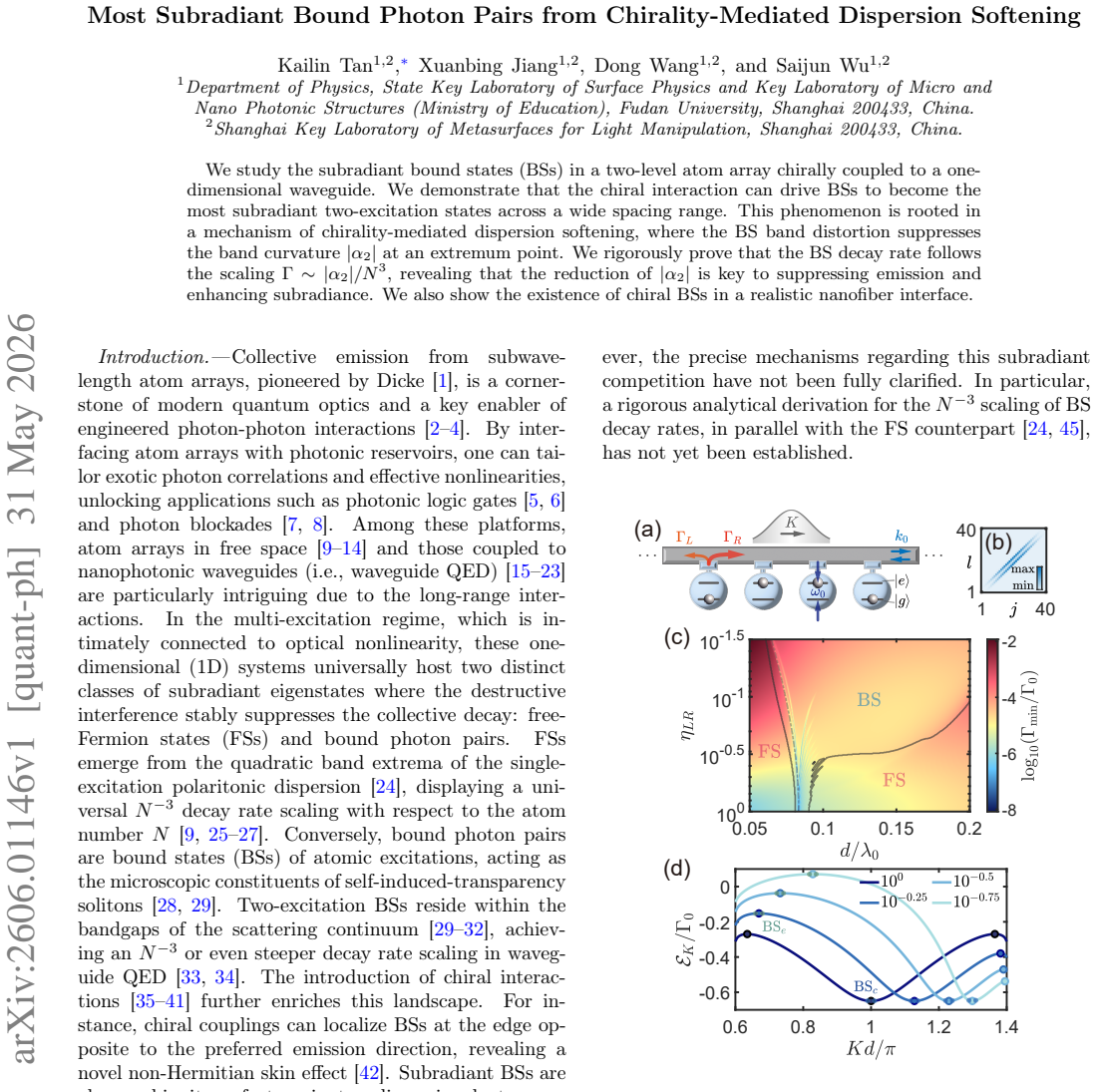
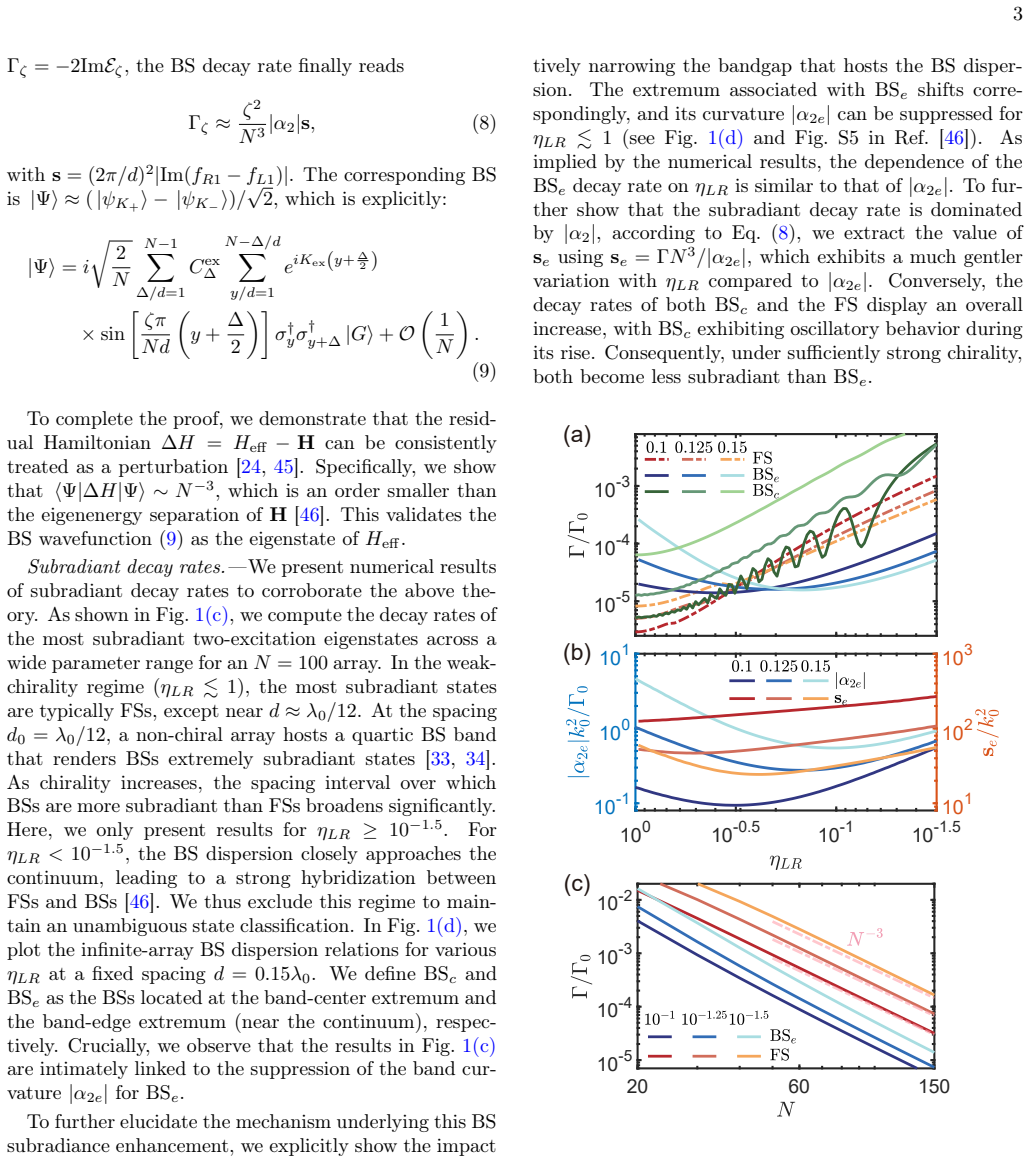
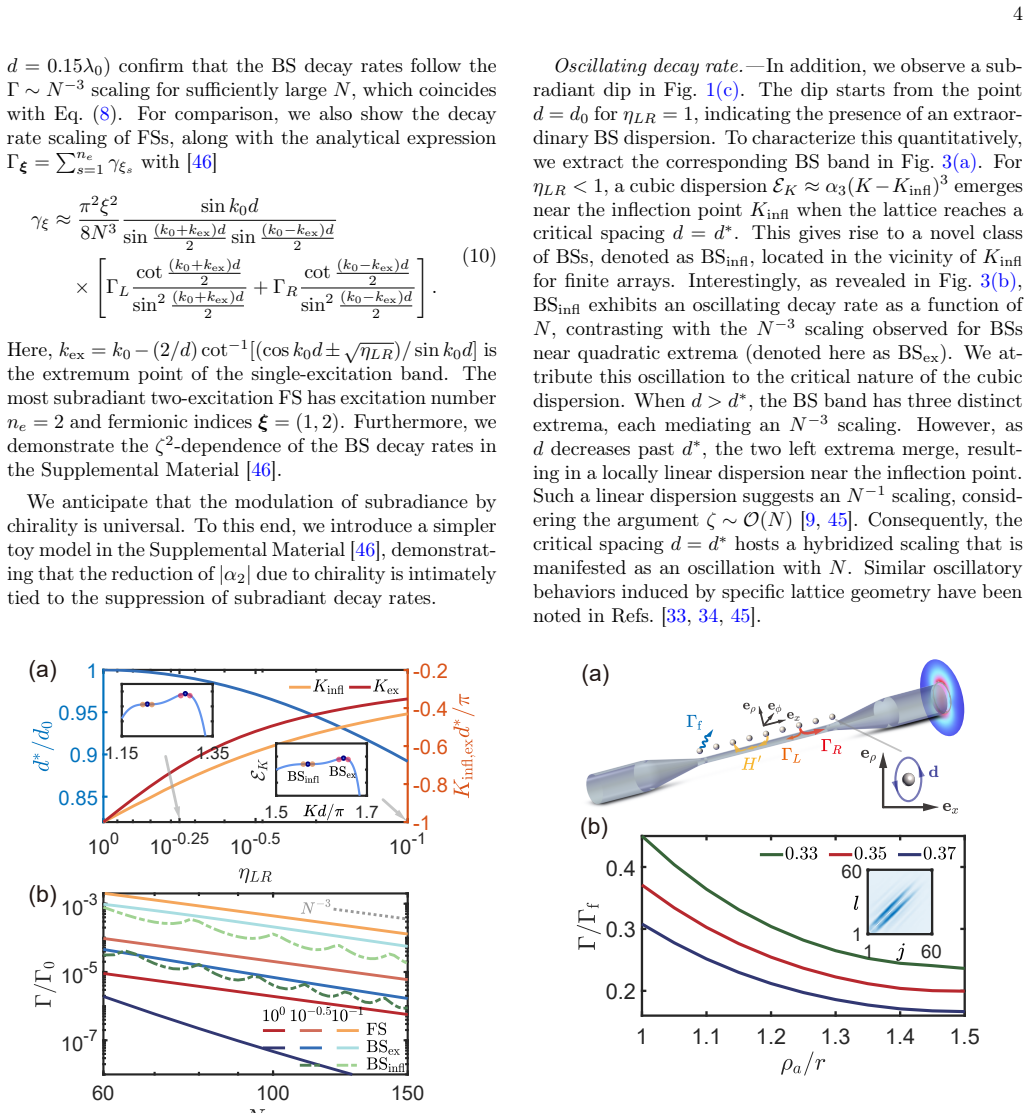
The authors demonstrate that the chiral interaction can drive bound states (BSs) to become the most subradiant two-excitation states across a wide spacing range. This is rooted in a mechanism of chirality-mediated dispersion softening, where the BS band distortion suppresses the band curvature |α₂| at an extremum point. They rigorously prove that the BS decay rate follows the scaling Γ ∼ |α₂|/N³, revealing that the reduction of |α₂| is key to suppressing emission and enhancing subradiance. They also show the existence of chiral BSs in a realistic nanofiber interface.
What carries the argument
Chirality-mediated dispersion softening: the distortion of the bound-state band by chiral coupling that suppresses its curvature |α₂| at an extremum point.
If this is right
- Bound states achieve the lowest decay rates among two-excitation states over a broad range of atom spacings.
- The decay rate of these states scales proportionally to |α₂| divided by N cubed.
- Reduction of |α₂| through band distortion is the controlling factor for enhanced subradiance.
- Chiral bound states can be realized in realistic atom-nanofiber waveguide interfaces.
Where Pith is reading between the lines
- The N³ scaling implies that maintaining small |α₂| in larger arrays could produce substantially longer-lived photon-pair states.
- The softening mechanism may extend to designing subradiant states in other chiral light-matter platforms.
- Experimental tests in nanofiber systems could directly verify the predicted dependence of lifetime on curvature.
Load-bearing premise
The model assumes that chiral coupling produces band distortion that suppresses |α₂| at an extremum point without other decay channels or non-chiral effects dominating the two-excitation dynamics.
What would settle it
Measuring the decay rate Γ of bound states for varying array sizes N and checking whether it scales as |α₂|/N³, or directly mapping the band curvature |α₂| to confirm minimization exactly where subradiance is strongest.
Figures
read the original abstract
We study the subradiant bound states (BSs) in a two-level atom array chirally coupled to a one-dimensional waveguide. We demonstrate that the chiral interaction can drive BSs to become the most subradiant two-excitation states across a wide spacing range. This phenomenon is rooted in a mechanism of chirality-mediated dispersion softening, where the BS band distortion suppresses the band curvature $|\alpha_2|$ at an extremum point. We rigorously prove that the BS decay rate follows the scaling $\Gamma \sim |\alpha_2|/N^3$, revealing that the reduction of $|\alpha_2|$ is key to suppressing emission and enhancing subradiance. We also show the existence of chiral BSs in a realistic nanofiber interface.
Editorial analysis
A structured set of objections, weighed in public.
Referee Report
Summary. The manuscript studies subradiant bound states (BSs) formed by two excitations in a chain of two-level atoms chirally coupled to a 1D waveguide. It claims that chirality induces dispersion softening that suppresses the quadratic band curvature |α₂| at an extremum, thereby rendering the BSs the most subradiant two-excitation states over a broad range of interatomic spacings. A rigorous proof is asserted that the collective decay rate obeys the scaling Γ ∼ |α₂|/N³, with the reduction of |α₂| identified as the mechanism for enhanced subradiance; the work also reports the existence of such chiral BSs at a realistic nanofiber interface.
Significance. If the scaling relation and its applicability in the |α₂|→0 limit are established, the result would identify a concrete, chirality-driven route to stronger two-photon subradiance without additional tuning parameters. The explicit scaling law and the focus on two-excitation bound states constitute clear strengths that could guide waveguide-QED experiments.
major comments (2)
- [Abstract] Abstract: the asserted rigorous proof that Γ ∼ |α₂|/N³ is obtained from a quadratic dispersion expansion near the band extremum. The central mechanism, however, drives |α₂| to zero; in that limit the leading term becomes quartic (or higher), and the Fourier integral over the collective decay kernel is expected to yield a different power (commonly ∼1/N⁵). The manuscript gives no indication that the derivation or supporting numerics were repeated after the quadratic coefficient vanishes.
- [Abstract] Abstract: no derivation steps, error estimates, or explicit verification (analytic or numeric) of the scaling are supplied, leaving the load-bearing claim that the 1/N³ factor survives the softening mechanism unverifiable from the given text.
minor comments (1)
- [Abstract] The abstract states that the effect holds “across a wide spacing range” but does not quantify the range or the residual |α₂| values achieved.
Simulated Author's Rebuttal
We thank the referee for the careful reading and constructive comments on the scaling relation. We address each major comment below and outline the revisions we will make.
read point-by-point responses
-
Referee: [Abstract] Abstract: the asserted rigorous proof that Γ ∼ |α₂|/N³ is obtained from a quadratic dispersion expansion near the band extremum. The central mechanism, however, drives |α₂| to zero; in that limit the leading term becomes quartic (or higher), and the Fourier integral over the collective decay kernel is expected to yield a different power (commonly ∼1/N⁵). The manuscript gives no indication that the derivation or supporting numerics were repeated after the quadratic coefficient vanishes.
Authors: The derivation of Γ ∼ |α₂|/N³ assumes the quadratic term is the leading contribution in the dispersion expansion near the extremum. Chirality-mediated softening substantially reduces |α₂| (thereby enhancing subradiance) but does not drive it exactly to zero in the finite-parameter regimes we consider; the quadratic term therefore remains dominant. We agree that the strict |α₂|→0 limit would require a higher-order analysis and that the manuscript does not explicitly address this. We will add a dedicated discussion of the |α₂|→0 case, including the expected change in scaling, together with additional analytic estimates and numerical checks performed after the quadratic coefficient is suppressed. revision: yes
-
Referee: [Abstract] Abstract: no derivation steps, error estimates, or explicit verification (analytic or numeric) of the scaling are supplied, leaving the load-bearing claim that the 1/N³ factor survives the softening mechanism unverifiable from the given text.
Authors: The abstract states the scaling result without steps, as is conventional. The full manuscript presents the derivation, but we accept that the presentation lacks sufficient detail, error estimates, and direct verification for the softened-dispersion regime. We will expand the main text (or supplementary material) with the explicit steps of the Fourier-integral evaluation, bounds on higher-order corrections, and side-by-side analytic/numeric confirmation that the 1/N³ factor persists when |α₂| is reduced but nonzero. revision: yes
Circularity Check
No circularity: scaling derivation is model-derived and independent of the chirality mechanism
full rationale
The paper states it 'rigorously prove[s]' the scaling Γ ∼ |α₂|/N³ from the underlying collective decay kernel and band structure. This is a standard quadratic-dispersion integral result applied to the BS band; the chirality-mediated softening that reduces |α₂| is a separate dynamical effect within the same Hamiltonian and does not redefine or fit the scaling itself. No self-citation load-bearing steps, no fitted inputs renamed as predictions, and no ansatz smuggled via prior work are present in the provided text. The derivation chain remains self-contained against the model's equations.
Axiom & Free-Parameter Ledger
axioms (1)
- domain assumption Two-level atoms with chiral coupling to 1D waveguide support bound states whose dispersion can be softened by chirality.
Reference graph
Works this paper leans on
-
[1]
The dash-dotted pink lines denote the analytical scaling of the FS decay rates
(c) Decay rate scaling ofBSe (blue) andFS(red) with respect to the atom numberNfor three differentη LR values at a fixed spacingd= 0.15λ 0. The dash-dotted pink lines denote the analytical scaling of the FS decay rates. Finally, the numerical results in Fig. 2(c) (evaluated at 4 d= 0.15λ 0) confirm that the BS decay rates follow the Γ∼N −3 scaling for suf...
-
[2]
R. H. Dicke, Coherence in spontaneous radiation pro- cesses, Phys. Rev.93, 99 (1954)
1954
-
[3]
D. E. Chang, V. Vuletić, and M. D. Lukin, Quantum nonlinear optics—photon by photon, Nat. Photonics8, 685 (2014)
2014
-
[4]
Chang, J
D. Chang, J. Douglas, A. González-Tudela, C.-L. Hung, and H. Kimble, Colloquium: Quantum matter built from nanoscopic lattices of atoms and photons, Rev. Mod. Phys.90, 031002 (2018)
2018
-
[5]
González-Tudela, A
A. González-Tudela, A. Reiserer, J. J. García-Ripoll, and F. J. García-Vidal, Light–matter interactions in quantum nanophotonic devices, Nat. Rev. Phys.6, 166 (2024)
2024
-
[6]
Schrinski, M
B. Schrinski, M. Lamaison, and A. S. Sørensen, Passive quantum phase gate for photons based on three level emitters, Phys. Rev. Lett.129, 130502 (2022)
2022
-
[7]
Levy-Yeyati, C
T. Levy-Yeyati, C. Vega, T. Ramos, and A. González- Tudela, Passive photonic cz gate with two-level emitters in chiral multimode waveguide qed, PRX Quantum6, 010342 (2025)
2025
-
[8]
A. S. Prasad, J. Hinney, S. Mahmoodian, K. Hammerer, S. Rind, P. Schneeweiss, A. S. Sørensen, J. Volz, and A. Rauschenbeutel, Correlating photons using the collec- tive nonlinear response of atoms weakly coupled to an optical mode, Nat. Photonics14, 719 (2020)
2020
-
[9]
Z.-G. Lu, Y. Wu, and X.-Y. Lü, Chiral interaction in- duced near-perfect photon blockade, Phys. Rev. Lett. 134, 013602 (2025)
2025
-
[10]
selec- tive radiance
A. Asenjo-Garcia, M. Moreno-Cardoner, A. Albrecht, 6 H. Kimble, and D. E. Chang, Exponential improvement in photon storage fidelities using subradiance and “selec- tive radiance” in atomic arrays, Phys. Rev. X7, 031024 (2017)
2017
-
[11]
Perczel, J
J. Perczel, J. Borregaard, D. E. Chang, H. Pichler, S. F. Yelin, P. Zoller, and M. D. Lukin, Topological quantum optics in two-dimensional atomic arrays, Phys. Rev. Lett. 119, 023603 (2017)
2017
-
[12]
J. A. Needham, I. Lesanovsky, and B. Olmos, Subradiance-protected excitation transport, New J. Phys.21, 073061 (2019)
2019
-
[13]
J. Rui, D. Wei, A. Rubio-Abadal, S. Hollerith, J. Zeiher, D. M. Stamper-Kurn, C. Gross, and I. Bloch, A subradi- ant optical mirror formed by a single structured atomic layer, Nature583, 369 (2020)
2020
-
[14]
Moreno-Cardoner, D
M. Moreno-Cardoner, D. Goncalves, and D. E. Chang, Quantum nonlinear optics based on two-dimensional ry- dberg atom arrays, Phys. Rev. Lett.127, 263602 (2021)
2021
-
[15]
F. Shah, T. L. Patti, O. Rubies-Bigorda, and S. F. Yelin, Quantum computing with subwavelength atomic arrays, Phys. Rev. A109, 012613 (2024)
2024
-
[16]
D. E. Chang, L. Jiang, A. Gorshkov, and H. Kimble, Cavity qed with atomic mirrors, New J. Phys.14, 063003 (2012)
2012
-
[17]
Paulisch, H
V. Paulisch, H. Kimble, and A. González-Tudela, Univer- sal quantum computation in waveguide qed using deco- herence free subspaces, New J. Phys.18, 043041 (2016)
2016
-
[18]
Asenjo-Garcia, J
A. Asenjo-Garcia, J. Hood, D. Chang, and H. Kimble, Atom-light interactions in quasi-one-dimensional nanos- tructures: A green’s-function perspective, Phys. Rev. A 95, 033818 (2017)
2017
-
[19]
N. V. Corzo, J. Raskop, A. Chandra, A. S. Sheremet, B. Gouraud, and J. Laurat, Waveguide-coupled single collective excitation of atomic arrays, Nature566, 359 (2019)
2019
-
[20]
Ðorđević, P
T. Ðorđević, P. Samutpraphoot, P. L. Ocola, H. Bernien, B. Grinkemeyer, I. Dimitrova, V. Vuletić, and M. D. Lukin, Entanglement transport and a nanophotonic in- terface for atoms in optical tweezers, Science373, 1511 (2021)
2021
-
[21]
A. S. Sheremet, M. I. Petrov, I. V. Iorsh, A. V. Poshakin- skiy, and A. N. Poddubny, Waveguide quantum electro- dynamics: Collective radiance and photon-photon corre- lations, Rev. Mod. Phys.95, 015002 (2023)
2023
-
[22]
Tabares, A
C. Tabares, A. Muñoz de Las Heras, L. Tagliacozzo, D. Porras, and A. González-Tudela, Variational quantum simulatorsbasedonwaveguideqed,Phys.Rev.Lett.131, 073602 (2023)
2023
-
[23]
Sunami, S
S. Sunami, S. Tamiya, R. Inoue, H. Yamasaki, and A. Goban, Scalable networking of neutral-atom qubits: Nanofiber-based approach for multiprocessor fault-tolerant quantum computers, PRX Quantum6, 010101 (2025)
2025
-
[24]
S. L. Moore, H. Y. Lee, N. Rivera, Y. Karube, M. Zif- fer, E. S. Yanev, T. P. Darlington, A. J. Sternbach, M. A. Holbrook, J. Pack,et al., Van der waals waveg- uide quantum electrodynamics probed by infrared nano- photoluminescence, Nat. Photonics19, 833 (2025)
2025
-
[25]
Zhang and K
Y.-X. Zhang and K. Mølmer, Free-fermion multiply ex- cited eigenstates and their experimental signatures in 1d arrays of two-level atoms, Phys. Rev. Lett.128, 093602 (2022)
2022
-
[26]
Albrecht, L
A. Albrecht, L. Henriet, A. Asenjo-Garcia, P. B. Dieterle, O. Painter, and D. E. Chang, Subradiant states of quan- tum bits coupled to a one-dimensional waveguide, New J. Phys.21, 025003 (2019)
2019
-
[27]
Henriet, J
L. Henriet, J. S. Douglas, D. E. Chang, and A. Albrecht, Critical open-system dynamics in a one-dimensional optical-lattice clock, Phys. Rev. A99, 023802 (2019)
2019
-
[28]
Zhang and K
Y.-X. Zhang and K. Mølmer, Theory of subradiant states of a one-dimensional two-level atom chain, Phys. Rev. Lett.122, 203605 (2019)
2019
-
[29]
Mahmoodian, G
S. Mahmoodian, G. Calajó, D. E. Chang, K. Hammerer, and A. S. Sørensen, Dynamics of many-body photon bound states in chiral waveguide qed, Phys. Rev. X10, 031011 (2020)
2020
-
[30]
Calajo and D
G. Calajo and D. E. Chang, Emergence of solitons from many-body photon bound states in quantum nonlinear media, Phys. Rev. Res.4, 023026 (2022)
2022
-
[31]
B. Bakkensen, Y.-X. Zhang, J. Bjerlin, and A. S. Sørensen, Photonic bound states and scattering reso- nances in waveguide qed, arXiv:2110.06093 (2021)
-
[32]
Schrinski and A
B. Schrinski and A. S. Sørensen, Polariton dynamics in one-dimensional arrays of atoms coupled to waveguides, New J. Phys.24, 123023 (2022)
2022
-
[33]
Bound, antibound and resonance two-photon states in chiral waveguide QED
A. Poddubny, Bound, antibound and resonance two- photon states in chiral waveguide qed, arXiv:2604.20602 (2026)
work page internal anchor Pith review Pith/arXiv arXiv 2026
-
[34]
Zhang, C
Y.-X. Zhang, C. Yu, and K. Mølmer, Subradiant bound dimer excited states of emitter chains coupled to a one dimensionalwaveguide,Phys.Rev.Res.2,013173(2020)
2020
-
[35]
A.N.Poddubny,Quasiflatbandenablingsubradianttwo- photon bound states, Phys. Rev. A101, 043845 (2020)
2020
-
[36]
Mitsch, C
R. Mitsch, C. Sayrin, B. Albrecht, P. Schneeweiss, and A. Rauschenbeutel, Quantum state-controlled directional spontaneous emission of photons into a nanophotonic waveguide, Nat. Commun.5, 5713 (2014)
2014
-
[37]
Pichler, T
H. Pichler, T. Ramos, A. J. Daley, and P. Zoller, Quan- tum optics of chiral spin networks, Phys. Rev. A91, 042116 (2015)
2015
-
[38]
N. V. Corzo, B. Gouraud, A. Chandra, A. Goban, A. S. Sheremet, D. V. Kupriyanov, and J. Laurat, Large bragg reflection from one-dimensional chains of trapped atoms nearananoscalewaveguide,Phys.Rev.Lett.117,133603 (2016)
2016
-
[39]
Le Kien and A
F. Le Kien and A. Rauschenbeutel, Nanofiber-mediated chiral radiative coupling between two atoms, Phys. Rev. A95, 023838 (2017)
2017
-
[40]
Jones, G
R. Jones, G. Buonaiuto, B. Lang, I. Lesanovsky, and B. Olmos, Collectively enhanced chiral photon emission from an atomic array near a nanofiber, Phys. Rev. Lett. 124, 093601 (2020)
2020
-
[41]
Liedl, F
C. Liedl, F. Tebbenjohanns, C. Bach, S. Pucher, A. Rauschenbeutel, and P. Schneeweiss, Observation of superradiant bursts in a cascaded quantum system, Phys. Rev. X14, 011020 (2024)
2024
-
[42]
Rauschenbeutel, Emergence of second-order coher- ence in superfluorescence, Phys
C.Bach, F.Tebbenjohanns, C.Liedl, P.Schneeweiss,and A. Rauschenbeutel, Emergence of second-order coher- ence in superfluorescence, Phys. Rev. Lett.136, 063402 (2026)
2026
-
[43]
Shi and A
J. Shi and A. N. Poddubny, Chiral dissociation of bound photon pairs for a non-hermitian skin effect, Phys. Rev. Lett.134, 233602 (2025)
2025
-
[44]
Marques, I
Y. Marques, I. Shelykh, and I. Iorsh, Bound photonic pairs in 2d waveguide quantum electrodynamics, Phys. Rev. Lett.127, 273602 (2021)
2021
-
[45]
Tečer, M
M. Tečer, M. Di Liberto, P. Silvi, S. Montangero, F. Ro- manato, and G. Calajó, Strongly interacting photons in 7 2d waveguide qed, Phys. Rev. Lett.132, 163602 (2024)
2024
-
[46]
Zhang and K
Y.-X. Zhang and K. Mølmer, Subradiant emission from regular atomic arrays: universal scaling of decay rates from the generalized bloch theorem, Phys. Rev. Lett. 125, 253601 (2020)
2020
-
[47]
[63–68],
See Supplemental Material for detailed derivations, ad- ditional plots and extended discussions, which includes Refs. [63–68],
-
[48]
M. O. Scully, E. S. Fry, C. R. Ooi, and K. Wódkiewicz, Directed spontaneous emission from an extended ensem- ble of n atoms: timing is everything, Phys. Rev. Lett.96, 010501 (2006)
2006
-
[49]
D. A. Steck, Rubidium 87 D line data (Version 2.3.4, last revised 8 August 2025), http://steck.us/alkalidata
2025
-
[50]
Tečer, G
M. Tečer, G. Calajó, and M. Di Liberto, Flat-band- mediated photon-photon interactions in two-dimensional waveguide qed networks, Phys. Rev. A113, 013701 (2026)
2026
-
[51]
Lodahl, S
P. Lodahl, S. Mahmoodian, S. Stobbe, A. Rauschenbeu- tel, P. Schneeweiss, J. Volz, H. Pichler, and P. Zoller, Chiral quantum optics, Nature541, 473 (2017)
2017
-
[52]
Suárez-Forero, M
D. Suárez-Forero, M. Jalali Mehrabad, C. Vega, A. González-Tudela, and M. Hafezi, Chiral quantum op- tics: recent developments and future directions, PRX Quantum6, 020101 (2025)
2025
-
[53]
Calajó, M
G. Calajó, M. Tečer, S. Montangero, P. Silvi, and M. Di Liberto, Many-body quantum dimerization in two- dimensional atomic arrays, Phys. Rev. A112, 013722 (2025)
2025
-
[54]
Bello, G
M. Bello, G. Platero, J. I. Cirac, and A. González-Tudela, Unconventional quantum optics in topological waveguide qed, Sci. Adv.5, eaaw0297 (2019)
2019
-
[55]
Perczel, J
J. Perczel, J. Borregaard, D. E. Chang, S. F. Yelin, and M. D. Lukin, Topological quantum optics using atomlike emitter arrays coupled to photonic crystals, Phys. Rev. Lett.124, 083603 (2020)
2020
-
[56]
C. Vega, D. Porras, and A. González-Tudela, Topologi- cal multimode waveguide qed, Phys. Rev. Res.5, 023031 (2023)
2023
-
[57]
G. Tian, Y. Wu, and X.-Y. Lü, Power-law-exponential interaction induced quantum spiral phases, Phys. Rev. Res.6, 033290 (2024)
2024
-
[58]
C. C. Rusconi, T. Shi, and J. I. Cirac, Exploiting the photonic nonlinearity of free-space subwavelength arrays of atoms, Phys. Rev. A104, 033718 (2021)
2021
-
[59]
Castells-Graells, J
D. Castells-Graells, J. I. Cirac, and D. S. Wild, Cavity quantum electrodynamics with atom arrays in free space, Phys. Rev. A111, 053712 (2025)
2025
-
[60]
Olmos and I
B. Olmos and I. Lesanovsky, Hybrid sub-and superradi- ant states in emitter arrays with quantized motion, Phys. Rev. Lett.134, 243602 (2025)
2025
-
[61]
Eltohfa and F
M. Eltohfa and F. Robicheaux, Effects of finite trap- ping on the decay, recoil, and decoherence of dark states of quantum emitter arrays, Phys. Rev. A112, 023112 (2025)
2025
-
[62]
Zhang, C
Y.-X. Zhang, C. R. i Carceller, M. Kjaergaard, and A. S. Sørensen, Charge-noise insensitive chiral photonic inter- face for waveguide circuit qed, Phys. Rev. Lett.127, 233601 (2021)
2021
-
[63]
Wang and H.-R
X. Wang and H.-R. Li, Chiral quantum network with giant atoms, Quantum Sci. Technol.7, 035007 (2022)
2022
-
[64]
Fedorovich, D
G. Fedorovich, D. Kornovan, A. Poddubny, and M. Petrov, Chirality-driven delocalization in disordered waveguide-coupled quantum arrays, Phys. Rev. A106, 043723 (2022)
2022
-
[65]
Zhong, N
J. Zhong, N. A. Olekhno, Y. Ke, A. V. Poshakinskiy, C. Lee, Y. S. Kivshar, and A. N. Poddubny, Photon- mediated localization in two-level qubit arrays, Phys. Rev. Lett.124, 093604 (2020)
2020
-
[66]
Le Kien, S
F. Le Kien, S. D. Gupta, K. Nayak, and K. Hakuta, Nanofiber-mediated radiative transfer between two dis- tant atoms, Phys. Rev. A72, 063815 (2005)
2005
-
[67]
L. Tong, J. Lou, and E. Mazur, Single-mode guiding properties of subwavelength-diameter silica and silicon wire waveguides, Opt. Express12, 1025 (2004)
2004
-
[68]
Solano, J
P. Solano, J. A. Grover, J. E. Hoffman, S. Ravets, F. K. Fatemi, L. A. Orozco, and S. L. Rolston, Opti- cal nanofibers: a new platform for quantum optics, in Advances In Atomic, Molecular, and Optical Physics, Vol. 66 (Elsevier, 2017) pp. 439–505
2017
-
[69]
Most Subradiant Bound Photon Pairs from Chirality-Mediated Dispersion Softening
M. B. Svendsen and B. Olmos, Modified dipole-dipole interactions in the presence of a nanophotonic waveguide, Quantum7, 1091 (2023). 1 Supplemental Material for “Most Subradiant Bound Photon Pairs from Chirality-Mediated Dispersion Softening” Kailin Tan, Xuanbing Jiang, Dong Wang, and Saijun Wu Department of Physics, State Key Laboratory of Surface Physic...
2023
-
[70]
To this end, we shall show that|˜µR,m|is bounded
Boundedness of˜µ R,m Here we prove that˜µR,m is a bounded sequence. To this end, we shall show that|˜µR,m|is bounded. First, if zex 1 =z ex 2 , the proof is trivial since˜µR,m is independent ofm. Thus, we focus on the case wherezex 1 ̸=z ex 2 . We find that |˜µR,m| ≤ 1 d 1 Bex Aex 1−zex 1 ei(k0+Kex /2)d 1−zex 2 ei(k0+Kex /2)d zex 2 zex 1 m −1 ∂Kzex 1 ...
-
[71]
ei(k0− Kex 2 )d(∂Kzex 1 −iz ex 1 d/2) 1−z ex 1 ei(k0− Kex 2 )d + ∂KAex Aex # +Bex h 1−z ex 1 ei(k0− Kex 2 )d ih zex 2 ei(k0− Kex 2 )d im
Boundedness of˜ν R,m Likewise, we demonstrate that|˜νR,m|is bounded. The proof is also trivial forzex 1 =z ex 2 , and we find |˜νR,m| ≤ ςSex 2 + 1 d 1 Bex Aex 1−zex 1 ei(k0+Kex /2)d 1−zex 2 ei(k0+Kex /2)d zex 2 zex 1 m −1 ei(k0+ Kex 2 )d(∂Kzex 1 +iz ex 1 d/2) 1−z ex 1 ei(k0+ Kex 2 )d + ∂KAex Aex + 1 Aex Bex 1−zex 2 ei(k0+Kex /2)d 1−zex 1 ei(k0+Kex /2)...
discussion (0)
Sign in with ORCID, Apple, or X to comment. Anyone can read and Pith papers without signing in.