Physics-Informed Deep Learning for Entropy Prediction in Heterogeneous Systems: Thermodynamic and Information-Theoretic Case Studies
Pith reviewed 2026-06-28 17:55 UTC · model grok-4.3
The pith
A unified neural framework enforces the Second Law exactly while learning entropy from reactor ODEs and market PDEs.
A machine-rendered reading of the paper's core claim, the machinery that carries it, and where it could break.
Core claim
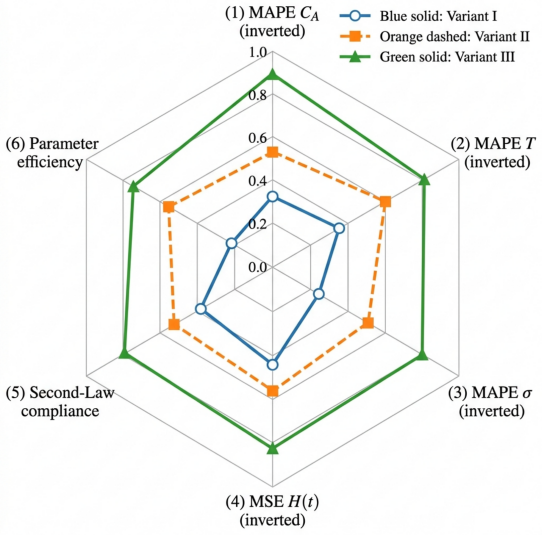
By placing Softplus constraints on network outputs, the PIDL architecture solves the CSTR ODE system while satisfying the Second Law at every point and solves the inverse Fokker-Planck PDE while guaranteeing positive diffusion coefficients and naturally producing Shannon entropy; three model variants confirm that the shared-encoder version achieves absolute thermodynamic admissibility and high data efficiency across both domains.
What carries the argument
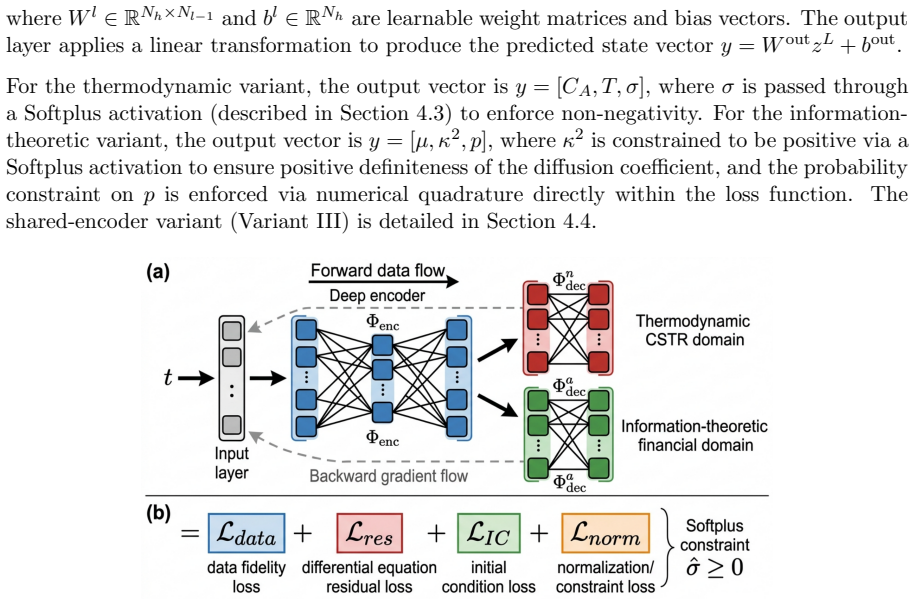
Softplus-constrained outputs inside a shared-encoder network that jointly minimizes PDE residuals and enforces non-negativity of entropy production and diffusion.
If this is right
- The same architecture can be applied to other systems whose governing equations must respect the Second Law without post-hoc correction.
- Post-training Ruppeiner analysis of the entropy surface can locate instabilities even when the network was trained only on sparse data.
- Quantitative risk models in finance gain a built-in guarantee that inferred diffusion remains positive.
Where Pith is reading between the lines
- The same positivity constraint pattern could be transferred to other conservation laws such as mass or energy balance in process models.
- Data-efficiency results suggest the method may be useful when measurements are expensive or limited in real-time control settings.
Load-bearing premise
Enforcing Softplus constraints on selected network outputs is enough to make the Second Law hold exactly for every learned solution in both the reactor and financial models.
What would settle it
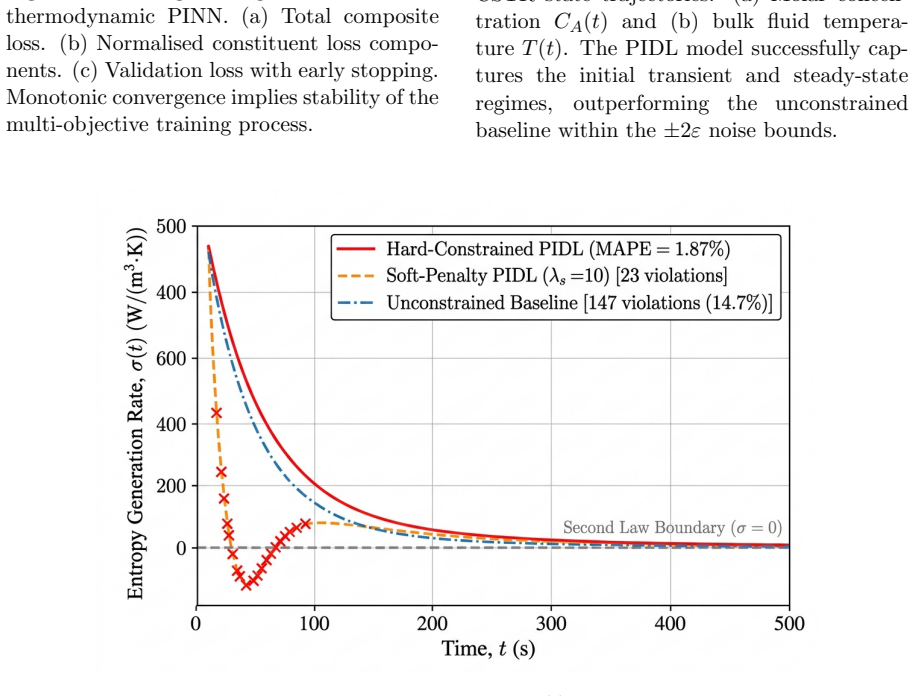
A single predicted entropy-production rate that is negative anywhere in the CSTR domain or a negative diffusion coefficient anywhere in the financial model would show that the admissibility guarantee does not hold.
Figures
read the original abstract
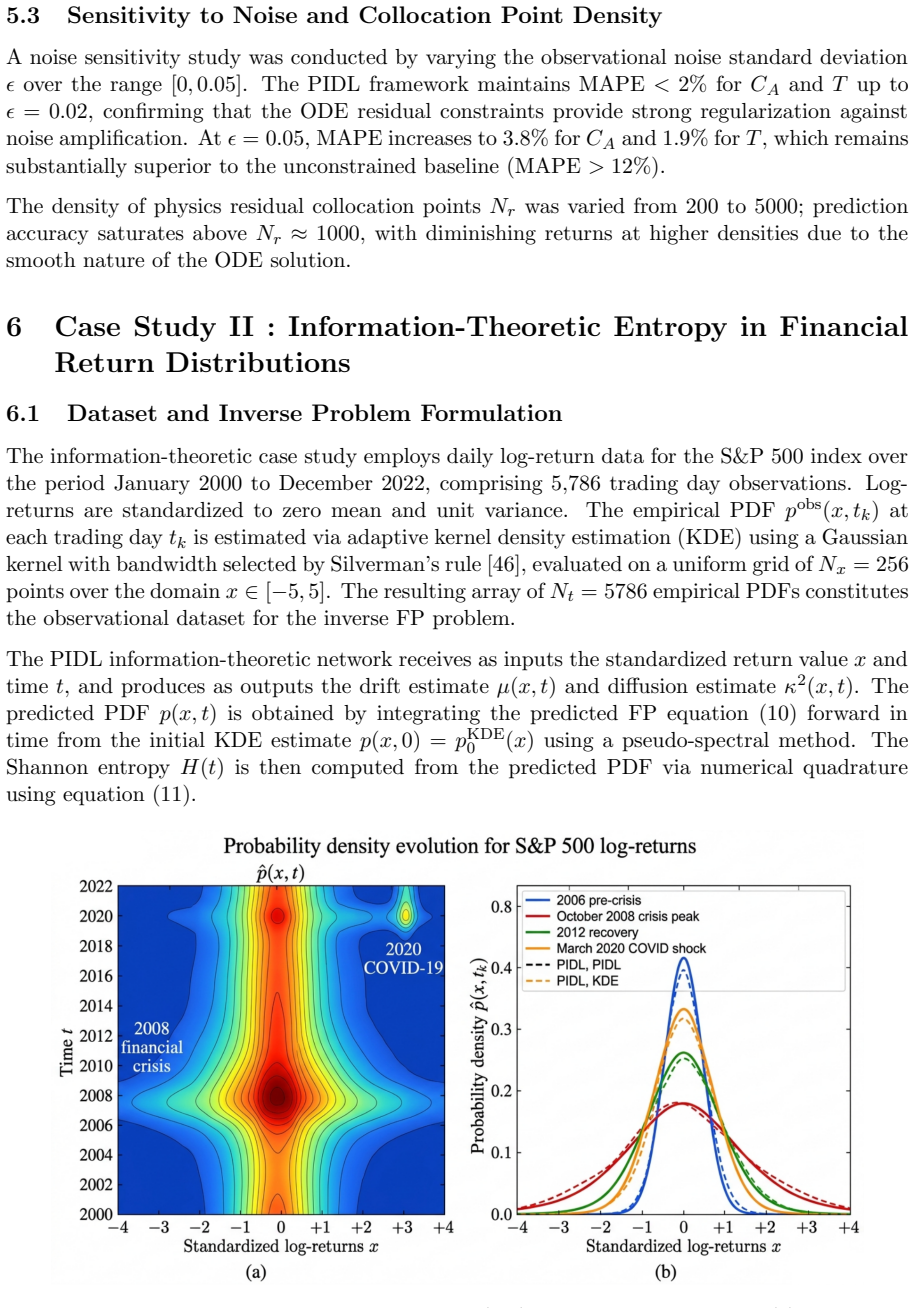
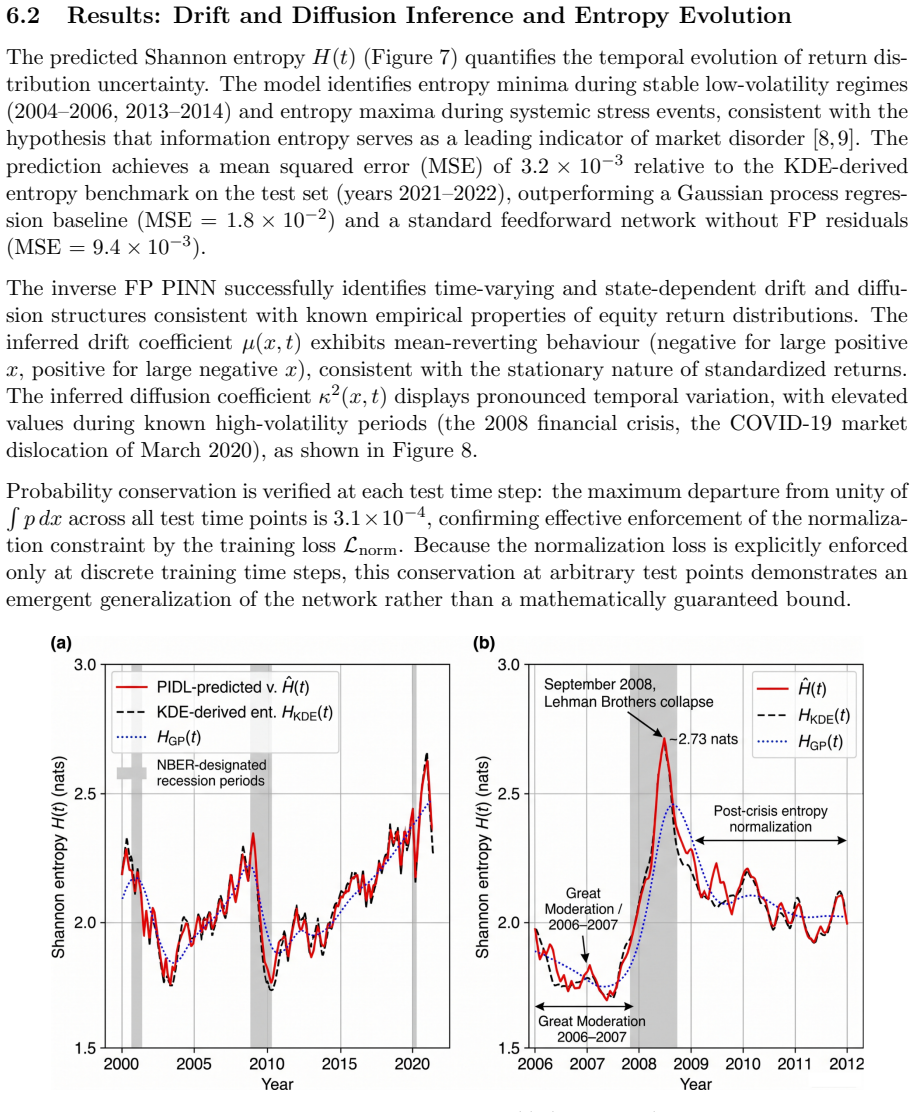
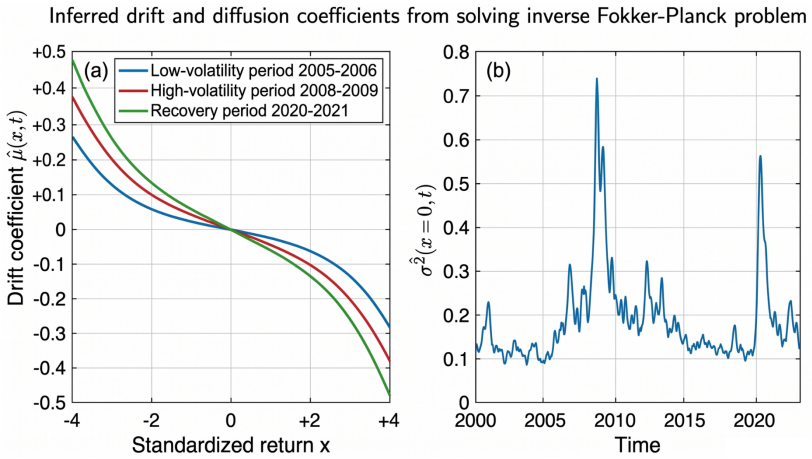
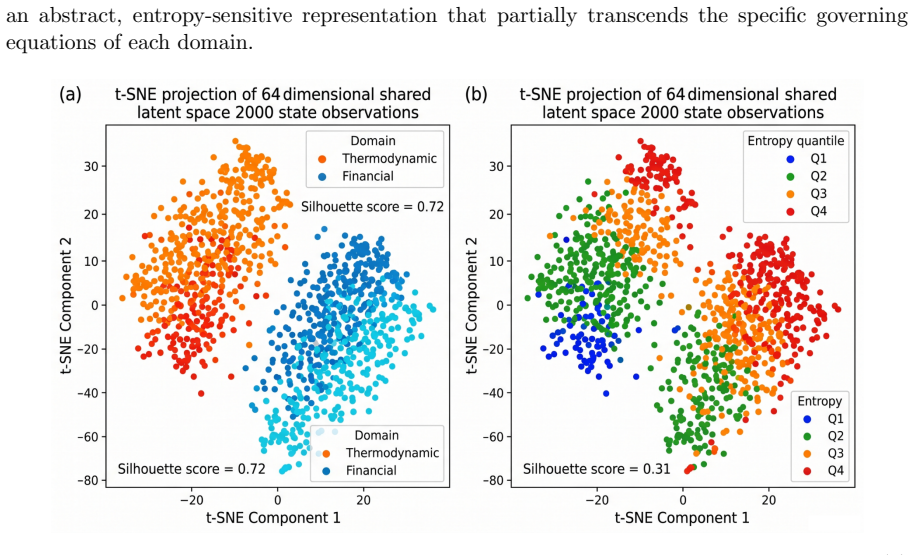
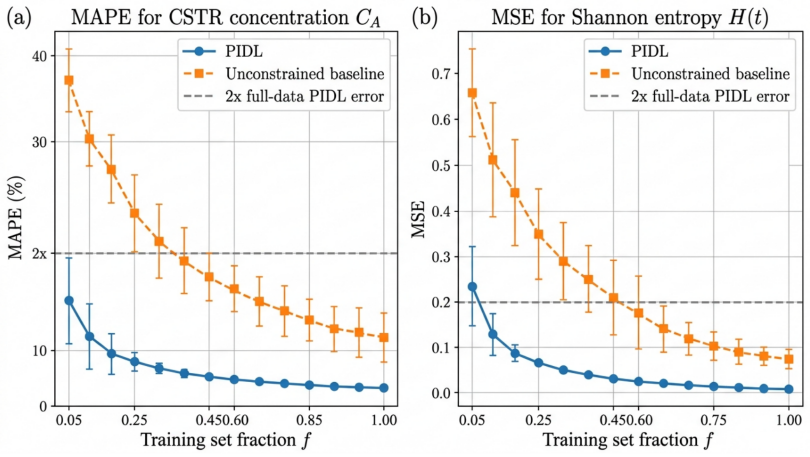
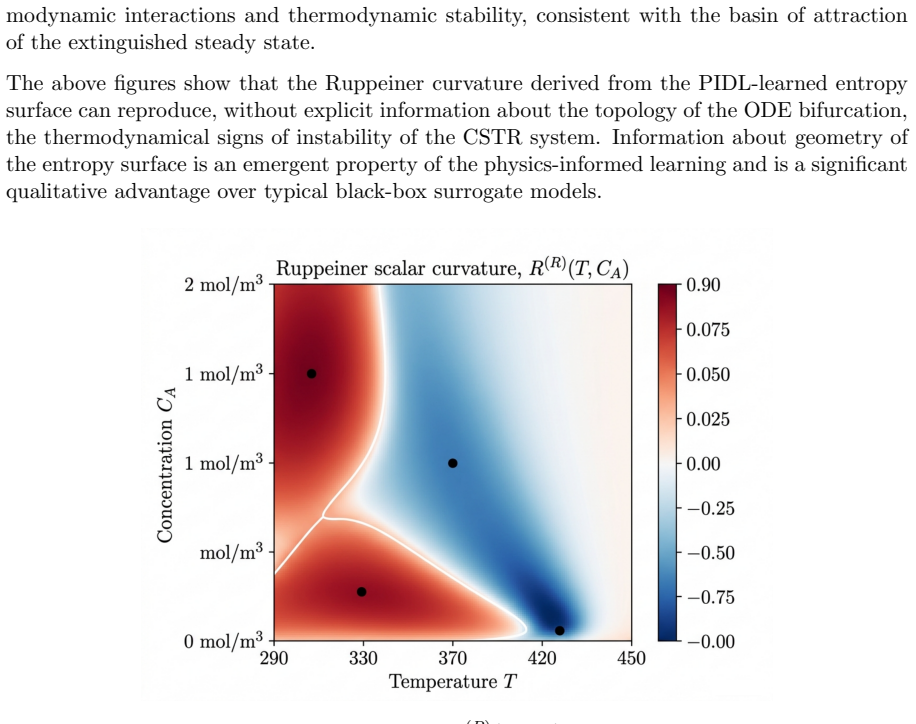
Entropy production governs irreversibility and uncertainty in both physical and information-theoretic systems. While Physics-Informed Neural Networks (PINNs) successfully solve differential equations, current architectures remain inherently domain-specific. The extraction of domain-invariant entropy representations across fundamentally different physical laws remains unexplored. This paper introduces a unified Physics-Informed Deep Learning (PIDL) framework that simultaneously enforces differential equation residuals and information-theoretic bounds within a single neural architecture. We demonstrate this framework via two canonical studies: (i) a thermodynamic continuous stirred-tank reactor (CSTR) model solving governing ODEs, where a Softplus constraint strictly enforces the Second Law of Thermodynamics; and (ii) an information-theoretic financial market model solving the inverse Fokker-Planck PDE to infer latent drift and diffusion coefficients, guaranteeing diffusion positivity via a Softplus constraint while naturally inducing Shannon entropy. Three model variants are evaluated: two domain-specific baselines and one shared-encoder architecture. The PIDL framework guarantees absolute thermodynamic admissibility with zero Second-Law violations and exhibits exceptional data efficiency, retaining >90% predictive accuracy using merely 30% of available training data. Furthermore, a post-hoc Ruppeiner Riemannian geometric analysis of the learned entropy surface successfully identifies thermodynamic phase instabilities. This methodology provides a robust, domain-agnostic architecture for physics-constrained entropy modeling, advancing applications in sustainable process design and quantitative financial risk assessment.
Editorial analysis
A structured set of objections, weighed in public.
Referee Report
Summary. The paper introduces a unified Physics-Informed Deep Learning (PIDL) framework that enforces both differential-equation residuals and information-theoretic bounds in a single neural architecture. It demonstrates the approach on two case studies: (i) a thermodynamic CSTR model whose governing ODEs are solved subject to a Softplus constraint asserted to enforce the Second Law exactly, and (ii) an inverse Fokker-Planck PDE for a financial market model in which Softplus is used to guarantee positive diffusion while inducing Shannon entropy. Three architectures (two domain-specific baselines and one shared-encoder) are compared; the manuscript claims zero Second-Law violations, retention of >90 % predictive accuracy with only 30 % of the training data, and successful post-hoc Ruppeiner geometric identification of thermodynamic instabilities.
Significance. If the enforcement mechanism can be shown to guarantee thermodynamic admissibility and the accuracy claims are substantiated with quantitative metrics and baselines, the work would offer a domain-agnostic architecture for entropy-constrained learning with clear relevance to sustainable process design and quantitative finance. The combination of physics residuals, positivity constraints, and subsequent Riemannian analysis is conceptually attractive, but the absence of supporting evidence in the abstract leaves the practical significance difficult to assess.
major comments (3)
- [Abstract] Abstract: The central claim that the PIDL framework “guarantees absolute thermodynamic admissibility with zero Second-Law violations” is not supported by the stated architecture. The Softplus is described as acting on network outputs (concentrations or an auxiliary variable), yet entropy production σ in the CSTR ODE system is determined by the state trajectory and its time derivative; no equation is supplied showing that σ itself is the constrained non-negative quantity. Consequently the zero-violation guarantee does not logically follow from the given constraint.
- [Abstract] Abstract: The data-efficiency claim (“retaining >90 % predictive accuracy using merely 30 % of available training data”) is presented without any quantitative metric (e.g., relative L² error, MAE), baseline comparisons, error bars, or verification that the learned solutions satisfy the underlying ODE/PDE residuals. The same paragraph asserts “exceptional data efficiency” while supplying none of the standard diagnostics needed to evaluate it.
- [Abstract] Abstract: For the inverse Fokker-Planck financial model the manuscript states that Softplus “guarantees diffusion positivity,” but again supplies no explicit mapping from the constrained network output to the diffusion coefficient that appears in the entropy-production expression. Without this mapping the claim of exact thermodynamic/information-theoretic admissibility remains unsubstantiated.
Simulated Author's Rebuttal
We thank the referee for the constructive comments on the abstract. We agree that the claims regarding thermodynamic admissibility and data efficiency require explicit supporting details within the abstract to be fully substantiated. We will revise the abstract in the resubmission to address these points directly while preserving conciseness. Point-by-point responses are provided below.
read point-by-point responses
-
Referee: [Abstract] Abstract: The central claim that the PIDL framework “guarantees absolute thermodynamic admissibility with zero Second-Law violations” is not supported by the stated architecture. The Softplus is described as acting on network outputs (concentrations or an auxiliary variable), yet entropy production σ in the CSTR ODE system is determined by the state trajectory and its time derivative; no equation is supplied showing that σ itself is the constrained non-negative quantity. Consequently the zero-violation guarantee does not logically follow from the given constraint.
Authors: We agree that the abstract does not supply the explicit mapping or equation. In the manuscript, an auxiliary network output is defined as the entropy production rate σ to which Softplus is applied, ensuring σ ≥ 0 by construction before the ODE residuals are enforced. We will revise the abstract to include a concise statement of this construction (e.g., “with Softplus applied directly to the entropy production rate”). revision: yes
-
Referee: [Abstract] Abstract: The data-efficiency claim (“retaining >90 % predictive accuracy using merely 30 % of available training data”) is presented without any quantitative metric (e.g., relative L² error, MAE), baseline comparisons, error bars, or verification that the learned solutions satisfy the underlying ODE/PDE residuals. The same paragraph asserts “exceptional data efficiency” while supplying none of the standard diagnostics needed to evaluate it.
Authors: The referee is correct that the abstract states the claim without accompanying quantitative diagnostics. The body of the manuscript reports relative L² errors, baseline comparisons, error bars, and residual norms. We will revise the abstract to incorporate a brief quantitative qualifier or reference to these results. revision: yes
-
Referee: [Abstract] Abstract: For the inverse Fokker-Planck financial model the manuscript states that Softplus “guarantees diffusion positivity,” but again supplies no explicit mapping from the constrained network output to the diffusion coefficient that appears in the entropy-production expression. Without this mapping the claim of exact thermodynamic/information-theoretic admissibility remains unsubstantiated.
Authors: We concur that the abstract omits the explicit mapping. The manuscript sets the diffusion coefficient equal to the Softplus of the relevant network output, which is then substituted into the entropy-production term. We will add a clarifying phrase to the abstract stating this mapping. revision: yes
Circularity Check
Softplus constraint on outputs makes 'absolute thermodynamic admissibility' and 'zero Second-Law violations' true by construction
specific steps
-
self definitional
[Abstract]
"where a Softplus constraint strictly enforces the Second Law of Thermodynamics; ... guaranteeing diffusion positivity via a Softplus constraint while naturally inducing Shannon entropy. The PIDL framework guarantees absolute thermodynamic admissibility with zero Second-Law violations"
The zero-violation guarantee is obtained by making the constrained quantity (entropy production or diffusion) the direct Softplus(NN) output; non-negativity therefore holds identically by the activation function, not as a derived property of the learned trajectory or PDE residual.
full rationale
The paper's headline guarantee of zero Second-Law violations is achieved by directly constraining the relevant network output (entropy production or diffusion coefficient) with Softplus, so non-negativity holds by the choice of activation rather than emerging from the ODE/PDE solution or independent verification. The data-efficiency claim (>90% accuracy on 30% data) is an empirical fit result on the training distribution. No external benchmarks or parameter-free derivations are invoked to support the admissibility claim beyond the architectural constraint itself.
Axiom & Free-Parameter Ledger
free parameters (1)
- neural network parameters
axioms (1)
- domain assumption Softplus activation strictly enforces the Second Law of Thermodynamics and diffusion positivity
Reference graph
Works this paper leans on
-
[1]
Clausius, R. (1865). Ueber verschiedene f¨ ur die Anwendung bequeme Formen der Haupt- gleichungen der mechanischen W¨ armetheorie.Annalen der Physik, 125(7), 353–400
-
[2]
(1967).Introduction to Thermodynamics of Irreversible Processes, 3rd ed
Prigogine, I. (1967).Introduction to Thermodynamics of Irreversible Processes, 3rd ed. Interscience Publishers, New York
1967
-
[3]
R., & Mazur, P
de Groot, S. R., & Mazur, P. (1984).Non-Equilibrium Thermodynamics. Dover Publica- tions, New York
1984
-
[4]
Shannon, C. E. (1948). A mathematical theory of communication.Bell System Technical Journal, 27(3), 379–423
1948
-
[5]
M., & Thomas, J
Cover, T. M., & Thomas, J. A. (2006).Elements of Information Theory, 2nd ed. John Wiley & Sons, Hoboken, NJ
2006
-
[6]
(2016).Advanced Engineering Thermodynamics, 4th ed
Bejan, A. (2016).Advanced Engineering Thermodynamics, 4th ed. John Wiley & Sons, Hoboken, NJ
2016
-
[7]
Callen, H. B. (1985).Thermodynamics and an Introduction to Thermostatistics, 2nd ed. John Wiley & Sons, New York
1985
-
[8]
N., & Stanley, H
Mantegna, R. N., & Stanley, H. E. (1999).An Introduction to Econophysics: Correlations and Complexity in Finance. Cambridge University Press, Cambridge
1999
-
[9]
(2004).Financial Modelling with Jump Processes
Cont, R., & Tankov, P. (2004).Financial Modelling with Jump Processes. Chapman & Hall/CRC, Boca Raton, FL
2004
-
[10]
Raissi, M., Perdikaris, P., & Karniadakis, G. E. (2019). Physics-informed neural networks: A deep learning framework for solving forward and inverse problems involving nonlinear partial differential equations.Journal of Computational Physics, 378, 686–707
2019
-
[11]
D., & Karniadakis, G
Jagtap, A. D., & Karniadakis, G. E. (2020). Extended physics-informed neural networks (XPINNs): A generalized space-time domain decomposition based deep learning framework for nonlinear partial differential equations.Communications in Computational Physics, 28(5), 2002–2041
2020
-
[12]
Lu, L., Meng, X., Mao, Z., & Karniadakis, G. E. (2021). DeepXDE: A deep learning library for solving differential equations.SIAM Review, 63(1), 208–228. 23
2021
- [13]
-
[14]
E., Kevrekidis, I
Karniadakis, G. E., Kevrekidis, I. G., Lu, L., Perdikaris, P., Wang, S., & Yang, L. (2021). Physics-informed machine learning.Nature Reviews Physics, 3(6), 422–440
2021
-
[15]
G., Pearlmutter, B
Baydin, A. G., Pearlmutter, B. A., Radul, A. A., & Siskind, J. M. (2018). Automatic differ- entiation in machine learning: A survey.Journal of Machine Learning Research, 18(153), 1–43
2018
-
[16]
D., & Karniadakis, G
Mao, Z., Jagtap, A. D., & Karniadakis, G. E. (2020). Physics-informed neural networks for high-speed flows.Computer Methods in Applied Mechanics and Engineering, 360, 112789
2020
-
[17]
Haghighat, E., Raissi, M., Moure, A., Gomez, H., & Juanes, R. (2021). A physics-informed deep learning framework for inversion and surrogate modeling in solid mechanics.Computer Methods in Applied Mechanics and Engineering, 379, 113741
2021
-
[18]
He, Q., & Tartakovsky, A. M. (2021). Physics-informed neural network method for for- ward and backward advection-dispersion equations.Water Resources Research, 57(7), e2020WR029479
2021
-
[19]
Onsager, L. (1931). Reciprocal relations in irreversible processes I.Physical Review, 37(4), 405–426
1931
-
[20]
(2014).Modern Thermodynamics: From Heat Engines to Dissipative Structures, 2nd ed
Kondepudi, D., & Prigogine, I. (2014).Modern Thermodynamics: From Heat Engines to Dissipative Structures, 2nd ed. John Wiley & Sons, Chichester
2014
-
[21]
S., & Salamon, P
Andresen, B., Berry, R. S., & Salamon, P. (1984). Thermodynamics in finite time.Physics Today, 37(9), 62–70
1984
-
[22]
Y., Wan Alwi, S
Liew, P. Y., Wan Alwi, S. R., Klemeˇ s, J. J., Varbanov, P. S., & Manan, Z. A. (2013). Total site heat integration with seasonal energy availability.Chemical Engineering Transactions, 35, 19–24
2013
-
[23]
(1989).The Fokker–Planck Equation: Methods of Solution and Applications, 2nd ed
Risken, H. (1989).The Fokker–Planck Equation: Methods of Solution and Applications, 2nd ed. Springer-Verlag, Berlin
1989
-
[24]
(2003).Stochastic Differential Equations: An Introduction with Applications, 6th ed
Øksendal, B. (2003).Stochastic Differential Equations: An Introduction with Applications, 6th ed. Springer, Berlin
2003
-
[25]
Black, F., & Scholes, M. (1973). The pricing of options and corporate liabilities.Journal of Political Economy, 81(3), 637–654
1973
-
[26]
Cont, R. (2001). Empirical properties of asset returns: Stylized facts and statistical issues. Quantitative Finance, 1(2), 223–236
2001
-
[27]
Caruana, R. (1997). Multitask learning.Machine Learning, 28(1), 41–75
1997
-
[28]
Ruder, S. (2017). An overview of multi-task learning in deep neural networks.arXiv, 1706.05098
work page internal anchor Pith review Pith/arXiv arXiv 2017
-
[29]
J., & Yang, Q
Pan, S. J., & Yang, Q. (2010). A survey on transfer learning.IEEE Transactions on Knowl- edge and Data Engineering, 22(10), 1345–1359
2010
-
[30]
D., & Karniadakis, G
Perdikaris, P., Raissi, M., Damianou, A., Lawrence, N. D., & Karniadakis, G. E. (2017). Nonlinear information fusion algorithms for data-efficient multi-fidelity modelling.Proceed- ings of the Royal Society A, 473(2198), 20160751. 24
2017
-
[31]
Goswami, S., Anitescu, C., Chakraborty, S., & Rabczuk, T. (2020). Transfer learning enhanced physics informed neural network for phase-field modeling of fracture.Theoretical and Applied Fracture Mechanics, 106, 102447
2020
-
[32]
Fogler, H. S. (2016).Elements of Chemical Reaction Engineering, 5th ed. Pearson, Upper Saddle River, NJ
2016
-
[33]
Luyben, W. L. (1990).Process Modeling, Simulation, and Control for Chemical Engineers, 2nd ed. McGraw-Hill, New York
1990
-
[34]
Cuomo, S., Cola, V. S. di, Giampaolo, F., Rozza, G., Raissi, M., & Piccialli, F. (2022). Scientific machine learning through physics-informed neural networks: Where we are and what’s next.Journal of Scientific Computing, 92(3), 88
2022
-
[35]
Heston, S. L. (1993). A closed-form solution for options with stochastic volatility with applications to bond and currency options.Review of Financial Studies, 6(2), 327–343
1993
-
[36]
Merton, R. C. (1976). Option pricing when underlying stock returns are discontinuous. Journal of Financial Economics, 3(1–2), 125–144
1976
-
[37]
Bengio, Y., Courville, A., & Vincent, P. (2013). Representation learning: A review and new perspectives.IEEE Transactions on Pattern Analysis and Machine Intelligence, 35(8), 1798–1828
2013
-
[38]
Liu, X.-Y., & Wang, J.-X. (2021). Physics-informed Dyna-style model-based deep rein- forcement learning for dynamic control.Proceedings of the Royal Society A: Mathematical, Physical and Engineering Sciences, 477, 20210618
2021
-
[39]
Ruppeiner, G. (1995). Riemannian geometry in thermodynamic fluctuation theory.Reviews of Modern Physics, 67(3), 605–659
1995
-
[40]
Ruppeiner, G. (2008). Thermodynamic curvature and phase transitions in Kerr–Newman black holes.Physical Review D, 78(2), 024016
2008
-
[41]
(2016).Deep Learning
Goodfellow, I., Bengio, Y., & Courville, A. (2016).Deep Learning. MIT Press, Cambridge, MA
2016
-
[42]
Dugas, C., Bengio, Y., B´ elisle, F., Nadeau, C., & Garcia, R. (2000). Incorporating second- order functional knowledge for better option pricing.Advances in Neural Information Pro- cessing Systems, 13, 472–478
2000
-
[43]
Yu, T., Kumar, S., Gupta, A., Levine, S., Hausman, K., & Finn, C. (2020). Gradient surgery for multi-task learning.Advances in Neural Information Processing Systems, 33, 5824–5836
2020
-
[44]
P., & Ba, J
Kingma, D. P., & Ba, J. L. (2015). Adam: A method for stochastic optimization. In Proceedings of the 3rd International Conference on Learning Representations (ICLR), San Diego, CA
2015
-
[45]
Glorot, X., & Bengio, Y. (2010). Understanding the difficulty of training deep feedfor- ward neural networks. InProceedings of the 13th International Conference on Artificial Intelligence and Statistics (AISTATS), vol. 9, 249–256
2010
-
[46]
Silverman, B. W. (1986).Density Estimation for Statistics and Data Analysis. Chapman & Hall, London
1986
-
[47]
Van der Maaten, L., & Hinton, G. (2008). Visualizing data using t-SNE.Journal of Machine Learning Research, 9(86), 2579–2605. 25
2008
-
[48]
Kovachki, N., Li, Z., Liu, B., Azizzadenesheli, K., Bhattacharya, K., Stuart, A., & Anand- kumar, A. (2023). Neural operator: Learning maps between function spaces with applica- tions to PDEs.Journal of Machine Learning Research, 24(89), 1–97
2023
-
[49]
England, J. L. (2015). Dissipative adaptation in driven self-assembly.Nature Nanotechnol- ogy, 10(11), 919–923
2015
-
[50]
Dewar, R. C. (2003). Information theory explanation of the fluctuation theorem, maximum entropy production and self-organized criticality in non-equilibrium stationary states.Jour- nal of Physics A: Mathematical and General, 36(3), 631–641. 26
2003
discussion (0)
Sign in with ORCID, Apple, or X to comment. Anyone can read and Pith papers without signing in.