Enhanced Spin-to-Charge Conversion in Bi2Se3/NiFe via Interface Engineering with a Ti Spacer Layer
Pith reviewed 2026-06-28 17:02 UTC · model grok-4.3
The pith
Inserting a titanium spacer between Bi2Se3 and NiFe raises the spin Hall angle by an order of magnitude by preserving topological surface states.
A machine-rendered reading of the paper's core claim, the machinery that carries it, and where it could break.
Core claim
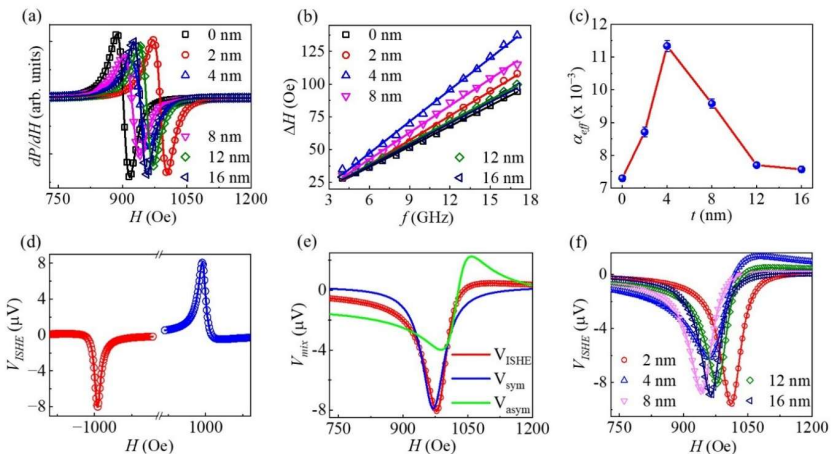
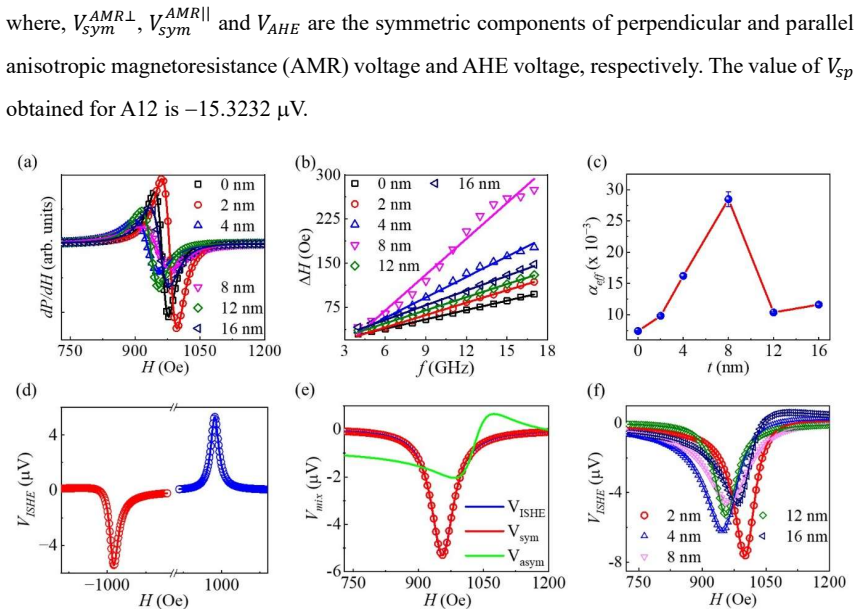
In Bi2Se3/NiFe thin-film stacks deposited by sputtering on silicon, insertion of a titanium spacer layer between the topological insulator and the ferromagnet increases the spin Hall angle by an order of magnitude. The titanium suppresses interdiffusion of atoms between Bi2Se3 and NiFe, thereby maintaining the integrity of the Dirac-cone topological surface states. This preservation enables more efficient conversion of pure spin current, generated by spin pumping during microwave-driven ferromagnetic resonance, into charge current. Thickness-dependent measurements reveal a 55% enhancement in the Gilbert damping parameter at 4 nm Bi2Se3, consistent with a pure surface-state contribution to th
What carries the argument
The titanium spacer layer, which suppresses interdiffusion between Bi2Se3 and NiFe to preserve topological surface states during spin pumping.
If this is right
- The spin Hall angle enhancement is tied directly to reduced atomic mixing at the Bi2Se3/NiFe boundary.
- The 55% Gilbert damping increase at 4 nm Bi2Se3 thickness indicates that surface states dominate the spin-pumping response.
- Sputter deposition on silicon substrates supports scalable fabrication of enhanced topological heterostructures.
- Interface control via thin metal spacers is required to achieve high spin-to-charge conversion in Bi2Se3-based devices.
Where Pith is reading between the lines
- Alternative diffusion-barrier materials could be substituted for titanium to test whether the efficiency gain generalizes beyond this specific choice.
- The same spacer strategy might improve reported conversion efficiencies in other topological insulator/ferromagnet combinations where interface mixing has been a limiting factor.
- Without such barriers, many existing Bi2Se3 device efficiencies could be limited by unintended surface-state degradation during fabrication.
Load-bearing premise
The order-of-magnitude rise in spin Hall angle with the titanium spacer stems specifically from preserved topological surface states of Bi2Se3 rather than from bulk or unrelated interface changes.
What would settle it
If spin Hall angle measurements show no enhancement with the Ti spacer in samples where independent spectroscopy confirms reduced interdiffusion but the Dirac-cone states are intentionally disrupted, the surface-state preservation mechanism would be ruled out.
Figures
read the original abstract
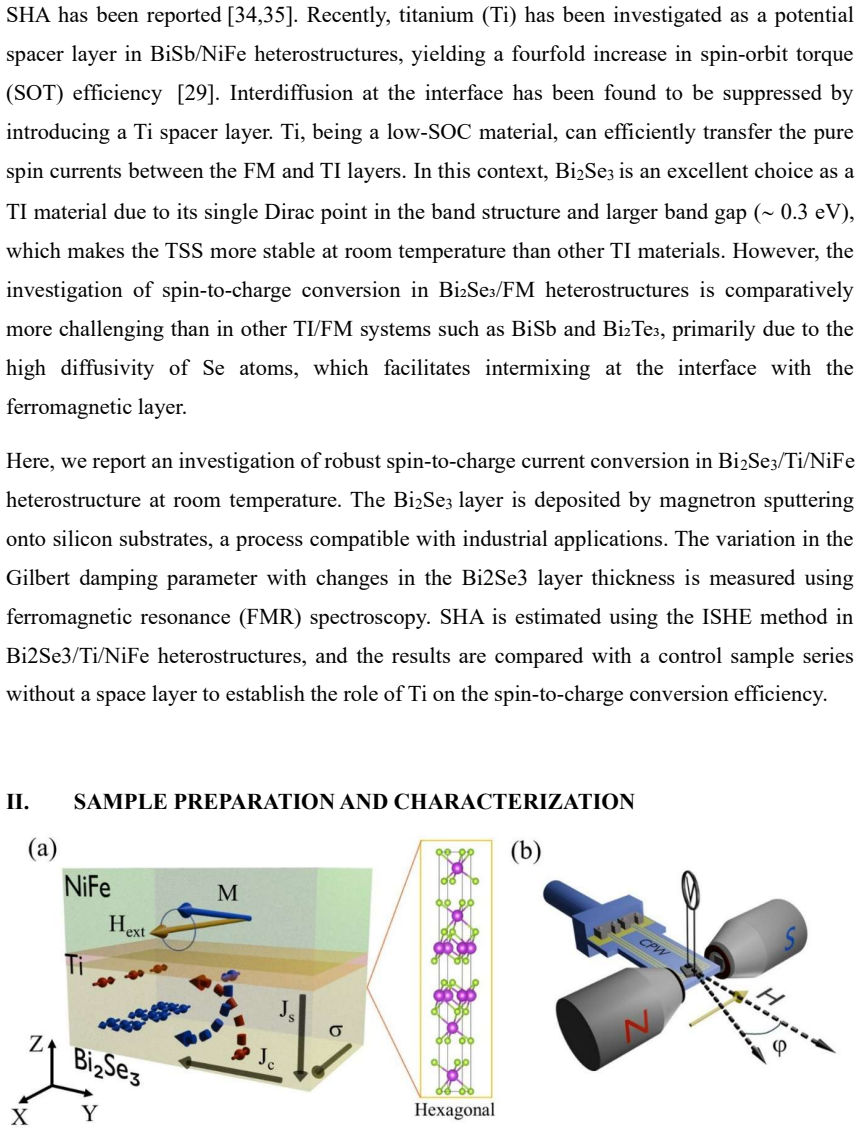
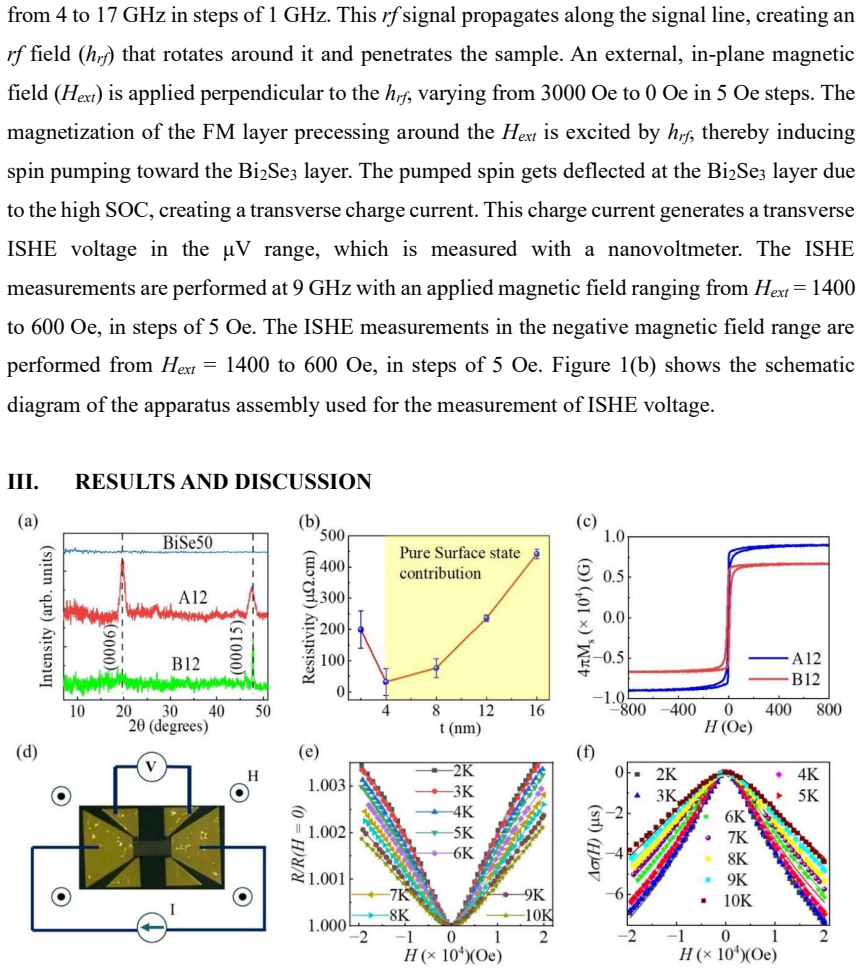
Topological insulators have attracted significant attention in spintronics due to their topological surface states and spin-momentum-locking-driven spin-to-charge conversion. Among these, Bi2Se3 has been extensively investigated because of its large bulk bandgap and single Dirac cone band structure. However, spin-to-charge conversion strongly depends on the quality of the topological insulator/ferromagnet interface. Here, we investigate spin-to-charge conversion in a sputter-deposited heterostructure comprising a topological insulator (Bi2Se3) and a ferromagnetic NiFe thin film separated by a titanium spacer layer. The Bi2Se3 layer is deposited on a silicon substrate for industrial compatibility. Pure spin current is injected into the Bi2Se3 layer through the titanium spacer via spin pumping induced by spin precession during microwave-driven ferromagnetic resonance of the ferromagnetic film. Spin pumping studies are performed by varying the Bi2Se3 thickness. The Gilbert damping parameter exhibits a significant 55% increase at a Bi2Se3 thickness of 4 nm, indicating a pure surface-state contribution. The spin Hall angle, which quantifies the spin-to-charge conversion efficiency, increases by an order of magnitude upon insertion of the titanium spacer layer. This enhancement is attributed to the suppression of interdiffusion between the Bi2Se3 and NiFe layers by titanium, thereby preserving the topological surface states. These findings highlight the important role of titanium spacer layers in spintronic devices based on topological materials.
Editorial analysis
A structured set of objections, weighed in public.
Referee Report
Summary. The manuscript reports spin-pumping experiments on sputter-deposited Bi2Se3/NiFe heterostructures on Si, with and without a Ti spacer layer. It claims that a 55% rise in Gilbert damping at 4 nm Bi2Se3 thickness signals a pure topological surface-state contribution, and that insertion of the Ti spacer produces an order-of-magnitude increase in the extracted spin Hall angle, which is attributed to suppression of Bi2Se3/NiFe interdiffusion that preserves the topological surface states.
Significance. If the causal attribution to preserved topological surface states is substantiated, the result would be significant for interface engineering in topological-insulator spintronic devices, particularly for sputter-grown stacks compatible with Si substrates. The work supplies an experimental demonstration of spacer-layer control over spin-to-charge conversion efficiency.
major comments (2)
- [Abstract] Abstract: the statement that the 55% Gilbert damping increase at 4 nm Bi2Se3 thickness 'indicates a pure surface-state contribution' is presented without thickness-dependent damping data, fitting procedure, or controls that separate surface-state, interface, and bulk contributions; this datum is load-bearing for the subsequent attribution of the SHA enhancement.
- [Abstract] Abstract: the order-of-magnitude SHA enhancement is attributed specifically to Ti-mediated suppression of interdiffusion that preserves TSS, yet the text supplies neither direct interface probes (TEM, XPS, ARPES) nor control-spacer comparisons to exclude alternative mechanisms such as altered spin-mixing conductance or Ti-specific scattering; this attribution is central to the paper's mechanistic claim.
minor comments (2)
- [Abstract] Abstract and methods: quantitative results (damping values, SHA magnitudes) are reported without error bars, full datasets, or description of analysis methods and fitting routines.
- The manuscript should clarify the Bi2Se3 thickness series used for the damping measurements and the precise definition of the spin Hall angle extraction (e.g., via inverse spin Hall voltage or linewidth analysis).
Simulated Author's Rebuttal
We thank the referee for the careful reading and constructive comments. The points raised concern the level of detail and supporting evidence presented for two key claims in the abstract. We address each below, noting where the full manuscript already contains relevant data and where we agree that clarifications or additional discussion are warranted.
read point-by-point responses
-
Referee: [Abstract] Abstract: the statement that the 55% Gilbert damping increase at 4 nm Bi2Se3 thickness 'indicates a pure surface-state contribution' is presented without thickness-dependent damping data, fitting procedure, or controls that separate surface-state, interface, and bulk contributions; this datum is load-bearing for the subsequent attribution of the SHA enhancement.
Authors: The full manuscript presents thickness-dependent Gilbert damping data (Figure 2 and associated text) obtained from FMR linewidth measurements across multiple Bi2Se3 thicknesses. The 55% increase is observed specifically at 4 nm, consistent with the expected dominance of topological surface states at that thickness given the spin coherence length in Bi2Se3. The extraction of the Gilbert damping parameter follows the standard linear fit to frequency-dependent linewidth, with the procedure and error analysis detailed in the Methods section. Controls include comparison of damping enhancement with and without the Ti spacer layer, as well as reference samples without Bi2Se3. We agree the abstract is overly concise on these points and will revise it to explicitly reference the relevant figures and briefly note how bulk versus surface contributions are distinguished via thickness dependence. revision: partial
-
Referee: [Abstract] Abstract: the order-of-magnitude SHA enhancement is attributed specifically to Ti-mediated suppression of interdiffusion that preserves TSS, yet the text supplies neither direct interface probes (TEM, XPS, ARPES) nor control-spacer comparisons to exclude alternative mechanisms such as altered spin-mixing conductance or Ti-specific scattering; this attribution is central to the paper's mechanistic claim.
Authors: The manuscript reports the SHA enhancement exclusively in the presence of the Ti spacer (Figure 4 and Table I), providing a direct experimental control that isolates the effect of the spacer. The attribution to preserved TSS via reduced interdiffusion is based on the known diffusion-barrier properties of Ti in similar chalcogenide/metal stacks and on the observed correlation between the damping increase (indicating stronger spin pumping into TSS) and the SHA rise. Alternative mechanisms such as changes in spin-mixing conductance are addressed in the supplementary information through analysis of the real and imaginary parts of the mixing conductance. We acknowledge that direct structural or spectroscopic interface characterization (TEM, XPS, ARPES) is not included in the present work; such measurements would strengthen the mechanistic interpretation but lie outside the scope of the current spin-pumping study. We will add a short paragraph in the discussion section acknowledging this limitation and the reliance on indirect evidence while retaining the central attribution supported by the spacer-control data. revision: partial
Circularity Check
No circularity: purely experimental measurements with no derivations or fitted predictions
full rationale
The paper reports experimental results from spin-pumping and ferromagnetic resonance measurements on Bi2Se3/NiFe heterostructures with and without Ti spacer. Quantities such as Gilbert damping (55% increase at 4 nm) and spin Hall angle (order-of-magnitude increase) are obtained directly from measured linewidths, voltages, and resonance parameters; no equations, models, or self-citations are used to derive one reported value from another by construction. The attribution of the SHA enhancement to preserved topological surface states is an interpretive claim resting on experimental controls, not a mathematical reduction. No load-bearing steps match any of the enumerated circularity patterns.
Axiom & Free-Parameter Ledger
Reference graph
Works this paper leans on
-
[1]
L. Fu, C. L. Kane, and E. J. Mele, Topological insulators in three dimensions, Phys. Rev. Lett. 98, 106803 (2007)
2007
-
[2]
Hsieh, D
D. Hsieh, D. Qian, L. Wray, Y . Xia, Y . S. Hor, R. J. Cava, and M. Z. Hasan, A topological Dirac insulator in a quantum spin Hall phase, Nature 452, 970 (2008)
2008
-
[3]
A. R. Mellnik et al., Spin-transfer torque generated by a topological insulator, Nature 511, 449 (2014)
2014
-
[4]
Fan et al., Magnetization switching through giant spin-orbit torque in a magnetically doped topological insulator heterostructure, Nat
Y . Fan et al., Magnetization switching through giant spin-orbit torque in a magnetically doped topological insulator heterostructure, Nat. Mater. 13, 699 (2014)
2014
-
[5]
Kondou, R
K. Kondou, R. Yoshimi, A. Tsukazaki, Y . Fukuma, J. Matsuno, K. S. Takahashi, M. Kawasaki, Y . Tokura, and Y . Otani, Fermi-level-dependent charge-to-spin current conversion by Dirac surface states of topological insulators, Nat. Phys. 12, 1027 (2016)
2016
-
[6]
Y . Wang, P. Deorani, K. Banerjee, N. Koirala, M. Brahlek, S. Oh, and H. Yang, Topological surface states originated spin-orbit torques in Bi2Se3, Phys. Rev. Lett. 114, 257202 (2015)
2015
-
[7]
M. Z. Hasan and C. L. Kane, Colloquium: Topological insulators, Rev. Mod. Phys. 82, 3045 (2010)
2010
-
[8]
Zhang, C
H. Zhang, C. X. Liu, X. L. Qi, X. Dai, Z. Fang, and S. C. Zhang, Topological insulators in Bi 2 Se 3, Bi 2 Te 3 and Sb 2 Te 3 with a single Dirac cone on the surface, Nat. Phys. 5, 438 (2009)
2009
-
[9]
C. H. Li, O. M. J. Van’t Erve, J. T. Robinson, Y . Liu, L. Li, and B. T. Jonker, Electrical detection of charge-current-induced spin polarization due to spin-momentum locking in Bi2Se3, Nat. Nanotechnol. 9, 218 (2014)
2014
-
[10]
Y . Ando, T. Hamasaki, T. Kurokawa, K. Ichiba, F. Yang, M. Novak, S. Sasaki, K. Segawa, Y . Ando, and M. Shiraishi, Electrical detection of the spin polarization due to charge flow in the surface state of the topological insulator Bi1.5Sb0.5Te1.7Se1.3, Nano Lett. 14, 6226 (2014)
2014
-
[11]
Y . L. Chen et al., Experimental Realization of a Three-Dimensional Topological Insulator, Bi 2 Te 3, Science (1979). 325, 178 (2009). 17
1979
-
[12]
Z. H. Pan, E. Vescovo, A. V . Fedorov, D. Gardner, Y . S. Lee, S. Chu, G. D. Gu, and T. Valla, Electronic structure of the topological insulator Bi2Se 3 using angle-resolved photoemission spectroscopy: Evidence for a nearly full surface spin polarization, Phys. Rev. Lett. 106, 257004 (2011)
2011
-
[13]
H. T. He, G. Wang, T. Zhang, I. K. Sou, G. K. L. Wong, J. N. Wang, H. Z. Lu, S. Q. Shen, and F. C. Zhang, Impurity effect on weak antilocalization in the topological insulator Bi2Te3, Phys. Rev. Lett. 106, 166805 (2011)
2011
-
[14]
J. J. Cha, M. Claassen, D. Kong, S. S. Hong, K. J. Koski, X. L. Qi, and Y . Cui, Effects of magnetic doping on weak antilocalization in narrow Bi 2Se 3 nanoribbons, Nano Lett. 12, 4355 (2012)
2012
-
[15]
Zhang, C
X. Zhang, C. H. Li, J. Moon, S. Leontsev, M. R. Page, B. T. Jonker, and O. Van ’T Erve, Interplay of spin current and magnetization in a topological-insulator/magnetic-insulator bilayer structure, Phys. Rev. Mater. 6, 074203 (2022)
2022
-
[16]
Jamali, J
M. Jamali, J. S. Lee, J. S. Jeong, F. Mahfouzi, Y . Lv, Z. Zhao, B. K. Nikolić, K. A. Mkhoyan, N. Samarth, and J. P. Wang, Giant Spin Pumping and Inverse Spin Hall Effect in the Presence of Surface and Bulk Spin-Orbit Coupling of Topological Insulator Bi2Se3, Nano Lett. 15, 7126 (2015)
2015
-
[17]
Deorani, J
P. Deorani, J. Son, K. Banerjee, N. Koirala, M. Brahlek, S. Oh, and H. Yang, Observation of inverse spin hall effect in bismuth selenide, Phys. Rev. B Condens. Matter Mater. Phys. 90, 094403 (2014)
2014
-
[18]
J. C. Rojas-Sánchez, N. Reyren, P. Laczkowski, W. Savero, J. P. Attané, C. Deranlot, M. Jamet, J. M. George, L. Vila, and H. Jaffrès, Spin pumping and inverse spin hall effect in platinum: The essential role of spin-memory loss at metallic interfaces, Phys. Rev. Lett. 112, 106602 (2014)
2014
-
[19]
W. Luo, W. Y . Deng, H. Geng, M. N. Chen, R. Shen, L. Sheng, and D. Y . Xing, Perfect inverse spin Hall effect and inverse Edelstein effect due to helical spin-momentum locking in topological surface states, Phys. Rev. B 93, 115118 (2016)
2016
-
[20]
Suzuki, S
T. Suzuki, S. Fukami, N. Ishiwata, M. Yamanouchi, S. Ikeda, N. Kasai, and H. Ohno, Current-induced effective field in perpendicularly magnetized Ta/CoFeB/MgO wire, Appl. Phys. Lett. 98, 142505 (2011). 18
2011
-
[21]
Manchon, H
A. Manchon, H. C. Koo, J. Nitta, S. M. Frolov, and R. A. Duine, New perspectives for Rashba spin-orbit coupling, Nat. Mater. 14, 871 (2015)
2015
-
[22]
N. H. D. Khang, Y . Ueda, and P. N. Hai, A conductive topological insulator with large spin Hall effect for ultralow power spin–orbit torque switching, Nat. Mater. 17, 808 (2018)
2018
-
[23]
H. H. Huy et al., Large inverse spin Hall effect in BiSb topological insulator for 4 Tb/in2magnetic recording technology, Appl. Phys. Lett. 122, 052401 (2023)
2023
-
[24]
Shirokura and P
T. Shirokura and P. N. Hai, High temperature spin Hall effect in topological insulator, Appl. Phys. Lett. 122, 232404 (2023)
2023
-
[25]
J. Han, A. Richardella, S. A. Siddiqui, J. Finley, N. Samarth, and L. Liu, Roomerature Spin-Orbit Torque Switching Induced by a Topological Insulator, Phys. Rev. Lett. 119, 077702 (2017)
2017
-
[26]
D. Zhu, Y . Wang, S. Shi, K. L. Teo, Y . Wu, and H. Yang, Highly efficient charge-to-spin conversion from in situ Bi2Se3/Fe heterostructures, Appl. Phys. Lett. 118, 062403 (2021)
2021
-
[27]
Y . R. Sapkota and D. Mazumdar, Influence of post-deposition annealing on the transport properties of sputtered Bi2Se3 thin films, Thin Solid Films 727, (2021)
2021
-
[28]
L. A. Walsh, C. M. Smyth, A. T. Barton, Q. Wang, Z. Che, R. Yue, J. Kim, M. J. Kim, R. M. Wallace, and C. L. Hinkle, Interface Chemistry of Contact Metals and Ferromagnets on the Topological Insulator Bi2Se3, Journal of Physical Chemistry C 121, 23551 (2017)
2017
-
[29]
Manoj, Z
T. Manoj, Z. Wen, J. Uzuhashi, T. Ohkubo, H. Sukegawa, C. Murapaka, B. York, X. Liu, Q. Le, and S. Mitani, Spin-Orbit Torque Modulated by Interface Chemistry in Topological BiSb/NiFe Bilayers with Titanium Insertion, ACS Appl. Electron. Mater. 6, 4269 (2024)
2024
-
[30]
S. Pal, A. Nandi, S. G. Nath, P. K. Pal, K. Sharma, S. Manna, A. Barman, and C. Mitra, Enhancement of spin to charge conversion efficiency at the topological surface state by inserting normal metal spacer layer in the topological insulator based heterostructure, Appl. Phys. Lett. 124, 112416 (2024). 19
2024
-
[31]
X. Yao, H. T. Yi, D. Jain, M. G. Han, and S. Oh, Spacer-Layer-Tunable Magnetism and High-Field Topological Hall Effect in Topological Insulator Heterostructures, Nano Lett. 21, 5914 (2021)
2021
-
[32]
Bonell, M
F. Bonell, M. Goto, G. Sauthier, J. F. Sierra, A. I. Figueroa, M. V . Costache, S. Miwa, Y . Suzuki, and S. O. Valenzuela, Control of Spin-Orbit Torques by Interface Engineering in Topological Insulator Heterostructures, Nano Lett. 20, 5893 (2020)
2020
-
[33]
L. Liu, A. Richardella, I. Garate, Y . Zhu, N. Samarth, and C. T. Chen, Spin-polarized tunneling study of spin-momentum locking in topological insulators, Phys. Rev. B Condens. Matter Mater. Phys. 91, 235437 (2015)
2015
-
[34]
W. Lin, K. Chen, S. Zhang, and C. L. Chien, Enhancement of Thermally Injected Spin Current through an Antiferromagnetic Insulator, Phys. Rev. Lett. 116, 186601 (2016)
2016
-
[35]
Saglam, W
H. Saglam, W. Zhang, M. B. Jungfleisch, J. Sklenar, J. E. Pearson, J. B. Ketterson, and A. Hoffmann, Spin transport through the metallic antiferromagnet FeMn, Phys. Rev. B 94, 140412 (2016)
2016
-
[36]
See Supplementary Materials for more detailed analysis
-
[37]
Hikami, A
S. Hikami, A. I. Larkin, and Y . O. Nagaoka, Spin-Orbit Interaction and Magnetoresistance in the Two Dimensional Random System, Progress Letters, 1980
1980
-
[38]
Gautam, V
S. Gautam, V . Aggarwal, B. Singh, V . P. S. Awana, R. Ganesan, and S. S. Kushvaha, Signature of weak-antilocalization in sputtered topological insulator Bi2Se3 thin films with varying thickness, Sci. Rep. 12, 9770 (2022)
2022
-
[39]
Panigrahi, M
B. Panigrahi, M. M. Raja, C. Murapaka, and A. Haldar, Dual mode spin to charge conversion using inverse spin Hall effect in NiFe/FeMn/NiFe multilayer thin films, J. Phys. D Appl. Phys. 57, 305005 (2024)
2024
-
[40]
H. P. Xue et al., Synergistic enhancement of Gilbert damping and spin relaxation time in Fe/ Bi2 Te3 heterostructures, Phys. Rev. B 111, 075104 (2025)
2025
-
[41]
Enhanced Spin-to-Charge Conversion in Bi₂Se₃/NiFe via Interface Engineering with a Ti Spacer Layer,
S. R. S. Maitra, C. Murapaka, and A. Haldar, Supplementary Materials for “Enhanced Spin-to-Charge Conversion in Bi₂Se₃/NiFe via Interface Engineering with a Ti Spacer Layer,” n.d. 20
-
[42]
Tserkovnyak, A
Y . Tserkovnyak, A. Brataas, G. E. W. Bauer, and B. I. Halperin, Nonlocal magnetization dynamics in ferromagnetic heterostructures, Rev. Mod. Phys. 77, 1375 (2005)
2005
-
[43]
Tserkovnyak, A
Y . Tserkovnyak, A. Brataas, and G. E. W. Bauer, Enhanced Gilbert Damping in Thin Ferromagnetic Films, Phys. Rev. Lett. 88, 4 (2002)
2002
-
[44]
Dolui, U
K. Dolui, U. Bajpai, and B. K. Nikolić, Effective spin-mixing conductance of topological-insulator/ferromagnet and heavy-metal/ferromagnet spin-orbit-coupled interfaces: A first-principles Floquet-nonequilibrium Green function approach, Phys. Rev. Mater. 4, 121201 (2020)
2020
-
[45]
Panigrahi, M
B. Panigrahi, M. Manivel Raja, C. Murapaka, and A. Haldar, Spin-to-charge conversion via dual-mode ferromagnetic resonance in Ta/NiFe/FeMn/CoFeB multilayer, J. Magn. Magn. Mater. 608, 172420 (2024)
2024
-
[46]
Tao et al., Self-consistent determination of spin Hall angle and spin diffusion length in Pt and Pd: The role of the interface spin loss, Science (1979)
X. Tao et al., Self-consistent determination of spin Hall angle and spin diffusion length in Pt and Pd: The role of the interface spin loss, Science (1979). 4, 1670 (2018)
1979
-
[47]
Manoj et al., Thickness dependent spin to charge interconversion efficiency in polycrystalline BiSb layers deposited on Si substrate, J
T. Manoj et al., Thickness dependent spin to charge interconversion efficiency in polycrystalline BiSb layers deposited on Si substrate, J. Appl. Phys. 138, (2025)
2025
discussion (0)
Sign in with ORCID, Apple, or X to comment. Anyone can read and Pith papers without signing in.