Fine-Tuning Diffusion Models for Molecular Generation via Reinforcement Learning and Fast Sampling
Pith reviewed 2026-06-28 17:45 UTC · model grok-4.3
The pith
Fine-tuning diffusion models via reinforcement learning and fewer denoising steps produces molecules that better meet multiple drug design criteria under protein structure constraints.
A machine-rendered reading of the paper's core claim, the machinery that carries it, and where it could break.
Core claim
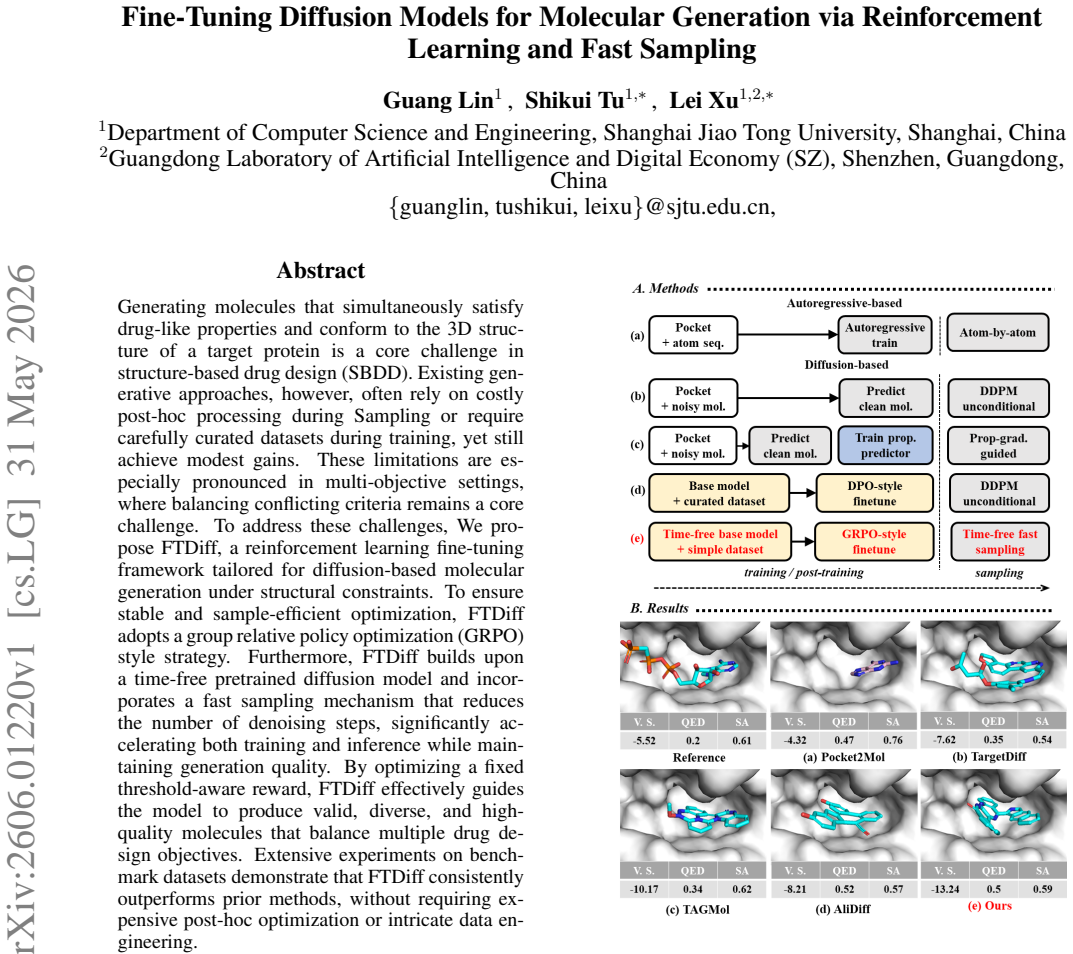
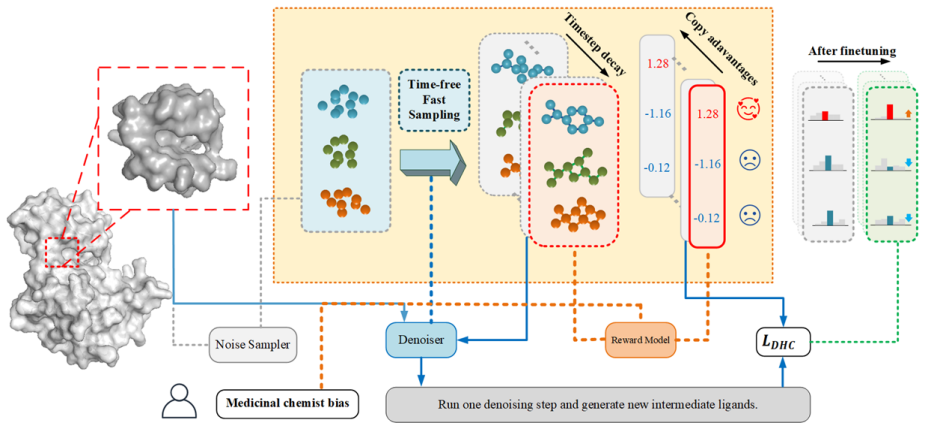
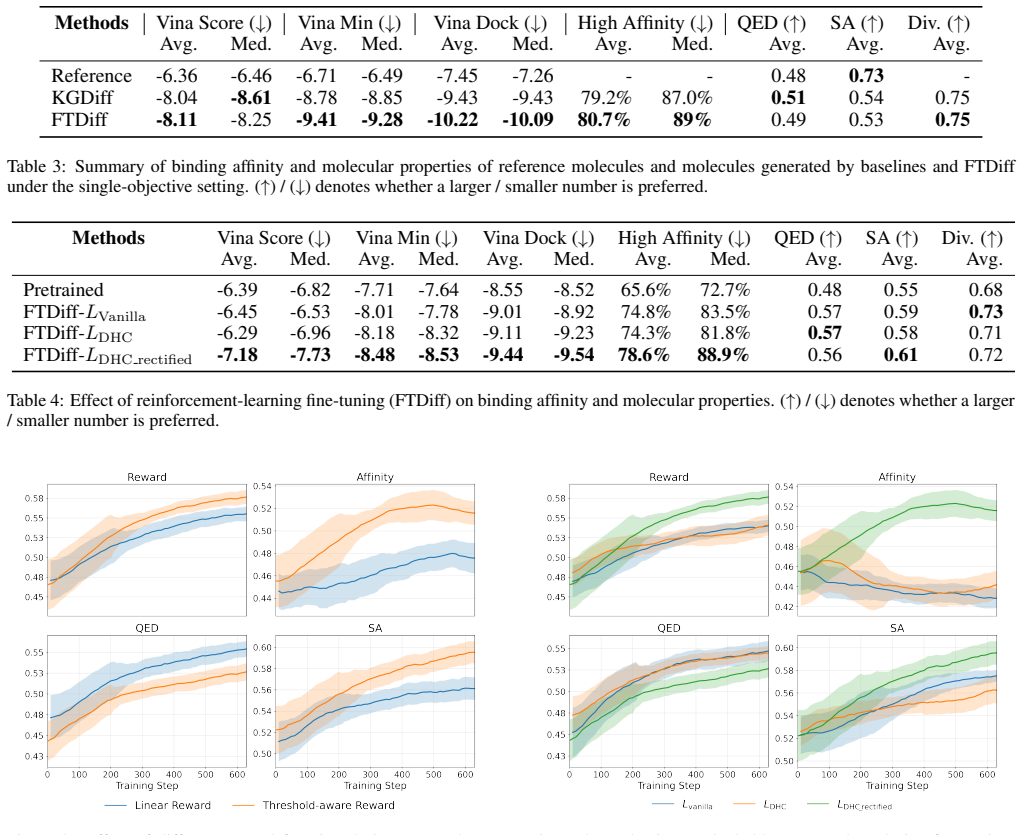
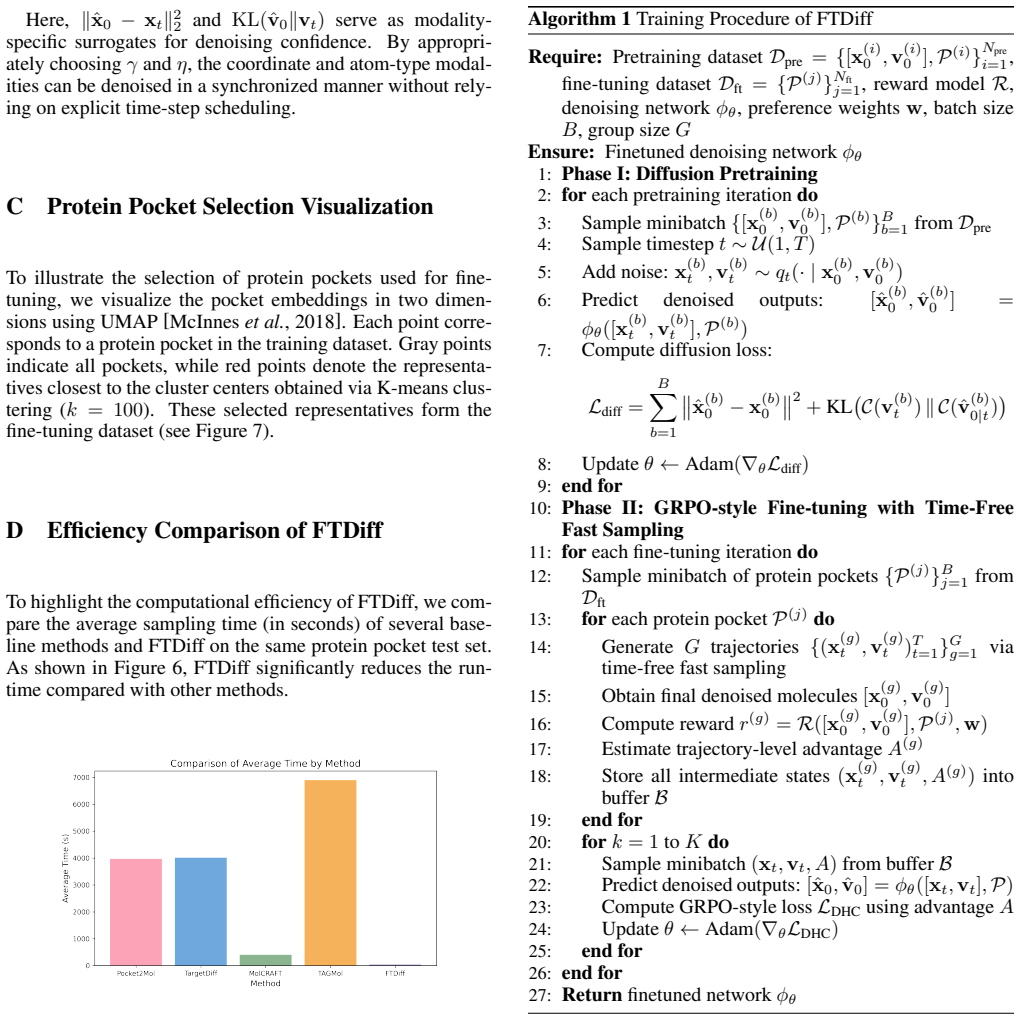
FTDiff is a reinforcement learning fine-tuning framework for diffusion-based molecular generation under structural constraints. It adopts a GRPO-style optimization strategy on a time-free pretrained diffusion model and adds a fast sampling mechanism that reduces denoising steps. By optimizing a fixed threshold-aware reward, the framework produces valid, diverse, and high-quality molecules that balance multiple drug design objectives, consistently outperforming prior methods on benchmarks without requiring expensive post-hoc optimization or intricate data engineering.
What carries the argument
The FTDiff framework, which applies group relative policy optimization to a time-free diffusion model together with a fast sampling mechanism that reduces denoising steps while optimizing a fixed threshold-aware reward under structural constraints.
If this is right
- Molecules can be produced that simultaneously satisfy drug-like properties and fit a given protein's 3D structure more reliably than before.
- Both training and inference run faster because the number of denoising steps is reduced.
- Multi-objective trade-offs in molecular generation become achievable without curated datasets or separate post-processing stages.
- The same fine-tuning recipe can be applied to other diffusion models that must respect hard geometric or property constraints.
Where Pith is reading between the lines
- The approach could be tested on non-molecular generative tasks that also involve multiple conflicting constraints, such as material or protein design.
- If the fast sampling preserves quality across different diffusion architectures, it may allow on-the-fly molecule suggestion inside interactive drug-design tools.
- The reward formulation might be reused to incorporate additional objectives like synthetic accessibility without changing the rest of the training pipeline.
Load-bearing premise
A fixed threshold-aware reward plus GRPO-style updates will stably balance several conflicting molecular properties while the reduced number of denoising steps keeps the generated molecules as good as the full sampling process.
What would settle it
A side-by-side comparison in which FTDiff-generated molecules score no higher than strong baselines on validity, diversity, or property metrics, or in which fast sampling visibly lowers those same scores.
Figures
read the original abstract
Generating molecules that simultaneously satisfy drug-like properties and conform to the 3D structure of a target protein is a core challenge in structure-based drug design (SBDD). Existing generative approaches, however, often rely on costly post-hoc processing during Sampling or require carefully curated datasets during training, yet still achieve modest gains. These limitations are especially pronounced in multi-objective settings, where balancing conflicting criteria remains a core challenge. To address these challenges, We propose FTDiff, a reinforcement learning fine-tuning framework tailored for diffusion-based molecular generation under structural constraints. To ensure stable and sample-efficient optimization, FTDiff adopts a group relative policy optimization (GRPO) style strategy. Furthermore, FTDiff builds upon a time-free pretrained diffusion model and incorporates a fast sampling mechanism that reduces the number of denoising steps, significantly accelerating both training and inference while maintaining generation quality. By optimizing a fixed threshold-aware reward, FTDiff effectively guides the model to produce valid, diverse, and high- quality molecules that balance multiple drug design objectives. Extensive experiments on benchmark datasets demonstrate that FTDiff consistently outperforms prior methods, without requiring expensive post-hoc optimization or intricate data engineering.
Editorial analysis
A structured set of objections, weighed in public.
Referee Report
Summary. The paper proposes FTDiff, a reinforcement learning fine-tuning framework for diffusion-based molecular generation in structure-based drug design. It employs a group relative policy optimization (GRPO) strategy with a fixed threshold-aware reward and incorporates a fast sampling mechanism on a time-free pretrained diffusion model to accelerate training and inference while maintaining quality. The method is said to produce valid, diverse, high-quality molecules balancing multiple objectives and to outperform prior methods on benchmark datasets without post-hoc optimization or intricate data engineering.
Significance. If the empirical claims hold, this work could be significant for advancing efficient fine-tuning of diffusion models for multi-objective molecular generation, addressing the challenges of balancing conflicting drug design criteria with stable and sample-efficient RL optimization and reduced denoising steps.
major comments (1)
- [Abstract] Abstract: The central claim that 'FTDiff consistently outperforms prior methods' is asserted without any accompanying quantitative results, metrics, error bars, dataset specifications, or ablation studies, which is load-bearing for evaluating the effectiveness of the proposed approach.
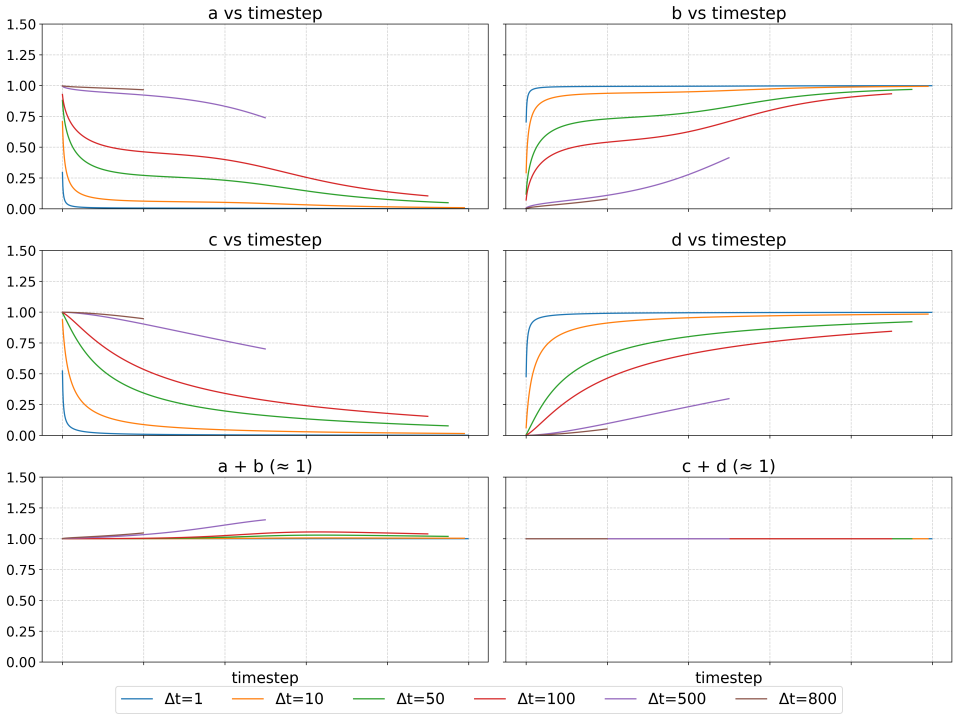
minor comments (2)
- [Abstract] Capitalization: 'We propose' should read 'we propose'.
- [Abstract] Typo: 'high- quality' should be 'high-quality'.
Simulated Author's Rebuttal
We thank the referee for their constructive feedback on our manuscript. We address the single major comment below and will revise the abstract accordingly to strengthen the presentation of our empirical claims.
read point-by-point responses
-
Referee: [Abstract] Abstract: The central claim that 'FTDiff consistently outperforms prior methods' is asserted without any accompanying quantitative results, metrics, error bars, dataset specifications, or ablation studies, which is load-bearing for evaluating the effectiveness of the proposed approach.
Authors: We agree that the abstract would be strengthened by including key quantitative results to support the claim. While the full manuscript reports extensive experiments with metrics (e.g., validity, diversity, QED, SA, and multi-objective rewards), error bars, dataset details (CrossDocked and others), and comparisons to baselines, the abstract itself does not. In the revised manuscript we will incorporate specific performance numbers, dataset specifications, and brief mention of ablations into the abstract to make the central claim self-contained and immediately evaluable. revision: yes
Circularity Check
No significant circularity detected
full rationale
The abstract and supplied text describe an empirical RL fine-tuning framework (GRPO-style optimization with a fixed threshold-aware reward and fast sampling on a time-free diffusion model) whose performance claims rest on benchmark experiments rather than any internal derivation chain. No equations, self-referential definitions, fitted-input predictions, or load-bearing self-citations appear in the provided material; the method components are presented as standard extensions whose interaction is tested externally. The derivation is therefore self-contained against the described experimental results.
Axiom & Free-Parameter Ledger
Reference graph
Works this paper leans on
-
[1]
The process of structure-based drug design.Chemistry & biology, 10(9):787–797,
[Anderson, 2003] Amy C Anderson. The process of structure-based drug design.Chemistry & biology, 10(9):787–797,
2003
-
[2]
Quantifying the chemical beauty of drugs
[Bickertonet al., 2012 ] G Richard Bickerton, Gaia V Paolini, J ´er´emy Besnard, Sorel Muresan, and Andrew L Hopkins. Quantifying the chemical beauty of drugs. Nature chemistry, 4(2):90–98,
2012
-
[3]
Training Diffusion Models with Reinforcement Learning
[Blacket al., 2023 ] Kevin Black, Michael Janner, Yilun Du, Ilya Kostrikov, and Sergey Levine. Training diffusion models with reinforcement learning.arXiv preprint arXiv:2305.13301,
work page internal anchor Pith review Pith/arXiv arXiv 2023
-
[4]
arXiv preprint arXiv:2406.01650 , year=
[Dornaet al., 2024 ] Vineeth Dorna, D Subhalingam, Keshav Kolluru, Shreshth Tuli, Mrityunjay Singh, Saurabh Singal, NM Krishnan, and Sayan Ranu. Tagmol: Target-aware gradient-guided molecule generation.arXiv preprint arXiv:2406.01650,
-
[5]
Machine learning-aided generative molecular design
[Duet al., 2024 ] Yuanqi Du, Arian R Jamasb, Jeff Guo, Tianfan Fu, Charles Harris, Yingheng Wang, Chenru Duan, Pietro Li `o, Philippe Schwaller, and Tom L Blun- dell. Machine learning-aided generative molecular design. Nature Machine Intelligence, pages 1–16,
2024
-
[6]
Estimation of synthetic accessibility score of drug-like molecules based on molecular complexity and fragment contributions.Journal of cheminformatics, 1:1– 11,
[Ertl and Schuffenhauer, 2009] Peter Ertl and Ansgar Schuf- fenhauer. Estimation of synthetic accessibility score of drug-like molecules based on molecular complexity and fragment contributions.Journal of cheminformatics, 1:1– 11,
2009
-
[7]
Three-dimensional con- volutional neural networks and a cross-docked data set for structure-based drug design.Journal of chemical informa- tion and modeling, 60(9):4200–4215,
[Francoeuret al., 2020 ] Paul G Francoeur, Tomohide Ma- suda, Jocelyn Sunseri, Andrew Jia, Richard B Iovanisci, Ian Snyder, and David R Koes. Three-dimensional con- volutional neural networks and a cross-docked data set for structure-based drug design.Journal of chemical informa- tion and modeling, 60(9):4200–4215,
2020
-
[8]
Transformer neural network for protein-specific de novo drug genera- tion as a machine translation problem.Scientific reports, 11(1):321,
[Grechishnikova, 2021] Daria Grechishnikova. Transformer neural network for protein-specific de novo drug genera- tion as a machine translation problem.Scientific reports, 11(1):321,
2021
-
[9]
Aligning target-aware molecule diffusion models with exact energy optimization
[Guet al., 2024 ] Siyi Gu, Minkai Xu, Alexander Powers, Weili Nie, Tomas Geffner, Karsten Kreis, Jure Leskovec, Arash Vahdat, and Stefano Ermon. Aligning target-aware molecule diffusion models with exact energy optimization. arXiv preprint arXiv:2407.01648,
-
[10]
arXiv preprint arXiv:2303.03543 , year=
[Guanet al., 2023 ] Jiaqi Guan, Wesley Wei Qian, Xingang Peng, Yufeng Su, Jian Peng, and Jianzhu Ma. 3d equiv- ariant diffusion for target-aware molecule generation and affinity prediction.arXiv preprint arXiv:2303.03543,
-
[11]
Jiaqi Guan, Wesley Wei Qian, Xingang Peng, Yufeng Su, Jian Peng, and Jianzhu Ma
[Guanet al., 2024 ] Jiaqi Guan, Xiangxin Zhou, Yuwei Yang, Yu Bao, Jian Peng, Jianzhu Ma, Qiang Liu, Liang Wang, and Quanquan Gu. Decompdiff: diffusion models with decomposed priors for structure-based drug design.arXiv preprint arXiv:2403.07902,
-
[12]
Denoising diffusion probabilistic models.Advances in neural information processing systems, 33:6840–6851,
[Hoet al., 2020 ] Jonathan Ho, Ajay Jain, and Pieter Abbeel. Denoising diffusion probabilistic models.Advances in neural information processing systems, 33:6840–6851,
2020
-
[13]
Protein- ligand interaction prior for binding-aware 3d molecule dif- fusion models
[Huanget al., 2024 ] Zhilin Huang, Ling Yang, Xiangxin Zhou, Zhilong Zhang, Wentao Zhang, Xiawu Zheng, Jie Chen, Yu Wang, Bin Cui, and Wenming Yang. Protein- ligand interaction prior for binding-aware 3d molecule dif- fusion models. InThe Twelfth International Conference on Learning Representations,
2024
-
[14]
Structure-based drug design to augment hit discovery.Drug discovery today, 16(17- 18):831–839,
[Kalyaanamoorthy and Chen, 2011] Subha Kalyaanamoor- thy and Yi-Ping Phoebe Chen. Structure-based drug design to augment hit discovery.Drug discovery today, 16(17- 18):831–839,
2011
-
[15]
Language models of protein sequences at the scale of evolution enable accurate structure prediction
[Linet al., 2022 ] Zeming Lin, Halil Akin, Roshan Rao, Brian Hie, Zhongkai Zhu, Wenting Lu, Allan dos San- tos Costa, Maryam Fazel-Zarandi, Tom Sercu, Sal Can- dido, et al. Language models of protein sequences at the scale of evolution enable accurate structure prediction. BioRxiv, 2022:500902,
2022
-
[16]
Generating 3d molecules for target protein binding.arXiv preprint arXiv:2204.09410,
[Liuet al., 2022 ] Meng Liu, Youzhi Luo, Kanji Uchino, Koji Maruhashi, and Shuiwang Ji. Generating 3d molecules for target protein binding.arXiv preprint arXiv:2204.09410,
-
[17]
Current progress in structure-based ratio- nal drug design marks a new mindset in drug discov- ery.Computational and structural biotechnology journal, 5(6):e201302011,
[Lounnaset al., 2013 ] Val`ere Lounnas, Tina Ritschel, Jan Kelder, Ross McGuire, Robert P Bywater, and Nico- las Foloppe. Current progress in structure-based ratio- nal drug design marks a new mindset in drug discov- ery.Computational and structural biotechnology journal, 5(6):e201302011,
2013
-
[18]
A 3d generative model for structure-based drug design.Advances in Neural Information Processing Sys- tems, 34:6229–6239,
[Luoet al., 2021 ] Shitong Luo, Jiaqi Guan, Jianzhu Ma, and Jian Peng. A 3d generative model for structure-based drug design.Advances in Neural Information Processing Sys- tems, 34:6229–6239,
2021
-
[19]
UMAP: Uniform Manifold Approximation and Projection for Dimension Reduction
[McInneset al., 2018 ] Leland McInnes, John Healy, and James Melville. Umap: Uniform manifold approximation and projection for dimension reduction.arXiv preprint arXiv:1802.03426,
work page internal anchor Pith review Pith/arXiv arXiv 2018
-
[20]
Pocket2mol: Efficient molecular sampling based on 3d protein pockets
[Penget al., 2022 ] Xingang Peng, Shitong Luo, Jiaqi Guan, Qi Xie, Jian Peng, and Jianzhu Ma. Pocket2mol: Efficient molecular sampling based on 3d protein pockets. InInter- national Conference on Machine Learning, pages 17644– 17655. PMLR,
2022
-
[21]
Alphadrug: protein target specific de novo molecular generation.PNAS nexus, 1(4):pgac227,
[Qianet al., 2022 ] Hao Qian, Cheng Lin, Dengwei Zhao, Shikui Tu, and Lei Xu. Alphadrug: protein target specific de novo molecular generation.PNAS nexus, 1(4):pgac227,
2022
-
[22]
Kgdiff: towards explainable target-aware molecule generation with knowledge guidance.Briefings in Bioinformatics, 25(1):bbad435,
[Qianet al., 2024 ] Hao Qian, Wenjing Huang, Shikui Tu, and Lei Xu. Kgdiff: towards explainable target-aware molecule generation with knowledge guidance.Briefings in Bioinformatics, 25(1):bbad435,
2024
-
[23]
[Quet al., 2024 ] Yanru Qu, Keyue Qiu, Yuxuan Song, Jingjing Gong, Jiawei Han, Mingyue Zheng, Hao Zhou, and Wei-Ying Ma. Molcraft: Structure-based drug de- sign in continuous parameter space.arXiv preprint arXiv:2404.12141,
-
[24]
Structural biology and drug discovery.Current pharmaceutical design, 12(17):2087–2097,
[Scapin, 2006] Giovanna Scapin. Structural biology and drug discovery.Current pharmaceutical design, 12(17):2087–2097,
2006
-
[25]
Structure-based drug design with equivariant diffu- sion models.Nature Computational Science, 4(12):899– 909,
[Schneuinget al., 2024 ] Arne Schneuing, Charles Harris, Yuanqi Du, Kieran Didi, Arian Jamasb, Ilia Igashov, Weitao Du, Carla Gomes, Tom L Blundell, Pietro Lio, et al. Structure-based drug design with equivariant diffu- sion models.Nature Computational Science, 4(12):899– 909,
2024
-
[26]
DeepSeekMath: Pushing the Limits of Mathematical Reasoning in Open Language Models
[Shaoet al., 2024 ] Zhihong Shao, Peiyi Wang, Qihao Zhu, Runxin Xu, Junxiao Song, Xiao Bi, Haowei Zhang, Mingchuan Zhang, YK Li, Yang Wu, et al. Deepseekmath: Pushing the limits of mathematical reasoning in open lan- guage models.arXiv preprint arXiv:2402.03300,
work page internal anchor Pith review Pith/arXiv arXiv 2024
-
[27]
Denoising Diffusion Implicit Models
[Songet al., 2020 ] Jiaming Song, Chenlin Meng, and Ste- fano Ermon. Denoising diffusion implicit models.arXiv preprint arXiv:2010.02502,
work page internal anchor Pith review Pith/arXiv arXiv 2020
-
[28]
Target-aware molecular graph generation
[Tanet al., 2023 ] Cheng Tan, Zhangyang Gao, and Stan Z Li. Target-aware molecular graph generation. InJoint Eu- ropean Conference on Machine Learning and Knowledge Discovery in Databases, pages 410–427. Springer,
2023
-
[29]
Diffusion model alignment using direct preference optimization
[Wallaceet al., 2024 ] Bram Wallace, Meihua Dang, Rafael Rafailov, Linqi Zhou, Aaron Lou, Senthil Purushwalkam, Stefano Ermon, Caiming Xiong, Shafiq Joty, and Nikhil Naik. Diffusion model alignment using direct preference optimization. InProceedings of the IEEE/CVF Conference on Computer Vision and Pattern Recognition, pages 8228– 8238,
2024
-
[30]
arXiv preprint arXiv:2403.13829 , year=
[Zhouet al., 2024 ] Xiangxin Zhou, Xiwei Cheng, Yuwei Yang, Yu Bao, Liang Wang, and Quanquan Gu. Decom- popt: Controllable and decomposed diffusion models for structure-based molecular optimization.arXiv preprint arXiv:2403.13829,
-
[31]
Ethical Statement There are no ethical issues. A Equivariant Conditional Diffusion Modeling We adopt an equivariant conditional diffusion framework for structure-based molecular generation, following prior work [Guanet al., 2023 ]. A ligand molecule is modeled as a con- tinuous random variable composed of atom types and three- dimensional coordinates, and...
2023
-
[32]
By appropri- ately choosingγandη, the coordinate and atom-type modal- ities can be denoised in a synchronized manner without rely- ing on explicit time-step scheduling
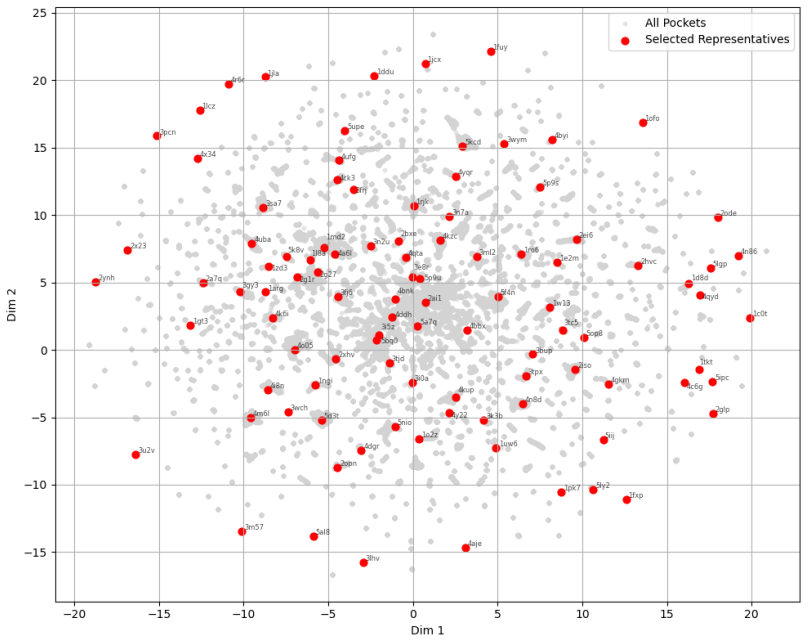
,(39) c(ˆv0,v t) : = 1 1 +ηlog(1 + KL( ˆv0∥vt)) .(40) Here,∥ ˆx0 −x t∥2 2 andKL( ˆv0∥vt)serve as modality- specific surrogates for denoising confidence. By appropri- ately choosingγandη, the coordinate and atom-type modal- ities can be denoised in a synchronized manner without rely- ing on explicit time-step scheduling. C Protein Pocket Selection Visualiz...
2018
discussion (0)
Sign in with ORCID, Apple, or X to comment. Anyone can read and Pith papers without signing in.