Stationarity-constrained representative volume elements for image-based homogenization of granular microstructures
Pith reviewed 2026-06-28 16:57 UTC · model grok-4.3
The pith
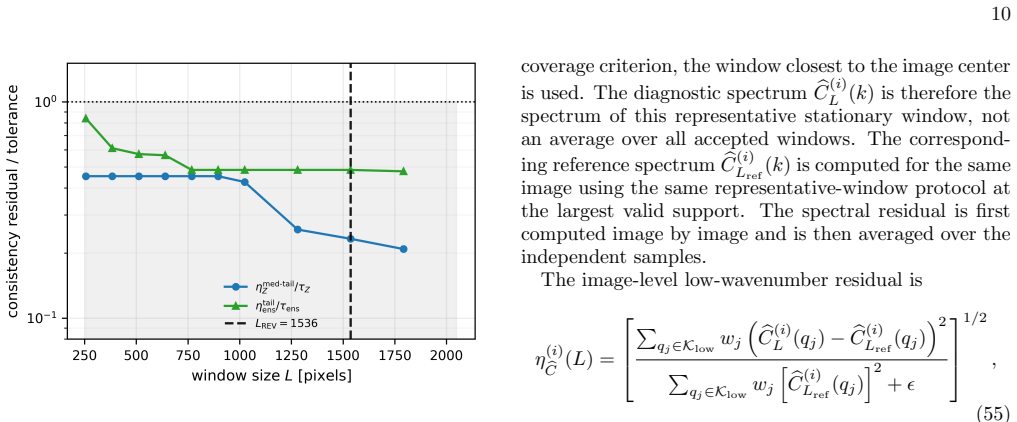
A stationarity-constrained workflow identifies 2 mm as the representative volume size for dune-sand microstructures.
A machine-rendered reading of the paper's core claim, the machinery that carries it, and where it could break.
Core claim
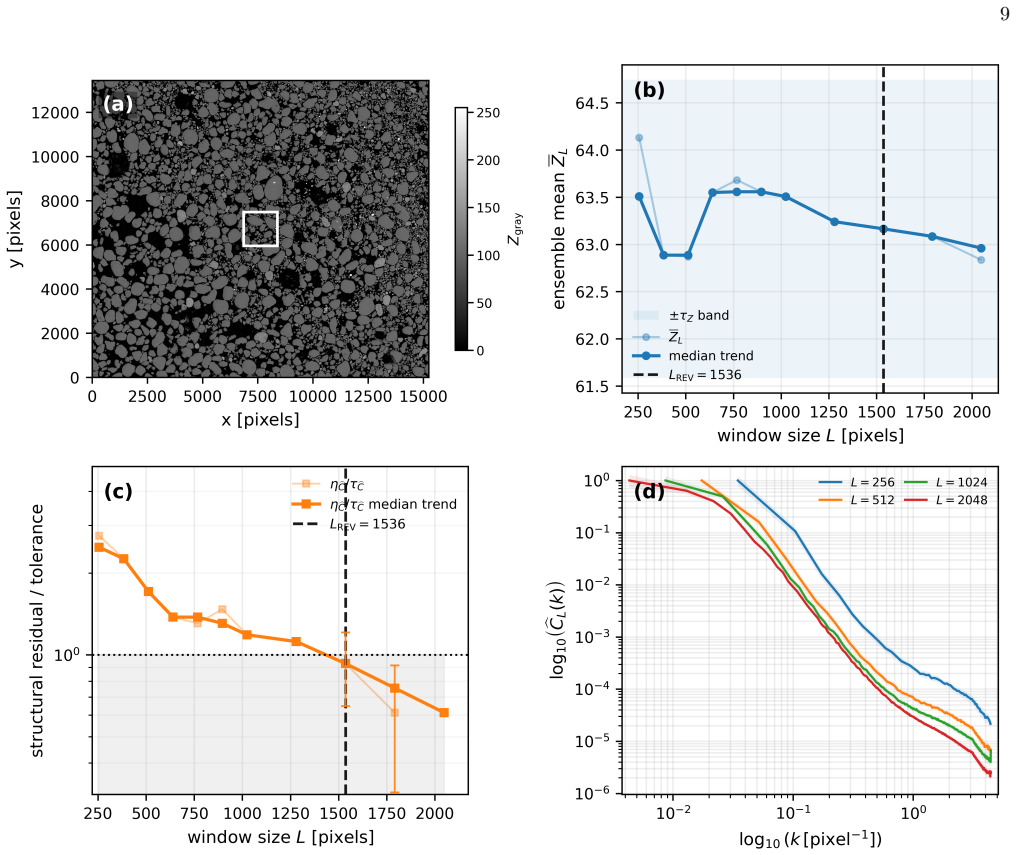
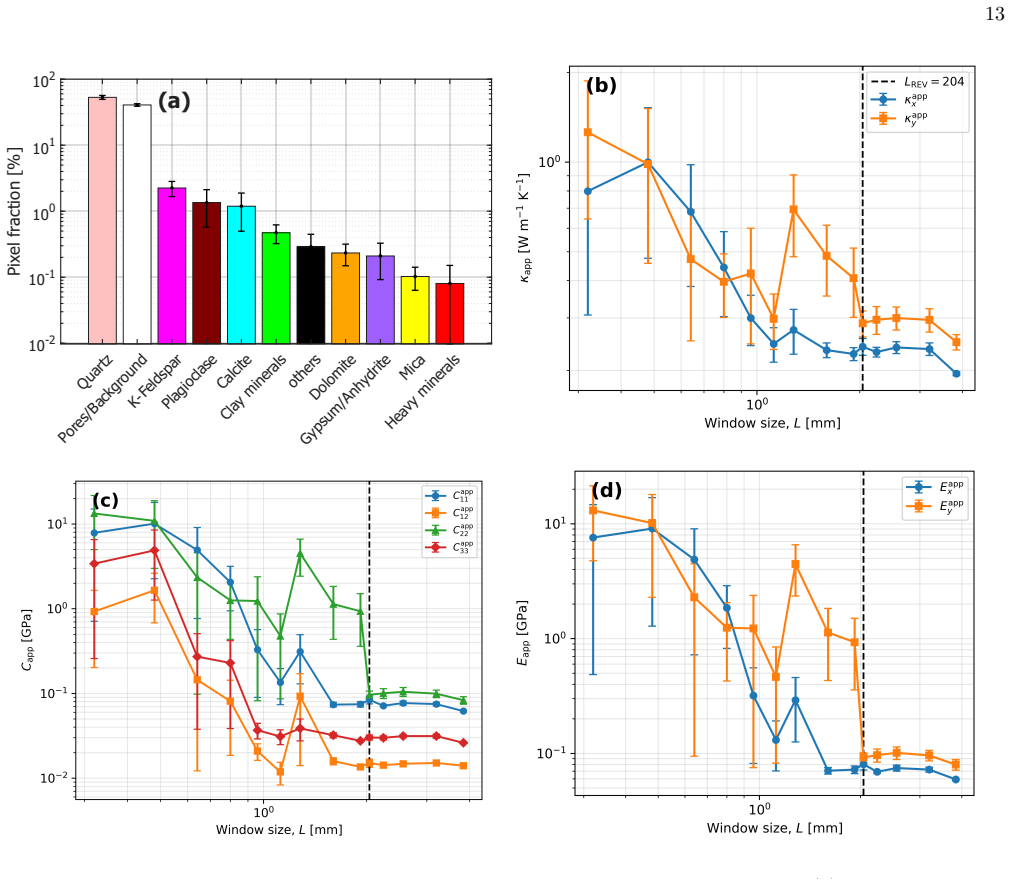
The central claim is that the representative support for homogenization in chemically mapped granular microstructures is given by the persistent mean-spectral criterion applied inside stationary domains, which for the studied dune-sand BSE images yields L_REV = 1536 pixels (ℓ_REV ≈ 2.01 mm), and is independently supported by property-level homogenization giving L_REV^prop = 204 pixels (ℓ_REV^prop ≈ 2.04 mm).
What carries the argument
The persistent mean-spectral criterion, which requires both the apparent-mean residual and the low-wavenumber covariance-spectrum residual to remain within tolerance over the non-reference tail, applied within stationary domains screened by local mean and standard-deviation compatibility.
If this is right
- The REV size is tied to the specific stationary domain and target observable rather than being a global image property.
- Property homogenization curves for conductivity, stiffness, and directional Young modulus stabilize in the large-window regime at this scale.
- The workflow can be used to make explicit the dependence of REV on stationarity, image field, window sequence, and observable.
Where Pith is reading between the lines
- If applied to other heterogeneous materials, the method might show whether millimetre-scale REVs are common in granular systems.
- Integrating this with finite-element simulations could test how REV choice affects predicted macroscopic behavior.
- The stationarity screening step could be extended to multi-modal imaging data for more robust domain identification.
Load-bearing premise
Local mean and standard-deviation compatibility on full-resolution BSE maps is enough to find domains where the mean-spectral criterion reliably picks the representative window size.
What would settle it
Observing that the apparent mean or spectral residuals fail to stabilize within tolerance even at window sizes larger than 1536 pixels inside the identified stationary domains would falsify the claim that this size is representative.
Figures
read the original abstract
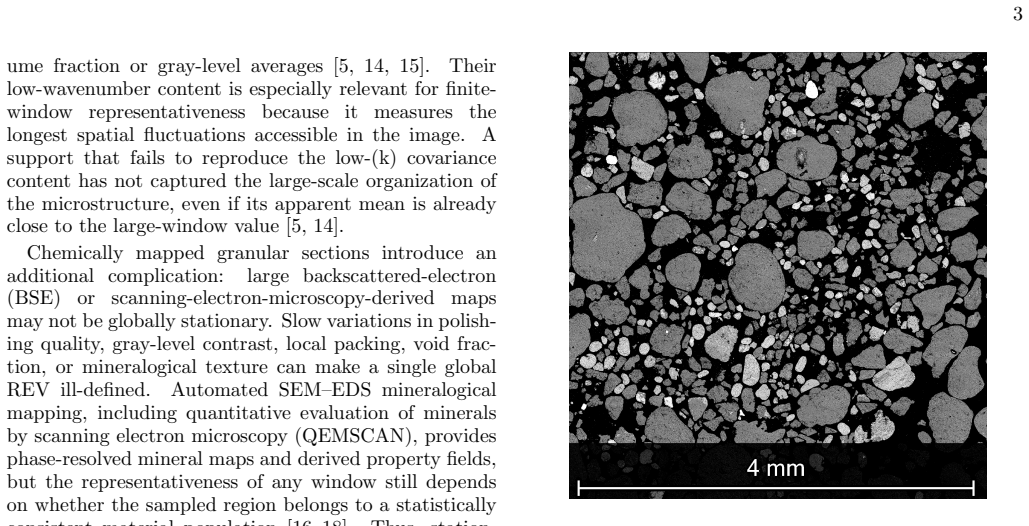
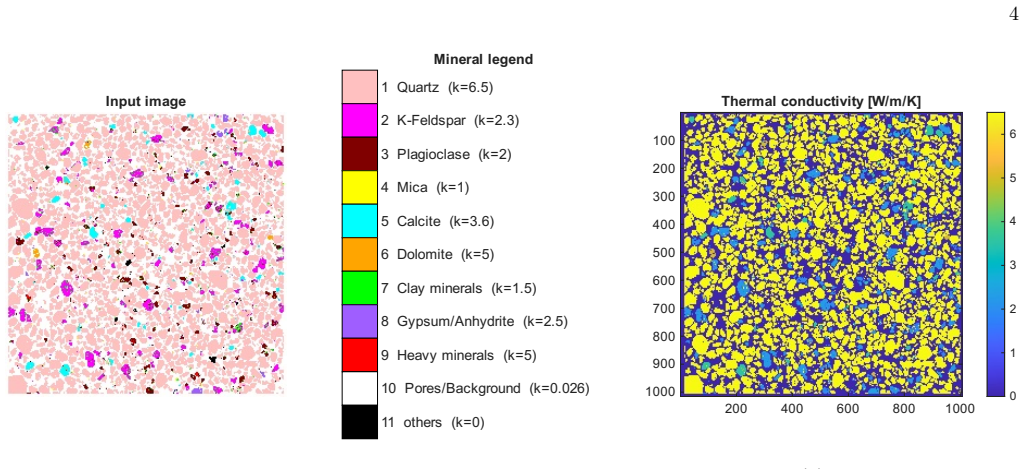
We present an image-based workflow for representative elementary volume (REV) sizing in chemically mapped granular microstructures, applied to Arabian dune-sand samples characterized by mineralogical and textural heterogeneity. The REV is treated as a finite-window convergence scale within approximately stationary material domains, rather than as a global length assigned to a non-stationary image. Full-resolution backscattered-electron (BSE) gray-level maps are screened by local mean and standard-deviation compatibility to identify stationary domains. Candidate windows are sampled only inside these domains, and the representative support is selected using a persistent mean--spectral criterion requiring both the apparent-mean residual and the low-wavenumber covariance-spectrum residual to remain within tolerance over the non-reference tail. Ensemble reproducibility is used as an auxiliary check. Applied to seven full-resolution BSE images of dune-sand microstructures, the strict stationary-domain criterion gives $(L_{\rm REV}=1536~\mathrm{pixels})$, corresponding to $(\ell_{\rm REV}\approx2.01~\mathrm{mm})$ for a BSE pixel size of $(1.31~\mu\mathrm{m})$. Property-level homogenization on QEMSCAN-derived numerical maps independently supports this millimetre-scale estimate: the converted support is $(L_{\rm REV}^{\rm prop}=201.2)$ pixels and is snapped to the nearest tested size, $(L_{\rm REV}^{\rm prop}=204)$ pixels $(\ell_{\rm REV}^{\rm prop}=2.04~\mathrm{mm})$. This length lies in the large-window regime of the apparent conductivity, stiffness, and directional Young-modulus curves. The workflow provides a reproducible route for REV sizing while making explicit its dependence on stationarity, image field, window sequence, and target observable.
Editorial analysis
A structured set of objections, weighed in public.
Referee Report
Summary. The manuscript proposes an image-based workflow for determining representative elementary volumes (REVs) in granular microstructures with mineralogical and textural heterogeneity, using Arabian dune-sand samples. Full-resolution BSE gray-level maps are screened for stationary domains via local mean and standard-deviation compatibility. Candidate windows are then sampled within these domains, and the REV size is selected using a persistent mean-spectral criterion that requires both the apparent-mean residual and the low-wavenumber covariance-spectrum residual to stay within tolerance over the non-reference tail, with ensemble reproducibility as an auxiliary check. For seven BSE images, the strict criterion yields L_REV = 1536 pixels (ℓ_REV ≈ 2.01 mm at 1.31 μm/pixel). This is independently supported by property-level homogenization on QEMSCAN-derived maps, giving L_REV^prop = 204 pixels (ℓ_REV^prop = 2.04 mm) in the large-window regime for apparent conductivity, stiffness, and directional Young modulus. The workflow explicitly notes its dependence on stationarity, image field, window sequence, and target observable.
Significance. If the stationarity screening is adequate, this work contributes a reproducible procedure for REV sizing that treats the REV as a convergence scale within stationary domains rather than a global property of potentially non-stationary images. The cross-validation between image-based spectral criteria and property homogenization is a notable strength. Explicit acknowledgment of the method's dependencies on specific choices enhances transparency. Such approaches are valuable in computational homogenization of heterogeneous materials where standard REV concepts may not apply directly.
major comments (1)
- [Abstract (workflow description)] The workflow's central premise—that local mean and standard-deviation screening on BSE maps sufficiently identifies stationary domains for reliable application of the persistent mean-spectral criterion—is not validated against controlled non-stationary test cases. Without such tests, it remains unclear whether longer-range correlations or drifts missed by first- and second-moment screening could affect the selected L_REV=1536 pixels. This assumption is load-bearing for the reported millimetre-scale REV and its QEMSCAN corroboration.
minor comments (2)
- [Abstract] Clarify how the value 201.2 pixels for L_REV^prop is obtained before snapping to 204 pixels, and specify the exact residual tolerances used in the mean-spectral criterion.
- [Abstract] The manuscript should include error bars or variability measures across the seven images and the supporting validation figures to allow independent assessment of the reported REV sizes.
Simulated Author's Rebuttal
We thank the referee for the constructive comment on the validation of the stationarity screening. We respond point by point below.
read point-by-point responses
-
Referee: The workflow's central premise—that local mean and standard-deviation screening on BSE maps sufficiently identifies stationary domains for reliable application of the persistent mean-spectral criterion—is not validated against controlled non-stationary test cases. Without such tests, it remains unclear whether longer-range correlations or drifts missed by first- and second-moment screening could affect the selected L_REV=1536 pixels. This assumption is load-bearing for the reported millimetre-scale REV and its QEMSCAN corroboration.
Authors: We agree that the stationarity identification relies on local mean and standard-deviation compatibility and that the manuscript does not present controlled tests on synthetic non-stationary microstructures to quantify the impact of undetected higher-order correlations. The workflow is explicitly conditioned on approximate stationarity within the screened domains, as stated in the abstract and methods, and the QEMSCAN-derived property homogenization provides independent support for the reported REV size on the specific dune-sand images. To address the concern, we will revise the discussion section to include an explicit statement on this limitation of moment-based screening and its potential implications for the selected L_REV. revision: yes
Circularity Check
No circularity: workflow applies explicit stationarity and convergence criteria directly to image data
full rationale
The derivation selects L_REV by screening BSE maps for local mean/std compatibility, then applying the persistent mean-spectral residual criterion inside those domains, with ensemble checks and an independent QEMSCAN property homogenization cross-check. No equation or step reduces by construction to a fitted parameter renamed as prediction, no self-definitional loop appears, and no load-bearing premise rests on a self-citation chain or imported ansatz. The reported millimetre-scale REV follows from direct application of the stated image-analysis rules to the given microstructures; the workflow is therefore self-contained.
Axiom & Free-Parameter Ledger
free parameters (1)
- residual tolerance
axioms (1)
- domain assumption Local mean and standard-deviation compatibility identifies stationary domains suitable for REV sampling
Reference graph
Works this paper leans on
-
[1]
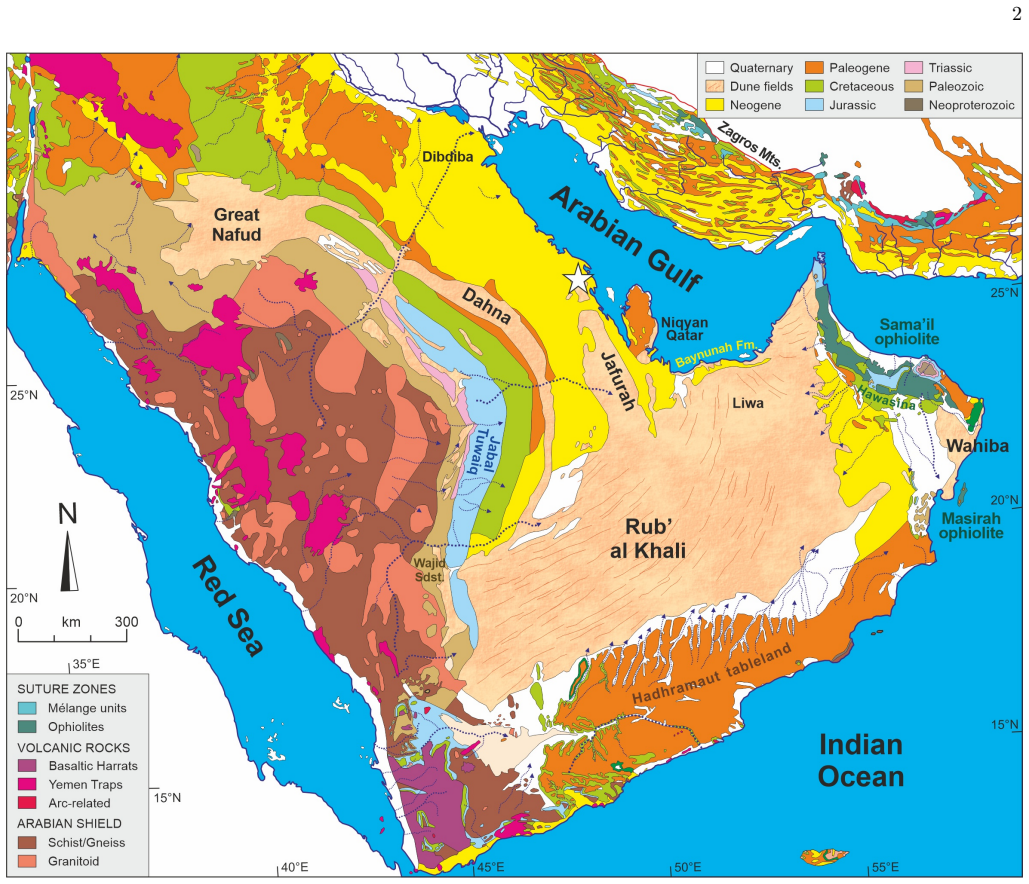
P. F. Friend, inFossil Vertebrates of Arabia, with Empha- sis on the Late Miocene Faunas, Geology, and Palaeoen- vironments of the Emirate of Abu Dhabi, United Arab Emirates(Yale University Press, New Haven, 1999) pp. 39–49
1999
-
[2]
Garzanti, P
E. Garzanti, P. Vermeesch, S. And‘o, G. Vezzoli, M. Vala- gussa, K. Allen, K. A. Khadi, and I. A. Al-Juboury, Provenance and recycling of arabian desert sand, Earth- Science Reviews120, 1–19 (2013)
2013
-
[3]
S. G. Fryberger, A. M. Al-Sari, T. J. Clisham, S. A. R. Rizvi, and K. G. Al-Hinai,Wind sedimentation in the jafurah sand sea, saudi arabia, Sedimentology31, 413– 431 (1984)
1984
-
[4]
Garzanti, P
E. Garzanti, P. Vermeesch, K. A. Al-Ramadan, S. And‘o, M. Limonta, M. Rittner, and G. Vezzoli,Tracing transcontinental sand transport: from anatolia–zagros to the rub’ al khali sand sea, Journal of Sedimentary Re- search87, 1196–1213 (2017)
2017
-
[5]
Torquato,Random Heterogeneous Materials: Mi- crostructure and Macroscopic Properties(Springer, New York, 2002)
S. Torquato,Random Heterogeneous Materials: Mi- crostructure and Macroscopic Properties(Springer, New York, 2002)
2002
-
[6]
M. J. Blunt, B. Bijeljic, H. Dong, O. Gharbi, S. Iglauer, P. Mostaghimi, A. Paluszny, and C. Pentland,Pore-scale imaging and modelling, Advances in Water Resources51, 197–216 (2013)
2013
-
[7]
Andr¨ a, N
H. Andr¨ a, N. Combaret, J. Dvorkin, E. Glatt, J.-F. Han, M. Kabel, Y. Keehm, F. Krzikalla, M. Lee, C. Madonna, M. Marsh, T. Mukerji, E. H. Saenger, R. Sain, N. Sax- ena, S. Ricker, A. Wiegmann, and X. Zhan,Digital rock physics benchmarks–part i: Imaging and segmentation, Computers & Geosciences50, 25–32 (2013)
2013
-
[8]
Andr¨ a, N
H. Andr¨ a, N. Combaret, J. Dvorkin, E. Glatt, J.-F. Han, M. Kabel, Y. Keehm, F. Krzikalla, M. Lee, C. Madonna, M. Marsh, T. Mukerji, E. H. Saenger, R. Sain, N. Sax- ena, S. Ricker, A. Wiegmann, and X. Zhan,Digital rock physics benchmarks–part ii: Computing effective proper- ties, Computers & Geosciences50, 33–43 (2013)
2013
-
[9]
Kanit, S
T. Kanit, S. Forest, I. Galliet, V. Mounoury, and D. Jeulin,Determination of the size of the representa- tive volume element for random composites: statistical and numerical approach, International Journal of Solids and Structures40, 3647–3679 (2003)
2003
-
[10]
Ostoja-Starzewski,Material spatial randomness: From statistical to representative volume element, Prob- abilistic Engineering Mechanics21, 112–132 (2006)
M. Ostoja-Starzewski,Material spatial randomness: From statistical to representative volume element, Prob- abilistic Engineering Mechanics21, 112–132 (2006)
2006
-
[11]
R. I. Al-Raoush and C. S. Willson,Extraction of physically realistic pore network properties from three- dimensional synchrotron x-ray microtomography images of unconsolidated porous media systems, Journal of Hy- drology300, 44–64 (2005)
2005
-
[12]
R. I. Al-Raoush and A. Papadopoulos,Representative el- ementary volume analysis of porous media using x-ray computed tomography, Powder Technology200, 69–77 (2010)
2010
-
[13]
M. S. Costanza-Robinson, B. D. Estabrook, and D. F. Fouhey,Representative elementary volume estimation for porosity, moisture saturation, and air-water interfacial areas in unsaturated porous media: Data quality implica- tions, Water Resources Research47, W07513 (2011)
2011
-
[14]
Y. Jiao, F. H. Stillinger, and S. Torquato,Modeling het- erogeneous materials via two-point correlation functions: Basic principles, Physical Review E76, 031110 (2007)
2007
-
[15]
Y. Jiao, F. H. Stillinger, and S. Torquato,Modeling het- erogeneous materials via two-point correlation functions. ii. algorithmic details and applications, Physical Review E77, 031135 (2008)
2008
-
[16]
Ayling, P
B. Ayling, P. Rose, S. Petty, E. Zemach, and P. Drakos, inProc, Thirty-Seventh Workshop on Geotherm Reserv Eng. Stanford, California: Stanford University(2012)
2012
-
[17]
Fuet al.,Application of automated mineralogy in petroleum geology, Ore Geology Reviews158, 105505 (2023)
C. Fuet al.,Application of automated mineralogy in petroleum geology, Ore Geology Reviews158, 105505 (2023)
2023
-
[18]
Hanet al.,Earth system science applications of next- generation sem-eds automated mineralogy, Frontiers in Earth Science10, 956912 (2022)
S. Hanet al.,Earth system science applications of next- generation sem-eds automated mineralogy, Frontiers in Earth Science10, 956912 (2022)
2022
-
[20]
Sanchez-Palencia,Non-Homogeneous Media and Vi- bration Theory(Springer, Berlin, 1980)
E. Sanchez-Palencia,Non-Homogeneous Media and Vi- bration Theory(Springer, Berlin, 1980)
1980
-
[21]
Moulinec and P
H. Moulinec and P. Suquet,A numerical method for com- puting the overall response of nonlinear composites with complex microstructure, Computer Methods in Applied Mechanics and Engineering157, 69–94 (1998)
1998
-
[22]
Pivovarov and P
D. Pivovarov and P. Steinmann,On periodic boundary conditions and ergodicity in computational homogeniza- tion of random materials, Computer Methods in Applied Mechanics and Engineering355, 493–511 (2019)
2019
-
[23]
Alonso-Marroquin, S
F. Alonso-Marroquin, S. Z. Khan, A. Alqubalee, P. Mora, and A. Al-Shuhail,Contact morphology of sand particles 16 in dunes, Scientific Reports15, 30332 (2025)
2025
-
[24]
C. Fu, S. Liu, H. Xu, J. Liu, X. Wang, Y. Zhang, and X. Li,Application of automated mineralogy in petroleum geology: A review, Marine and Petroleum Geology155, 106401 (2023)
2023
-
[25]
Bensoussan, J.-L
A. Bensoussan, J.-L. Lions, and G. Papanicolaou, Asymptotic Analysis for Periodic Structures(North- Holland, Amsterdam, 1978)
1978
-
[26]
Schneider,A review of nonlinear FFT-based compu- tational homogenization methods, Acta Mechanica232, 2051–2100 (2021)
M. Schneider,A review of nonlinear FFT-based compu- tational homogenization methods, Acta Mechanica232, 2051–2100 (2021)
2051
-
[27]
Zeman, J
J. Zeman, J. Vondˇ rejc, J. Nov´ ak, and I. Marek,Acceler- ating a FFT-based solver for numerical homogenization of periodic media by conjugate gradients, Journal of Com- putational Physics229, 8065–8071 (2010)
2010
-
[28]
C. Miehe,Strain-driven homogenization of inelastic mi- crostructures and composites based on an incremental variational formulation, International Journal for Nu- merical Methods in Engineering55, 1285–1322 (2002)
2002
-
[29]
Terada and N
K. Terada and N. Kikuchi,A class of general algorithms for multi-scale analyses of heterogeneous media, Com- puter Methods in Applied Mechanics and Engineering 190, 5427–5464 (2001)
2001
discussion (0)
Sign in with ORCID, Apple, or X to comment. Anyone can read and Pith papers without signing in.