Resonant Raman scattering in bilayer 3R-MoS₂
Pith reviewed 2026-06-28 16:38 UTC · model grok-4.3
The pith
The Raman response in bilayer 3R-MoS2 is governed by the interplay between incoming and outgoing resonance processes.
A machine-rendered reading of the paper's core claim, the machinery that carries it, and where it could break.
Core claim
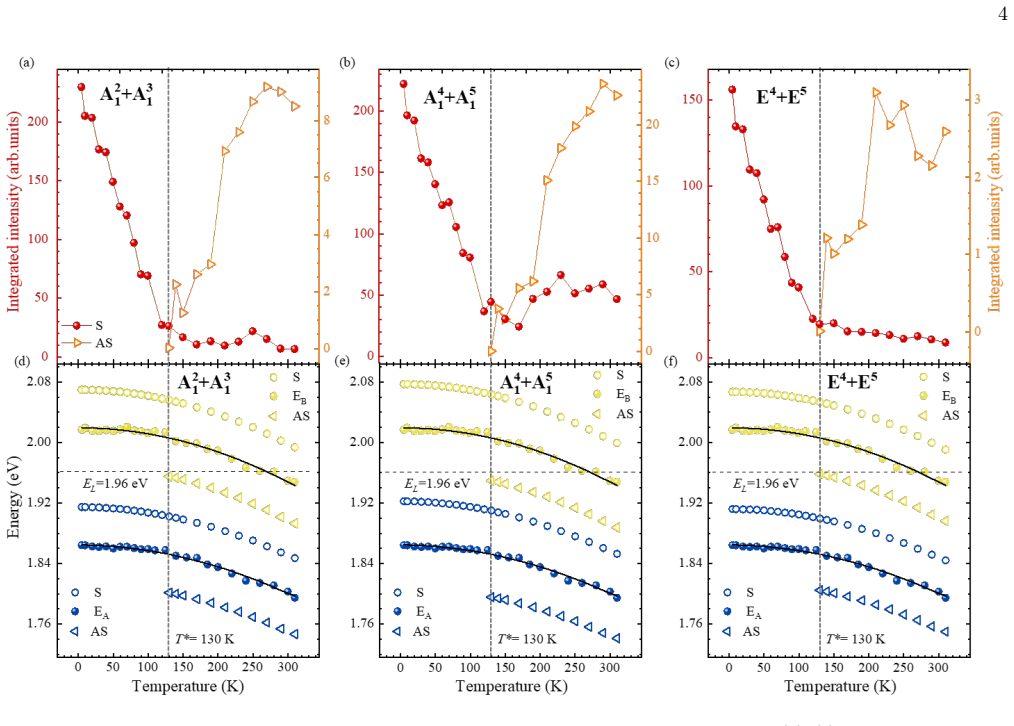
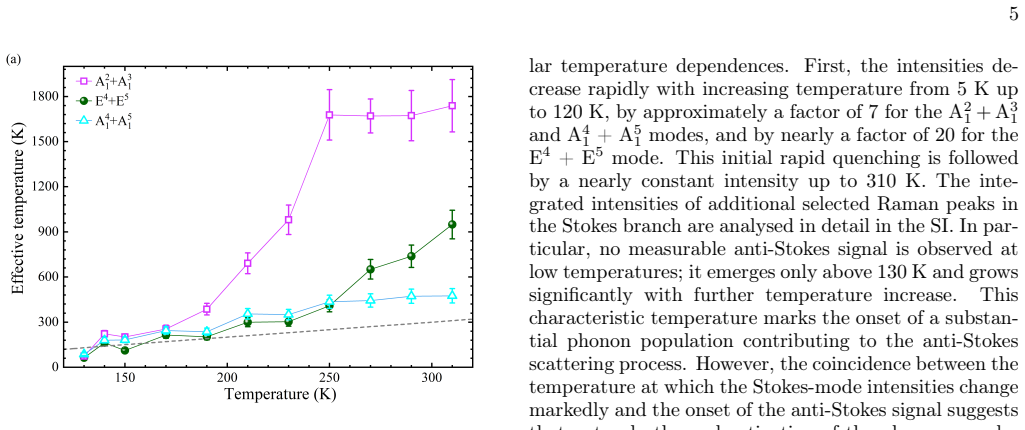
These results demonstrate that the Raman response is governed by the interplay between incoming and outgoing resonance processes, providing deeper insight into exciton-phonon coupling in van der Waals materials. Contributions from both zone-centre and finite-momentum phonons are observed, along with pronounced quenching of the Stokes intensity at low temperatures followed by saturation, the emergence of anti-Stokes scattering above 130 K, and a strong deviation of the effective phonon temperature from the lattice temperature induced by resonance effects.
What carries the argument
Interplay between incoming and outgoing resonance processes with excitonic transitions, which determines Raman intensities and effective phonon temperatures.
If this is right
- Raman intensities quench at low temperatures due to resonance conditions with excitonic transitions.
- Anti-Stokes scattering emerges above 130 K once thermal population allows it under resonance.
- Effective phonon temperature deviates from lattice temperature because resonance effects dominate the scattering.
- Both zone-centre and finite-momentum phonons participate in the resonant Raman process.
Where Pith is reading between the lines
- This resonance mechanism may apply to other bilayer transition metal dichalcogenides with similar excitonic features.
- Mapping resonance conditions across more wavelengths could identify optimal excitation energies for enhanced signals.
Load-bearing premise
That the observed temperature evolution of intensities and the deviation between effective phonon temperature and lattice temperature arise primarily from resonance conditions with excitonic transitions rather than from unaccounted thermal expansion, defect scattering, or laser-induced heating.
What would settle it
Measuring Raman intensities and effective phonon temperatures under non-resonant laser wavelengths at the same temperatures and finding that quenching and deviations remain unchanged would falsify the claim that resonance conditions govern the response.
Figures
read the original abstract
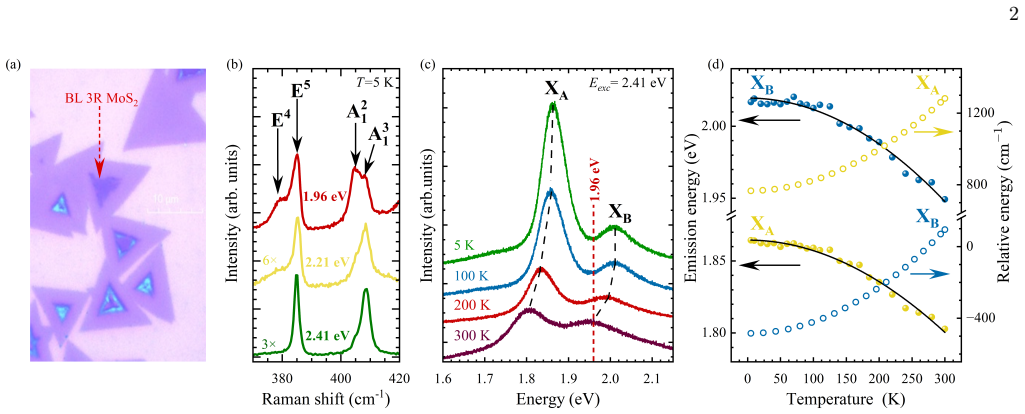
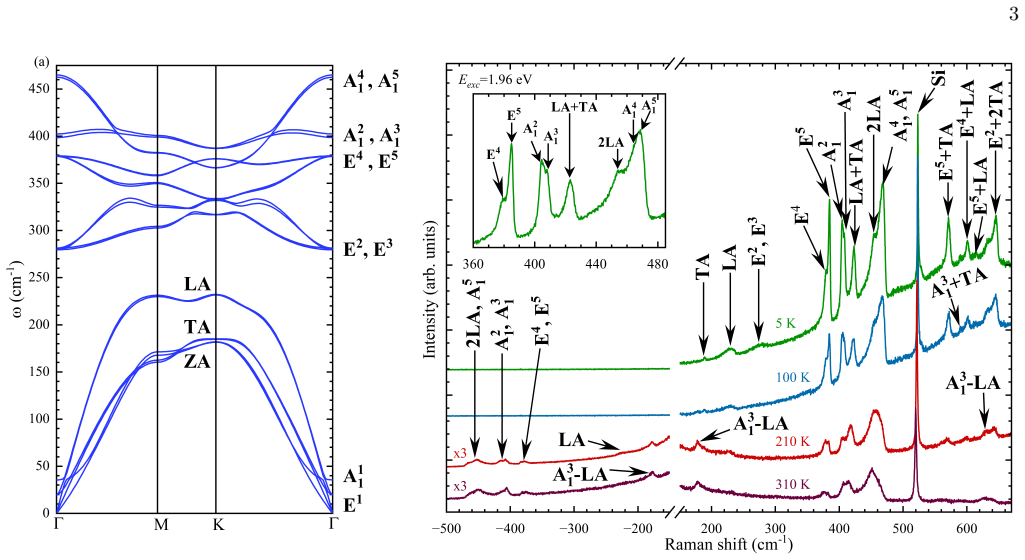
Raman scattering is a powerful spectroscopic technique widely employed to investigate light-matter interactions and lattice dynamics in two-dimensional materials. Here, we investigate the temperature-dependent resonant Raman response of bilayer 3R-MoS$_2$. The study combines multi-wavelength Raman spectroscopy, photoluminescence measurements, and density functional theory calculations to track the evolution of excitonic transitions and resonance conditions. We observe contributions from both zone-centre and finite-momentum phonons, a pronounced quenching of the Stokes intensity at low temperatures followed by saturation, the emergence of anti-Stokes scattering above 130~K, and a strong deviation of the effective phonon temperature from the lattice temperature induced by resonance effects. These results demonstrate that the Raman response is governed by the interplay between incoming and outgoing resonance processes, providing deeper insight into exciton-phonon coupling in van der Waals materials.
Editorial analysis
A structured set of objections, weighed in public.
Referee Report
Summary. The manuscript reports temperature-dependent resonant Raman spectroscopy on bilayer 3R-MoS₂, combining multi-wavelength Raman measurements, photoluminescence, and DFT calculations. It observes contributions from zone-centre and finite-momentum phonons, Stokes intensity quenching below ~130 K followed by saturation, emergence of anti-Stokes scattering above 130 K, and a strong deviation between effective phonon temperature and lattice temperature. The central claim is that these features demonstrate the Raman response is governed by the interplay between incoming and outgoing resonance processes with excitonic transitions.
Significance. If the attribution to resonance interplay is robust, the work would provide insight into exciton-phonon coupling in van der Waals materials by linking spectroscopic temperature evolution to specific excitonic resonance conditions. The multi-wavelength approach and combination with PL and DFT are positive features for tracking resonance conditions.
major comments (2)
- [Abstract] Abstract: the central claim that the Raman response 'is governed by the interplay between incoming and outgoing resonance processes' is load-bearing, yet the abstract (and methods description) supplies no quantitative error bars on intensities, data exclusion criteria, or explicit checks against alternative explanations such as laser-induced heating, defect scattering, or thermal expansion.
- [Results (temperature evolution)] Temperature-dependent measurements: the observed Stokes quenching below ~130 K, saturation, anti-Stokes onset, and effective vs. lattice temperature mismatch are attributed to resonance conditions tracked via multi-wavelength Raman + PL + DFT, but without laser-power series, non-resonant reference spectra, or an independent lattice-temperature probe (e.g., thermal-expansion-corrected band-gap shift), alternative mechanisms cannot be falsified.
Simulated Author's Rebuttal
We thank the referee for the constructive feedback. We address each major comment below, clarifying the supporting evidence from our multi-wavelength Raman, PL, and DFT data while agreeing to strengthen quantitative aspects and alternative-explanation checks in revision.
read point-by-point responses
-
Referee: [Abstract] Abstract: the central claim that the Raman response 'is governed by the interplay between incoming and outgoing resonance processes' is load-bearing, yet the abstract (and methods description) supplies no quantitative error bars on intensities, data exclusion criteria, or explicit checks against alternative explanations such as laser-induced heating, defect scattering, or thermal expansion.
Authors: The referee is correct that the abstract omits error bars and explicit alternative checks. The full manuscript tracks resonance conditions via multi-wavelength Raman shifts matching PL exciton peaks and DFT calculations; the Stokes quenching, saturation, and anti-Stokes onset align quantitatively with the incoming/outgoing resonance window crossing ~130 K. We will add intensity error bars (from replicate measurements) and a methods subsection on data exclusion (SNR > 5) plus a paragraph ruling out laser heating (low power, no power-dependent shift observed) and thermal expansion (PL band-gap shift used as proxy). revision: yes
-
Referee: [Results (temperature evolution)] Temperature-dependent measurements: the observed Stokes quenching below ~130 K, saturation, anti-Stokes onset, and effective vs. lattice temperature mismatch are attributed to resonance conditions tracked via multi-wavelength Raman + PL + DFT, but without laser-power series, non-resonant reference spectra, or an independent lattice-temperature probe (e.g., thermal-expansion-corrected band-gap shift), alternative mechanisms cannot be falsified.
Authors: We agree that dedicated power-series and non-resonant reference spectra are absent. Our attribution rests on the observed temperature evolution matching the independently measured PL exciton shifts and DFT resonance conditions across multiple laser lines; the effective-phonon-temperature deviation is inconsistent with uniform heating (which would affect all modes equally) and instead follows the resonance detuning. PL data already provides the band-gap shift proxy. We will add explicit discussion of why defect scattering and heating are ruled out by the wavelength dependence and will include a non-resonant comparison spectrum if space allows. revision: partial
Circularity Check
No circularity: experimental observations only
full rationale
The manuscript is a purely experimental report combining multi-wavelength Raman spectroscopy, photoluminescence, and standard DFT calculations to observe and interpret temperature-dependent Stokes/anti-Stokes intensities and effective phonon temperatures in bilayer 3R-MoS2. No equations, fitted parameters, or model predictions are presented that reduce any claimed result to its own inputs by construction. No self-citations are invoked as load-bearing uniqueness theorems or ansatzes. The central interpretation (resonance interplay governing the response) follows from direct spectral data rather than tautological re-derivation, satisfying the self-contained experimental criterion for score 0.
Axiom & Free-Parameter Ledger
Reference graph
Works this paper leans on
-
[1]
Lopez-Sanchez, D
O. Lopez-Sanchez, D. Lembke, M. Kayci, A. Radenovic, and A. Kis, Nature Nanotechnology8, 497 (2013)
2013
-
[2]
S. Jo, N. Ubrig, H. Berger, A. B. Kuzmenko, and A. F. Morpurgo, Nano Letters14, 2019 (2014)
2019
-
[3]
K. F. Mak and J. Shan, Nature Photonics10, 216 (2016)
2016
-
[4]
J. Zhu, J. Wu, Y. Sun, J. Huang, Y. Xia, H. Wang, H. Wang, Y. Wang, Q. Yi, and G. Zou, RSC Adv.6, 110604 (2016)
2016
-
[5]
P. Yan, H. Chen, J. Yin, Z. Xu, J. Li, Z. Jiang, W. Zhang, J. Wang, I. L. Li, Z. Sun, and S. Ruan, Nanoscale9, 1871 (2017)
2017
-
[6]
Z.-Y. Wang, X. Cui, A. C. Liapis, H.-R. Shao, X. Cheng, J. Yang, N. Shang, W. Zhang, H. Kaaripuro, J. C. Arias Muñoz,et al., Nature Materials , 1 (2026)
2026
-
[7]
C.-J.Kim, K.-H.Choi, Y.Lee, S.Kang, S.Yim, W.Song, J. Lim, S. Myung, S. S. Lee, S. Park, et al., Applied Science and Convergence Technology34, 53 (2025)
2025
-
[8]
Thayil and S
R. Thayil and S. R. Parne, Applied Energy411, 127606 (2026)
2026
-
[9]
Javeed, A
A. Javeed, A. Majid, N. Ahmed, and J. Iqbal, Journal of Physics and Chemistry of Solids , 113412 (2025)
2025
-
[10]
Hüser, T
F. Hüser, T. Olsen, and K. S. Thygesen, Physical Review B—Condensed Matter and Materials Physics88, 245309 (2013)
2013
-
[11]
Chhowalla, H
M. Chhowalla, H. S. Shin, G. Eda, L.-J. Li, K. P. Loh, and H. Zhang, Nature chemistry5, 263 (2013)
2013
-
[12]
M. R. Molas, A. O. Slobodeniuk, T. Kazimierczuk, K. Nogajewski, M. Bartos, P. Kapuściński, K. Oreszczuk, K. Watanabe, T. Taniguchi, C. Faugeras,et al., Physical review letters123, 096803 (2019)
2019
-
[13]
A. O. Slobodeniuk and M. R. Molas, Physical Review B 108, 035427 (2023)
2023
-
[14]
K. F. Mak, C. Lee, J. Hone, J. Shan, and T. F. Heinz, Physical review letters105, 136805 (2010)
2010
-
[15]
Q. H. Wang, K. Kalantar-Zadeh, A. Kis, J. N. Coleman, and M. S. Strano, Nature nanotechnology7, 699 (2012)
2012
-
[16]
Jin, P.-C
W. Jin, P.-C. Yeh, N. Zaki, D. Zhang, J. T. Sadowski, A. Al-Mahboob, A. M. van Der Zande, D. A. Chenet, J. I. Dadap, I. P. Herman,et al., Phys. Rev. Lett111, 106801 (2013)
2013
-
[17]
Jiang, H
T. Jiang, H. Liu, D. Huang, S. Zhang, Y. Li, X. Gong, Y.- R. Shen, W.-T. Liu, and S. Wu, Nature nanotechnology 9, 825 (2014)
2014
-
[18]
M. R. Molas, K. Nogajewski, M. Potemski, and A. Babiński, Scientific Reports7, 5036 (2017)
2017
-
[19]
Duan and H
X. Duan and H. Zhang, Introduction: two-dimensional layered transition metal dichalcogenides (2024)
2024
-
[20]
Ahmed, M
A. Ahmed, M. Z. Iqbal, A. Dahshan, S. Aftab, H. H. Hegazy, and E. S. Yousef, Nanoscale16, 2097 (2024)
2097
-
[21]
Y. Xie, A. Zhang, G. Wang, S. Huo, P. Niu, and E. Wu, Nano Research18, 94907853 (2025)
2025
-
[22]
C. Lee, H. Yan, L. E. Brus, T. F. Heinz, J. Hone, and S. Ryu, ACS Nano4, 2695 (2010), pMID: 20392077
2010
-
[23]
Tonndorf, R
P. Tonndorf, R. Schmidt, P. Böttger, X. Zhang, J. Börner, A. Liebig, M. Albrecht, C. Kloc, O. Gordan, D. R. T. Zahn, S. M. de Vasconcellos, and R. Brats- 8 chitsch, Opt. Express21, 4908 (2013)
2013
-
[24]
Placidi, M
M. Placidi, M. Dimitrievska, V. Izquierdo-Roca, X. Fontané, A. Castellanos-Gomez, A. Pérez-Tomás, N. Mestres, M. Espindola-Rodriguez, S. López-Marino, M.Neuschitzer, V.Bermudez, A.Yaremko,andA.Pérez- Rodríguez, 2D Materials2, 035006 (2015)
2015
-
[25]
Grzeszczyk, K
M. Grzeszczyk, K. Gołasa, M. Zinkiewicz, K. Noga- jewski, M. R. Molas, M. Potemski, A. Wysmołek, and A. Babiński, 2D Materials3, 025010 (2016)
2016
-
[26]
Zhang, N
S. Zhang, N. Zhang, Y. Zhao, T. Cheng, X. Li, R. Feng, H. Xu, Z. Liu, J. Zhang, and L. Tong, Chem. Soc. Rev. 47, 3217 (2018)
2018
-
[27]
Kipczak, M
Ł. Kipczak, M. Grzeszczyk, K. Olkowska-Pucko, A. Babiński, and M. Molas, Journal of Applied Physics 128, 044302 (2020)
2020
-
[28]
Strachan, A
J. Strachan, A. F. Masters, and T. Maschmeyer, ACS Applied Energy Materials4, 7405 (2021)
2021
-
[29]
J.-U. Lee, J. Park, Y.-W. Son, and H. Cheong, Nanoscale 7, 3229 (2015)
2015
-
[30]
S. Deb, J. Krause, P. E. Faria Junior, M. A. Kempf, R. Schwartz, K. Watanabe, T. Taniguchi, J. Fabian, and T. Korn, Nature Communications15, 7595 (2024)
2024
-
[31]
Aggarwal, I
V. Aggarwal, I. H. Abidi, J. Limb, C. Kofler, A. K. Verma, S. P. Giridhar, N. S. Dissanayake, P. Vashishtha, J. O. Tollerud, J. Mao,et al., ACS Applied Materials & Interfaces17, 48658 (2025)
2025
-
[32]
Gołasa, M
K. Gołasa, M. Grzeszczyk, R. Bożek, P. Leszczyński, A. Wysmołek, M. Potemski, and A. Babiński, Solid state communications197, 53 (2014)
2014
-
[33]
D. W. Latzke, W. Zhang, A. Suslu, T.-R. Chang, H. Lin, H.-T. Jeng, S. Tongay, J. Wu, A. Bansil, and A. Lanzara, Physical Review B91, 235202 (2015)
2015
-
[34]
Bhatnagar, T
M. Bhatnagar, T. Woźniak, Ł. Kipczak, N. Zawadzka, K. Olkowska-Pucko, M. Grzeszczyk, J. Pawłowski, K. Watanabe, T. Taniguchi, A. Babiński,et al., Scien- tific Reports12, 14169 (2022)
2022
-
[35]
C. M. Chow, H. Yu, A. M. Jones, J. R. Schaibley, M. Koehler, D. G. Mandrus, R. Merlin, W. Yao, and X. Xu, npj 2D Materials and Applications1, 33 (2017)
2017
-
[36]
Shree, M
S. Shree, M. Semina, C. Robert, B. Han, T. Amand, A. Balocchi, M. Manca, E. Courtade, X. Marie, T. Taniguchi, K. Watanabe, M. M. Glazov, and B. Ur- baszek, Phys. Rev. B98, 035302 (2018)
2018
-
[37]
Kumar, B
D. Kumar, B. Singh, R. Kumar, M. Kumar, and P. Ku- mar, Nanotechnology32, 285705 (2021)
2021
-
[38]
Maher, L
R. Maher, L. Cohen, J. Gallop, E. Le Ru, and P. Etchegoin, The Journal of Physical Chemistry B110, 6797 (2006)
2006
-
[39]
Zinkiewicz, M
M. Zinkiewicz, M. Grzeszczyk, T. Kazimierczuk, M. Bar- tos, K. Nogajewski, W. Pacuski, K. Watanabe, T. Taniguchi, A. Wysmołek, P. Kossacki,et al., npj 2D Materials and Applications8, 2 (2024)
2024
-
[40]
Najmaei, Z
S. Najmaei, Z. Liu, W. Zhou, X. Zou, G. Shi, S. Lei, B. I. Yakobson, J.-C. Idrobo, P. M. Ajayan, and J. Lou, Nature materials12, 754 (2013)
2013
-
[41]
Kumar, S
N. Kumar, S. Najmaei, Q. Cui, F. Ceballos, P. M. Ajayan, J. Lou, and H. Zhao, Physical Review B—Condensed Matter and Materials Physics87, 161403 (2013)
2013
-
[42]
Y. Li, Y. Rao, K. F. Mak, Y. You, S. Wang, C. R. Dean, and T. F. Heinz, Nano letters13, 3329 (2013)
2013
-
[43]
S. S. Coutinho, M. S. Tavares, C. A. Barboza, N. F. Frazão, E. Moreira, and D. L. Azevedo, Journal of Physics and Chemistry of Solids111, 25 (2017)
2017
-
[44]
Liang, D
J. Liang, D. Yang, J. Wu, J. I. Dadap, K. Watanabe, T. Taniguchi, and Z. Ye, Physical Review X12, 041005 (2022)
2022
-
[45]
Zheng, X
J. Zheng, X. Yan, Z. Lu, H. Qiu, G. Xu, X. Zhou, P. Wang, X. Pan, K. Liu, and L. Jiao, Adv. Mater29, 1604540 (2017)
2017
-
[46]
Zhang, Z
D. Zhang, Z. Zeng, Q. Tong, Y. Jiang, S. Chen, B. Zheng, J. Qu, F. Li, W. Zheng, F. Jiang,et al., Advanced Ma- terials32, 1908061 (2020)
2020
-
[47]
Ullah, J.-H
F. Ullah, J.-H. Lee, Z. Tahir, A. Samad, C. T. Le, J. Kim, D. Kim, M. U. Rashid, S. Lee, K. Kim,et al., ACS Ap- plied Materials & Interfaces13, 57588 (2021)
2021
-
[48]
M.Xu, H.Ji, L.Zheng, W.Li, J.Wang, H.Wang, L.Luo, Q.Lu, X.Gan, Z.Liu, etal.,NatureCommunications15, 562 (2024)
2024
-
[49]
Sekine, K
T. Sekine, K. Uchinokura, T. Nakashizu, E. Matsuura, and R. Yoshizaki, Journal of the Physical Society of Japan53, 811 (1984)
1984
-
[50]
W. Na, K. Kim, J.-U. Lee, and H. Cheong, 2D Materials 6, 015004 (2018)
2018
-
[51]
N. B. Shinde and S. K. Eswaran, The Journal of Physical Chemistry Letters12, 6197 (2021)
2021
-
[52]
J. Shi, P. Yu, F. Liu, P. He, R. Wang, L. Qin, J. Zhou, X. Li, J. Zhou, X. Sui,et al., Advanced Materials29, 1701486 (2017)
2017
-
[53]
Paradisanos, S
I. Paradisanos, S. Shree, A. George, N. Leisgang, C. Robert, K. Watanabe, T. Taniguchi, R. J. Warburton, A. Turchanin, X. Marie,et al., Nature communications 11, 2391 (2020)
2020
-
[54]
Grzeszczyk, J
M. Grzeszczyk, J. Szpakowski, A. Slobodeniuk, T. Kaz- imierczuk, M. Bhatnagar, T. Taniguchi, K. Watanabe, P. Kossacki, M. Potemski, A. Babiński,et al., Scientific Reports11, 17037 (2021)
2021
-
[55]
T. Hart, R. Aggarwal, and B. Lax, Physical Review B1, 638 (1970)
1970
-
[56]
Menéndez and M
J. Menéndez and M. Cardona, Physical Review B29, 2051 (1984)
2051
-
[57]
Zhang, X.-F
X. Zhang, X.-F. Qiao, W. Shi, J.-B. Wu, D.-S. Jiang, and P.-H. Tan, Chemical Society Reviews44, 2757 (2015)
2015
-
[58]
K. Gołasa, M. Grzeszczyk, J. Binder, R. Bożek, A. Wysmołek, and A. Babiński, Aip Advances5, doi.org/10.1063/1.4926670 (2015)
-
[59]
Soubelet, A
P. Soubelet, A. E. Bruchhausen, A. Fainstein, K. Noga- jewski, and C. Faugeras, Physical Review B93, 155407 (2016)
2016
-
[60]
R. N. Gontijo, G. C. Resende, C. Fantini, and B. R. Car- valho, Journal of Materials Research34, 1976 (2019)
1976
-
[61]
Tan, Y.-J
Q.-H. Tan, Y.-J. Sun, X.-L. Liu, K.-X. Xu, Y.-F. Gao, S.-L. Ren, P.-H. Tan, and J. Zhang, Nano Research14, 239 (2021)
2021
-
[62]
R. Maher, J. Hou, L. Cohen, E. Le Ru, J. Had- field, J. Harvey, P. Etchegoin, F. Liu, M. Green, R. Brown, et al., The Journal of chemical physics123, 10.1063/1.2004841 (2005)
-
[63]
Goldstein, S.-Y
T. Goldstein, S.-Y. Chen, J. Tong, D. Xiao, A. Ramasub- ramaniam, and J. Yan, Scientific reports6, 28024 (2016)
2016
-
[64]
Kresse and J
G. Kresse and J. Furthmüller, Physical Review B54, 11169 (1996)
1996
-
[65]
Kresse and D
G. Kresse and D. Joubert, Physical Review B59, 1758 (1999)
1999
-
[66]
J. P. Perdew, K. Burke, and M. Ernzerhof, Physical Re- view Letters77, 3865 (1996)
1996
-
[67]
Grimme, J
S. Grimme, J. Antony, S. Ehrlich, and H. Krieg, The Journal of Chemical Physics132, 154104 (2010). 9
2010
-
[68]
Parlinski, Z
K. Parlinski, Z. Q. Li, and Y. Kawazoe, Physical Review Letters78, 4063 (1997)
1997
- [69]
-
[70]
L. M. Malard, T. V. Alencar, A. P. M. Barboza, K. F. Mak, and A. M. de Paula, Physical Review B87, 201401 (2013)
2013
-
[71]
H. Li, J. Wu, Z. Yin, and H. Zhang, Nano Letters13, 3329 (2013). 10 Supporting Information Resonant Raman scattering in bilayer 3R-MoS 2 Chinmay K. Mohanty,1,∗ Kacper Walczyk,1 Tomasz Woźniak,2 Chengcheng Jiang,3 Adam Babiński,1 Clement Faugeras,4 Zhaolong Chen,3 and Maciej R. Molas1,† 1Faculty of Physics, University of Warsaw, 02-093 Warsaw, Poland 2Inst...
2013
discussion (0)
Sign in with ORCID, Apple, or X to comment. Anyone can read and Pith papers without signing in.