Quantum Statistics and Structural Topology Govern Thermal Transport in Two-Dimensional Monolayer Amorphous Carbon
Pith reviewed 2026-06-28 16:06 UTC · model grok-4.3
The pith
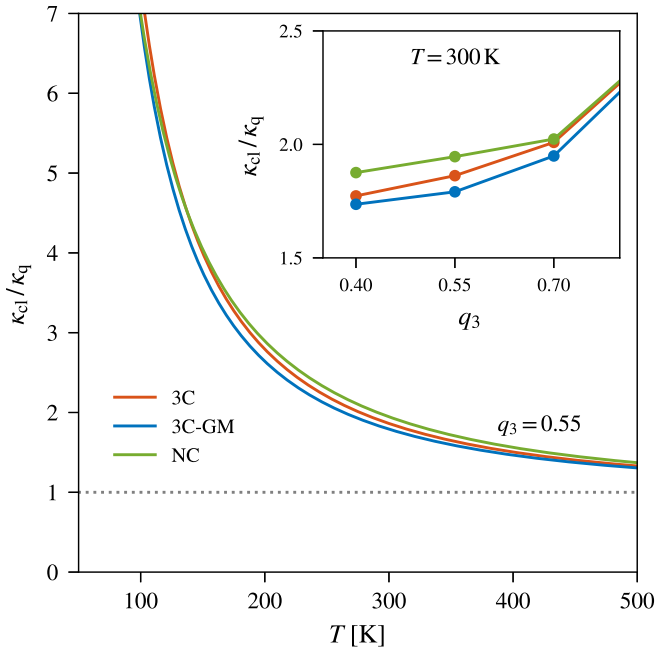
Quantum statistics cut the thermal conductivity of two-dimensional monolayer amorphous carbon to less than half its classical value at room temperature.
A machine-rendered reading of the paper's core claim, the machinery that carries it, and where it could break.
Core claim
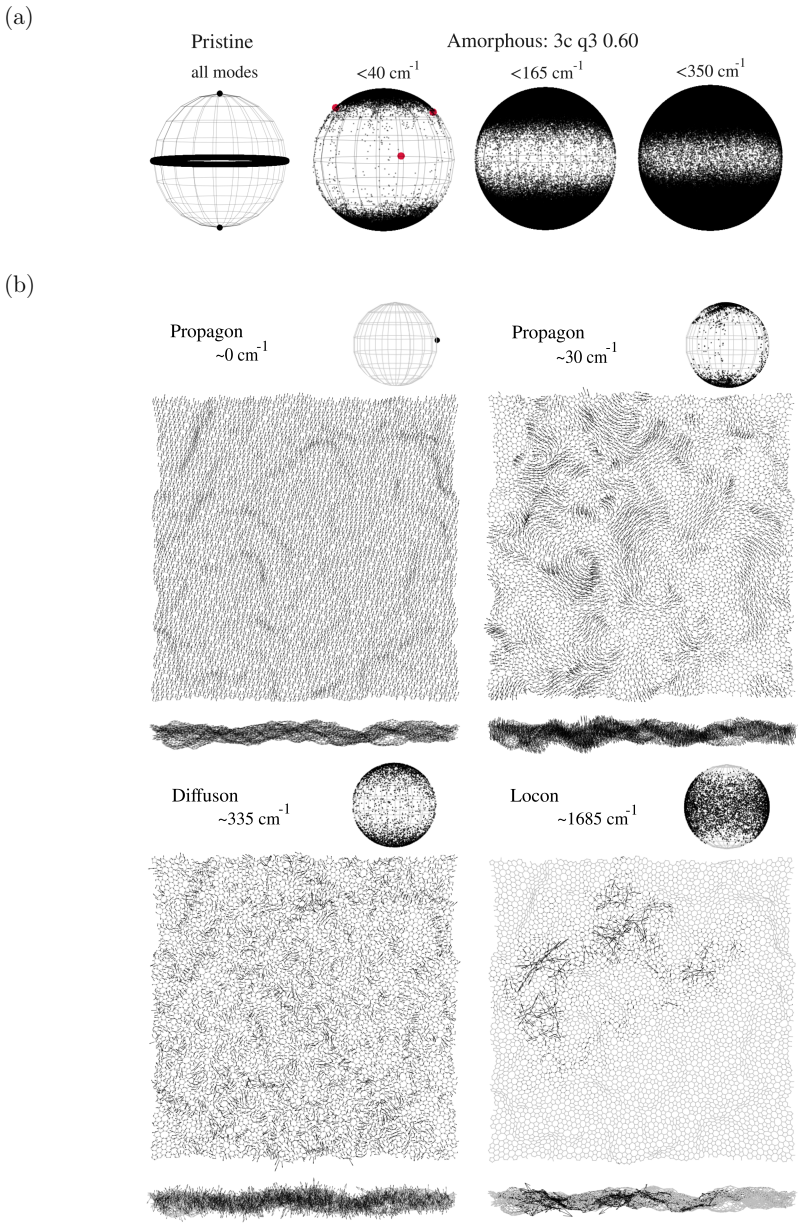
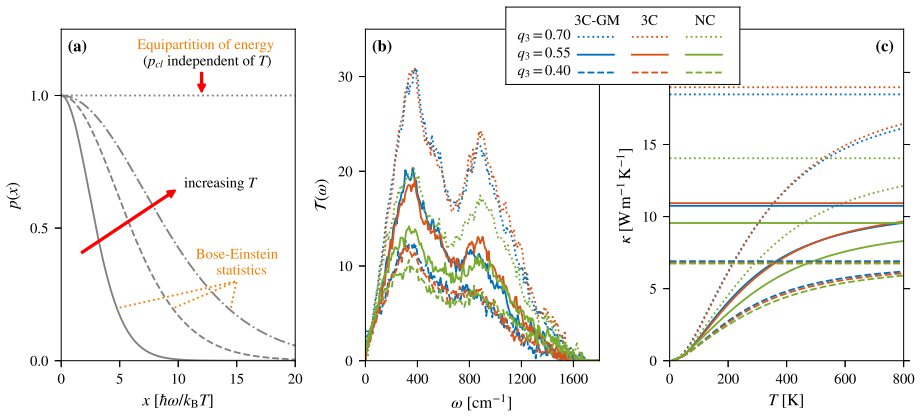
In two-dimensional monolayer amorphous carbon, the quantum thermal conductivity is less than half of the classical value at room temperature and up to nearly an order of magnitude lower at low temperatures. The predicted room-temperature values range from 3.5 to 10 W/m/K depending on the degree of amorphization, and the vibrational modes exhibit distinct polarization behavior while falling into propagons, diffusons, and locons categories.
What carries the argument
The local bond order parameter q3 used to quantify amorphization in configurations generated by three distinct algorithms, combined with a fully quantum mechanical calculation of thermal conductivity from vibrational modes.
If this is right
- At room temperature, classical treatments overestimate the thermal conductivity by more than a factor of two.
- At low temperatures, the overestimation can reach nearly an order of magnitude.
- Thermal conductivity values between 3.5 and 10 W/m/K at room temperature match recent experimental observations.
- The degree of amorphization, as measured by q3, influences the thermal conductivity across different structural topologies.
- Vibrational modes in these structures show usual classifications but with distinct polarization characteristics.
Where Pith is reading between the lines
- Similar quantum suppression might occur in other two-dimensional amorphous materials, suggesting a need to revisit classical simulations for them.
- The difference in mode polarization could influence interactions with electrons or photons in these structures.
- Since multiple amorphization methods yield consistent trends, the findings may apply broadly to real monolayer amorphous carbon samples.
Load-bearing premise
The three amorphization algorithms produce MAC configurations whose vibrational spectra and thermal transport are representative of experimentally realizable monolayer amorphous carbon.
What would settle it
A measurement showing that the thermal conductivity of monolayer amorphous carbon at room temperature exceeds 20 W/m/K or matches classical predictions at low temperatures would contradict the quantum calculation.
Figures
read the original abstract
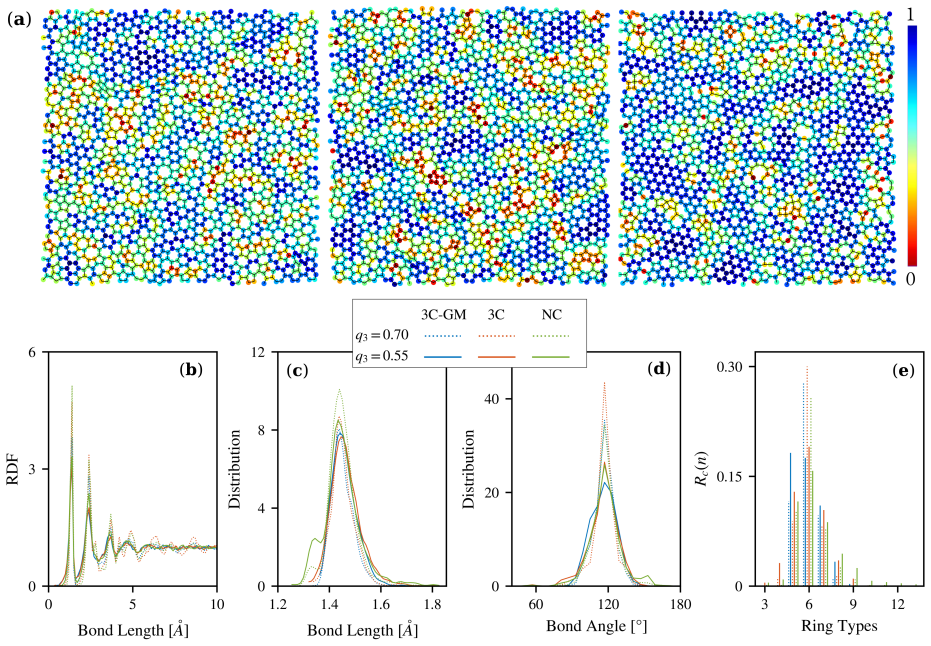
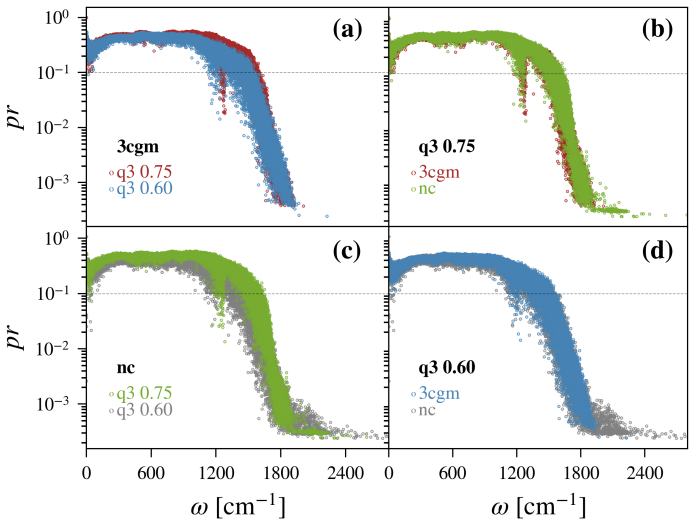
We investigate the quantum thermal conductivity (TC) of two-dimensional monolayer amorphous carbon (MAC). We employ three distinct amorphization algorithms to generate various possible MAC configurations, ranging from Zachariasen-type continuous random networks to nanocrystallites embedded in random networks. The local bond order parameter, q3, is used to quantify the amorphousness of the structures, and TC is computed as functions of q3 and temperature. This framework enables us to assess how structural topology, degree of amorphization, and quantum statistics contribute to heat conduction in a two-dimensional amorphous solid. At room temperature, TC values are predicted to range between 3.5 to 10 W/m/K, in agreement with recent experiments. Analysis of vibrational modes reveals that, while the modes of these 2D amorphous structures fall into the usual categories, namely, propagons, diffusons, and locons, their polarization characteristics display distinct behavior. Owing to the fully quantum mechanical framework, we examine both low- and high-temperature characteristics of this 2D amorphous system. By examining the classical limit, we show that classical treatments substantially overestimate the TC of MAC; namely, the quantum TC is less than half of the classical value at room temperature and up to nearly an order of magnitude lower at low temperatures.
Editorial analysis
A structured set of objections, weighed in public.
Referee Report
Summary. The manuscript investigates quantum thermal conductivity (TC) of 2D monolayer amorphous carbon (MAC) generated via three amorphization algorithms. TC is computed versus the local bond-order parameter q3 and temperature; room-temperature values are reported in the 3.5–10 W/m/K range, stated to agree with recent experiments. Vibrational modes are classified as propagons, diffusons, and locons with distinct polarization properties. By comparing to the classical limit, the work claims that quantum statistics suppress TC by more than a factor of two at 300 K and up to nearly an order of magnitude at low temperatures.
Significance. If the generated configurations are representative, the result would establish that classical treatments substantially overestimate TC in 2D amorphous solids and would supply a topology- and amorphization-dependent framework for quantum transport. The use of multiple generation algorithms and a fully quantum treatment of the mode spectrum constitute clear strengths.
major comments (1)
- [Structure-generation and validation sections (implicit in abstract and methods)] The central claim that the reported quantum-to-classical TC ratio applies to experimentally realizable MAC rests on the assumption that the three amorphization algorithms produce structures whose vibrational density of states, mode diffusivities, and polarization match real samples. No direct validation (RDF, bond-angle distributions, or measured vibrational spectra) against the cited experiments is provided; this is load-bearing for the factor-of-two to order-of-magnitude suppression result.
minor comments (1)
- [Abstract] The abstract states agreement with experiments but supplies neither error bars on the computed TC values nor explicit citations to the experimental TC data points being compared.
Simulated Author's Rebuttal
We thank the referee for the detailed and constructive report. We address the major comment below regarding structural validation.
read point-by-point responses
-
Referee: [Structure-generation and validation sections (implicit in abstract and methods)] The central claim that the reported quantum-to-classical TC ratio applies to experimentally realizable MAC rests on the assumption that the three amorphization algorithms produce structures whose vibrational density of states, mode diffusivities, and polarization match real samples. No direct validation (RDF, bond-angle distributions, or measured vibrational spectra) against the cited experiments is provided; this is load-bearing for the factor-of-two to order-of-magnitude suppression result.
Authors: We agree that explicit comparisons of radial distribution functions, bond-angle distributions, and vibrational spectra to the cited experiments would provide stronger direct evidence that the generated structures are representative. The manuscript currently relies on the agreement between computed room-temperature TC values (3.5–10 W/m/K) and recent experiments, together with the use of three distinct amorphization algorithms spanning Zachariasen-type networks to nanocrystallite-embedded structures, as indirect support for applicability. We acknowledge that this leaves the quantum-to-classical suppression claim somewhat dependent on the unverified assumption that mode diffusivities and polarization statistics match experiment. In the revised manuscript we will add a new subsection comparing the structural metrics (RDF, bond-angle distributions) of our configurations to available literature data on MAC and note the absence of direct experimental vibrational spectra as a limitation. This constitutes a partial revision that clarifies the evidential basis without new computations. revision: partial
Circularity Check
No circularity: computational chain from structure generation to quantum TC is self-contained
full rationale
The paper generates MAC configurations via three amorphization algorithms, quantifies disorder with the standard local bond-order parameter q3, computes vibrational mode spectra and diffusivities, then applies a fully quantum mechanical framework (with explicit classical limit) to obtain TC(T, q3). The reported quantum-to-classical ratio follows directly from evaluating the same mode-based expression in the ħ→0 limit; no fitted parameter is relabeled as a prediction, no self-citation supplies a uniqueness theorem, and no ansatz is smuggled. The agreement with experiment is an external benchmark, not an internal tautology. The derivation therefore remains independent of its own outputs.
Axiom & Free-Parameter Ledger
axioms (1)
- domain assumption The vibrational modes of 2D amorphous solids can be classified as propagons, diffusons, and locons
Reference graph
Works this paper leans on
-
[1]
T.; Zhang, H.; Lin, J.; Mayorov, A
Toh, C. T.; Zhang, H.; Lin, J.; Mayorov, A. S.; Wang, Y. P.; Orofeo, C. M.; Ferry, D. B.; Andersen, H.; Kakenov, N.; Guo, Z.; Abidi, I. H.; Sims, H.; Suenaga, K.; Pantelides, S. T.; ¨Ozyilmaz, B.. Synthesis and properties of free-standing monolayer amorphous carbon. Nature 2020, 577, 199–203. DOI: 10.1038/s41586-019-1871-2
-
[2]
Kotakoski, J.; Krasheninnikov, A. V.; Kaiser, U.; Meyer, J. C.. From Point Defects in Graphene to Two-Dimensional Amorphous Carbon. Physical Review Letters 2011, 106, 105505. DOI: 10.1103/PhysRevLett.106.105505
-
[3]
Tian, H.; Yao, Z.; Li, Z.; Guo, J.; Liu, L.. Unlocking More Potentials in Two-Dimensional Space: Disorder Engineering in Two-Dimensional Amorphous Carbon. ACS Nano 2023, 17, 24468–24478. DOI: 10.1021/acsnano.3c09593
-
[4]
Turning Defects Into Ad- vantages: Structures, Synthesis, and Applications of 2D Amorphous Carbon
Wang, Y.; Zhang, Q.; Li, L.; Wu, F.; Geng, D.; Hu, W.. Turning Defects Into Ad- vantages: Structures, Synthesis, and Applications of 2D Amorphous Carbon. Advanced Functional Materials 2025, 35, e09481. DOI: 10.1002/adfm.202509481
-
[5]
Tian, H.; Ma, Y.; Li, Z.; Cheng, M.; Ning, S.; Han, E.; Xu, M.; Zhang, P. F.; Zhao, K.; Li, R.; Zou, Y.; Liao, P.; Yu, S.; Li, X.; Wang, J.; Liu, S.; Li, Y.; Huang, X.; Yao, Z.; 13 Ding, D.; Guo, J.; Huang, Y.; Lu, J.; Han, Y.; Wang, Z.; Cheng, Z. G.; Liu, J.; Xu, Z.; Liu, K.; Gao, P.; Jiang, Y.; Lin, L.; Zhao, X.; Wang, L.; Bai, X.; Fu, W.; Wang, J. Y.; ...
-
[6]
H.; Zhu, J.; Zhou, W.; Wang, W.; Baroni, S.; Zhou, L.; Song, B
Wang, Y.; Liang, N.; Zhang, X.; Yan, W.; He, H.; Fiorentino, A.; Tao, X.; Li, A.; Yang, F.; Li, B.; Liu, T. H.; Zhu, J.; Zhou, W.; Wang, W.; Baroni, S.; Zhou, L.; Song, B.. Thermal Transport in a 2D Amorphous Material. Physical Review X 2025, 15, 031077. DOI: 10.1103/fjww-9pm3
-
[7]
Phonons, Localization, and Thermal Conductivity of Diamond Nanothreads and Amorphous Graphene
Zhu, T.; Ertekin, E.. Phonons, Localization, and Thermal Conductivity of Diamond Nanothreads and Amorphous Graphene. Nano Letters 2016, 16, 4763-4772. DOI: 10.1021/acs.nanolett.6b00557
-
[8]
Thermal transport in amor- phous graphene with varying structural quality
Aleandro Antidormi; Luciano Colombo; Stephan Roche. Thermal transport in amor- phous graphene with varying structural quality. 2D Materials 2020, 8, 015028. DOI: 10.1088/2053-1583/abc7f8
-
[9]
Stuart, S. J.; Tutein, A. B.; Harrison, J. A.. A reactive potential for hydrocarbons with intermolecular interactions. The Journal of Chemical Physics 2000, 112, 6472-6486. DOI: 10.1063/1.481208
-
[10]
New empirical approach for the structure and energy of covalent systems
Tersoff, J.. New empirical approach for the structure and energy of covalent systems. Physical Review B 1988, 37, 6991–7000. DOI: 10.1103/PhysRevB.37.6991
-
[11]
Tersoff, J.. Empirical Interatomic Potential for Carbon, with Applications to Amor- phous Carbon. Physical Review Letters 1988, 61, 2879–2882. DOI: 10.1103/Phys- RevLett.61.2879
-
[12]
Lindsay, L.; Broido, D. A.. Optimized Tersoff and Brenner empirical potential parameters 14 for lattice dynamics and phonon thermal transport in carbon nanotubes and graphene. Phys. Rev. B 2010, 81, 205441. DOI: 10.1103/PhysRevB.81.205441
-
[13]
A. P. Thompson; H. M. Aktulga; R. Berger; D. S. Bolintineanu; W. M. Brown; P. S. Crozier; P. J. in ’t Veld; A. Kohlmeyer; S. G. Moore; T. D. Nguyen; R. Shan; M. J. Stevens; J. Tranchida; C. Trott; S. J. Plimpton. LAMMPS - a flexible simulation tool for particle-based materials modeling at the atomic, meso, and continuum scales. Comp. Phys. Comm. 2022, 271...
-
[14]
Amorphous graphene: a realization of Zachariasen’s glass
Avishek Kumar; Mark Wilson; M F Thorpe. Amorphous graphene: a realization of Zachariasen’s glass. Journal of Physics: Condensed Matter 2012, 24, 485003. DOI: 10.1088/0953-8984/24/48/485003
-
[15]
Evolution of domains and grain boundaries in graphene: a kinetic Monte Carlo simulation
Zhuang, J.; Zhao, R.; Dong, J.; Yan, T.; Ding, F.. Evolution of domains and grain boundaries in graphene: a kinetic Monte Carlo simulation. Phys. Chem. Chem. Phys. 2016, 18, 2932-2939. DOI: 10.1039/C5CP07142A
-
[16]
Steinhardt, P. J.; Nelson, D. R.; Ronchetti, M.. Bond-orientational order in liquids and glasses. Phys. Rev. B 1983, 28, 784–805. DOI: 10.1103/PhysRevB.28.784
-
[17]
A Local Order Parameter-Based Method for Simulation of Free Energy Barriers in Crystal Nucleation
Eslami, H.; Khanjari, N.; M¨ uller-Plathe, F.. A Local Order Parameter-Based Method for Simulation of Free Energy Barriers in Crystal Nucleation. Journal of Chemical Theory and Computation 2017, 13, 1307-1316. DOI: 10.1021/acs.jctc.6b01034
-
[18]
Phonon scattering in graphene over substrate steps
Sevin¸ cli, H.; Brandbyge, M.. Phonon scattering in graphene over substrate steps. Applied Physics Letters 2014, 105, 153108. DOI: 10.1063/1.4898066
-
[19]
Allen, P. B.; Feldman, J. L.. Thermal conductivity of disordered harmonic solids. Phys. Rev. B 1993, 48, 12581–12588. DOI: 10.1103/PhysRevB.48.12581
-
[20]
Philip B. Allen; Joseph L. Feldman; Jaroslav Fabian; Frederick Wooten. Diffusons, locons 15 and propagons: Character of atomic vibrations in amorphous Si. Philosophical Magazine B 1999, 79, 1715-1731. DOI: 10.1080/13642819908223054
-
[21]
Rego, L. G. C.; Kirczenow, G.. Quantized Thermal Conductance of Dielectric Quantum Wires. Phys. Rev. Lett. 1998, 81, 232–235. DOI: 10.1103/PhysRevLett.81.232
-
[22]
Green function, quasi-classical Langevin and Kubo–Greenwood methods in quantum thermal transport
H Sevin¸ cli; S Roche; G Cuniberti; M Brandbyge; R Gutierrez; L Medrano Sandonas. Green function, quasi-classical Langevin and Kubo–Greenwood methods in quantum thermal transport. Journal of Physics: Condensed Matter 2019, 31, 273003. DOI: 10.1088/1361-648x/ab119a
-
[23]
Phonon transport in amorphous carbon using Green–Kubo modal analysis
Lv, W.; Henry, A.. Phonon transport in amorphous carbon using Green–Kubo modal analysis. Applied Physics Letters 2016, 108, 181905. DOI: 10.1063/1.4948605
-
[24]
Ziman, J. M.. Electrons and Phonons: The Theory of Transport Phenomena in Solids. Oxford University Press, 2001
2001
-
[25]
Zeller, R. C.; Pohl, R. O.. Thermal Conductivity and Specific Heat of Noncrystalline Solids. Phys. Rev. B 1971, 4, 2029–2041. DOI: 10.1103/PhysRevB.4.2029
-
[26]
P. W. Anderson; B. I. Halperin; C. M. Varma. Anomalous low-temperature thermal prop- erties of glasses and spin glasses. The Philosophical Magazine: A Journal of Theoretical Experimental and Applied Physics 1972, 25, 1–9. DOI: 10.1080/14786437208229210
-
[27]
Thermal transport engineering in amor- phous graphene: Non-equilibrium molecular dynamics study
Saeed Bazrafshan; Ali Rajabpour. Thermal transport engineering in amor- phous graphene: Non-equilibrium molecular dynamics study. Interna- tional Journal of Heat and Mass Transfer 2017, 112, 379 - 386. DOI: https://doi.org/10.1016/j.ijheatmasstransfer.2017.04.127
-
[28]
Pereira; Ari Harju; Timon Rabczuk
Bohayra Mortazavi; Zheyong Fan; Luiz Felipe C. Pereira; Ari Harju; Timon Rabczuk. Amorphized graphene: A stiff material with low thermal conductivity. Carbon 2016, 103, 318-326. DOI: https://doi.org/10.1016/j.carbon.2016.03.007. 16
-
[29]
Zhang, Y. T.; Wang, Y. P.; Zhang, Y. Y.; Du, S.; Pantelides, S. T.. Thermal transport of monolayer amorphous carbon and boron nitride. Applied Physics Letters 2022, 120, 222201. DOI: 10.1063/5.0089967
-
[30]
Metropolis, N.; Rosenbluth, A. W.; Rosenbluth, M. N.; Teller, A. H.; Teller, E.. Equation of State Calculations by Fast Computing Machines. The Journal of Chemical Physics 1953, 21, 1087-1092. DOI: 10.1063/1.1699114
-
[31]
Phonon dispersion of graphite by inelastic x-ray scattering
Mohr, M.; Maultzsch, J.; Dobardˇ zi´ c, E.; Reich, S.; Miloˇ sevi´ c, I.; Damnjanovi´ c, M.; Bosak, A.; Krisch, M.; Thomsen, C.. Phonon dispersion of graphite by inelastic x-ray scattering. Phys. Rev. B 2007, 76, 035439. DOI: 10.1103/PhysRevB.76.035439
-
[32]
Khan, A. I.; Navid, I. A.; Noshin, M.; Uddin, H. M. A.; Hossain, F. F.; Subrina, S.. Equilibrium Molecular Dynamics (MD) Simulation Study of Thermal Conductivity of Graphene Nanoribbon: A Comparative Study on MD Potentials. Electronics 2015, 4, 1109–1124. DOI: 10.3390/electronics4041109
-
[33]
The Physics of Phonons
Srivastava, G.P.. The Physics of Phonons. Taylor & Francis, 1990
1990
-
[34]
Beltukov, Y. M.; Fusco, C.; Parshin, D. A.; Tanguy, A.. Boson peak and Ioffe-Regel criterion in amorphous siliconlike materials: The effect of bond directionality. Physical Review E 2016, 93, 023006. DOI: 10.1103/PhysRevE.93.023006
-
[35]
Introduction to Graphene-Based Nanoma- terials: From Electronic Structure to Quantum Transport
Torres, L.E.F.F.; Roche, S.; Charlier, J.C.. Introduction to Graphene-Based Nanoma- terials: From Electronic Structure to Quantum Transport. Cambridge University Press, 2014
2014
-
[36]
Efficient linear scaling method for com- puting the thermal conductivity of disordered materials
Li, W.; Sevin¸ cli, H.; Roche, S.; Cuniberti, G.. Efficient linear scaling method for com- puting the thermal conductivity of disordered materials. Phys. Rev. B 2011, 83, 155416. DOI: 10.1103/PhysRevB.83.155416. 17 Figure 1: (a) Continuous random network (CRN) and embedded nanocrystallite (NC@RN) structures obtained using 3C-GM, 3C, and nC algorithms are ...
discussion (0)
Sign in with ORCID, Apple, or X to comment. Anyone can read and Pith papers without signing in.