A semi-classical study of muon-enhanced proton-boron-11 fusion
Pith reviewed 2026-06-28 12:40 UTC · model grok-4.3
The pith
A muon enhances the proton-boron-11 fusion cross-section by several orders of magnitude at low energies.
A machine-rendered reading of the paper's core claim, the machinery that carries it, and where it could break.
Core claim
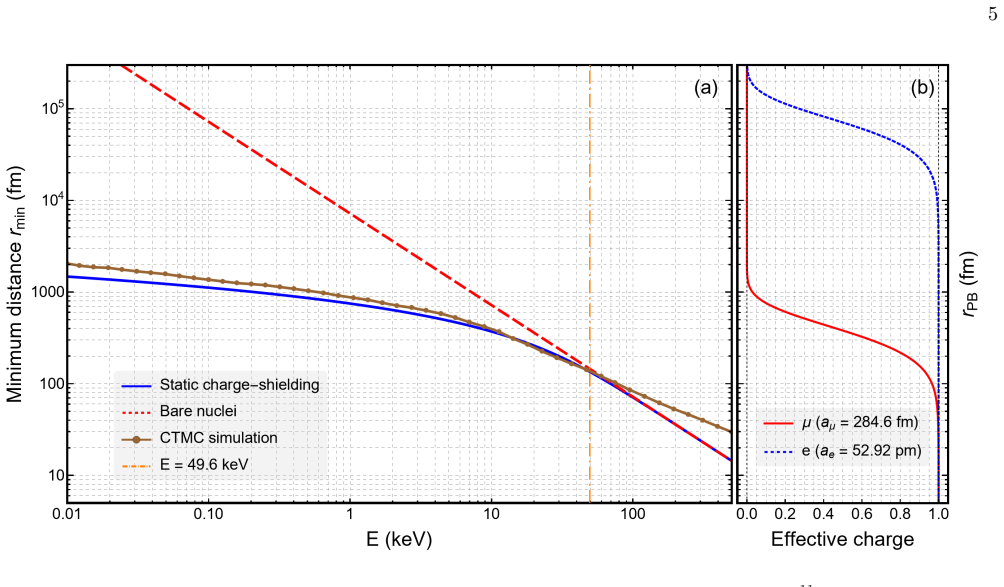
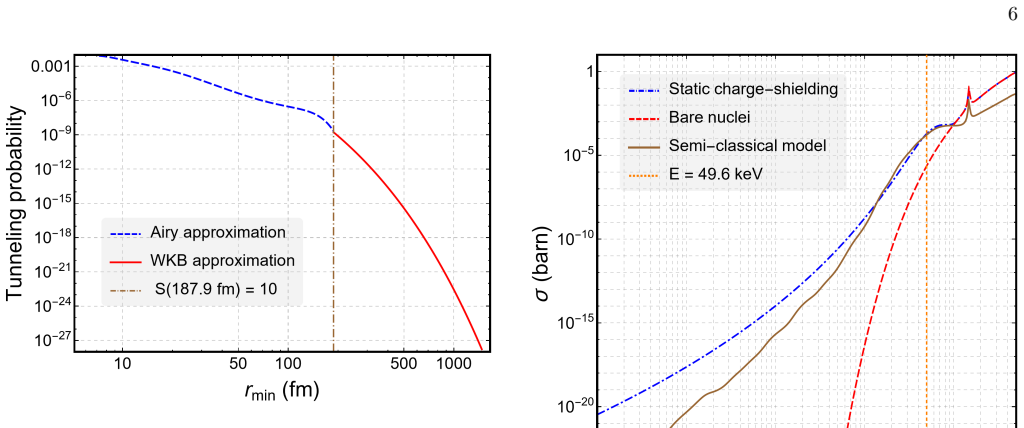
In the semi-classical treatment a pμ atom approaches a 11B nucleus along classical trajectories whose closest-approach distances are obtained by Monte Carlo sampling; the fusion cross-section is then evaluated from the tunneling probability through the Coulomb barrier that begins at each such turning point, yielding an enhancement of several orders of magnitude relative to the bare p-11B case at low collision energies.
What carries the argument
Statistical distribution of classical turning points for the pμ + 11B system generated by trajectory Monte Carlo, used as the launch point for the tunneling calculation.
If this is right
- The muon-catalyzed p-11B cross-section exceeds the bare-nucleus cross-section by several orders of magnitude at low energies.
- Both the dynamic Monte Carlo treatment and the static shielding model produce the same qualitative conclusion of strong muon catalysis.
- Closer proton-nucleus approaches enabled by the muon raise the tunneling probability enough to dominate the low-energy behavior.
- The microcanonical sampling supplies a distribution of turning points that directly enters the cross-section integral.
Where Pith is reading between the lines
- If the calculated rates hold, muon catalysis could reduce the beam or plasma energies needed to observe measurable p-11B fusion events.
- Adding quantum corrections to the pμ approach phase would test how sensitive the reported enhancement is to the classical-trajectory assumption.
- The same Monte Carlo turning-point method could be applied to other light-nucleus fusion reactions to map the range of muon-catalyzed enhancements.
- An experimental campaign measuring fusion yields in a muon-exposed p-11B target at keV-scale energies would directly confront the prediction.
Load-bearing premise
The probability of fusion is fixed solely by the quantum tunneling amplitude evaluated at the classical turning point taken from the Monte Carlo trajectories.
What would settle it
A direct measurement of the muon-catalyzed p-11B fusion rate at low center-of-mass energies that shows no enhancement of several orders of magnitude over the bare-nucleus rate.
Figures
read the original abstract
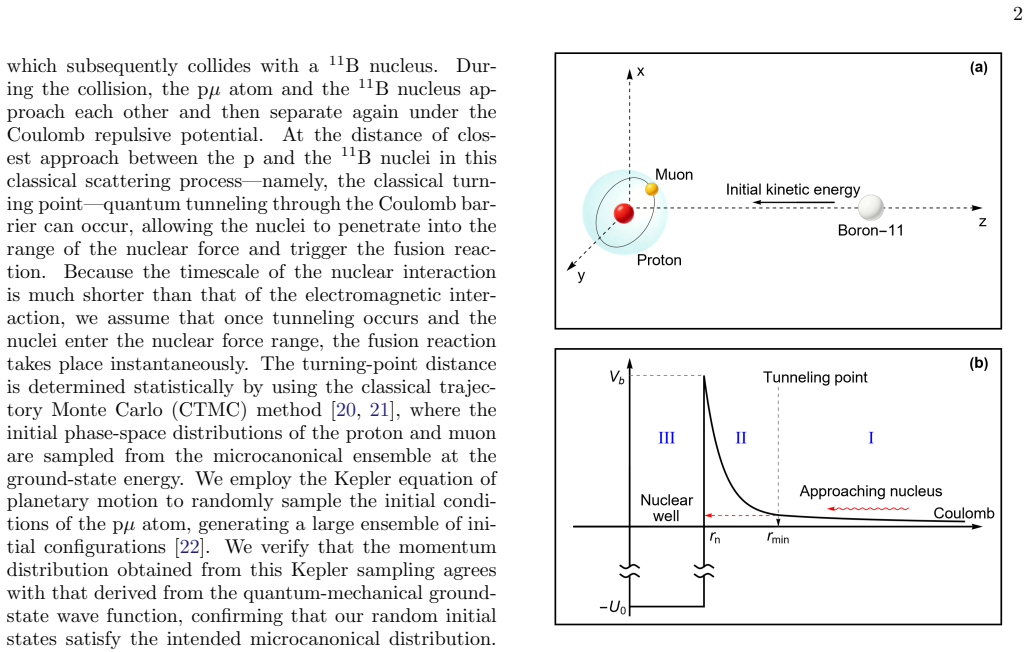
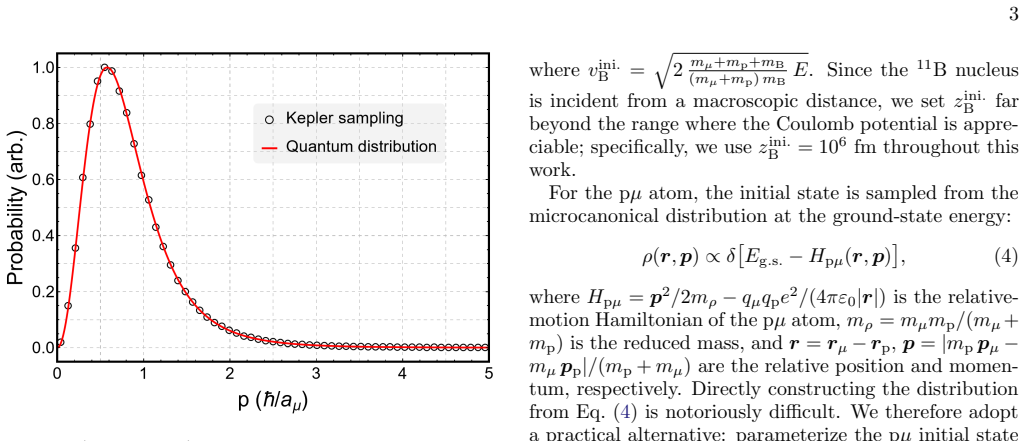
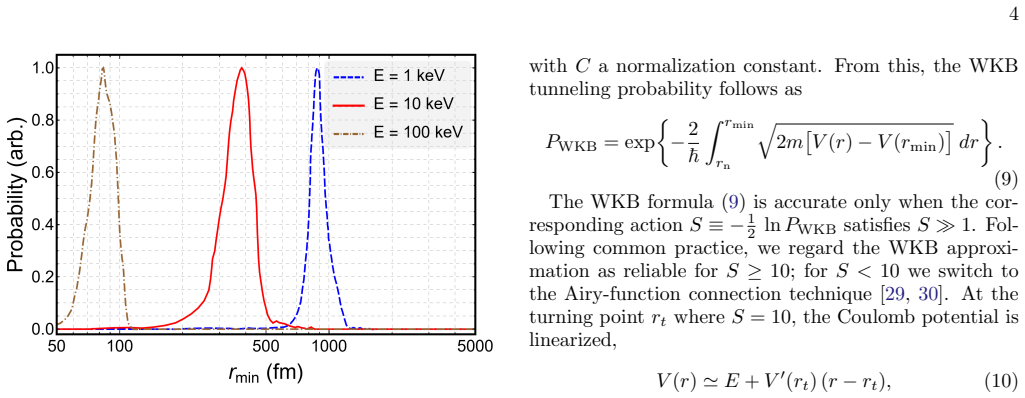
A recent theoretical study has suggested that muons can enhance proton-boron-11 (p-$^{11}$B) reaction cross-section by several orders of magnitude in the low-energy regime. In this work, we investigate this reaction process using a semi-classical treatment, that is, a muon and a proton first form a muonic hydrogen atom p$\mu$, which subsequently collides with a $^{11}$B nucleus. During the collision, the p$\mu$ atom approaches the $^{11}$B nucleus and is then repelled by the Coulomb repulsive potential. At the distance of closest approach between the proton and the $^{11}$B nuclei in this classical scattering process -- namely, the classical turning point -- quantum tunneling through the Coulomb barrier can occur, allowing the proton to penetrate into the range of the nuclear force of the $^{11}$B and trigger the fusion reaction. We determine the turning point statistically by using the classical trajectory Monte Carlo method, where the initial phase-space distributions of the proton and muon are sampled from the ground-state microcanonical distribution. Our results show that, compared with the bare-nucleus case, the reaction cross-section is enhanced by several orders of magnitude in the low-energy region. A comparison with the static charge-shielding treatment reveals certain differences; however, both approaches demonstrate that the catalytic effect of the muon can significantly enhance the low-energy p-$^{11}$B reaction cross-section.
Editorial analysis
A structured set of objections, weighed in public.
Referee Report
Summary. The paper claims that a semi-classical CTMC treatment of pμ + 11B collisions, with initial conditions sampled from the ground-state microcanonical distribution, yields classical turning points that produce several orders of magnitude enhancement in the low-energy p-11B fusion cross-section relative to the bare-nucleus case when the bare tunneling probability is evaluated at those r_min values; a comparison to static charge-shielding is also presented.
Significance. If the central result holds, the work would provide a dynamical semi-classical route to muon-catalyzed enhancement of aneutronic fusion that goes beyond static shielding models and could motivate further study of muon effects in low-energy nuclear reactions. The use of standard CTMC with microcanonical sampling is a clear methodological strength, as is the explicit comparison between dynamical and static treatments.
major comments (2)
- [Abstract / Method] Abstract and method description: the claim that the reaction cross-section is enhanced by several orders of magnitude rests on the distribution of classical turning points from CTMC trajectories accurately determining the tunneling probability, yet no benchmark against quantum scattering calculations or test of the classical approximation for the pμ–11B relative motion is supplied; at the low energies where the enhancement is asserted, the de Broglie wavelength is comparable to the Coulomb scale, making this the load-bearing approximation.
- [Results] Results: the reported enhancement lacks accompanying convergence tests with respect to the number of Monte Carlo trajectories, error bars on the turning-point distribution, or sensitivity analysis to the microcanonical sampling parameters, so the quantitative magnitude of the enhancement cannot be assessed from the presented data.
Simulated Author's Rebuttal
We thank the referee for the careful reading and constructive comments on our manuscript. We address each major comment below and indicate the revisions planned for the next version.
read point-by-point responses
-
Referee: [Abstract / Method] Abstract and method description: the claim that the reaction cross-section is enhanced by several orders of magnitude rests on the distribution of classical turning points from CTMC trajectories accurately determining the tunneling probability, yet no benchmark against quantum scattering calculations or test of the classical approximation for the pμ–11B relative motion is supplied; at the low energies where the enhancement is asserted, the de Broglie wavelength is comparable to the Coulomb scale, making this the load-bearing approximation.
Authors: We agree that the classical approximation for the pμ–11B relative motion is a key assumption whose validity at low energies requires careful consideration, given that the de Broglie wavelength becomes comparable to the Coulomb scale. Our work employs the standard CTMC approach with microcanonical sampling, which is widely used for dynamical studies of this type. However, we acknowledge that an explicit benchmark against quantum scattering calculations is not provided. In the revised manuscript we will expand the methods discussion to address the range of applicability of the semi-classical treatment and explicitly note this limitation. revision: partial
-
Referee: [Results] Results: the reported enhancement lacks accompanying convergence tests with respect to the number of Monte Carlo trajectories, error bars on the turning-point distribution, or sensitivity analysis to the microcanonical sampling parameters, so the quantitative magnitude of the enhancement cannot be assessed from the presented data.
Authors: We accept the referee's point that convergence tests, error bars, and sensitivity analysis are needed to support the quantitative claims. In the revised manuscript we will add results demonstrating convergence with respect to the number of trajectories, include statistical error estimates on the turning-point distributions, and provide a brief sensitivity analysis to the microcanonical sampling parameters. revision: yes
Circularity Check
No circularity: standard CTMC turning-point sampling yields independent enhancement estimate
full rationale
The derivation samples initial conditions from the external microcanonical ground-state distribution of pμ, propagates classical trajectories under Coulomb repulsion to obtain statistical r_min values, and evaluates bare-nucleus tunneling at those r_min; none of these steps defines the output cross-section in terms of itself, fits a parameter to the result, or relies on a self-citation chain for a uniqueness theorem. The claimed orders-of-magnitude enhancement is therefore a direct consequence of the muon-modified classical approach dynamics rather than a tautology.
Axiom & Free-Parameter Ledger
free parameters (1)
- ground-state microcanonical distribution
axioms (1)
- domain assumption The proton fuses with 11B via quantum tunneling evaluated exactly at the classical turning point of the pμ-11B trajectory
Reference graph
Works this paper leans on
-
[1]
I. Last, S. Ron, and J. Jortner, Phys. Rev. A83, 043202 (2011)
2011
-
[2]
M. Liu, H. Xie, Y. Wang, J. Dong, K. Feng, X. Gu, X. Huang, X. Jiang, Y. Li, Z. Li, B. Liu, W. Liu, D. Luo, Y.-K. M. Peng, Y. Shi, S. Song, X. Song, T. Sun, M. Tan, and H. Zhao, Phys. Plasmas31, 062701 (2024)
2024
-
[3]
Scisci` o, G
M. Scisci` o, G. Petringa, Z. Zhu, M. R. D. Rodrigues, M. Alonzo, P. L. Andreoli, F. Filippi, F. Consoli, M. Huault, D. Raffestin, D. Molloy, H. Larreur, D. Sin- gappuli, T. Carriere, C. Verona, P. Nicolai, A. McNamee, 8 M. Ehret, E. Filippov,et al., Matter Radiat. Extremes 10, 037401 (2025)
2025
-
[4]
Beckman, T
O. Beckman, T. Huus, and C. Zupancic, Phys. Rev.91, 606 (1953)
1953
-
[5]
D. C. Moreau, Nucl. Fusion17, 13 (1977)
1977
-
[6]
Mazzucconi, E
D. Mazzucconi, E. S. Bellotti, D. Vavassori, D. Dellasega, S. Agosteo, M. Passoni, A. Pola, and D. Bortot, Eur. Phys. J. A61, 114 (2025)
2025
-
[7]
J. M. Dawson, inFusion, Vol. 1, edited by E. Teller (Aca- demic Press, New York, 1981) part B
1981
-
[8]
Ogawaet al., Nucl
K. Ogawaet al., Nucl. Fusion64, 096028 (2024)
2024
-
[9]
S. V. Putvinski, D. D. Ryutov, and P. N. Yushmanov, Nucl. Fusion59, 076018 (2019)
2019
-
[10]
E. P. Hartouni, A. S. Moore, A. J. Crilly, B. D. Appelbe, P. A. Amendt, K. L. Baker, D. T. Casey, D. S. Clark, T. D¨ oppner, M. J. Eckart, J. E. Field, M. Gatu-Johnson, G. P. Grim, R. Hatarik, J. Jeet, S. M. Kerr, J. Kilkenny, A. L. Kritcher, K. D. Meaney, and others, Nat. Phys. 19, 72 (2022)
2022
-
[11]
Tentori and F
A. Tentori and F. Belloni, Nucl. Fusion63, 086001 (2023)
2023
-
[12]
A novel approach to proton-boron-11 fusion
H.-Y. Wang, Y.-Q. Li, Q. Wu, and Z.-F. Cui, (2026), arXiv:2604.18928 [nucl-th]
work page internal anchor Pith review Pith/arXiv arXiv 2026
-
[13]
Rafelski and S
J. Rafelski and S. E. Jones, Sci. Am.257, 84 (1987)
1987
-
[14]
Froelich, Adv
P. Froelich, Adv. Phys.41, 405 (1992)
1992
-
[15]
Wu and M
Q. Wu and M. Kamimura, Phys. Rev. C109, 054625 (2024)
2024
- [16]
-
[17]
Koshigiri, H
K. Koshigiri, H. Ohtsubo, and M. Morita, Prog. Theor. Phys.71, 1293 (1984)
1984
-
[18]
inMuonic Atoms and Molecules, Monte Verita, edited by L. A. Schaller and C. Petitjean (Birkh¨ auser Basel, 1993)
1993
-
[19]
Wiaux, R
V. Wiaux, R. Prieels, J. Deutsch, J. Govaerts, V. Bru- danin, V. Egorov, C. Petitjean, and P. Tru¨ ol, Phys. Rev. C65, 025503 (2002)
2002
-
[20]
I. C. Percival and D. Richards, inAdvances in Atomic and Molecular Physics, Vol. 11, edited by D. R. Bates and B. Bederson (Academic Press, New York, 1975) pp. 1–82
1975
-
[21]
Liu,Classical Trajectory Perspective of Atomic Ion- ization in Strong Laser Fields: Semiclassical Modeling (Springer, New York, 2013)
J. Liu,Classical Trajectory Perspective of Atomic Ion- ization in Strong Laser Fields: Semiclassical Modeling (Springer, New York, 2013)
2013
-
[22]
Abrines and I
R. Abrines and I. C. Percival, Proc. Phys. Soc.88, 861 (1966)
1966
-
[23]
W. C. Swope, H. C. Andersen, P. H. Berens, and K. R. Wilson, J. Chem. Phys.76, 637 (1982)
1982
-
[24]
Verlet, Phys
L. Verlet, Phys. Rev.159, 98 (1967)
1967
-
[25]
Table of nuclear charge radii,
IAEA Nuclear Data Services, “Table of nuclear charge radii,” (2023)
2023
-
[26]
Abrines, I
R. Abrines, I. C. Percival, and N. A. Valentine, Proc. Phys. Soc.89, 515 (1966)
1966
-
[27]
J. S. Cohen, Phys. Rev. A26, 3008 (1982)
1982
-
[28]
J. G. Leopold and I. C. Percival, J. Phys. B: Atom. Mol. Phys.12, 709 (1979)
1979
-
[29]
L. D. Landau and E. M. Lifshitz,Quantum Mechanics: Non-Relativistic Theory, 3rd ed., Course of Theoretical Physics, Vol. 3 (Pergamon Press, 1977)
1977
-
[30]
F. W. J. Olver,Asymptotics and Special Functions(Aca- demic Press, 1974)
1974
-
[31]
Abramowitz and I
M. Abramowitz and I. A. Stegun,Handbook of Mathe- matical Functions with Formulas, Graphs, and Mathe- matical Tables(National Bureau of Standards, 1964)
1964
-
[32]
H.-Y. Wang, Y.-Q. Li, Q. Wu, and Z.-F. Cui, (2026), arXiv:2601.00241 [nucl-th]
-
[33]
C. E. Rolfs and W. S. Rodney,Cauldrons in the Cos- mos: Nuclear Astrophysics(University of Chicago Press, Chicago, 1988)
1988
discussion (0)
Sign in with ORCID, Apple, or X to comment. Anyone can read and Pith papers without signing in.