Resonant Coupling and the Non-Phononic Flat Band in Amorphous Solids
Pith reviewed 2026-06-28 12:56 UTC · model grok-4.3
The pith
The resonant-coupling model reproduces the non-phononic flat band in amorphous solids and links it to the boson peak.
A machine-rendered reading of the paper's core claim, the machinery that carries it, and where it could break.
Core claim
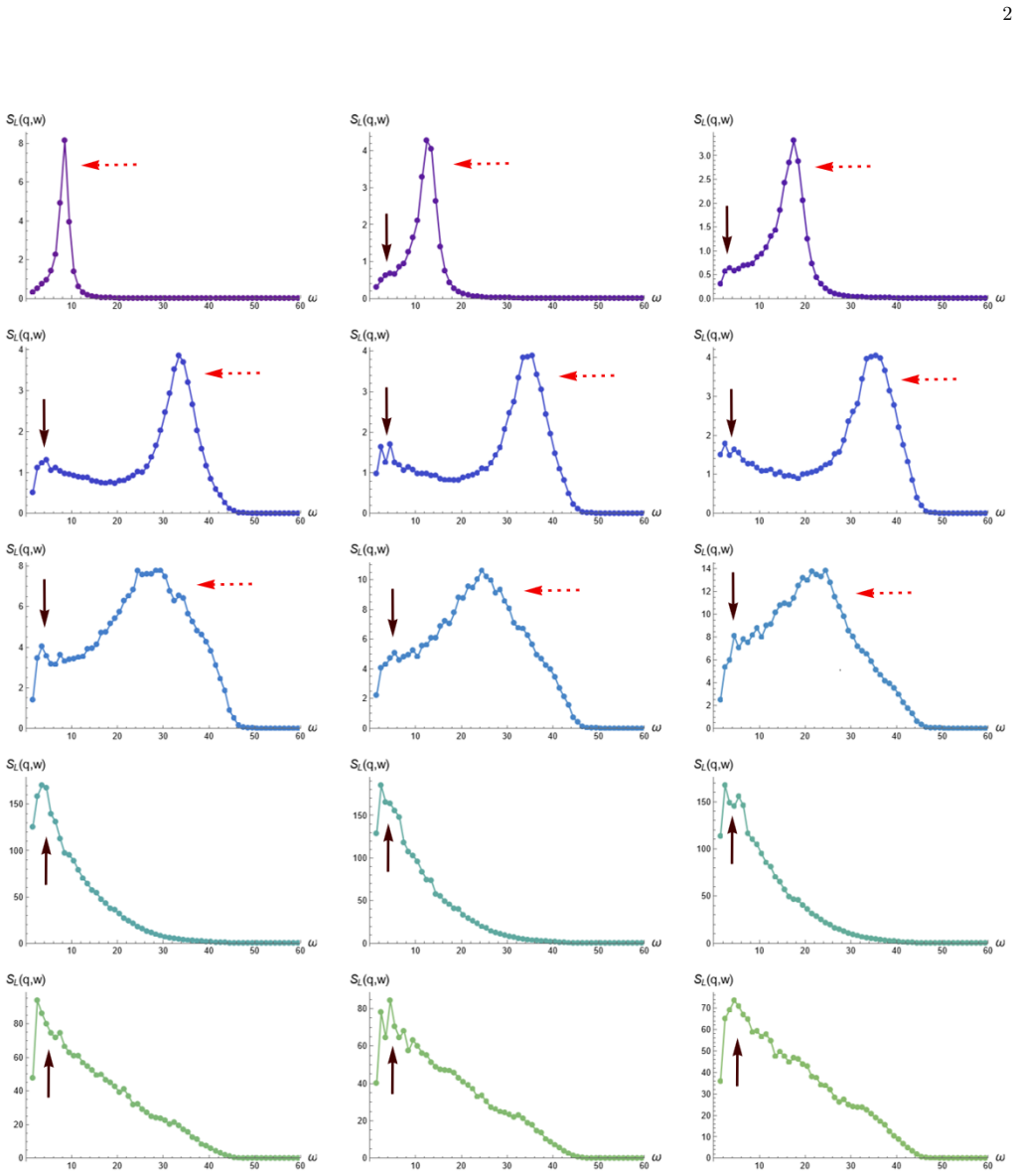
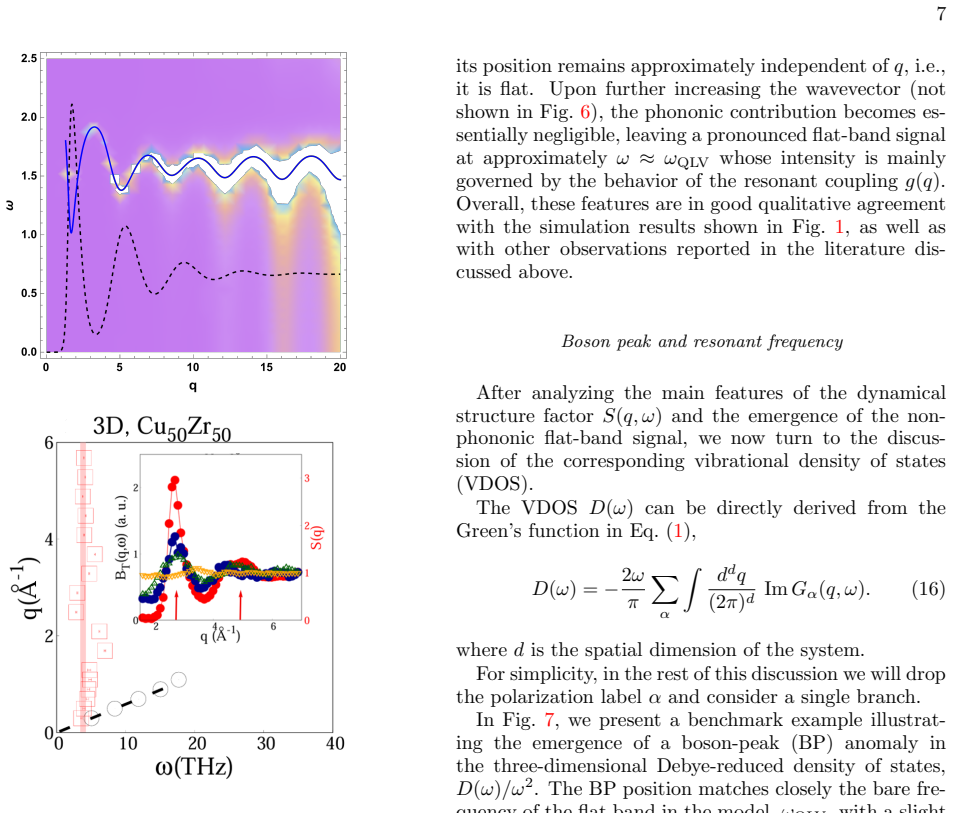
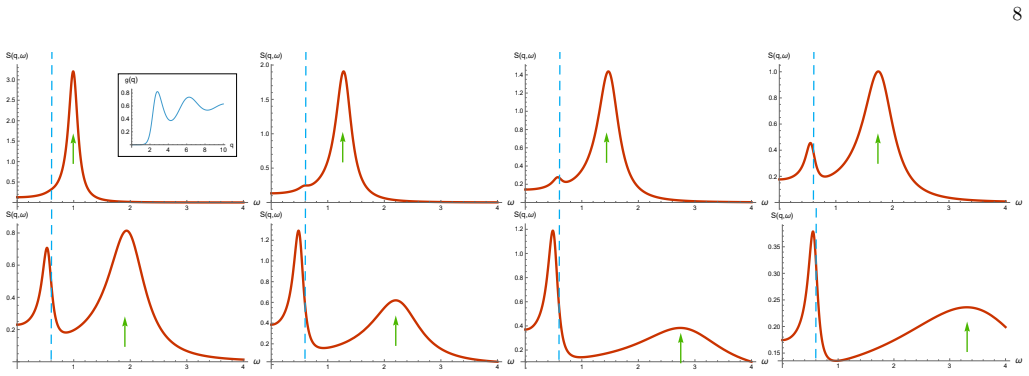
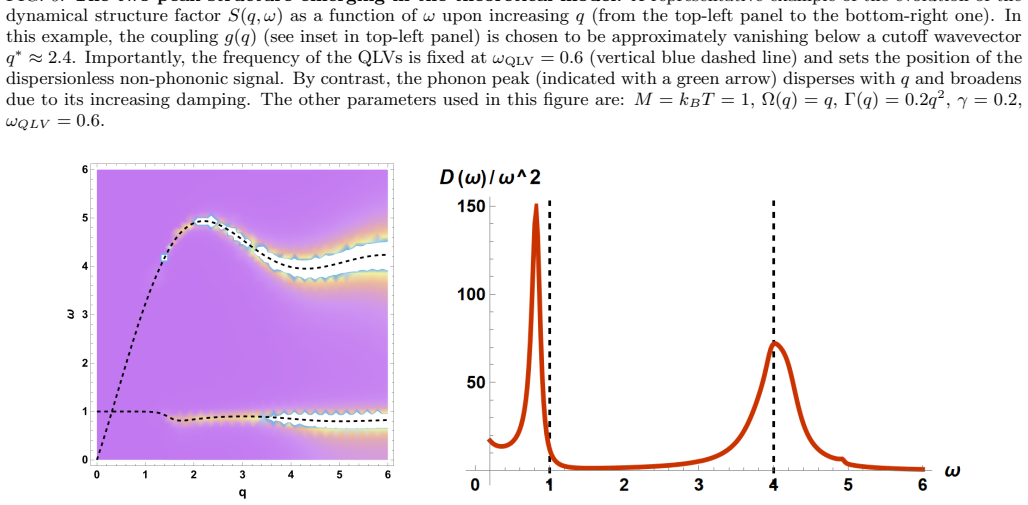
Recent experiments and simulations show a non-phononic flat band in the dynamical structure factor of two- and three-dimensional amorphous solids. This feature sits near the boson-peak frequency, is nearly dispersionless, appears only above a critical wave vector of order the first diffraction peak, and has reduced intensity that correlates strongly with the static structure factor. The resonant-coupling model, a single-mode harmonic realization of the soft-potential scenario, naturally reproduces these main features and thereby clarifies the flat band's connection to the boson peak.
What carries the argument
The resonant-coupling model: a single-mode harmonic realization of the soft-potential scenario in which acoustic phonons interact with single-frequency quasi-localized vibrations; it supplies the minimal framework that generates the flat band's observed traits.
If this is right
- The flat band arises directly from resonant phonon-quasi-localized mode coupling rather than from many-body effects.
- Its energy coincides with the boson-peak frequency because that is the frequency at which the coupling is resonant.
- The intensity threshold at the first diffraction peak wave vector follows from the same coupling mechanism.
- The correlation between flat-band intensity and static structure factor is a direct signature of the underlying vibrational coupling.
Where Pith is reading between the lines
- The same resonant-coupling picture could be used to predict how the flat band shifts when the density of quasi-localized modes is varied in simulations.
- If the model holds, suppressing the boson peak by stiffening local modes should simultaneously eliminate the flat band.
- The framework offers a route to connect the flat band to other low-frequency anomalies such as the two-level systems that dominate thermal properties at still lower temperatures.
Load-bearing premise
The resonant-coupling model is assumed to be an adequate single-mode harmonic realization of the soft-potential scenario whose parameters can be chosen to match the observed flat-band characteristics without additional many-body effects.
What would settle it
A simulation or measurement in which the flat band's reduced intensity fails to correlate with the static structure factor even when the boson peak is present, or in which the flat band remains after resonant coupling to quasi-localized modes is suppressed.
Figures
read the original abstract
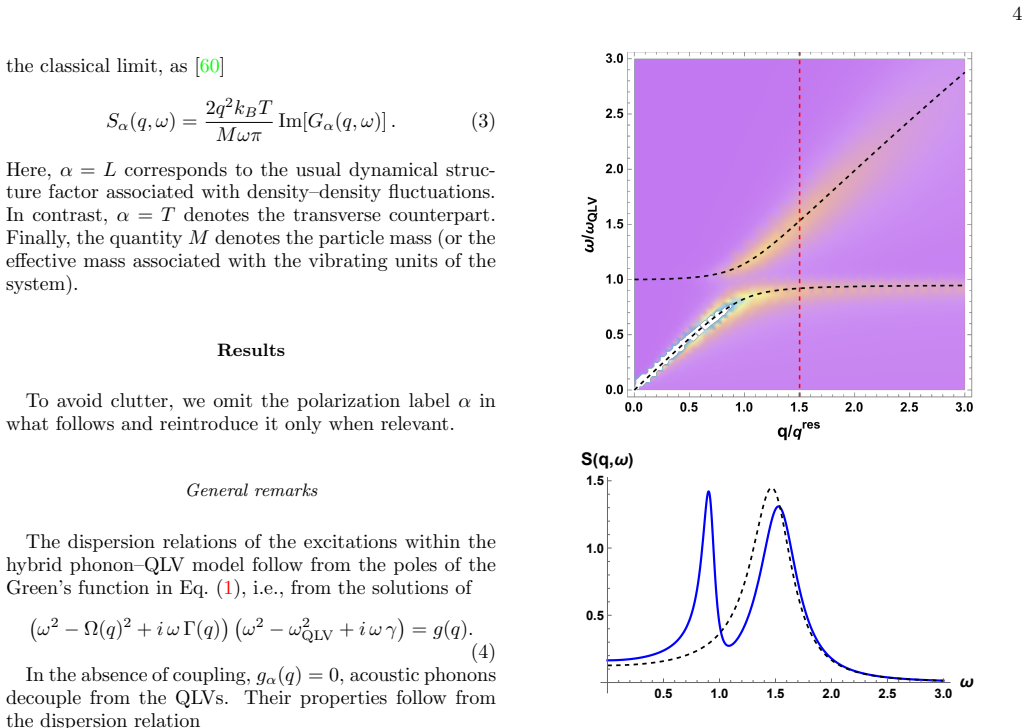
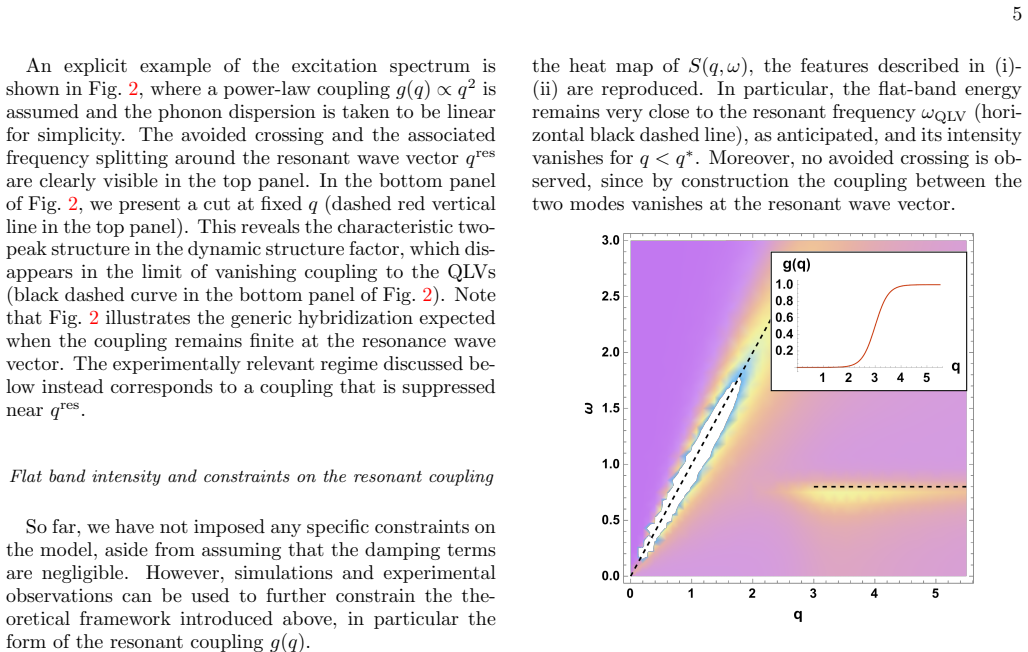
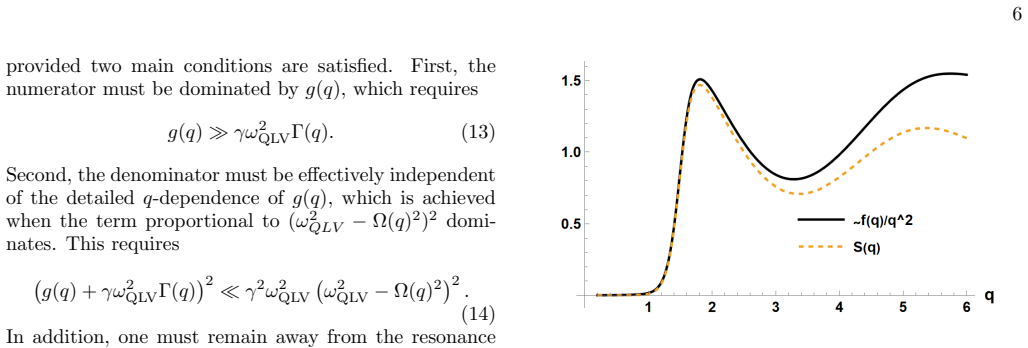
Recent experiments and simulations provide compelling evidence for the emergence of a non-phononic flat band in the dynamical structure factor of two- and three-dimensional amorphous solids. This feature has been suggested to be connected to the excess in the reduced vibrational density of states of glasses, commonly known as the boson peak, and displays several apparently universal characteristics. First, it is nearly dispersionless, with an energy close to the boson-peak frequency. Second, its intensity is negligible below a critical wave vector of the order of the first diffraction peak. Third, its reduced intensity exhibits a strong correlation with the static structure factor. Here, we revisit the resonant-coupling model, a single-mode harmonic realization of the soft-potential scenario in which acoustic phonons interact with single frequency quasi-localized vibrations. We show that this minimal framework naturally reproduces the main features of the observed flat band and clarifies its connection to the boson peak.
Editorial analysis
A structured set of objections, weighed in public.
Referee Report
Summary. The manuscript revisits the resonant-coupling model, a minimal single-mode harmonic realization of the soft-potential scenario, in which acoustic phonons couple to a single-frequency quasi-localized vibration (QLV). The authors claim that this framework naturally reproduces the three main observed features of the non-phononic flat band in the dynamical structure factor of amorphous solids: near-dispersionless dispersion at the boson-peak frequency, negligible intensity below a critical wave vector of order the first diffraction peak, and strong correlation of reduced intensity with the static structure factor. The work positions the flat band as a direct consequence of resonant coupling and thereby clarifies its link to the boson peak.
Significance. If the reproduction of the flat-band signatures can be shown to follow from the model without parameter values chosen specifically to place the resonance at the boson-peak scale, the result supplies a transparent analytic bridge between the soft-potential picture and the universal flat-band phenomenology reported in recent experiments and simulations. The single-mode harmonic construction permits an explicit dressed-propagator treatment, which is a strength for interpretability. The significance is tempered by the need to demonstrate that the key parameters are not simply fitted to the very scales the model is asked to explain.
major comments (2)
- [Model section, Hamiltonian] Model section (Hamiltonian definition): the bare QLV frequency ω_0 and the resonant-coupling matrix element g are introduced as adjustable parameters and are set to the boson-peak energy scale; the resulting pole of the dressed phonon propagator therefore lies at that scale by construction, so the claim that the flat band 'naturally' appears at the boson-peak frequency requires an independent route from the static structure factor to these parameters.
- [Results section] Results on dynamical structure factor: the three listed signatures (dispersionless character, intensity onset near first peak of S(q), and intensity–S(q) correlation) are asserted to be reproduced, yet no quantitative comparison metrics, error bars, or parameter-free predictions are supplied; without these it is impossible to judge whether the match is emergent or the result of tuning g and ω_0 to the observed scales.
minor comments (2)
- Notation for the dynamical structure factor S(q,ω) and the reduced intensity should be defined once at first use and used consistently thereafter.
- Figure captions should explicitly state the values of the two free parameters (ω_0 and g) used in each panel so that readers can assess the degree of tuning.
Simulated Author's Rebuttal
We thank the referee for the careful reading and constructive comments on our manuscript. We address the major comments point by point below.
read point-by-point responses
-
Referee: Model section (Hamiltonian definition): the bare QLV frequency ω_0 and the resonant-coupling matrix element g are introduced as adjustable parameters and are set to the boson-peak energy scale; the resulting pole of the dressed phonon propagator therefore lies at that scale by construction, so the claim that the flat band 'naturally' appears at the boson-peak frequency requires an independent route from the static structure factor to these parameters.
Authors: We agree that ω_0 and g are model parameters set to the boson-peak scale. Within the resonant-coupling framework, which is a minimal single-mode realization of the soft-potential scenario, the boson peak is identified with the QLV resonance frequency; the flat band then emerges at this scale as a direct consequence of the resonant coupling. The static structure factor enters through the q-dependent intensity and the onset condition, thereby linking the flat-band phenomenology to S(q). An explicit microscopic derivation of the numerical values of ω_0 and g from S(q) lies outside the scope of this minimal model. We will revise the model section to clarify this point and to distinguish the emergent flat-band features from the input frequency scale. revision: partial
-
Referee: Results on dynamical structure factor: the three listed signatures (dispersionless character, intensity onset near first peak of S(q), and intensity–S(q) correlation) are asserted to be reproduced, yet no quantitative comparison metrics, error bars, or parameter-free predictions are supplied; without these it is impossible to judge whether the match is emergent or the result of tuning g and ω_0 to the observed scales.
Authors: The three signatures are obtained from the explicit dressed-propagator calculation of the dynamical structure factor. We concur that quantitative metrics would allow a clearer assessment of robustness. In the revised manuscript we will add quantitative measures (e.g., dispersion width, correlation coefficient between reduced intensity and S(q)) together with a brief parameter-sensitivity analysis demonstrating that the reported features persist for a range of g and ω_0 around the boson-peak scale. revision: yes
Circularity Check
No significant circularity; model reproduces features from independent soft-potential assumptions
full rationale
The provided abstract and skeptic summary describe a minimal single-mode harmonic resonant-coupling construction whose parameters are set to observed scales. However, no equations, self-citations, or explicit fitting steps are quoted that would reduce the flat-band reproduction to a definition or input by construction. The derivation is presented as emergent from the soft-potential scenario without load-bearing self-citation chains or ansatz smuggling. This qualifies as self-contained against external benchmarks of boson-peak phenomenology, yielding a normal non-finding.
Axiom & Free-Parameter Ledger
Reference graph
Works this paper leans on
-
[1]
Pengcheng Pea- cock
and reexamine it in the context of recent exper- imental and numerical observations of a non-phononic flat band in the dynamical structure factor. For a re- cent review of these observations, we refer the reader to Ref. [10]. The resonant coupling model As our starting point, we consider a renormalized phonon Green function whose inverse is given by G−1 α...
-
[2]
P. M. Chaikin and T. C. Lubensky,Principles of con- densed matter physics, Vol. 10 (Cambridge university press Cambridge, 1995)
1995
-
[3]
Ramos,Low-temperature Thermal And Vibrational Properties Of Disordered Solids: A Half-century Of Uni- versal ”Anomalies” Of Glasses(World Scientific Publish- ing Company, 2022)
M. Ramos,Low-temperature Thermal And Vibrational Properties Of Disordered Solids: A Half-century Of Uni- versal ”Anomalies” Of Glasses(World Scientific Publish- ing Company, 2022)
2022
-
[4]
Phillips,Amorphous Solids: Low-temperature Prop- erties, Topics in current physics (Springer-Verlag, 1981)
W. Phillips,Amorphous Solids: Low-temperature Prop- erties, Topics in current physics (Springer-Verlag, 1981)
1981
-
[5]
R. O. Pohl, X. Liu, and E. Thompson, Rev. Mod. Phys. 10 74, 991 (2002)
2002
-
[6]
Esquinazi, ed.,Tunneling Systems in Amorphous and Crystalline Solids(Springer-Verlag, Berlin, Heidelberg, 1998)
P. Esquinazi, ed.,Tunneling Systems in Amorphous and Crystalline Solids(Springer-Verlag, Berlin, Heidelberg, 1998)
1998
-
[7]
Flubacher, A
P. Flubacher, A. Leadbetter, J. Morrison, and B. Sto- icheff, Journal of Physics and Chemistry of Solids12, 53 (1959)
1959
-
[8]
Nakayama, Reports on Progress in Physics65, 1195 (2002)
T. Nakayama, Reports on Progress in Physics65, 1195 (2002)
2002
-
[9]
Hu and H
Y.-C. Hu and H. Tanaka, Nature Physics18, 669 (2022)
2022
-
[10]
Hu and H
Y.-C. Hu and H. Tanaka, Physical Review Research5, 023055 (2023)
2023
-
[11]
A flat-band per- spective on the boson peak in amorphous solids,
S. Mahajan, L.-Z. Huang, C. Jiang, Y.-J. Wang, M. P. Ciamarra, J. Zhang, and M. Baggioli, “A flat-band per- spective on the boson peak in amorphous solids,” (2026), arXiv:2509.06340 [cond-mat.soft]
Pith/arXiv arXiv 2026
-
[12]
X. Y. Li, H. P. Zhang, S. Lan, D. L. Abernathy, C. H. Hu, L. R. Fan, M. Z. Li, and X.-L. Wang, Nature Com- munications17, 860 (2025)
2025
-
[13]
Boson peak in covalent network glasses: Isostaticity and marginal stability,
H. Mizuno, T. Mori, G. Baldi, and E. Minamitani, “Boson peak in covalent network glasses: Isostaticity and marginal stability,” (2025), arXiv:2508.20481 [cond- mat.dis-nn]
arXiv 2025
-
[14]
Boson peak in the dy- namical structure factor of network- and packing-type glasses,
H. Mizuno and E. Minamitani, “Boson peak in the dy- namical structure factor of network- and packing-type glasses,” (2026), arXiv:2601.19118 [cond-mat.soft]
arXiv 2026
-
[15]
Jiang, Z
C. Jiang, Z. Zheng, Y. Chen, M. Baggioli, and J. Zhang, Phys. Rev. Lett.133, 188302 (2024)
2024
-
[16]
Baldi, V
G. Baldi, V. M. Giordano, G. Monaco, F. Sette, E. Fabi- ani, A. Fontana, and G. Ruocco, Phys. Rev. B77, 214309 (2008)
2008
-
[17]
Ruzicka, T
B. Ruzicka, T. Scopigno, S. Caponi, A. Fontana, O. Pilla, P. Giura, G. Monaco, E. Pontecorvo, G. Ruocco, and F. Sette, Phys. Rev. B69, 100201 (2004)
2004
-
[18]
Anoma- lies
G. Baldi, A. Fontana, and G. Monaco, inLow- Temperature Thermal and Vibrational Properties of Dis- ordered Solids: A Half-Century of Universal “Anoma- lies” of Glasses, edited by M. A. Ramos (World Scien- tific, 2022) pp. 177–226
2022
-
[19]
Tømterud, S
M. Tømterud, S. D. Eder, C. B¨ uchner, L. Wondraczek, I. Simonsen, W. Schirmacher, J. R. Manson, and B. Holst, Nature Physics19, 1910 (2023)
1910
-
[20]
Steurer, A
W. Steurer, A. Apfolter, M. Koch, W. E. Ernst, B. Holst, E. Sønderg˚ ard, and J. R. Manson, Phys. Rev. Lett.99, 035503 (2007)
2007
-
[21]
Tømterud, S
M. Tømterud, S. D. Eder, S. K. Hellner, C. B¨ uchner, M. Heyde, H.-J. Freund, S. Forti, D. Convertino, C. Co- letti, J. R. Manson, and B. Holst, Phys. Rev. B111, 205423 (2025)
2025
-
[22]
Meyer, J
A. Meyer, J. Wuttke, W. Petry, A. Peker, R. Bormann, G. Coddens, L. Kranich, O. G. Randl, and H. Schober, Phys. Rev. B53, 12107 (1996)
1996
-
[23]
Inoue, T
K. Inoue, T. Kanaya, S. Ikeda, K. Kaji, K. Shibata, M. Misawa, and Y. Kiyanagi, The Journal of chemical physics95, 5332 (1991)
1991
-
[24]
Ruffl´ e, G
B. Ruffl´ e, G. Guimbreti` ere, E. Courtens, R. Vacher, and G. Monaco, Phys. Rev. Lett.96, 045502 (2006)
2006
-
[25]
Computational simula- tions of the vibrational properties of glasses,
H. Mizuno and A. Ikeda, “Computational simula- tions of the vibrational properties of glasses,” inLow- Temperature Thermal and Vibrational Properties of Dis- ordered Solids, Chap. Chapter 10, pp. 375–433
-
[26]
Buchenau, Philosophical Magazine B65, 303 (1992)
U. Buchenau, Philosophical Magazine B65, 303 (1992)
1992
-
[27]
B. B. Laird and H. R. Schober, Phys. Rev. Lett.66, 636 (1991)
1991
-
[28]
H. R. Schober and B. B. Laird, Phys. Rev. B44, 6746 (1991)
1991
-
[29]
Buchenau, A
U. Buchenau, A. Wischnewski, D. Richter, and B. Frick, Phys. Rev. Lett.77, 4035 (1996)
1996
-
[30]
Buchenau, H
U. Buchenau, H. M. Zhou, N. Nucker, K. S. Gilroy, and W. A. Phillips, Phys. Rev. Lett.60, 1318 (1988)
1988
-
[31]
V. G. Karpov, M. I. Klinger, and F. N. Ignat’ev, Soviet Physics JETP57, 439 (1983), russian original: Zh. Eksp. Teor. Fiz. 84, 760–775 (1983)
1983
-
[32]
V. G. Karpov and D. A. Parshin, Soviet Physics JETP 61, 1308 (1985), russian original: Zh. Eksp. Teor. Fiz. 88, 2212–2227 (1985)
1985
-
[33]
Buchenau, Y
U. Buchenau, Y. M. Galperin, V. L. Gurevich, and H. R. Schober, Phys. Rev. B43, 5039 (1991)
1991
-
[35]
D. A. Parshin, H. R. Schober, and V. L. Gurevich, Phys. Rev. B76, 064206 (2007)
2007
-
[36]
Buchenau, Y
U. Buchenau, Y. M. Galperin, V. L. Gurevich, D. A. Parshin, M. A. Ramos, and H. R. Schober, Phys. Rev. B46, 2798 (1992)
1992
-
[37]
H. R. Schober and C. Oligschleger, Phys. Rev. B53, 11469 (1996)
1996
-
[38]
Schober, C
H. Schober, C. Oligschleger, and B. Laird, Journal of Non-Crystalline Solids156-158, 965 (1993)
1993
-
[39]
V. A. Luchnikov, N. N. Medvedev, Y. I. Naberukhin, and H. R. Schober, Phys. Rev. B62, 3181 (2000)
2000
-
[40]
H. R. Schober, Journal of Physics: Condensed Matter 16, S2659 (2004)
2004
-
[41]
Schober, Journal of Non-Crystalline Solids357, 501–505 (2011)
H. Schober, Journal of Non-Crystalline Solids357, 501–505 (2011)
2011
-
[42]
Lerner and E
E. Lerner and E. Bouchbinder, The Journal of Chemical Physics155, 200901 (2021)
2021
-
[43]
Lerner and E
E. Lerner and E. Bouchbinder, The Journal of Chemical Physics158, 194503 (2023)
2023
-
[44]
Moriel, E
A. Moriel, E. Lerner, and E. Bouchbinder, Phys. Rev. Res.6, 023053 (2024)
2024
-
[45]
Moriel, E
A. Moriel, E. Lerner, and E. Bouchbinder, Journal of Applied Physics136, 225105 (2024)
2024
-
[46]
Mahajan and M
S. Mahajan and M. P. Ciamarra, Phys. Rev. Lett.127, 215504 (2021)
2021
-
[47]
Mahajan, D
S. Mahajan, D. Seow Yang Han, C. Jiang, M. Baggioli, and M. P. Ciamarra, Phys. Rev. E112, 035413 (2025)
2025
-
[48]
Mahajan and M
S. Mahajan and M. P. Ciamarra, SciPost Phys.15, 069 (2023)
2023
-
[49]
Flenner and G
E. Flenner and G. Szamel, Science Advances11, eadu6097 (2025)
2025
-
[50]
Flenner and G
E. Flenner and G. Szamel, The Journal of Physical Chemistry B129, 1855 (2025)
2025
-
[51]
Zhang, X
H. Zhang, X. Wang, H.-B. Yu, and J. F. Douglas, The Journal of Chemical Physics154, 084505 (2021)
2021
-
[52]
Jiang, M
C. Jiang, M. Baggioli, and J. F. Douglas, The Journal of Chemical Physics160, 214505 (2024)
2024
-
[53]
Jiang and M
C. Jiang and M. Baggioli, Journal of Physics: Condensed Matter36, 505101 (2024)
2024
-
[54]
Bianchi, V
E. Bianchi, V. M. Giordano, and F. Lund, Phys. Rev. B 101, 174311 (2020)
2020
-
[55]
Quantum theory of elastic strings and the thermal conductivity of glasses,
F. Lund and B. Scheihing-Hitschfeld, “Quantum theory of elastic strings and the thermal conductivity of glasses,” (2026), arXiv:2601.12721 [cond-mat.mtrl-sci]
arXiv 2026
-
[56]
Pang, Phys
T. Pang, Phys. Rev. B45, 2490 (1992)
1992
-
[57]
Malinovsky, V
V. Malinovsky, V. Novikov, and A. Sokolov, Physics Letters A153, 63 (1991)
1991
-
[58]
Maurer and W
E. Maurer and W. Schirmacher, Journal of Low Temper- 11 ature Physics137, 453 (2004)
2004
-
[59]
A. A. Maradudin, E. W. Montroll, G. H. Weiss, and I. P. Ipatova,Theory of Lattice Dynamics in the Harmonic Approximation, 2nd ed., Solid State Physics Supplement, Vol. 3 (Academic Press, New York, 1971)
1971
-
[60]
V. L. Gurevich, D. A. Parshin, and H. R. Schober, Phys. Rev. B67, 094203 (2003)
2003
-
[61]
A. L. Fetter and J. D. Walecka,Quantum Theory of Many-Particle Systems(McGraw-Hill, New York, 1971)
1971
-
[62]
A. I. Akhiezer, Journal of Physics (USSR)1, 277 (1939)
1939
-
[63]
P. G. Klemens, Proceedings of the Physical Society. Sec- tion A68, 1113 (1955)
1955
-
[64]
L. Wang, G. Szamel, and E. Flenner, Soft Matter16, 7165 (2020)
2020
-
[65]
A. I. Chumakov, G. Monaco, A. Monaco, W. A. Crich- ton, A. Bosak, R. R¨ uffer, A. Meyer, F. Kargl, L. Comez, D. Fioretto, H. Giefers, S. Roitsch, G. Wortmann, M. H. Manghnani, A. Hushur, Q. Williams, J. Balogh, K. Parli´ nski, P. Jochym, and P. Piekarz, Phys. Rev. Lett.106, 225501 (2011)
2011
-
[66]
Y. Wang, L. Hong, Y. Wang, W. Schirmacher, and J. Zhang, Phys. Rev. B98, 174207 (2018)
2018
-
[67]
Y. Tian, X. Shen, Q. Gao, Z. Lu, J. Yang, Q. Zheng, C. F. Aleman, D. Luo, A. H. Reid, B. Xu,et al., arXiv preprint arXiv:2111.10171 (2021)
arXiv 2021
-
[68]
Y. Qi, N. Chen, Z. Zhou, Q. Xu, Y. Lv, X. Zou, T. Jiang, P. Zhu, M. Zhu, D. Chen, Z. Sun, X. Li, and D. Xiang, “Direct observation of ultrafast amorphous- amorphous transitions indicated by bond stretching and angle bending in phase-change material gete,” (2026), arXiv:2603.17400 [cond-mat.mtrl-sci]
arXiv 2026
-
[69]
Heterogeneous elastic- ity: The tale of the boson peak,
W. Schirmacher and G. Ruocco, “Heterogeneous elastic- ity: The tale of the boson peak,” inLow-Temperature Thermal and Vibrational Properties of Disordered Solids (World Scientific, 2022) Chap. 9, pp. 331–373
2022
-
[70]
G. Ding, E. Ma, F. Jiang, J. Duan, S. Cai, N. Xu, B. Cui, L. Dai, and M. Jiang, Nature Physics21, 1911 (2025)
1911
discussion (0)
Sign in with ORCID, Apple, or X to comment. Anyone can read and Pith papers without signing in.