E4GEN: Event-level Explainable Extreme-Enhanced Time-series Generation
Pith reviewed 2026-06-28 15:40 UTC · model grok-4.3
The pith
E4GEN is an explainable diffusion framework that generates time series with improved fidelity for both regular patterns and extreme events.
A machine-rendered reading of the paper's core claim, the machinery that carries it, and where it could break.
Core claim
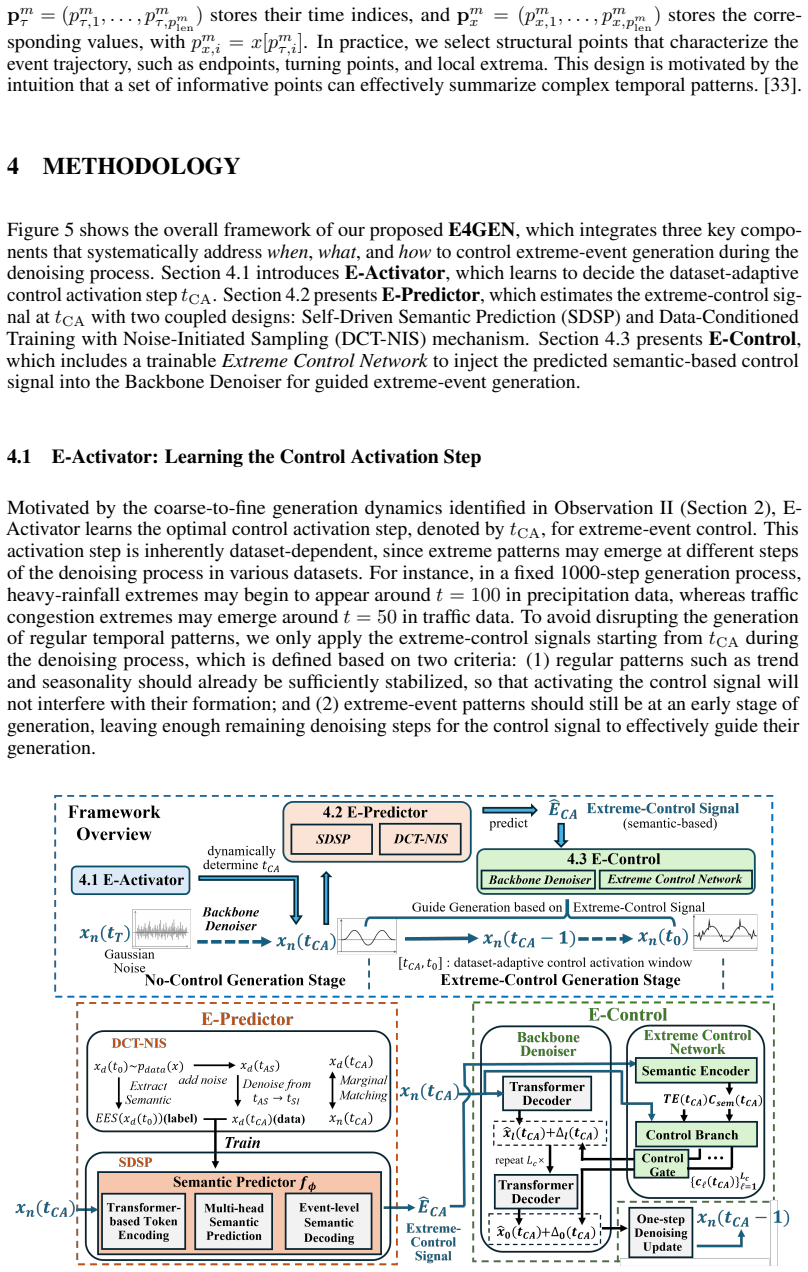
E4GEN provides systematic insights into when, what, and how to control extreme-event generation through three key components: E-Activator learns the dataset-adaptive extreme-control signal activation step during the denoising process; E-Predictor determines what control signal to enforce through Self-Driven Semantic Prediction and a novel Data-Conditioned Training, Noise-Initiated Sampling mechanism; E-Control specifies how to control extreme-event generation through a trainable Extreme Control Network that transforms the semantic control signal into layer-wise signals and injects it into the denoising process.
What carries the argument
The E-Activator, E-Predictor, and E-Control components that learn and apply dataset-adaptive extreme-control signals during the diffusion denoising process without interfering with regular temporal components.
If this is right
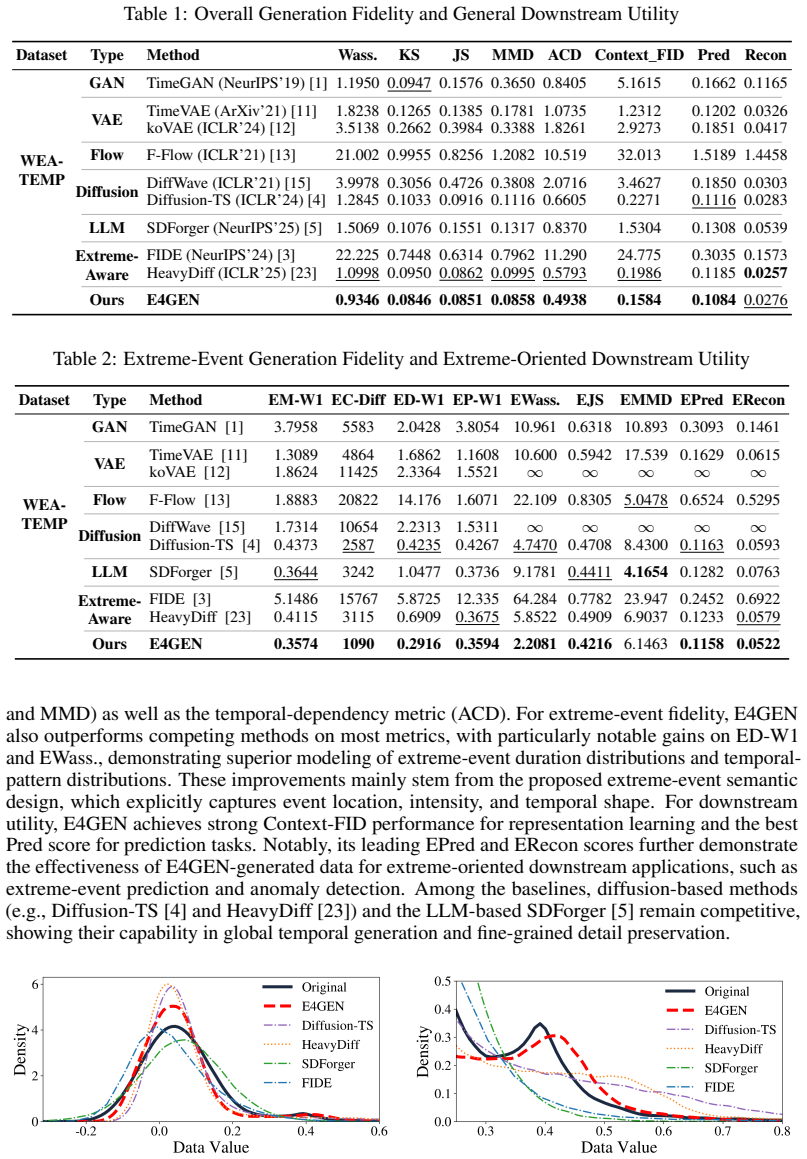
- Generated time series achieve higher overall distributional fidelity while also improving fidelity on extreme events.
- The generated data yields better results on downstream utility tasks compared with prior methods.
- Control over extreme events is achieved through separate, interpretable decisions about activation timing, signal selection, and injection mechanism.
- Training proceeds without requiring labeled extreme events thanks to the self-driven semantic prediction approach.
Where Pith is reading between the lines
- The self-driven control mechanism could be adapted to other generative tasks where rare events must be modeled without explicit labels.
- Layer-wise injection of control signals might offer a template for adding targeted constraints in other diffusion or autoregressive models.
- Datasets with different extreme-event characteristics could be used to test whether the activation step remains dataset-adaptive across domains.
- The separation of activation, prediction, and control steps could help diagnose failure modes when generated extremes still deviate from real data.
Load-bearing premise
The Self-Driven Semantic Prediction and Data-Conditioned Training mechanism can reliably infer and apply latent extreme-event control signals without access to training labels for extremes.
What would settle it
Running E4GEN on a dataset with independently verified extreme events and finding that the generated series show no measurable improvement over baselines on extreme-specific fidelity metrics or that the inferred control signals fail to align with the timing of actual extremes.
Figures
read the original abstract
Generating realistic time series is essential for scientific research and real-world applications. However, existing methods often emphasize overall distributional fidelity while failing to faithfully capture extreme events. To advance existing research, we propose E4GEN, an explainable diffusion framework for extreme event-aware time-series generation. E4GEN provides systematic insights into when, what, and how to control extreme-event generation through three key components. First, E-Activator learns the dataset-adaptive extreme-control signal activation step during the denoising process without interfering with regular temporal components, including trend and seasonality. Second, E-Predictor determines what control signal to enforce through Self-Driven Semantic Prediction, where each sample derives its own control signal by inferring latent extreme-event information during generation. It also includes a novel Data-Conditioned Training, Noise-Initiated Sampling mechanism to address the issue of unavailable training labels. Third, E-Control specifies how to control extreme-event generation through a trainable Extreme Control Network, which transforms the semantic control signal into layer-wise signals and injects it into the denoising process. We evaluate E4GEN on six datasets with 17 metrics, and extensive experiments show that E4GEN outperforms state-of-the-art models across multiple dimensions, including overall fidelity, extreme-event fidelity, and downstream utility.
Editorial analysis
A structured set of objections, weighed in public.
Referee Report
Summary. The paper proposes E4GEN, an explainable diffusion framework for extreme-event-aware time-series generation. It introduces three components: E-Activator (learns dataset-adaptive extreme-control signal activation during denoising without interfering with trend/seasonality), E-Predictor (uses Self-Driven Semantic Prediction to derive per-sample control signals by inferring latent extreme information, plus Data-Conditioned Training and Noise-Initiated Sampling to handle missing extreme labels), and E-Control (trainable Extreme Control Network that transforms semantic signals into layer-wise injections). Experiments on six datasets using 17 metrics claim outperformance over SOTA in overall fidelity, extreme-event fidelity, and downstream utility.
Significance. If the empirical claims and the validity of the inferred control signals hold, the work would advance time-series generation by addressing a key weakness in capturing extremes while adding explainability; this has potential value in domains like finance, climate, and healthcare where extremes drive decisions. The parameter-free aspects of the activation and the label-free training mechanism are notable strengths if independently verified.
major comments (3)
- [Abstract, §3] Abstract and §3 (E-Predictor): The central claim that Self-Driven Semantic Prediction plus Data-Conditioned Training reliably infers latent extreme-event control signals without any extreme labels lacks an independent validation step (e.g., correlation of inferred signals with known extreme timestamps or an ablation measuring signal accuracy against ground-truth extremes). Without this, gains on the 17 metrics could be attributable to the Extreme Control Network alone rather than true event-level control.
- [Abstract] Abstract: The outperformance claim on extreme-event fidelity and overall utility is stated without any equations, ablation tables, error bars, dataset names, or statistical significance tests. This prevents assessment of whether the reported gains are load-bearing or could be explained by implementation details of the diffusion backbone.
- [§3.2] §3.2 (Data-Conditioned Training): The mechanism for addressing unavailable training labels via Noise-Initiated Sampling is described at a high level; it is unclear whether the inferred signals are grounded externally or risk circularity by deriving control from the same generation process they are meant to condition.
minor comments (2)
- [§3] Notation for the three invented entities (E-Activator, E-Predictor, E-Control) should be introduced with explicit mathematical definitions in §3 rather than descriptive prose only.
- [Abstract, Experiments] The abstract mentions 'explainable' but does not specify what form the explanations take (e.g., visualizations of activation steps or signal attributions); this should be clarified with an example in the experiments section.
Simulated Author's Rebuttal
We thank the referee for the constructive feedback on E4GEN. The comments highlight important areas for strengthening the validation of the inferred control signals and the clarity of our claims and mechanisms. We address each major comment below and commit to revisions that enhance the manuscript without altering its core contributions.
read point-by-point responses
-
Referee: [Abstract, §3] Abstract and §3 (E-Predictor): The central claim that Self-Driven Semantic Prediction plus Data-Conditioned Training reliably infers latent extreme-event control signals without any extreme labels lacks an independent validation step (e.g., correlation of inferred signals with known extreme timestamps or an ablation measuring signal accuracy against ground-truth extremes). Without this, gains on the 17 metrics could be attributable to the Extreme Control Network alone rather than true event-level control.
Authors: We agree that an explicit independent validation step would more convincingly isolate the contribution of Self-Driven Semantic Prediction. The current manuscript demonstrates the value of the full E4GEN pipeline through ablations and downstream metrics, but does not include direct correlation of inferred signals against ground-truth extremes (as the framework is designed for label-free settings). In revision we will add experiments on synthetic data with known extreme timestamps to report correlation metrics and an ablation that disables the predictor while retaining E-Control, thereby addressing whether gains are attributable to true event-level control. revision: yes
-
Referee: [Abstract] Abstract: The outperformance claim on extreme-event fidelity and overall utility is stated without any equations, ablation tables, error bars, dataset names, or statistical significance tests. This prevents assessment of whether the reported gains are load-bearing or could be explained by implementation details of the diffusion backbone.
Authors: Abstracts are necessarily concise, and the manuscript already contains the requested details (dataset names, ablation tables, 17 metrics, error bars, and significance tests) in Sections 4 and 5. To improve accessibility we will revise the abstract to name the six datasets and cite the key quantitative gains with references to the corresponding tables and statistical tests, while leaving the full equations and ablations in the body. revision: partial
-
Referee: [§3.2] §3.2 (Data-Conditioned Training): The mechanism for addressing unavailable training labels via Noise-Initiated Sampling is described at a high level; it is unclear whether the inferred signals are grounded externally or risk circularity by deriving control from the same generation process they are meant to condition.
Authors: We will expand §3.2 with additional pseudocode and a step-by-step diagram clarifying the training and sampling flow. Data-Conditioned Training learns the predictor from the empirical data distribution during the forward process; Noise-Initiated Sampling begins from pure noise but conditions the predictor on progressively denoised samples drawn from the same distribution. This is not circular because the predictor is trained to recover latent extreme semantics from the data itself, independent of the final generated output. The revised text will make this grounding explicit. revision: yes
Circularity Check
No circularity detected; derivation self-contained
full rationale
The paper presents E4GEN as a diffusion-based framework with three components (E-Activator, E-Predictor via Self-Driven Semantic Prediction and Data-Conditioned Training, E-Control) for extreme-event time-series generation. No equations, derivations, or parameter-fitting steps are visible in the provided text that would allow reduction of any claimed prediction or control signal to its inputs by construction. The central claims rest on experimental outperformance across six datasets and 17 metrics rather than on any self-referential mathematical identity or unverified self-citation chain. The absence of load-bearing self-citations or ansatz smuggling in the abstract supports treating the described mechanisms as independently motivated.
Axiom & Free-Parameter Ledger
invented entities (3)
-
E-Activator
no independent evidence
-
E-Predictor
no independent evidence
-
E-Control
no independent evidence
Reference graph
Works this paper leans on
-
[1]
Time-series generative adversarial networks.Advances in neural information processing systems, 32, 2019
Jinsung Yoon, Daniel Jarrett, and Mihaela Van der Schaar. Time-series generative adversarial networks.Advances in neural information processing systems, 32, 2019
2019
-
[2]
Time-series generation by contrastive imitation.Advances in neural information processing systems, 34:28968–28982, 2021
Daniel Jarrett, Ioana Bica, and Mihaela van der Schaar. Time-series generation by contrastive imitation.Advances in neural information processing systems, 34:28968–28982, 2021
2021
-
[3]
Fide: Frequency-inflated conditional diffusion model for extreme-aware time series generation.Advances in Neural Information Processing Systems, 37:114434–114457, 2024
Asadullah Hill Galib, Pang-Ning Tan, and Lifeng Luo. Fide: Frequency-inflated conditional diffusion model for extreme-aware time series generation.Advances in Neural Information Processing Systems, 37:114434–114457, 2024
2024
-
[4]
Diffusion-ts: Interpretable diffusion for general time series genera- tion
Xinyu Yuan and Yan Qiao. Diffusion-ts: Interpretable diffusion for general time series genera- tion. InThe Twelfth International Conference on Learning Representations (ICLR), 2024
2024
-
[5]
Forging time series with language: A large language model approach to synthetic data generation.Advances in Neural Information Processing Systems, 2025
Cécile Rousseau, Tobia Boschi, Giandomenico Cornacchia, Dhaval Salwala, Alessandra Pascale, and Juan Bernabe Moreno. Forging time series with language: A large language model approach to synthetic data generation.Advances in Neural Information Processing Systems, 2025
2025
-
[6]
Pcf-gan: generating sequential data via the characteristic function of measures on the path space.Advances in Neural Information Processing Systems, 36:39755–39781, 2023
Hang Lou, Siran Li, and Hao Ni. Pcf-gan: generating sequential data via the characteristic function of measures on the path space.Advances in Neural Information Processing Systems, 36:39755–39781, 2023
2023
-
[7]
Tsgm: a flexible framework for generative modeling of synthetic time series.Advances in Neural Information Processing Systems, 37:129042–129061, 2024
Alexander Nikitin, Letizia Iannucci, and Samuel Kaski. Tsgm: a flexible framework for generative modeling of synthetic time series.Advances in Neural Information Processing Systems, 37:129042–129061, 2024
2024
-
[8]
Self-interpretable time series prediction with counterfactual explanations
Jingquan Yan and Hao Wang. Self-interpretable time series prediction with counterfactual explanations. InInternational Conference on Machine Learning, pages 39110–39125. PMLR, 2023
2023
-
[9]
Surrogate time series.Physica D: Nonlinear Phenom- ena, 142(3-4):346–382, 2000
Thomas Schreiber and Andreas Schmitz. Surrogate time series.Physica D: Nonlinear Phenom- ena, 142(3-4):346–382, 2000
2000
-
[10]
Gt-gan: General purpose time series synthesis with generative adversarial networks.Advances in Neural Information Processing Systems, 35:36999–37010, 2022
Jinsung Jeon, Jeonghak Kim, Haryong Song, Seunghyeon Cho, and Noseong Park. Gt-gan: General purpose time series synthesis with generative adversarial networks.Advances in Neural Information Processing Systems, 35:36999–37010, 2022. 10
2022
-
[11]
Abhyuday Desai, Cynthia Freeman, Zuhui Wang, and Ian Beaver. Timevae: A variational auto-encoder for multivariate time series generation.arXiv preprint arXiv:2111.08095, 2021
-
[12]
Gen- erative modeling of regular and irregular time series data via koopman vaes
Ilan Naiman, N Benjamin Erichson, Pu Ren, Michael W Mahoney, and Omri Azencot. Gen- erative modeling of regular and irregular time series data via koopman vaes. InThe Twelfth International Conference on Learning Representations, 2024
2024
-
[13]
Generative time-series modeling with fourier flows
Ahmed Alaa, Alex James Chan, and Mihaela van der Schaar. Generative time-series modeling with fourier flows. InInternational Conference on Learning Representations, 2021
2021
-
[14]
Are language models actually useful for time series forecasting?Advances in Neural Information Processing Systems, 37:60162–60191, 2024
Mingtian Tan, Mike Merrill, Vinayak Gupta, Tim Althoff, and Tom Hartvigsen. Are language models actually useful for time series forecasting?Advances in Neural Information Processing Systems, 37:60162–60191, 2024
2024
-
[15]
Diffwave: A versatile diffusion model for audio synthesis
Zhifeng Kong, Wei Ping, Jiaji Huang, Kexin Zhao, and Bryan Catanzaro. Diffwave: A versatile diffusion model for audio synthesis. InInternational Conference on Learning Representations, 2021
2021
-
[16]
On the constrained time-series generation problem.Advances in Neural Information Processing Systems, 36:61048–61059, 2023
Andrea Coletta, Sriram Gopalakrishnan, Daniel Borrajo, and Svitlana Vyetrenko. On the constrained time-series generation problem.Advances in Neural Information Processing Systems, 36:61048–61059, 2023
2023
-
[17]
Generative adversarial networks in time series: A systematic literature review.ACM Computing Surveys, 55(10):1–31, 2023
Eoin Brophy, Zhengwei Wang, Qi She, and Tomás Ward. Generative adversarial networks in time series: A systematic literature review.ACM Computing Surveys, 55(10):1–31, 2023
2023
-
[18]
Jingyi Gu, Xuan Zhang, and Guiling Wang. Beyond the norm: A survey of synthetic data generation for rare events.arXiv preprint arXiv:2506.06380, 2025
-
[19]
Long-tailed diffusion models with oriented calibration
Tianjiao Zhang, Huangjie Zheng, Jiangchao Yao, Xiangfeng Wang, Mingyuan Zhou, Ya Zhang, and Yanfeng Wang. Long-tailed diffusion models with oriented calibration. InThe twelfth international conference on learning representations, 2024
2024
-
[20]
Improving generation quality of long-tailed diffusion via disentangled latent representations
Esther Rodriguez, Monica Welfert, Samuel McDowell, Nathan Stromberg, Julian Antolin Camarena, and Lalitha Sankar. Improving generation quality of long-tailed diffusion via disentangled latent representations. InNeurIPS Workshop on Structured Probabilistic Inference & Generative Modeling, 2025
2025
-
[21]
Tails of lipschitz triangular flows
Priyank Jaini, Ivan Kobyzev, Yaoliang Yu, and Marcus Brubaker. Tails of lipschitz triangular flows. InInternational Conference on Machine Learning, pages 4673–4681. PMLR, 2020
2020
-
[22]
t3-variational autoencoder: Learning heavy-tailed data with student’s t and power divergence
Juno Kim, Jaehyuk Kwon, Mincheol Cho, Hyunjong Lee, and Joong-Ho Won. t3-variational autoencoder: Learning heavy-tailed data with student’s t and power divergence. InInternational Conference on Learning Representations (ICLR), 2024
2024
-
[23]
Heavy-tailed diffusion models
Kushagra Pandey, Jaideep Pathak, Yilun Xu, Stephan Mandt, Michael Pritchard, Arash Vahdat, and Morteza Mardani. Heavy-tailed diffusion models. InInternational Conference on Learning Representations (ICLR), 2025
2025
-
[24]
Back to Basics: Let Denoising Generative Models Denoise
Tianhong Li and Kaiming He. Back to basics: Let denoising generative models denoise.arXiv preprint arXiv:2511.13720, 2025
work page internal anchor Pith review Pith/arXiv arXiv 2025
-
[25]
Deterministic nonperiodic flow 1
Edward N Lorenz. Deterministic nonperiodic flow 1. InUniversality in Chaos, 2nd edition, pages 367–378. Routledge, 2017
2017
-
[26]
Recurrence time analysis, long-term correlations, and extreme events.Physical Review E—Statistical, Nonlinear, and Soft Matter Physics, 71(5):056106, 2005
Eduardo G Altmann and Holger Kantz. Recurrence time analysis, long-term correlations, and extreme events.Physical Review E—Statistical, Nonlinear, and Soft Matter Physics, 71(5):056106, 2005
2005
-
[27]
The effect of long-term correlations on the return periods of rare events.Physica A: Statistical Mechanics and its Applications, 330(1-2):1–7, 2003
Armin Bunde, Jan F Eichner, Shlomo Havlin, and Jan W Kantelhardt. The effect of long-term correlations on the return periods of rare events.Physica A: Statistical Mechanics and its Applications, 330(1-2):1–7, 2003
2003
-
[28]
Improved denoising diffusion probabilistic models
Alexander Quinn Nichol and Prafulla Dhariwal. Improved denoising diffusion probabilistic models. InInternational conference on machine learning, pages 8162–8171. PMLR, 2021. 11
2021
-
[29]
Timebridge: Better diffusion prior design with bridge models for time series generation
Jinseong Park, Seungyun Lee, Woojin Jeong, Yujin Choi, and Jaewook Lee. Timebridge: Better diffusion prior design with bridge models for time series generation. InProceedings of the 32nd ACM SIGKDD Conference on Knowledge Discovery and Data Mining V . 1, pages 1135–1146, 2026
2026
-
[30]
Stl: A seasonal-trend decomposition.J
Robert B Cleveland, William S Cleveland, Jean E McRae, Irma Terpenning, et al. Stl: A seasonal-trend decomposition.J. off. Stat, 6(1):3–73, 1990
1990
-
[31]
Defining extreme events: A cross-disciplinary review.Earth’s Future, 6(3):441–455, 2018
Lauren E McPhillips, Heejun Chang, Mikhail V Chester, Yaella Depietri, Erin Friedman, Nancy B Grimm, John S Kominoski, Timon McPhearson, Pablo Méndez-Lázaro, Emma J Rosi, et al. Defining extreme events: A cross-disciplinary review.Earth’s Future, 6(3):441–455, 2018
2018
-
[32]
Models for exceedances over high thresholds.Journal of the Royal Statistical Society Series B: Statistical Methodology, 52(3):393–425, 1990
Anthony C Davison and Richard L Smith. Models for exceedances over high thresholds.Journal of the Royal Statistical Society Series B: Statistical Methodology, 52(3):393–425, 1990
1990
-
[33]
Time series shapelets: a new primitive for data mining
Lexiang Ye and Eamonn Keogh. Time series shapelets: a new primitive for data mining. In Proceedings of the 15th ACM SIGKDD international conference on Knowledge discovery and data mining, pages 947–956, 2009
2009
-
[34]
Denoising diffusion probabilistic models.Advances in neural information processing systems, 33:6840–6851, 2020
Jonathan Ho, Ajay Jain, and Pieter Abbeel. Denoising diffusion probabilistic models.Advances in neural information processing systems, 33:6840–6851, 2020
2020
-
[35]
Springer, 2009
Cédric Villani et al.Optimal transport: old and new, volume 338. Springer, 2009
2009
-
[36]
On the estimation of the discrepancy between empirical curves of distribution for two independent samples.Bull
Nikolai V Smirnov et al. On the estimation of the discrepancy between empirical curves of distribution for two independent samples.Bull. Math. Univ. Moscou, 2(2):3–14, 1939
1939
-
[37]
Divergence measures based on the shannon entropy.IEEE Transactions on Information theory, 37(1):145–151, 2002
Jianhua Lin. Divergence measures based on the shannon entropy.IEEE Transactions on Information theory, 37(1):145–151, 2002
2002
-
[38]
A kernel two-sample test.The journal of machine learning research, 13(1):723–773, 2012
Arthur Gretton, Karsten M Borgwardt, Malte J Rasch, Bernhard Schölkopf, and Alexander Smola. A kernel two-sample test.The journal of machine learning research, 13(1):723–773, 2012
2012
-
[39]
Data series similarity using correlation-aware measures
Katsiaryna Mirylenka, Michele Dallachiesa, and Themis Palpanas. Data series similarity using correlation-aware measures. InProceedings of the 29th International Conference on Scientific and Statistical Database Management, pages 1–12, 2017
2017
-
[40]
Tsgbench: Time series generation benchmark.Proceedings of the VLDB Endowment, 17(3):305–318, 2023
Yihao Ang, Qiang Huang, Yifan Bao, Anthony KH Tung, and Zhiyong Huang. Tsgbench: Time series generation benchmark.Proceedings of the VLDB Endowment, 17(3):305–318, 2023
2023
-
[41]
Psa-gan: Progressive self attention gans for synthetic time series
Paul Jeha, Michael Bohlke-Schneider, Pedro Mercado, Shubham Kapoor, Rajbir Singh Nirwan, Valentin Flunkert, Jan Gasthaus, and Tim Januschowski. Psa-gan: Progressive self attention gans for synthetic time series. InThe tenth international conference on learning representations, 2022
2022
-
[42]
LSTM-based Encoder-Decoder for Multi-sensor Anomaly Detection
Pankaj Malhotra, Anusha Ramakrishnan, Gaurangi Anand, Lovekesh Vig, Puneet Agarwal, and Gautam Shroff. Lstm-based encoder-decoder for multi-sensor anomaly detection.arXiv preprint arXiv:1607.00148, 2016
work page internal anchor Pith review Pith/arXiv arXiv 2016
-
[43]
C-rnn-gan: Continuous recurrent neural networks with adversarial training, 2016
Olof Mogren. C-rnn-gan: Continuous recurrent neural networks with adversarial training, 2016
2016
-
[44]
Hyland, and Gunnar Rätsch
Cristóbal Esteban, Stephanie L. Hyland, and Gunnar Rätsch. Real-valued (medical) time series generation with recurrent conditional gans, 2017
2017
-
[45]
A recurrent latent variable model for sequential data.arXiv, 2015
Junyoung Chung, Kyle Kastner, Laurent Dinh, Kratarth Goel, Aaron Courville, and Yoshua Bengio. A recurrent latent variable model for sequential data.arXiv, 2015
2015
-
[46]
Diffwave: A versatile diffusion model for audio synthesis.arXiv, 2020
Zhifeng Kong, Wei Ping, Jiaji Huang, Kexin Zhao, and Bryan Catanzaro. Diffwave: A versatile diffusion model for audio synthesis.arXiv, 2020
2020
-
[47]
Kashif Rasul, Calvin Seward, Ingmar Schuster, and Roland V ollgraf. Autoregressive denoising diffusion models for multivariate probabilistic time series forecasting.Proceedings of the 38th International Conference on Machine Learning, PMLR 139:8857-8868, 2021, 2021. 12
2021
-
[48]
Csdi: Conditional score-based diffusion models for probabilistic time series imputation.arXiv, 2021
Yusuke Tashiro, Jiaming Song, Yang Song, and Stefano Ermon. Csdi: Conditional score-based diffusion models for probabilistic time series imputation.arXiv, 2021
2021
-
[49]
Diffusion-ts: Interpretable diffusion for general time series genera- tion.arXiv, 2024
Xinyu Yuan and Yan Qiao. Diffusion-ts: Interpretable diffusion for general time series genera- tion.arXiv, 2024
2024
-
[50]
Hao Xue and Flora D. Salim. Promptcast: A new prompt-based learning paradigm for time series forecasting.IEEE Transactions on Knowledge and Data Engineering, 2023
2023
-
[51]
Hua, R., Liu, Z., Zhang, K., and Yang, Y
Nate Gruver, Marc Finzi, Shikai Qiu, and Andrew Gordon Wilson. Large language models are zero-shot time series forecasters.arXiv preprint arXiv:2310.07820, 2023
-
[52]
One fits all: Power general time series analysis by pretrained lm
Tian Zhou, Peisong Niu, Xue Wang, Liang Sun, and Rong Jin. One fits all: Power general time series analysis by pretrained lm. InAdvances in Neural Information Processing Systems, volume 36, 2023
2023
-
[53]
Time-LLM: Time series forecasting by reprogramming large language models
Ming Jin, Shiyu Wang, Lintao Ma, Zhixuan Chu, James Y Zhang, Xiaoming Shi, Pin-Yu Chen, Yuxuan Liang, Yuan-Fang Li, Shirui Pan, and Qingsong Wen. Time-LLM: Time series forecasting by reprogramming large language models. InInternational Conference on Learning Representations (ICLR), 2024
2024
-
[54]
Maddix, and Yuyang Wang
Abdul Fatir Ansari, Lorenzo Stella, Caner Turkmen, Xiyuan Zhang, Pedro Mercado, Huibin Shen, Oleksandr Shchur, Syama Sundar Rangapuram, Sebastian Pineda Arango, Shubham Kapoor, Jasper Zschiegner, Danielle C. Maddix, and Yuyang Wang. Chronos: Learning the language of time series.arXiv, 2024
2024
-
[55]
Heavy-tailed diffusion with denoising levy probabilistic models
Dario Shariatian, Umut Simsekli, and Alain Durmus. Heavy-tailed diffusion with denoising levy probabilistic models. InInternational Conference on Learning Representations, 2025
2025
-
[56]
Exgan: Adversarial generation of extreme samples
Siddharth Bhatia, Arjit Jain, and Bryan Hooi. Exgan: Adversarial generation of extreme samples. InProceedings of the AAAI Conference on Artificial Intelligence, volume 35, pages 6841–6849, 2021
2021
-
[57]
Pareto gan: Extending the representational power of gans to heavy-tailed distributions
Todd Huster, Jeremy Cohen, Zinan Lin, Kevin Chan, Charles Kamhoua, Nandi O Leslie, Cho- Yu Jason Chiang, and Vyas Sekar. Pareto gan: Extending the representational power of gans to heavy-tailed distributions. InInternational Conference on Machine Learning, pages 4523–4532. PMLR, 2021
2021
-
[58]
Springer, 2006
Laurens De Haan and Ana Ferreira.Extreme value theory: an introduction. Springer, 2006
2006
-
[59]
Oreshkin, Dmitri Carpov, Nicolas Chapados, and Yoshua Bengio
Boris N. Oreshkin, Dmitri Carpov, Nicolas Chapados, and Yoshua Bengio. N-beats: Neural basis expansion analysis for interpretable time series forecasting. InThe Eighth International Conference on Learning Representations (ICLR), 2020
2020
-
[60]
An algorithm for the machine calculation of complex fourier series.Mathematics of computation, 19(90):297–301, 1965
James W Cooley and John W Tukey. An algorithm for the machine calculation of complex fourier series.Mathematics of computation, 19(90):297–301, 1965
1965
-
[61]
Adding conditional control to text-to-image diffusion models
Lvmin Zhang, Anyi Rao, and Maneesh Agrawala. Adding conditional control to text-to-image diffusion models. InProceedings of the IEEE/CVF international conference on computer vision, pages 3836–3847, 2023
2023
-
[62]
Hourly weather data [dataset], 2022
Custom Weather. Hourly weather data [dataset], 2022. Dewey Data. https://doi.org/10. 82551/YX6H-K352
2022
-
[63]
Daily weather data [dataset]], 2022
Custom Weather. Daily weather data [dataset]], 2022. Dewey Data. https://doi.org/10. 82551/VBWQ-AQ20
2022
-
[64]
Moody, Michele Emdin, Gorazd Antolic, Roman Dorn, Ales Smrdel, Carlo Marchesi, and Roger G
Franc Jager, Alessandro Taddei, George B. Moody, Michele Emdin, Gorazd Antolic, Roman Dorn, Ales Smrdel, Carlo Marchesi, and Roger G. Mark. Long-term ST database: a reference for the development and evaluation of automated ischaemia detectors and for the study of the dynamics of myocardial ischaemia.Medical & Biological Engineering & Computing, 41(2):172–...
2003
-
[65]
Physiobank, physiotoolkit, and physionet: components of a new research resource for complex physiologic signals.circulation, 101(23):e215–e220, 2000
Ary L Goldberger, Luis AN Amaral, Leon Glass, Jeffrey M Hausdorff, Plamen Ch Ivanov, Roger G Mark, Joseph E Mietus, George B Moody, Chung-Kang Peng, and H Eugene Stanley. Physiobank, physiotoolkit, and physionet: components of a new research resource for complex physiologic signals.circulation, 101(23):e215–e220, 2000
2000
-
[66]
Individual household electric power consumption [dataset],
Georges Hebrail and Alice Berard. Individual household electric power consumption [dataset],
-
[67]
https://archive.ics.uci.edu/ml/datasets/ individual+household+electric+power+consumption
UCI Machine Learning Repository. https://archive.ics.uci.edu/ml/datasets/ individual+household+electric+power+consumption
-
[68]
Pems-sf [dataset], 2011
Marco Cuturi. Pems-sf [dataset], 2011. UCI Machine Learning Repository. https://archive. ics.uci.edu/ml/datasets/pems-sf
2011
-
[69]
Performance measurement system (pems), 2026
California Department of Transportation. Performance measurement system (pems), 2026. https://dot.ca.gov/programs/traffic-operations/mpr/pems-source
2026
-
[70]
Ts2vec: Towards universal representation of time series
Zhihan Yue, Yujing Wang, Juanyong Duan, Tianmeng Yang, Congrui Huang, Yunhai Tong, and Bixiong Xu. Ts2vec: Towards universal representation of time series. InProceedings of the AAAI conference on artificial intelligence, volume 36, pages 8980–8987, 2022. 14 A Reproducibility Statement To improve reproducibility, we release an anonymous GitHub repository a...
discussion (0)
Sign in with ORCID, Apple, or X to comment. Anyone can read and Pith papers without signing in.