RPCASSM: Robust PCA State Space Model For Infrared Small Target Detection
Pith reviewed 2026-06-28 15:12 UTC · model grok-4.3
The pith
RPCASSM adapts the robust PCA paradigm into state space modules that scan background and target regions separately according to their distinct spatial properties in infrared images.
A machine-rendered reading of the paper's core claim, the machinery that carries it, and where it could break.
Core claim
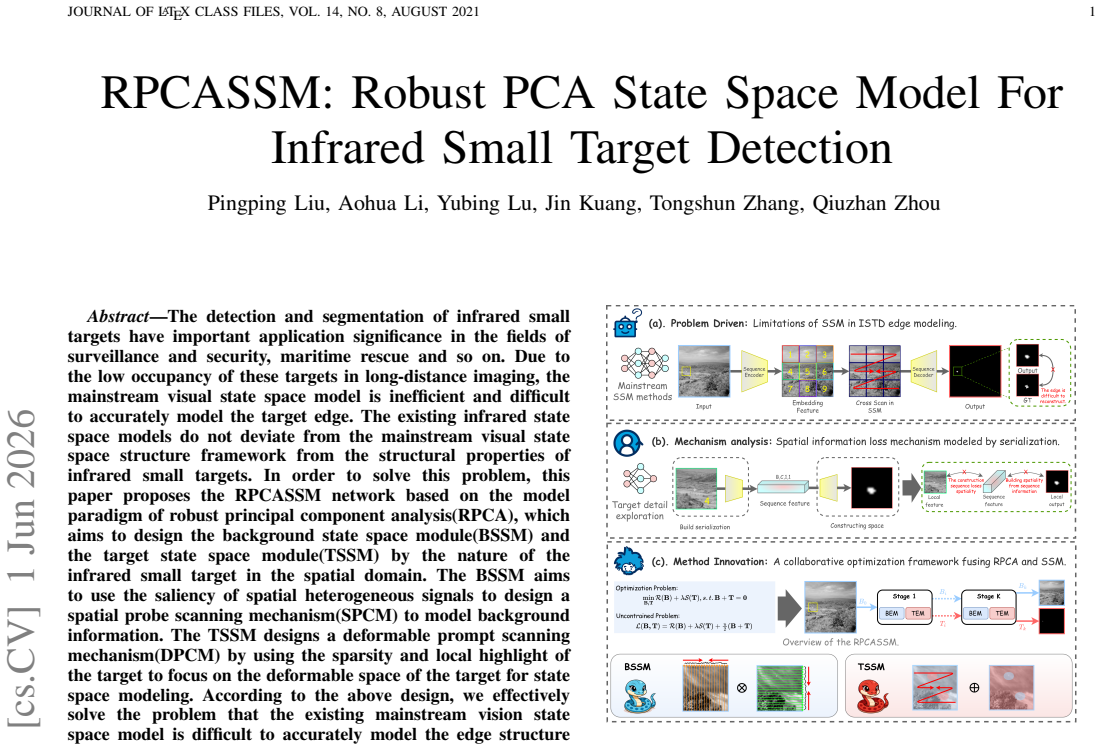
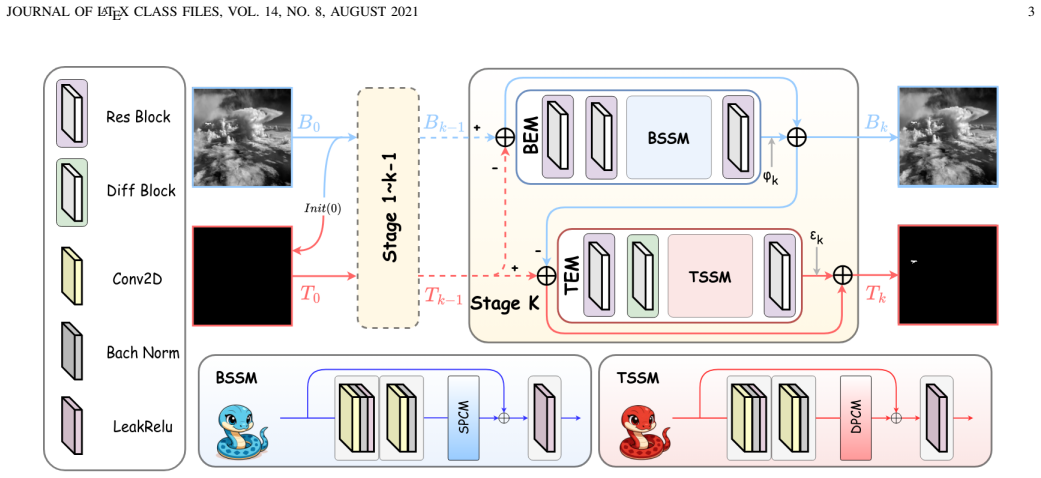
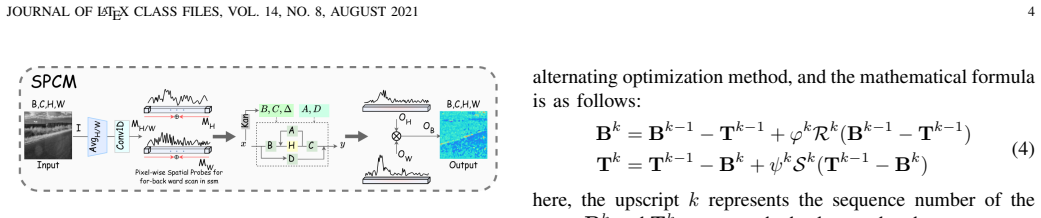
RPCASSM is a network built on the robust PCA model paradigm that introduces a background state space module (BSSM) with a spatial probe scanning mechanism (SPCM) derived from background saliency of heterogeneous signals and a target state space module (TSSM) with a deformable prompt scanning mechanism (DPCM) derived from target sparsity and local highlight; together these modules solve the edge-modeling shortfall of mainstream vision state space models for infrared small targets.
What carries the argument
Background state space module (BSSM) with spatial probe scanning mechanism (SPCM) and target state space module (TSSM) with deformable prompt scanning mechanism (DPCM), both constructed from the spatial-domain properties of infrared small targets inside an RPCA-style separation.
If this is right
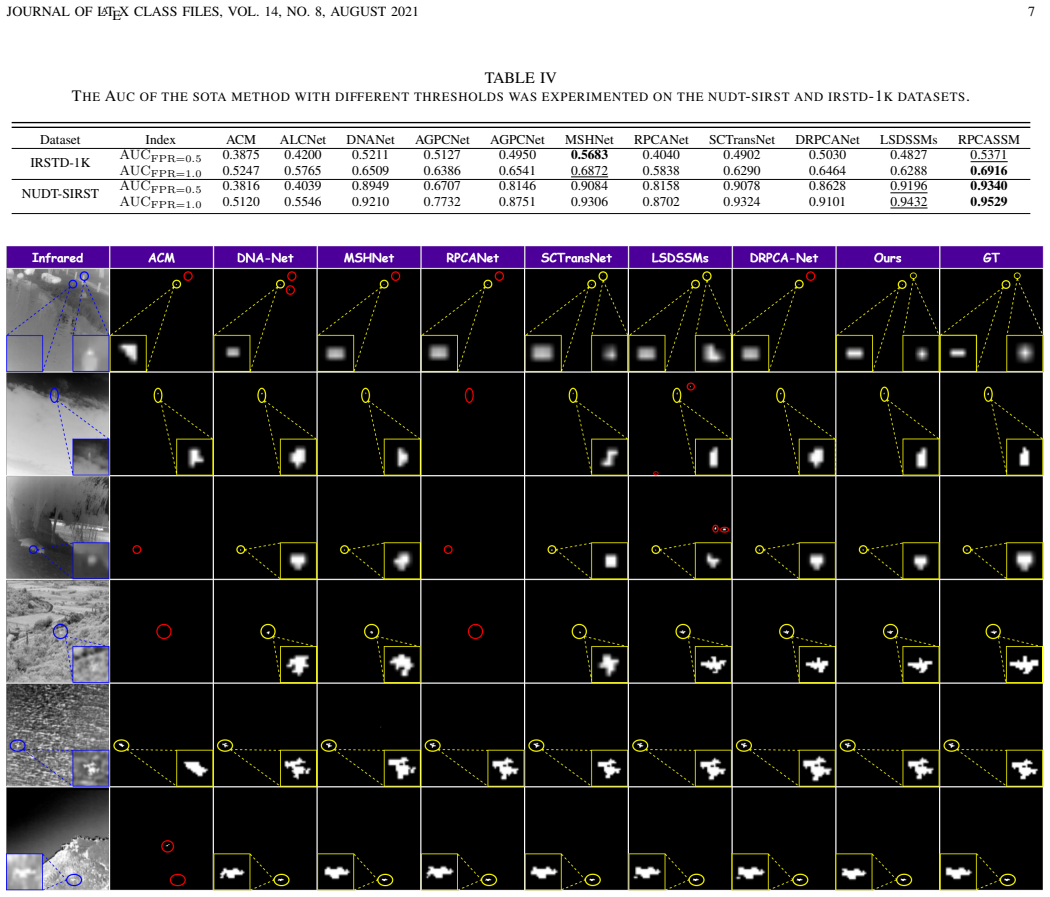
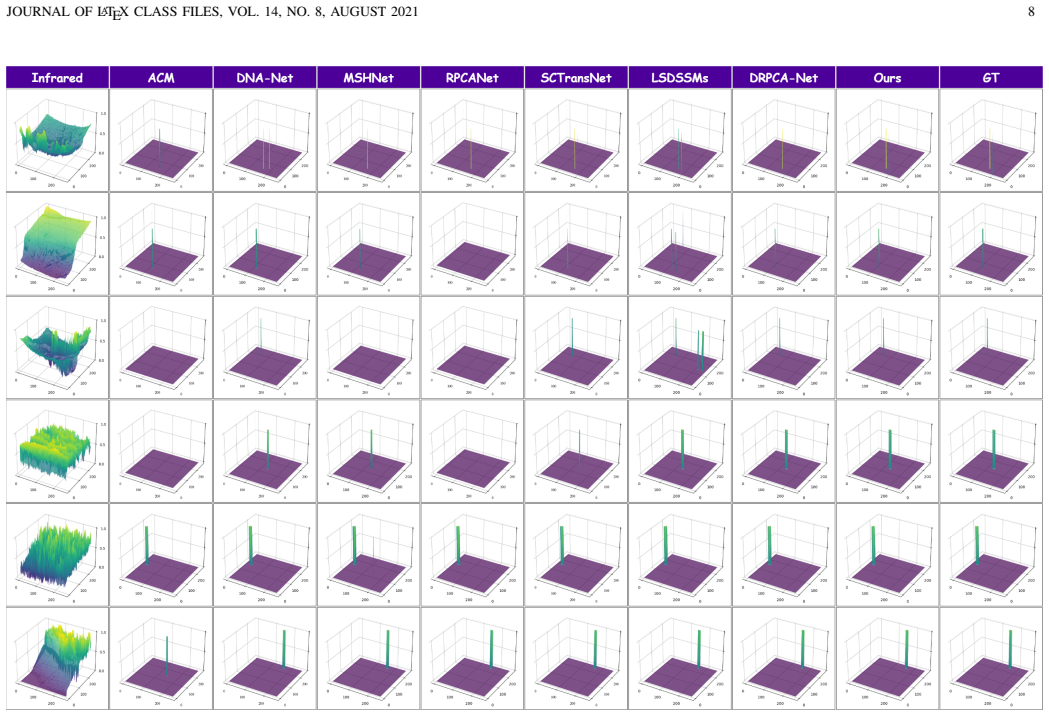
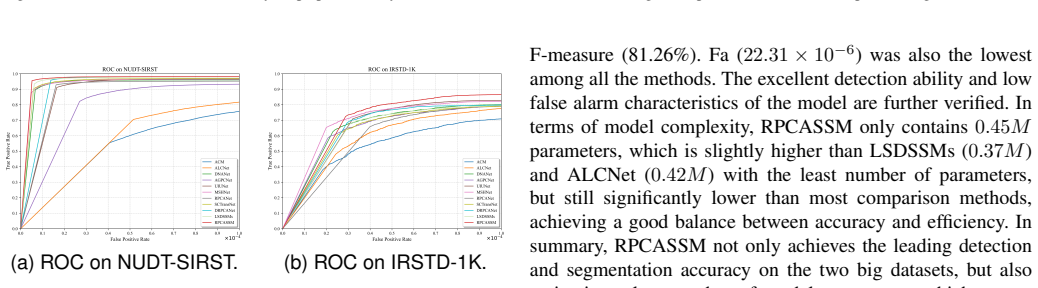
- The separation of background and target scanning yields measurable gains in detection and segmentation accuracy on standard infrared small-target benchmarks.
- The RPCA-inspired structure keeps the overall model inside the state-space family while adding domain-specific scanning rules.
- The design directly targets the low-occupancy and edge-structure problems that current vision state space models leave unaddressed.
- Public code release allows direct replication and extension on the reported datasets.
Where Pith is reading between the lines
- If the scanning mechanisms prove stable across different sensor resolutions, the same separation principle could be tested on other sparse-object detection tasks such as astronomy or medical imaging.
- The approach leaves open whether the same RPCA-style split can be applied to video sequences where temporal consistency of small targets becomes an additional constraint.
- A natural next measurement would be to quantify how much of the reported gain comes from the scanning rules versus the overall RPCA framing.
Load-bearing premise
The spatial probe and deformable prompt scanning mechanisms, derived from background and target spatial properties, will produce accurate edge modeling without introducing new artifacts or needing extensive extra tuning.
What would settle it
A controlled comparison on the same benchmark datasets in which edge-precision metrics (such as boundary F-score or pixel-level IoU on target contours) show no statistically significant gain over a standard vision state space model baseline.
Figures


read the original abstract
The detection and segmentation of infrared small targets have important application significance in the fields of surveillance and security, maritime rescue and so on. Due to the low occupancy of these targets in long-distance imaging, the mainstream visual state space model is inefficient and difficult to accurately model the target edge. The existing infrared state space models do not deviate from the mainstream visual state space structure framework from the structural properties of infrared small targets. In order to solve this problem, this paper proposes the RPCASSM network based on the model paradigm of robust principal component analysis(RPCA), which aims to design the background state space module(BSSM) and the target state space module(TSSM) by the nature of the infrared small target in the spatial domain. The BSSM aims to use the saliency of spatial heterogeneous signals to design a spatial probe scanning mechanism(SPCM) to model background information. The TSSM designs a deformable prompt scanning mechanism(DPCM) by using the sparsity and local highlight of the target to focus on the deformable space of the target for state space modeling. According to the above design, we effectively solve the problem that the existing mainstream vision state space model is difficult to accurately model the edge structure of infrared small target. Experimental results on the existing benchmark data sets prove the effectiveness of the RPCASSM design. Our code will be made public at \href{https://github.com/PepperCS/RPCASSM}{RPCASSM}.
Editorial analysis
A structured set of objections, weighed in public.
Referee Report
Summary. The paper proposes RPCASSM, a network based on the robust principal component analysis (RPCA) paradigm for infrared small target detection and segmentation. It introduces a Background State Space Module (BSSM) employing a Spatial Probe Scanning Mechanism (SPCM) to model background via spatial saliency, and a Target State Space Module (TSSM) using a Deformable Prompt Scanning Mechanism (DPCM) to focus on sparse, locally highlighted targets. The central claim is that these modules, derived from infrared small target spatial properties, solve the edge-modeling deficiencies of standard vision state space models. Effectiveness is asserted through experiments on existing benchmark datasets, with code to be released publicly.
Significance. If the experimental claims hold, the work offers a targeted adaptation of state space models to infrared small target characteristics via RPCA-inspired decomposition, which could improve edge fidelity in low-occupancy detection tasks. The explicit public code release is a positive contribution for reproducibility in the computer vision community.
major comments (2)
- [Experimental Results] Experimental section: only aggregate detection/segmentation scores on benchmarks are reported; no ablation studies isolate the SPCM or DPCM contributions, and no direct edge-specific metrics (e.g., boundary precision, Hausdorff distance, or edge IoU) are provided to substantiate the claim of improved edge modeling.
- [Method] Method section (BSSM/TSSM descriptions): the design of SPCM and DPCM is motivated by spatial-domain heuristics (saliency, sparsity, local highlight), but no analysis or visualization demonstrates that these mechanisms avoid introducing new artifacts or require post-hoc tuning, leaving the causal link to accurate edge modeling unverified.
minor comments (1)
- [Abstract] The abstract states that experiments 'prove the effectiveness' without referencing specific tables, figures, or quantitative improvements; this phrasing should be softened to 'demonstrate' pending detailed results.
Simulated Author's Rebuttal
We thank the referee for the constructive comments. We address each major comment below and note the planned revisions.
read point-by-point responses
-
Referee: [Experimental Results] Experimental section: only aggregate detection/segmentation scores on benchmarks are reported; no ablation studies isolate the SPCM or DPCM contributions, and no direct edge-specific metrics (e.g., boundary precision, Hausdorff distance, or edge IoU) are provided to substantiate the claim of improved edge modeling.
Authors: We agree that the current experimental section reports only aggregate metrics. To substantiate the edge-modeling claim, the revised manuscript will add ablation studies isolating SPCM and DPCM contributions together with edge-specific metrics such as boundary precision and Hausdorff distance. revision: yes
-
Referee: [Method] Method section (BSSM/TSSM descriptions): the design of SPCM and DPCM is motivated by spatial-domain heuristics (saliency, sparsity, local highlight), but no analysis or visualization demonstrates that these mechanisms avoid introducing new artifacts or require post-hoc tuning, leaving the causal link to accurate edge modeling unverified.
Authors: The SPCM and DPCM designs are derived directly from the spatial properties stated in the method section. To strengthen verification of the causal link, the revised manuscript will incorporate visualizations and analysis showing the mechanisms' effects on edge modeling and confirming absence of new artifacts. revision: yes
Circularity Check
No significant circularity; design is heuristic and externally validated
full rationale
The paper motivates BSSM (via SPCM) and TSSM (via DPCM) from explicit spatial-domain properties of IR small targets (saliency, sparsity, local highlight) inside an RPCA-inspired framework, then reports aggregate detection/segmentation results on standard benchmarks as evidence of effectiveness. No equations, fitted parameters, or self-citations are exhibited that would make any performance claim or edge-modeling assertion reduce to the inputs by construction. The derivation chain therefore remains self-contained and non-circular.
Axiom & Free-Parameter Ledger
axioms (1)
- domain assumption Infrared small targets exhibit sparsity and local highlight in the spatial domain while background signals are heterogeneous.
invented entities (2)
-
Background State Space Module (BSSM) with Spatial Probe Scanning Mechanism (SPCM)
no independent evidence
-
Target State Space Module (TSSM) with Deformable Prompt Scanning Mechanism (DPCM)
no independent evidence
Reference graph
Works this paper leans on
-
[1]
Single- frame infrared small-target detection: A survey,
M. Zhao, W. Li, L. Li, J. Hu, P. Ma, and R. Tao, “Single- frame infrared small-target detection: A survey,”IEEE Geoscience and Remote Sensing Magazine, vol. 10, no. 2, pp. 87–119, 2022
2022
-
[2]
Classification of small boats in infrared images for maritime surveillance,
M. Teutsch and W. Kr ¨uger, “Classification of small boats in infrared images for maritime surveillance,” in2010 International WaterSide Security Conference, 2010, pp. 1–7
2010
-
[3]
Ascnet: Asymmetric sampling correction network for infrared image destriping,
S. Yuan, H. Qin, X. Yan, S. Yang, S. Yang, N. Akhtar, and H. Zhou, “Ascnet: Asymmetric sampling correction network for infrared image destriping,”IEEE Transac- tions on Geoscience and Remote Sensing, 2025
2025
-
[4]
Max-mean and max-median filters for detection of small targets,
S. D. Deshpande, M. H. Er, R. Venkateswarlu, and P. Chan, “Max-mean and max-median filters for detection of small targets,” inSignal and Data Processing of Small Targets 1999, vol. 3809. SPIE, 1999, pp. 74–83
1999
-
[5]
Detection of dim targets in digital infrared imagery by morphological image process- ing,
J.-F. Rivest and R. Fortin, “Detection of dim targets in digital infrared imagery by morphological image process- ing,”Optical Engineering, vol. 35, no. 7, pp. 1886–1893, 1996
1996
-
[6]
A local contrast method for small infrared target detection,
C. P. Chen, H. Li, Y . Wei, T. Xia, and Y . Y . Tang, “A local contrast method for small infrared target detection,”IEEE transactions on geoscience and remote sensing, vol. 52, no. 1, pp. 574–581, 2013
2013
-
[7]
A local contrast method for infrared small-target detection utilizing a tri-layer window,
J. Han, S. Moradi, I. Faramarzi, C. Liu, H. Zhang, and Q. Zhao, “A local contrast method for infrared small-target detection utilizing a tri-layer window,”IEEE Geoscience and Remote Sensing Letters, vol. 17, no. 10, pp. 1822–1826, 2019
2019
-
[8]
Infrared patch-image model for small target detection in a single image,
C. Gao, D. Meng, Y . Yang, Y . Wang, X. Zhou, and A. G. Hauptmann, “Infrared patch-image model for small target detection in a single image,”IEEE transactions on image processing, vol. 22, no. 12, pp. 4996–5009, 2013
2013
-
[9]
Infrared small target detection via low-rank tensor completion with top-hat regularization,
H. Zhu, S. Liu, L. Deng, Y . Li, and F. Xiao, “Infrared small target detection via low-rank tensor completion with top-hat regularization,”IEEE Transactions on Geo- science and Remote Sensing, vol. 58, no. 2, pp. 1004– 1016, 2019
2019
-
[10]
Dense nested attention network for infrared small target detection,
B. Li, C. Xiao, L. Wang, Y . Wang, Z. Lin, M. Li, W. An, and Y . Guo, “Dense nested attention network for infrared small target detection,”IEEE Transactions on Image Processing, vol. 32, pp. 1745–1758, 2022
2022
-
[11]
Asymmetric contextual modulation for infrared small target detec- tion,
Y . Dai, Y . Wu, F. Zhou, and K. Barnard, “Asymmetric contextual modulation for infrared small target detec- tion,” inProceedings of the IEEE/CVF winter conference on applications of computer vision, 2021, pp. 950–959
2021
-
[12]
Attentional local contrast networks for infrared small target detection,
——, “Attentional local contrast networks for infrared small target detection,”IEEE transactions on geoscience and remote sensing, vol. 59, no. 11, pp. 9813–9824, 2021
2021
-
[13]
Sctransnet: Spatial-channel cross transformer network for infrared small target detection,
S. Yuan, H. Qin, X. Yan, N. Akhtar, and A. Mian, “Sctransnet: Spatial-channel cross transformer network for infrared small target detection,”IEEE Transactions on Geoscience and Remote Sensing, vol. 62, pp. 1–15, 2024
2024
-
[14]
Lsdssms: Infrared small target detection network based on low- rank sparse decomposition state space models,
Y . Lu, P. Liu, A. Li, Q. Zhou, and K. Zhang, “Lsdssms: Infrared small target detection network based on low- rank sparse decomposition state space models,”IEEE Transactions on Geoscience and Remote Sensing, 2025
2025
-
[15]
Mim-istd: Mamba-in-mamba for effi- cient infrared small target detection,
T. Chen, Z. Ye, Z. Tan, T. Gong, Y . Wu, Q. Chu, B. Liu, N. Yu, and J. Ye, “Mim-istd: Mamba-in-mamba for effi- cient infrared small target detection,”IEEE Transactions on Geoscience and Remote Sensing, 2024
2024
-
[16]
Mamba: Linear-time sequence mod- eling with selective state spaces,
A. Gu and T. Dao, “Mamba: Linear-time sequence mod- eling with selective state spaces,” inFirst Conference on Language Modeling, 2024
2024
-
[17]
T. Dao and A. Gu, “Transformers are ssms: Generalized models and efficient algorithms through structured state space duality,”arXiv preprint arXiv:2405.21060, 2024
work page internal anchor Pith review Pith/arXiv arXiv 2024
-
[18]
Vmamba: Visual state space model,
Y . Liu, Y . Tian, Y . Zhao, H. Yu, L. Xie, Y . Wang, Q. Ye, J. Jiao, and Y . Liu, “Vmamba: Visual state space model,”Advances in neural information processing systems, vol. 37, pp. 103 031–103 063, 2024
2024
-
[19]
Cwnet: Causal wavelet network for low-light image enhancement,
T. Zhang, P. Liu, Y . Lu, M. Cai, Z. Zhang, Z. Zhang, and Q. Zhou, “Cwnet: Causal wavelet network for low-light image enhancement,”arXiv preprint arXiv:2507.10689, 2025
-
[20]
T. Zhang, P. Liu, M. Cai, Z. Zhang, Y . Lu, and Q. Zhou, “Bsmamba: Brightness and semantic modeling for long- range interaction in low-light image enhancement,”arXiv preprint arXiv:2506.18346, 2025
-
[21]
Irmamba: Pixel difference mamba with layer restoration for infrared small target detection,
M. Zhang, X. Li, F. Gao, and J. Guo, “Irmamba: Pixel difference mamba with layer restoration for infrared small target detection,” inProceedings of the AAAI Conference on Artificial Intelligence, vol. 39, no. 9, 2025, pp. 10 003–10 011
2025
-
[22]
Smile: Spatial-spectral mamba interactive learning for infrared small target de- tection,
Y . Li, L. Wang, and S. Chen, “Smile: Spatial-spectral mamba interactive learning for infrared small target de- tection,”IEEE Transactions on Geoscience and Remote Sensing, 2025
2025
-
[23]
Rp- canet: Deep unfolding rpca based infrared small target detection,
F. Wu, T. Zhang, L. Li, Y . Huang, and Z. Peng, “Rp- canet: Deep unfolding rpca based infrared small target detection,” inProceedings of the IEEE/CVF Winter Con- ference on Applications of Computer Vision, 2024, pp. 4809–4818
2024
-
[24]
Point-to-point regression: Accurate infrared small target detection with single- point annotation,
R. Ni, J. Wu, Z. Qiu, L. Chen, C. Luo, F. Huang, Q. Liu, B. Wang, Y . Li, and Y . Li, “Point-to-point regression: Accurate infrared small target detection with single- point annotation,”IEEE Transactions on Geoscience and Remote Sensing, 2025
2025
-
[25]
Mapping degeneration meets label evolution: Learning infrared small target detection with single point supervision,
X. Ying, L. Liu, Y . Wang, R. Li, N. Chen, Z. Lin, W. Sheng, and S. Zhou, “Mapping degeneration meets label evolution: Learning infrared small target detection with single point supervision,” inProceedings of the IEEE/CVF conference on computer vision and pattern recognition, 2023, pp. 15 528–15 538
2023
-
[26]
Background modeling in the fourier domain for maritime infrared target detec- JOURNAL OF LATEX CLASS FILES, VOL. 14, NO. 8, AUGUST 2021 11 tion,
A. Zhou, W. Xie, and J. Pei, “Background modeling in the fourier domain for maritime infrared target detec- JOURNAL OF LATEX CLASS FILES, VOL. 14, NO. 8, AUGUST 2021 11 tion,”IEEE Transactions on Circuits and Systems for Video Technology, vol. 30, no. 8, pp. 2634–2649, 2020
2021
-
[27]
Dynamic high-frequency convolution for infrared small target detection,
R. Li, C. Xiao, Q. Yin, W. An, N. Chen, X. Ying, M. Li, and Y . Wang, “Dynamic high-frequency convolution for infrared small target detection,”IEEE Transactions on Circuits and Systems for Video Technology, pp. 1–1, 2026
2026
-
[28]
Irsam: Advancing segment anything model for infrared small target detection,
M. Zhang, Y . Wang, J. Guo, Y . Li, X. Gao, and J. Zhang, “Irsam: Advancing segment anything model for infrared small target detection,” inEuropean Conference on Com- puter Vision. Springer, 2024, pp. 233–249
2024
-
[29]
Text-irstd: Leveraging semantic text to promote infrared small target detection in complex scenes,
F. Huang, S. Zheng, Z. Qiu, H. Liu, H. Bai, and L. Chen, “Text-irstd: Leveraging semantic text to promote infrared small target detection in complex scenes,”arXiv preprint arXiv:2503.07249, 2025
-
[30]
Rethinking evaluation of infrared small target detection.CoRR, abs/2509.16888, 2025
Y . Pang, X. Zhao, L. Zhang, H. Lu, G. E. Fakhri, X. Liu, and S. Lu, “Rethinking evaluation of infrared small target detection,”arXiv preprint arXiv:2509.16888, 2025
-
[31]
Miss detection vs. false alarm: Adversarial learning for small object segmentation in infrared images,
H. Wang, L. Zhou, and L. Wang, “Miss detection vs. false alarm: Adversarial learning for small object segmentation in infrared images,” inProceedings of the IEEE/CVF international conference on computer vision, 2019, pp. 8509–8518
2019
-
[32]
Isnet: Shape matters for infrared small target detection,
M. Zhang, R. Zhang, Y . Yang, H. Bai, J. Zhang, and J. Guo, “Isnet: Shape matters for infrared small target detection,” inProceedings of the IEEE/CVF conference on computer vision and pattern recognition, 2022, pp. 877–886
2022
-
[33]
Infrared small target detection with scale and location sensitivity,
Q. Liu, R. Liu, B. Zheng, H. Wang, and Y . Fu, “Infrared small target detection with scale and location sensitivity,” inProceedings of the IEEE/CVF Conference on Com- puter Vision and Pattern Recognition, 2024, pp. 17 490– 17 499
2024
-
[34]
Pinwheel-shaped convolution and scale-based dynamic loss for infrared small target detection,
J. Yang, S. Liu, J. Wu, X. Su, N. Hai, and X. Huang, “Pinwheel-shaped convolution and scale-based dynamic loss for infrared small target detection,” inProceedings of the AAAI Conference on Artificial Intelligence, vol. 39, no. 9, 2025, pp. 9202–9210
2025
-
[35]
Mtu-net: Multilevel transunet for space-based infrared tiny ship detection,
T. Wu, B. Li, Y . Luo, Y . Wang, C. Xiao, T. Liu, J. Yang, W. An, and Y . Guo, “Mtu-net: Multilevel transunet for space-based infrared tiny ship detection,”IEEE Transac- tions on Geoscience and Remote Sensing, vol. 61, pp. 1–15, 2023
2023
-
[36]
Drpca-net: Make robust pca great again for infrared small target detection,
Z. Xiong, F. Zhou, F. Wu, S. Yuan, M. Fu, Z. Peng, J. Yang, and Y . Dai, “Drpca-net: Make robust pca great again for infrared small target detection,”IEEE Transac- tions on Geoscience and Remote Sensing, 2025
2025
-
[37]
Attention is all you need,
A. Vaswani, N. Shazeer, N. Parmar, J. Uszkoreit, L. Jones, A. N. Gomez, Ł. Kaiser, and I. Polosukhin, “Attention is all you need,”Advances in neural informa- tion processing systems, vol. 30, 2017
2017
-
[38]
Deep residual learning for image recognition,
K. He, X. Zhang, S. Ren, and J. Sun, “Deep residual learning for image recognition,” inProceedings of the IEEE conference on computer vision and pattern recog- nition, 2016, pp. 770–778
2016
-
[39]
KAN: Kolmogorov-Arnold Networks
Z. Liu, Y . Wang, S. Vaidya, F. Ruehle, J. Halver- son, M. Solja ˇci´c, T. Y . Hou, and M. Tegmark, “Kan: Kolmogorov-arnold networks,”arXiv preprint arXiv:2404.19756, 2024
work page internal anchor Pith review Pith/arXiv arXiv 2024
-
[40]
Deformable convolutional networks,
J. Dai, H. Qi, Y . Xiong, Y . Li, G. Zhang, H. Hu, and Y . Wei, “Deformable convolutional networks,” in Proceedings of the IEEE international conference on computer vision, 2017, pp. 764–773
2017
-
[41]
Agpcnet: Attention-guided pyramid context networks for infrared small target detection,
T. Zhang, S. Cao, T. Pu, and Z. Peng, “Agpcnet: Attention-guided pyramid context networks for infrared small target detection,”arXiv preprint arXiv:2111.03580, 2021
-
[42]
Uiu-net: U-net in u-net for infrared small object detection,
X. Wu, D. Hong, and J. Chanussot, “Uiu-net: U-net in u-net for infrared small object detection,”IEEE Transac- tions on Image Processing, vol. 32, pp. 364–376, 2022. VI. BIOGRAPHYSECTION Pingping Liureceived M.S. and Ph.D. degrees from College of Computer Science and Technology, Jilin University, China, in 2004 and 2009, respec- tively. She is currently a ...
2022
-
[43]
degree in College of Computer Science and Technology, Jilin University, China
He is currently pursuing his Ph.D. degree in College of Computer Science and Technology, Jilin University, China. His research interests include infrared small target detection, tracking, and image segmentation. JOURNAL OF LATEX CLASS FILES, VOL. 14, NO. 8, AUGUST 2021 12 Jin Kuangwas born in 2001. He received the B.S. degree from Xiangnan University in 2...
2021
discussion (0)
Sign in with ORCID, Apple, or X to comment. Anyone can read and Pith papers without signing in.