IstGPT: LLM-based Anomaly Detection for Spatial-Temporal Graph in Industrial Systems
Pith reviewed 2026-06-28 14:23 UTC · model grok-4.3
The pith
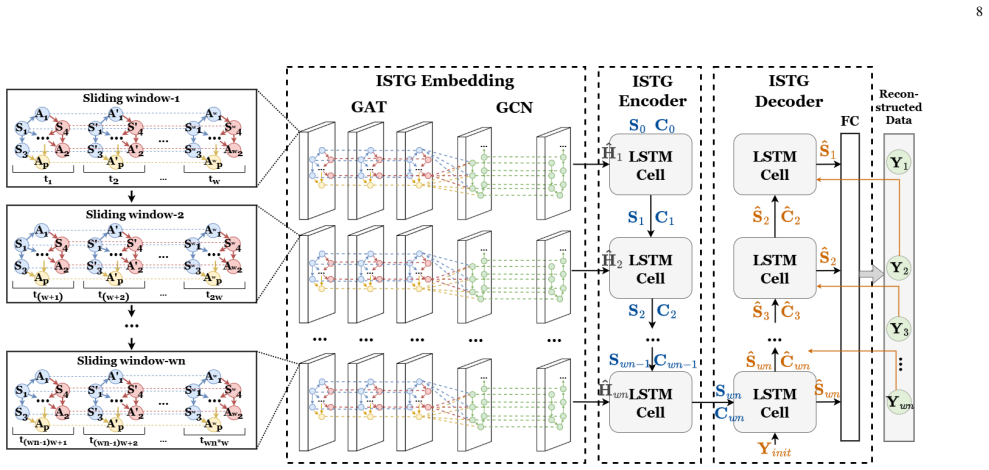
IstGPT uses LLMs to extract sensor-actuator dependency graphs from industrial knowledge and applies graph neural networks to detect anomalies via reconstruction errors, outperforming twelve baselines on nine datasets.
A machine-rendered reading of the paper's core claim, the machinery that carries it, and where it could break.
Core claim
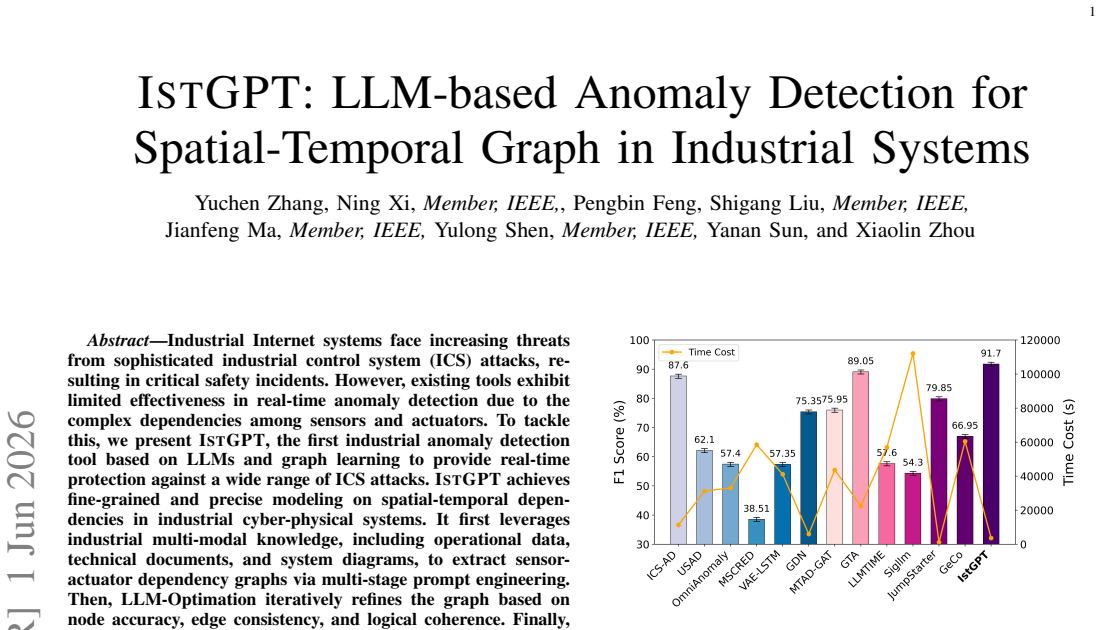
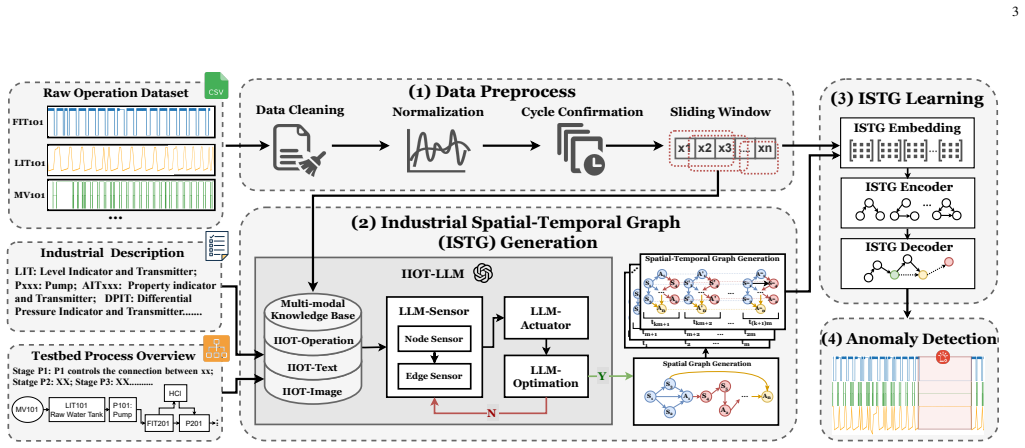
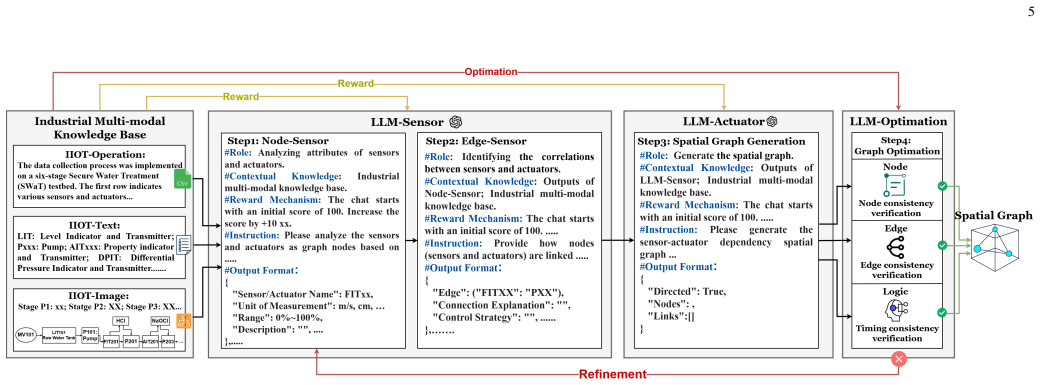
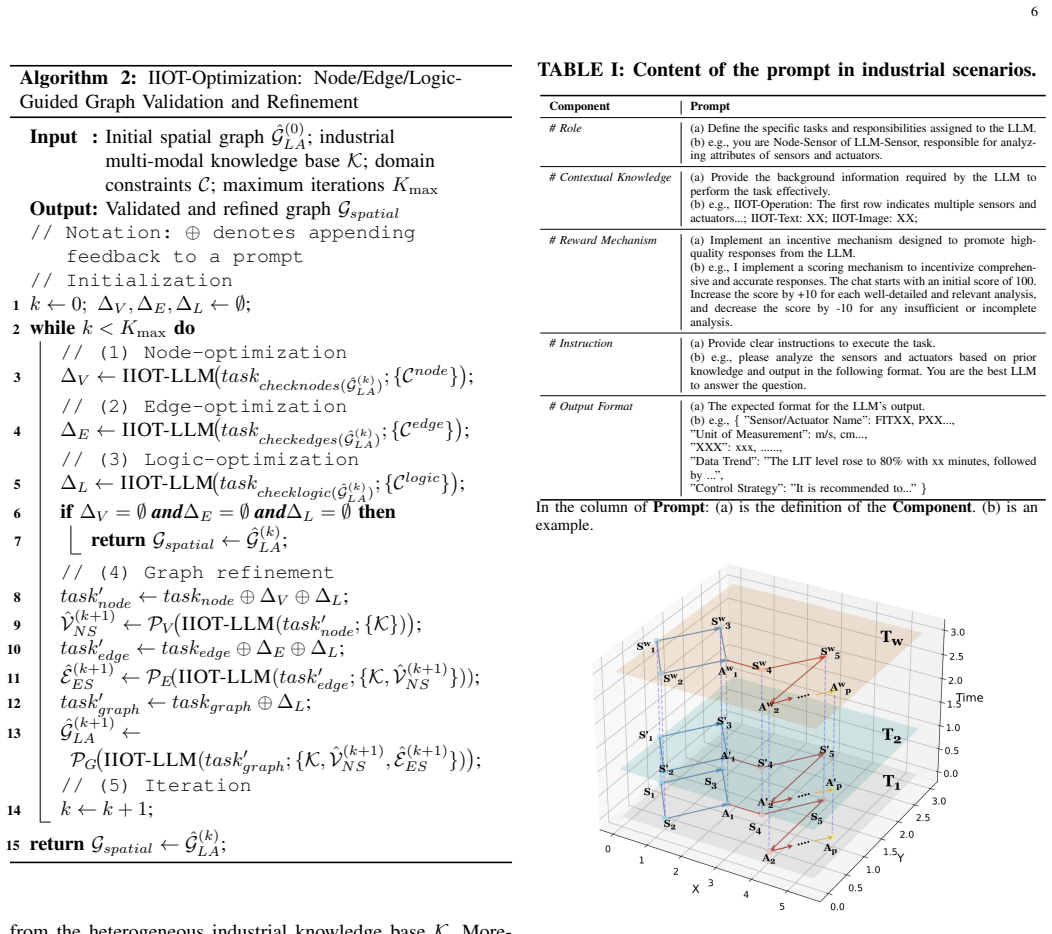
IstGPT is the first industrial anomaly detection tool based on LLMs and graph learning. It extracts sensor-actuator dependency graphs from operational data, technical documents, and system diagrams via multi-stage prompt engineering, refines them iteratively with LLM-Optimation on node accuracy, edge consistency, and logical coherence, and integrates the graphs into improved graph neural networks with an encoder-decoder architecture to detect anomalies through reconstruction errors. This approach yields the best F1-scores and eTaF1 across nine datasets, including two public, six simulated, and one real-world robotic arm dataset, when tested against twelve state-of-the-art baselines.
What carries the argument
The LLM-extracted and LLM-Optimation-refined sensor-actuator dependency graph, which supplies spatial-temporal structure to the encoder-decoder graph neural network for anomaly detection by reconstruction error.
If this is right
- IstGPT supplies real-time protection against a wide range of ICS attacks through fine-grained spatial-temporal modeling.
- The same pipeline attains leading F1 and eTaF1 scores on public, simulated, and real robotic-arm data alike.
- The method demonstrates deployment feasibility in actual industrial environments.
- Graph refinement based on accuracy, consistency, and coherence metrics improves model reliability over unrefined extraction.
Where Pith is reading between the lines
- The graph-extraction step could be reused in other cyber-physical domains that possess similar sensor-actuator relations, such as building automation or vehicle networks.
- Because the refinement loop operates on existing documents and diagrams, new industrial sites might require less custom engineering to reach usable detection performance.
- If the extracted graphs prove stable across slight system changes, the approach may support continuous monitoring without frequent full retraining of the neural network.
Load-bearing premise
Multi-stage prompt engineering and LLM-Optimation can reliably produce accurate sensor-actuator dependency graphs from multi-modal industrial knowledge without systematic errors that degrade downstream detection.
What would settle it
On a held-out industrial dataset, manually replace the LLM-derived dependency graph with an independently verified correct graph or a deliberately incorrect one and measure whether the F1-score advantage over the twelve baselines disappears.
Figures
read the original abstract
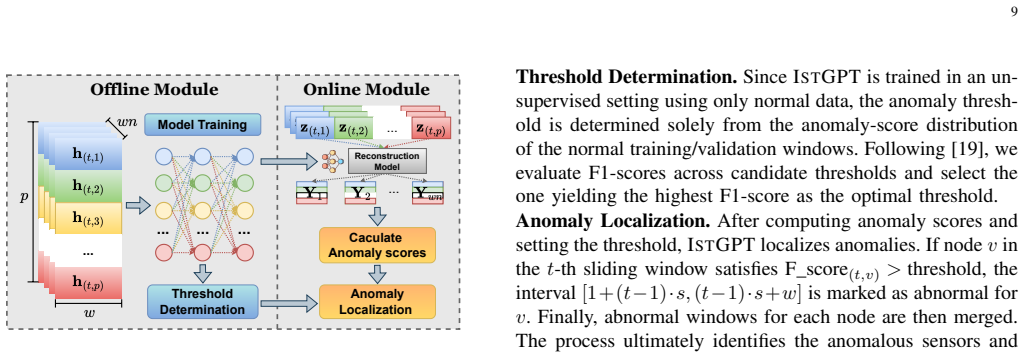
Industrial Internet systems face increasing threats from sophisticated industrial control system (ICS) attacks, resulting in critical safety incidents. However, existing tools exhibit limited effectiveness in real-time anomaly detection due to the complex dependencies among sensors and actuators. To tackle this, we present IstGPT, the first industrial anomaly detection tool based on LLMs and graph learning to provide real-time protection against a wide range of ICS attacks. IstGPT achieves fine-grained and precise modeling on spatial-temporal dependencies in industrial cyber-physical systems. It first leverages industrial multi-modal knowledge, including operational data, technical documents, and system diagrams, to extract sensor-actuator dependency graphs via multi-stage prompt engineering. Then, LLM-Optimation iteratively refines the graph based on node accuracy, edge consistency, and logical coherence. Finally, IstGPT integrated improved graph neural networks with an encoder-decoder architecture to detect anomalies via reconstruction errors. We evaluate IstGPT against 12 state-of-the-art baselines on 9 datasets, including 2 public, 6 simulated, and a real-world robotic arm dataset. IstGPT achieves the best F1-scores and eTaF1 (a newer time-aware metric) across nine datasets. We further discuss the feasibility of deploying IstGPT in real-world industrial scenarios.
Editorial analysis
A structured set of objections, weighed in public.
Referee Report
Summary. The paper introduces IstGPT, an LLM-based anomaly detection system for industrial control systems that extracts sensor-actuator dependency graphs from multi-modal knowledge (operational data, documents, diagrams) using multi-stage prompt engineering, refines them via LLM-Optimation based on node accuracy/edge consistency/logical coherence, and then applies improved GNNs in an encoder-decoder architecture to detect anomalies through reconstruction errors. It reports superior F1-scores and eTaF1 (time-aware metric) over 12 baselines across 9 datasets (2 public, 6 simulated, 1 real-world robotic arm).
Significance. If the LLM-derived graphs prove accurate and the performance claims hold under rigorous validation, the approach could meaningfully advance real-time ICS anomaly detection by integrating LLM-driven graph construction with spatial-temporal GNN modeling, addressing complex sensor-actuator dependencies that limit existing tools.
major comments (2)
- [Abstract and §3 (graph extraction and LLM-Optimation)] The central performance claim (best F1 and eTaF1 on all 9 datasets) rests on the fidelity of the sensor-actuator graphs produced by multi-stage prompting and LLM-Optimation, yet the manuscript provides no quantitative validation of these graphs (e.g., edge precision, node accuracy, or comparison against ground-truth ICS topologies or expert labels) on either the public or simulated datasets. Without such checks, gains cannot be attributed to the claimed spatial-temporal modeling rather than LLM priors or dataset artifacts.
- [Abstract and §4 (experiments)] The abstract states superior performance on nine datasets but supplies no quantitative details on error bars, statistical significance tests, data exclusion rules, hyperparameter tuning protocols for the 12 baselines, or implementation specifics; this prevents verification of the headline result and must be addressed in the experimental section.
minor comments (2)
- [§4] Clarify the precise definition and computation of the eTaF1 metric, including any time-window parameters, as it is presented as a key evaluation criterion.
- [§3.3] The description of 'improved graph neural networks' in the encoder-decoder lacks explicit architectural modifications or equations relative to standard GNN baselines; add these details for reproducibility.
Simulated Author's Rebuttal
We thank the referee for the constructive feedback on our manuscript. We address each major comment point by point below and outline the planned revisions.
read point-by-point responses
-
Referee: [Abstract and §3 (graph extraction and LLM-Optimation)] The central performance claim (best F1 and eTaF1 on all 9 datasets) rests on the fidelity of the sensor-actuator graphs produced by multi-stage prompting and LLM-Optimation, yet the manuscript provides no quantitative validation of these graphs (e.g., edge precision, node accuracy, or comparison against ground-truth ICS topologies or expert labels) on either the public or simulated datasets. Without such checks, gains cannot be attributed to the claimed spatial-temporal modeling rather than LLM priors or dataset artifacts.
Authors: We agree this is a valid concern and that direct quantitative validation of graph fidelity (node accuracy, edge precision/consistency) would allow stronger attribution of gains to the spatial-temporal modeling. The manuscript currently relies on the LLM-Optimation criteria (node accuracy, edge consistency, logical coherence) and downstream anomaly detection performance as indirect evidence. In the revised version we will add a dedicated subsection or appendix reporting quantitative graph validation metrics on the simulated datasets (where ground-truth topologies can be derived) and qualitative expert review on the real-world dataset. revision: yes
-
Referee: [Abstract and §4 (experiments)] The abstract states superior performance on nine datasets but supplies no quantitative details on error bars, statistical significance tests, data exclusion rules, hyperparameter tuning protocols for the 12 baselines, or implementation specifics; this prevents verification of the headline result and must be addressed in the experimental section.
Authors: We acknowledge that the current experimental section lacks these reproducibility details. In the revision we will expand §4 (and the abstract if space permits) to report: (i) mean and standard deviation across multiple random seeds, (ii) statistical significance tests (e.g., paired t-test or Wilcoxon) against the strongest baselines, (iii) explicit data exclusion/preprocessing rules, (iv) hyperparameter search ranges and selection protocol applied uniformly to all 12 baselines, and (v) implementation details or repository links. revision: yes
Circularity Check
No circularity: pipeline uses external LLM prompting and standard GNN reconstruction without self-referential fits or load-bearing self-citations
full rationale
The described derivation consists of (1) multi-stage LLM prompting on external multi-modal sources to build dependency graphs, (2) iterative refinement using node/edge/logical criteria, and (3) encoder-decoder GNN anomaly detection via reconstruction error, followed by standard F1/eTaF1 evaluation on held-out datasets. None of these steps reduce a reported performance number to a fitted input or prior self-citation by construction. No equations are supplied that equate a prediction to its own definition, and the evaluation metrics are conventional rather than redefined. The central claim therefore rests on empirical comparison rather than tautological re-labeling of inputs.
Axiom & Free-Parameter Ledger
Reference graph
Works this paper leans on
-
[1]
Industrial internet of things intelligence empowering smart manufacturing: A literature review,
Y . Hu, Q. Jia, Y . Yao, Y . Lee, M. Lee, C. Wang, X. Zhou, R. Xie, and F. R. Yu, “Industrial internet of things intelligence empowering smart manufacturing: A literature review,”IEEE Internet of Things Journal, vol. 11, no. 11, pp. 19 143–19 167, 2024
2024
-
[2]
S. S. Buchanan,Cyber-attacks to industrial control systems since stuxnet: A systematic review. Capitol Technology University, 2022
2022
-
[3]
A tale of two industroyers: It was the season of darkness,
L. Salazar, S. R. Castro, J. Lozano, K. Koneru, E. Zambon, B. Huang, R. Baldick, M. Krotofil, A. Rojas, and A. A. Cardenas, “A tale of two industroyers: It was the season of darkness,” in2024 IEEE Symposium on Security and Privacy (SP). IEEE, 2024, pp. 312–330
2024
-
[4]
A case study of russian cyber-attacks on the ukrainian power grid: Implications and best practices for the united states,
M. Pollard, “A case study of russian cyber-attacks on the ukrainian power grid: Implications and best practices for the united states,” Pepperdine Policy Review, vol. 16, no. 1, p. 1, 2024
2024
-
[5]
Don’t drink the cyber: Extrap- olating the possibilities of oldsmar’s water treatment cyberattack,
J. Cervini, A. Rubin, and L. Watkins, “Don’t drink the cyber: Extrap- olating the possibilities of oldsmar’s water treatment cyberattack,” in International conference on cyber warfare and security, vol. 17, no. 1. Academic Conferences International Limited, 2022, pp. 19–25
2022
-
[6]
Intrusion prevention system against spoofed data frames at the electronic control unit level,
Z. Liu, W. Yang, S. Wang, and H. Fan, “Intrusion prevention system against spoofed data frames at the electronic control unit level,”Journal of Networking and Network Applications, vol. 5, no. 1, pp. 1–12, 2025
2025
-
[7]
A deep one-class intrusion detection scheme in software-defined industrial networks,
B. Hu, Y . Bi, M. Zhi, K. Zhang, F. Yan, Q. Zhang, and Z. Liu, “A deep one-class intrusion detection scheme in software-defined industrial networks,”IEEE Transactions on Industrial Informatics, vol. 18, no. 6, pp. 4286–4296, 2021
2021
-
[8]
Scaphy: Detecting modern ics attacks by correlating behaviors in scada and physical,
M. Ike, K. Phan, K. Sadoski, R. Valme, and W. Lee, “Scaphy: Detecting modern ics attacks by correlating behaviors in scada and physical,” in 2023 IEEE Symposium on Security and Privacy (SP). IEEE, 2023, pp. 20–37
2023
-
[9]
Machine learning for anomaly detection: A systematic review,
A. B. Nassif, M. A. Talib, Q. Nasir, and F. M. Dakalbab, “Machine learning for anomaly detection: A systematic review,”Ieee Access, vol. 9, pp. 78 658–78 700, 2021
2021
-
[10]
[sok] evaluations in industrial intrusion detection research,
O. Lamberts, K. Wolsing, and E. Wagner, “[sok] evaluations in industrial intrusion detection research,”Journal of Systems Research, 3 (1), 2023
2023
-
[11]
A survey of physics-based attack detection in cyber-physical systems,
J. Giraldo, D. Urbina, A. Cardenas, J. Valente, M. Faisal, J. Ruths, N. O. Tippenhauer, H. Sandberg, and R. Candell, “A survey of physics-based attack detection in cyber-physical systems,”ACM Computing Surveys (CSUR), vol. 51, no. 4, pp. 1–36, 2018
2018
-
[12]
Deep learning-based anomaly detection in cyber-physical systems: Progress and opportuni- ties,
Y . Luo, Y . Xiao, L. Cheng, G. Peng, and D. Yao, “Deep learning-based anomaly detection in cyber-physical systems: Progress and opportuni- ties,”ACM Computing Surveys (CSUR), vol. 54, no. 5, pp. 1–36, 2021
2021
-
[13]
Sok: Pragmatic assessment of machine learning for network intrusion detection,
G. Apruzzese, P. Laskov, and J. Schneider, “Sok: Pragmatic assessment of machine learning for network intrusion detection,” in2023 IEEE 8th European Symposium on Security and Privacy (EuroS&P). IEEE, 2023, pp. 592–614
2023
-
[14]
Applications of deep learning algorithms for supervisory control and data acquisition intrusion detection system,
A. Balla, M. H. Habaebi, M. R. Islam, and S. Mubarak, “Applications of deep learning algorithms for supervisory control and data acquisition intrusion detection system,”Cleaner Engineering and Technology, vol. 9, p. 100532, 2022
2022
-
[15]
Perspectives from a comprehensive evaluation of reconstruction-based anomaly detec- tion in industrial control systems,
C. Fung, S. Srinarasi, K. Lucas, H. B. Phee, and L. Bauer, “Perspectives from a comprehensive evaluation of reconstruction-based anomaly detec- tion in industrial control systems,” inEuropean Symposium on Research in Computer Security. Springer, 2022, pp. 493–513
2022
-
[16]
Mtad rf: Multivariate time-series anomaly detection based on reconstruction and forecast,
K. Qin, M. Xu, B. A. Muhammad, and J. Han, “Mtad rf: Multivariate time-series anomaly detection based on reconstruction and forecast,” Journal of Networking and Network Applications, vol. 3, no. 1, pp. 45– 57, 2023
2023
-
[17]
Attributions for ml-based ics anomaly detection: From theory to practice,
C. Fung, E. Zeng, and L. Bauer, “Attributions for ml-based ics anomaly detection: From theory to practice,” inProc. 31st Netw. Distrib. Syst. Secur. Symp, 2024
2024
-
[18]
Usad: Unsupervised anomaly detection on multivariate time series,
J. Audibert, P. Michiardi, F. Guyard, S. Marti, and M. A. Zuluaga, “Usad: Unsupervised anomaly detection on multivariate time series,” inProceedings of the 26th ACM SIGKDD international conference on knowledge discovery & data mining, 2020, pp. 3395–3404
2020
-
[19]
Robust anomaly detection for multivariate time series through stochastic recurrent neural network,
Y . Su, Y . Zhao, C. Niu, R. Liu, W. Sun, and D. Pei, “Robust anomaly detection for multivariate time series through stochastic recurrent neural network,” inProceedings of the 25th ACM SIGKDD international conference on knowledge discovery & data mining, 2019, pp. 2828– 2837
2019
-
[20]
A deep neural network for unsupervised anomaly detection and diagnosis in multivariate time series data,
C. Zhang, D. Song, Y . Chen, X. Feng, C. Lumezanu, W. Cheng, J. Ni, B. Zong, H. Chen, and N. V . Chawla, “A deep neural network for unsupervised anomaly detection and diagnosis in multivariate time series data,” inProceedings of the AAAI conference on artificial intelligence, vol. 33, no. 01, 2019, pp. 1409–1416
2019
-
[21]
Anomaly detection for time series using vae-lstm hybrid model,
S. Lin, R. Clark, R. Birke, S. Sch ¨onborn, N. Trigoni, and S. Roberts, “Anomaly detection for time series using vae-lstm hybrid model,” in ICASSP 2020-2020 IEEE International Conference on Acoustics, Speech and Signal Processing (ICASSP). Ieee, 2020, pp. 4322–4326
2020
-
[22]
Graph neural network-based anomaly detection in multivariate time series,
A. Deng and B. Hooi, “Graph neural network-based anomaly detection in multivariate time series,” inProceedings of the AAAI conference on artificial intelligence, vol. 35, no. 5, 2021, pp. 4027–4035
2021
-
[23]
Multivariate time-series anomaly detection via graph attention network,
H. Zhao, Y . Wang, J. Duan, C. Huang, D. Cao, Y . Tong, B. Xu, J. Bai, J. Tong, and Q. Zhang, “Multivariate time-series anomaly detection via graph attention network,” in2020 IEEE international conference on data mining (ICDM). IEEE, 2020, pp. 841–850
2020
-
[24]
Learning graph structures with transformer for multivariate time-series anomaly detection in iot,
Z. Chen, D. Chen, X. Zhang, Z. Yuan, and X. Cheng, “Learning graph structures with transformer for multivariate time-series anomaly detection in iot,”IEEE Internet of Things Journal, vol. 9, no. 12, pp. 9179–9189, 2021
2021
-
[25]
Large language models are zero-shot time series forecasters,
N. Gruver, M. Finzi, S. Qiu, and A. G. Wilson, “Large language models are zero-shot time series forecasters,”Advances in Neural Information Processing Systems, vol. 36, pp. 19 622–19 635, 2023
2023
-
[26]
Large language models can be zero-shot anomaly detectors for time series?
S. Alnegheimish, L. Nguyen, L. Berti-Equille, and K. Veeramachaneni, “Large language models can be zero-shot anomaly detectors for time series?”arXiv preprint arXiv:2405.14755, 2024
-
[27]
{Jump-Starting}multivariate time series anomaly detection for online service systems,
M. Ma, S. Zhang, J. Chen, J. Xu, H. Li, Y . Lin, X. Nie, B. Zhou, Y . Wang, and D. Pei, “{Jump-Starting}multivariate time series anomaly detection for online service systems,” in2021 USENIX Annual Technical Conference (USENIX ATC 21), 2021, pp. 413–426
2021
-
[28]
Stgat- mad: Spatial-temporal graph attention network for multivariate time series anomaly detection,
J. Zhan, S. Wang, X. Ma, C. Wu, C. Yang, D. Zeng, and S. Wang, “Stgat- mad: Spatial-temporal graph attention network for multivariate time series anomaly detection,” inICASSP 2022-2022 IEEE International Conference on Acoustics, Speech and Signal Processing (ICASSP). IEEE, 2022, pp. 3568–3572
2022
-
[29]
Physics-informed gated recurrent graph attention unit network for anomaly detection in industrial cyber- physical systems,
W. Wu, C. Song, J. Zhao, and Z. Xu, “Physics-informed gated recurrent graph attention unit network for anomaly detection in industrial cyber- physical systems,”Information Sciences, vol. 629, pp. 618–633, 2023
2023
-
[30]
Knowledge- based fault diagnosis in industrial internet of things: a survey,
Y . Chi, Y . Dong, Z. J. Wang, F. R. Yu, and V . C. Leung, “Knowledge- based fault diagnosis in industrial internet of things: a survey,”IEEE Internet of Things Journal, vol. 9, no. 15, pp. 12 886–12 900, 2022
2022
-
[31]
Tabor: A graphical model- based approach for anomaly detection in industrial control systems,
Q. Lin, S. Adepu, S. Verwer, and A. Mathur, “Tabor: A graphical model- based approach for anomaly detection in industrial control systems,” inProceedings of the 2018 on asia conference on computer and communications security, 2018, pp. 525–536
2018
-
[32]
Process-oriented hetero- geneous graph learning in gnn-based ics anomalous pattern recognition,
L. Shuaiyi, K. Wang, L. Zhang, and B. Wang, “Process-oriented hetero- geneous graph learning in gnn-based ics anomalous pattern recognition,” Pattern Recognition, vol. 141, p. 109661, 2023
2023
-
[33]
Physics-informed machine learning,
G. E. Karniadakis, I. G. Kevrekidis, L. Lu, P. Perdikaris, S. Wang, and L. Yang, “Physics-informed machine learning,”Nature Reviews Physics, vol. 3, no. 6, pp. 422–440, 2021
2021
-
[34]
Data-knowledge-driven distributed monitoring for large-scale processes based on digraph,
W. Wu, C. Song, J. Liu, and J. Zhao, “Data-knowledge-driven distributed monitoring for large-scale processes based on digraph,”Journal of Process Control, vol. 109, pp. 60–73, 2022
2022
-
[35]
A. Hurst, A. Lerer, A. P. Goucher, A. Perelman, A. Ramesh, A. Clark, A. Ostrow, A. Welihinda, A. Hayes, A. Radfordet al., “Gpt-4o system card,”arXiv preprint arXiv:2410.21276, 2024
work page internal anchor Pith review Pith/arXiv arXiv 2024
-
[36]
Gecos replacing experts: Generalizable and comprehensible industrial intrusion detection,
K. Wolsing, E. Wagner, L. Lux, K. Wehrle, M. Henze, and F. Fraunhofer, “Gecos replacing experts: Generalizable and comprehensible industrial intrusion detection,” inUSENIX Security, 2025
2025
-
[37]
A survey of industrial control system testbeds,
H. Holm, M. Karresand, A. Vidstr ¨om, and E. Westring, “A survey of industrial control system testbeds,” inSecure IT Systems: 20th Nordic Conference, NordSec 2015, Stockholm, Sweden, October 19–21, 2015, Proceedings. Springer, 2015, pp. 11–26
2015
-
[38]
A survey on industrial control sys- tem testbeds and datasets for security research,
M. Conti, D. Donadel, and F. Turrin, “A survey on industrial control sys- tem testbeds and datasets for security research,”IEEE Communications Surveys & Tutorials, vol. 23, no. 4, pp. 2248–2294, 2021
2021
-
[39]
Scada (supervisory control and data acquisition) systems: Vulnerability assessment and security recommen- dations,
D. Upadhyay and S. Sampalli, “Scada (supervisory control and data acquisition) systems: Vulnerability assessment and security recommen- dations,”Computers & Security, vol. 89, p. 101666, 2020
2020
-
[40]
The role of the scada rtu in today’s substation,
C. Wester, N. Engelman, T. Smith, K. Odetunde, B. Anderson, and J. Reilly, “The role of the scada rtu in today’s substation,” in2015 68th Annual Conference for Protective Relay Engineers. IEEE, 2015, pp. 622–628
2015
-
[41]
Plc and scada based industrial automated system,
B. Tomar and N. Kumar, “Plc and scada based industrial automated system,” in2020 IEEE International Conference for Innovation in Technology (INOCON). IEEE, 2020, pp. 1–5
2020
-
[42]
P. Veli ˇckovi´c, G. Cucurull, A. Casanova, A. Romero, P. Lio, and Y . Ben- gio, “Graph attention networks,”arXiv preprint arXiv:1710.10903, 2017
work page internal anchor Pith review Pith/arXiv arXiv 2017
-
[43]
Industrial control systems (ics): Cyber attacks & security optimization,
E. D. Emake, I. A. Adeyanju, and G. O. Uzedhe, “Industrial control systems (ics): Cyber attacks & security optimization,”International 17 Journal of Computer Engineering and Information Technology, vol. 12, no. 5, pp. 31–41, 2020
2020
-
[44]
Machine learning in industrial control system (ics) security: current landscape, opportuni- ties and challenges,
A. M. Koay, R. K. L. Ko, H. Hettema, and K. Radke, “Machine learning in industrial control system (ics) security: current landscape, opportuni- ties and challenges,”Journal of Intelligent Information Systems, vol. 60, no. 2, pp. 377–405, 2023
2023
-
[45]
Missing data filling method based on linear interpolation and lightgbm,
G. Huang, “Missing data filling method based on linear interpolation and lightgbm,” inJournal of Physics: Conference Series, vol. 1754, no. 1. IOP Publishing, 2021, p. 012187
2021
-
[46]
Relation inference among sensor time series in smart buildings with metric learning,
S. Li, D. Hong, and H. Wang, “Relation inference among sensor time series in smart buildings with metric learning,” inProceedings of the AAAI Conference on Artificial Intelligence, vol. 34, no. 04, 2020, pp. 4683–4690
2020
-
[47]
In-sensor computing: materials, devices, and integration technologies,
T. Wan, B. Shao, S. Ma, Y . Zhou, Q. Li, and Y . Chai, “In-sensor computing: materials, devices, and integration technologies,”Advanced materials, vol. 35, no. 37, p. 2203830, 2023
2023
-
[48]
Introduction to
F. R. Macaulay, “Introduction to” the smoothing of time series”,” inThe smoothing of time series. NBER, 1931, pp. 17–30
1931
-
[49]
Moving average filter based phase-locked loops: Performance analysis and design guidelines,
S. Golestan, M. Ramezani, J. M. Guerrero, F. D. Freijedo, and M. Mon- fared, “Moving average filter based phase-locked loops: Performance analysis and design guidelines,”IEEE transactions on power electronics, vol. 29, no. 6, pp. 2750–2763, 2013
2013
-
[50]
Investigating the impact of min-max data normalization on the regression performance of k-nearest neighbor with different sim- ilarity measurements,
P. J. M. Ali, “Investigating the impact of min-max data normalization on the regression performance of k-nearest neighbor with different sim- ilarity measurements,”ARO-The Scientific Journal of Koya University, vol. 10, no. 1, pp. 85–91, 2022
2022
-
[51]
Normalization techniques in training dnns: Methodology, analysis and application,
L. Huang, J. Qin, Y . Zhou, F. Zhu, L. Liu, and L. Shao, “Normalization techniques in training dnns: Methodology, analysis and application,” IEEE transactions on pattern analysis and machine intelligence, vol. 45, no. 8, pp. 10 173–10 196, 2023
2023
-
[52]
Structured principal component analy- sis model with variable correlation constraint,
R. Zhai, J. Zeng, and Z. Ge, “Structured principal component analy- sis model with variable correlation constraint,”IEEE Transactions on Control Systems Technology, vol. 30, no. 2, pp. 558–569, 2021
2021
-
[53]
Staged: A spatial-temporal aware graph encoder–decoder for fault diagnosis in industrial processes,
S. Li, W. Meng, S. He, J. Bi, and G. Liu, “Staged: A spatial-temporal aware graph encoder–decoder for fault diagnosis in industrial processes,” IEEE Transactions on Industrial Informatics, vol. 20, no. 2, pp. 1742– 1752, 2023
2023
-
[54]
Prompting frameworks for large language models: A survey,
X. Liu, J. Wang, J. Sun, X. Yuan, G. Dong, P. Di, W. Wang, and D. Wang, “Prompting frameworks for large language models: A survey,” arXiv preprint arXiv:2311.12785, 2023
-
[55]
Unleashing the potential of prompt engineering in large language models: a comprehensive review,
B. Chen, Z. Zhang, N. Langren ´e, and S. Zhu, “Unleashing the potential of prompt engineering in large language models: a comprehensive review,”arXiv preprint arXiv:2310.14735, 2023
-
[56]
Graph convolutional networks: a comprehensive review,
S. Zhang, H. Tong, J. Xu, and R. Maciejewski, “Graph convolutional networks: a comprehensive review,”Computational Social Networks, vol. 6, no. 1, pp. 1–23, 2019
2019
-
[57]
Graph transformers: A survey,
A. Shehzad, F. Xia, S. Abid, C. Peng, S. Yu, D. Zhang, and K. Verspoor, “Graph transformers: A survey,”IEEE Transactions on Neural Networks and Learning Systems, 2026
2026
-
[58]
Fundamentals of recurrent neural network (rnn) and long short-term memory (lstm) network,
A. Sherstinsky, “Fundamentals of recurrent neural network (rnn) and long short-term memory (lstm) network,”Physica D: Nonlinear Phe- nomena, vol. 404, p. 132306, 2020
2020
-
[59]
A comprehensive survey of regression- based loss functions for time series forecasting,
A. Jadon, A. Patil, and S. Jadon, “A comprehensive survey of regression- based loss functions for time series forecasting,” inInternational Con- ference on Data Management, Analytics & Innovation. Springer, 2024, pp. 117–147
2024
-
[60]
Cross-entropy loss functions: Theoretical analysis and applications,
A. Mao, M. Mohri, and Y . Zhong, “Cross-entropy loss functions: Theoretical analysis and applications,” inInternational conference on Machine learning. PMLR, 2023, pp. 23 803–23 828
2023
-
[61]
Gpt-5 and open-weight large language models: Advances in reasoning, transparency, and control,
M. Leon, “Gpt-5 and open-weight large language models: Advances in reasoning, transparency, and control,”Information Systems, p. 102620, 2025
2025
-
[62]
Do you know existing accuracy metrics overrate time-series anomaly detections?
W.-S. Hwang, J.-H. Yun, J. Kim, and B. G. Min, “Do you know existing accuracy metrics overrate time-series anomaly detections?” inProceed- ings of the 37th ACM/SIGAPP Symposium on Applied Computing, 2022, pp. 403–412
2022
-
[63]
Inplant scada,
“Inplant scada,” https://www.supcon.com/new/NBD/
-
[64]
Nettoplcsim - network extension for plcsim,
“Nettoplcsim - network extension for plcsim,” https://nettoplcsim. sourceforge.net/
-
[65]
Totally integrated automation portal,
“Totally integrated automation portal,” https://www.siemens.com/ global/en/products/automation/industry-software/automation-software/ tia-portal.html
-
[66]
Factory i/o,
“Factory i/o,” https://factoryio.com/
-
[67]
Armpi fpv,
“Armpi fpv,” https://www.hiwonder.com.cn/product-detail/ArmPi-FPV . html
-
[68]
Raspberrypi 4b,
“Raspberrypi 4b,” https://www.raspberrypi.com/products/ raspberry-pi-4-model-b/
-
[69]
Cybersecurity in industrial con- trol systems: Issues, technologies, and challenges,
M. R. Asghar, Q. Hu, and S. Zeadally, “Cybersecurity in industrial con- trol systems: Issues, technologies, and challenges,”Computer Networks, vol. 165, p. 106946, 2019
2019
-
[70]
Industrial control via application containers: Maintaining determinism in iaas,
F. Hofer, M. Sehr, A. Sangiovanni-Vincentelli, and B. Russo, “Industrial control via application containers: Maintaining determinism in iaas,” Systems Engineering, vol. 24, no. 5, pp. 352–368, 2021
2021
-
[71]
Cgan-based cyber deception framework against reconnaissance attacks in ics,
X. Qin, F. Jiang, X. Qin, L. Ge, M. Lu, and R. Doss, “Cgan-based cyber deception framework against reconnaissance attacks in ics,”Computer Networks, vol. 251, p. 110655, 2024
2024
-
[72]
Securing industrial control sys- tems: Components, cyber threats, and machine learning-driven defense strategies,
M. Nankya, R. Chataut, and R. Akl, “Securing industrial control sys- tems: Components, cyber threats, and machine learning-driven defense strategies,”Sensors, vol. 23, no. 21, p. 8840, 2023
2023
-
[73]
Robust random cut forest based anomaly detection on streams,
S. Guha, N. Mishra, G. Roy, and O. Schrijvers, “Robust random cut forest based anomaly detection on streams,” inInternational conference on machine learning. PMLR, 2016, pp. 2712–2721
2016
-
[74]
Anomaly detec- tion in streams with extreme value theory,
A. Siffer, P.-A. Fouque, A. Termier, and C. Largouet, “Anomaly detec- tion in streams with extreme value theory,” inProceedings of the 23rd ACM SIGKDD international conference on knowledge discovery and data mining, 2017, pp. 1067–1075
2017
-
[75]
Large language models can deliver accurate and interpretable time series anomaly detection,
J. Liu, C. Zhang, J. Qian, M. Ma, S. Qin, C. Bansal, Q. Lin, S. Rajmohan, and D. Zhang, “Large language models can deliver accurate and interpretable time series anomaly detection,”arXiv preprint arXiv:2405.15370, 2024
discussion (0)
Sign in with ORCID, Apple, or X to comment. Anyone can read and Pith papers without signing in.