Ellis-Bronnikov Wormhole Shadows with Spherically Symmetric Accretion Flow
Pith reviewed 2026-06-28 13:50 UTC · model grok-4.3
The pith
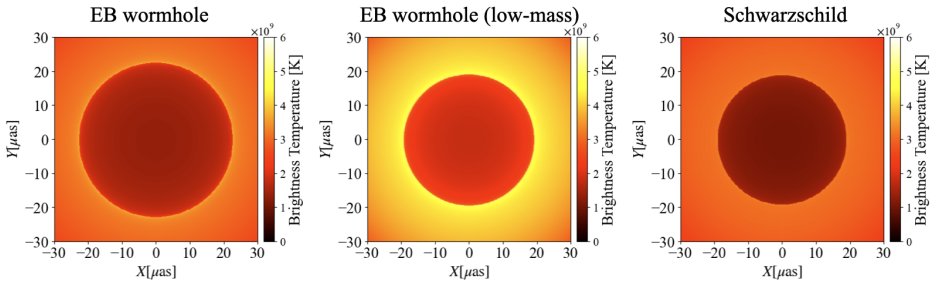
Ellis-Bronnikov wormholes produce brighter shadows and photon rings than Schwarzschild black holes under the same spherically symmetric accretion flow.
A machine-rendered reading of the paper's core claim, the machinery that carries it, and where it could break.
Core claim
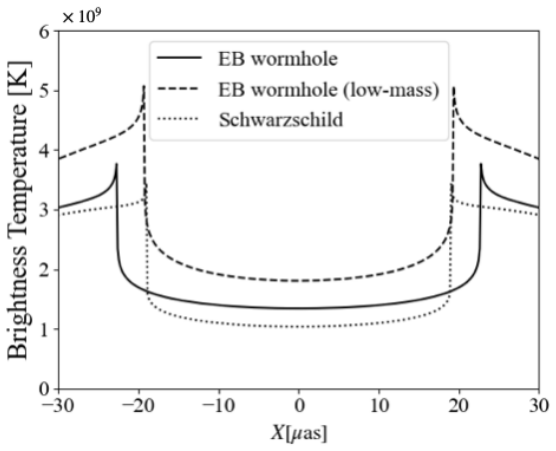
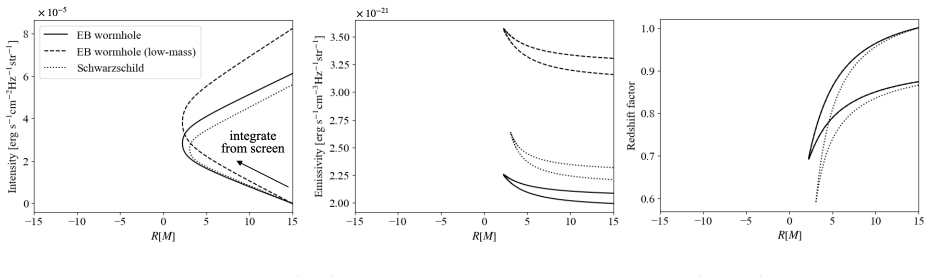
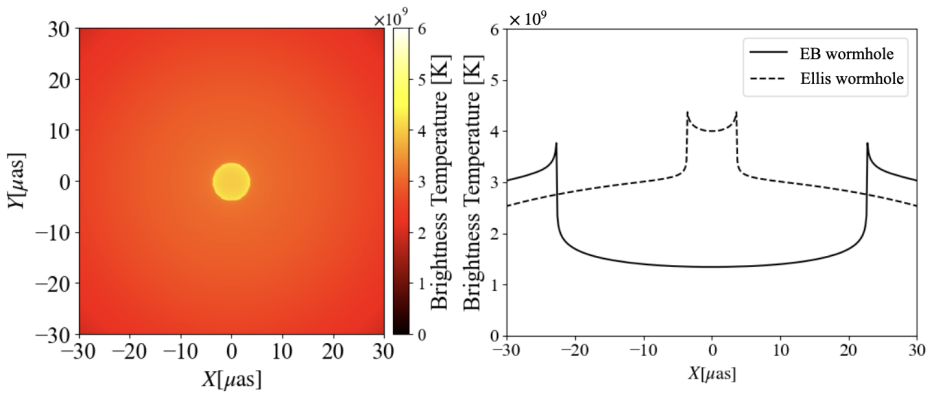
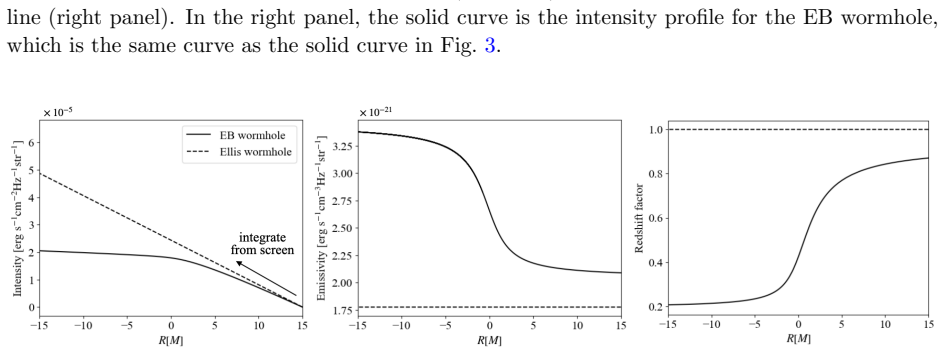
The Ellis-Bronnikov wormhole lacks an event horizon, allowing emission from accreting matter around and beyond the throat to reach the observer and increase the intensity of both the central shadow region and the photon ring relative to the Schwarzschild black hole under identical spherically symmetric steady-state accretion and synchrotron emission.
What carries the argument
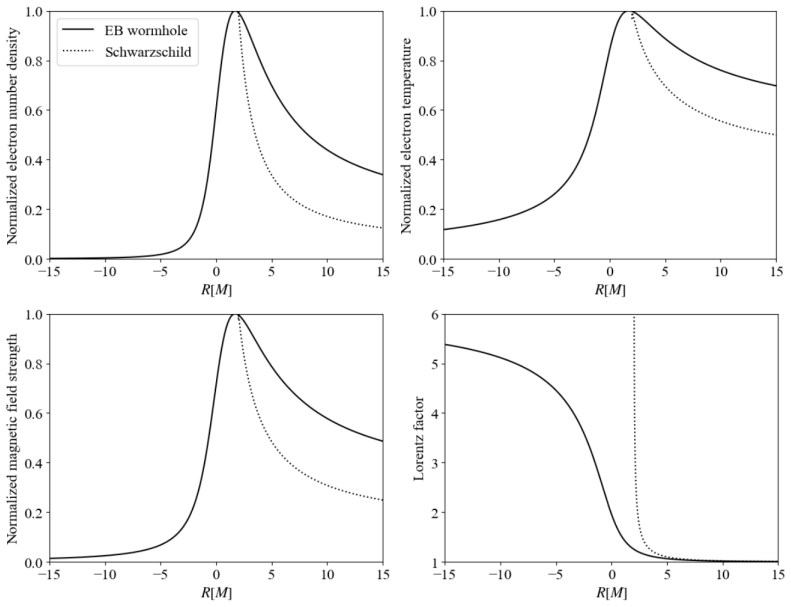
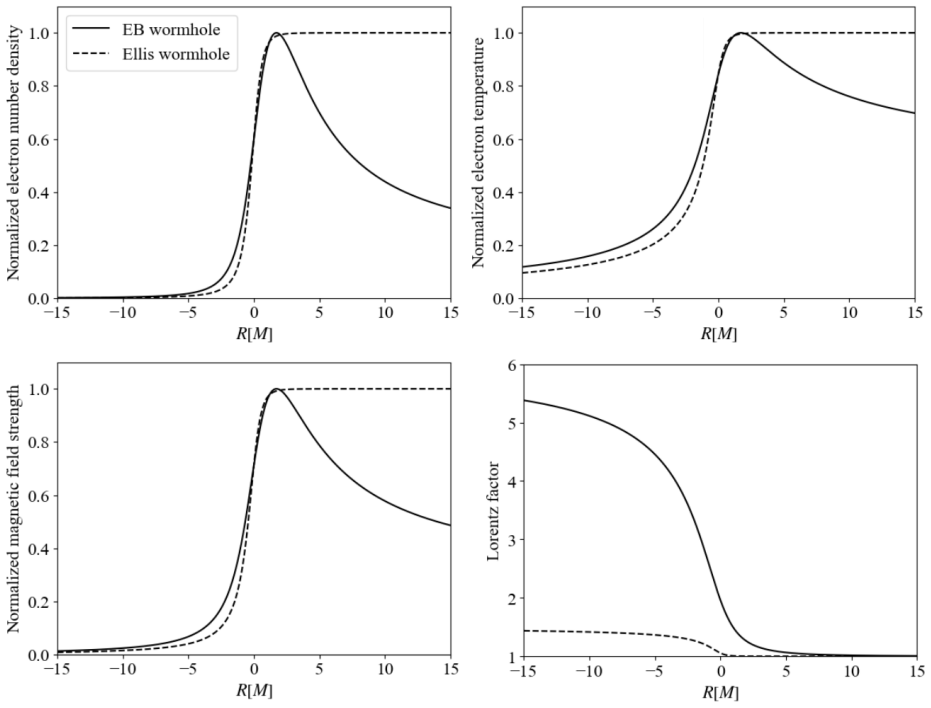
General relativistic radiative transfer simulations of synchrotron emission from a spherically symmetric steady-state accretion flow.
If this is right
- The brightness increase traces directly to the absence of an event horizon.
- Both the wormhole and black-hole images remain compatible with existing EHT observations of M87*.
- The images for both spacetimes consist of a central shadow and a surrounding photon ring.
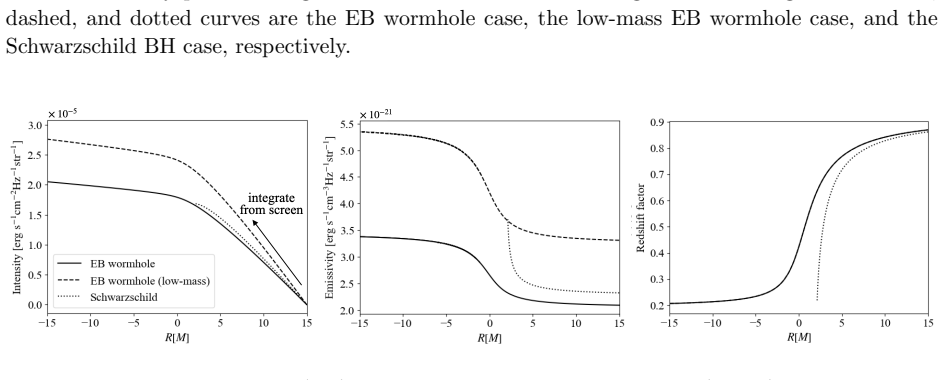
- Emission from matter on the far side of the throat supplies the additional intensity in the wormhole case.
Where Pith is reading between the lines
- If real accretion flows are strongly asymmetric or time-variable, the brightness contrast between wormhole and black hole would likely diminish.
- The same simulation method could be applied to other wormhole metrics to test whether the extra brightness is a generic feature.
- Future observations with improved dynamic range might isolate the far-side emission contribution as a diagnostic.
Load-bearing premise
The accretion flow is spherically symmetric and in steady state.
What would settle it
High-resolution images of M87* that show shadow-region brightness matching only the black-hole prediction with no extra contribution from far-side emission.
Figures
read the original abstract
We investigate the observational differences between the Ellis--Bronnikov (EB) wormhole and the Schwarzschild black hole (BH) by performing general relativistic radiative transfer (GRRT) simulations. We consider a spherically symmetric steady-state accretion flow and perform GRRT simulations incorporating synchrotron emission. For both the EB wormhole and the Schwarzschild BH, the simulated images consist of a central shadow region and a bright photon ring. We find that both the shadow region and the photon ring of the EB wormhole are brighter than those of the Schwarzschild BH. These differences arise from the absence of an event horizon in the EB wormhole, allowing the emission from the accreting matter around and beyond the throat to contribute to the observed intensity. We also compare the simulated images with the Event Horizon Telescope (EHT) observations of M87* and find that both the EB wormhole and the Schwarzschild BH are in reasonable agreement with the current EHT results.
Editorial analysis
A structured set of objections, weighed in public.
Referee Report
Summary. The manuscript investigates observational differences between the Ellis-Bronnikov wormhole and the Schwarzschild black hole by performing GRRT simulations of spherically symmetric steady-state accretion flows with synchrotron emission. It finds that both the shadow region and photon ring are brighter for the wormhole, attributing this to additional emission from matter beyond the throat due to the lack of an event horizon. The simulated images are compared to EHT observations of M87*, with both models showing reasonable agreement.
Significance. If the reported brightness differences are robust, this provides a potential way to observationally distinguish wormholes from black holes using EHT-like imaging. The approach builds on standard GRRT techniques used in black hole shadow studies and includes a direct comparison to real data, which strengthens its relevance. However, the significance depends on whether the fixed accretion flow assumption holds.
major comments (2)
- [Accretion flow model and GRRT setup] The central claim that the brightness differences arise from the absence of an event horizon assumes identical density, temperature, and velocity profiles for the accretion flow in both the EB wormhole and Schwarzschild metrics. The paper performs GRRT under the fixed-flow assumption but does not solve the hydrodynamic equations separately for each spacetime, leaving open whether the through-flow permitted by the wormhole throat would self-consistently alter these profiles and reduce or eliminate the reported intensity contrast.
- [Abstract and Results] The abstract states the central brightness difference between wormhole and black hole but supplies no quantitative error bars, description of numerical resolution, convergence tests, or explicit comparison of fitted parameters to EHT data. This absence makes the quantitative claim difficult to verify from the presented information.
minor comments (1)
- [Abstract] The abstract could specify the range of wormhole parameters (e.g., throat radius) explored in the simulations.
Simulated Author's Rebuttal
We thank the referee for the constructive comments. We address each major comment point by point below.
read point-by-point responses
-
Referee: The central claim that the brightness differences arise from the absence of an event horizon assumes identical density, temperature, and velocity profiles for the accretion flow in both the EB wormhole and Schwarzschild metrics. The paper performs GRRT under the fixed-flow assumption but does not solve the hydrodynamic equations separately for each spacetime, leaving open whether the through-flow permitted by the wormhole throat would self-consistently alter these profiles and reduce or eliminate the reported intensity contrast.
Authors: We appreciate the referee highlighting this point. Our study employs the fixed-flow assumption to isolate the radiative transfer effects due to the differing spacetime geometries while holding the accretion model fixed, an approach standard in comparative GRRT analyses of alternative metrics. We acknowledge that a self-consistent solution of the GR hydrodynamic equations in each background could modify the profiles, particularly given the wormhole throat. In the revised manuscript we will add an explicit discussion of this limitation in the methods and conclusions sections, clarifying that the reported differences hold under the stated assumption and identifying self-consistent flow modeling as future work. revision: yes
-
Referee: The abstract states the central brightness difference between wormhole and black hole but supplies no quantitative error bars, description of numerical resolution, convergence tests, or explicit comparison of fitted parameters to EHT data. This absence makes the quantitative claim difficult to verify from the presented information.
Authors: We agree the abstract would benefit from additional context. We will revise the abstract to include a brief statement on the grid resolution used for the GRRT calculations and the qualitative consistency with EHT M87* data. Full quantitative details, including resolution studies, convergence tests, and direct comparison metrics, are already contained in Sections 3 and 4 of the manuscript; the revised abstract will direct readers to these sections. revision: yes
Circularity Check
No circularity; derivation self-contained against external benchmarks
full rationale
The paper computes GRRT images under a fixed spherically symmetric steady-state accretion model transplanted to both the EB wormhole and Schwarzschild metrics, then attributes intensity differences to the metric (presence or absence of horizon) and compares the outputs to independent EHT observations of M87*. No equations show a fitted parameter or ansatz that is renamed as a prediction, no self-citation chain bears the central claim, and the radiative-transfer step is not equivalent to the input flow profiles by construction. The comparison to external data keeps the result falsifiable outside the paper's assumptions.
Axiom & Free-Parameter Ledger
Reference graph
Works this paper leans on
-
[1]
The entropy per particleσis therefore conserved along the flow:u µ∇µσ= 0, whereu µ is the four-velocity of the fluid
Thermodynamics We assume the flow to be adiabatic and free of dissipative processes. The entropy per particleσis therefore conserved along the flow:u µ∇µσ= 0, whereu µ is the four-velocity of the fluid. For an adiabatic fluid, the first law of thermodynamics can be written as d ρ n =−pd 1 n ,(A1) 16 whereρ,p,nare the total energy density, the pressure, an...
-
[2]
Here, we introduce an orthonormal tetrad{e µ ˆα}attached to a static observer
Steady-state accretion flows in a static and spherically symmetric spacetime We consider a static and spherically symmetric spacetime described by the following metric: ds2 =−A(R)dt 2 +B(R)dR 2 +C(R)(dθ 2 + sin2 θdϕ2).(A5) In addition, we consider a perfect fluid whose energy-momentum tensor is given by T µν = (ρ+p)u µuν +pg µν.(A6) Since we focus on a sp...
-
[3]
Application to polytropic fluid In the present paper, we consider polytropic fluids as an explicit example. The equation of state (EOS) for polytropic fluids is given by p=Kn Γ,(A15) whereKis a constant that is determined by the thermodynamic properties of the fluid, while Γ is the adiabatic index. In order to calculate a shadow image, we need to find the...
-
[4]
Event Horizon Telescope Collaboration,First M87 Event Horizon Telescope Results. I. The Shadow of the Supermassive Black Hole,ApJ875(2019) L1
2019
-
[5]
Event Horizon Telescope Collaboration,First Sagittarius A* Event Horizon Telescope Results. I. The Shadow of the Supermassive Black Hole in the Center of the Milky Way, ApJL930(2022) L12
2022
-
[6]
Event Horizon Telescope Collaboration,First Sagittarius A* Event Horizon Telescope Results. VI. Testing the Black Hole Metric,ApJL930(2022) L17
2022
-
[7]
Y. Mizuno, Z. Younsi, C. M. Fromm, O. Porth, M. De Laurentis, H. Olivares, H. Falcke, M. Kramer, and L. Rezzolla,The current ability to test theories of gravity with black hole shadows,Nature Astronomy2(2018) 585 [1804.05812]
Pith/arXiv arXiv 2018
-
[8]
J. R¨ oder, A. Cruz-Osorio, C. M. Fromm, Y. Mizuno, Z. Younsi, and L. Rezzolla,Probing the spacetime and accretion model for the Galactic Center: Comparison of Kerr and dilaton black hole shadows,A&A671(2023) A143 [2301.09549]
arXiv 2023
-
[9]
K. Moriyama, A. Cruz-Osorio, Y. Mizuno, I. K. Dihingia, and A. Uniyal,Black hole accretion and radiation variability in general relativistic magnetohydrodynamic simulations with Rezzolla–Zhidenko spacetime,A&A694(2025) A135 [2501.08720]. 23
arXiv 2025
- [10]
-
[11]
M. S. Morris and K. S. Thorne,Wormholes in space-time and their use for interstellar travel: A tool for teaching general relativity,Am. J. Phys.56(1988) 395
1988
-
[12]
M. S. Morris, K. S. Thorne, and U. Yurtsever,Wormholes, Time Machines, and the Weak Energy Condition,Phys. Rev. Lett.61(1988) 1446
1988
-
[13]
H. G. Ellis,Ether flow through a drainhole: A particle model in general relativity,Journal of Mathematical Physics14(1973) 104
1973
-
[14]
K. A. Bronnikov,Scalar-tensor theory and scalar charge,Acta Phys. Polon. B4(1973) 251
1973
-
[15]
H.-a. Shinkai and S. A. Hayward,Fate of the first traversible wormhole: Black hole collapse or inflationary expansion,Phys. Rev. D66(2002) 044005 [gr-qc/0205041]
Pith/arXiv arXiv 2002
-
[16]
J. A. Gonzalez, F. S. Guzman, and O. Sarbach,Instability of wormholes supported by a ghost scalar field. I. Linear stability analysis,Class. Quant. Grav.26(2009) 015010 [0806.0608]
Pith/arXiv arXiv 2009
-
[17]
J. A. Gonzalez, F. S. Guzman, and O. Sarbach,Instability of wormholes supported by a ghost scalar field. II. Nonlinear evolution,Class. Quant. Grav.26(2009) 015011 [0806.1370]
Pith/arXiv arXiv 2009
-
[18]
K. A. Bronnikov, J. C. Fabris, and A. Zhidenko,On the stability of scalar-vacuum space-times,Eur. Phys. J. C71(2011) 1791 [1109.6576]
Pith/arXiv arXiv 2011
-
[19]
K. A. Bronnikov, R. A. Konoplya, and A. Zhidenko,Instabilities of wormholes and regular black holes supported by a phantom scalar field,Phys. Rev. D86(2012) 024028 [1205.2224]
Pith/arXiv arXiv 2012
-
[20]
A. Das and S. Kar,The Ellis wormhole with ‘tachyon matter’,Class. Quant. Grav.22 (2005) 3045 [gr-qc/0505124]
Pith/arXiv arXiv 2005
-
[21]
A. Shatskiy, I. D. Novikov, and N. S. Kardashev,New analytic models of ’traversable’ wormholes,Phys. Usp.51(2008) 457 [0810.0468]
Pith/arXiv arXiv 2008
-
[22]
K. A. Bronnikov, L. N. Lipatova, I. D. Novikov, and A. A. Shatskiy,Example of a stable wormhole in general relativity,Grav. Cosmol.19(2013) 269 [1312.6929]
Pith/arXiv arXiv 2013
-
[23]
P. Kanti, B. Kleihaus, and J. Kunz,Wormholes in Dilatonic Einstein-Gauss-Bonnet Theory, Phys. Rev. Lett.107(2011) 271101 [1108.3003]
Pith/arXiv arXiv 2011
-
[24]
P. Kanti, B. Kleihaus, and J. Kunz,Stable Lorentzian Wormholes in Dilatonic Einstein-Gauss-Bonnet Theory,Phys. Rev. D85(2012) 044007 [1111.4049]
Pith/arXiv arXiv 2012
-
[25]
Chetouani and G
L. Chetouani and G. Cl´ ement,Geometrical optics in the Ellis geometry,Gen. Rel. Grav.16 24 (1984) 111
1984
-
[26]
J. G. Cramer, R. L. Forward, M. S. Morris, M. Visser, G. Benford, and G. A. Landis,Natural wormholes as gravitational lenses,Phys. Rev. D51(1995) 3117 [astro-ph/9409051]
Pith/arXiv arXiv 1995
-
[27]
D. F. Torres, G. E. Romero, and L. A. Anchordoqui,Might some gamma-ray bursts be an observable signature of natural wormholes?,Phys. Rev. D58(1998) 123001 [astro-ph/9802106]
Pith/arXiv arXiv 1998
-
[28]
M. Safonova, D. F. Torres, and G. E. Romero,Microlensing by natural wormholes: Theory and simulations,Phys. Rev. D65(2002) 023001 [gr-qc/0105070]
Pith/arXiv arXiv 2002
-
[29]
M. B. Bogdanov and A. M. Cherepashchuk,Search for exotic matter from gravitational microlensing observations of stars,Astrophys. Space Sci.317(2008) 181 [0807.2774]
Pith/arXiv arXiv 2008
-
[30]
Abe,Gravitational Microlensing by the Ellis Wormhole,Astrophys
F. Abe,Gravitational Microlensing by the Ellis Wormhole,Astrophys. J.725(2010) 787 [1009.6084]
Pith/arXiv arXiv 2010
-
[31]
Y. Toki, T. Kitamura, H. Asada, and F. Abe,Astrometric Image Centroid Displacements due to Gravitational Microlensing by the Ellis Wormhole,Astrophys. J.740(2011) 121 [1107.5374]
Pith/arXiv arXiv 2011
-
[32]
T. Kitamura, K. Nakajima, and H. Asada,Demagnifying gravitational lenses toward hunting a clue of exotic matter and energy,Phys. Rev. D87(2013) 027501 [1211.0379]
Pith/arXiv arXiv 2013
-
[33]
N. Tsukamoto and T. Harada,Light curves of light rays passing through a wormhole,Phys. Rev. D95(2017) 024030 [1607.01120]
Pith/arXiv arXiv 2017
-
[34]
N. Tsukamoto, T. Harada, and K. Yajima,Can we distinguish between black holes and wormholes by their Einstein ring systems?,Phys. Rev. D86(2012) 104062 [1207.0047]
Pith/arXiv arXiv 2012
-
[35]
Clement,Scattering of Klein-Gordon and Maxwell Waves by an Ellis Geometry,Int
G. Clement,Scattering of Klein-Gordon and Maxwell Waves by an Ellis Geometry,Int. J. Theor. Phys.23(1984) 335
1984
-
[36]
K. K. Nandi, Y.-Z. Zhang, and A. V. Zakharov,Gravitational lensing by wormholes,Phys. Rev. D74(2006) 024020 [gr-qc/0602062]
Pith/arXiv arXiv 2006
-
[37]
T. K. Dey and S. Sen,Gravitational lensing by wormholes,Mod. Phys. Lett. A23(2008) 953 [0806.4059]
Pith/arXiv arXiv 2008
-
[38]
Muller,Exact geometric optics in a Morris-Thorne wormhole spacetime,Phys
T. Muller,Exact geometric optics in a Morris-Thorne wormhole spacetime,Phys. Rev. D77 (2008) 044043
2008
-
[39]
Bhattacharya and A
A. Bhattacharya and A. A. Potapov,Bending of light in Ellis wormhole geometry,Mod. Phys. Lett. A25(2010) 2399. 25
2010
-
[40]
G. W. Gibbons and M. Vyska,The Application of Weierstrass elliptic functions to Schwarzschild Null Geodesics,Class. Quant. Grav.29(2012) 065016 [1110.6508]
Pith/arXiv arXiv 2012
-
[41]
K. Nakajima and H. Asada,Deflection angle of light in an Ellis wormhole geometry,Phys. Rev. D85(2012) 107501 [1204.3710]
Pith/arXiv arXiv 2012
-
[42]
N. Tsukamoto and T. Harada,There are no rotating stars of a perfect fluid in Hoˇ rava-Lifshitz gravity,Galaxies1(2013) 261 [1201.1738]
Pith/arXiv arXiv 2013
-
[43]
Tsukamoto,Strong deflection limit analysis and gravitational lensing of an Ellis wormhole,Phys
N. Tsukamoto,Strong deflection limit analysis and gravitational lensing of an Ellis wormhole,Phys. Rev. D94(2016) 124001 [1607.07022]
Pith/arXiv arXiv 2016
-
[44]
N. Tsukamoto,Deflection angle in the strong deflection limit in a general asymptotically flat, static, spherically symmetric spacetime,Phys. Rev. D95(2017) 064035 [1612.08251]
Pith/arXiv arXiv 2017
-
[45]
Tsukamoto,Retrolensing by a wormhole at deflection anglesπand 3π,Phys
N. Tsukamoto,Retrolensing by a wormhole at deflection anglesπand 3π,Phys. Rev. D95 (2017) 084021 [1701.09169]
Pith/arXiv arXiv 2017
-
[46]
Jusufi,Deflection angle of light by wormholes using the Gauss–Bonnet theorem,Int
K. Jusufi,Deflection angle of light by wormholes using the Gauss–Bonnet theorem,Int. J. Geom. Meth. Mod. Phys.14(2017) 1750179 [1706.01244]
Pith/arXiv arXiv 2017
-
[47]
T. Cai, H. Huang, Z. Wang, and M. Zhu,Higher-order correction to weak-field lensing of an Ellis-Bronnikov wormhole,Phys. Rev. D108(2023) 023004 [2302.13704]
arXiv 2023
-
[48]
C. Bambi,Can the supermassive objects at the centers of galaxies be traversable wormholes? The first test of strong gravity for mm/sub-mm very long baseline interferometry facilities, Phys. Rev. D87(2013) 107501 [1304.5691]
Pith/arXiv arXiv 2013
-
[49]
P. G. Nedkova, V. K. Tinchev, and S. S. Yazadjiev,Shadow of a rotating traversable wormhole,Phys. Rev. D88(2013) 124019 [1307.7647]
Pith/arXiv arXiv 2013
-
[50]
T. Ohgami and N. Sakai,Wormhole shadows,Phys. Rev. D91(2015) 124020 [1704.07065]
Pith/arXiv arXiv 2015
-
[51]
T. Ohgami and N. Sakai,Wormhole shadows in rotating dust,Phys. Rev. D94(2016) 064071 [1704.07093]
Pith/arXiv arXiv 2016
-
[52]
N. Tsukamoto and Y. Gong,Extended source effect on microlensing light curves by an Ellis wormhole,Phys. Rev. D97(2018) 084051 [1711.04560]
Pith/arXiv arXiv 2018
-
[53]
Shaikh,Shadows of rotating wormholes,Phys
R. Shaikh,Shadows of rotating wormholes,Phys. Rev. D98(2018) 024044 [1803.11422]
Pith/arXiv arXiv 2018
-
[54]
S. Paul, R. Shaikh, P. Banerjee, and T. Sarkar,Observational signatures of wormholes with thin accretion disks,JCAP03(2020) 055 [1911.05525]
arXiv 2020
-
[55]
M. A. Bugaev, I. D. Novikov, S. V. Repin, and A. A. Shelkovnikova,Gravitational Lensing and Wormhole Shadows,Astron. Rep.65(2021) 1185 [2106.03256]. 26
arXiv 2021
-
[56]
V. A. Ishkaeva and S. V. Sushkov,Image of an accreting general Ellis-Bronnikov wormhole, Phys. Rev. D108(2023) 084054 [2308.02268]
arXiv 2023
- [57]
-
[58]
Alloqulov, F
M. Alloqulov, F. Atamurotov, A. Abdujabbarov, B. Ahmedov, and V. Khamidov,Shadow and weak gravitational lensing for Ellis-Bronnikov wormhole,Chin. Phys. C48(2024) 025104
2024
-
[59]
I. D. Novikov, S. V. Repin, and D. A. Paksivatova,Observing an accretion disk inside a wormhole shadow,2508.02752
-
[60]
J. ze Xia, H. xuan Jiang, C. Liu, and Y. Mizuno,Dynamics and radiative signatures of accretion flows onto a kerr-like wormhole,2605.04631
-
[61]
V. A. Ishkaeva and S. V. Sushkov,Image of a wormhole with an arbitrary throat profile, 2605.16413
-
[62]
Takahashi and M
R. Takahashi and M. Umemura,General relativistic radiative transfer code in rotating black hole space – time : ARTIST,MNRAS4585(2017) 4567
2017
-
[63]
M. M. Takahashi, K. Ohsuga, R. Takahashi, T. Ogawa, M. Umemura, and Y. Asahina,3D photon conserving code for time-dependent general relativistic radiative transfer: CARTOON,MNRAS517(2022) 3711 [2210.00686]
arXiv 2022
-
[64]
R. Mahadevan, R. Narayan, and I. Yi,Harmony in Electrons: Cyclotron and Synchrotron Emission by Thermal Electrons in a Magnetic Field,ApJ465(1996) 327 [astro-ph/9601073]
Pith/arXiv arXiv 1996
-
[65]
H.-Y. Pu, K. Yun, Z. Younsi, and S.-J. Yoon,Odyssey: A Public GPU-based Code for General Relativistic Radiative Transfer in Kerr Spacetime,ApJ820(2016) 105 [1601.02063]
Pith/arXiv arXiv 2016
-
[66]
A. Pandya, Z. Zhang, M. Chandra, and C. F. Gammie,Polarized Synchrotron Emissivities and Absorptivities for Relativistic Thermal, Power-law, and Kappa Distribution Functions, ApJ822(2016) 34 [1602.08749]
Pith/arXiv arXiv 2016
-
[67]
Dexter,A public code for general relativistic, polarised radiative transfer around spinning black holes,MNRAS462(2016) 115
J. Dexter,A public code for general relativistic, polarised radiative transfer around spinning black holes,MNRAS462(2016) 115. [65]Event Horizon Telescope)collaboration,Verification of Radiative Transfer Schemes for the EHT,Astrophys. J.897(2020) 148. 27
2016
-
[68]
T. Kawashima, K. Ohsuga, and H. R. Takahashi,RAIKOU: A General Relativistic, Multiwavelength Radiative Transfer Code,ApJ949(2023) 101 [2108.05131]
arXiv 2023
-
[69]
M. M. Takahashi, T. Kawashima, and K. Ohsuga,Black hole spin estimation with time-variable image of M 87 during the flaring state,PASJ78(2026) 298 [2511.18410]
arXiv 2026
-
[70]
K. Gebhardt and J. Thomas,The Black Hole Mass, Stellar Mass-to-Light Ratio, and Dark Halo in M87,Astrophys. J.700(2009) 1690 [0906.1492]
Pith/arXiv arXiv 2009
-
[71]
S. Bird, W. E. Harris, J. P. Blakeslee, and C. Flynn,The inner halo of M 87: a first direct view of the red-giant population,A&A524(2010) A71 [1009.3202]
Pith/arXiv arXiv 2010
-
[72]
K. Gebhardt, J. Adams, D. Richstone, T. R. Lauer, S. M. Faber, K. G¨ ultekin, J. Murphy, and S. Tremaine,The Black Hole Mass in M87 from Gemini/NIFS Adaptive Optics Observations,ApJ729(2011) 119 [1101.1954]
Pith/arXiv arXiv 2011
-
[73]
Event Horizon Telescope Collaboration,First M87 Event Horizon Telescope Results. VII. Polarization of the Ring,ApJL910(2021) L12
2021
-
[74]
Event Horizon Telescope Collaboration,First M87 Event Horizon Telescope Results. VIII. Magnetic Field Structure near The Event Horizon,ApJL910(2021) L13
2021
-
[75]
M. D. Johnsonet al.,The Black Hole Explorer: motivation and vision,Proc. SPIE Int. Soc. Opt. Eng.13092(2024) 130922D [2406.12917]
arXiv 2024
-
[76]
Akiyamaet al.,The Japanese vision for the Black Hole Explorer mission,Proc
K. Akiyamaet al.,The Japanese vision for the Black Hole Explorer mission,Proc. SPIE Int. Soc. Opt. Eng.13092(2024) 130922E [2406.09516]
arXiv 2024
-
[77]
T. Kawashima, Y. Tsunetoe, K. Ohsuga, M. Kino, Y. Mizuno, K. Moriyama, H. Saida, K. Akiyama, K. Hada, and K. Niinuma,Black hole spacetime and properties of accretion flows and jets probed by Black Hole Explorer: science cases proposed by BHEX Japan team, Proc. SPIE Int. Soc. Opt. Eng.13092(2024) 130926X [2406.09995]. 28
arXiv 2024
discussion (0)
Sign in with ORCID, Apple, or X to comment. Anyone can read and Pith papers without signing in.