Large ephemeral regions and their tilt angles
Pith reviewed 2026-06-28 12:58 UTC · model grok-4.3
The pith
Ephemeral regions occupy the low-flux end of the BMR spectrum and contribute to the solar dynamo.
A machine-rendered reading of the paper's core claim, the machinery that carries it, and where it could break.
Core claim
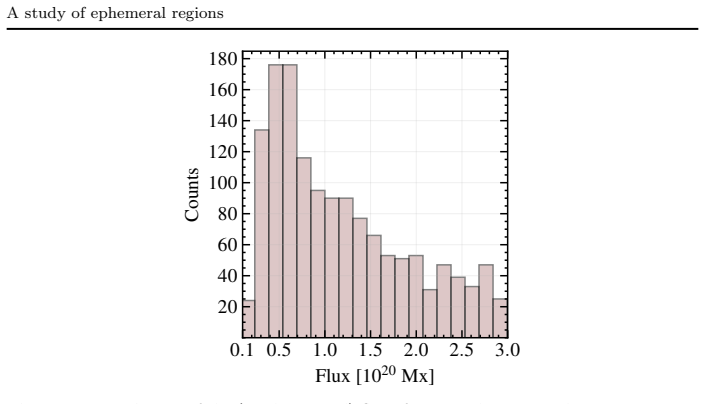
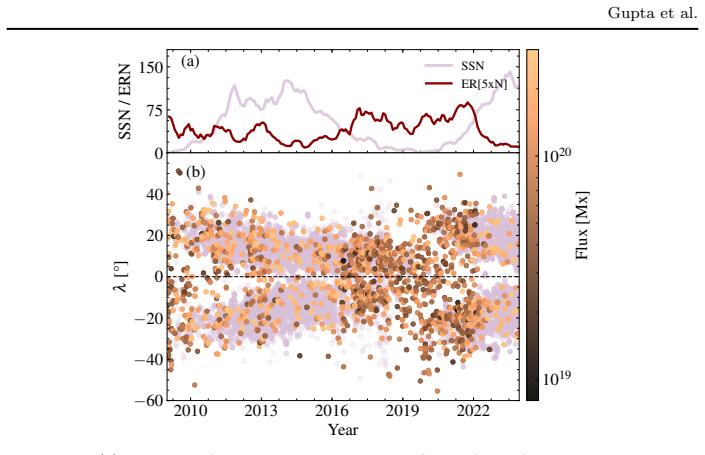
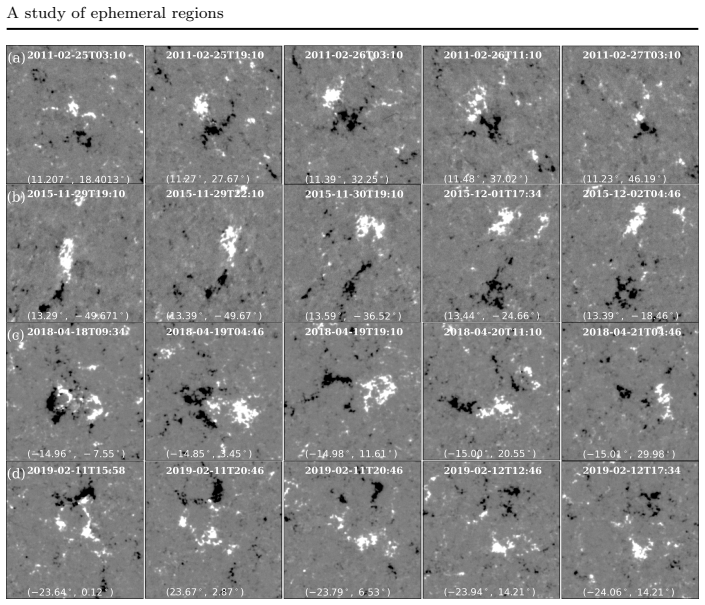
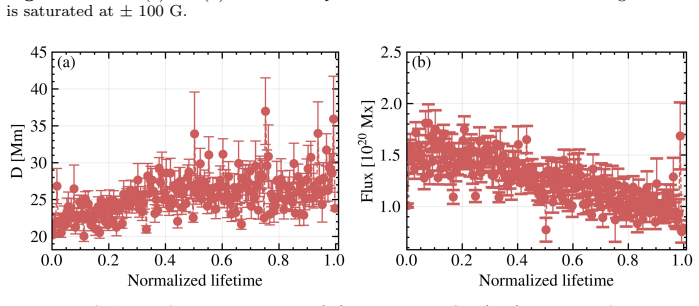
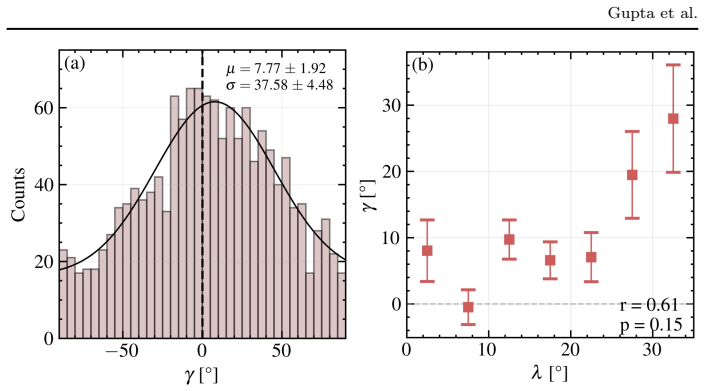
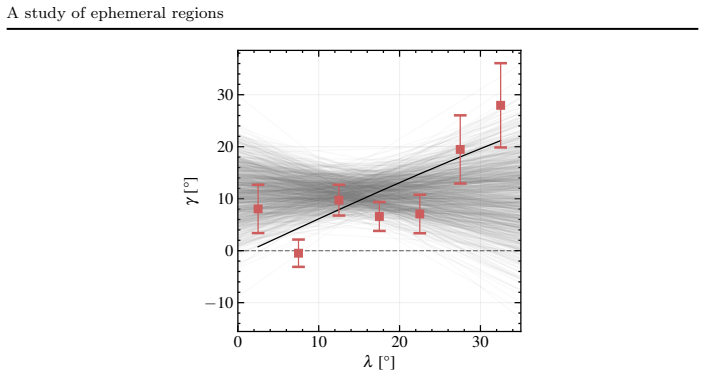
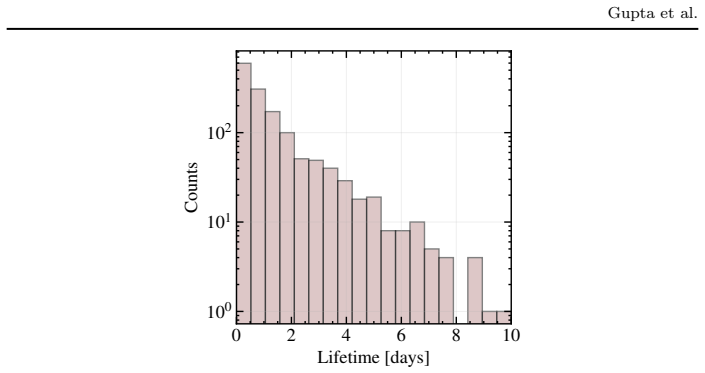
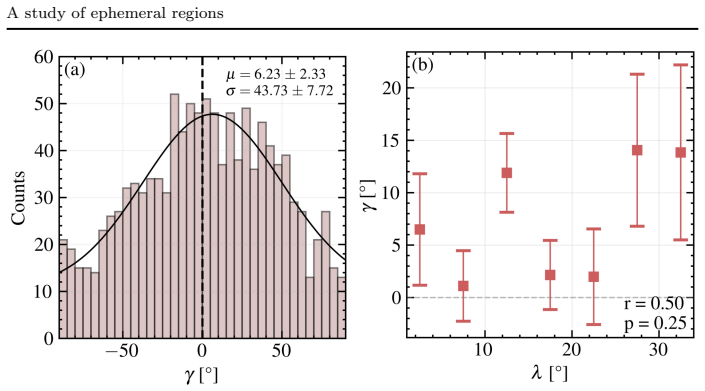
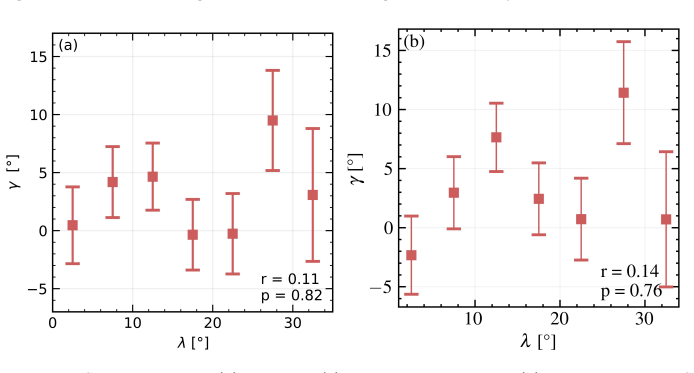
By applying flux and footpoint-separation thresholds to the AutoTAB catalog, the authors isolate ephemeral regions with fluxes between 10^19 and 10^20 Mx. These regions exhibit an average lifetime of 1.2 days, with footpoint separation growing during the first half of their life before saturating. ERs occur most frequently near solar minima. For lifetimes shorter than two days their tilts form a broad noisy distribution without systematic latitude dependence, but including longer-lived ERs yields a weak though statistically insignificant increasing trend with latitude. The authors conclude that short-lived ERs are dominated by turbulent convection while stronger ones may retain Coriolis-impa
What carries the argument
flux and footpoint-separation thresholds applied to the AutoTAB catalog to isolate ephemeral regions, combined with analysis of their tilt distributions versus lifetime and latitude
If this is right
- ERs occur most frequently near solar minima, likely because the catalog detects weaker regions more readily when strong BMRs are scarce.
- Short-lived ERs are shaped by turbulent convection rather than systematic rotation effects.
- Longer-lived ERs may retain tilts imparted by the Coriolis force.
- ERs occupy the low-flux end of the BMR spectrum and contribute meaningfully to the solar dynamo.
Where Pith is reading between the lines
- Dynamo models could treat magnetic flux emergence as a continuous spectrum rather than distinct populations of ERs and larger BMRs.
- Higher-sensitivity observations in future cycles might reveal whether the weak latitude trend in tilts becomes statistically significant.
- The observed saturation of footpoint separation points to a limiting role for supergranular flows in ER evolution.
- Flux transport simulations could test whether including these ER properties alters predicted polar field reversals.
Load-bearing premise
The flux and footpoint-separation thresholds applied to the AutoTAB catalog successfully isolate true ephemeral regions without significant contamination from other magnetic features or mis-tracking.
What would settle it
Repeating the tilt-latitude analysis on an independent magnetic region catalog or during a different solar cycle and finding either a statistically significant latitude trend in short-lived ERs or none at all in longer-lived ones.
Figures
read the original abstract
The ephemeral regions (ERs), which are short-lived bipolar magnetic regions that emerge across the solar cycle but do not appear as sunspots, play a crucial role in the Sun's magnetic flux budget. However, their properties, particularly the tilt distribution, are poorly constrained by observations. In this study, we isolate ERs from the Automatic Tracking Algorithm for Bipolar Magnetic Regions (AutoTAB) catalog during Solar Cycles 24 and 25 by applying flux and footpoint-separation thresholds. Although AutoTAB was designed to track high-flux regions, it also records ephemeral regions with fluxes of 10^19 to 10^20 Mx, placing them at the upper end of the ER spectrum. The isolated ERs have an average lifetime of 1.2 days. Footpoint separation begins at supergranular scales (about 20 Mm), grows during the first half of the lifetime, and then saturates. ERs occur most frequently near solar minima, consistent with earlier studies and likely reflecting AutoTAB's greater sensitivity to weaker regions when strong BMRs are scarce. Tilt properties reveal a more complex picture. For lifetimes shorter than two days, ERs show a broad, noisy distribution with no systematic latitude dependence. Including longer-lived ERs produces a weak, though statistically insignificant, increasing trend with latitude, suggesting that short-lived ERs are shaped by turbulent convection, while stronger, longer-lived ERs may retain Coriolis-imparted tilts. Overall, these results support the view that ERs occupy the low-flux end of the BMR spectrum and contribute meaningfully to the solar dynamo.
Editorial analysis
A structured set of objections, weighed in public.
Referee Report
Summary. The manuscript isolates ephemeral regions (ERs) from the AutoTAB catalog in Solar Cycles 24 and 25 by applying flux (10^19–10^20 Mx) and footpoint-separation thresholds. It reports an average lifetime of 1.2 days, footpoint separation starting at ~20 Mm and saturating, a frequency peak near minima attributed to sensitivity changes, and tilt distributions that are broad/noisy with no latitude dependence for lifetimes <2 days but a weak (statistically insignificant) increasing trend when longer-lived ERs are included. The central claim is that these ERs occupy the low-flux end of the bipolar magnetic region (BMR) spectrum and contribute meaningfully to the solar dynamo.
Significance. If the selection thresholds reliably isolate genuine ERs, the work supplies observational constraints on ER lifetimes, footpoint evolution, and tilt statistics that extend the BMR spectrum downward and support a dynamo contribution from the low-flux population.
major comments (2)
- [Abstract] Abstract (isolation method paragraph): The central dynamo-contribution claim requires that the flux (10^19–10^20 Mx) and footpoint-separation thresholds applied to AutoTAB successfully select true ERs rather than BMR fragments, mis-tracked features, or the low-flux tail of ordinary BMRs. No quantitative validation is reported (overlap with independent ER catalogs, false-positive rate from simulations, or robustness to threshold variation), and the minimum-phase frequency peak is explicitly attributed to sensitivity changes without a correction or bias estimate.
- [Abstract] Abstract (tilt properties paragraph): The latitude trend is reported as 'statistically insignificant' yet is used to distinguish turbulent convection (short-lived) from Coriolis (longer-lived) regimes. No sample sizes, error bars on the tilt measurements, or details of the statistical test are provided, making it impossible to assess whether the data support the claimed distinction or the overall BMR-spectrum conclusion.
Simulated Author's Rebuttal
We thank the referee for the constructive comments. We address each major point below, indicating where the manuscript will be revised.
read point-by-point responses
-
Referee: [Abstract] Abstract (isolation method paragraph): The central dynamo-contribution claim requires that the flux (10^19–10^20 Mx) and footpoint-separation thresholds applied to AutoTAB successfully select true ERs rather than BMR fragments, mis-tracked features, or the low-flux tail of ordinary BMRs. No quantitative validation is reported (overlap with independent ER catalogs, false-positive rate from simulations, or robustness to threshold variation), and the minimum-phase frequency peak is explicitly attributed to sensitivity changes without a correction or bias estimate.
Authors: The flux range follows the conventional definition of ephemeral regions as the low-flux extension of bipolar magnetic regions, and the separation threshold isolates supergranular-scale features. AutoTAB itself has been validated for bipolar-region tracking in earlier work. We agree that explicit discussion of threshold robustness is warranted and will add a sensitivity analysis (varying the flux and separation bounds by ±10% and reporting changes in derived statistics) to the methods section. For the frequency peak, we will expand the text to note the likely sensitivity bias and state that a quantitative correction requires detection-efficiency modeling not performed here. These additions address the concern while preserving the reported ER properties. revision: partial
-
Referee: [Abstract] Abstract (tilt properties paragraph): The latitude trend is reported as 'statistically insignificant' yet is used to distinguish turbulent convection (short-lived) from Coriolis (longer-lived) regimes. No sample sizes, error bars on the tilt measurements, or details of the statistical test are provided, making it impossible to assess whether the data support the claimed distinction or the overall BMR-spectrum conclusion.
Authors: The abstract is necessarily concise. The revised manuscript will report the number of regions in each lifetime bin, the standard error on the mean tilt angle, and the statistical procedure (linear regression of tilt versus latitude with p-value threshold). This will enable readers to evaluate the strength of the latitude dependence and the regime distinction. revision: yes
Circularity Check
No significant circularity: pure observational catalog analysis
full rationale
The paper performs threshold-based selection on the external AutoTAB catalog and reports direct statistical measurements (lifetimes, separations, tilt distributions) from the resulting sample. No equations, fitted parameters, or model predictions are present. The central claim that ERs occupy the low-flux end of the BMR spectrum is an interpretive summary of the observed flux range, not a derivation that reduces to its own inputs. No self-citations are invoked as load-bearing uniqueness theorems or ansatzes. The reported tilt trend is explicitly labeled statistically insignificant, avoiding any circular prediction. This is a standard observational study whose conclusions rest on the catalog data itself rather than on any self-referential chain.
Axiom & Free-Parameter Ledger
free parameters (2)
- flux threshold
- footpoint-separation threshold
axioms (2)
- domain assumption AutoTAB catalog accurately detects and tracks bipolar regions down to 10^19 Mx without significant false positives or tracking errors.
- domain assumption Lifetime and tilt measurements are not strongly affected by projection effects or line-of-sight cancellation at the observed latitudes.
Reference graph
Works this paper leans on
-
[1]
Cameron, R., Sch¨ ussler, M.: 2015, The crucial role of surface magnetic fields for the solar dynamo.Science347,
2015
-
[2]
DOI. ADS. Cattaneo, F.: 1999, Dynamo Theory and the Origin of Small Scale Magnetic Fields. In: Hanslmeier, A., Messerotti, M. (eds.)Motions in the Solar Atmosphere,Astrophysics and Space Science Library239,
1999
-
[3]
DOI. ADS. Chae, J., Martin, S.F., Yun, H.S., Kim, J., Lee, S., Goode, P.R., Spirock, T., Wang, H.: 2001, Small Magnetic Bipoles Emerging in a Filament Channel.Astrophys. J.548,
2001
-
[4]
DOI. ADS. Charbonneau, P.: 2020, Dynamo models of the solar cycle.Living Reviews in Solar Physics 17,
2020
-
[5]
DOI. ADS. Clette, F., Lef` evre, L.: 2015,SILSO Sunspot Number V2.0, https://doi.org/10.24414/qnza- ac80. Published by WDC SILSO - Royal Observatory of Belgium (ROB). Hagenaar, H.J.: 2001, Ephemeral Regions on a Sequence of Full-Disk Michelson Doppler Imager Magnetograms.Astrophys. J.555,
-
[6]
DOI. ADS. Hagenaar, H.J., Schrijver, C.J., Title, A.M.: 2003, The Properties of Small Magnetic Regions on the Solar Surface and the Implications for the Solar Dynamo(s).Astrophys. J.584,
2003
-
[7]
DOI. ADS. Hale, G.E., Nicholson, S.B.: 1925, The Law of Sun-Spot Polarity.Astrophys. J.62,
1925
-
[8]
DOI. ADS. Hale, G.E., Ellerman, F., Nicholson, S.B., Joy, A.H.: 1919, The Magnetic Polarity of Sun-Spots. Astrophys. J.49,
1919
-
[9]
DOI. ADS. Harvey, K.L.: 1993, The Magnetic Bipoles on the Sun.PhD Thesis, Utrecht University, The Netherlands. Harvey, K.L., Martin, S.F.: 1973, Ephemeral Active Regions.Sol. Phys.32,
1993
-
[10]
DOI. ADS. Harvey, K.L., Harvey, J.W., Martin, S.F.: 1975, Ephemeral Active Regions in 1970 and
1975
-
[11]
DOI. ADS. Hofer, B., Krivova, N.A., Cameron, R., Solanki, S.K., Jiang, J.: 2024, The influence of small bipolar magnetic regions on basic solar quantities.Astron. Astrophys.683, A48. DOI. ADS. Howard, R.F.: 1991, Axial Tilt Angles of Sunspot Groups.Sol. Phys.136,
2024
-
[12]
DOI. ADS. Howard, R.F.: 1996, Axial Tilt Angles of Active Regions.Sol. Phys.169,
1996
-
[13]
DOI. ADS. Jha, B.K., Karak, B.B., Mandal, S., Banerjee, D.: 2020, Magnetic Field Dependence of Bipolar Magnetic Region Tilts on the Sun: Indication of Tilt Quenching.Astrophys. J. Lett.889, L19. DOI. ADS. Jha, B.K., Priyadarshi, A., Mandal, S., Chatterjee, S., Banerjee, D.: 2021, Measurements of Solar Differential Rotation Using the Century Long Kodaikana...
2020
-
[14]
DOI. ADS. Karak, B.B.: 2023, Models for the long-term variations of solar activity.Living Reviews in Solar Physics20,
2023
-
[15]
DOI. ADS. Karak, B.B., Brandenburg, A.: 2016, Is the Small-scale Magnetic Field Correlated with the Dynamo Cycle?Astrophys. J.816,
2016
-
[16]
DOI. ADS. SOLA: ERs.tex; 2 June 2026; 2:41; p. 13 Gupta et al. Karak, B.B., Miesch, M.: 2017, Solar Cycle Variability Induced by Tilt Angle Scatter in a Babcock-Leighton Solar Dynamo Model.Astrophys. J.847,
2026
-
[17]
DOI. ADS. Karak, B.B., Miesch, M.: 2018, Recovery from Maunder-like Grand Minima in a Babcock– Leighton Solar Dynamo Model.Astrophys. J. Lett.860, L26. DOI. ADS. Kumar, P., Karak, B.B., Sreedevi, A.: 2024, Variabilities in the polar field and solar cycle due to irregular properties of bipolar magnetic regions.Mon. Not. R. Astron. Soc.530,
2018
-
[18]
DOI. ADS. Leighton, R.B.: 1964, Transport of Magnetic Fields on the Sun.Astrophys. J.140,
1964
-
[19]
DOI. ADS. Mandal, S., Krivova, N.A., Solanki, S.K., Sinha, N., Banerjee, D.: 2020, Sunspot area catalog revisited: Daily cross-calibrated areas since 1874.Astron. Astrophys.640, A78. DOI. ADS. Martin, S.F.: 2024, Observations key to understanding solar cycles: a re- view.Frontiers in Astronomy and Space SciencesV olume 10 -
2020
-
[20]
DOI. https://www.frontiersin.org/journals/astronomy-and-space- sciences/articles/10.3389/fspas.2023.1177097. Maunder, E.W.: 1903, Spoerer’s law of zones.The Observatory26,
-
[21]
Nordlund, A., Brandenburg, A., Jennings, R.L., Rieutord, M., Ruokolainen, J., Stein, R.F., Tuominen, I.: 1992, Dynamo Action in Stratified Convection with Overshoot.Astrophys
ADS. Nordlund, A., Brandenburg, A., Jennings, R.L., Rieutord, M., Ruokolainen, J., Stein, R.F., Tuominen, I.: 1992, Dynamo Action in Stratified Convection with Overshoot.Astrophys. J. 392,
1992
-
[22]
DOI. ADS. Scherrer, P.H., Bogart, R.S., Bush, R.I., Hoeksema, J.T., Kosovichev, A.G., Schou, J., Rosen- berg, W., Springer, L., Tarbell, T.D., Title, A., Wolfson, C.J., Zayer, I., MDI Engineering Team: 1995, The Solar Oscillations Investigation - Michelson Doppler Imager.Sol. Phys. 162,
1995
-
[23]
DOI. ADS. Schou, J., Scherrer, P.H., Bush, R.I., Wachter, R., Couvidat, S., Rabello-Soares, M.C., Bogart, R.S., Hoeksema, J.T., Liu, Y., Duvall, T.L., Akin, D.J., Allard, B.A., Miles, J.W., Rairden, R., Shine, R.A., Tarbell, T.D., Title, A.M., Wolfson, C.J., Elmore, D.F., Norton, A.A., Tomczyk, S.: 2012, Design and Ground Calibration of the Helioseismic a...
2012
-
[24]
DOI. ADS. Schrijver, C.J., Title, A.M., Harvey, K.L., Sheeley, N.R., Wang, Y.-M., van den Oord, G.H.J., Shine, R.A., Tarbell, T.D., Hurlburt, N.E.: 1998, Large-scale coronal heating by the small- scale magnetic field of the Sun.Nature394,
1998
-
[25]
DOI. ADS. Solanki, S.K.: 2003, Sunspots: An overview.Astron. Astrophys. Rev.11,
2003
-
[26]
DOI. ADS. Sreedevi, A., Jha, B.K., Karak, B.B., Banerjee, D.: 2023, AutoTAB: Automatic Tracking Algorithm for Bipolar Magnetic Regions.Astrophys. J. Suppl.268,
2023
-
[27]
DOI. ADS. Sreedevi, A., Jha, B.K., Karak, B.B., Banerjee, D.: 2024, Analysis of BMR Tilt from AutoTAB Catalog: Hinting toward the Thin Flux Tube Model?Astrophys. J.966,
2024
-
[28]
DOI. ADS. Stenflo, J.O., Kosovichev, A.G.: 2012, Bipolar Magnetic Regions on the Sun: Global Analysis of the SOHO/MDI Data Set.Astrophys. J.745,
2012
-
[29]
DOI. ADS. Thornton, L.M., Parnell, C.E.: 2011, Small-Scale Flux Emergence Observed Using Hin- ode/SOT.Sol. Phys.269,
2011
-
[30]
DOI. ADS. Tlatov, A.G., Pevtsov, A.A.: 2010, The latitude of ephemeral regions as an indicator for solar- cycle strength .Memorie della Societa Astronomica Italiana81,
2010
-
[31]
DOI. ADS. van Driel-Gesztelyi, L., Green, L.M.: 2015, Evolution of Active Regions.Living Reviews in Solar Physics12,
2015
-
[32]
DOI. ADS. Wang, Y.-M., Sheeley, J. N. R.: 1991, Magnetic Flux Transport and the Sun’s Dipole Moment: New Twists to the Babcock-Leighton Model.Astrophys. J.375,
1991
-
[33]
DOI. ADS. Wang, Y.-M., Sheeley, N.R. Jr.: 1989, Average Properties of Bipolar Magnetic Regions during Sunspot Cycle-21.Sol. Phys.124,
1989
-
[34]
DOI. ADS. Whitbread, T., Yeates, A.R., Mu˜ noz-Jaramillo, A.: 2018, How Many Active Regions Are Necessary to Predict the Solar Dipole Moment?Astrophys. J.863,
2018
-
[35]
DOI. ADS. Yang, S., Zhang, J.: 2014, Properties of Solar Ephemeral Regions at the Emergence Stage. Astrophys. J.781,
2014
-
[36]
DOI. ADS. Yang, S., Zhang, J., Li, T., Liu, Y.: 2012, Self-cancellation of Ephemeral Regions in the Quiet Sun.Astrophys. J. Lett.752, L24. DOI. ADS. Yeates, A.R.: 2020, How Good Is the Bipolar Approximation of Active Regions for Surface Flux Transport?Sol. Phys.295,
2012
-
[37]
DOI. ADS. SOLA: ERs.tex; 2 June 2026; 2:41; p. 14
2026
discussion (0)
Sign in with ORCID, Apple, or X to comment. Anyone can read and Pith papers without signing in.