Non-destructive cavity readout of molecules for precision measurements
Pith reviewed 2026-06-28 12:02 UTC · model grok-4.3
The pith
Coupling molecules to a high-finesse optical cavity allows non-destructive readout of rotational-hyperfine state populations.
A machine-rendered reading of the paper's core claim, the machinery that carries it, and where it could break.
Core claim
Coupling the molecules to a high-finesse optical cavity measures the population in a selected rotational-hyperfine state non-destructively, enabling fast repeated measurements with reduced heating and losses and with precision below the standard quantum limit, an advantage for radioactive molecules where production and sample size are limited.
What carries the argument
High-finesse optical cavity that couples to the molecules to extract state population information without destroying the sample.
Load-bearing premise
The cavity coupling can be arranged so that it does not itself introduce heating, losses, or noise sources that cancel the claimed advantages over traditional methods.
What would settle it
An experiment that measures the same molecular sample before and after cavity coupling and finds heating, loss rates, or readout noise at least as large as those in standard destructive techniques.
Figures
read the original abstract
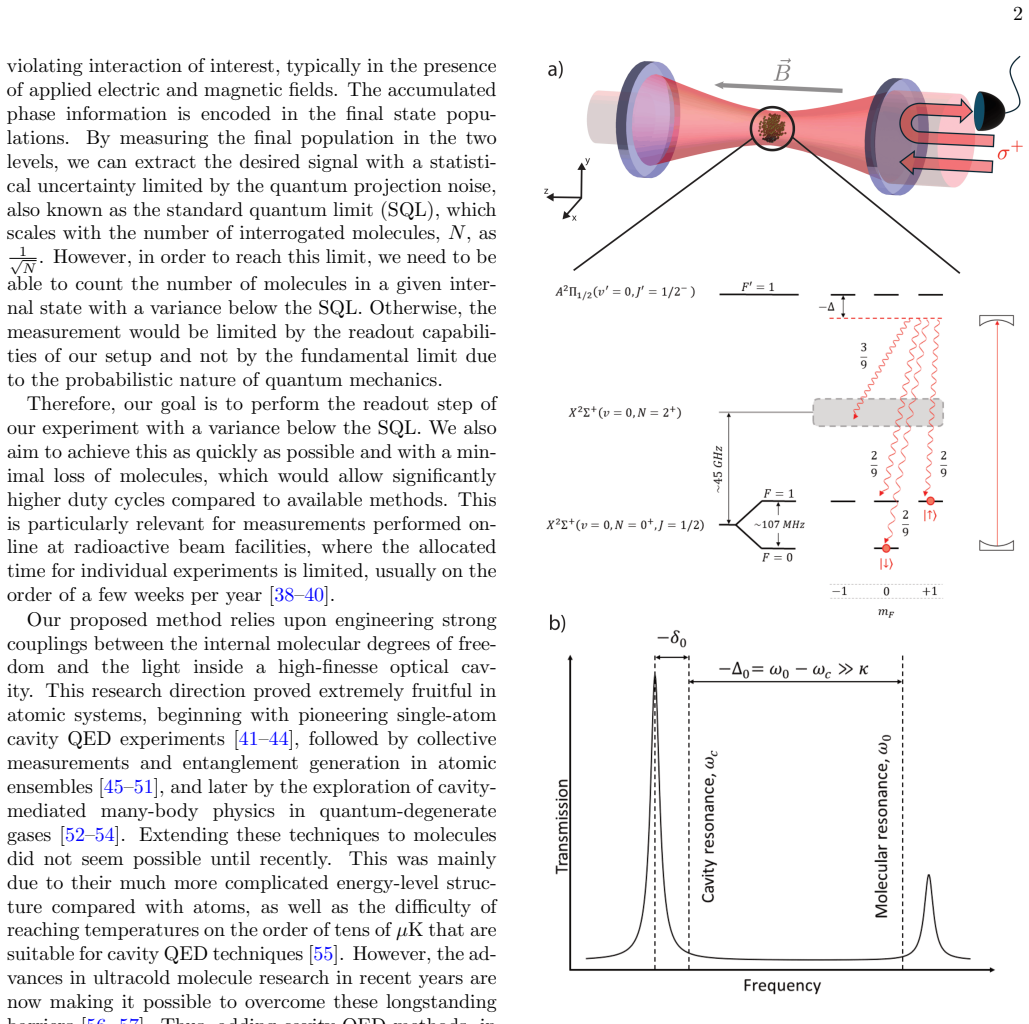
We propose a non-destructive method to measure the population of molecules in a selected rotational-hyperfine state by coupling them to a high-finesse optical cavity. In contrast to traditional techniques, our approach enables fast (less than 1 ms) repeated measurements with reduced heating and losses, and with precision below the standard quantum limit. The method is particularly advantageous for radioactive molecules, systems of high interest for symmetry violation searches, for which production and sample size are limited, and repeated interrogation is essential for improved sensitivity.
Editorial analysis
A structured set of objections, weighed in public.
Referee Report
Summary. The manuscript proposes a non-destructive readout technique in which molecules in a selected rotational-hyperfine state are coupled to a high-finesse optical cavity. The central claims are that the method permits repeated measurements in less than 1 ms, reduces heating and losses relative to traditional techniques, achieves precision below the standard quantum limit, and is especially beneficial for radioactive molecules whose limited production makes non-destructive, repeated interrogation essential for symmetry-violation searches.
Significance. If the proposed cavity coupling can be implemented without introducing new dominant loss or noise channels, the technique would constitute a meaningful advance for precision measurements on radioactive species, where sample size is the primary sensitivity bottleneck.
major comments (2)
- [Abstract] Abstract: the claims of sub-SQL precision and reduced heating/losses are stated without any derivation, noise budget, or quantitative estimate of cavity parameters, coupling strength, or decoherence rates that would allow the reader to assess whether the performance targets are reachable.
- The manuscript provides no analysis of the cavity-molecule interaction Hamiltonian, the resulting measurement back-action, or the conditions under which the readout remains non-destructive; without these elements the central performance assertions cannot be evaluated.
Simulated Author's Rebuttal
We thank the referee for their careful reading of our manuscript. The comments highlight the need for more quantitative support of the central claims, which we address below by outlining additions to the revised version.
read point-by-point responses
-
Referee: [Abstract] Abstract: the claims of sub-SQL precision and reduced heating/losses are stated without any derivation, noise budget, or quantitative estimate of cavity parameters, coupling strength, or decoherence rates that would allow the reader to assess whether the performance targets are reachable.
Authors: We agree that the abstract and main text would benefit from explicit estimates. In the revision we add a new section with order-of-magnitude calculations using realistic cavity parameters (finesse ~10^5, mode volume ~10^{-12} m^3), typical molecular transition strengths, and decoherence rates from spontaneous emission and cavity loss. A basic noise budget is included showing how the dispersive readout can reach sub-SQL sensitivity while keeping heating below levels of traditional fluorescence methods. revision: yes
-
Referee: The manuscript provides no analysis of the cavity-molecule interaction Hamiltonian, the resulting measurement back-action, or the conditions under which the readout remains non-destructive; without these elements the central performance assertions cannot be evaluated.
Authors: We accept that a derivation of the interaction is required. The revised manuscript adds a subsection deriving the dispersive Hamiltonian for the molecule-cavity system, estimating the AC Stark shift and photon scattering rate, and identifying the regime (large single-photon detuning, weak driving) in which back-action remains negligible over the <1 ms readout window, preserving the non-destructive character. revision: yes
Circularity Check
No significant circularity
full rationale
The paper is a forward proposal for an experimental method rather than a derivation chain. No equations, fitted parameters, predictions, or self-citations that reduce to inputs are described in the abstract or reader's assessment. The work focuses on advantages of cavity coupling for radioactive molecules without load-bearing mathematical steps that could exhibit circularity.
Axiom & Free-Parameter Ledger
Reference graph
Works this paper leans on
-
[1]
The molecular cloud will then be super- posed with the optical lattice created by a standing wave inside the optical cavity
for details). The molecular cloud will then be super- posed with the optical lattice created by a standing wave inside the optical cavity. This lattice will be used as a conservative trap for the molecules while ensuring that they are located close to the cavity waist. We expect a transfer efficiency from the MOT to the cavity lattice of about 1−10%. Then...
-
[2]
Navas, C
S. Navas, C. Amsler, T. Gutsche, C. Hanhart, J. Hern´ andez-Rey, C. Louren¸ co, A. Masoni, M. Mikhasenko, R. Mitchell, C. Patrignani,et al., Physical Review D110, 030001 (2024)
2024
-
[3]
Safronova, D
M. Safronova, D. Budker, D. DeMille, D. Kimball, A. Derevianko, and C. Clark, Rev. Mod. Phys.90, 025008 (2018)
2018
-
[4]
T. S. Roussy, L. Caldwell, T. Wright, W. B. Cairncross, Y. Shagam, K. B. Ng, N. Schlossberger, S. Y. Park, A. Wang, J. Ye,et al., Science381, 46 (2023)
2023
-
[5]
Andreev, D
V. Andreev, D. Ang, D. DeMille, J. Doyle, G. Gabrielse, J. Haefner, Z. Hutzler, N.R. and. Lasner, C. Meisen- helder, B. O’Leary,et al., Nature562, 355 (2018)
2018
-
[6]
N. R. Hutzler, Quantum Science and Technology5, 044011 (2020)
2020
-
[7]
Grasdijk, O
O. Grasdijk, O. Timgren, J. Kastelic, T. Wright, S. Lam- oreaux, D. DeMille, K. Wenz, M. Aitken, T. Zelevinsky, T. Winick,et al., Quantum Science and Technology6, 044007 (2021)
2021
-
[8]
Arrowsmith-Kron, M
G. Arrowsmith-Kron, M. Athanasakis-Kaklamanakis, M. Au, J. Ballof, R. Berger, A. Borschevsky, A. Breier, 6 F. Buchinger, D. Budker, and L. Caldwell, Rep. Prog. Phys.87, 084301 (2024)
2024
-
[9]
Altunta¸ s, J
E. Altunta¸ s, J. Ammon, S. B. Cahn, and D. DeMille, Physical Review Letters120, 142501 (2018)
2018
-
[10]
J. W. Blanchard, D. Budker, D. DeMille, M. G. Ko- zlov, and L. V. Skripnikov, Physical Review Research5, 013191 (2023)
2023
-
[11]
Karthein, S.-M
J. Karthein, S.-M. Udrescu, S. B. Moroch, I. Belosevic, K. Blaum, A. Borschevsky, Y. Chamorro, D. DeMille, J. Dilling, R. F. Garcia Ruiz,et al., Physical Review Letters133, 033003 (2024)
2024
-
[12]
X. Yang, S. Wang, S. Wilkins, and R. Garcia Ruiz, Prog. Part. Nucl. Phys.129, 104005 (2023)
2023
-
[13]
Engel, Annual Review of Nuclear and Particle Science 75
J. Engel, Annual Review of Nuclear and Particle Science 75
-
[14]
R. F. Garcia Ruiz, R. Berger, J. Billowes, C. Binnersley, M. Bissell, A. Breier, A. Brinson, K. Chrysalidis, T. Co- colios, B. Cooper,et al., Nature581, 396 (2020)
2020
-
[15]
Udrescu, A
S. Udrescu, A. Brinson, R. G. Ruiz, K. Gaul, R. Berger, J. Billowes, C. Binnersley, M. Bissell, A. Breier, K. Chrysalidis,et al., Physical Review Letters127, 033001 (2021)
2021
-
[16]
Udrescu, S
S.-M. Udrescu, S. G. Wilkins, A. Breier, M. Athanasakis- Kaklamanakis, R. F. Garcia Ruiz, M. Au, I. Beloˇ sevi´ c, R. Berger, M. Bissell, C. Binnersley,et al., Nature Physics20, 202 (2024)
2024
-
[17]
Wilkins, S
S. Wilkins, S. Udrescu, M. Athanasakis-Kaklamanakis, R. Garcia Ruiz, M. Au, I. Beloˇ sevi´ c, R. Berger, M. Bis- sell, A. Breier, A. Brinson,et al., Science390, 386 (2025)
2025
-
[18]
Wilkins, H
S. Wilkins, H. Perrett, S. Udrescu, A. Kyuberis, L. Paˇ steka, M. Au, I. Beloˇ sevi´ c, R. Berger, C. Binnersley, M. Bissell,et al., Phys. Rev. Res.8, L012012 (2026)
2026
-
[19]
C. J. Conn, P. Yu, M. I. Howard, Y. Yang, C. Zhang, A. Jadbabaie, A. Gorou, A. N. Gaiser, T. C. Steimle, L. Cheng,et al., arXiv preprint arXiv:2508.08368 (2025)
arXiv 2025
-
[20]
Udrescu, D
S.-M. Udrescu, D. A. Torres, and R. F. Garcia Ruiz, Physical Review Research6, 013128 (2024)
2024
-
[21]
DeMille, N
D. DeMille, N. R. Hutzler, A. M. Rey, and T. Zelevinsky, Nature Physics20, 741 (2024)
2024
-
[22]
Langen, G
T. Langen, G. Valtolina, D. Wang, and J. Ye, Nature Physics20, 702 (2024)
2024
-
[23]
Barry, D
J. Barry, D. McCarron, E. Norrgard, M. Steinecker, and D. DeMille, Nature512, 286 (2014)
2014
-
[24]
J. J. Burau, P. Aggarwal, K. Mehling, and J. Ye, Physical Review Letters130, 193401 (2023)
2023
-
[25]
Truppe, H
S. Truppe, H. Williams, M. Hambach, L. Caldwell, N. Fitch, E. Hinds, B. Sauer, and M. Tarbutt, Nature Physics13, 1173 (2017)
2017
-
[26]
J. E. Padilla-Castillo, J. Cai, P. Agarwal, P. Kukreja, R. Thomas, B. G. Sartakov, S. Truppe, G. Meijer, and S. C. Wright, Phys. Rev. Lett.135, 243401 (2025)
2025
-
[27]
J. J. Park, Y.-K. Lu, A. O. Jamison, and W. Ketterle, Nature Physics19, 1567 (2023)
2023
-
[28]
Miller, A
C. Miller, A. N. Carroll, J. Lin, H. Hirzler, H. Gao, H. Zhou, M. D. Lukin, and J. Ye, Nature633, 332 (2024)
2024
-
[29]
Bigagli, W
N. Bigagli, W. Yuan, S. Zhang, B. Bulatovic, T. Karman, I. Stevenson, and S. Will, Nature631, 289 (2024)
2024
-
[30]
L. R. Picard, A. J. Park, G. E. Patenotte, S. Gebretsad- kan, D. Wellnitz, A. M. Rey, and K.-K. Ni, Nature637, 821 (2025)
2025
-
[31]
Christakis, J
L. Christakis, J. S. Rosenberg, R. Raj, S. Chi, A. Morn- ingstar, D. A. Huse, Z. Z. Yan, and W. S. Bakr, Nature 614, 64 (2023)
2023
-
[32]
C. M. Holland, Y. Lu, and L. W. Cheuk, Science382, 1143 (2023)
2023
-
[33]
N. B. Vilas, P. Robichaud, C. Hallas, G. K. Li, L. An- deregg, and J. M. Doyle, Nature628, 282 (2024)
2024
-
[34]
D. K. Ruttley, T. R. Hepworth, A. Guttridge, and S. L. Cornish, Nature637, 827 (2025)
2025
-
[35]
Kondov, C.-H
S. Kondov, C.-H. Lee, K. Leung, C. Liedl, I. Majew- ska, R. Moszynski, and T. Zelevinsky, Nature Physics 15, 1118 (2019)
2019
-
[36]
J. C. Shaw, J. C. Schnaubelt, and D. J. McCarron, Phys. Rev. Res.3, L042041 (2021)
2021
-
[37]
H. J. Kimble, Physica Scripta1998, 127 (1998)
1998
-
[38]
Haroche, Reviews of Modern Physics85, 1083 (2013)
S. Haroche, Reviews of Modern Physics85, 1083 (2013)
2013
-
[39]
Yano and T
Y. Yano and T. Motobayashi, Nuclear Physics News17, 5 (2007)
2007
-
[40]
Glasmacher, B
T. Glasmacher, B. Sherrill, W. Nazarewicz, A. Gade, P. Mantica, J. Wei, G. Bollen, and B. Bull, Nuclear Physics News27, 28 (2017)
2017
-
[41]
M. J. Borge and B. Jonson, Journal of Physics G: Nuclear and Particle Physics44, 044011 (2017)
2017
-
[42]
R. J. Thompson, G. Rempe, and H. J. Kimble, Phys. Rev. Lett.68, 1132 (1992)
1992
-
[43]
Pinkse, T
P. Pinkse, T. Fischer, P. Maunz, and G. Rempe, Nature 404, 365 (2000)
2000
-
[44]
K. M. Fortier, S. Y. Kim, M. J. Gibbons, P. Ahmadi, and M. S. Chapman, Phys. Rev. Lett.98, 233601 (2007)
2007
-
[45]
Terraciano, R
M. Terraciano, R. Olson Knell, D. Norris, J. Jing, A. Fern´ andez, and L. Orozco, Nature Physics5, 480 (2009)
2009
-
[46]
I. D. Leroux, M. H. Schleier-Smith, and V. Vuleti´ c, Phys. Rev. Lett.104, 073602 (2010)
2010
-
[47]
K. C. Cox, G. P. Greve, J. M. Weiner, and J. K. Thomp- son, Phys. Rev. Lett.116, 093602 (2016)
2016
-
[48]
Hosten, N
O. Hosten, N. J. Engelsen, R. Krishnakumar, and M. A. Kasevich, Nature529, 505 (2016)
2016
-
[49]
Pedrozo-Pe˜ nafiel, S
E. Pedrozo-Pe˜ nafiel, S. Colombo, C. Shu, A. F. Adiy- atullin, Z. Li, E. Mendez, B. Braverman, A. Kawasaki, D. Akamatsu, Y. Xiao,et al., Nature588, 414 (2020)
2020
-
[50]
Periwal, E
A. Periwal, E. S. Cooper, P. Kunkel, J. F. Wienand, E. J. Davis, and M. Schleier-Smith, Nature600, 630 (2021)
2021
-
[51]
J. M. Robinson, M. Miklos, Y. M. Tso, C. J. Kennedy, T. Bothwell, D. Kedar, J. K. Thompson, and J. Ye, Na- ture Physics20, 208 (2024)
2024
-
[52]
Shadmany, A
D. Shadmany, A. Kumar, A. Soper, L. Palm, C. Yin, H. Ando, B. Li, L. Taneja, M. Jaffe, S. David, and J. Si- mon, Science Advances11, eads8171 (2025)
2025
-
[53]
Brennecke, T
F. Brennecke, T. Donner, S. Ritter, T. Bourdel, M. K¨ ohl, and T. Esslinger, Nature450, 268 (2007)
2007
-
[54]
R. M. Kroeze, Y. Guo, V. D. Vaidya, J. Keeling, and B. L. Lev, Phys. Rev. Lett.121, 163601 (2018)
2018
-
[55]
K. Roux, H. Konishi, V. Helson, and J.-P. Brantut, Na- ture Communications11, 2974 (2020)
2020
-
[56]
B. L. Lev, A. Vukics, E. R. Hudson, B. C. Sawyer, P. Domokos, H. Ritsch, and J. Ye, Physical Review A—Atomic, Molecular, and Optical Physics77, 023402 (2008)
2008
-
[57]
Y. Lu, S. J. Li, C. M. Holland, and L. W. Cheuk, Nature Physics20, 389 (2024)
2024
-
[58]
Jorapur, T
V. Jorapur, T. K. Langin, Q. Wang, G. Zheng, and D. De- Mille, Phys. Rev. Lett.132, 163403 (2024)
2024
-
[59]
[59– 70]
See Supplemental Material below for details about the theoretical model, numerical estimations, conveyor belt MOT, and microwave transfers, which includes Refs. [59– 70]
-
[60]
G. K. Li, C. Hallas, and J. M. Doyle, New J. Phys.27, 7 043002 (2025)
2025
-
[61]
Hallas, G
C. Hallas, G. K. Li, N. B. Vilas, P. Robichaud, L. An- deregg, and J. M. Doyle, Phys. Rev. Lett.136, 133402 (2026)
2026
-
[62]
S. S. Yu, J. You, Y. Bao, L. Anderegg, C. Hallas, G. K. Li, D. Lim, E. Chae, W. Ketterle, K.-K. Ni,et al., Nature Communications (2026)
2026
-
[63]
Z. Zeng, S. Yang, S. Deng, and B. Yan, Phys. Rev. Lett. 136, 073402 (2026)
2026
-
[64]
Sawaoka, A
H. Sawaoka, A. Nasir, A. Lunstad, M. Li, J. Mango, Z. D. Lasner, and J. M. Doyle, Phys. Rev. Res.8, 013100 (2026)
2026
-
[65]
Wang,Laser Cooling, Trapping, and Coherent Con- trol of Strontium Monofluoride Molecules, Ph.D
Q. Wang,Laser Cooling, Trapping, and Coherent Con- trol of Strontium Monofluoride Molecules, Ph.D. thesis, University of Chicago (2025)
2025
-
[66]
H. J. Williams, L. Caldwell, N. J. Fitch, S. Truppe, J. Rodewald, E. A. Hinds, B. E. Sauer, and M. R. Tar- butt, Phys. Rev. Lett.120, 163201 (2018)
2018
-
[67]
Y. Bao, S. S. Yu, L. Anderegg, E. Chae, W. Ketterle, K.-K. Ni, and J. M. Doyle, Science382, 1138 (2023)
2023
-
[68]
Anderegg, N
L. Anderegg, N. B. Vilas, C. Hallas, P. Robichaud, A. Jadbabaie, J. M. Doyle, and N. R. Hutzler, Science 382, 665 (2023)
2023
-
[69]
Norrgard,Magneto-optical trapping of diatomic molecules, Ph.D
E. Norrgard,Magneto-optical trapping of diatomic molecules, Ph.D. thesis, Yale University (2016)
2016
-
[70]
Colarusso, B
P. Colarusso, B. Guo, K.-Q. Zhang, and P. Bernath, Jour- nal of Molecular Spectroscopy175, 158 (1996)
1996
-
[71]
Jorapur,Towards a Bose-Einstein Condensate of SrF Molecules, Ph.D
V. Jorapur,Towards a Bose-Einstein Condensate of SrF Molecules, Ph.D. thesis, Yale University (2024)
2024
-
[72]
eEDM collaboration, P
N. eEDM collaboration, P. Aggarwal, H. L. Bethlem, A. Borschevsky, M. Denis, K. Esajas, P. A. Haase, Y. Hao, S. Hoekstra, K. Jungmann,et al., The European Physical Journal D72, 1 (2018)
2018
-
[73]
Verma, A
M. Verma, A. M. Jayich, and A. C. Vutha, Physical Re- view Letters125, 153201 (2020)
2020
-
[74]
E. S. Shuman, J. F. Barry, D. R. Glenn, and D. DeMille, Phys. Rev. Lett.103, 223001 (2009)
2009
-
[75]
Tanji-Suzuki, I
H. Tanji-Suzuki, I. D. Leroux, M. H. Schleier-Smith, M. Cetina, A. T. Grier, J. Simon, and V. Vuleti´ c, in Advances in Atomic, Molecular, and Optical Physics, Advances In Atomic, Molecular, and Optical Physics, Vol. 60, edited by E. Arimondo, P. Berman, and C. Lin (Academic Press, 2011) pp. 201–237
2011
-
[76]
Duan,Enhanced light-atom interaction in an optical resonator, Ph.D
Y. Duan,Enhanced light-atom interaction in an optical resonator, Ph.D. thesis (2020)
2020
-
[77]
Zhang, R
H. Zhang, R. McConnell, S. ´Cuk, Q. Lin, M. H. Schleier- Smith, I. D. Leroux, and V. Vuleti´ c, Phys. Rev. Lett. 109, 133603 (2012)
2012
-
[78]
Z. Chen, J. G. Bohnet, J. M. Weiner, K. C. Cox, and J. K. Thompson, Physical Review A89, 043837 (2014)
2014
-
[79]
Z. Li, B. Braverman, S. Colombo, C. Shu, A. Kawasaki, A. F. Adiyatullin, E. Pedrozo-Pe˜ nafiel, E. Mendez, and V. Vuleti´ c, PRX Quantum3, 020308 (2022)
2022
-
[80]
T. E. Wall, J. F. Kanem, J. J. Hudson, B. E. Sauer, D. Cho, M. G. Boshier, E. A. Hinds, and M. R. Tarbutt, Phys. Rev. A78, 062509 (2008)
2008
discussion (0)
Sign in with ORCID, Apple, or X to comment. Anyone can read and Pith papers without signing in.