Reconnection-Driven Injection and Stochastic Reacceleration during Cosmological Magnetogenesis
Pith reviewed 2026-06-28 13:43 UTC · model grok-4.3
The pith
Reconnection during cosmological magnetogenesis injects suprathermal protons but yields a nonthermal energy fraction of only 10^{-7}.
A machine-rendered reading of the paper's core claim, the machinery that carries it, and where it could break.
Core claim
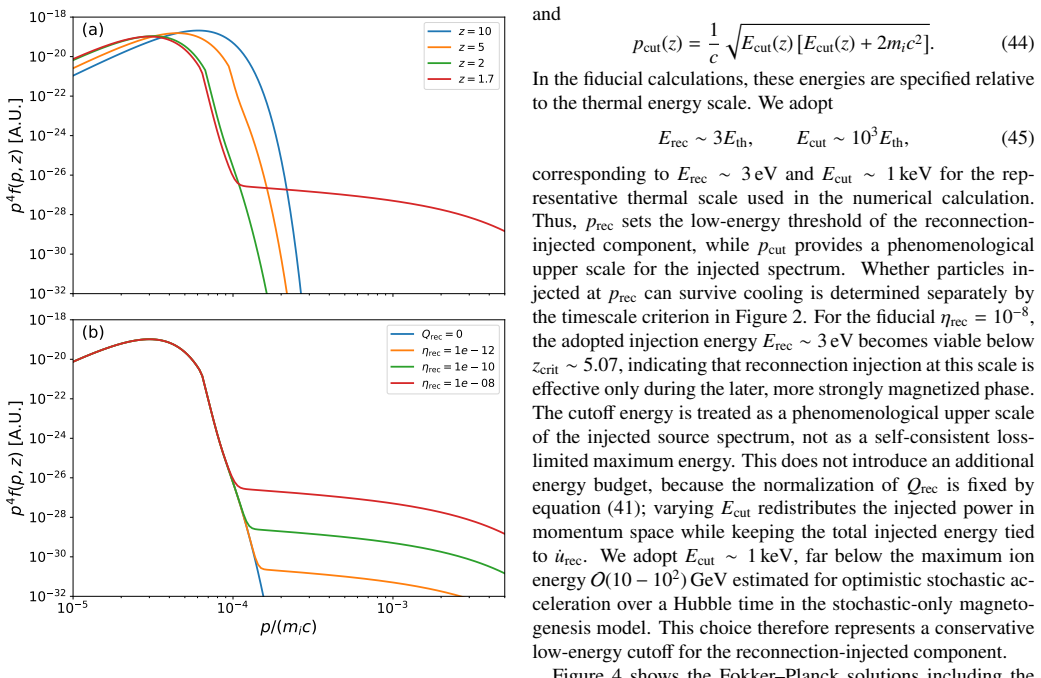
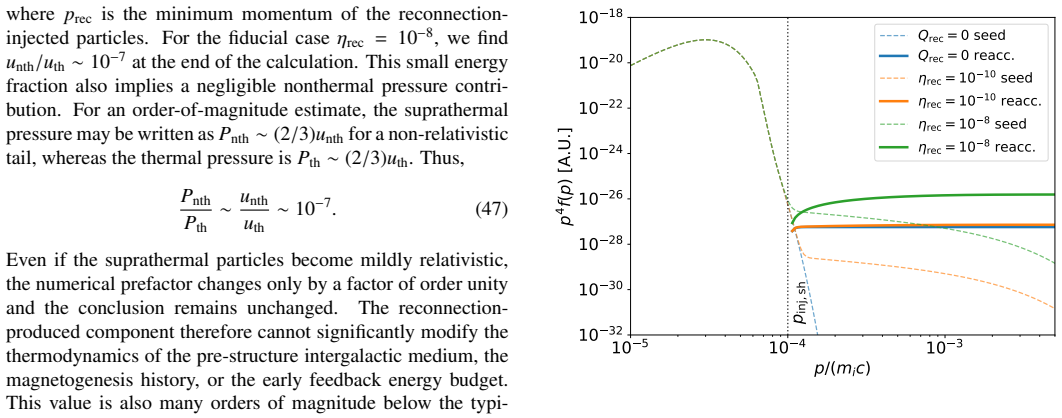
Reconnection acts as a fast injection channel and produces a visible suprathermal tail. However, the resulting nonthermal energy fraction remains very small, of order 10^{-7} in the fiducial model, implying a negligible nonthermal pressure contribution to the pre-structure intergalactic medium. This limitation arises because the extremely high-beta plasma contains only a small magnetic-energy reservoir. Using a test-particle shock reacceleration estimate, the reconnection-produced tail can enhance the suprathermal proton population available for later structure-formation shocks by about an order of magnitude, yet the associated hadronic gamma-ray emission from low-density cluster outskirts s
What carries the argument
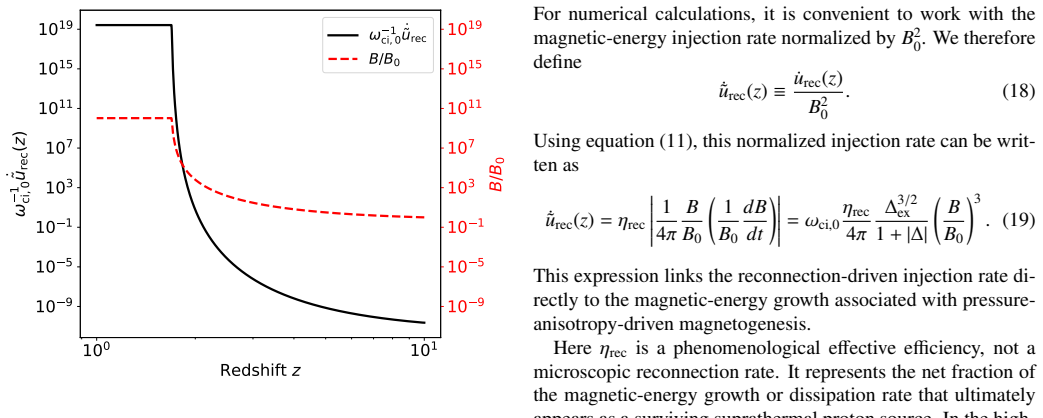
A phenomenological reconnection-driven source term added to the Fokker-Planck equation for the isotropic ion distribution, with its injection power tied directly to the magnetic-energy growth rate.
If this is right
- Reconnection during cosmological magnetogenesis is unlikely to dominate the cosmic-ray energy budget directly.
- The nonthermal pressure contribution to the pre-structure intergalactic medium remains negligible.
- The reconnection-produced suprathermal tail enhances the seed population available for structure-formation shocks by about an order of magnitude.
- Hadronic gamma-ray emission from low-density cluster outskirts remains far below current detectability.
Where Pith is reading between the lines
- If reconnection operates more efficiently at unresolved scales, the seed population could become large enough to alter the starting conditions for shock acceleration in forming structures.
- The same small magnetic reservoir that caps the nonthermal fraction also limits how much the process could affect the overall thermal history of the intergalactic medium.
- Future simulations that resolve reconnection sites explicitly could test whether the assumed tie between magnetic growth rate and injection power holds in expanding cosmology.
Load-bearing premise
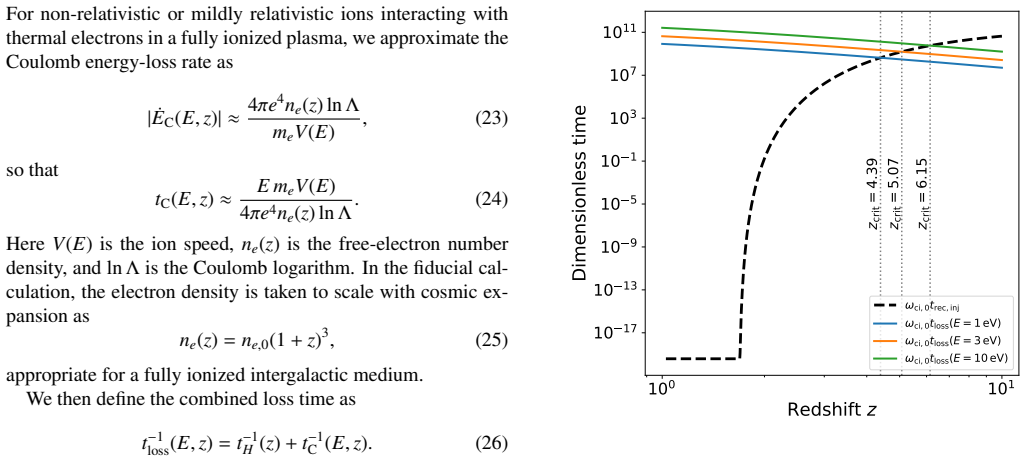
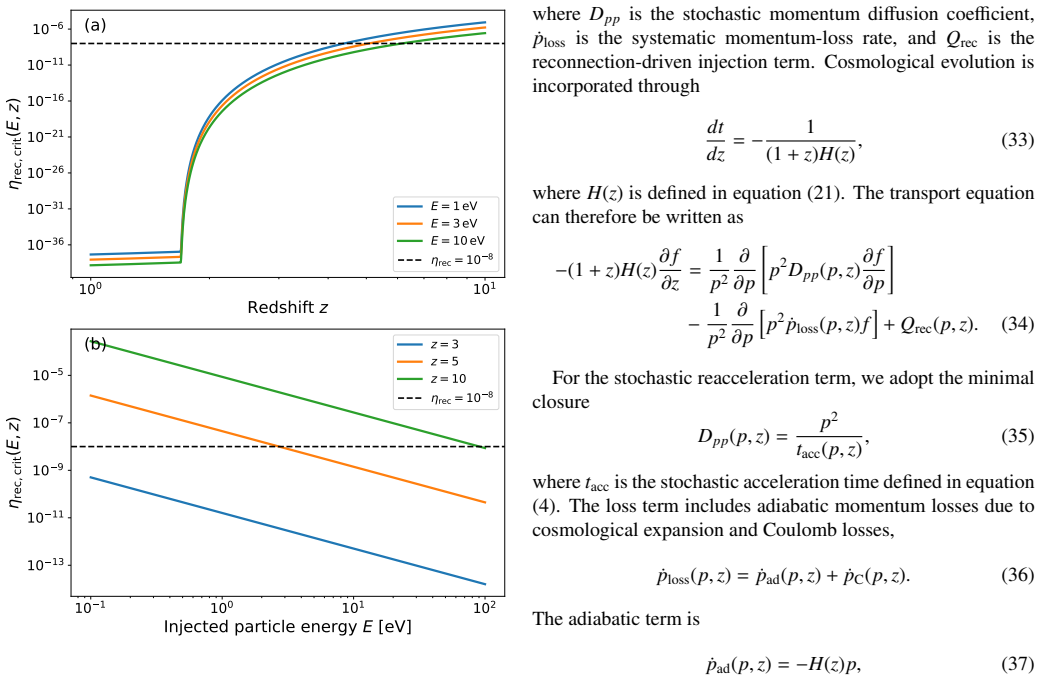
The power injected by reconnection is taken to scale directly with the rate at which magnetic energy grows, and that reservoir itself is limited by the small magnetic fraction present in the high-beta plasma.
What would settle it
A measurement or simulation showing the nonthermal proton energy fraction during magnetogenesis exceeding roughly 10^{-6} would indicate that the reconnection source term supplies more energy than assumed.
Figures
read the original abstract
We investigate whether magnetic reconnection can provide suprathermal proton seed particles during cosmological magnetogenesis prior to nonlinear structure formation. Previous work showed that pressure-anisotropy-driven stochastic acceleration alone is strongly limited by cosmological expansion and Coulomb cooling. Here, we extend this framework by adding a phenomenological reconnection-driven source term to the Fokker--Planck equation for the isotropic ion distribution, with the injection power tied to the magnetic-energy growth rate during magnetogenesis. We find that reconnection can act as a fast injection channel and can produce a visible suprathermal tail. However, the resulting nonthermal energy fraction remains very small, of order $10^{-7}$ in the fiducial model, implying a negligible nonthermal pressure contribution to the pre-structure intergalactic medium. This limitation arises because the extremely high-beta plasma contains only a small magnetic-energy reservoir, even when reconnection itself is locally fast. Using a test-particle shock reacceleration estimate, we further show that the reconnection-produced tail can enhance the suprathermal proton population available for later structure-formation shocks by about an order of magnitude. Nevertheless, the associated hadronic gamma-ray emission from low-density cluster outskirts is expected to remain far below current detectability. We therefore conclude that reconnection during cosmological magnetogenesis is unlikely to dominate the cosmic-ray energy budget directly, but may provide a low-level seed population for subsequent shock acceleration.
Editorial analysis
A structured set of objections, weighed in public.
Referee Report
Summary. The manuscript investigates whether magnetic reconnection can inject suprathermal protons as seed particles during cosmological magnetogenesis by extending prior work on pressure-anisotropy-driven stochastic acceleration. It adds a phenomenological reconnection-driven source term to the Fokker-Planck equation for the isotropic ion distribution, with injection power tied directly to the magnetic-energy growth rate. The central results are that the nonthermal energy fraction remains of order 10^{-7} (negligible for pre-structure IGM pressure), the reconnection tail can enhance the suprathermal population available for later shocks by roughly an order of magnitude, and associated hadronic gamma-ray emission stays below detectability. The conclusion is that reconnection is unlikely to dominate the cosmic-ray budget directly but may supply a low-level seed population.
Significance. If the modeling holds, the work supplies a quantitative upper limit on reconnection's direct contribution to the cosmic-ray energy budget in the high-beta regime, showing that the small magnetic-energy reservoir (combined with expansion and cooling) caps the nonthermal fraction at a very low level. The test-particle shock reacceleration estimate provides a concrete, falsifiable link to structure-formation models and clarifies the seeding role for subsequent acceleration. This is a useful clarification for cosmic-ray origin studies even if the absolute normalization carries model dependence.
major comments (1)
- [model description / Fokker-Planck setup] The reconnection-driven source term in the Fokker-Planck equation has its injection power normalized directly to the magnetic-energy growth rate. This choice sets the reported nonthermal fraction (~10^{-7}) by construction once the high-beta limit is adopted, rather than through an independent calibration or external benchmark; the absence of sensitivity tests on the normalization parameter therefore makes the numerical value of the energy fraction and the order-of-magnitude seed enhancement dependent on an unvalidated modeling assumption.
minor comments (2)
- No error bars, Monte-Carlo realizations, or parameter-variation scans are described for the fiducial nonthermal fraction or the shock-seed enhancement factor.
- The high-beta assumption and the precise form of the phenomenological source term would benefit from a short dedicated paragraph justifying the chosen normalization against existing kinetic simulations of reconnection in high-beta plasmas.
Simulated Author's Rebuttal
We thank the referee for the constructive feedback on our manuscript. We address the single major comment below and indicate the planned revisions.
read point-by-point responses
-
Referee: The reconnection-driven source term in the Fokker-Planck equation has its injection power normalized directly to the magnetic-energy growth rate. This choice sets the reported nonthermal fraction (~10^{-7}) by construction once the high-beta limit is adopted, rather than through an independent calibration or external benchmark; the absence of sensitivity tests on the normalization parameter therefore makes the numerical value of the energy fraction and the order-of-magnitude seed enhancement dependent on an unvalidated modeling assumption.
Authors: The normalization to the magnetic-energy growth rate is a phenomenological modeling choice motivated by the physical expectation that reconnection dissipates stored magnetic energy into suprathermal particles. In the high-beta regime relevant to pre-structure IGM, this necessarily yields a small nonthermal fraction because the magnetic reservoir itself is tiny relative to the thermal energy. We acknowledge, however, that the absolute normalization (i.e., the efficiency with which dissipated magnetic energy is channeled into the nonthermal tail) is not independently calibrated and that sensitivity tests are absent. In the revised manuscript we will add explicit sensitivity calculations varying the normalization parameter over a plausible range and will report the resulting variation in the nonthermal fraction and seed enhancement. revision: yes
Circularity Check
No significant circularity identified
full rationale
The paper adopts a phenomenological source term with injection power tied to magnetic-energy growth rate as an explicit modeling choice. The resulting nonthermal fraction of order 10^{-7} is a direct numerical consequence of the high-beta regime (magnetic energy reservoir << thermal energy) within that setup. No load-bearing step reduces a claimed derivation or prediction to its own inputs by construction; the limitation is presented as following from the plasma beta and the chosen normalization. The framework is self-contained as a model calculation with no evident self-citation chain or self-definitional reduction in the abstract or described chain.
Axiom & Free-Parameter Ledger
free parameters (1)
- reconnection source normalization
axioms (2)
- domain assumption Pressure-anisotropy-driven stochastic acceleration is strongly limited by cosmological expansion and Coulomb cooling
- domain assumption Extremely high-beta plasma during magnetogenesis contains only a small magnetic-energy reservoir
Reference graph
Works this paper leans on
-
[1]
2015, , 579, A101
Aladro, R., Martín, S., Riquelme, D., et al. 2015, , 579, A101
2015
-
[2]
Search for cosmic-ray induced gamma-ray emission in Galaxy Clusters
Search for Cosmic-Ray-induced Gamma-Ray Emission in Galaxy Clusters. The Astrophysical Journal , keywords =. doi:10.1088/0004-637X/787/1/18 , archivePrefix =. 1308.5654 , primaryClass =
work page internal anchor Pith review Pith/arXiv arXiv doi:10.1088/0004-637x/787/1/18
-
[3]
Detection of the Characteristic Pion-Decay Signature in Supernova Remnants
Detection of the Characteristic Pion-Decay Signature in Supernova Remnants. Science , keywords =. doi:10.1126/science.1231160 , archivePrefix =. 1302.3307 , primaryClass =
work page internal anchor Pith review Pith/arXiv arXiv doi:10.1126/science.1231160
-
[4]
and Le, Truong and Dermer, Charles D
Becker, Peter A. and Le, Truong and Dermer, Charles D. , title =. 2006 , month =. doi:10.1086/505319 , url =
-
[5]
Monthly Notices of the Royal Astronomical Society , keywords =
The acceleration of cosmic rays in shock fronts - I. Monthly Notices of the Royal Astronomical Society , keywords =. doi:10.1093/mnras/182.2.147 , adsnote =
-
[6]
The Astrophysical Journal Letters , keywords =
Particle acceleration by astrophysical shocks. The Astrophysical Journal Letters , keywords =. doi:10.1086/182658 , adsnote =
-
[7]
and Lazarian, A
Brunetti, G. and Lazarian, A. , title =. Monthly Notices of the Royal Astronomical Society , volume =. 2016 , month =
2016
-
[8]
Compressible turbulence in galaxy clusters: physics and stochastic particle re-acceleration. Monthly Notices of the Royal Astronomical Society , keywords =. doi:10.1111/j.1365-2966.2007.11771.x , archivePrefix =. astro-ph/0703591 , primaryClass =
-
[9]
Simulations of Ion Acceleration at Non-relativistic Shocks. I. Acceleration Efficiency. The Astrophysical Journal , keywords =. doi:10.1088/0004-637X/783/2/91 , archivePrefix =. 1310.2943 , primaryClass =
work page internal anchor Pith review Pith/arXiv arXiv doi:10.1088/0004-637x/783/2/91
-
[10]
Journal of Plasma Physics , author=
A review of the 0.1 reconnection rate problem , volume=. Journal of Plasma Physics , author=. 2017 , pages=. doi:10.1017/S0022377817000666 , number=
-
[11]
doi:10.3847/1538-4357/ab4c33 , year =
Comisso, Luca and Sironi, Lorenzo , title =. doi:10.3847/1538-4357/ab4c33 , year =
-
[12]
Physical Review Letters , volume =
Particle Acceleration in Relativistic Plasma Turbulence , author =. Physical Review Letters , volume =. 2018 , month =
2018
-
[13]
Reports on Progress in Physics , keywords =
REVIEW ARTICLE: An introduction to the theory of diffusive shock acceleration of energetic particles in tenuous plasmas. Reports on Progress in Physics , keywords =. doi:10.1088/0034-4885/46/8/002 , adsnote =
-
[14]
Cosmic ray transport in galaxy clusters: implications for radio halos, gamma-ray signatures, and cool core heating , DOI= "10.1051/0004-6361/201015652", journal =
-
[15]
Falceta-Gonçalves, D. and Kowal, G. , title =. 2015 , month =. doi:10.1088/0004-637X/808/1/65 , url =
-
[16]
Physical Review , year = 1949, month = apr, volume =
On the Origin of the Cosmic Radiation. Physical Review , year = 1949, month = apr, volume =. doi:10.1103/PhysRev.75.1169 , adsurl =
-
[17]
Constraining turbulence and conduction in the hot ICM through density perturbations , DOI= "10.1051/0004-6361/201322295", url= "https://doi.org/10.1051/0004-6361/201322295", journal =
-
[18]
R.J. Gould , abstract =. Energy loss of a fast ion in a plasma , journal =. 1971 , issn =. doi:https://doi.org/10.1016/0375-9601(71)90658-X , url =
-
[19]
Stochastic particle acceleration during pressure-anisotropy-driven magnetogenesis in the pre-structure Universe , journal =. 2026 , issn =. doi:https://doi.org/10.1016/j.astropartphys.2026.103264 , author =
-
[20]
Universe , VOLUME =
Ha, Ji-Hoon , TITLE =. Universe , VOLUME =. 2025 , NUMBER =
2025
-
[21]
Ha, Ji-Hoon and Ryu, Dongsu and Kang, Hyesung , title =. 2023 , month =. doi:10.3847/1538-4357/acabbe , url =
-
[22]
Ha, Ji-Hoon and Ryu, Dongsu and Kang, Hyesung , title =. 2020 , month =. doi:10.3847/1538-4357/ab7c5b , url =
-
[23]
Proton Acceleration in Weak Quasi-parallel Intracluster Shocks: Injection and Early Acceleration
Proton Acceleration in Weak Quasi-parallel Intracluster Shocks: Injection and Early Acceleration. The Astrophysical Journal , keywords =. doi:10.3847/1538-4357/aad634 , archivePrefix =. 1807.09403 , primaryClass =
work page internal anchor Pith review Pith/arXiv arXiv doi:10.3847/1538-4357/aad634
-
[24]
Properties of Merger Shocks in Merging Galaxy Clusters
Properties of Merger Shocks in Merging Galaxy Clusters. The Astrophysical Journal , keywords =. doi:10.3847/1538-4357/aab4a2 , archivePrefix =. 1706.05509 , primaryClass =
work page internal anchor Pith review Pith/arXiv arXiv doi:10.3847/1538-4357/aab4a2
-
[25]
The Quiescent Intracluster Medium in the Core of the Perseus Cluster
The quiescent intracluster medium in the core of the Perseus cluster. Nature , keywords =. doi:10.1038/nature18627 , archivePrefix =. 1607.04487 , primaryClass =
work page internal anchor Pith review Pith/arXiv arXiv doi:10.1038/nature18627
-
[26]
Diffuse radio emission from clusters in the MareNostrum Universe simulation. Monthly Notices of the Royal Astronomical Society , keywords =. doi:10.1111/j.1365-2966.2008.13955.x , archivePrefix =. 0807.1266 , primaryClass =
-
[27]
Shock Waves and Cosmic Ray Acceleration in the Outskirts of Galaxy Clusters
Shock Waves and Cosmic Ray Acceleration in the Outskirts of Galaxy Clusters. The Astrophysical Journal , keywords =. doi:10.1088/0004-637X/785/2/133 , archivePrefix =. 1403.1420 , primaryClass =
work page internal anchor Pith review Pith/arXiv arXiv doi:10.1088/0004-637x/785/2/133
-
[28]
Kang, Hyesung and Ryu, Dongsu , title =. 2011 , month =. doi:10.1088/0004-637X/734/1/18 , url =
-
[29]
Diffusive Shock Acceleration in Test-Particle Regime
Diffusive Shock Acceleration in Test-particle Regime. The Astrophysical Journal , keywords =. doi:10.1088/0004-637X/721/1/886 , archivePrefix =. 1008.0429 , primaryClass =
work page internal anchor Pith review Pith/arXiv arXiv doi:10.1088/0004-637x/721/1/886
-
[30]
Gamma-Rays from Intergalactic Shocks
Gamma Rays from Intergalactic Shocks. The Astrophysical Journal , keywords =. doi:10.1086/345946 , archivePrefix =. astro-ph/0202318 , primaryClass =
work page internal anchor Pith review Pith/arXiv arXiv doi:10.1086/345946
-
[31]
Nature , year = 1995, month = nov, volume =
Evidence for shock acceleration of high-energy electrons in the supernova remnant SN1006. Nature , year = 1995, month = nov, volume =. doi:10.1038/378255a0 , adsurl =
-
[32]
Kunz, Matthew W. and Jones, Thomas W. and Zhuravleva, Irina. Plasma Physics of the Intracluster Medium. Handbook of X-ray and Gamma-ray Astrophysics. 2022. doi:10.1007/978-981-16-4544-0_125-1
-
[33]
Kunz, M. W. and Schekochihin, A. A. and Cowley, S. C. and Binney, J. J. and Sanders, J. S. , title =. Monthly Notices of the Royal Astronomical Society , volume =. 2011 , month =. doi:10.1111/j.1365-2966.2010.17621.x , url =
-
[34]
Komatsu, E. and Smith, K. M. and Dunkley, J. and Bennett, C. L. and Gold, B. and Hinshaw, G. and Jarosik, N. and Larson, D. and Nolta, M. R. and Page, L. and Spergel, D. N. and Halpern, M. and Hill, R. S. and Kogut, A. and Limon, M. and Meyer, S. S. and Odegard, N. and Tucker, G. S. and Weiland, J. L. and Wollack, E. and Wright, E. L. , title =. 2011 , mo...
work page internal anchor Pith review doi:10.1088/0067-0049/192/2/18 2011
-
[35]
Why does Steady-State Magnetic Reconnection have a Maximum Local Rate of Order 0.1? , author =. Phys. Rev. Lett. , volume =. 2017 , month =
2017
-
[36]
Miniati, Francesco and Bell, A. R. , title =. 2011 , month =. doi:10.1088/0004-637X/729/1/73 , url =
-
[37]
2003, MNRAS, 344, 1000, doi: 10.1046/j.1365-8711.2003.06897.x
Numerical modelling of gamma radiation from galaxy clusters. Monthly Notice of the Royal Astronomical Society , keywords =. doi:10.1046/j.1365-8711.2003.06647.x , archivePrefix =. astro-ph/0303593 , primaryClass =
-
[38]
Properties of Cosmic Shock Waves in Large Scale Structure Formation
Properties of Cosmic Shock Waves in Large-Scale Structure Formation. The Astrophysical Journal , keywords =. doi:10.1086/317027 , archivePrefix =. astro-ph/0005444 , primaryClass =
work page internal anchor Pith review Pith/arXiv arXiv doi:10.1086/317027
-
[39]
Earth, Planets and Space , keywords =
Magnetic reconnection in large-scale cosmic plasmas. Earth, Planets and Space , keywords =. doi:10.1186/BF03353288 , adsnote =
-
[40]
Energetics of high-energy cosmic radiations , author =. Phys. Rev. D , volume =. 2019 , month =. doi:10.1103/PhysRevD.99.063012 , url =
-
[41]
Origin and impacts of the first cosmic rays , author =. Phys. Rev. D , volume =. 2019 , month =. doi:10.1103/PhysRevD.100.061301 , url =
-
[42]
Inverse Compton emission from a cosmic-ray precursor in RX J1713.7-3946 , journal =
Yutaka Ohira and Ryo Yamazaki , keywords =. Inverse Compton emission from a cosmic-ray precursor in RX J1713.7-3946 , journal =. 2017 , issn =. doi:https://doi.org/10.1016/j.jheap.2017.03.001 , url =
-
[43]
Additional planets and stellar models
Ohira, Yutaka and Murase, Kohta and Yamazaki, Ryo , title =. Monthly Notices of the Royal Astronomical Society , volume =. 2011 , month =. doi:10.1111/j.1365-2966.2010.17539.x , url =
-
[44]
Simultaneous Acceleration of Protons and Electrons at Nonrelativistic Quasiparallel Collisionless Shocks. Physical Review Letters , keywords =. doi:10.1103/PhysRevLett.114.085003 , archivePrefix =. 1412.0672 , primaryClass =
work page internal anchor Pith review Pith/arXiv arXiv doi:10.1103/physrevlett.114.085003
-
[45]
Planck 2018 results. VI. Cosmological parameters. Astronomy & Astrophysics , keywords =. doi:10.1051/0004-6361/201833910 , archivePrefix =. 1807.06209 , primaryClass =
work page internal anchor Pith review Pith/arXiv arXiv doi:10.1051/0004-6361/201833910 2018
-
[46]
Stochastic Acceleration by Turbulence
Stochastic Acceleration by Turbulence. Space Science Reviews , keywords =. doi:10.1007/s11214-012-9900-6 , archivePrefix =. 1205.2136 , primaryClass =
work page internal anchor Pith review Pith/arXiv arXiv doi:10.1007/s11214-012-9900-6
-
[47]
Detecting shock waves in cosmological smoothed particle hydrodynamics simulations. Monthly Notices of the Royal Astronomical Society , keywords =. doi:10.1111/j.1365-2966.2005.09953.x , archivePrefix =. astro-ph/0603483 , primaryClass =
-
[48]
Additional planets and stellar models
Simulating the -ray emission from galaxy clusters: a universal cosmic ray spectrum and spatial distribution. Monthly Notices of the Royal Astronomical Society , keywords =. doi:10.1111/j.1365-2966.2010.17328.x , archivePrefix =. 1001.5023 , primaryClass =
-
[49]
The Astrophysical Journal , keywords =
A Diffusive Shock Acceleration Model for Protons in Weak Quasi-parallel Intracluster Shocks. The Astrophysical Journal , keywords =. doi:10.3847/1538-4357/ab3a3a , archivePrefix =. 1905.04476 , primaryClass =
-
[50]
Science , volume =
Dongsu Ryu and Hyesung Kang and Jungyeon Cho and Santabrata Das , title =. Science , volume =. 2008 , doi =
2008
-
[51]
Cosmological Shock Waves and Their Role in the Large Scale Structure of the Universe
Cosmological Shock Waves and Their Role in the Large-Scale Structure of the Universe. The Astrophysical Journal , keywords =. doi:10.1086/376723 , archivePrefix =. astro-ph/0305164 , primaryClass =
work page internal anchor Pith review Pith/arXiv arXiv doi:10.1086/376723
-
[52]
The Energy Spectrum of Primary Cosmic-Ray Electrons in Clusters of Galaxies and Inverse Compton Emission. The Astrophysical Journal , keywords =. doi:10.1086/307501 , archivePrefix =. astro-ph/9901061 , primaryClass =
work page internal anchor Pith review Pith/arXiv arXiv doi:10.1086/307501
-
[53]
Shock finding on a moving-mesh: I. Shock statistics in non-radiative cosmological simulations
Shock finding on a moving mesh - I. Shock statistics in non-radiative cosmological simulations. Monthly Notices of the Royal Astronomical Society , keywords =. doi:10.1093/mnras/stu2386 , archivePrefix =. 1407.4117 , primaryClass =
work page internal anchor Pith review Pith/arXiv arXiv doi:10.1093/mnras/stu2386
-
[54]
Schekochihin, A. A. and Cowley, S. C. , title =. Physics of Plasmas , volume =. 2006 , month =
2006
-
[55]
Schekochihin, A. A. and Cowley, S. C. , title =. Astronomische Nachrichten , volume =. doi:https://doi.org/10.1002/asna.200610600 , year =
-
[56]
Schekochihin, A. A. and Cowley, S. C. and Kulsrud, R. M. and Hammett, G. W. and Sharma, P. , title =. doi:10.1086/431202 , year =
-
[57]
Cosmic Ray Astrophysics
-
[58]
Cosmological Shocks in Adaptive Mesh Refinement Simulations and the Acceleration of Cosmic Rays
Cosmological Shocks in Adaptive Mesh Refinement Simulations and the Acceleration of Cosmic Rays. The Astrophysical Journal , keywords =. doi:10.1086/592496 , archivePrefix =. 0806.1522 , primaryClass =
work page internal anchor Pith review Pith/arXiv arXiv doi:10.1086/592496
-
[59]
Shock waves in Eulerian cosmological simulations: main properties and acceleration of cosmic rays. Monthly Notices of the Royal Astronomical Society , keywords =. doi:10.1111/j.1365-2966.2009.14691.x , archivePrefix =. 0808.0609 , primaryClass =
-
[60]
The First Magnetic Fields. Space Science Reviews , keywords =. doi:10.1007/s11214-011-9833-5 , archivePrefix =. 1109.4052 , primaryClass =
work page internal anchor Pith review Pith/arXiv arXiv doi:10.1007/s11214-011-9833-5
-
[61]
Monthly Notices of the Royal Astronomical Society , volume =
Wiener, Joshua and Zweibel, Ellen G , title =. Monthly Notices of the Royal Astronomical Society , volume =. 2019 , month =
2019
-
[62]
and Oh, S
Wiener, Joshua and Zweibel, Ellen G. and Oh, S. Peng , title =. Monthly Notices of the Royal Astronomical Society , volume =. 2018 , month =
2018
-
[63]
Cosmic Ray Streaming in Clusters of Galaxies
Cosmic ray streaming in clusters of galaxies. Monthly Notices of the Royal Astronomical Society , keywords =. doi:10.1093/mnras/stt1163 , archivePrefix =. 1303.4746 , primaryClass =
work page internal anchor Pith review Pith/arXiv arXiv doi:10.1093/mnras/stt1163
discussion (0)
Sign in with ORCID, Apple, or X to comment. Anyone can read and Pith papers without signing in.