Astrophysical Applications of the Physics presented in the Film Interstellar
Pith reviewed 2026-06-28 13:42 UTC · model grok-4.3
The pith
Rapidly spinning black holes allow stable orbits between the innermost stable circular orbit and the event horizon, enabling extreme time dilation.
A machine-rendered reading of the paper's core claim, the machinery that carries it, and where it could break.
Core claim
General relativity permits bound orbits between the ISCO and the event horizon for rapidly spinning black holes, enabling the extreme time dilation (one hour equals seven years) required by the Interstellar scenario.
What carries the argument
The Kerr metric for rotating black holes, which shifts the location of the innermost stable circular orbit inward for high spin parameters, allowing stable orbits in the high time-dilation zone.
If this is right
- Extreme time dilation effects become possible for planets orbiting near the horizons of spinning black holes.
- The required spin rate must be high for the time dilation factor to reach seven years per hour.
- Computations of orbital parameters and dilation factors provide quantitative support for such configurations.
- These orbits may have implications for observations of matter or hypothetical planets near astrophysical black holes.
Where Pith is reading between the lines
- Real supermassive black holes with near-maximal spin could host environments with dramatic time differences between nearby and distant observers.
- This mechanism might influence interpretations of signals from accretion flows or compact objects close to black hole horizons.
- Extensions could include checking stability against perturbations or radiation effects not considered in the basic model.
Load-bearing premise
The black hole must be spinning at a sufficiently high rate and the planet must occupy a stable circular orbit at a radius where the time-dilation factor reaches the required value without additional disruptive effects.
What would settle it
A calculation showing that no stable circular orbits exist for any spin parameter in the region between the event horizon and the Schwarzschild ISCO, or an observation ruling out planets in such orbits around known high-spin black holes.
Figures
read the original abstract
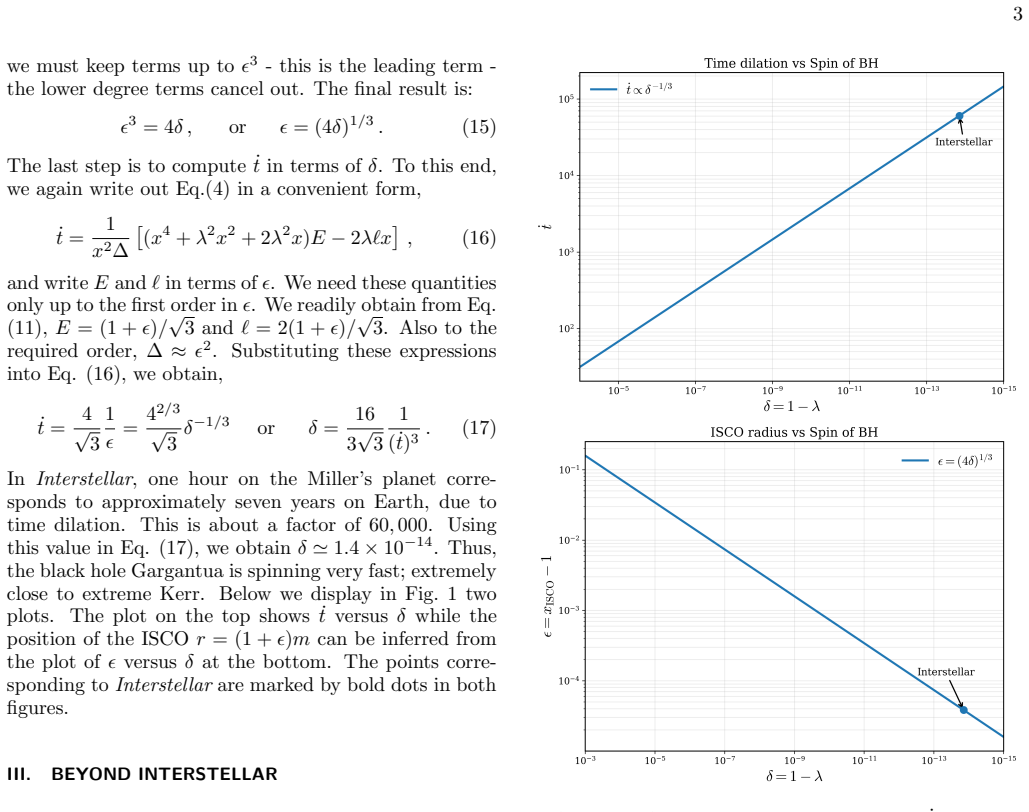
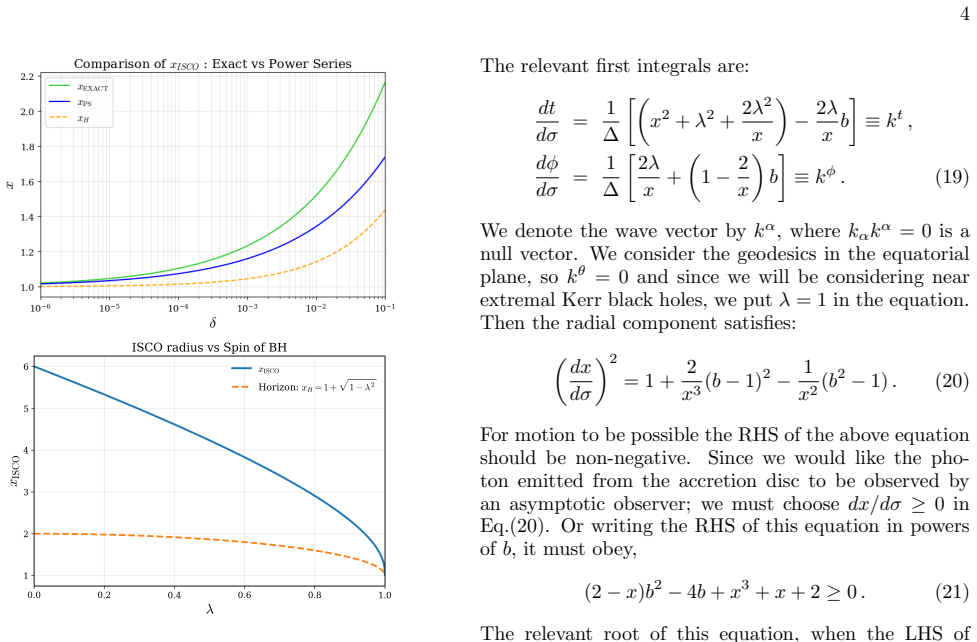
The film Interstellar is grounded in real physics calculations. A key requirement in the film is that of a planet orbiting a supermassive black hole such that one hour on the planet corresponds to seven years on Earth. Such extreme time dilation is possible only if the planet orbits the black hole very close to its horizon. For a non-rotating (Schwarzschild) black hole, the innermost stable circular orbit (ISCO) lies at three times the Schwarzschild radius; a bound orbit between the ISCO and the event horizon is not possible. Surprisingly, general relativity allows such orbits to exist if the black hole is spinning rapidly. In this work, we present computations that are non-trivial and interesting in themselves, but more importantly, they may have useful astrophysical implications.
Editorial analysis
A structured set of objections, weighed in public.
Referee Report
Summary. The manuscript claims that the extreme time dilation (one hour on the planet equals seven years on Earth) required by the Interstellar film is permitted by general relativity only for a rapidly spinning Kerr black hole, where bound orbits exist at radii closer to the horizon than the Schwarzschild ISCO at 3 r_s; it presents non-trivial computations of such orbits and discusses their astrophysical implications.
Significance. If the computations hold, the work correctly recovers standard Kerr geodesic results on the spin-dependent ISCO and time-dilation factor, providing a clear illustration of strong-field effects with potential applications to modeling orbits and redshift near astrophysical spinning black holes.
minor comments (1)
- [Abstract] Abstract: the sentence 'a bound orbit between the ISCO and the event horizon is not possible' for Schwarzschild and 'such orbits' for Kerr is slightly loose, as it implicitly refers to the Schwarzschild ISCO value; explicitly state that the Kerr ISCO radius decreases with spin, allowing stable circular orbits at r where the redshift reaches the required factor.
Simulated Author's Rebuttal
We thank the referee for their review and recommendation of minor revision. The manuscript presents explicit computations of stable orbits and time-dilation factors for high-spin Kerr black holes to realize the extreme dilation required by Interstellar, while noting possible astrophysical contexts.
Circularity Check
No significant circularity detected
full rationale
The paper applies standard Kerr geodesic analysis to compute time dilation for circular orbits near a rapidly spinning black hole, reproducing the Interstellar scenario. The abstract explicitly contrasts the Schwarzschild ISCO (at 3 Rs) with the known spin-dependent reduction of r_ISCO(a) to M at a=1, and the unbounded growth of the redshift factor; these are textbook results from the Kerr metric, not derived or fitted within the paper. No equations, self-citations, or ansatze are shown that would make any prediction equivalent to an input by construction. The derivation chain is self-contained against external benchmarks (Kerr geodesics) and receives the default non-circularity finding.
Axiom & Free-Parameter Ledger
Reference graph
Works this paper leans on
-
[1]
Dhurandhar, S. V. and Mitra, S. , title =. 2023 , isbn =
2023
-
[2]
, title =
Chandrasekhar, S. , title =. 1983 , isbn =
1983
-
[3]
, title =
Carter, B. , title =. Phys. Rev. , volume =. 1968 , doi =
1968
-
[4]
Narlikar, J. V. , title =. 1983 , isbn =
1983
-
[5]
Misner, C. W. and Thorne, K. S. and Wheeler, J. A. , title =. 1973 , isbn =
1973
-
[6]
Thorne, K. S. , title =. 2014 , isbn =
2014
-
[7]
Hawking, S. W. and Ellis, G. F. R. , title =. 1973 , isbn =
1973
-
[8]
, title =
Luminet, J.-P. , title =. Annalen der Physik , volume =. 2015 , doi =
2015
-
[9]
Adler, R. J. , title =. 2019 , isbn =
2019
-
[10]
Adler, R. J. and Bazin, M. and Schiffer, M. , title =. 1995 , isbn =
1995
-
[11]
Hartle, J. B. , title =. 2003 , isbn =
2003
-
[12]
Creighton, J. D. E. and Anderson, W. G. , title =. 2011 , isbn =
2011
-
[13]
Bardeen, J. M. and Press, W. H. and Teukolsky, S. A. , title =. Astrophys. J. , volume =. 1972 , doi =
1972
-
[14]
Thorne, K. S. , title =. 1994 , isbn =
1994
-
[15]
, title =
Poisson, E. , title =. 2004 , isbn =
2004
-
[16]
and Friedman, A
Susskind, L. and Friedman, A. , title =. 2023 , isbn =
2023
-
[17]
, title =
Carroll, S. , title =. 2019 , isbn =
2019
-
[18]
Schutz, B. F. , title =. 2009 , isbn =
2009
-
[19]
Dhurandhar, S. V. , title =. Class. Quantum Grav. , volume =. 1986 , doi =
1986
-
[20]
Wilkins, D. C. , title =. Phys. Rev. D , volume =. 1972 , doi =
1972
-
[21]
, title =
Visser, M. , title =. arXiv , eprint =. 2007 , doi =
2007
-
[22]
Bardeen, J. M. , title =. Black Holes , editor =
-
[23]
Teukolsky, S. A. , title =. Astrophys. J. , volume =. 1973 , doi =
1973
-
[24]
, title =
Penrose, R. , title =. Phys. Rev. Lett. , volume =. 1965 , doi =
1965
-
[25]
Kokkotas, K. D. and Schutz, B. F. , title =. Monthly Notices of the Royal Astronomical Society , volume =. 1992 , month =. doi:10.1093/mnras/255.1.119 , url =
-
[26]
Andersson, Nils and Kokkotas, Kostas D. , title =. Monthly Notices of the Royal Astronomical Society , volume =. 1998 , month =. doi:10.1046/j.1365-8711.1998.01840.x , url =
-
[27]
Time-delay interferometry without delays , author =. Phys. Rev. D , volume =. 2021 , month =. doi:10.1103/PhysRevD.103.082001 , url =
-
[28]
Hierarchical Black Hole Mergers in Active Galactic Nuclei , author =. Phys. Rev. Lett. , volume =. 2019 , month =. doi:10.1103/PhysRevLett.123.181101 , url =
-
[29]
Tinto, Massimo and Dhurandhar, Sanjeev V. Time-Delay Interferometry. Living Reviews in Relativity. 2021. doi:10.1007/s41114-020-00029-6
-
[30]
and DeBra,D
Tinto,M. and DeBra,D. and Buchman,S. and Tilley,S. , title =. Review of Scientific Instruments , volume =. 2015 , doi =
2015
-
[31]
Aasi, J. and et. al. , title=. Class. Quantum Grav. , volume=. doi:10.1088/0264-9381/32/7/074001 , year=
-
[32]
On the minimum flexing of LISA's arms. Class. Quantum Grav. , year = "2006", month = "Mar", volume =. doi:10.1088/0264-9381/23/5/017 , adsurl =
-
[33]
and Karas, V
Martocchia, A. and Karas, V. and Matt, G. , title =. Monthly Notices of the Royal Astronomical Society , volume =. 2000 , doi =
2000
-
[34]
Bromley, B. C. and Miller, W. A. and Pariev, V. I. , title =. Nature , volume =. 1998 , doi =
1998
-
[35]
, title =
Laor, A. , title =. The Astrophysical Journal , volume =. 1991 , doi =
1991
-
[36]
Observation of Gravitational Waves from a Binary Black Hole Merger , author =. Phys. Rev. Lett. , volume =. 2016 , month =
2016
-
[37]
Thorne , title =
Kip S. Thorne , title =
-
[38]
Le Opere di Galileo Galilei , Publisher =
-
[39]
Accadia, T. and et. al. , title=. J. Instrum. , volume=. doi:10.1088/1748-0221/7/03/P03012 , year=
-
[40]
Bender, P. L. and Hils, D. , doi =. Confusion noise level due to galactic and extragalactic binaries , volume =. Class. Quantum Grav. , pages =
-
[41]
Armstrong, J. W. , doi =. Living Rev. Relativity , title =
-
[42]
The gravitational wave signal from the Galactic disk population of binaries containing two compact objects , volume =. Astron. Astrophys. , pages =. doi:10.1051/0004-6361:20010683 , eprint =
-
[43]
and Estabrook, F
Tinto, M. and Estabrook, F. B. , doi =. Parallel beam interferometric detectors of gravitational waves , volume =. Phys. Rev. D , pages =
-
[44]
Tinto, M. , doi =. The. Class. Quantum Grav. , pages =
-
[45]
and Wahlquist, H
Estabrook, F. and Wahlquist, H. , doi =. Response of Doppler spacecraft tracking to gravitational radiation , volume =. Gen. Relativ. Gravit. , pages =
-
[46]
Estabrook, F. B. , doi =. Response functions of free mass gravitational wave antennas , volume =. Gen. Relativ. Gravit. , pages =
-
[47]
Bender, P. L. and et. al. , cited =
-
[48]
Cancellation of laser noise in an unequal-arm interferometer detector of gravitational radiation , author =. Phys. Rev. D , volume =. 1999 , month =. doi:10.1103/PhysRevD.59.102003 , url =
-
[49]
Geometric Time Delay Interferometry
Geometric time delay interferometry , volume =. doi:10.1103/PhysRevD.72.042003 , eid =. arXiv , author =:gr-qc/0504145 , journal =
work page internal anchor Pith review Pith/arXiv arXiv doi:10.1103/physrevd.72.042003
-
[50]
Time Delay Interferometry for LISA with one arm dysfunctional
Time Delay Interferometry for. doi:10.1088/0264-9381/27/13/135013 , eid =. arXiv , author =:1001.4911 , journal =
work page internal anchor Pith review Pith/arXiv arXiv doi:10.1088/0264-9381/27/13/135013
-
[51]
Time-delay interferometry and the relativistic treatment of LISA optical links
Time-delay interferometry and the relativistic treatment of. doi:10.1088/1742-6596/154/1/012047 , eid =. arXiv , author =:0808.2696 , journal =
work page internal anchor Pith review Pith/arXiv arXiv doi:10.1088/1742-6596/154/1/012047
-
[52]
Optimal filtering of the LISA data
Optimal filtering of the. doi:10.1103/PhysRevD.70.022003 , eid =. arXiv , author =:gr-qc/0401108 , journal =
work page internal anchor Pith review Pith/arXiv arXiv doi:10.1103/physrevd.70.022003
-
[53]
and Estabrook, F
Tinto, M. and Estabrook, F. B. and Armstrong, J. W. , doi =. Time-delay interferometry for. Phys. Rev. D , numpages =
-
[54]
Tinto, M. , doi =. Spacecraft to spacecraft coherent laser tracking as a xylophone interferometer detector of gravitational radiation , volume =. Phys. Rev. D , numpages =
-
[55]
Armstrong, J. W. and Estabrook, F. B. and Tinto, M. , doi =. Time-Delay Interferometry for Space-Based Gravitational Wave Searches , volume =. Astrophys. J. , pages =
-
[56]
Algebraic approach to time-delay data analysis for LISA , author =. Phys. Rev. D , volume =. 2002 , month =. doi:10.1103/PhysRevD.65.102002 , url =
-
[57]
Estabrook, F. B. and Tinto, M. and Armstrong, J. W. , doi =. Time-delay analysis of. Phys. Rev. D , numpages =
-
[58]
Shaddock, D. A. , doi =. Operating. Phys. Rev. D , numpages =
-
[59]
Cornish, N. J. and Hellings, R. W. , doi =. The effects of orbital motion on. Class. Quantum Grav. , pages =
-
[60]
Data combinations accounting for LISA spacecraft motion , author =. Phys. Rev. D , volume =. 2003 , month =. doi:10.1103/PhysRevD.68.061303 , url =
-
[61]
doi:10.1103/PhysRevD.66.122002 , eid =. arXiv , author =:gr-qc/0209039 , journal =
work page internal anchor Pith review Pith/arXiv arXiv doi:10.1103/physrevd.66.122002
-
[62]
and Pai, A
Rajesh Nayak, K. and Pai, A. and Dhurandhar, S. V. and Vinet, J.-Y. , journal =. Improving the sensitivity of
-
[63]
and Dhurandhar, S
Rajesh Nayak, K. and Dhurandhar, S. V. and Pai, A. and Vinet, J.-Y. , doi =. Optimizing the directional sensitivity of. Phys. Rev. D , numpages =
-
[64]
Faller, J. E. and Bender, P. L. , booktitle =. A possible laser gravitational wave experiment in space , volume =
-
[65]
Faller, J. E. and Bender, P. L. and Hall, J. L. and Hils, D. and Vincent, M. A. , booktitle =. Space antenna for gravitational wave astronomy , volume =
-
[66]
Faller, J. E. and Bender, P. L. and Hall, J. L. and Hils, D. and Stebbins, R. T. and Vincent, M. A. , doi =. An antenna for laser gravitational-wave observations in space , volume =. Adv. Space Res. , note =
-
[67]
and Hellings, R
Giampieri, G. and Hellings, R. W. and Tinto, M. and Faller, J. E. , doi =. Algorithms for unequal-arm. Opt. Commun. , pages =
-
[68]
Jenkins, G. M. and Watts, D. G. , publisher =. Spectral Analysis and its applications , year =
-
[69]
, cited =
Wolfram, S. , cited =. Mathematica , url =
-
[70]
NGO: The New Gravitational Wave Observatory , url =
-
[71]
and Weispfenning, V
Becker, T. and Weispfenning, V. , doi =. Gr\"obner Bases: A Computational Approach to Commutative Algebra , volume =
-
[72]
and Robbiano, L
Kreuzer, M. and Robbiano, L. , gbs_id =. Computational Commutative Algebra 1 , year =
-
[73]
, format =
Summers, D. , format =. Algorithm tradeoffs , year =
-
[74]
Folkner, W. M. and Hechler, F. and Sweetser, T. H. and Vincent, M. A. and Bender, P. L. , doi =. Class. Quantum Grav. , pages =
-
[75]
and Armstrong, J
Tinto, M. and Armstrong, J. W. and Estabrook, F. B. , doi =. Discriminating a gravitational wave background from instrumental noise in the. Phys. Rev. D , numpages =
-
[76]
and Vinet, J.-Y
Rajesh Nayak, K. and Vinet, J.-Y. , doi =. Algebraic Approach to Time-Delay Data Analysis: Orbiting case , volume =. Class. Quantum Grav. , pages =
-
[77]
Dhurandhar, S. V. and Vinet, J.-Y. and Rajesh Nayak, K. , doi =. General relativistic treatment of. Class. Quantum Grav. , numpages =
-
[78]
Sensitivity and parameter-estimation precision for alternate LISA configurations
Sensitivity and parameter-estimation precision for alternate. doi:10.1088/0264-9381/25/6/065005 , eid =. arXiv , author =:0710.4369 , journal =
work page internal anchor Pith review Pith/arXiv arXiv doi:10.1088/0264-9381/25/6/065005
-
[79]
, publisher =
Noble, B. , publisher =. Applied Linear Algebra , year =
-
[80]
Selby, S. M. , publisher =. Standard of Mathematical Tables , year =
discussion (0)
Sign in with ORCID, Apple, or X to comment. Anyone can read and Pith papers without signing in.