3d Summation-by-Parts scheme for Linear Wave Equations on Hyperboloidal Slices
Pith reviewed 2026-06-28 13:31 UTC · model grok-4.3
The pith
A summation-by-parts scheme for linear wave equations on hyperboloidal slices reaches future null infinity while remaining stable at the origin and z-axis.
A machine-rendered reading of the paper's core claim, the machinery that carries it, and where it could break.
Core claim
We derive a fully 3-dimensional Summation-By-Parts scheme for a class of linear wave equations on hyperboloidal slices that meet future null infinity on a Minkowski background. The scheme is derived in spherical polar coordinates, with a major strength being that it is provably stable and allows having grid points at the origin and on the z-axis, despite coordinate singularities, and at infinity, by introducing compactification followed by rescaling. Interesting relations are obtained between the rescaling and compactification factors that simplify the equations, and the conditions on constraint addition terms are discovered to maintain symmetric hyperbolicity.
What carries the argument
The summation-by-parts finite-difference operator on a compactified and rescaled hyperboloidal slice, which supplies discrete energy estimates that include the boundary at future null infinity while accommodating spherical-coordinate singularities.
If this is right
- The same construction applies when the problem is reduced to a standard Cauchy problem or to finite spacelike slices with an outer boundary.
- Dissipation operators can be placed at every point in the domain, including boundaries, in curvilinear coordinates while still satisfying the dissipative property.
- These operators reduce to the standard Kreiss-Oliger form on a Cartesian grid in the interior.
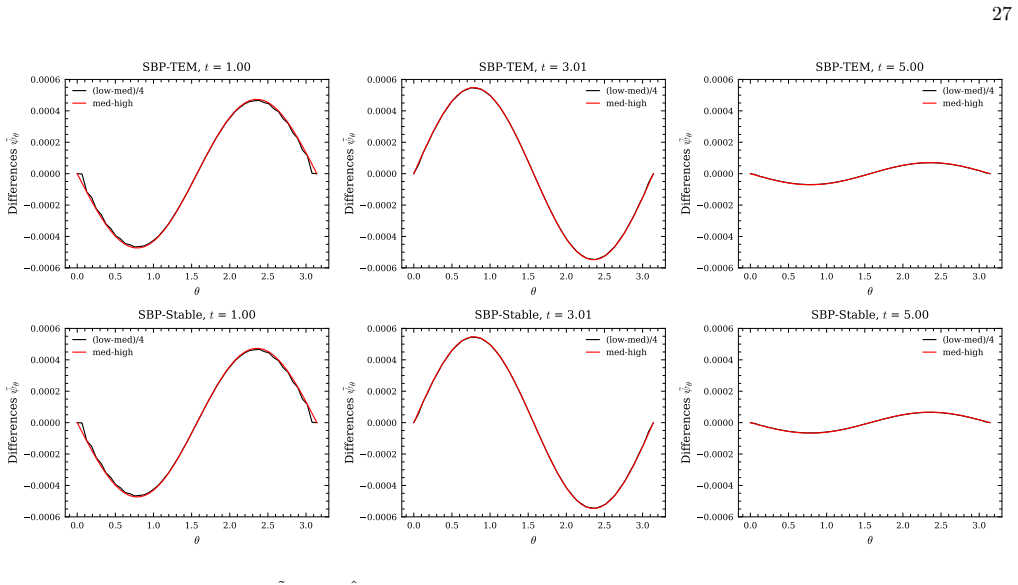
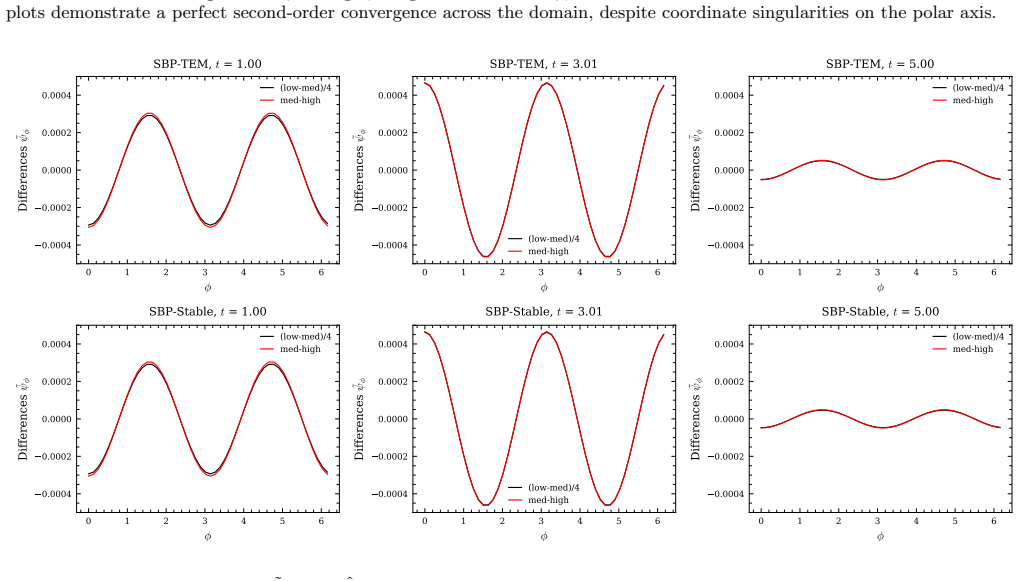
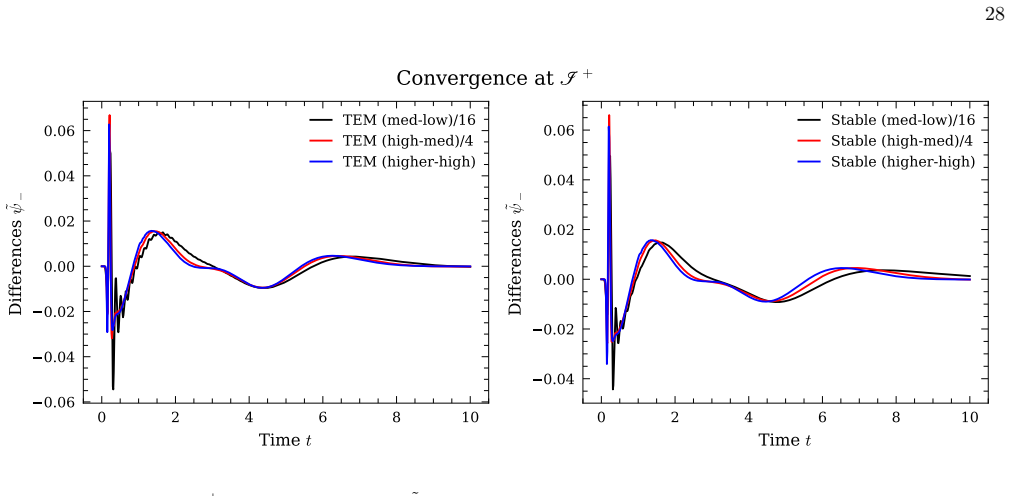
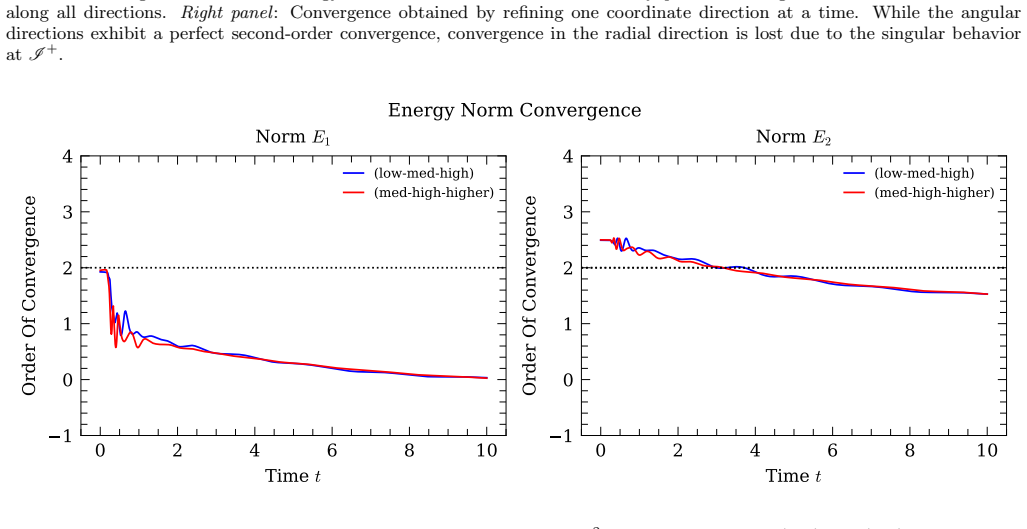
- New norm-based convergence tests yield more accurate error measurements than conventional ones.
- The approach supplies a route to nonlinear systems such as the Einstein equations with wave extraction at null infinity.
Where Pith is reading between the lines
- The same rescaling-compactification relations may allow the scheme to be adapted to other asymptotic coordinate systems without loss of stability.
- Extending the method to higher-order or spectral accuracy would directly improve the fidelity of extracted waveforms.
- Stable long-term evolution on hyperboloidal slices could remove the need for artificial outer boundaries in black-hole merger simulations.
Load-bearing premise
The specific relations between the rescaling and compactification factors simplify the equations while preserving symmetric hyperbolicity and the dissipative property in the energy norms.
What would settle it
A numerical run in which the discrete energy norm grows unbounded or the scheme becomes unstable when points are placed at the origin or z-axis would falsify the stability claim.
Figures

read the original abstract
We derive a fully 3-dimensional Summation-By-Parts scheme for a class of linear wave equations on hyperboloidal slices that meet future null infinity on a Minkowski background. The scheme is derived in spherical polar coordinates, with a major strength being that it is provably stable and allows having grid points at the origin and on the $z$-axis, despite coordinate singularities, and at infinity, by introducing compactification followed by rescaling. Reducing it to the standard Cauchy problem, or on finite spacelike slices with an outer boundary, will follow a similar procedure. Interesting relations are obtained between the rescaling and compactification factors that simplify the equations, and the conditions on constraint addition terms are discovered to maintain symmetric hyperbolicity. Numerical implementation is achieved using finite-difference methods at second-order accuracy, which can be generalized to higher-order or spectral accuracies as well. Dissipation operators are given a more abstract treatment, which makes it possible to define them everywhere in the domain, including at the boundary points, in curvilinear coordinates, such that they satisfy the dissipative property (DP) in our energy norms. These generalizations reduce to the well-known Kreiss-Oliger dissipation operators whenever defined on a Cartesian grid in the bulk and satisfy the DP in the standard $L^2$-norms. We also propose new norm convergence tests that produce more accurate outputs. Promising results are obtained, giving hope for application to fully nonlinear systems, like the Einstein Field Equations, and extracting the resulting gravitational waves free of systematic errors or gauge ambiguities.
Editorial analysis
A structured set of objections, weighed in public.
Referee Report
Summary. The manuscript claims to derive a fully 3-dimensional summation-by-parts (SBP) finite-difference scheme for a class of linear wave equations on hyperboloidal slices that reach future null infinity on a Minkowski background. The scheme is constructed in spherical polar coordinates, incorporating compactification followed by rescaling to permit grid points at the origin, along the z-axis, and at infinity despite coordinate singularities. It asserts that the scheme is provably stable via the SBP property together with energy norms that remain non-increasing once specific relations between the rescaling and compactification factors are imposed and constraint-addition terms are chosen to preserve symmetric hyperbolicity and the dissipative property. Numerical results at second-order accuracy are presented, dissipation operators are generalized to satisfy the dissipative property everywhere (including boundaries) in curvilinear coordinates, and new norm-convergence tests are proposed. The approach is stated to reduce to the standard Cauchy problem or finite spacelike slices and to offer a route toward nonlinear systems such as the Einstein equations.
Significance. If the stability proof and the required relations hold, the work is significant for numerical relativity: it supplies a stable discretization that reaches future null infinity, thereby enabling gravitational-wave extraction free of gauge ambiguities or outer-boundary systematics. Credit is due for the extension of SBP operators to spherical coordinates with singularities, the abstract treatment of dissipation operators that recover Kreiss-Oliger form on Cartesian grids, and the introduction of new norm-convergence tests. These elements, once fully documented, could serve as a foundation for higher-order or nonlinear implementations.
major comments (1)
- [Abstract] Abstract (paragraph on relations and constraint terms): the central stability claim rests on the existence of specific relations between rescaling and compactification factors that preserve symmetric hyperbolicity and the dissipative property in the energy norm, together with conditions on constraint-addition terms. The manuscript must supply the explicit derivation or algebraic steps that produce these relations; without them the load-bearing step from the SBP property to provable stability cannot be verified.
minor comments (1)
- [Numerical results] Numerical results section: the description of 'promising results' at second-order accuracy would be strengthened by explicit error tables, convergence rates, or error bars that quantify the observed accuracy.
Simulated Author's Rebuttal
We thank the referee for the careful reading, positive assessment of significance, and recommendation of minor revision. We address the single major comment below.
read point-by-point responses
-
Referee: [Abstract] Abstract (paragraph on relations and constraint terms): the central stability claim rests on the existence of specific relations between rescaling and compactification factors that preserve symmetric hyperbolicity and the dissipative property in the energy norm, together with conditions on constraint-addition terms. The manuscript must supply the explicit derivation or algebraic steps that produce these relations; without them the load-bearing step from the SBP property to provable stability cannot be verified.
Authors: We agree that the abstract paragraph is too terse and does not exhibit the algebraic steps. In the revised manuscript we will expand the abstract to include a concise outline of the key relations (derived from requiring the energy norm to be non-increasing after compactification and rescaling) and the precise conditions imposed on the constraint-addition terms to preserve symmetric hyperbolicity and the dissipative property. These steps are already present in Sections 3 and 4 of the main text; the revision will simply make the load-bearing algebra visible at the abstract level so that the stability claim can be verified without first reading the body. revision: yes
Circularity Check
No significant circularity; derivation is self-contained
full rationale
The paper derives an SBP finite-difference scheme for linear wave equations on hyperboloidal slices by applying standard SBP operators after compactification and rescaling in spherical coordinates. Stability is shown to follow from the SBP property together with an energy norm that remains non-increasing once rescaling-compactification relations and constraint terms are selected to preserve symmetric hyperbolicity and the dissipative property. These relations are obtained as part of the construction rather than presupposed, and the scheme reduces to known Cartesian Kreiss-Oliger operators in the appropriate limit. No load-bearing step equates a prediction to a fitted input, invokes a self-citation chain, or renames a result by definition; the central claim is an explicit mathematical construction whose correctness can be checked independently of the paper's own equations.
Axiom & Free-Parameter Ledger
axioms (2)
- domain assumption The wave equations are linear on a Minkowski background
- ad hoc to paper Conditions on constraint addition terms maintain symmetric hyperbolicity
Reference graph
Works this paper leans on
-
[1]
The truncation error associated withD r, defined by (140), in the bulk is computed to be (Υr)−1Drf I =f ′ I + (∆r)2 6 f ′′′ I + (∆r)4 5! f(5) I +
SBP-TEM In this method, we defineD r at the last grid point by imposing the TEM property, suggested in [97], so that the order of accuracy ofD r remains the same throughout the domain. The truncation error associated withD r, defined by (140), in the bulk is computed to be (Υr)−1Drf I =f ′ I + (∆r)2 6 f ′′′ I + (∆r)4 5! f(5) I +. . . , (144) forI= 0, . . ...
-
[2]
The only way is to define (Drf) Nr,J,K = fNr,J,K −f Nr−1,J,K 2 ,(149) for allJandK, giving the following boundary matrix B= diag(0,
SBP-Stable This scheme prefers to makeBdiagonal over preserv- ing the accuracy of theD r atI=N r. The only way is to define (Drf) Nr,J,K = fNr,J,K −f Nr−1,J,K 2 ,(149) for allJandK, giving the following boundary matrix B= diag(0, . . . ,0,( ˜W−)NrNr /2),(150) and, thereby, all equations in (131) are satisfied identi- cally. This way, we assure the discret...
-
[3]
agrees with the fourth-order KODO in the bulk, defined by (158)
In1Dwith the standardL 2 norm Ideally, we wish to define a fourth-order dissipation operator, denoted byQ (4), such that it (i). agrees with the fourth-order KODO in the bulk, defined by (158). (ii). should be (∆r) 3 times a discrete approximation of the fourth-order derivative at the boundary points. (iii). satisfies the DP, (161), when boundary points a...
-
[4]
Extremal Black Holes and the Third Law of Black Hole Thermodynamics
In3D, spherical polar coordinates, and the energy norm As pointed out earlier in this section, for a dissipation operator to work, each mode in an expansion of the gen- eral solution should be an eigenvector of the dissipation operator, with a real positive- (or negative-, depending on the sign appearing before the operator) definite eigen- value. With th...
2024
-
[5]
M. W. Choptuik, Universality and scaling in gravita- tional collapse of massless scalar field, Phys. Rev. Lett. 70, 9 (1993)
1993
-
[6]
Christodoulou, The instability of naked singularities in the gravitational collapse of a scalar field, Annals of Mathematics149, 183 (1999)
D. Christodoulou, The instability of naked singularities in the gravitational collapse of a scalar field, Annals of Mathematics149, 183 (1999)
1999
-
[7]
Penrose, Gravitational collapse: The role of general relativity, Riv
R. Penrose, Gravitational collapse: The role of general relativity, Riv. Nuovo Cim.1, 252 (1969)
1969
-
[8]
Penrose, Asymptotic properties of fields and space- times, Phys
R. Penrose, Asymptotic properties of fields and space- times, Phys. Rev. Lett.10, 66 (1963)
1963
-
[9]
Winicour, Characteristic evolution and matching, Living Rev
J. Winicour, Characteristic evolution and matching, Living Rev. Relativity15, 2 (2012), [Online article]
2012
-
[10]
S. Maet al., Fully relativistic three-dimensional Cauchy- characteristic matching for physical degrees of freedom, Phys. Rev. D109, 124027 (2024), arXiv:2308.10361 [gr- qc]
arXiv 2024
-
[11]
S. Ma, M. A. Scheel, J. Moxon, K. C. Nelli, N. Deppe, L. E. Kidder, W. Throwe, and N. L. Vu, Merging black holes with Cauchy-characteristic matching: Computa- tion of late-time tails, Phys. Rev. D112, 024003 (2025), arXiv:2412.06906 [gr-qc]
arXiv 2025
-
[12]
N. T. Bishop, R. G´ omez, L. Lehner, and J. Winicour, Cauchy-characteristic extraction in numerical relativity, Phys. Rev. D54, 6153 (1996), arXiv:gr-qc/9705033
Pith/arXiv arXiv 1996
-
[13]
N. T. Bishop, R. G´ omez, L. Lehner, M. Maharaj, and J. Winicour, High powered gravitational news, Phys. Rev. D56, 6298 (1997), arXiv:gr-qc/9708065
Pith/arXiv arXiv 1997
- [14]
-
[15]
M. Boyle and A. H. Mrou´ e, Extrapolating gravitational- wave data from numerical simulations, Phys. Rev. D80, 124045 (2009), arXiv:0905.3177 [gr-qc]
Pith/arXiv arXiv 2009
-
[16]
T. Giannakopoulos, D. Hilditch, and M. Zilhao, Hy- perbolicity of General Relativity in Bondi-like gauges, Phys. Rev. D102, 064035 (2020), arXiv:2007.06419 [gr- qc]
arXiv 2020
-
[17]
T. Giannakopoulos, N. T. Bishop, D. Hilditch, D. Poll- ney, and M. Zilhao, Gauge structure of the Einstein field equations in Bondi-like coordinates, Phys. Rev. D105, 084055 (2022), arXiv:2111.14794 [gr-qc]
arXiv 2022
-
[18]
T. Giannakopoulos, N. T. Bishop, D. Hilditch, D. Poll- ney, and M. Zilh˜ ao, Numerical convergence of model Cauchy-characteristic extraction and matching, Phys. Rev. D108, 104033 (2023), arXiv:2306.13010 [gr-qc]
arXiv 2023
-
[19]
Friedrich, On the Regular and the Asymptotic Char- acteristic Initial Value Problem for Einstein’s Vacuum Field Equations, Proc
H. Friedrich, On the Regular and the Asymptotic Char- acteristic Initial Value Problem for Einstein’s Vacuum Field Equations, Proc. R. Soc. Lond. A375, 169 (1981)
1981
-
[20]
H. Friedrich, The asymptotic characteristic initial value problem for Einstein’s vacuum field equations as an ini- tial value problem for a first order quasi-linear symmet- ric hyperbolic system, Proc. Roy. Soc. LondonA 378, 401 (1981)
1981
-
[21]
Friedrich, Cauchy problems for the conformal vac- uum field equations in general relativity, Communica- tions in Mathematical Physics91, 445 (1983)
H. Friedrich, Cauchy problems for the conformal vac- uum field equations in general relativity, Communica- tions in Mathematical Physics91, 445 (1983)
1983
-
[22]
Andersson, P
L. Andersson, P. T. Chru´ sciel, and H. Friedrich, On the regularity of solutions to the Yamabe equation and the existence of smooth hyperboloidal initial data for Einstein’s field equations, Commun. Math. Phys.149, 587–612 (1992)
1992
-
[23]
L. Andersson and P. T. Chru´ sciel, Hyperboloidal Cauchy data for vacuum Einstein equations and ob- structions to smoothness of null infinity, Phys. Rev. Lett.70, 2829 (1993), arXiv:gr-qc/9304019
Pith/arXiv arXiv 1993
-
[24]
Andersson and P
L. Andersson and P. T. Chru´ sciel, On ”Hyperboloidal” Cauchy Data for Vacuum Einstein Equations and Ob- structions to Smoothness of Scri, Commun. Math. Phys. 161, 533 (1994)
1994
-
[25]
H¨ ubner, Method for calculating the global structure of (singular) spacetimes, Phys
P. H¨ ubner, Method for calculating the global structure of (singular) spacetimes, Phys. Rev. D53, 701 (1996), arXiv:gr-qc/9409029
Pith/arXiv arXiv 1996
-
[26]
P. H¨ ubner, How to avoid artificial boundaries in the numerical calculation of black hole spacetimes, Class. Quant. Grav.16, 2145 (1999), arXiv:gr-qc/9804065
Pith/arXiv arXiv 1999
-
[27]
H¨ ubner, A scheme to numerically evolve data for the conformal Einstein equation, Class
P. H¨ ubner, A scheme to numerically evolve data for the conformal Einstein equation, Class. Quant. Grav.16, 2823 (1999), arXiv:gr-qc/9903088
Pith/arXiv arXiv 1999
-
[28]
H¨ ubner, Numerical calculation of conformally smooth hyperboloidal data, Class
P. H¨ ubner, Numerical calculation of conformally smooth hyperboloidal data, Class. Quant. Grav.18, 1421 (2001), arXiv:gr-qc/0010052
Pith/arXiv arXiv 2001
-
[29]
J. Frauendiener, Numerical treatment of the hyper- boloidal initial value problem for the vacuum Einstein equations. I. The conformal field equations, Phys. Rev. D58, 064002 (1998), arXiv:gr-qc/9712050
Pith/arXiv arXiv 1998
-
[30]
J. Frauendiener, Numerical treatment of the hyper- boloidal initial value problem for the vacuum Einstein equations. II. The evolution equations, Phys. Rev. D58, 064003 (1998), arXiv:gr-qc/9712052. 34
Pith/arXiv arXiv 1998
-
[31]
J. Frauendiener, Numerical treatment of the hyper- boloidal initial value problem for the vacuum Einstein equations: III. On the determination of radiation, Class. Quant. Grav.17, 373 (2000), arXiv:gr-qc/9808072
Pith/arXiv arXiv 2000
-
[32]
Zenginoglu, Hyperboloidal foliations and scri-fixing, Class
A. Zenginoglu, Hyperboloidal foliations and scri-fixing, Class. Quant. Grav.25, 145002 (2008), arXiv:0712.4333 [gr-qc]
Pith/arXiv arXiv 2008
-
[33]
Zengino˘ glu, Hyperboloidal evolution with the Ein- stein equations, Class
A. Zengino˘ glu, Hyperboloidal evolution with the Ein- stein equations, Class. Quant. Grav.25, 195025 (2008), arXiv:0808.0810 [gr-qc]
Pith/arXiv arXiv 2008
-
[34]
A. Zengino˘ glu and L. E. Kidder, Hyperboloidal evolu- tion of test fields in three spatial dimensions, Phys. Rev. D81, 124010 (2010), arXiv:1004.0760 [gr-qc]
Pith/arXiv arXiv 2010
-
[35]
Zengino˘ glu, Hyperboloidal layers for hyperbolic equations on unbounded domains, J
A. Zengino˘ glu, Hyperboloidal layers for hyperbolic equations on unbounded domains, J. Comput. Phys. 230, 2286 (2011), arXiv:1008.3809 [math.NA]
Pith/arXiv arXiv 2011
-
[36]
A. Zengino˘ glu and C. R. Galley, Caustic echoes from a Schwarzschild black hole, Phys. Rev. D86, 064030 (2012), arXiv:1206.1109 [gr-qc]
Pith/arXiv arXiv 2012
-
[37]
H. Yang, A. Zimmerman, A. Zengino˘ glu, F. Zhang, E. Berti, and Y. Chen, Quasinormal modes of nearly extremal Kerr spacetimes: Spectrum bifurcation and power-law ringdown, Phys. Rev. D88, 044047 (2013), arXiv:1307.8086 [gr-qc]
Pith/arXiv arXiv 2013
-
[38]
Rinne, A hyperboloidal method for numerical sim- ulations of multidimensional nonlinear wave equations: nonlinear tails, Nonlinearity38, 105026 (2025)
O. Rinne, A hyperboloidal method for numerical sim- ulations of multidimensional nonlinear wave equations: nonlinear tails, Nonlinearity38, 105026 (2025)
2025
-
[39]
V. Moncrief and O. Rinne, Regularity of the Einstein Equations at Future Null Infinity, Class. Quant. Grav. 26, 125010 (2009), arXiv:0811.4109 [gr-qc]
Pith/arXiv arXiv 2009
-
[41]
O. Rinne, An Axisymmetric evolution code for the Einstein equations on hyperboloidal slices, Class.Quant.Grav.27, 035014 (2010), arXiv:0910.0139 [gr-qc]
Pith/arXiv arXiv 2010
-
[42]
O. Rinne and V. Moncrief, Hyperboloidal Einstein- matter evolution and tails for scalar and Yang- Mills fields, Class.Quant.Grav.30, 095009 (2013), arXiv:1301.6174 [gr-qc]
Pith/arXiv arXiv 2013
-
[43]
O. Rinne, Numerical and analytical methods for asymptotically flat spacetimes, arXiv:1407.7407 (2014), arXiv:1407.7407 [gr-qc]
Pith/arXiv arXiv 2014
-
[44]
O. Baake and O. Rinne, Superradiance of a charged scalar field coupled to the Einstein- Maxwell equations, Phys. Rev. D94, 124016 (2016), arXiv:1610.08352 [gr- qc]
Pith/arXiv arXiv 2016
-
[45]
M. Maliborski and O. Rinne, Critical phenomena in the general spherically symmetric Einstein-Yang-Mills sys- tem, Phys. Rev. D97, 044053 (2018), arXiv:1712.04458 [gr-qc]
Pith/arXiv arXiv 2018
-
[46]
A. Va˜ n´ o-Vi˜ nuales, S. Husa, and D. Hilditch, Spher- ical symmetry as a test case for unconstrained hy- perboloidal evolution, Class. Quant. Grav.32, 175010 (2015), arXiv:1412.3827 [gr-qc]
Pith/arXiv arXiv 2015
-
[47]
A. Va˜ n´ o-Vi˜ nuales and S. Husa, Unconstrained hyper- boloidal evolution of black holes in spherical symmetry with GBSSN and Z4c, J. Phys.: Conf. Ser.600, 012061 (2015), arXiv:1412.4801 [gr-qc]
Pith/arXiv arXiv 2015
-
[48]
A. Va˜ n´ o-Vi˜ nuales,Free evolution of the hyperboloidal initial value problem in spherical symmetry, Ph.D. the- sis, U. Iles Balears, Palma (2015), arXiv:1512.00776 [gr- qc]
Pith/arXiv arXiv 2015
-
[49]
A. Va˜ n´ o-Vi˜ nuales and S. Husa, Free hyperboloidal evo- lution in spherical symmetry, inThe Fourteenth Mar- cel Grossmann Meeting, Vol. 2 (2017) pp. 2025–2030, arXiv:1601.04079 [gr-qc]
Pith/arXiv arXiv 2017
-
[50]
A. Va˜ n´ o-Vi˜ nuales and S. Husa, Spherical symmetry as a test case for unconstrained hyperboloidal evolution II: gauge conditions, Class. Quant. Grav.35, 045014 (2018), arXiv:1705.06298 [gr-qc]
Pith/arXiv arXiv 2018
-
[51]
Va˜ n´ o-Vi˜ nuales, Spherically symmetric black hole spacetimes on hyperboloidal slices, Front
A. Va˜ n´ o-Vi˜ nuales, Spherically symmetric black hole spacetimes on hyperboloidal slices, Front. Appl. Math. Stat.9, 10.3389/fams.2023.1206017 (2023), arXiv:2304.05384 [gr-qc]
-
[52]
A. Va˜ n´ o-Vi˜ nuales, Conformal diagrams for stationary and dynamical strong-field hyperboloidal slices, Class. Quant. Grav.41, 105003 (2024), arXiv:2311.04972 [gr- qc]
arXiv 2024
-
[53]
A. Va˜ n´ o-Vi˜ nuales and T. Valente, Height-function- based 4D reference metrics for hyperboloidal evolution, Gen. Rel. Grav.56, 135 (2024), arXiv:2408.08952 [gr- qc]
arXiv 2024
-
[54]
J. D. ´Alvares and A. Va˜ no-Vi˜ nuales, Free hyperboloidal evolution of the Einstein–Maxwell–Klein–Gordon system, Class. Quant. Grav.42, 155018 (2025), arXiv:2505.17176 [gr-qc]
arXiv 2025
-
[55]
J. D. ´Alvares and A. Va˜ n´ o-Vi˜ nuales, Charged scalar field at future null infinity via nonlinear hyperboloidal evolution, Phys. Rev. D112, 104053 (2025), [Erratum: Phys.Rev.D 113, 049902 (2026)], arXiv:2506.15311 [gr- qc]
arXiv 2025
-
[56]
Hilditch, Dual Foliation Formulations of General Rel- ativity (2015), arXiv:1509.02071 [gr-qc]
D. Hilditch, Dual Foliation Formulations of General Rel- ativity (2015), arXiv:1509.02071 [gr-qc]
Pith/arXiv arXiv 2015
-
[57]
D. Hilditch, E. Harms, M. Bugner, H. R¨ uter, and B. Br¨ ugmann, The evolution of hyperboloidal data with the dual foliation formalism: Mathematical analysis and wave equation tests, Class. Quant. Grav.35, 055003 (2018), arXiv:1609.08949 [gr-qc]
Pith/arXiv arXiv 2018
-
[58]
E. Gasper´ ın and D. Hilditch, The weak null condition in free-evolution schemes for numerical relativity: dual foliation GHG with constraint damping, Class. Quant. Grav.36, 195016 (2019), arXiv:1812.06550 [gr-qc]
arXiv 2019
-
[59]
E. Gasper´ ın, S. Gautam, D. Hilditch, and A. Va˜ n´ o- Vi˜ nuales, The hyperboloidal numerical evolution of a good-bad-ugly wave equation, Class. Quant. Grav.37, 035006 (2020), arXiv:1909.11749 [gr-qc]
arXiv 2020
- [60]
- [61]
- [62]
-
[63]
C. Peterson, S. Gautam, I. Rainho, A. Va˜ n´ o Vi˜ nuales, and D. Hilditch, 3D evolution of a semilinear wave model for the Einstein field equations on compactified hyperboloidal slices, Phys. Rev. D108, 024067 (2023), arXiv:2303.16190 [gr-qc]
arXiv 2023
-
[64]
C. Peterson, S. Gautam, A. Va˜ n´ o Vi˜ nuales, and D. Hilditch, Spherical evolution of the generalized har- monic gauge formulation of general relativity on com- 35 pactified hyperboloidal slices, Phys. Rev. D110, 124033 (2024), arXiv:2409.02994 [gr-qc]
arXiv 2024
-
[65]
A. Nakonieczna, L. Nakonieczny, and I. R´ acz, Black hole initial data by numerical integration of the parabolic–hyperbolic form of the constraints, Int. J. Mod. Phys. D30, 2150111 (2021), arXiv:1712.00607 [gr- qc]
arXiv 2021
-
[66]
K. Csuk´ as and I. R´ acz, Numerical investigations of the asymptotics of solutions to the evolutionary form of the constraints, Class. Quant. Grav.37, 155006 (2020), arXiv:1911.02900 [gr-qc]
arXiv 2020
-
[67]
K. Csuk´ as and I. R´ acz, Is it possible to construct asymp- totically flat initial data using the evolutionary forms of the constraints?, Phys. Rev. D107, 084013 (2023), arXiv:2302.00590 [gr-qc]
arXiv 2023
-
[68]
K. Csuk´ as and I. R´ acz, Hyperboloidal initial data with- out logarithmic singularities, Gen. Rel. Grav.57, 96 (2025), arXiv:2503.11804 [gr-qc]
arXiv 2025
-
[69]
Friedrich, On the hyperbolicity of Einstein’s and other gauge field equations, Comm
H. Friedrich, On the hyperbolicity of Einstein’s and other gauge field equations, Comm. Math. Phys.100, 525 (1985)
1985
-
[70]
Garfinkle, Harmonic coordinate method for simu- lating generic singularities, Phys
D. Garfinkle, Harmonic coordinate method for simu- lating generic singularities, Phys. Rev. D65, 044029 (2002), arXiv:gr-qc/0110013
Pith/arXiv arXiv 2002
-
[71]
Strand, Summation by parts for finite difference approximations for d/dx, Journal of Computational Physics110, 47 (1994)
B. Strand, Summation by parts for finite difference approximations for d/dx, Journal of Computational Physics110, 47 (1994)
1994
-
[72]
N. Hale, C. Harley, P. Nchupang, and J. Nord- str¨ om, Summation-by-parts operators for general func- tion spaces: optimal nodes (2026), arXiv:2604.23306 [math.NA]
Pith/arXiv arXiv 2026
-
[73]
M. Mandal, A. G. Malan, P. Nchupang, and J. Nord- str¨ om, A high order accurate and energy stable contin- uous galerkin framework on summation-by-parts form for the incompressible navier-stokes equations (2026), arXiv:2604.22253 [math.NA]
Pith/arXiv arXiv 2026
-
[74]
D. Stewart and K. Duru, Local linear stability of dual- pairing summation-by-parts methods for nonlinear con- servation laws (2026), arXiv:2603.21457 [math.NA]
arXiv 2026
-
[75]
Z. A. Worku, D. C. D. R. Fern´ andez, and D. W. Zingg, Convergence of entropy-stable continuous summation- by-parts discretizations of symmetric hyperbolic conser- vation laws (2026), arXiv:2603.18369 [math.NA]
arXiv 2026
-
[76]
J. Glaubitz, A. Iske, J. Lampert, and P. ¨Offner, Why summation by parts is not enough (2026), arXiv:2602.10786 [math.NA]
arXiv 2026
-
[77]
K. Ricardo, D. Lee, and K. Duru, Thermodynamic con- sistency and structure-preservation in summation by parts methods for the moist compressible euler equa- tions (2024), arXiv:2411.07562 [physics.ao-ph]
arXiv 2024
-
[78]
D. Stewart, N. Lee, and K. Duru, A dual-pairing summation-by-parts finite difference framework for nonlinear conservation laws (2026), arXiv:2411.06629 [math.NA]
arXiv 2026
-
[79]
Glaubitz, H
J. Glaubitz, H. Ranocha, A. R. Winters, M. Schlottke- Lakemper, P. ¨Offner, and G. Gassner, Generalized up- wind summation-by-parts operators and their applica- tion to nodal discontinuous galerkin methods, Journal of Computational Physics529, 113841 (2025)
2025
-
[80]
Ranocha, A
H. Ranocha, A. R. Winters, M. Schlottke-Lakemper, P. ¨Offner, J. Glaubitz, and G. J. Gassner, On the robust- ness of high-order upwind summation-by-parts methods for nonlinear conservation laws, Journal of Computa- tional Physics520, 113471 (2025)
2025
-
[81]
C. Gundlach, J. M. Martin-Garcia, and D. Garfinkle, Summation by parts methods for spherical harmonic decompositions of the wave equation in any dimensions, Class. Quant. Grav.30, 145003 (2013), arXiv:1010.2427 [math.NA]
Pith/arXiv arXiv 2013
discussion (0)
Sign in with ORCID, Apple, or X to comment. Anyone can read and Pith papers without signing in.