Deep Learning-Accelerated Dynamic Kinetic Monte Carlo Simulation for Hydrogen Transport in Tungsten
Pith reviewed 2026-06-28 13:51 UTC · model grok-4.3
The pith
Deep learning models replace NEB barrier calculations inside kinetic Monte Carlo to reach macroscopic timescales for hydrogen in polycrystalline tungsten.
A machine-rendered reading of the paper's core claim, the machinery that carries it, and where it could break.
Core claim
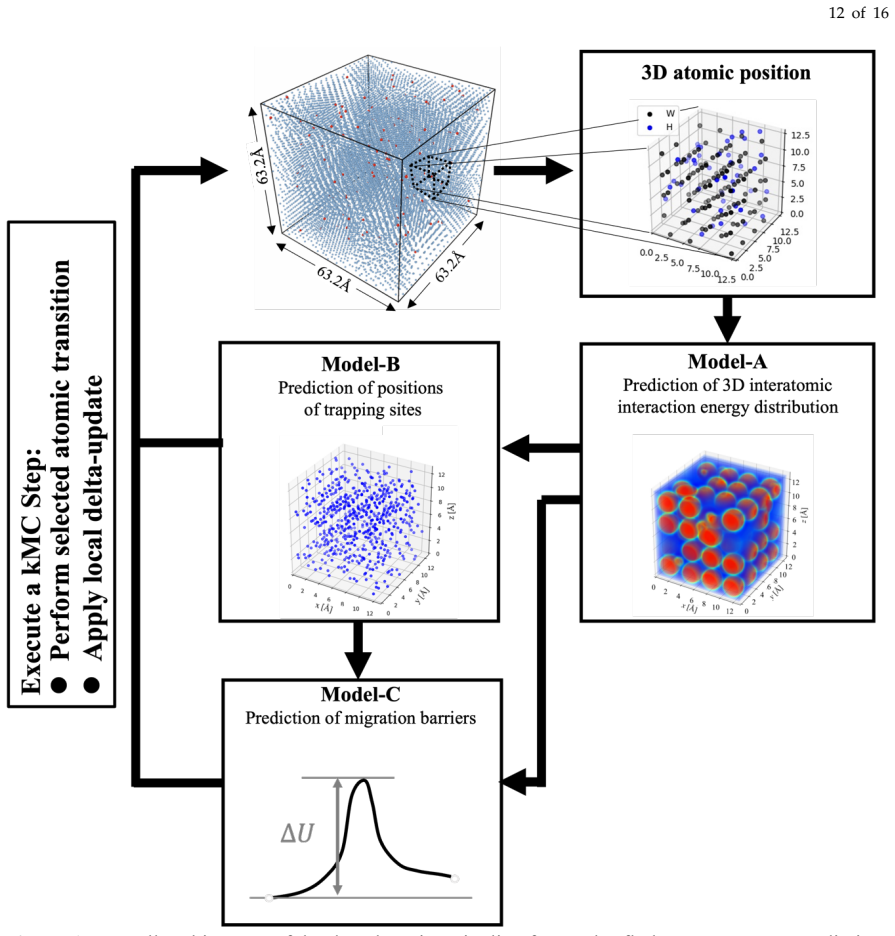
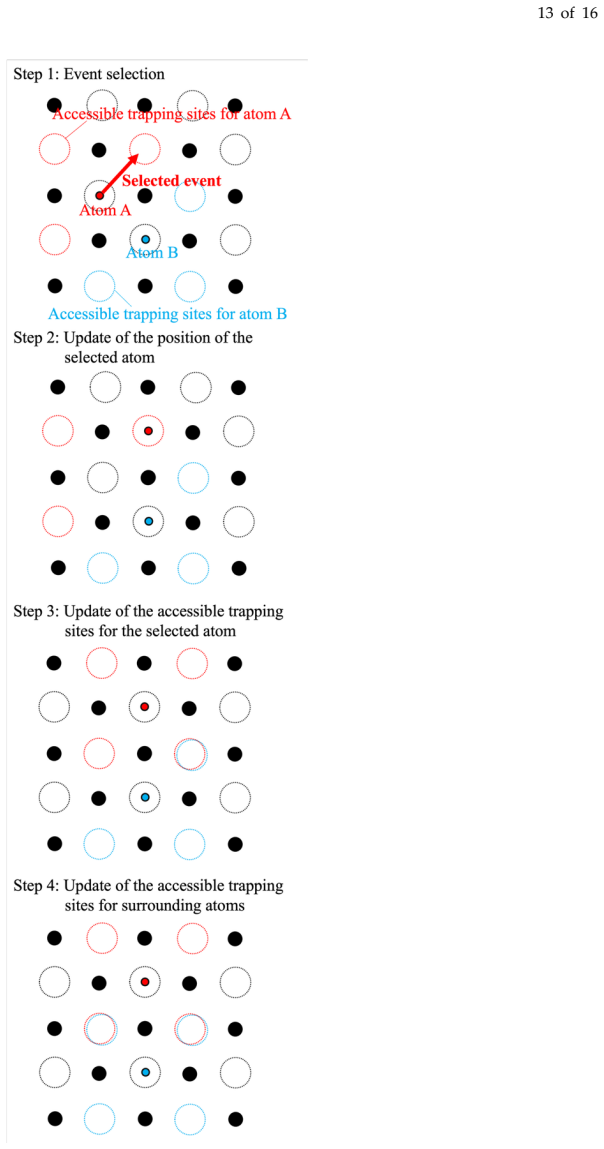
By replacing on-the-fly NEB calculations with a pix2pix model for 3D potential-energy maps, a U-Net for trapping-site detection, and a 3D-CNN for migration barriers, together with a hierarchical spatial index and differential local-update algorithm of O(1) complexity, the method performs accurate kMC trajectories on realistic polycrystalline tungsten at macroscopic timescales without continuous atomistic recalculations.
What carries the argument
Three-stage deep-learning pipeline (pix2pix for local 3D potential energy, U-Net for trapping sites, 3D-CNN for migration barriers) plus hierarchical spatial index and differential O(1) local-update algorithm.
If this is right
- Simulations of full-scale plasma-wall interaction become feasible at atomic resolution.
- Dynamic hydrogen retention and recycling under continuous irradiation can be tracked over reactor-relevant times.
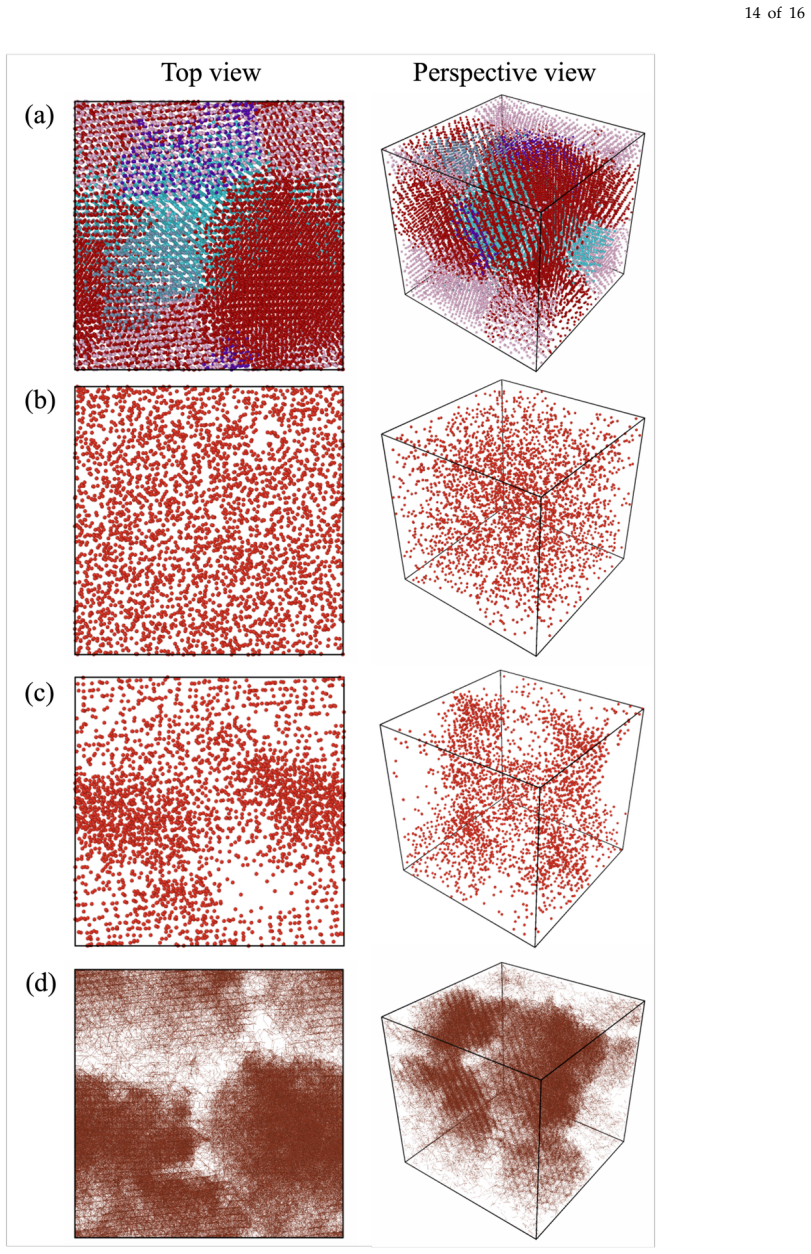
- Preferential trapping at grain boundaries emerges naturally from the atomic-scale energetics without ad-hoc rules.
Where Pith is reading between the lines
- The same pipeline could be retrained on other bcc metals or on irradiated microstructures containing vacancies and dislocations.
- If the networks prove transferable, the method would allow rapid exploration of how grain size or texture alters long-term hydrogen inventory.
- Coupling the accelerated kMC to continuum plasma codes would close the scale gap between wall atomistics and edge-plasma modeling.
Load-bearing premise
The three trained networks generalize accurately enough to disordered grain-boundary environments that the resulting kMC trajectories remain faithful to those produced by full NEB calculations.
What would settle it
Direct comparison of hydrogen site-occupancy statistics and trapping times between a DL-accelerated run and an otherwise identical NEB-based run on the same small polycrystalline tungsten sample; statistically significant divergence would falsify the claim.
Figures
read the original abstract
In magnetic confinement fusion reactors, hydrogen plasma irradiation causes material saturation and recycling, where hydrogen released from the tungsten wall significantly impacts the peripheral plasma. Kinetic Monte Carlo (kMC) simulations are essential for investigating the dynamic balance between incident and emitted fluxes at the atomic scale. However, standard kMC frameworks are inadequate for handling realistic material complexities, such as polycrystalline structures and dynamic evolution under irradiation, being computationally bottlenecked by continuous transition parameter updates. Conventionally, evaluating migration barriers in disordered systems (e.g., grain boundaries) relies on computationally prohibitive on-the-fly atomistic calculations like the Nudged Elastic Band (NEB) method. Here, we present a deep learning-accelerated Dynamic kMC framework that eliminates this reliance. Our approach integrates a three-stage deep learning pipeline: a pix2pix model for predicting local 3D potential energy distributions, a U-Net for extracting hydrogen trapping sites, and a 3D-CNN for directly evaluating migration barriers. To achieve macroscopic timescales, we implemented a hierarchical spatial index combined with a differential local-update algorithm operating in O(1) complexity. This architecture restricts recalculations to the immediate vicinity of moving atoms, accelerating updates. Demonstrated on a large-scale realistic polycrystalline tungsten model, the framework successfully reproduces preferential hydrogen trapping along grain boundaries, bridging the gap between atomic-scale accuracy and macroscopic timescales for full-scale plasma-wall interaction simulations.
Editorial analysis
A structured set of objections, weighed in public.
Referee Report
Summary. The manuscript presents a deep learning-accelerated dynamic kinetic Monte Carlo framework for hydrogen transport in tungsten. It combines a three-stage DL pipeline (pix2pix for local 3D potential energy distributions, U-Net for trapping sites, and 3D-CNN for migration barriers) with a hierarchical spatial index and O(1) differential local-update algorithm. The approach is demonstrated on a large-scale polycrystalline tungsten model and is claimed to reproduce preferential hydrogen trapping along grain boundaries while reaching macroscopic timescales.
Significance. If the DL models prove accurate, the framework would address a key computational bottleneck in kMC simulations of disordered systems, enabling atomic-scale modeling of plasma-wall interactions over realistic length and time scales in fusion materials research.
major comments (2)
- [Abstract] Abstract: the central claim that the framework 'successfully reproduces preferential hydrogen trapping along grain boundaries' is presented without any quantitative accuracy metrics, NEB-vs-DL error distributions on held-out grain-boundary configurations, kMC sensitivity tests, or ablation studies, leaving the fidelity of the three DL models unevidenced.
- [Abstract] The weakest assumption—that the pix2pix, U-Net, and 3D-CNN models generalize to disordered grain-boundary environments without introducing unacceptable errors in the kMC dynamics—is load-bearing for the claim of replacing on-the-fly NEB calculations, yet no validation details (training data, held-out test performance, or error propagation analysis) are supplied.
Simulated Author's Rebuttal
We thank the referee for the constructive comments on the abstract and the need for quantitative validation of the DL models. We respond point-by-point below.
read point-by-point responses
-
Referee: [Abstract] Abstract: the central claim that the framework 'successfully reproduces preferential hydrogen trapping along grain boundaries' is presented without any quantitative accuracy metrics, NEB-vs-DL error distributions on held-out grain-boundary configurations, kMC sensitivity tests, or ablation studies, leaving the fidelity of the three DL models unevidenced.
Authors: The referee is correct that the abstract presents the claim without supporting quantitative metrics, error distributions, sensitivity tests, or ablation studies. The provided manuscript text contains only the high-level description and does not include these details. We will revise the abstract to qualify the claim (e.g., 'demonstrates' rather than 'successfully reproduces') and note that detailed validation is required. revision: yes
-
Referee: [Abstract] The weakest assumption—that the pix2pix, U-Net, and 3D-CNN models generalize to disordered grain-boundary environments without introducing unacceptable errors in the kMC dynamics—is load-bearing for the claim of replacing on-the-fly NEB calculations, yet no validation details (training data, held-out test performance, or error propagation analysis) are supplied.
Authors: We agree that no validation details on training data, held-out performance, or error propagation are supplied in the abstract or the manuscript summary. This assumption is indeed central, and the current text does not provide the requested evidence. We will revise the abstract to acknowledge the generalization assumption and its unquantified status in the present work. revision: yes
- The manuscript does not contain NEB-vs-DL error distributions on held-out grain-boundary configurations, kMC sensitivity tests, ablation studies, training data details, held-out test performance, or error propagation analysis, so these cannot be supplied without new computations.
Circularity Check
No significant circularity
full rationale
The paper presents a three-stage DL pipeline (pix2pix, U-Net, 3D-CNN) plus O(1) hierarchical updates as an engineering acceleration of standard kMC. No equations, fitted parameters, or self-citations are shown that reduce any claimed result to its inputs by construction. The central demonstration (reproduction of GB trapping preference) is scoped as an empirical outcome of the trained models on a polycrystalline structure, not a tautological renaming or self-referential prediction. This is the normal case of an applied ML method whose validity rests on external training data and validation rather than internal redefinition.
Axiom & Free-Parameter Ledger
free parameters (1)
- Trained weights of pix2pix, U-Net, and 3D-CNN models
axioms (1)
- domain assumption Deep learning models trained on appropriate data can accurately predict migration barriers and trapping sites in disordered polycrystalline tungsten without on-the-fly NEB calculations.
Reference graph
Works this paper leans on
-
[1]
%&'-+𝜌(/𝑟
Deep Learning-Accelerated Dynamic Kinetic Monte Carlo Simulation for Hydrogen Transport in Tungsten Seiki Saito 1, Keisuke Takeuchi 1, Hiroaki Nakamura 2,3, Yasuhiro Oda 4, Kazuo Hoshino 5, Yuki Homma 6, Shohei Yamoto 7, Yuki Uchida 8 1 Graduate School of Science and Engineering, Yamagata University, Yonezawa, Japan 2 Department Research, National Institu...
1995
discussion (0)
Sign in with ORCID, Apple, or X to comment. Anyone can read and Pith papers without signing in.