Radial-flow fluctuations in the geometrical-scaling framework
Pith reviewed 2026-06-28 12:21 UTC · model grok-4.3
The pith
Geometrical scaling accounts for radial-flow fluctuations through variations in the saturation momentum scale.
A machine-rendered reading of the paper's core claim, the machinery that carries it, and where it could break.
Core claim
Within the geometrical scaling framework, event-by-event spectral fluctuations are governed by fluctuations of the saturation momentum scale; consequently, the single-mode ansatz introduced in the momentum-rescaling model emerges naturally. The GS picture further suggests a connection between transverse-momentum correlations and fluctuations of the emission region that may be probed through HBT analyses. Employing the string percolation model, the multiplicity dependence of radial-flow fluctuations is estimated, leading to the proposal of the scaled quantity A0(NΔy) ≡ v0² NΔy as a diagnostic observable for testing the role of effective flux-tube fluctuations.
What carries the argument
Geometrical scaling, in which the saturation momentum scale provides the characteristic scale for particle production and governs event-by-event spectral fluctuations.
If this is right
- The GS framework produces results similar to the momentum-rescaling model.
- The single-mode ansatz for spectral fluctuations emerges naturally from saturation momentum variations.
- Transverse-momentum correlations connect to emission region fluctuations that HBT analyses can probe.
- The scaled quantity A0(NΔy) acts as a diagnostic for effective flux-tube fluctuations.
Where Pith is reading between the lines
- If A0(NΔy) proves independent of multiplicity in data, it would support saturation-scale fluctuations as the dominant source across different collision energies.
- The proposed link to HBT radii offers a way to test whether initial-state geometry fluctuations survive into final-state flow observables.
Load-bearing premise
The string percolation model is sufficiently closely related to geometrical scaling that its multiplicity dependence can be used to estimate radial-flow fluctuations and define the diagnostic A0(NΔy).
What would settle it
A measurement showing that A0(NΔy) fails to exhibit the multiplicity dependence predicted from the string percolation model, or that the single-mode ansatz does not describe the observed v0(pT) fluctuations, would challenge the GS account.
Figures
read the original abstract
We discuss radial-flow fluctuations using the $p_{\rm T}$-differential measure \(v_0(p_{\rm T})\), together with its $p_{\rm T}$-integrated counterpart \(v_0\), within the framework of geometrical scaling (GS), where the saturation momentum scale provides the characteristic scale for particle production. We show that the GS framework leads to results similar to those obtained from the momentum-rescaling model proposed by Jiangyong Jia. In the GS picture, event-by-event spectral fluctuations are governed by fluctuations of the saturation momentum scale; consequently, the single-mode ansatz introduced in Jia's model emerges naturally. We also show that the GS picture suggests a possible connection between transverse-momentum correlations and fluctuations of the emission region, which may be probed through Hanbury Brown and Twiss (HBT) analyses. Using the string percolation model, which is closely related to GS, we estimate the multiplicity dependence of radial-flow fluctuations and propose the scaled quantity $A_0(N_{\Delta y}) \equiv v_0^2 N_{\Delta y}$, with $N_{\Delta y}=(dN/dy)\Delta y$, as a diagnostic observable for testing the role of effective flux-tube fluctuations.
Editorial analysis
A structured set of objections, weighed in public.
Referee Report
Summary. The paper claims that the geometrical scaling (GS) framework, with the saturation momentum scale as the characteristic scale for particle production, leads to results similar to Jia's momentum-rescaling model for radial-flow fluctuations measured by v0(pT) and v0. Event-by-event spectral fluctuations are governed by saturation-scale fluctuations, causing the single-mode ansatz to emerge naturally. The work also suggests a link between transverse-momentum correlations and emission-region fluctuations accessible via HBT analyses. Using the string percolation model (described as closely related to GS), it estimates the multiplicity dependence of radial-flow fluctuations and proposes the scaled diagnostic A0(N_Δy) ≡ v0² N_Δy, with N_Δy = (dN/dy) Δy, to test effective flux-tube fluctuations.
Significance. If the claimed natural emergence of the single-mode ansatz from GS holds, the manuscript would provide a theoretical bridge between saturation physics and radial-flow fluctuation studies, offering a possible explanation for the ansatz without additional assumptions. The suggested HBT connection and the concrete, falsifiable diagnostic A0(N_Δy) are strengths that could guide future experimental tests. No machine-checked proofs or reproducible code are present, but the proposal is grounded in established frameworks and identifies a testable observable.
major comments (1)
- [Abstract] Abstract: the central claim that 'the single-mode ansatz introduced in Jia's model emerges naturally' from the GS picture (because spectral fluctuations are governed by saturation-momentum-scale fluctuations) is asserted without any derivation, explicit equations, or mapping shown in the manuscript. This is load-bearing for the stated similarity to Jia's model and cannot be assessed from the provided text.
minor comments (2)
- The notation v0(pT), v0, and N_Δy is introduced without explicit definitions or references to prior usage; ensure all symbols are defined on first appearance.
- The phrase 'closely related to GS' for the string percolation model is used to justify the multiplicity estimate; a brief reference or qualitative argument supporting this relation would improve clarity even if the estimate is an auxiliary step.
Simulated Author's Rebuttal
We thank the referee for the careful reading, the recognition of the potential theoretical bridge between saturation physics and radial-flow studies, and the constructive comment on the abstract. We address the major comment below.
read point-by-point responses
-
Referee: [Abstract] Abstract: the central claim that 'the single-mode ansatz introduced in Jia's model emerges naturally' from the GS picture (because spectral fluctuations are governed by saturation-momentum-scale fluctuations) is asserted without any derivation, explicit equations, or mapping shown in the manuscript. This is load-bearing for the stated similarity to Jia's model and cannot be assessed from the provided text.
Authors: We agree that the abstract states the emergence concisely without an explicit derivation or equations. In the GS framework the invariant yield depends on the ratio p_T/Q_s; fluctuations in the saturation scale Q_s therefore induce a uniform rescaling of the entire p_T spectrum. This is the single-mode ansatz by construction. The manuscript body develops the GS picture but does not spell out this one-to-one mapping in a dedicated paragraph. We will revise the manuscript (and expand the abstract if space permits) to include a short explicit derivation of the mapping, with the relevant functional dependence on Q_s shown. revision: yes
Circularity Check
No significant circularity identified
full rationale
The derivation chain is self-contained: the central result follows from the GS premise that saturation momentum scale sets the characteristic scale for particle production, so that event-by-event spectral fluctuations are controlled by fluctuations of that scale and the single-mode ansatz therefore appears as a direct consequence. This mapping is presented as an internal implication of the GS framework itself rather than a fit or a self-citation. The string-percolation model is used only for a separate numerical estimate of multiplicity dependence when defining the diagnostic A0(N_Δy); it is not required for the claimed natural emergence of the ansatz and is explicitly labeled as an auxiliary step. No equation or claim reduces to its own input by construction.
Axiom & Free-Parameter Ledger
axioms (1)
- domain assumption Geometrical scaling supplies the characteristic scale for particle production in the collisions under study
Reference graph
Works this paper leans on
-
[1]
76 TeV [20] − 0. 019 0 . 854
-
[2]
00 TeV [20] − 0. 149 0 . 954
-
[3]
00 TeV [21] − 0. 225 0 . 985
-
[4]
0 TeV [22] − 0. 472 1 . 164 p− Pb → π ± + X
-
[5]
02 TeV [23] 0 . 078 0 . 899
-
[6]
02 TeV [24] 0 . 315 0 . 600 As representative examples, we consider pp → π ± + X at √ s = 7 . 00 TeV [21] and p–Pb→ π ± + X at √ s =
-
[7]
The resulting KGS is shown in Fig
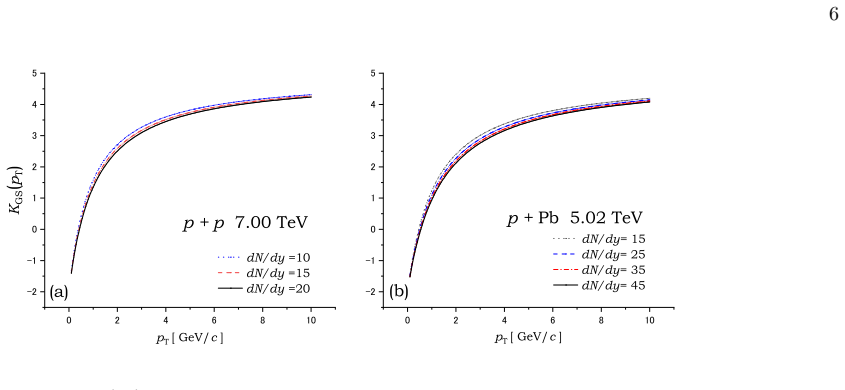
02 TeV [23]. The resulting KGS is shown in Fig. 1. As shown in Fig. 1, KGS(pT) starts from a negative value at low pT, crosses zero at around pT ≃ 0. 5–0. 7 GeV/ c, and increases monotonically with increasing pT.[25] The obtained GS spectral response function exhibits a similar pT dependence for pp and p–Pb collisions, suggesting a universal character of ...
- [8]
-
[9]
S. Acharya et al. (ALICE), Long-range transverse mo- mentum correlations and radial flow in Pb − Pb colli- sions at the LHC, Phys. Rev. Lett. 136, 032302 (2026), arXiv:2504.04796 [nucl-ex]
arXiv 2026
-
[10]
A. Mazeliauskas and D. Teaney, Fluctuations of har- monic and radial flow in heavy ion collisions with principal components, Phys. Rev. C 93, 024913 (2016), arXiv:1509.07492 [nucl-th]
Pith/arXiv arXiv 2016
-
[11]
Jia, Sources of Radial-Flow Fluctuations in the Quark - Gluon Plasma, Phys
J. Jia, Sources of Radial-Flow Fluctuations in the Quark - Gluon Plasma, Phys. Rev. Lett. 136, 112301 (2026), arXiv:2507.14399 [nucl-th]
arXiv 2026
-
[12]
A. M. Stasto, K. J. Golec-Biernat, and J. Kwiecinski, Geometric scaling for the total gamma* p cross-section in the low x region, Phys. Rev. Lett. 86, 596 (2001), arXiv:hep-ph/0007192
Pith/arXiv arXiv 2001
-
[13]
E. Iancu, K. Itakura, and L. McLerran, Ge- ometric scaling above the saturation scale, Nucl. Phys. A 708, 327 (2002), arXiv:hep-ph/0203137
Pith/arXiv arXiv 2002
-
[14]
Iancu, K
E. Iancu, K. Itakura, and L. McLerran, Ge- ometric scaling in the color glass condensate, Nucl. Phys. A 721, 293 (2003)
2003
-
[15]
L. McLerran and M. Praszalowicz, Geometrical Scal- ing and the Dependence of the Average Trans- verse Momentum on the Multiplicity and Energy for the ALICE Experiment, Phys. Lett. B 741, 246 (2015), arXiv:1407.6687 [hep-ph]
Pith/arXiv arXiv 2015
-
[16]
D. Kharzeev and E. Levin, Manifestations of high density QCD in the first RHIC data, Phys. Lett. B 523, 79 (2001), arXiv:nucl-th/0108006
Pith/arXiv arXiv 2001
-
[17]
F. Gelis, E. Iancu, J. Jalilian-Marian, and R. Venugopalan, The Color Glass Conden- sate, Ann. Rev. Nucl. Part. Sci. 60, 463 (2010), arXiv:1002.0333 [hep-ph]
Pith/arXiv arXiv 2010
-
[18]
Osada, Multiplicity-dependent satura- tion momentum in p-Pb collisions at 5.02 TeV, Phys
T. Osada, Multiplicity-dependent satura- tion momentum in p-Pb collisions at 5.02 TeV, Phys. Rev. C 103, 024911 (2021), arXiv:2011.00456 [nucl-th]
arXiv 2021
-
[19]
T. Osada and T. Kumaoka, Saturation momentum scale extracted from semi-inclusive transverse spectra in high- energy pp collisions, Phys. Rev. C 100, 034906 (2019), arXiv:1904.10823 [hep-ph]
arXiv 2019
-
[20]
T. Osada and M. Ishihara, Event-by-event mean pT fluctuations and transverse size of color flux tube generated in p-p collisions at √ s=0.90TeV, J. Phys. G 45, 015104 (2018), arXiv:1702.07440 [hep-ph]
Pith/arXiv arXiv 2018
-
[21]
C. Plumberg and U. Heinz, Probing the proper- ties of event-by-event distributions in Hanbury- Brown–Twiss radii, Phys. Rev. C 92, 044906 (2015), [Addendum: Phys.Rev.C 92, 049901 (2015)], arXiv:1507.04968 [nucl-th]
Pith/arXiv arXiv 2015
-
[22]
C. Plumberg and U. Heinz, Observable con- sequences of event-by-event fluctuations of HBT radii, Nucl. Phys. A 956, 381 (2016), arXiv:1512.07631 [nucl-th]
Pith/arXiv arXiv 2016
-
[23]
J. Dias de Deus and C. Pajares, String Percola- tion and the Glasma, Phys. Lett. B 695, 211 (2011), arXiv:1011.1099 [hep-ph]
Pith/arXiv arXiv 2011
-
[24]
M. A. Braun, F. Del Moral, and C. Pajares, Per- colation of strings and the first RHIC data on multiplicity and transverse momentum distributions, Phys. Rev. C 65, 024907 (2002), arXiv:hep-ph/0105263
Pith/arXiv arXiv 2002
-
[25]
K. J. Golec-Biernat and M. Wusthoff, Saturation effects in deep inelastic scattering at low Q**2 and its impli- cations on diffraction, Phys. Rev. D 59, 014017 (1998), arXiv:hep-ph/9807513
Pith/arXiv arXiv 1998
-
[26]
We therefore use N (pT) in the definition of v0(pT) below, while the corresponding single-mode relation is equivalently written for n(pT)
Since the multiplicity is fixed in a semi-inclusive even t class, N (pT) and the normalized spectrum n(pT) differ only by an overall constant. We therefore use N (pT) in the definition of v0(pT) below, while the corresponding single-mode relation is equivalently written for n(pT)
-
[27]
S. Chatrchyan et al. (CMS), Study of the In- clusive Production of Charged Pions, Kaons, and Protons in pp Collisions at √ s = 0 . 9, 2.76, and 7 TeV, Eur. Phys. J. C 72, 2164 (2012), arXiv:1207.4724 [hep-ex]
Pith/arXiv arXiv 2012
-
[28]
S. Acharya et al. (ALICE), Multiplicity dependence of light-flavor hadron production in pp collisions at √ s = 7 TeV, Phys. Rev. C 99, 024906 (2019), arXiv:1807.11321 [nucl-ex]
Pith/arXiv arXiv 2019
-
[29]
A. M. Sirunyan et al. (CMS), Measurement of charged pion, kaon, and proton production in proton-proton col- lisions at √ s = 13 TeV, Phys. Rev. D 96, 112003 (2017), arXiv:1706.10194 [hep-ex]
Pith/arXiv arXiv 2017
-
[30]
S. Chatrchyan et al. (CMS), Study of the Production of Charged Pions, Kaons, and Protons in pPb Collisions at √ sN N = 5.02 TeV, Eur. Phys. J. C 74, 2847 (2014), arXiv:1307.3442 [hep-ex]
Pith/arXiv arXiv 2014
-
[31]
B. B. Abelev et al. (ALICE), Multiplicity Depen- dence of Pion, Kaon, Proton and Lambda Pro- duction in p-Pb Collisions at √ sN N = 5.02 TeV, Phys. Lett. B 728, 25 (2014), arXiv:1307.6796 [nucl-ex]
Pith/arXiv arXiv 2014
-
[32]
It should be noted that the zero-crossing point is not determined solely by the spectral response itself, but can also be affected by analysis conventions, such as the finite pT range used to define v0 and the normalization of the event-by-event spectra
discussion (0)
Sign in with ORCID, Apple, or X to comment. Anyone can read and Pith papers without signing in.