Roughness-controlled Tribocharging Governs Friction in Dry Glass Contacts
Pith reviewed 2026-06-28 12:29 UTC · model grok-4.3
The pith
Increasing nanoscale roughness on glass reduces friction by suppressing tribocharging rather than increasing it through interlocking.
A machine-rendered reading of the paper's core claim, the machinery that carries it, and where it could break.
Core claim
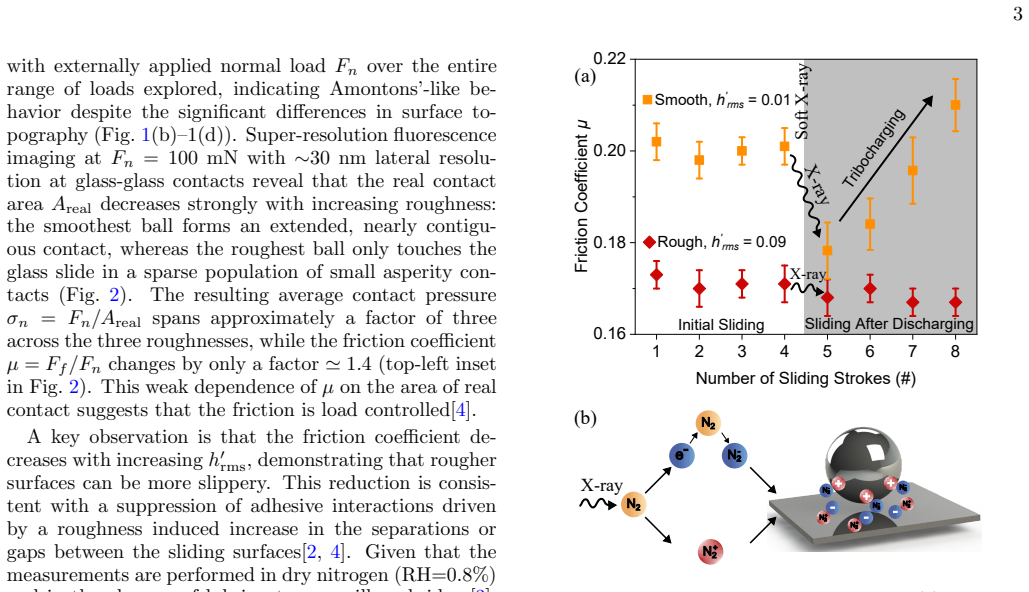
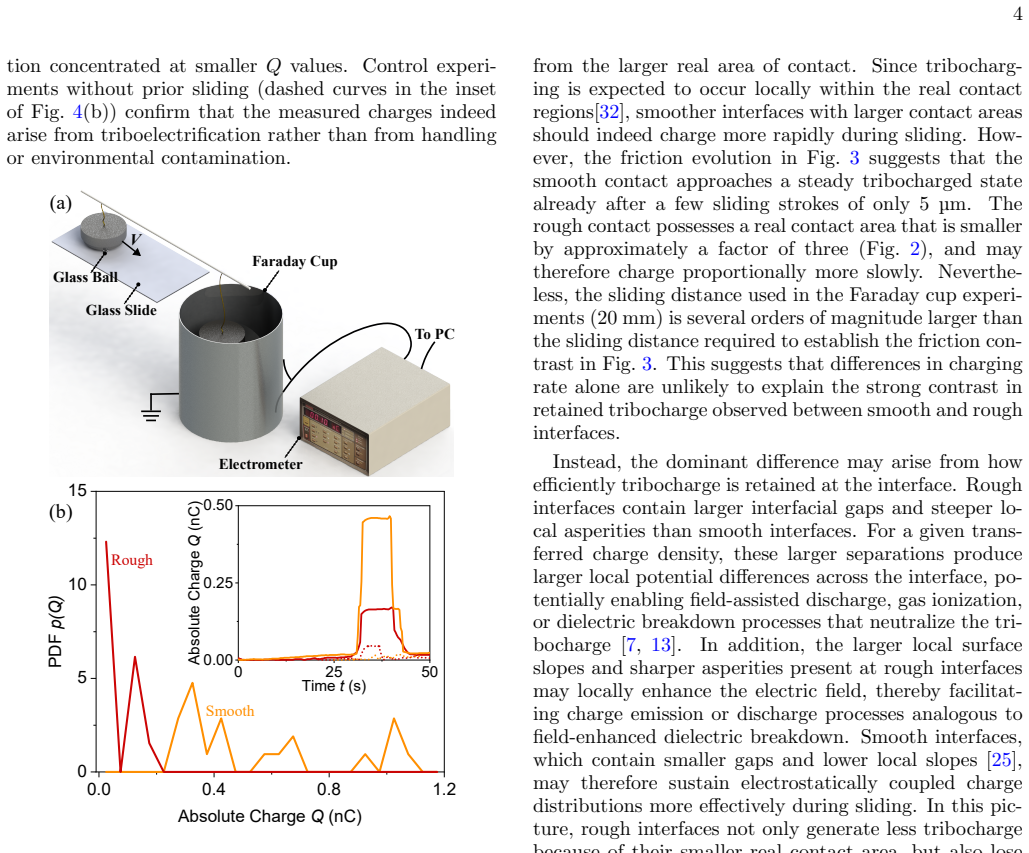
Sliding dry glass contacts generate tribocharges whose electrostatic attraction contributes substantially to measured friction; because higher nanoscale roughness reduces retained charge and real contact area, the friction coefficient falls despite rising average pressure, and neutralizing the charges with soft x-rays removes the roughness dependence.
What carries the argument
Roughness-controlled retention of tribocharge and resulting electroadhesion, quantified by root-mean-square surface slope, real contact area imaging, and electrometry.
If this is right
- Roughness can be deliberately increased to lower friction in dry dielectric contacts by limiting charge retention.
- Electrostatic adhesion must be included in models of friction for insulating materials under dry conditions.
- Neutralizing tribocharge offers an independent way to tune friction without changing surface topography.
- The classical expectation that polishing always lowers friction does not hold when triboelectric effects dominate.
Where Pith is reading between the lines
- The same roughness-charge mechanism may appear in other dielectric pairs such as polymers or ceramics under dry sliding.
- Humidity or surface treatments that promote charge leakage could mask or reverse the roughness effect observed here.
- Surface design for low-friction dry contacts may benefit more from controlling charge dissipation than from minimizing roughness.
Load-bearing premise
The observed drop in friction with increasing roughness is caused mainly by lower retained tribocharge and not by unmeasured changes in mechanical contact properties.
What would settle it
If soft x-ray discharge leaves the roughness dependence of friction unchanged while all other contact conditions remain fixed, the claim that tribocharging governs the effect would be falsified.
Figures
read the original abstract
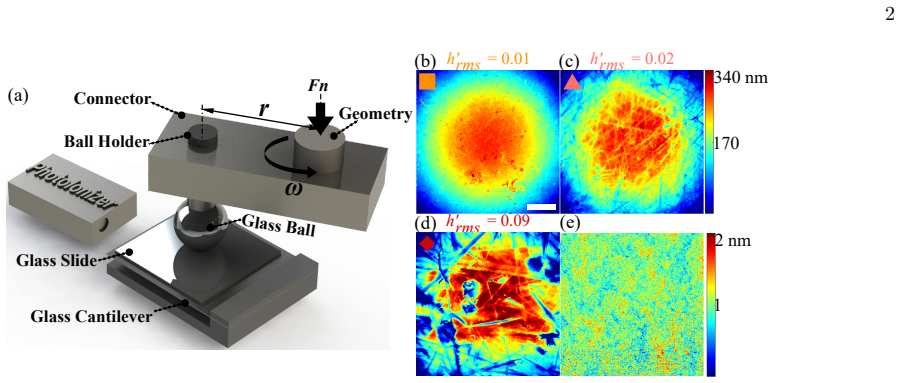
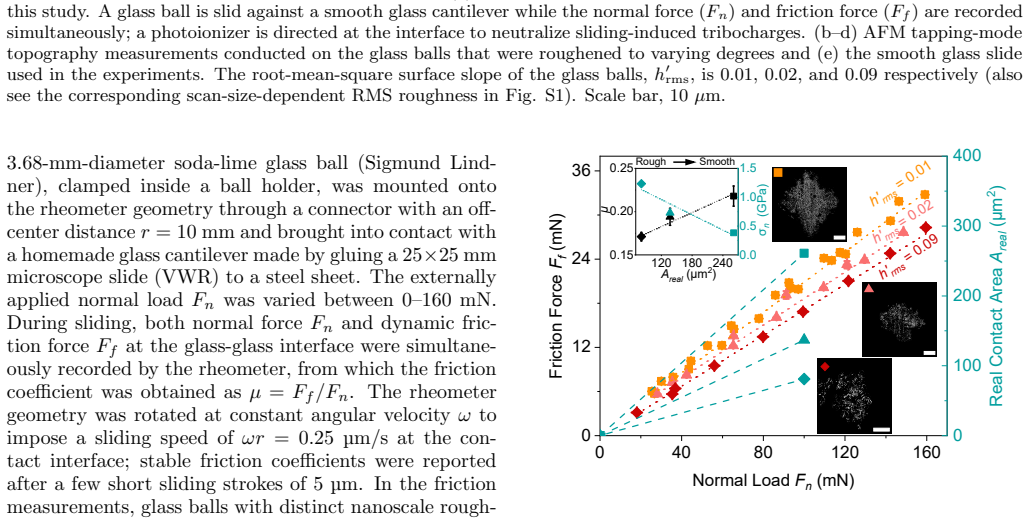
Friction is commonly reduced by polishing surfaces, based on the idea that roughness enhances mechanical interlocking and thus friction. Here we show that, for dry glass-glass contacts, increasing nanoscale roughness can instead reduce friction because it suppresses triboelectric adhesion. Using rheometer-based friction measurements in dry nitrogen, super-resolution imaging of the real contact area, soft x-ray discharge, and Faraday-cup electrometry, we demonstrate that sliding generates substantial tribocharges whose electrostatic attraction contributes significantly to friction. As the root-mean-square surface slope h'_rms of the glass ball is increased from 0.01 to 0.09, the real contact area and retained tribocharge both decrease strongly, while the average contact pressure increases by a factor of three; nevertheless, the friction coefficient drops by about 30%. Discharging the interface with soft x-rays largely removes the roughness dependence of friction. Our results show that nanoscale roughness controls tribocharging and electroadhesion in dielectric contacts, inverting the classical relation between roughness and friction and identifying triboelectric effects as a key design parameter for friction control.
Editorial analysis
A structured set of objections, weighed in public.
Referee Report
Summary. The manuscript claims that in dry glass-glass contacts, increasing nanoscale roughness (h'_rms from 0.01 to 0.09) reduces the friction coefficient by ~30% despite a threefold increase in average contact pressure, because roughness suppresses tribocharging and the resulting electroadhesion. This is demonstrated via rheometer-based friction measurements in dry nitrogen, super-resolution imaging of real contact area, soft x-ray discharge, and Faraday-cup electrometry, with the key result that x-ray discharge largely removes the roughness dependence of friction.
Significance. If the central claim holds, the work inverts the classical roughness-friction relation for dielectric contacts by identifying triboelectric charging as a dominant, roughness-controlled contributor to friction via electroadhesion. The convergence of four independent experimental techniques (rheometry, imaging, x-ray discharge, electrometry) provides a strong empirical foundation and opens design routes for friction control in dry systems without relying on lubrication or polishing.
major comments (2)
- [X-ray discharge experiments] X-ray discharge experiments (results section describing discharge protocol and friction after exposure): the isolation of tribocharge as the cause of the roughness-dependent friction drop requires that soft x-ray exposure neutralizes charge without independently modifying surface energy, adsorbed layers, or near-surface mechanics in a roughness-dependent manner. No explicit controls (e.g., x-ray effects on pre-discharged samples, humid interfaces, or post-exposure surface characterization) are described to rule out photochemical or desorption side-effects that could covary with h'_rms.
- [Results on friction vs. roughness] Friction and charge retention data (figures showing trends with h'_rms): while multiple techniques converge, the reported ~30% friction drop, threefold pressure increase, and strong decreases in contact area and retained charge lack accompanying quantitative error bars, replicate counts, or statistical analysis in the presented results, which is load-bearing for the claim that tribocharge reduction dominates over mechanical changes.
minor comments (1)
- [Abstract] Abstract states trends without error bars or statistical details; adding these would improve clarity even if full data are in the main text.
Simulated Author's Rebuttal
We thank the referee for their careful reading and constructive comments on our manuscript. We address each major comment below.
read point-by-point responses
-
Referee: [X-ray discharge experiments] X-ray discharge experiments (results section describing discharge protocol and friction after exposure): the isolation of tribocharge as the cause of the roughness-dependent friction drop requires that soft x-ray exposure neutralizes charge without independently modifying surface energy, adsorbed layers, or near-surface mechanics in a roughness-dependent manner. No explicit controls (e.g., x-ray effects on pre-discharged samples, humid interfaces, or post-exposure surface characterization) are described to rule out photochemical or desorption side-effects that could covary with h'_rms.
Authors: We agree that explicit controls would further isolate the role of tribocharge. Although Faraday-cup electrometry already confirms charge neutralization and the friction response tracks charge removal across techniques, we will add control data in the revision: x-ray exposure on minimally charged samples and post-exposure surface characterization (AFM and contact-angle measurements) across the h'_rms range to check for roughness-dependent side effects. revision: yes
-
Referee: [Results on friction vs. roughness] Friction and charge retention data (figures showing trends with h'_rms): while multiple techniques converge, the reported ~30% friction drop, threefold pressure increase, and strong decreases in contact area and retained charge lack accompanying quantitative error bars, replicate counts, or statistical analysis in the presented results, which is load-bearing for the claim that tribocharge reduction dominates over mechanical changes.
Authors: We acknowledge that clearer statistical presentation is warranted. Each condition was measured on at least five independent samples; we will revise the main figures and text to display error bars (SEM), report replicate numbers explicitly, and include appropriate statistical tests (e.g., ANOVA with post-hoc comparisons) to quantify the significance of the observed trends. revision: yes
Circularity Check
No circularity: purely experimental claims with independent measurements
full rationale
The paper reports experimental observations of friction coefficients, real contact areas via super-resolution imaging, retained tribocharge via Faraday-cup electrometry, and the effect of soft x-ray discharge on roughness dependence. No equations, derivations, or predictions are presented that reduce by construction to fitted inputs, self-definitions, or self-citation chains. The central claim that tribocharge retention drives the friction-roughness relation rests on direct comparison of discharged vs. undischarged interfaces, which is an external experimental control rather than a tautological reduction. Self-citation load-bearing, ansatz smuggling, and renaming of known results are absent from the provided text.
Axiom & Free-Parameter Ledger
axioms (1)
- domain assumption Soft x-ray discharge selectively removes tribocharge without altering contact area or mechanical properties
Reference graph
Works this paper leans on
-
[1]
F. W. DelRio, M. P. de Boer, J. A. Knapp, E. D. Reedy, P. J. Clews, and M. L. Dunn, The role of van der waals forces in adhesion of micromachined surfaces, Nature Ma- terials4, 629 (2005)
2005
-
[2]
Peng, F.-C
L. Peng, F.-C. Hsia, S. Woutersen, M. Bonn, B. Weber, and D. Bonn, Nonmonotonic friction due to water cap- illary adhesion and hydrogen bonding at multiasperity interfaces, Physical Review Letters129, 256101 (2022)
2022
-
[3]
Peng, C.-C
L. Peng, C.-C. Hsu, C. Xiao, D. Bonn, and B. We- ber, Controlling macroscopic friction through interfacial siloxane bonding, Physical Review Letters131, 226201 (2023)
2023
-
[4]
F.-C. Hsia, S. Franklin, P. Audebert, A. M. Brouwer, D. Bonn, and B. Weber, Rougher is more slippery: How adhesive friction decreases with increasing surface rough- ness due to the suppression of capillary adhesion, Physi- cal Review Research3, 043204 (2021)
2021
-
[5]
Jimidar and J
I. Jimidar and J. M. Harper, The enduring puzzle of static electricity, Physics Today78, 54 (2025)
2025
-
[6]
D. J. Lacks and R. M. Sankaran, Contact electrification of insulating materials, J. Phys. D: Appl. Phys.44, 453001 (2011)
2011
-
[7]
Y. I. Sobolev, W. Adamkiewicz, M. Siek, and B. A. Grzy- bowski, Charge mosaics on contact-electrified dielectrics result from polarity-inverting discharges, Nature Physics 18, 1347 (2022)
2022
-
[8]
Y. Xu, S. Wu, Y. Zhu, and J. Wu, An adhesion model for contact electrification, International Journal of Mechan- ical Sciences272, 109280 (2024)
2024
-
[9]
Pertl, I
F. Pertl, I. C. Lenton, T. Cramer, and S. Waitukaitis, No time for surface charge: How bulk conductivity hides charge patterns from kelvin probe force microscopy in contact-electrified surfaces, Physical Review Letters135, 146202 (2025)
2025
-
[10]
J. C. Sobarzo and S. Waitukaitis, Multiple charge car- rier species as a possible cause for triboelectric cycles, Physical Review E109, L032108 (2024)
2024
-
[11]
J. C. Sobarzo, F. Pertl, D. M. Balazs, T. Costanzo, M. Sauer, A. Foelske, M. Ostermann, C. M. Pichler, Y. Wang, Y. Nagata,et al., Spontaneous ordering of iden- tical materials into a triboelectric series, Nature638, 664 (2025)
2025
-
[12]
Grosjean and S
G. Grosjean and S. Waitukaitis, Single-collision statistics reveal a global mechanism driven by sample history for contact electrification in granular media, Physical Review Letters130, 098202 (2023)
2023
-
[13]
Zhang, T
Y. Zhang, T. P¨ ahtz, Y. Liu, X. Wang, R. Zhang, Y. Shen, R. Ji, and B. Cai, Electric field and humidity trigger con- tact electrification, Physical Review X5, 011002 (2015)
2015
-
[14]
Xu and P
C. Xu and P. Egberts, Triboelectrification and unique frictional characteristics of germanium-based nanofilms, Small20, 2309862 (2024)
2024
-
[15]
V. Lee, S. R. Waitukaitis, M. Z. Miskin, and H. M. Jaeger, Direct observation of particle interactions and clustering in charged granular streams, Nature Physics 11, 733 (2015)
2015
-
[16]
Steinpilz, K
T. Steinpilz, K. Joeris, F. Jungmann, D. Wolf, L. Bren- del, J. Teiser, T. Shinbrot, and G. Wurm, Electrical charging overcomes the bouncing barrier in planet for- mation, Nature Physics16, 225 (2020)
2020
-
[17]
J. Hu, M. Iwamoto, and X. Chen, A review of contact electrification at diversified interfaces and related appli- cations on triboelectric nanogenerator, Nano-Micro Let- ters16, 7 (2024)
2024
-
[18]
Huang, S
F. Huang, S. Kuang, R. Zou, B. Chaudhuri, and A. Yu, Modeling and analysis of particle triboelectrification in pneumatic conveying, Powder Technology429, 118970 (2023). 6
2023
-
[19]
L. Peng, S. Kooij, H. Ciftci, D. Bonn, and B. We- ber, Polarity-dependent electroadhesion at silicon inter- faces with nanoscale roughness (2025), arXiv:2508.18970 [cond-mat.soft]
arXiv 2025
-
[20]
D. J. Lacks and T. Shinbrot, Long-standing and unre- solved issues in triboelectric charging, Nature Reviews Chemistry3, 465 (2019)
2019
-
[21]
Galembeck, T
F. Galembeck, T. A. L. Burgo, L. B. S. Balestrin, R. F. Gouveia, C. A. Silva, and A. Galembeck, Friction, tribo- chemistry and triboelectricity: recent progress and per- spectives, RSC Adv.4, 64280 (2014)
2014
-
[22]
Demirkurt, D
B. Demirkurt, D. Petrova, D. K. Sharma, M. Vacha, B. Weber, D. Bonn, and A. M. Brouwer, Resolving multi-asperity contacts at the nanoscale through super- resolution fluorescence imaging, J. Phys. Chem. Lett.15, 1936 (2024)
1936
-
[23]
Pradhan, M
A. Pradhan, M. M¨ user, N. Miller, J. Abdelnabe, L. Af- ferrante, D. Albertini, D. Aldave, L. Algieri, N. Ali, A. Almqvist,et al., The surface-topography challenge: A multi-laboratory benchmark study to advance the characterization of topography, Tribology letters73, 110 (2025)
2025
-
[24]
Persson, Elastoplastic contact between randomly rough surfaces, Physical Review Letters87, 116101 (2001)
B. Persson, Elastoplastic contact between randomly rough surfaces, Physical Review Letters87, 116101 (2001)
2001
-
[25]
Terwisscha-Dekker, A
H. Terwisscha-Dekker, A. M. Brouwer, B. Weber, and D. Bonn, Elastic contact between rough surfaces: Bridg- ing the gap between theory and experiment, Journal of the Mechanics and Physics of Solids188, 105676 (2024)
2024
-
[26]
Berman, C
A. Berman, C. Drummond, and J. Israelachvili, Amon- tons’ law at the molecular level, Tribology letters4, 95 (1998)
1998
-
[27]
U. G. Musa, S. D. Cezan, B. Baytekin, and H. T. Baytekin, The charging events in contact-separation elec- trification, Scientific reports8, 2472 (2018)
2018
-
[28]
P. K. Panda, D. Singh, M. H. K¨ ohler, D. D. de Var- gas, Z. L. Wang, and R. Ahuja, Contact electrification through interfacial charge transfer: a mechanistic view- point on solid–liquid interfaces, Nanoscale Advances4, 884 (2022)
2022
-
[29]
Sayfidinov, S
K. Sayfidinov, S. D. Cezan, B. Baytekin, and H. T. Baytekin, Minimizing friction, wear, and energy losses by eliminating contact charging, Science advances4, eaau3808 (2018)
2018
-
[30]
V. Lee, N. M. James, S. R. Waitukaitis, and H. M. Jaeger, Collisional charging of individual submillimeter particles: Using ultrasonic levitation to initiate and track charge transfer, Physical Review Materials2, 035602 (2018)
2018
-
[32]
Grosjean, M
G. Grosjean, M. Ostermann, M. Sauer, M. Hahn, C. M. Pichler, F. Fahrnberger, F. Pertl, D. M. Balazs, M. M. Link, S. H. Kim, D. L. Schrader, A. Blanco, F. Gracia, N. Mujica, and S. R. Waitukaitis, Adventitious carbon breaks symmetry in oxide contact electrification, Nature 651, 626 (2026)
2026
-
[33]
Navarro-Rodriguez, E
M. Navarro-Rodriguez, E. Palacios-Lidon, and A. M. So- moza, The surface charge decay: A theoretical and ex- perimental analysis, Applied Surface Science610, 155437 (2023). Supplemental Material for: Roughness-controlled Tribocharging Governs Friction in Dry Glass Contacts Liang Peng1*, Beg¨ um Demirkurt1, Thibault Roch 1, Albert M. Brouwer 2, Bart Weber ...
2023
-
[34]
Demirkurt, D
B. Demirkurt, D. Petrova, D. K. Sharma, M. Vacha, B. Weber, D. Bonn, and A. M. Brouwer, Resolving multi-asperity contacts at the nanoscale through super-resolution fluorescence imaging, The Journal of Physical Chemistry Letters15, 1936 (2024)
1936
-
[35]
B. N. Persson, General theory of electroadhesion, Journal of Physics: Condensed Matter33, 435001 (2021)
2021
discussion (0)
Sign in with ORCID, Apple, or X to comment. Anyone can read and Pith papers without signing in.