Moire-Engineered Excitonic Landscape and Phonon-Mediated Recombination in Twisted WSe2 Bilayers
Pith reviewed 2026-06-28 13:12 UTC · model grok-4.3
The pith
Twisting WSe2 bilayers creates a moiré potential that redistributes carriers into indirect valleys to enable strong interlayer exciton emission via phonon-assisted recombination.
A machine-rendered reading of the paper's core claim, the machinery that carries it, and where it could break.
Core claim
The moiré potential induced by the twist angle in WSe2/WSe2 bilayers redistributes carriers into indirect valleys, thereby enhancing recombination efficiency and stabilizing the interlayer excitons, which produces strong interlayer excitonic emission and phonon-assisted recombination while suppressing localized defect-bound exciton emission.
What carries the argument
The moiré potential generated by the twist-angle-dependent superlattice, which redistributes carriers into indirect valleys and thereby stabilizes interlayer excitons against other decay channels.
If this is right
- Interlayer excitons are stabilized and their radiative recombination efficiency increases.
- Phonon-assisted recombination channels become prominent in the low-temperature emission spectrum.
- Emission from localized defect-bound excitons is strongly suppressed by the presence of the moiré potential.
- Precise twist-angle and dielectric-environment control becomes a practical method for engineering excitonic landscapes in TMDs.
Where Pith is reading between the lines
- The same twist-and-encapsulation approach could be tested in other TMD bilayers to determine whether the carrier-redistribution effect is material-specific or general.
- Device structures that combine twisted TMD regions with electrical gates might allow dynamic tuning of the exciton-phonon coupling strength.
- The observed suppression of defect emission suggests that moiré engineering could be combined with other 2D materials to create cleaner quantum-emitter platforms.
Load-bearing premise
The photoluminescence features are produced by moiré-driven carrier redistribution and phonon assistance rather than by sample-specific defects, strain gradients, or other uncontrolled mechanisms.
What would settle it
If photoluminescence spectra from a set of twisted WSe2 bilayers with systematically varied twist angles show no corresponding systematic change in the strength or energy of the interlayer-exciton and phonon-assisted peaks, the claim that the moiré potential is responsible would be falsified.
Figures
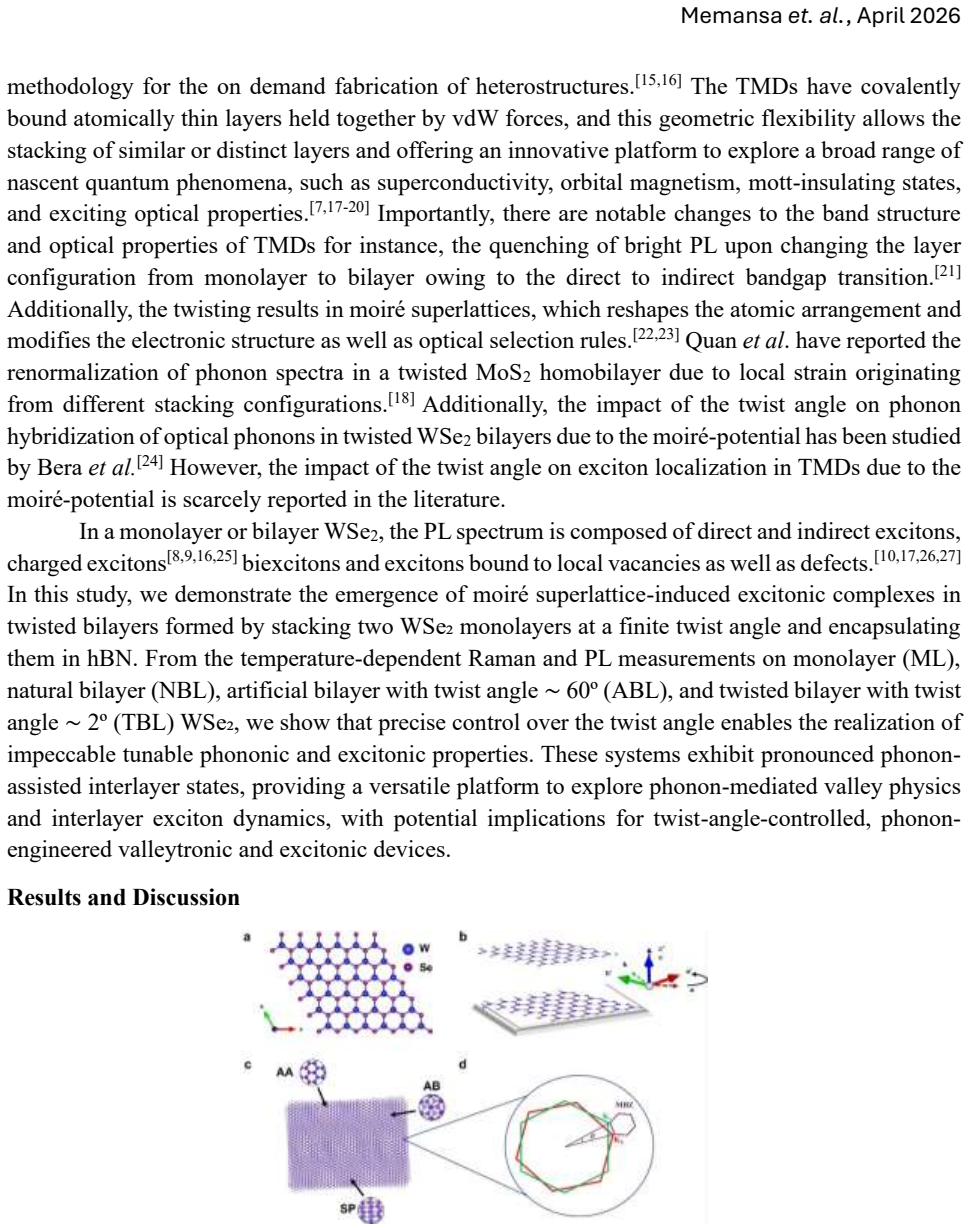
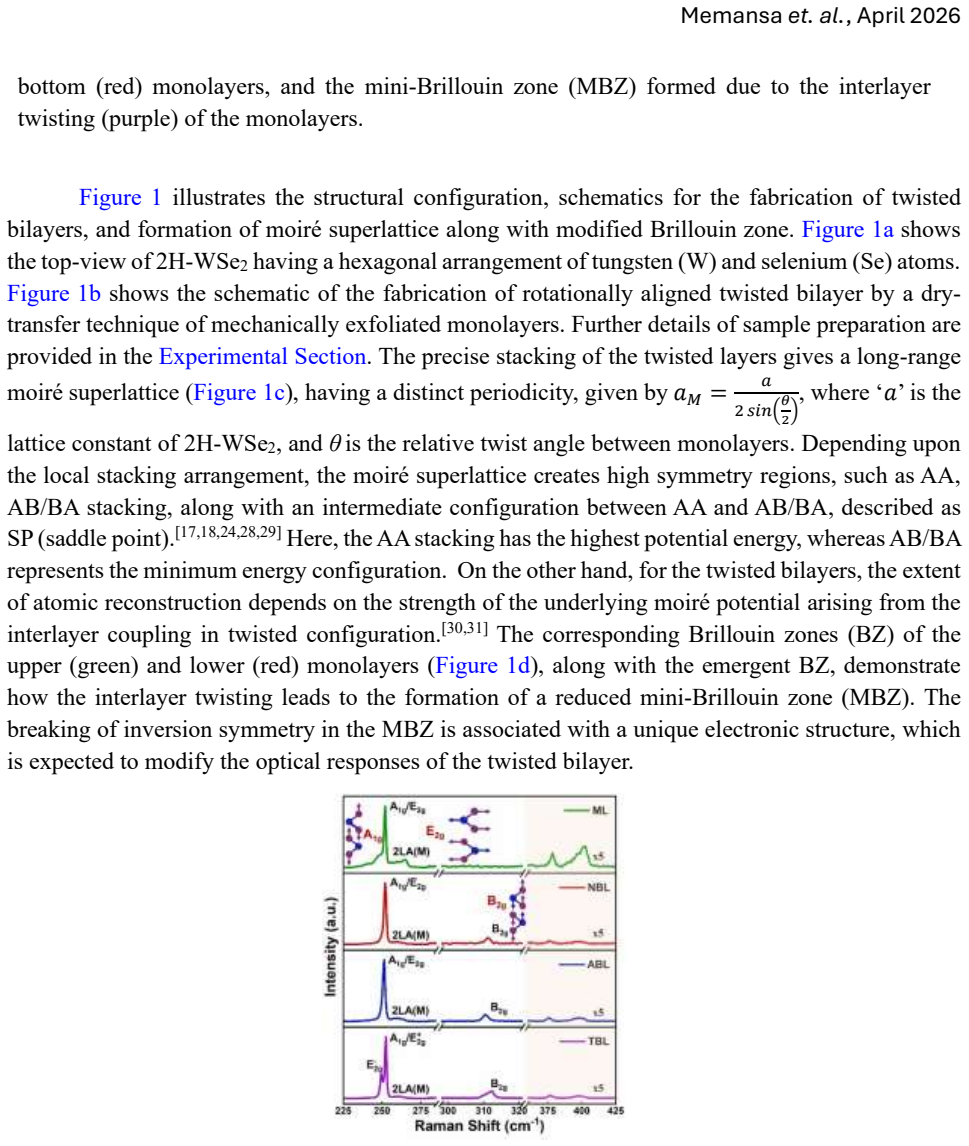
read the original abstract
We report light emission from the moire superlattice of a twisted bilayer of tungsten diselenide (WSe2/WSe2) encapsulated in insulating hexagonal boron nitride (hBN). The low-temperature photoluminescence (PL) spectroscopy reveals signatures of moire-potential induced strong interlayer excitonic emission and phonon-assisted recombination, while the twisting significantly suppresses the emission from localized defect-bound excitons. The moire potential redistributes carriers into indirect valleys, thereby enhancing recombination efficiency and stabilizing the interlayer excitons. Our findings establish that precise control of twist angle and dielectric environment provides a new route for engineering excitonic systems for exploring exciton-phonon interactions and associated quantum phenomena in transition metal dichalcogenides.
Editorial analysis
A structured set of objections, weighed in public.
Referee Report
Summary. The manuscript reports low-temperature photoluminescence measurements on hBN-encapsulated twisted WSe2 bilayers. It claims that the moiré potential redistributes carriers into indirect valleys, producing strong interlayer excitonic emission and phonon-assisted recombination while suppressing defect-bound exciton lines, thereby establishing twist-angle and dielectric-environment control as a route to engineer excitonic systems in TMDs.
Significance. If the moiré-based interpretation of the PL changes holds, the work identifies a tunable platform for exciton-phonon studies in transition-metal dichalcogenides. The experimental approach is straightforward and the reported spectral trends are potentially useful, but the manuscript supplies no machine-checked modeling, parameter-free predictions, or direct valley-occupation measurements that would strengthen the central claim.
major comments (1)
- [Results and Discussion] The central claim that twist-induced moiré potential (rather than strain gradients, hBN inhomogeneity, or sample-specific defects) redistributes carriers and drives the observed PL changes rests entirely on inference from low-T spectra. No momentum-resolved spectroscopy, twist-angle series with commensurate-angle controls, or quantitative modeling that isolates moiré depth from alternative mechanisms is presented, leaving the causal link unverified.
minor comments (2)
- The abstract and main text should specify the exact twist angles studied, the number of devices measured, and the criteria used to exclude data affected by bubbles or strain.
- Peak assignments for the claimed interlayer and phonon-assisted features would benefit from explicit comparison to calculated moiré potential depths or reference spectra from aligned bilayers.
Simulated Author's Rebuttal
We thank the referee for the careful review and constructive feedback on our manuscript. We address the major comment point by point below.
read point-by-point responses
-
Referee: [Results and Discussion] The central claim that twist-induced moiré potential (rather than strain gradients, hBN inhomogeneity, or sample-specific defects) redistributes carriers and drives the observed PL changes rests entirely on inference from low-T spectra. No momentum-resolved spectroscopy, twist-angle series with commensurate-angle controls, or quantitative modeling that isolates moiré depth from alternative mechanisms is presented, leaving the causal link unverified.
Authors: We agree that momentum-resolved spectroscopy and quantitative modeling would provide further direct support. However, the manuscript presents systematic low-temperature PL data showing that the strong interlayer excitonic emission, phonon-assisted recombination, and suppression of defect-bound lines appear specifically upon twisting and correlate with the expected moiré-induced redistribution into indirect valleys. hBN encapsulation is used to minimize dielectric inhomogeneity, and the twist-angle dependence of the spectral changes is inconsistent with strain gradients or sample-specific defects, which would not produce the observed twist-specific features or the enhancement of interlayer emission. We have expanded the discussion to explicitly compare the data against these alternative mechanisms. revision: partial
Circularity Check
No circularity: purely experimental report with no derivation chain
full rationale
This is an experimental photoluminescence study reporting spectral features in twisted WSe2 bilayers. The abstract and provided text contain no equations, fitted parameters, predictions, or mathematical derivations. Claims about moire-potential redistribution and phonon-assisted processes are inferences from observed PL peaks and suppression of defect lines, not reductions of any result to its own inputs by construction. No self-citations are load-bearing for a derivation, and no ansatz or uniqueness theorem is invoked. The paper is self-contained against external benchmarks as a report of measurements; the skeptic's concern about alternative mechanisms (defects/strain) is a question of evidence strength, not circularity in any claimed derivation.
Axiom & Free-Parameter Ledger
axioms (1)
- domain assumption Standard interpretation of low-temperature photoluminescence spectra in encapsulated 2D materials
Reference graph
Works this paper leans on
-
[1]
Twist Angle -Dependent Phonon Hybridization in WSe 2/WSe2 Homobilayer,
K. P. Bera, D. Solanki, S. Mandal, et al., "Twist Angle -Dependent Phonon Hybridization in WSe 2/WSe2 Homobilayer," ACS Nano 18, no. 35 (2024): 24379-24390, https://doi.org/10.1021/acsnano.4c06767
-
[2]
Phonon Renormalization in Reconstructed MoS 2 Moiré Superlattices,
J. Quan, L. Linhart, M. -L. Lin, et al., "Phonon Renormalization in Reconstructed MoS 2 Moiré Superlattices," Nature Materials 20, no. 8 (2021): 1100-1105, https://doi.org/10.1038/s41563-021-00960-1
-
[3]
Twist -Dependent Tuning of Excitonic Emissions in Bilayer WSe2,
P. K. Barman, P. Upadhyay, R. Rajarapu, et al., "Twist -Dependent Tuning of Excitonic Emissions in Bilayer WSe2," ACS Omega 7, no. 7 (2022): 6412-6418, https://doi.org/10.1021/acsomega.1c07219
-
[4]
Exciton Dynamics in WSe 2 Bilayers,
G. Wang, X. Marie, L. Bouet, et al., "Exciton Dynamics in WSe 2 Bilayers," Applied Physics Letters 105, no. 18 (2014): 182105, https://doi.org/10.1063/1.4900945
-
[5]
Tuning Exciton Complexes in Twisted Bilayer WSe 2 at Intermediate Misorientation,
R. Debnath, S. Sett, S. Kundu, et al., "Tuning Exciton Complexes in Twisted Bilayer WSe 2 at Intermediate Misorientation," Physical Review B 106, no. 12 (2022): 125409, https://doi.org/10.1103/PhysRevB.106.125409
-
[6]
Momentum-Dark Intervalley Exciton in Monolayer Tungsten Diselenide Brightened via Chiral Phonon,
Z. Li, T. Wang, C. Jin, et al., "Momentum-Dark Intervalley Exciton in Monolayer Tungsten Diselenide Brightened via Chiral Phonon," ACS Nano 13, no. 12 (2019): 14107-14113, https://doi.org/10.1021/acsnano.9b06682
-
[7]
Coulomb -Bound Four - and Five -Particle Intervalley States in an Atomically -Thin Semiconductor,
S.-Y . Chen, T. Goldstein, T. Taniguchi, K. Watanabe, and J. Yan, "Coulomb -Bound Four - and Five -Particle Intervalley States in an Atomically -Thin Semiconductor," Nature Communications 9, no. 1 (2018): 3717, https://doi.org/10.1038/s41467-018-05558-x
-
[8]
Twist -Tailoring Coulomb Correlations in van der Waals Homobilayers,
P. Merkl, F. Mooshammer, S. Brem, et al., "Twist -Tailoring Coulomb Correlations in van der Waals Homobilayers," Nature Communications 11, no. 1 (2020): 2167, https://doi.org/10.1038/s41467-020-16069-z
-
[9]
Electrically Switchable Intervalley Excitons with Strong Two-Phonon Scattering in Bilayer WSe 2,
M. M. Altaiary, E. Liu, C.-T. Liang, et al., "Electrically Switchable Intervalley Excitons with Strong Two-Phonon Scattering in Bilayer WSe 2," Nano Letters 22, no. 5 (2022): 1829 -1835, https://doi.org/10.1021/acs.nanolett.1c01590
-
[10]
Temperature Dependence of the Energy Gap in Semiconductors,
Y . P. Varshni, "Temperature Dependence of the Energy Gap in Semiconductors," Physica 34, no. 1 (1967): 149- 154, https://doi.org/10.1016/0031-8914(67)90062-6
-
[11]
J. Kopaczek, S. Zelewski, K. Yumigeta, et al., "Temperature Dependence of the Indirect Gap and the Direct Optical Transitions at the High-Symmetry Point of the Brillouin Zone and Band Nesting in MoS2, MoSe2, MoTe2, WS2, and WSe 2 Crystals," The Journal of Physical Chemistry C 126, no. 12 (2022): 5665 -5674, https://doi.org/10.1021/acs.jpcc.2c01044
-
[12]
C.-C. Li, M. Gong, X. -D. Chen, et al., "Temperature Dependent Energy Gap Shifts of Single Color Center in Diamond Based on Modified Varshni Equation," Diamond and Related Materials 74, no. (2017): 119 -124, https://doi.org/10.1016/j.diamond.2017.03.002
discussion (0)
Sign in with ORCID, Apple, or X to comment. Anyone can read and Pith papers without signing in.