The Use of Computational Thinking Skills, Difficulties, and Strategies of Introductory Programming Students Solving Bebras Tasks
Pith reviewed 2026-06-28 12:28 UTC · model grok-4.3
The pith
Introductory programming students apply computational thinking skills like algorithmic thinking and abstraction when solving Bebras tasks, but struggle to plan systematically and explain their reasoning.
A machine-rendered reading of the paper's core claim, the machinery that carries it, and where it could break.
Core claim
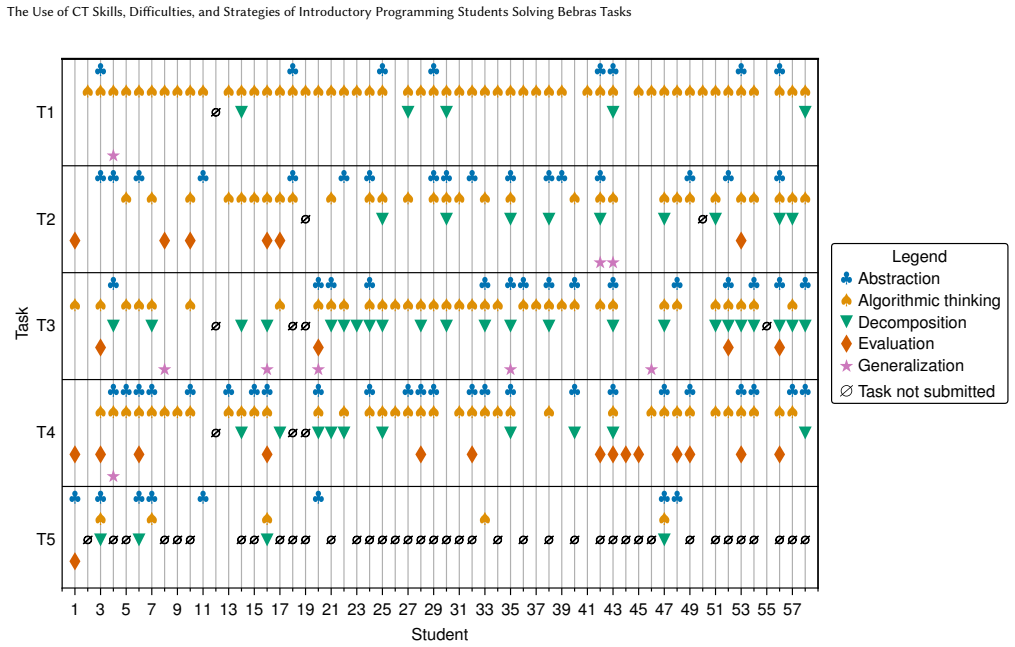
Students in introductory programming apply computational thinking skills when solving Bebras tasks, with algorithmic thinking, abstraction, and decomposition appearing most frequently and evaluation and generalization appearing much less frequently; the presence of these skills is positively associated with correct answers, yet students face challenges understanding tasks and making plans and report various strategies for problem solving.
What carries the argument
Application of an existing coding scheme for computational thinking skills to student plans and solutions on Bebras tasks, paired with thematic analysis of post-task comments on difficulties and strategies.
If this is right
- Presence of computational thinking skills correlates with correct answers on the tasks.
- Students encounter four main areas of difficulty, including task understanding and plan creation.
- Bebras tasks can serve as opportunities for introductory programming students to engage computational thinking skills.
- These tasks could be incorporated into future research on computational thinking development in this population.
Where Pith is reading between the lines
- Similar submissions from computer science majors could be compared to test whether the same skill patterns and difficulties hold.
- Instructional interventions targeting evaluation and generalization might increase their frequency in student work.
- Bebras tasks could be sequenced by difficulty to scaffold systematic planning in introductory courses.
Load-bearing premise
The existing coding scheme for computational thinking skills can be applied reliably to these students' submissions and the thematic analysis of difficulties and strategies accurately reflects their experiences.
What would settle it
An independent replication in which multiple coders fail to agree on the computational thinking skills present in the same set of submissions or find no association between skill presence and solution correctness.
Figures
read the original abstract
Computational thinking (CT) is regarded as a fundamental skill set everyone should learn. Identifying when and how CT skills are used is challenging but important to inform interventions supporting their development. Previous research has examined how students and experts apply CT skills when solving introductory computational problems. However, the extent to which higher education students in introductory programming courses do so in depth is underexplored. We address this gap by examining how those students apply CT skills when solving computational problems, the difficulties they encounter, and the strategies they employ. We collected plans and solutions to Bebras tasks (short problems introducing CS concepts and considered effective for eliciting CT skills) in an introductory programming course for non-CS majors. We gathered 241 submissions from 58 students across five tasks, along with post-task comments and reflections on strategies. We analyzed the data using descriptive statistics, applied an existing coding scheme to identify CT skills, and conducted thematic analysis to identify difficulties and strategies. Submissions varied in structure and level of detail. The most prevalent CT skills were algorithmic thinking, abstraction, and decomposition, while evaluation and generalization appeared much less frequently. CT skill presence was positively associated with correct answers. Students faced challenges in four areas, including understanding the tasks and making a plan, and reported various problem-solving strategies. Consolidating and extending prior research on CT skills and problem solving, our findings show that students in introductory programming apply CT skills but can struggle to solve problems systematically and explain their reasoning. Furthermore, Bebras tasks create opportunities for this population to engage CT skills and could be used in future research.
Editorial analysis
A structured set of objections, weighed in public.
Referee Report
Summary. The paper investigates how 58 non-CS major students in an introductory programming course apply computational thinking (CT) skills when solving five Bebras tasks. It collects 241 submissions (plans, solutions, and reflections), applies an existing CT coding scheme via descriptive statistics to quantify skill prevalence (algorithmic thinking, abstraction, and decomposition most common; evaluation and generalization rare), reports a positive association between CT skill presence and correct answers, and uses thematic analysis to identify four areas of difficulty (e.g., task understanding and planning) plus problem-solving strategies. The central claim is that these students engage CT skills but struggle with systematic problem-solving and explanation, and that Bebras tasks are suitable for future CT research with this population.
Significance. If the coding reliability holds, the work offers a concrete empirical snapshot of CT skill use in a non-CS introductory population, extends prior expert/student comparisons, and provides actionable evidence that Bebras tasks can surface both strengths and gaps. The positive association finding, if robust, could inform curriculum design; the thematic difficulties add practical detail on barriers to systematic reasoning.
major comments (2)
- [Methods / Data Analysis] Methods / Data Analysis: The paper applies an existing CT coding scheme to 241 submissions and reports prevalence plus a positive association with correct answers, yet provides no inter-rater reliability statistic (Cohen’s kappa, percentage agreement, or similar) and no validation or adaptation details for non-CS majors. Because the prevalence figures and the skill–correctness association are load-bearing for the central claim, this omission leaves the quantitative results sensitive to single-coder interpretation.
- [Methods / Thematic Analysis] Methods / Thematic Analysis: The thematic analysis of difficulties and strategies is described only as “thematic analysis” with no mention of multiple independent coders, member checking, audit trail, or saturation criteria. Given that the four difficulty areas and reported strategies are presented as findings, the absence of these standard safeguards is a load-bearing concern for the qualitative component.
minor comments (2)
- [Abstract and §3] Abstract and §3: Sample demographics (e.g., prior programming experience, gender distribution, exact course level) are not summarized, making it hard to assess generalizability to other introductory cohorts.
- [Results] Results: The exact statistical test used for the “positive association” between CT skill presence and correct answers is not named (chi-square, logistic regression, etc.), and effect sizes or confidence intervals are not reported.
Simulated Author's Rebuttal
We thank the referee for the constructive feedback. We address the two major comments on methods below and will revise the manuscript to increase transparency in both the quantitative coding and qualitative analysis sections.
read point-by-point responses
-
Referee: [Methods / Data Analysis] Methods / Data Analysis: The paper applies an existing CT coding scheme to 241 submissions and reports prevalence plus a positive association with correct answers, yet provides no inter-rater reliability statistic (Cohen’s kappa, percentage agreement, or similar) and no validation or adaptation details for non-CS majors. Because the prevalence figures and the skill–correctness association are load-bearing for the central claim, this omission leaves the quantitative results sensitive to single-coder interpretation.
Authors: We agree that the absence of inter-rater reliability reporting is a limitation. The coding followed an existing published scheme applied by the first author (with prior CT research experience) without modification for this population. In revision we will expand the methods to detail the exact application steps, any pilot coding performed, and explicitly state the single-coder nature of the analysis, thereby addressing sensitivity concerns while preserving the descriptive findings. revision: yes
-
Referee: [Methods / Thematic Analysis] Methods / Thematic Analysis: The thematic analysis of difficulties and strategies is described only as “thematic analysis” with no mention of multiple independent coders, member checking, audit trail, or saturation criteria. Given that the four difficulty areas and reported strategies are presented as findings, the absence of these standard safeguards is a load-bearing concern for the qualitative component.
Authors: We acknowledge that the thematic analysis description is insufficiently detailed. The analysis followed an inductive thematic approach on the 241 submissions and reflections; we will revise the methods to specify the steps taken (familiarization, initial coding, theme development), note that a single researcher led the process with team discussion of emerging themes, and add a limitations paragraph on the lack of independent coders or member checking. revision: yes
Circularity Check
No circularity: purely empirical observational study
full rationale
The paper collects 241 student submissions to Bebras tasks, applies an existing (non-self-authored) coding scheme for CT skills, performs descriptive statistics and thematic analysis, and reports associations. No equations, fitted parameters, derivations, predictions from inputs, or self-referential definitions appear. The central claims rest on direct data analysis rather than any reduction to prior self-citations or constructed equivalences. Self-citation, if present for the coding scheme, is not load-bearing as the scheme is described as existing and external.
Axiom & Free-Parameter Ledger
Reference graph
Works this paper leans on
-
[1]
Alfred V. Aho. 2011. Ubiquity symposium: Computation and Computational Thinking.Ubiquity2011, January, Article 1 (Jan. 2011), 8 pages. doi:10.1145/ 1922681.1922682
arXiv 2011
-
[2]
Ana Liz Souto O. Araujo, Wilkerson L. Andrade, Dalton D. Serey Guerrero, and Monilly Ramos Araujo Melo. 2019. How Many Abilities Can We Measure in Computational Thinking? A Study on Bebras Challenge. InProceedings of the 50th ACM Technical Symposium on Computer Science Education (SIGCSE ’19). Association for Computing Machinery, New York, NY, USA, 545–551...
arXiv 2019
-
[3]
Soumela Atmatzidou and Stavros Demetriadis. 2016. Advancing Students’ Com- putational Thinking Skills through Educational Robotics: A Study on Age and Gender Relevant Differences.Robotics and Autonomous Systems75 (Jan. 2016), 661–670. doi:10.1016/j.robot.2015.10.008
-
[4]
Erik Barendsen, Linda Mannila, Barbara Demo, Nataša Grgurina, Cruz Izu, Clau- dio Mirolo, Sue Sentance, Amber Settle, and Gabrielundefined Stupurienun- defined. 2015. Concepts in K-9 Computer Science Education. InProceedings of the 2015 ITiCSE on Working Group Reports(Vilnius, Lithuania)(ITICSE- WGR ’15). Association for Computing Machinery, New York, NY,...
-
[5]
Francisco Bavera, Teresa Quintero, Marcela Daniele, and Flavia Buffarini. 2020. Computational Thinking Skills in Primary Teachers: Evaluation Using Bebras. InComputer Science – CACIC 2019(Cham), Patricia Pesado and Marcelo Arroyo (Eds.). Springer International Publishing, Río Cuarto, Argentina, 405–415. doi:10. 1007/978-3-030-48325-8_26
2020
-
[6]
Fasshauer, Fred J
Zaur Berkaliev, Shavila Devi, Gregory E. Fasshauer, Fred J. Hickernell, Ozgul Kartal, Xiaofan Li, Patrick McCray, Stephanie Whitney, and Judith S. Zawojewski
-
[7]
doi:10.1080/10511970.2014.893939
Initiating a Programmatic Assessment Report.PRIMUS24, 5 (May 2014), 403–420. doi:10.1080/10511970.2014.893939
-
[8]
Matthew Berland and Victor R. Lee. 2011. Collaborative Strategic Board Games as a Site for Distributed Computational Thinking:.International Journal of Game-Based Learning1, 2 (April 2011), 65–81. doi:10.4018/ijgbl.2011040105
-
[9]
Sarah Bonner, Peggy Chen, Kristi Jones, and Brandon Milonovich. 2021. For- mative Assessment of Computational Thinking: Cognitive and Metacogni- tive Processes.Applied Measurement in Education34, 1 (Jan. 2021), 27–45. doi:10.1080/08957347.2020.1835912
-
[10]
Virginia Braun and Victoria Clarke. 2006. Using Thematic Analysis in Psychol- ogy.Qualitative Research in Psychology3, 2 (Jan. 2006), 77–101. doi:10.1191/ 1478088706qp063oa
2006
-
[11]
Karen Brennan and Mitchel Resnick. 2012. New frameworks for studying and assessing the development of computational thinking. InProceedings of the 2012 annual meeting of the American educational research association, Vol. 1. AERA, Vancouver, Canada, 25
2012
-
[12]
Milena Corrales Álvarez, Angela Muñoz Muñoz, and Sergio Cardona. 2025. Computational Thinking in the University Context: A Literature Review of Assessment Instruments.TecnoLógicas28 (Sept. 2025), e3394. doi:10.22430/ 22565337.3394
arXiv 2025
-
[13]
Betul C. Czerkawski and Eugene W. Lyman. 2015. Exploring Issues About Computational Thinking in Higher Education.TechTrends59, 2 (March 2015), 57–65. doi:10.1007/s11528-015-0840-3
-
[14]
Valentina Dagiene and Vladimiras Dolgopolovas. 2022. Short Tasks for Scaffold- ing Computational Thinking by the Global Bebras Challenge.Mathematics10, 17 (Jan. 2022), 3194. doi:10.3390/math10173194
-
[15]
Valentina Dagien˙e and Sue Sentance. 2016. It’s Computational Thinking! Bebras Tasks in the Curriculum. InInformatics in Schools: Improvement of Informatics Knowledge and Perception, Andrej Brodnik and Françoise Tort (Eds.). Springer International Publishing, Cham, 28–39. doi:10.1007/978-3-319-46747-4_3
-
[16]
Valentina Dagien˙e, Sue Sentance, and Gabriel˙e Stupurien˙e. 2017. Developing a Two-Dimensional Categorization System for Educational Tasks in Informatics. Informatica28, 1 (Feb. 2017), 23–44. doi:10.3233/INF-2017-1127
-
[17]
Imke de Jong and Johan Jeuring. 2020. Computational Thinking Interventions in Higher Education: A Scoping Literature Review of Interventions Used to Teach Computational Thinking. InProceedings of the 20th Koli Calling International Conference on Computing Education Research (Koli Calling ’20). Association for Computing Machinery, New York, NY, USA, 1–10. ...
-
[18]
Imke de Jong, Bo Sichterman, and Johan Jeuring. 2024. Use of Computational Thinking Skills When Solving Bebras Tasks: A Think-aloud Study. InProceedings of the 24th Koli Calling International Conference on Computing Education Research (Koli Calling ’24). Association for Computing Machinery, New York, NY, USA, 1–11. doi:10.1145/3699538.3699543
-
[19]
Andrea A. diSessa. 2018. Computational Literacy and “The Big Picture” Concern- ing Computers in Mathematics Education.Mathematical Thinking and Learning 20, 1 (2018), 3–31. doi:10.1080/10986065.2018.1403544
-
[20]
Andreas Febrian, Oenardi Lawanto, Kamyn Peterson-Rucker, Alia Melvin, and Shane E. Guymon. 2018. Does Everyone Use Computational Thinking?: A Case Study of Art and Computer Science Majors. In2018 ASEE Annual Conference & Exposition
2018
-
[21]
Matthew Graham, Anthony Milanowski, and Jackson Miller. 2012. Measuring and Promoting Inter-Rater Agreement of Teacher and Principal Performance Ratings.Online Submission(2012). 14 The Use of CT Skills, Difficulties, and Strategies of Introductory Programming Students Solving Bebras Tasks
2012
-
[22]
Sarah Jane Grigg and Lisa Benson. 2012. Effects of Student Strategies on Suc- cessful Problem Solving. In2012 ASEE Annual Conference & Exposition. 25.508.1– 25.508.13. doi:10.18260/1-2--21266
-
[23]
Shuchi Grover and Roy Pea. 2013. Computational Thinking in K–12: A Review of the State of the Field.Educational Researcher42, 1 (2013), 38–43. doi:10.3102/ 0013189X12463051
2013
-
[24]
Ting-Chia Hsu, Shao-Chen Chang, and Yu-Ting Hung. 2018. How to Learn and How to Teach Computational Thinking: Suggestions Based on a Review of the Literature.Computers & Education126 (Nov. 2018), 296–310. doi:10.1016/j. compedu.2018.07.004
work page doi:10.1016/j 2018
-
[25]
2011.Computational Thinking in K–12 Education: Teacher Re- sources(second ed.)
International Society for Technology in Education and Computer Science Teach- ers Association. 2011.Computational Thinking in K–12 Education: Teacher Re- sources(second ed.). ISTE and CSTA. https://cdn.iste.org/www-root/2020- 10/ISTE_CT_Teacher_Resources_2ed.pdf
2011
-
[26]
Cruz Izu, Claudio Mirolo, Amber Settle, Linda Mannila, and Gabriele Stupuriene
-
[27]
Informatics in Education16, 1 (2017), 39–59
Exploring Bebras Tasks Content and Performance: A Multinational Study. Informatics in Education16, 1 (2017), 39–59. doi:10.15388/infedu.2017.03
-
[28]
Filiz Kalelioglu, Yasemin Gulbahar, and Volkan Kukul. 2016. A Framework for Computational Thinking Based on a Systematic Research Review.Baltic Journal of Modern Computing4 (05 2016), 583–596
2016
-
[29]
Oliver Kastner-Hauler, Karin Tengler, Barbara Sabitzer, and Zsolt Lavicza. 2024. A Learning Environment to Promote the Computational Thinker: A Bebras Per- spective Evaluation. InInformatics in Schools. Innovative Approaches to Computer Science Teaching and Learning, Zsuzsa Pluhár and Bence Gaál (Eds.). Springer Nature Switzerland, Cham, 85–98. doi:10.100...
-
[30]
Yeping Li, Alan H. Schoenfeld, Andrea A. diSessa, Arthur C. Graesser, Lisa C. Benson, Lyn D. English, and Richard A. Duschl. 2020. Computational Thinking Is More about Thinking than Computing.Journal for STEM Education Research 3, 1 (2020), 1–18. doi:10.1007/s41979-020-00030-2
-
[31]
Marcia C. Linn. 1985. The Cognitive Consequences of Programming Instruction in Classrooms.Educational Researcher14, 5 (1985), 14–29. jstor:1174202 doi:10. 2307/1174202
1985
-
[32]
James Lockwood and Aidan Mooney. 2018. Developing a Computational Think- ing Test using Bebras problems. InCC-TEL 2018 and TACKLE 2018 Workshops. https://mural.maynoothuniversity.ie/id/eprint/10316/ In: A. Piotrkowicz, R. Dent- Spargo, S. Dennerlein, I. Koren, P. Antoniou, P. Bailey, T. Treasure-Jones, I. Fronza, C. Pahl (eds.): Joint Proceedings of the C...
2018
-
[33]
Chang Lu, Rob Macdonald, Bryce Odell, Vasyl Kokhan, Carrie Demmans Epp, and Maria Cutumisu. 2022. A Scoping Review of Computational Thinking Assessments in Higher Education.Journal of Computing in Higher Education34, 2 (Aug. 2022), 416–461. doi:10.1007/s12528-021-09305-y
-
[34]
Feiya Luo, Maya Israel, Ruohan Liu, Wei Yan, Brian Gane, and John Hampton
-
[35]
InProceedings of the 51st ACM Technical Symposium on Computer Science Education (SIGCSE ’20)
Understanding Students’ Computational Thinking through Cognitive Interviews: A Learning Trajectory-based Analysis. InProceedings of the 51st ACM Technical Symposium on Computer Science Education (SIGCSE ’20). Association for Computing Machinery, New York, NY, USA, 919–925. doi:10.1145/3328778. 3366845
-
[36]
Joseph A. Lyon and Alejandra J. Magana. 2020. Computational Thinking in Higher Education: A Review of the Literature.Computer Applications in Engi- neering Education28, 5 (2020), 1174–1189. doi:10.1002/cae.22295
-
[37]
Joseph A. Lyon, Alejandra J. Magana, and Ruth A. Streveler. 2022. Characterizing Computational Thinking in the Context of Model-Planning Activities.Modelling 20223, 3 (2022), 344–358. doi:10.3390/MODELLING3030022
-
[38]
Shuai Ma, Junling Wang, Yuanhao Zhang, Xiaojuan Ma, and April Yi Wang. 2025. DBox: Scaffolding Algorithmic Programming Learning through Learner-LLM Co-Decomposition. InProceedings of the 2025 CHI Conference on Human Factors in Computing Systems (CHI ’25). Association for Computing Machinery, New York, NY, USA, Article 585, 20 pages. doi:10.1145/3706598.3713748
-
[39]
Lauren Margulieux, Tuba Ayer Ketenci, and Adrienne Decker. 2019. Review of Measurements Used in Computing Education Research and Suggestions for Increasing Standardization.Computer Science Education29, 1 (Jan. 2019), 49–78. doi:10.1080/08993408.2018.1562145
-
[40]
Samiha Marwan, Nicki Choquette, Veronica Cateté, and Briana B. Morrison. 2024. Exploring Novices’ Problem-Solving Strategies in Computing and Math Domains. InProceedings of the 24th Koli Calling International Conference on Computing Education Research. ACM, Koli Finland, 1–8. doi:10.1145/3699538.3699557
-
[41]
Dee Miller, Leen-Kiat Soh, Vlad Chiriacescu, Elizabeth Ingraham, Duane F
L. Dee Miller, Leen-Kiat Soh, Vlad Chiriacescu, Elizabeth Ingraham, Duane F. Shell, Stephen Ramsay, and Melissa Patterson Hazley. 2013. Improving Learning of Computational Thinking Using Creative Thinking Exercises in CS-1 Computer Science Courses. In2013 IEEE Frontiers in Education Conference (FIE). IEEE Com- puter Society, Los Alamitos, CA, USA, 1426–14...
-
[42]
Mills, Jen Cope, Laura Scholes, and Luke Rowe
Kathy A. Mills, Jen Cope, Laura Scholes, and Luke Rowe. 2024. Coding and Computational Thinking Across the Curriculum: A Review of Educational Outcomes.Review of Educational Research(April 2024), 00346543241241327. doi:10.3102/00346543241241327
-
[43]
and Altadmri, Amjad , year = 2014, series =
Briana B. Morrison, Brian Dorn, and Mark Guzdial. 2014. Measuring Cognitive Load in Introductory CS: Adaptation of an Instrument. InProceedings of the Tenth Annual Conference on International Computing Education Research. ACM, Glasgow Scotland United Kingdom, 131–138. doi:10.1145/2632320.2632348
-
[44]
Andrade, Dalton Serey, and Monilly Ramos Araujo Melo
Ana Liz Souto Oliveira, Wilkerson L. Andrade, Dalton Serey, and Monilly Ramos Araujo Melo. 2025. Quantifying Computational Thinking Skills: An Exploratory Study on Bebras Tasks.Journal of the Brazilian Computer Society31, 1 (2025), 338–354. Issue 1. doi:10.5753/jbcs.2025.3893
-
[45]
Tauno Palts and Margus Pedaste. 2020. A Model for Developing Computational Thinking Skills.Informatics in Education19, 1 (March 2020), 113–128. doi:10. 15388/infedu.2020.06
2020
-
[46]
1980.Mindstorms: Children, Computers, and Powerful Ideas
Seymour Papert. 1980.Mindstorms: Children, Computers, and Powerful Ideas. Basic Books, Inc., USA
1980
-
[47]
Roy D. Pea and D. Midian Kurland. 1984. On the Cognitive Effects of Learning Computer Programming.New Ideas in Psychology2, 2 (Jan. 1984), 137–168. doi:10.1016/0732-118X(84)90018-7
-
[48]
1945.How to Solve It: A New Aspect of Mathematical Method
George Polya. 1945.How to Solve It: A New Aspect of Mathematical Method. Prince- ton University Press, Princeton, NJ. jstor:j.ctvc773pk doi:10.2307/j.ctvc773pk
-
[49]
1981.Mathematical discovery : on understanding, learning, and teaching problem solving(combined ed
George Polya. 1981.Mathematical discovery : on understanding, learning, and teaching problem solving(combined ed. ed.). Wiley. https://cir.nii.ac.jp/crid/ 1970586434849214760
1981
-
[50]
David K. Pugalee. 2004. A Comparison of Verbal and Written Descriptions of Students’ Problem Solving Processes.Educational Studies in Mathematics55, 1 (2004), 27–47. doi:10.1023/B:EDUC.0000017666.11367.c7
-
[51]
Santos, and Marcos Zampieri
Nishat Raihan, Mohammed Latif Siddiq, Joanna C.S. Santos, and Marcos Zampieri
-
[52]
InProceedings of the 56th ACM Technical Symposium on Computer Science Education V
Large Language Models in Computer Science Education: A Systematic Lit- erature Review. InProceedings of the 56th ACM Technical Symposium on Computer Science Education V. 1 (SIGCSETS 2025). Association for Computing Machinery, New York, NY, USA, 938–944. doi:10.1145/3641554.3701863
-
[53]
Anthony Robins, Janet Rountree, and Nathan Rountree. 2003. Learning and Teaching Programming: A Review and Discussion.Computer Science Education 21, 1 (2003), 137–172. doi:10.1076/CSED.13.2.137.14200
-
[54]
Marcos Román-González, Jesús Moreno-León, and Gregorio Robles. 2019. Com- bining Assessment Tools for a Comprehensive Evaluation of Computational Thinking Interventions. InComputational Thinking Education, Siu-Cheung Kong and Harold Abelson (Eds.). Springer Singapore, Singapore, 79–98. doi:10.1007/ 978-981-13-6528-7_6
2019
-
[55]
2013.Computational thinking: the developing definition
Cynthia Selby and John Woollard. 2013.Computational thinking: the developing definition. Project Report. University of Southampton. https://eprints.soton.ac. uk/356481/
2013
-
[56]
Cynthia C. Selby. 2015. Relationships: Computational Thinking, Pedagogy of Programming, and Bloom’s Taxonomy. InProceedings of the Workshop in Primary and Secondary Computing Education. ACM, London United Kingdom, 80–87. doi:10.1145/2818314.2818315
-
[57]
Şenol Şen. 2023. Relations between Preservice Teachers’ Self-Efficacy, Computa- tional Thinking Skills and Metacognitive Self-Regulation.European Journal of Psychology of Education38, 3 (Sept. 2023), 1251–1269. doi:10.1007/s10212-022- 00651-8
-
[58]
Shute, Chen Sun, and Jodi Asbell-Clarke
Valerie J. Shute, Chen Sun, and Jodi Asbell-Clarke. 2017. Demystifying Com- putational Thinking.Educational Research Review22 (Nov. 2017), 142–158. doi:10.1016/j.edurev.2017.09.003
-
[59]
Elliot M. Soloway. 1986. Learning to Program = Learning to Construct Mechanisms and Explanations.Commun. ACM29, 9 (Sept. 1986), 850–858. doi:10.1145/6592.6594
-
[60]
Dewi Sulistiyowati and Masduki Masduki. 2024. Exploration of Students Compu- tational Thinking Abilities in Solving Sequences and Series Problems Based on Learning Style.Desimal7, 2 (July 2024), 189–204. doi:10.24042/djm.v7i2.21971
-
[61]
Chen Sun, Stephanie Yang, and Betsy Becker. 2024. Debugging in Computational Thinking: A Meta-analysis on the Effects of Interventions on Debugging Skills. Journal of Educational Computing Research62, 4 (2024), 867–901. doi:10.1177/ 07356331241227793
2024
-
[62]
David Weintrop, Elham Beheshti, Michael Horn, Kai Orton, Kemi Jona, Laura Trouille, and Uri Wilensky. 2016. Defining Computational Thinking for Mathe- matics and Science Classrooms.Journal of Science Education and Technology25, 1 (2016), 127–147. doi:10.1007/s10956-015-9581-5
-
[63]
Matthew West, Geoffrey L Herman, and Craig Zilles. 2015. PrairieLearn: Mastery- based Online Problem Solving with Adaptive Scoring and Recommendations Driven by Machine Learning. In2015 ASEE Annual Conference & Exposition. ASEE Conferences, Seattle, Washington. doi:10.18260/p.24575
-
[64]
Jeannette M. Wing. 2006. Computational Thinking.Commun. ACM49, 3 (March 2006), 33–35. doi:10.1145/1118178.1118215
-
[65]
Jeannette M. Wing. 2008. Computational Thinking and Thinking about Comput- ing.Philosophical Transactions of the Royal Society A: Mathematical, Physical and Engineering Sciences366, 1881 (2008), 3717–3725. doi:10.1098/rsta.2008.0118
-
[66]
Karen Woo and Garry Falloon. 2022. Problem Solved, but How? An Exploratory Study into Students’ Problem Solving Processes in Creative Coding Tasks.Think- ing Skills and Creativity46 (2022), 101193. doi:10.1016/j.tsc.2022.101193
-
[67]
Ting-Ting Wu, Andik Asmara, Yueh-Min Huang, and Intan Permata Hapsari
-
[68]
doi:10.1177/ 21582440241249897
Identification of Problem-Solving Techniques in Computational Thinking 15 Enrico Benedetti, Isaac Alpizar-Chacon, and Johan Jeuring Studies: Systematic Literature Review.SAGE Open14, 2 (2024). doi:10.1177/ 21582440241249897
2024
-
[69]
María Zapata-Cáceres, Pedro Marcelino, Laila El-Hamamsy, and Estefanía Martín- Barroso. 2024. A Bebras Computational Thinking (ABC-Thinking) Program for Primary School: Evaluation Using the Competent Computational Thinking Test. Education and Information Technologies29, 12 (2024), 14969–14998. doi:10.1007/ s10639-023-12441-w
2024
-
[70]
Ying Zhou, Ching Sing Chai, Xiuting Li, Chao Ma, Baoping Li, Ding Yu, and Jyh-Chong Liang. 2023. Application of Metacognitive Planning Scaffolding for the Cultivation of Computational Thinking.Journal of Educational Computing Research61, 6 (Oct. 2023), 1123–1142. doi:10.1177/07356331231160294 16
discussion (0)
Sign in with ORCID, Apple, or X to comment. Anyone can read and Pith papers without signing in.