Information scrambling in all-to-all interacting models
Pith reviewed 2026-06-28 14:09 UTC · model grok-4.3
The pith
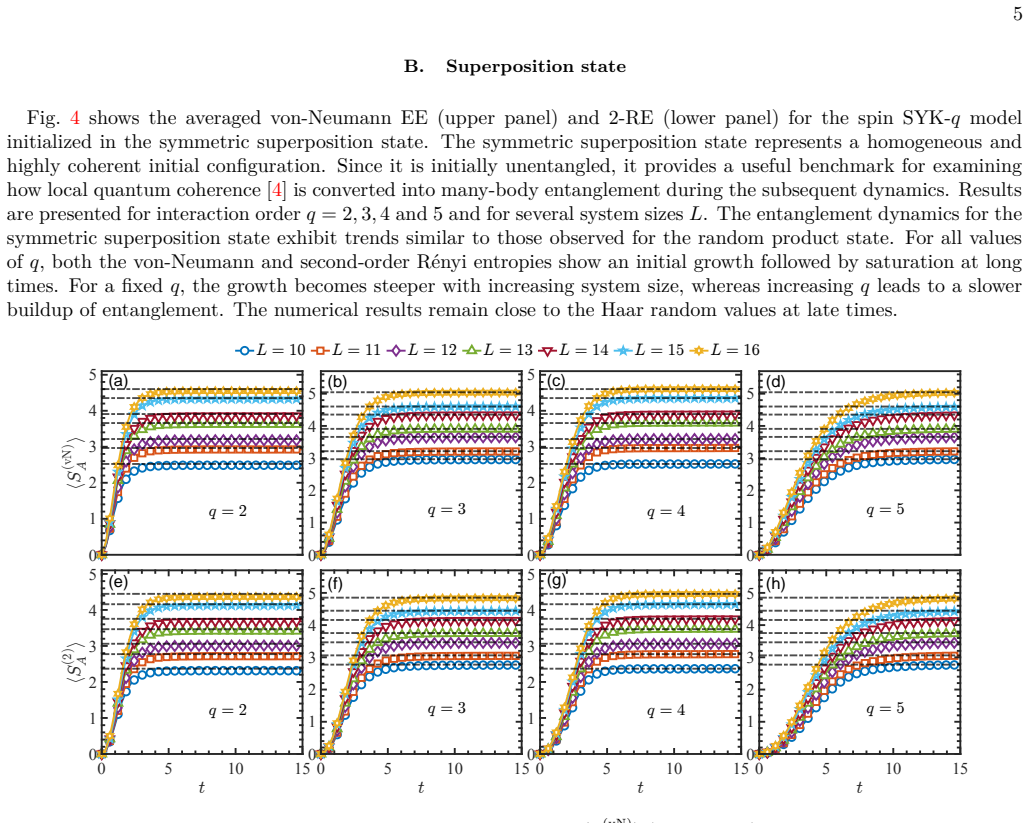
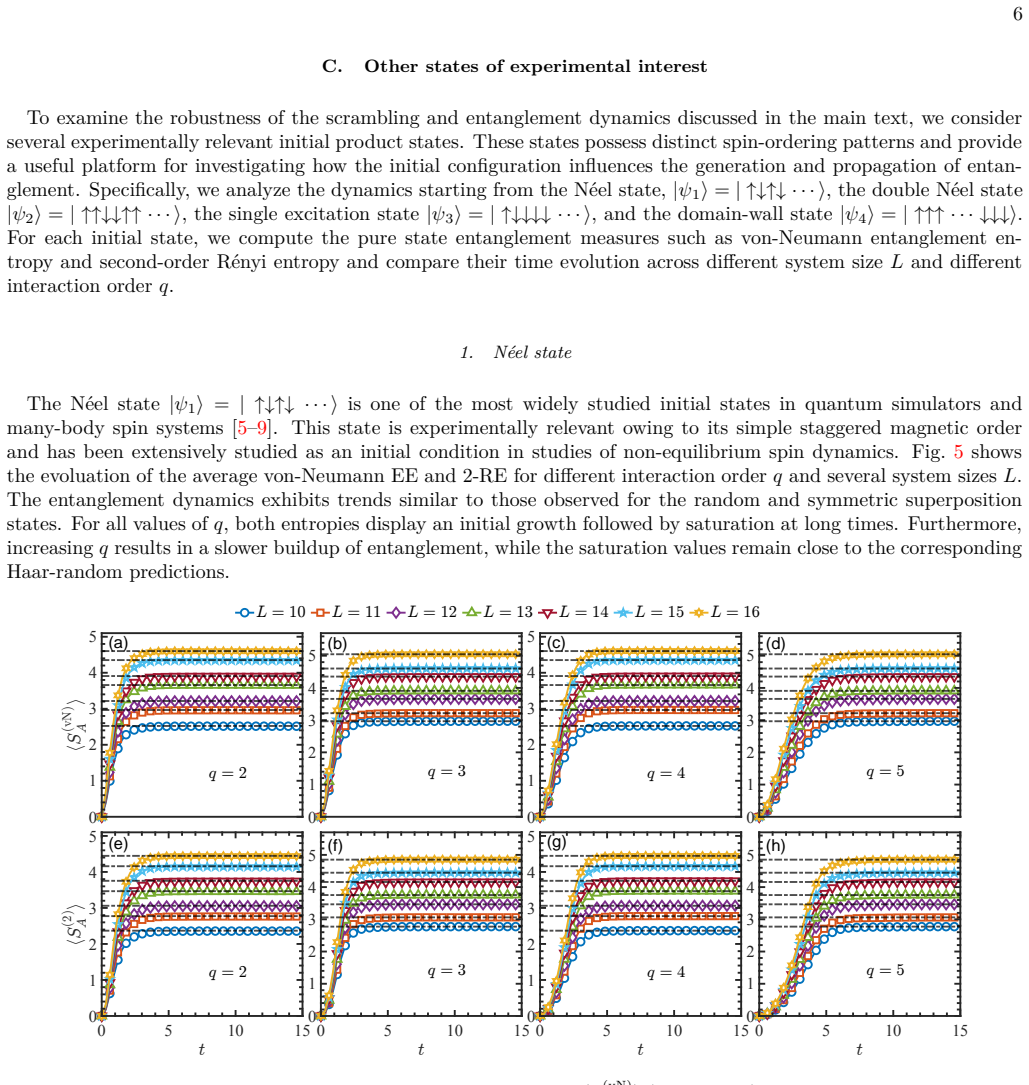
Von Neumann and Rényi entropies saturate near Haar-random values in all-to-all spin SYK models, signaling efficient scrambling.
A machine-rendered reading of the paper's core claim, the machinery that carries it, and where it could break.
Core claim
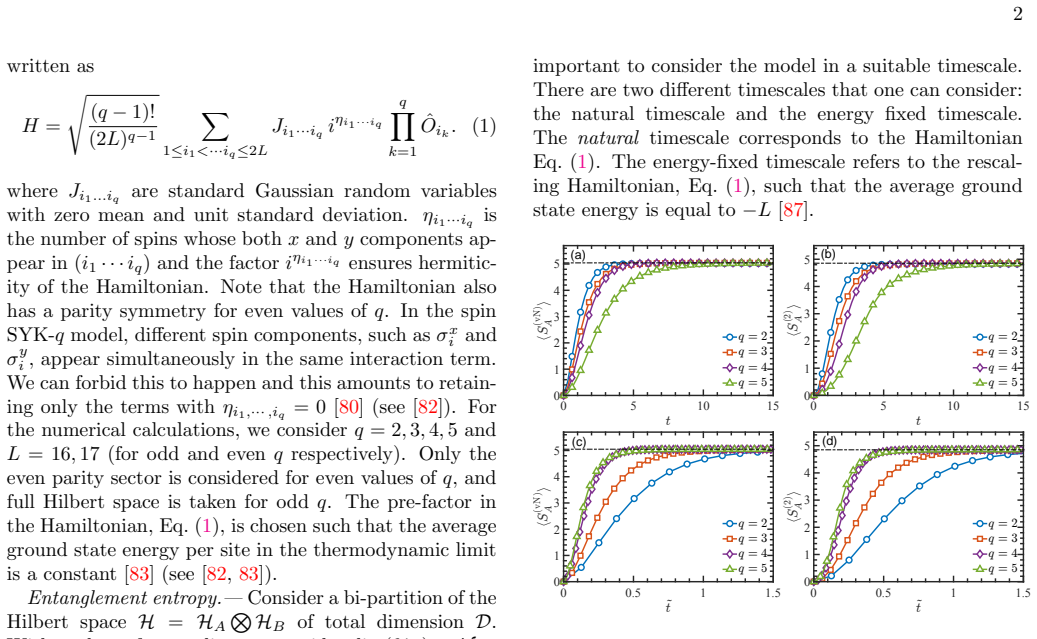
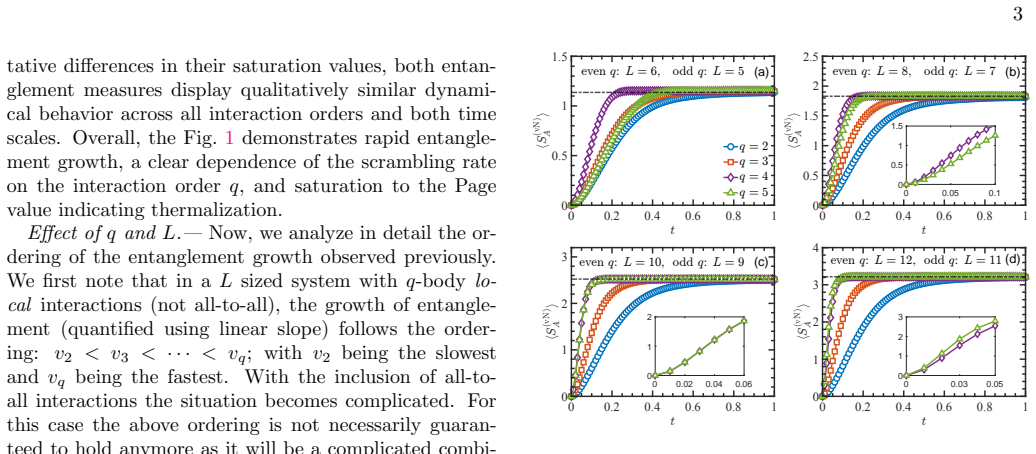
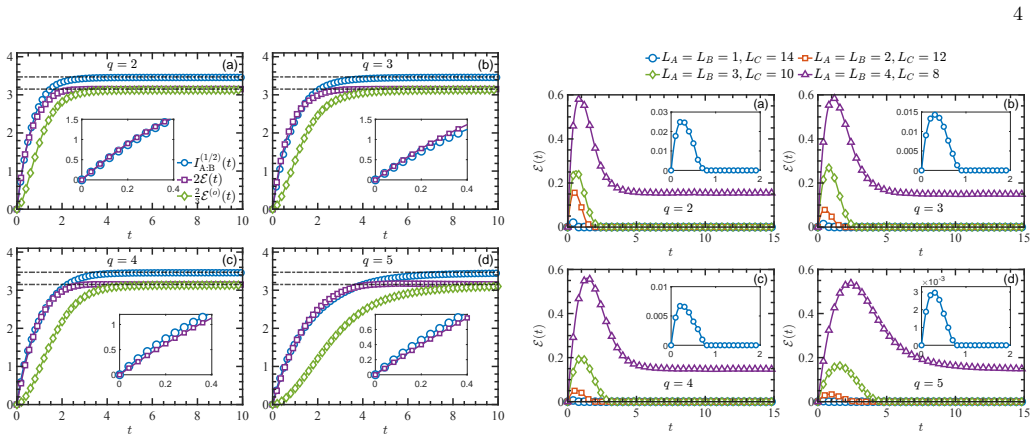
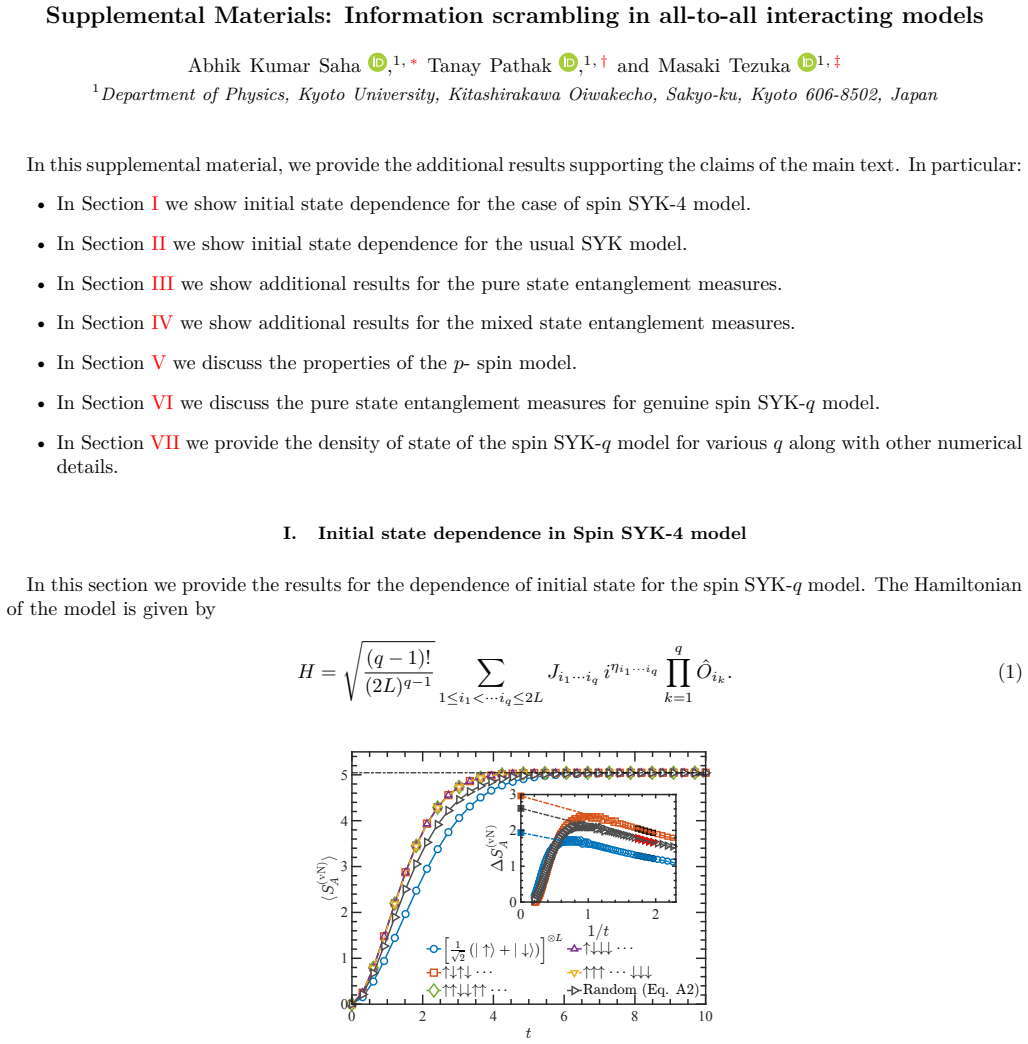
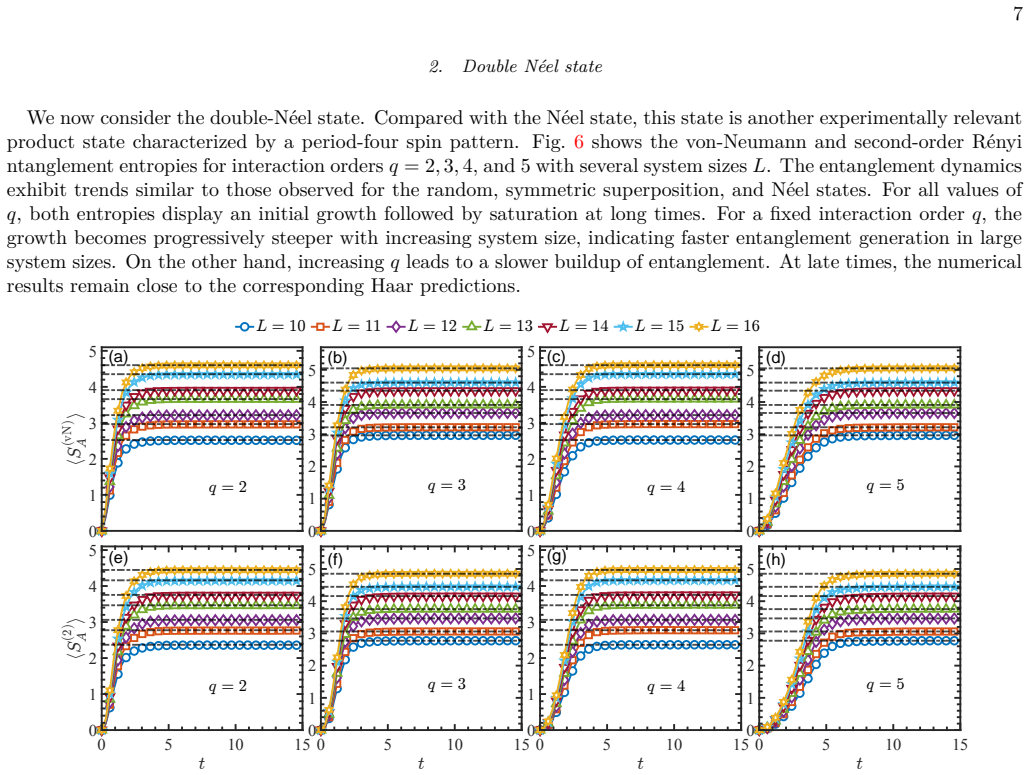
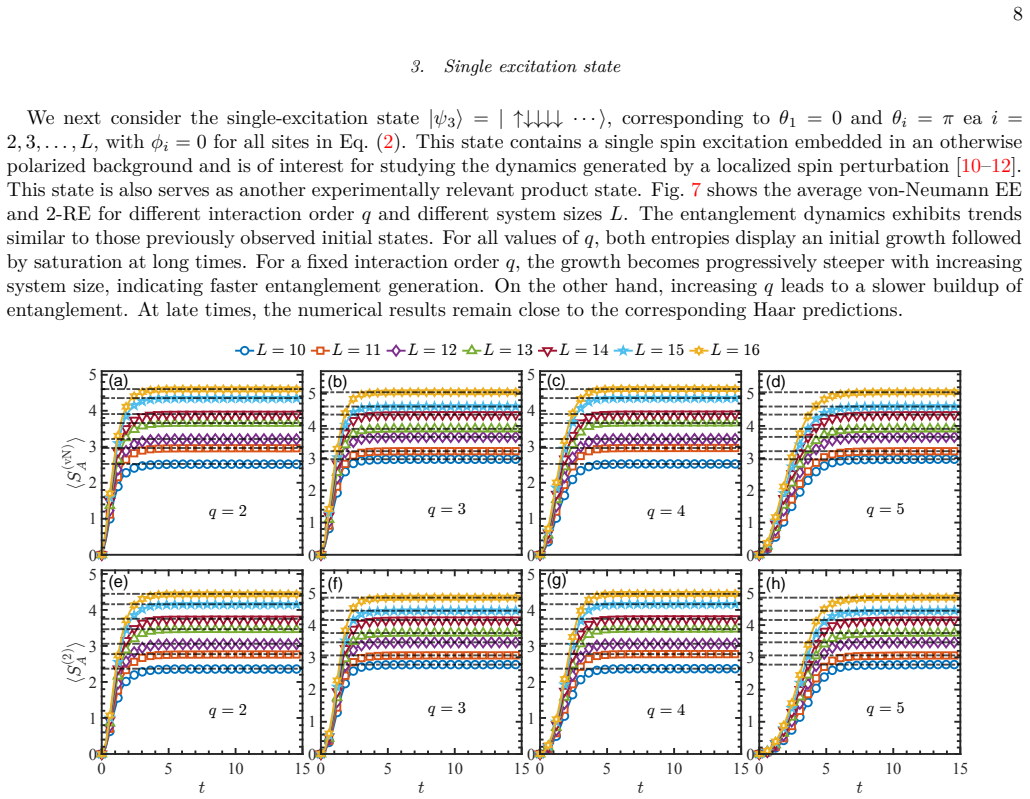
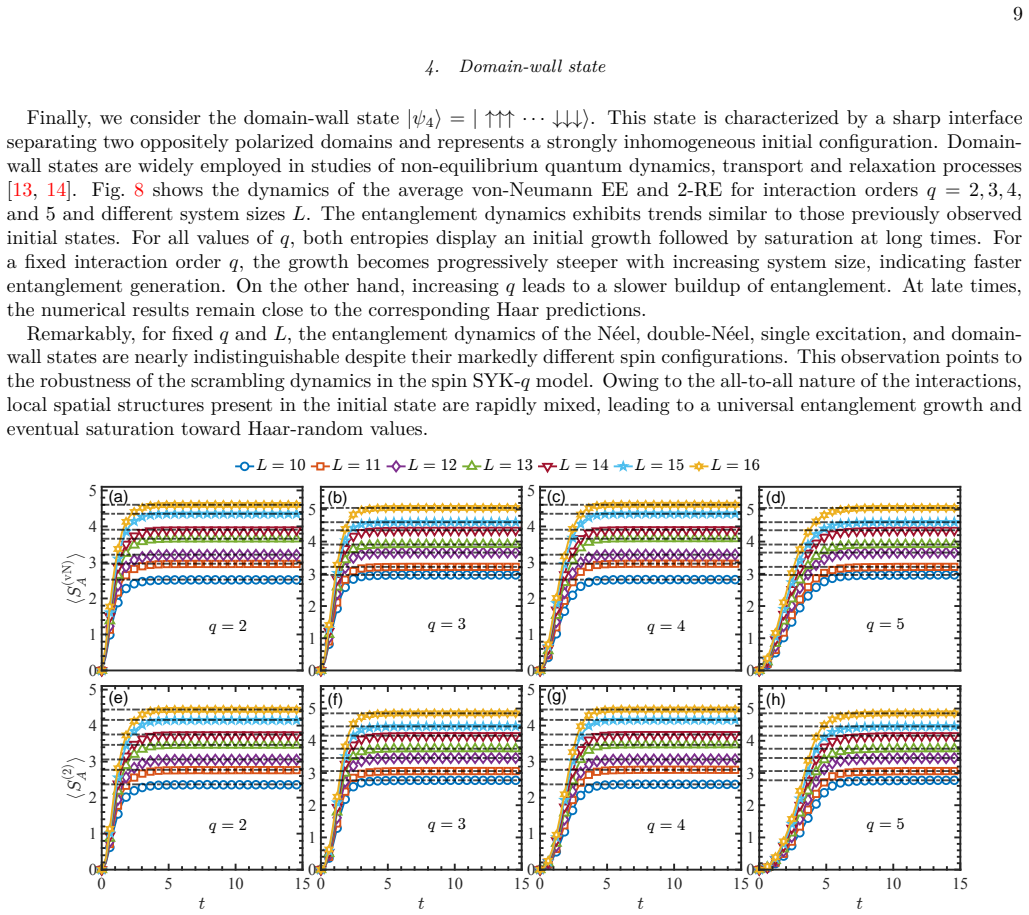
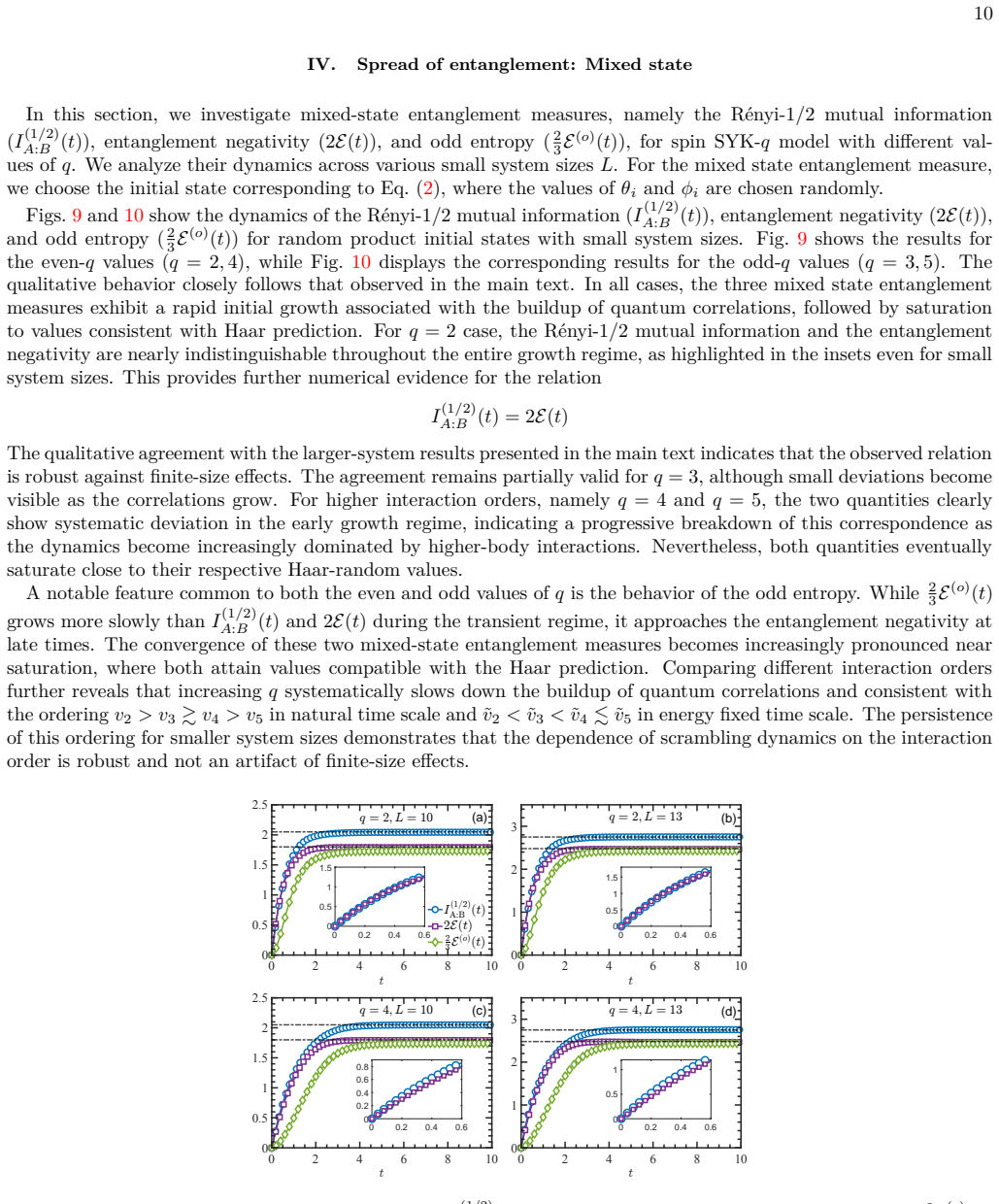
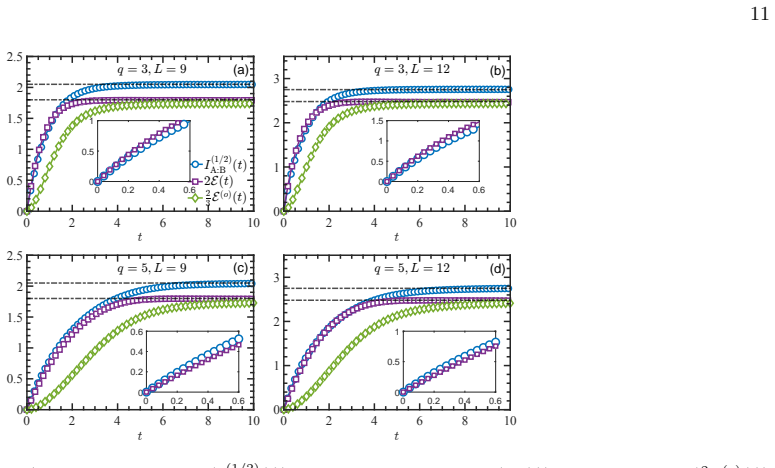
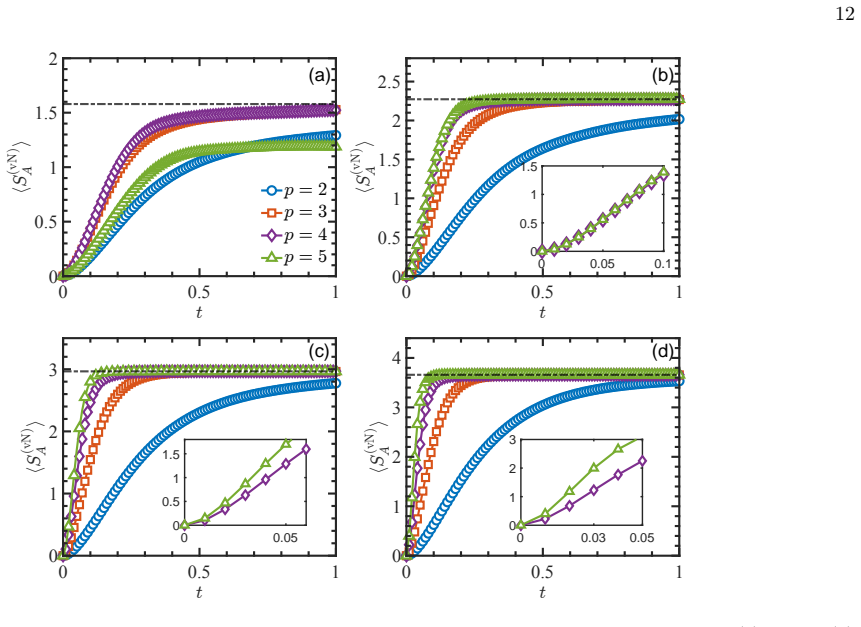
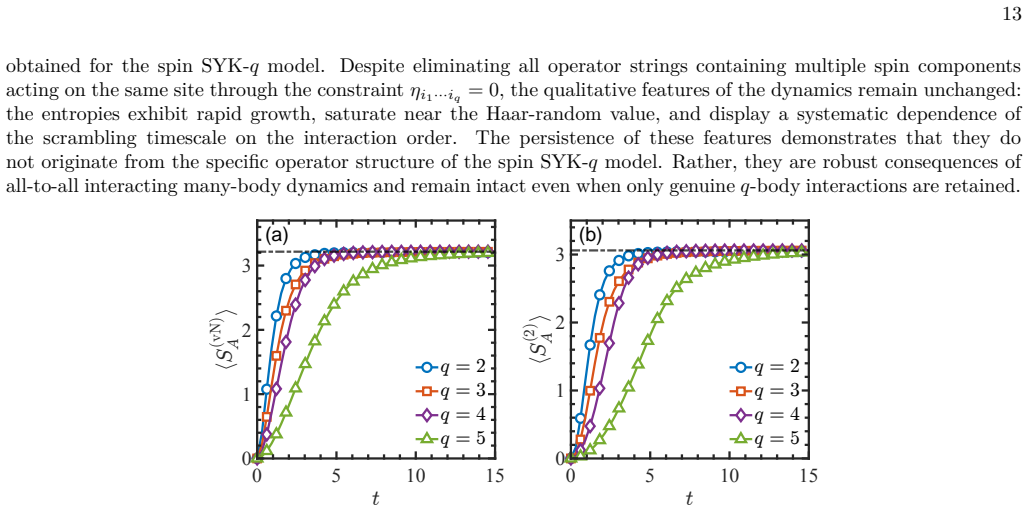
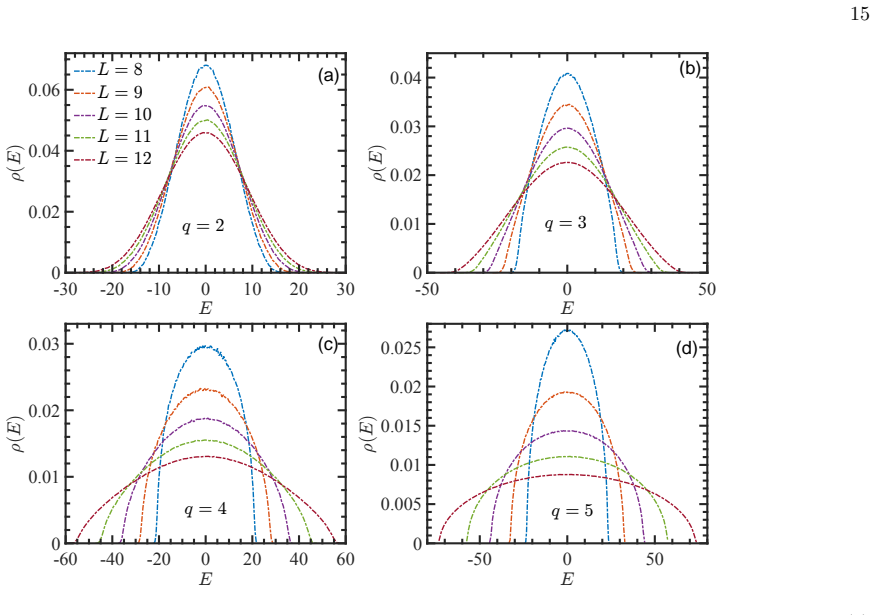
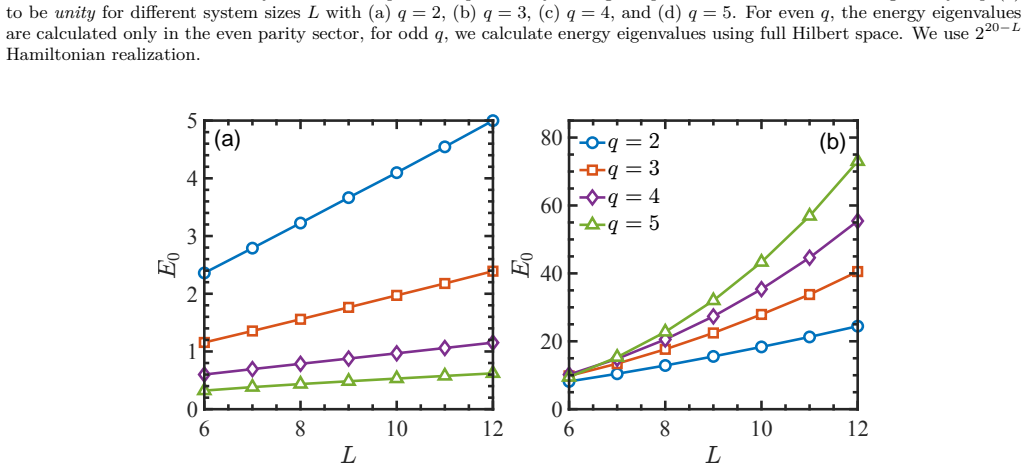
In the all-to-all interacting spin SYK-q model, von-Neumann and Rényi entropies exhibit rapid growth followed by saturation near Haar-random values, signaling efficient scrambling. The scrambling rate reveals a nontrivial dependence on the interaction order, system size, and Hamiltonian scaling. We numerically find a universal relation between the Rényi-1/2 mutual information and entanglement negativity for minimal interaction order in the early growth regime. Furthermore, entanglement negativity displays a Page-curve-like behavior under unequal subsystem partitioning, characterized by the birth, spread, and eventual death of quantum correlations.
What carries the argument
The all-to-all interacting spin SYK-q model probed through von-Neumann, Rényi, and mixed-state entanglement measures.
Load-bearing premise
Numerical results obtained on finite system sizes and chosen Hamiltonian scalings represent the thermodynamic limit without dominant finite-size artifacts.
What would settle it
A direct computation on significantly larger systems showing that saturation values remain far below Haar-random predictions or that the reported universal relation between Rényi-1/2 mutual information and negativity fails to appear for the minimal interaction order.
Figures
read the original abstract
Information scrambling is a hallmark of quantum chaos and thermalization in isolated quantum many-body systems. We investigate scrambling dynamics in the all-to-all interacting spin Sachdev-Ye-Kitaev (SYK)-$q$ model using both pure- and mixed-state entanglement measures. We show that von-Neumann and R\'enyi entropies exhibit rapid growth followed by saturation near Haar-random values, signaling efficient scrambling. The scrambling rate reveals a nontrivial dependence on the interaction order, system size, and Hamiltonian scaling. We further employ mixed-state entanglement as a powerful probe of information scrambling. We numerically find a universal relation between the R\'enyi-1/2 mutual information and entanglement negativity for minimal interaction order in the early growth regime. Furthermore, entanglement negativity displays a Page-curve-like behavior under unequal subsystem partitioning, characterized by the birth, spread, and eventual death of quantum correlations. Our results provide a generic description of information scrambling using entanglement dynamics in all-to-all interacting spin systems with multi-body interactions.
Editorial analysis
A structured set of objections, weighed in public.
Referee Report
Summary. The manuscript investigates information scrambling in the all-to-all interacting spin SYK-q model via pure- and mixed-state entanglement measures. It reports that von Neumann and Rényi entropies exhibit rapid growth followed by saturation near Haar-random values, a nontrivial dependence of the scrambling rate on interaction order q, system size N, and Hamiltonian scaling, a numerically observed universal relation between Rényi-1/2 mutual information and entanglement negativity for minimal q in the early-time regime, and Page-curve-like behavior in negativity under unequal bipartitions.
Significance. If the central numerical claims hold after addressing finite-size controls, the work would provide concrete evidence that all-to-all multi-body spin models scramble efficiently as diagnosed by multiple entanglement probes and would illustrate the diagnostic power of mixed-state quantities such as negativity for early-time scrambling. The combination of pure-state entropy growth with mixed-state diagnostics is a methodological strength.
major comments (2)
- [numerical results on entropy saturation and early-time mutual-information/negativity relation] The claims of saturation 'near Haar-random values' and of a 'universal relation' between Rényi-1/2 mutual information and negativity rest on finite-N numerics (abstract and numerical-results paragraphs). No finite-size scaling collapse, 1/N extrapolation, or direct comparison against the known 1/N corrections to Haar-averaged entanglement quantities is shown; without these controls the saturation values and the apparent universality could be dominated by finite-size artifacts rather than reflecting the thermodynamic or large-N limit.
- [negativity under unequal partitioning] The reported Page-curve-like behavior of negativity under unequal subsystem partitioning is presented for specific finite partitions and Hamiltonian scalings. The manuscript does not demonstrate that the birth-spread-death sequence survives in the large-N limit or is robust to the choice of interaction-order scaling, which is load-bearing for the claim that negativity furnishes a generic description of scrambling.
minor comments (1)
- [early growth regime discussion] Notation for the Rényi index (Rényi-1/2) and the precise definition of the mutual information should be stated explicitly when first introduced to avoid ambiguity with standard conventions.
Simulated Author's Rebuttal
We thank the referee for the careful reading and constructive comments on our manuscript. We address the two major comments point by point below, indicating the revisions we will incorporate.
read point-by-point responses
-
Referee: [numerical results on entropy saturation and early-time mutual-information/negativity relation] The claims of saturation 'near Haar-random values' and of a 'universal relation' between Rényi-1/2 mutual information and negativity rest on finite-N numerics (abstract and numerical-results paragraphs). No finite-size scaling collapse, 1/N extrapolation, or direct comparison against the known 1/N corrections to Haar-averaged entanglement quantities is shown; without these controls the saturation values and the apparent universality could be dominated by finite-size artifacts rather than reflecting the thermodynamic or large-N limit.
Authors: We agree that finite-size controls are necessary to support the claims of saturation near Haar-random values and the apparent universality of the relation. In the revised manuscript we will add 1/N extrapolations of the late-time saturation values for both von Neumann and Rényi entropies, together with direct comparisons to the known 1/N corrections for Haar-averaged quantities. We will also include data for the Rényi-1/2 mutual information versus negativity relation across the available range of N to demonstrate that the observed universality persists with increasing system size. These additions will be placed in a new subsection on finite-size analysis. revision: yes
-
Referee: [negativity under unequal partitioning] The reported Page-curve-like behavior of negativity under unequal subsystem partitioning is presented for specific finite partitions and Hamiltonian scalings. The manuscript does not demonstrate that the birth-spread-death sequence survives in the large-N limit or is robust to the choice of interaction-order scaling, which is load-bearing for the claim that negativity furnishes a generic description of scrambling.
Authors: We acknowledge that the birth-spread-death sequence for negativity is currently shown only for finite N and selected q and Hamiltonian scalings. In the revision we will enlarge the data set to include additional system sizes and multiple values of q, explicitly testing robustness under different interaction-order scalings. We will add a paragraph discussing the observed consistency of the sequence within the numerically accessible regime while noting that a complete large-N demonstration would benefit from complementary analytic or approximate methods. This will better delineate the scope of the claim. revision: partial
Circularity Check
No significant circularity; claims rest on direct numerical output.
full rationale
The paper reports numerical observations of von-Neumann and Rényi entropy growth to near-Haar saturation and a universal relation between Rényi-1/2 mutual information and negativity in the early-time regime for the SYK-q model. These are presented as simulation results on finite systems under chosen Hamiltonian scalings, with no equations, fitted parameters, or derivations shown that reduce by construction to self-definitions or prior self-citations. No load-bearing self-citation chains, ansatzes smuggled via citation, or renaming of known results appear in the provided text; the central claims remain independent empirical findings rather than tautological restatements of inputs.
Axiom & Free-Parameter Ledger
Reference graph
Works this paper leans on
-
[1]
Entanglement in many-body systems,
Luigi Amico, Rosario Fazio, Andreas Osterloh, and Vlatko Vedral, “Entanglement in many-body systems,” 5 Rev. Mod. Phys.80, 517–576 (2008), arXiv:quant- ph/0703044
arXiv 2008
-
[2]
Quantum entanglement in con- densed matter systems,
Nicolas Laflorencie, “Quantum entanglement in con- densed matter systems,” Phys. Rept.643, 1–59 (2016), arXiv:1512.03388 [cond-mat.str-el]
Pith/arXiv arXiv 2016
-
[3]
Separability criterion for density matri- ces,
Asher Peres, “Separability criterion for density matri- ces,” Phys. Rev. Lett.77, 1413–1415 (1996)
1996
-
[4]
Computable measure of entanglement,
G. Vidal and R. F. Werner, “Computable measure of entanglement,” Phys. Rev. A65, 032314 (2002)
2002
-
[5]
En- tanglement negativity in quantum field theory,
Pasquale Calabrese, John Cardy, and Erik Tonni, “En- tanglement negativity in quantum field theory,” Phys. Rev. Lett.109, 130502 (2012), arXiv:1206.3092 [cond- mat.stat-mech]
Pith/arXiv arXiv 2012
-
[6]
Entanglement wedge cross section from the dual density matrix,
Kotaro Tamaoka, “Entanglement wedge cross section from the dual density matrix,” Phys. Rev. Lett.122, 141601 (2019)
2019
-
[7]
A Field Theory Study of Entanglement Wedge Cross Section: Odd En- tropy,
Ali Mollabashi and Kotaro Tamaoka, “A Field Theory Study of Entanglement Wedge Cross Section: Odd En- tropy,” JHEP08, 078 (2020), arXiv:2004.04163 [hep- th]
arXiv 2020
-
[8]
Jonah Kudler-Flam, Yuya Kusuki, and Shinsei Ryu, “Correlation measures and the entanglement wedge cross-section after quantum quenches in two- dimensional conformal field theories,” JHEP04, 074 (2020), arXiv:2001.05501 [hep-th]
arXiv 2020
-
[9]
En- tanglement negativity in quantum field theory,
Pasquale Calabrese, John Cardy, and Erik Tonni, “En- tanglement negativity in quantum field theory,” Phys. Rev. Lett.109, 130502 (2012)
2012
-
[10]
Entanglement negativity and confor- mal field theory: a monte carlo study,
Vincenzo Alba, “Entanglement negativity and confor- mal field theory: a monte carlo study,” J. Stat. Mech. 2013, P05013 (2013)
2013
-
[11]
Finite temperature entanglement negativity in con- formal field theory,
Pasquale Calabrese, John Cardy, and Erik Tonni, “Finite temperature entanglement negativity in con- formal field theory,” J. Phys. A48, 015006 (2015), arXiv:1408.3043 [cond-mat.stat-mech]
Pith/arXiv arXiv 2015
-
[12]
On the mutual information in conformal field theory,
Bin Chen, Lin Chen, Peng-xiang Hao, and Jiang Long, “On the mutual information in conformal field theory,” JHEP06, 096 (2017), arXiv:1704.03692 [hep-th]
Pith/arXiv arXiv 2017
-
[13]
Jonah Kudler-Flam, Yuya Kusuki, and Shinsei Ryu, “The quasi-particle picture and its breakdown af- ter local quenches: mutual information, negativ- ity, and reflected entropy,” JHEP03, 146 (2021), arXiv:2008.11266 [hep-th]
arXiv 2021
-
[14]
Entanglement negativity after a global quan- tum quench,
Andrea Coser, Erik Tonni, and Pasquale Cal- abrese, “Entanglement negativity after a global quan- tum quench,” J. Stat. Mech.2014, P12017 (2014), arXiv:1410.0900 [cond-mat.stat-mech]
Pith/arXiv arXiv 2014
-
[15]
Quantum information dynamics in multipartite integrable sys- tems,
Vincenzo Alba and Pasquale Calabrese, “Quantum information dynamics in multipartite integrable sys- tems,” EPL126, 60001 (2019), arXiv:1809.09119 [cond- mat.stat-mech]
arXiv 2019
-
[16]
Quantum in- formation scrambling after a quantum quench,
Vincenzo Alba and Pasquale Calabrese, “Quantum in- formation scrambling after a quantum quench,” Phys. Rev. B100, 115150 (2019), arXiv:1903.09176 [cond- mat.stat-mech]
arXiv 2019
-
[17]
Quantum scram- bling and the growth of mutual information,
Akram Touil and Sebastian Deffner, “Quantum scram- bling and the growth of mutual information,” Quantum Sci. Technol.5, 035005 (2020), arXiv:2002.02867 [quant- ph]
arXiv 2020
-
[18]
Time evolution of entanglement negativity across a defect,
Matthias Gruber and Viktor Eisler, “Time evolution of entanglement negativity across a defect,” J. Phys. A53, 205301 (2020), arXiv:2001.06274 [cond-mat.stat-mech]
arXiv 2020
-
[19]
Quench Dynamics of R´ enyi Negativities and the Quasiparticle Picture,
Sara Murciano, Vincenzo Alba, and Pasquale Cal- abrese, “Quench Dynamics of R´ enyi Negativities and the Quasiparticle Picture,” (2022) arXiv:2110.14589 [cond-mat.stat-mech]
arXiv 2022
-
[20]
Bruno Bertini, Katja Klobas, and Tsung-Cheng Lu, “Entanglement Negativity and Mutual Information af- ter a Quantum Quench: Exact Link from Space- Time Duality,” Phys. Rev. Lett.129, 140503 (2022), arXiv:2203.17254 [quant-ph]
arXiv 2022
-
[21]
Mixed-State Entanglement in a Minimal Model of Quantum Chaos,
Tanay Pathak, “Mixed-State Entanglement in a Minimal Model of Quantum Chaos,” (2026), arXiv:2603.14292 [quant-ph]
arXiv 2026
-
[22]
Gapless spin-fluid ground state in a random quantum Heisenberg magnet,
Subir Sachdev and Jinwu Ye, “Gapless spin-fluid ground state in a random quantum Heisenberg magnet,” Phys. Rev. Lett.70, 3339–3342 (1993)
1993
-
[23]
Hidden correlations in the Hawking ra- diation and thermal noise, talk at KITP, 2015,
Alexei Kitaev, “Hidden correlations in the Hawking ra- diation and thermal noise, talk at KITP, 2015,” (2015)
2015
-
[24]
A simple model of quantum holog- raphy,
Alexei Kitaev, “A simple model of quantum holog- raphy,” Talks at KITP (2015), available online: http://online.kitp.ucsb.edu/online/entangled15/ kitaev/andhttp://online.kitp.ucsb.edu/online/ entangled15/kitaev2/
2015
-
[25]
Validity of random matrix theories for many-particle systems,
J. B. French and S. S. M. Wong, “Validity of random matrix theories for many-particle systems,” Phys. Lett. B33, 449–452 (1970)
1970
-
[26]
Two-body random Hamil- tonian and level density,
O. Bohigas and J. Flores, “Two-body random Hamil- tonian and level density,” Phys. Lett. B34, 261–263 (1971)
1971
-
[27]
Bekenstein-Hawking Entropy and Strange Metals,
Subir Sachdev, “Bekenstein-Hawking Entropy and Strange Metals,” Phys. Rev. X5, 041025 (2015), arXiv:1506.05111 [hep-th]
Pith/arXiv arXiv 2015
-
[28]
Thermaliza- tion of many many-body interacting Sachdev-Ye- Kitaev models,
Jan C. Louw and Stefan Kehrein, “Thermaliza- tion of many many-body interacting Sachdev-Ye- Kitaev models,” Phys. Rev. B105, 075117 (2022), arXiv:2111.08671 [cond-mat.str-el]
arXiv 2022
-
[29]
Near-equilibrium approach to transport in complex Sachdev-Ye- Kitaev models,
Cristian Zanoci and Brian Swingle, “Near-equilibrium approach to transport in complex Sachdev-Ye- Kitaev models,” Phys. Rev. B105, 235131 (2022), arXiv:2204.06019 [cond-mat.str-el]
arXiv 2022
-
[30]
Richard A. Davison, Wenbo Fu, Antoine Georges, Yingfei Gu, Kristan Jensen, and Subir Sachdev, “Ther- moelectric transport in disordered metals without quasi- particles: The Sachdev-Ye-Kitaev models and hologra- phy,” Phys. Rev. B95, 155131 (2017), arXiv:1612.00849 [cond-mat.str-el]
Pith/arXiv arXiv 2017
-
[31]
Notes on the complex Sachdev-Ye-Kitaev model,
Yingfei Gu, Alexei Kitaev, Subir Sachdev, and Grigory Tarnopolsky, “Notes on the complex Sachdev-Ye-Kitaev model,” JHEP02, 157 (2020), arXiv:1910.14099 [hep- th]
arXiv 2020
-
[32]
Sachdev-Ye-Kitaev superconduc- tivity: Quantum Kuramoto and generalized Richard- son models,
Hanteng Wang, A. L. Chudnovskiy, Alexander Gorsky, and Alex Kamenev, “Sachdev-Ye-Kitaev superconduc- tivity: Quantum Kuramoto and generalized Richard- son models,” Phys. Rev. Res.2, 033025 (2020), arXiv:2002.11757 [cond-mat.str-el]
arXiv 2020
-
[33]
Numerical study of fermion and boson models with infinite-range ran- dom interactions,
Wenbo Fu and Subir Sachdev, “Numerical study of fermion and boson models with infinite-range ran- dom interactions,” Phys. Rev. B94, 035135 (2016), arXiv:1603.05246 [cond-mat.str-el]
Pith/arXiv arXiv 2016
-
[34]
Chaos in a classical limit of the Sachdev-Ye-Kitaev model,
Thomas Scaffidi and Ehud Altman, “Chaos in a classical limit of the Sachdev-Ye-Kitaev model,” Phys. Rev. B 100, 155128 (2019), arXiv:1711.04768 [cond-mat.stat- mech]
arXiv 2019
-
[35]
A General- ization of Sachdev-Ye-Kitaev,
David J. Gross and Vladimir Rosenhaus, “A General- ization of Sachdev-Ye-Kitaev,” JHEP02, 093 (2017), arXiv:1610.01569 [hep-th]
Pith/arXiv arXiv 2017
-
[36]
Supersymmetric Sachdev-Ye-Kitaev models,
Wenbo Fu, Davide Gaiotto, Juan Maldacena, and 6 Subir Sachdev, “Supersymmetric Sachdev-Ye-Kitaev models,” Phys. Rev. D95, 026009 (2017), [Addendum: Phys.Rev.D 95, 069904 (2017)], arXiv:1610.08917 [hep- th]
arXiv 2017
-
[37]
Su- persymmetric SYK model and random matrix theory,
Tianlin Li, Junyu Liu, Yuan Xin, and Yehao Zhou, “Su- persymmetric SYK model and random matrix theory,” JHEP06, 111 (2017), arXiv:1702.01738 [hep-th]
arXiv 2017
-
[38]
Periodic Table of the Ordi- nary and Supersymmetric Sachdev-Ye-Kitaev Models,
Fadi Sun and Jinwu Ye, “Periodic Table of the Ordi- nary and Supersymmetric Sachdev-Ye-Kitaev Models,” Phys. Rev. Lett.124, 244101 (2020), arXiv:1905.07694 [cond-mat.str-el]
arXiv 2020
-
[39]
On 1-D,N= 4 Supersymmetric SYK-Type Models (I),
S. James Gates, Yangrui Hu, and S. N. Hazel Mak, “On 1-D,N= 4 Supersymmetric SYK-Type Models (I),” JHEP06, 158 (2021), arXiv:2103.11899 [hep-th]
arXiv 2021
-
[40]
Antonio M. Garc´ ıa-Garc´ ıa, Lucas S´ a, and Jacobus J. M. Verbaarschot, “Symmetry Classification and Univer- sality in Non-Hermitian Many-Body Quantum Chaos by the Sachdev-Ye-Kitaev Model,” Phys. Rev. X12, 021040 (2022), arXiv:2110.03444 [hep-th]
arXiv 2022
-
[41]
Entan- glement Entropy of Non-Hermitian Eigenstates and the Ginibre Ensemble,
Giorgio Cipolloni and Jonah Kudler-Flam, “Entan- glement Entropy of Non-Hermitian Eigenstates and the Ginibre Ensemble,” Phys. Rev. Lett.130, 010401 (2023), arXiv:2206.12438 [cond-mat.stat-mech]
arXiv 2023
-
[42]
Pratik Nandy, Tanay Pathak, and Masaki Tezuka, “Probing quantum chaos through singular-value cor- relations in the sparse non-Hermitian Sachdev-Ye- Kitaev model,” Phys. Rev. B111, L060201 (2025), arXiv:2406.11969 [quant-ph]
arXiv 2025
-
[43]
Juan Maldacena and Xiao-Liang Qi, “Eternal traversable wormhole,” (2018), arXiv:1804.00491 [hep-th]
Pith/arXiv arXiv 2018
-
[44]
Replica symmetry breaking for the inte- grable two-site Sachdev–Ye–Kitaev model,
Yiyang Jia, Dario Rosa, and Jacobus J. M. Ver- baarschot, “Replica symmetry breaking for the inte- grable two-site Sachdev–Ye–Kitaev model,” J. Math. Phys.63, 103302 (2022), arXiv:2201.05952 [hep-th]
arXiv 2022
-
[45]
Higher Dimensional Generaliza- tions of the SYK Model,
Micha Berkooz, Prithvi Narayan, Moshe Rozali, and Joan Sim´ on, “Higher Dimensional Generaliza- tions of the SYK Model,” JHEP01, 138 (2017), arXiv:1610.02422 [hep-th]
Pith/arXiv arXiv 2017
-
[46]
Local criticality, diffusion and chaos in generalized Sachdev-Ye-Kitaev models,
Yingfei Gu, Xiao-Liang Qi, and Douglas Stanford, “Local criticality, diffusion and chaos in generalized Sachdev-Ye-Kitaev models,” JHEP05, 125 (2017), arXiv:1609.07832 [hep-th]
Pith/arXiv arXiv 2017
-
[47]
Towards a full solution of the large N double-scaled SYK model,
Micha Berkooz, Mikhail Isachenkov, Vladimir Narovlansky, and Genis Torrents, “Towards a full solution of the large N double-scaled SYK model,” JHEP03, 079 (2019), arXiv:1811.02584 [hep-th]
Pith/arXiv arXiv 2019
-
[48]
Chord diagrams, exact correlators in spin glasses and black hole bulk reconstruction,
Micha Berkooz, Prithvi Narayan, and Joan Simon, “Chord diagrams, exact correlators in spin glasses and black hole bulk reconstruction,” JHEP08, 192 (2018), arXiv:1806.04380 [hep-th]
Pith/arXiv arXiv 2018
-
[49]
Disorder-free Sachdev-Ye-Kitaev models: Integrability and a pre- cursor of chaos,
Soshun Ozaki and Hosho Katsura, “Disorder-free Sachdev-Ye-Kitaev models: Integrability and a pre- cursor of chaos,” Phys. Rev. Res.7, 013092 (2025), arXiv:2402.13154 [cond-mat.str-el]
arXiv 2025
-
[50]
Wei Wang, Andrew Davis, Gaopei Pan, Yuxuan Wang, and Zi Yang Meng, “Phase diagram of the spin- 1 2 Yukawa–Sachdev-Ye-Kitaev model: Non-Fermi liquid, insulator, and superconductor,” Phys. Rev. B103, 195108 (2021), arXiv:2102.10755 [cond-mat]
arXiv 2021
-
[51]
Holographic metals and the fractional- ized Fermi liquid,
Subir Sachdev, “Holographic metals and the fractional- ized Fermi liquid,” Phys. Rev. Lett.105, 151602 (2010), arXiv:1006.3794 [hep-th]
Pith/arXiv arXiv 2010
-
[52]
Strongly correlated metal built from Sachdev-Ye- Kitaev models,
Xue-Yang Song, Chao-Ming Jian, and Leon Balents, “Strongly correlated metal built from Sachdev-Ye- Kitaev models,” Phys. Rev. Lett.119, 216601 (2017), arXiv:1705.00117 [cond-mat]
Pith/arXiv arXiv 2017
-
[53]
Chaos- Integrability Transition in the BPS Subspace of theN= 2 SYK Model,
Leon Miyahara and Shono Shibuya, “Chaos- Integrability Transition in the BPS Subspace of theN= 2 SYK Model,” (2026), arXiv:2605.20913 [hep-th]
Pith/arXiv arXiv 2026
-
[55]
Spectral and thermodynamic properties of the Sachdev-Ye-Kitaev model,
Antonio M. Garc´ ıa-Garc´ ıa and Jacobus J. M. Ver- baarschot, “Spectral and thermodynamic properties of the Sachdev-Ye-Kitaev model,” Phys. Rev. D94, 126010 (2016), arXiv:1610.03816 [hep-th]
Pith/arXiv arXiv 2016
-
[56]
Black Holes and Random Matrices,
Jordan S. Cotler, Guy Gur-Ari, Masanori Hanada, Joseph Polchinski, Phil Saad, Stephen H. Shenker, Douglas Stanford, Alexandre Streicher, and Masaki Tezuka, “Black Holes and Random Matrices,” JHEP 05, 118 (2017), [Erratum: JHEP 09, 002 (2018)], arXiv:1611.04650 [hep-th]
Pith/arXiv arXiv 2017
-
[57]
Chethan Krishnan, K. V. Pavan Kumar, and Dario Rosa, “Contrasting SYK-like Models,” JHEP01, 064 (2018), arXiv:1709.06498 [hep-th]
Pith/arXiv arXiv 2018
-
[58]
AdS 2 holography and the SYK model,
Gabor Sarosi, “AdS 2 holography and the SYK model,” inProceedings of XIII Modave Summer School in Math- ematical Physics — PoS(Modave2017), Modave2017 (Sissa Medialab, 2018)
2018
-
[59]
SYK worm- hole formation in real time,
Juan Maldacena and Alexey Milekhin, “SYK worm- hole formation in real time,” JHEP04, 258 (2021), arXiv:1912.03276 [hep-th]
arXiv 2021
-
[60]
Pedagogical introduction to the Sachdev–Ye–Kitaev model and two-dimensional dilaton gravity,
Dmitrii A. Trunin, “Pedagogical introduction to the Sachdev–Ye–Kitaev model and two-dimensional dilaton gravity,” Physics-Uspekhi64, 219–252 (2021)
2021
-
[61]
Sachdev-Ye-Kitaev mod- els and beyond: Window into non-Fermi liquids,
Debanjan Chowdhury, Antoine Georges, Olivier Par- collet, and Subir Sachdev, “Sachdev-Ye-Kitaev mod- els and beyond: Window into non-Fermi liquids,” Rev. Mod. Phys.94, 035004 (2022)
2022
-
[62]
Snowmass White Paper: Quantum Aspects of Black Holes and the Emergence of Space- time,
Raphael Bousso, Xi Dong, Netta Engelhardt, Thomas Faulkner, Thomas Hartman, Stephen H. Shenker, and Douglas Stanford, “Snowmass White Paper: Quantum Aspects of Black Holes and the Emergence of Space- time,” (2022), arXiv:2201.03096 [hep-th]
arXiv 2022
-
[63]
Snow- mass white paper: Quantum information in quan- tum field theory and quantum gravity,
Thomas Faulkner, Thomas Hartman, Matthew Head- rick, Mukund Rangamani, and Brian Swingle, “Snow- mass white paper: Quantum information in quan- tum field theory and quantum gravity,” (2022), arXiv:2203.07117 [hep-th]
arXiv 2022
-
[64]
Report of the Snowmass 2021 Theory Fron- tier Topical Group on Quantum Information Science,
Simon Catterall, Roni Harnik, Veronika E. Hubeny, Christian W. Bauer, Asher Berlin, Zohreh Davoudi, Thomas Faulkner, Thomas Hartman, Matthew Head- rick, Yonatan F. Kahn, Henry Lamm, Yannick Meurice, Surjeet Rajendran, Mukund Rangamani, and Brian Swingle, “Report of the Snowmass 2021 Theory Fron- tier Topical Group on Quantum Information Science,” (2022), ...
arXiv 2021
-
[65]
Many-Body Quantum Teleportation via Operator Spreading in the Traversable Worm- hole Protocol,
Thomas Schuster, Bryce Kobrin, Ping Gao, Iris Cong, Emil T. Khabiboulline, Norbert M. Linke, Mikhail D. Lukin, Christopher Monroe, Beni Yoshida, and Nor- man Y. Yao, “Many-Body Quantum Teleportation via Operator Spreading in the Traversable Worm- hole Protocol,” Phys. Rev. X12, 031013 (2022), arXiv:2102.00010 [quant-ph]
arXiv 2022
-
[66]
Magneto- Thermoelectric Transport in Graphene Quantum Dot with Strong Correlations,
Laurel E. Anderson, Antti Laitinen, Andrew Zim- merman, Thomas Werkmeister, Henry Shackleton, 7 Alexander Kruchkov, Takashi Taniguchi, Kenji Watan- abe, Subir Sachdev, and Philip Kim, “Magneto- Thermoelectric Transport in Graphene Quantum Dot with Strong Correlations,” Phys. Rev. Lett.132(2024), arXiv:2401.08050 [cond-mat]
arXiv 2024
-
[67]
Ippei Danshita, Masanori Hanada, and Masaki Tezuka, “Creating and probing the Sachdev–Ye–Kitaev model with ultracold gases: Towards experimental studies of quantum gravity,” Progress of Theoretical and Experi- mental Physics2017, 083I01 (2017), arXiv:1606.02454 [quant-ph]
Pith/arXiv arXiv 2017
-
[68]
Digital Quantum Simulation of Minimal AdS/CFT,
L. Garc´ ıa-´Alvarez, I. L. Egusquiza, L. Lamata, A. del Campo, J. Sonner, and E. Solano, “Digital Quantum Simulation of Minimal AdS/CFT,” Phys. Rev. Lett. 119, 040501 (2017), arXiv:1607.08560 [quant-ph]
Pith/arXiv arXiv 2017
-
[69]
Mimicking black hole event horizons in atomic and solid-state systems,
M. Franz and M. Rozali, “Mimicking black hole event horizons in atomic and solid-state systems,” Nature Rev. Mater.3, 491–501 (2018), arXiv:1808.00541 [cond- mat.str-el]
Pith/arXiv arXiv 2018
-
[70]
Quantum simulation of the non-fermi-liquid state of Sachdev-Ye-Kitaev model,
Zhihuang Luo, Yi-Zhuang You, Jun Li, Chao-Ming Jian, Dawei Lu, Cenke Xu, Bei Zeng, and Raymond Laflamme, “Quantum simulation of the non-fermi-liquid state of Sachdev-Ye-Kitaev model,” npj Quantum Inf. 5, 53 (2019)
2019
-
[71]
Traversable wormhole dynamics on a quantum processor,
Daniel Jafferis, Alexander Zlokapa, Joseph D. Lykken, David K. Kolchmeyer, Samantha I. Davis, Nikolai Lauk, Hartmut Neven, and Maria Spiropulu, “Traversable wormhole dynamics on a quantum processor,” Nature 612, 51–55 (2022)
2022
-
[72]
Experiments implementing small commuting mod- els lack gravitational features,
Bryce Kobrin, Thomas Schuster, and Norman Y. Yao, “Experiments implementing small commuting mod- els lack gravitational features,” Nature643, E17–E19 (2025), arXiv:2302.07897 [quant-ph]
arXiv 2025
-
[73]
Reply to: Experiments implementing small commuting models lack gravita- tional features,
Daniel Jafferis, Alex Zlokapa, Joseph D. Lykken, David K. Kolchmeyer, Samantha I. Davis, Hartmut Neven, and Maria Spiropulu, “Reply to: Experiments implementing small commuting models lack gravita- tional features,” Nature643, E20–E23 (2025)
2025
-
[74]
Sachdev-Ye-Kitaev model on a noisy quantum computer,
Muhammad Asaduzzaman, Raghav G. Jha, and Bharath Sambasivam, “Sachdev-Ye-Kitaev model on a noisy quantum computer,” Phys. Rev. D109, 105002 (2024), arXiv:2311.17991 [quant-ph]
arXiv 2024
-
[75]
Towards Quantum Advantage in Sparsi- fied Bosonic SYK Models,
Vaibhav Gautam, Atsushi Matsuo, and Masahito Yamazaki, “Towards Quantum Advantage in Sparsi- fied Bosonic SYK Models,” (2025), arXiv:2512.17294 [quant-ph]
arXiv 2025
-
[76]
Moongul Byun, Keun-Young Kim, and Hyeonsoo Lee, “Quantum simulation of traversable-wormhole-inspired quantum teleportation in a chaotic binary sparse syk model,” (2026), arXiv:2604.10090 [hep-th]
Pith/arXiv arXiv 2026
-
[78]
Two-local modifications of Sachdev- Ye-Kitaev model with quantum chaos,
Masanori Hanada, Sam van Leuven, Onur Oktay, and Masaki Tezuka, “Two-local modifications of Sachdev- Ye-Kitaev model with quantum chaos,” Phys. Rev. E 113, 014217 (2026), arXiv:2505.09900 [quant-ph]
arXiv 2026
-
[79]
Bosonic model of quan- tum holography,
Brian Swingle and Mike Winer, “Bosonic model of quan- tum holography,” Phys. Rev. B109, 094206 (2024), arXiv:2311.01516 [hep-th]
arXiv 2024
-
[80]
Com- plexity of quadratic quantum chaos,
Pallab Basu, Suman Das, and Pratik Nandy, “Com- plexity of quadratic quantum chaos,” JHEP04, 081 (2026), arXiv:2509.04075 [hep-th]
Pith/arXiv arXiv 2026
-
[81]
Entanglement pro- duction in the Sachdev-Ye-Kitaev model and its vari- ants,
Tanay Pathak and Masaki Tezuka, “Entanglement pro- duction in the Sachdev-Ye-Kitaev model and its vari- ants,” Phys. Rev. E113, L052204 (2026)
2026
-
[82]
See Supplemental Material at URL-will-be-inserted-by- publisher, with additional references [93–103], for de- tails on numerics and additional supporting results
discussion (0)
Sign in with ORCID, Apple, or X to comment. Anyone can read and Pith papers without signing in.