Excitonic and Charge-Transfer Contributions to Molecular Dimer Absorption: A Decomposition Approach Applied to a BPEA Dimer
Pith reviewed 2026-06-28 12:11 UTC · model grok-4.3
The pith
Exciton-CT mixing in molecular dimers reorganizes absorption spectra and broadens them primarily through energetic splitting of components rather than individual band widths.
A machine-rendered reading of the paper's core claim, the machinery that carries it, and where it could break.
Core claim
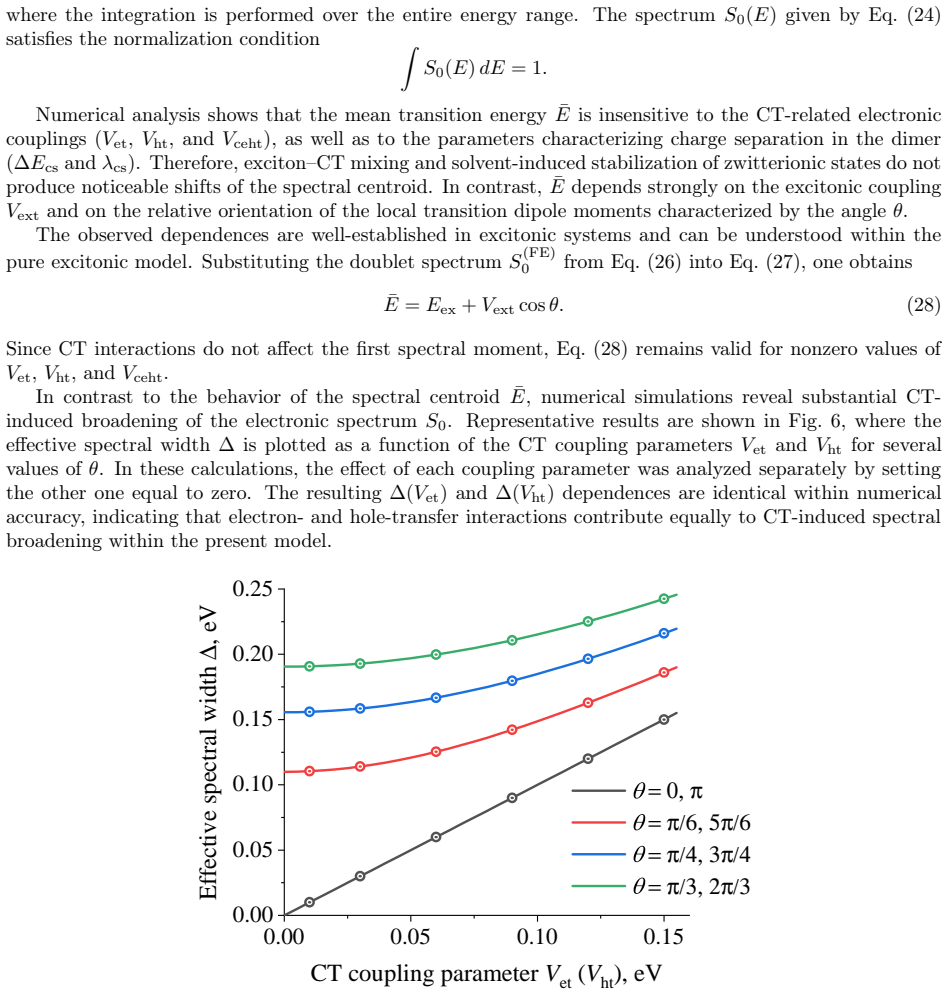
The unified adiabatic-state formalism treats coupling between Frenkel exciton and charge-transfer states together with solvent stabilization on a common set of potential surfaces. Exciton-CT mixing reorganizes the absorption profile and induces pronounced broadening whose dominant origin is additional energetic splitting between spectral components, not widening of the individual bands. The first spectral moment stays essentially unaffected. In the BPEA dimer this yields a predominantly excitonic low-energy doublet and higher-energy states carrying substantial CT character.
What carries the argument
Unified adiabatic-state formalism for coupled Frenkel exciton and charge-transfer states with solvent stabilization; it decomposes the spectrum by projecting onto mixed adiabatic surfaces whose parameters are taken as transferable.
If this is right
- The first spectral moment of the absorption band remains essentially constant even when exciton-CT mixing is strong.
- CT-induced broadening arises mainly from extra energetic splitting between mixed states rather than from wider individual transitions.
- In the BPEA dimer the lowest-energy absorption features are predominantly excitonic while higher features carry large CT character.
- Adding intramolecular vibrations and environmental modes to the adiabatic surfaces yields a practical route to fitting real spectra.
Where Pith is reading between the lines
- The splitting mechanism suggests that modest changes in inter-chromophore distance could tune line width without moving the band center.
- If the decomposition transfers to larger aggregates it could help separate CT contributions from pure excitonic delocalization in thin-film spectra.
- The same adiabatic surfaces might be used to predict how CT mixing affects the rate of charge separation after photoexcitation.
Load-bearing premise
The coupling strengths and solvent response can be captured inside one transferable set of adiabatic surfaces without needing separate treatments for each interaction.
What would settle it
A measured first spectral moment that shifts noticeably when CT mixing is increased in a dimer whose geometry is fixed, or a decomposition in which individual component widths account for most of the observed broadening instead of the splitting between them.
Figures
read the original abstract
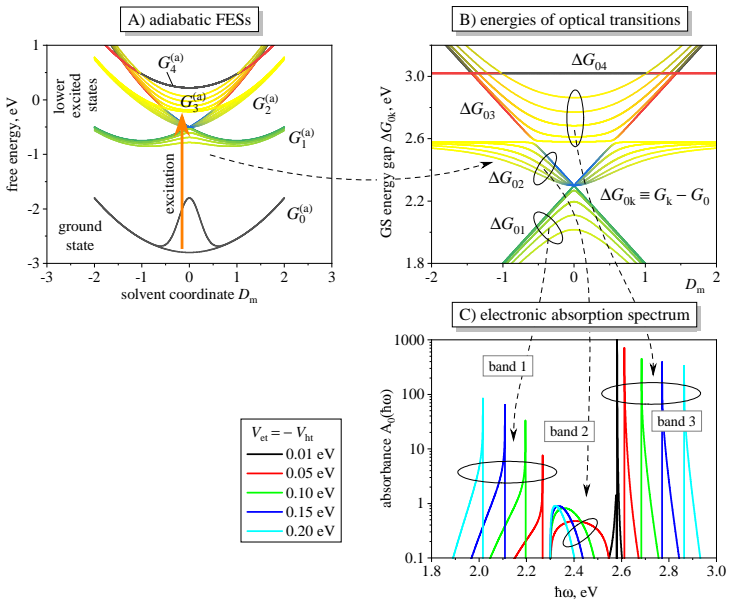
Electronic absorption spectra of multichromophoric systems are often governed by complex excited-state structures arising from excitonic and charge-transfer (CT) interactions between chromophores, while direct identification of the underlying electronic transitions is frequently hindered by strong vibronic and solvent-induced broadening. In this paper, we develop a theoretical framework for the analysis and decomposition of absorption spectra of molecular dimers with coupled Frenkel exciton (FE) and charge-transfer states, including solvent-induced stabilization of zwitterionic configurations within a unified adiabatic-state formalism. The analysis reveals that exciton-CT mixing strongly reorganizes the electronic absorption profile and produces pronounced spectral broadening, while leaving the first spectral moment essentially unaffected. Numerical calculations show that the dominant mechanism of CT-induced broadening originates primarily from additional energetic splitting between spectral components rather than from broadening of the individual bands themselves. The electronic model is further extended to include coupling to high-frequency intramolecular vibrations and low-frequency environmental degrees of freedom, providing a practical framework for interpretation of realistic experimental spectra. The developed formalism is applied to the absorption spectrum of a covalently linked 9,10-bis(phenylethynyl)anthracene dimer in dichloromethane, where spectral decomposition reveals a predominantly excitonic low-energy doublet and higher-energy states with substantial CT character. The proposed approach offers a physically transparent framework for the analysis of complex absorption spectra in molecular aggregates and organic electronic materials with coupled excitonic and CT states.
Editorial analysis
A structured set of objections, weighed in public.
Referee Report
Summary. The paper develops a theoretical framework for decomposing absorption spectra of molecular dimers involving coupled Frenkel exciton (FE) and charge-transfer (CT) states within a unified adiabatic-state formalism that incorporates solvent stabilization of zwitterionic configurations. It claims that exciton-CT mixing strongly reorganizes the electronic absorption profile and produces pronounced spectral broadening primarily through additional energetic splitting between components (rather than broadening of individual bands), while leaving the first spectral moment essentially unaffected. The model is extended to include coupling to high-frequency intramolecular vibrations and low-frequency environmental modes, and is applied to the absorption spectrum of a covalently linked BPEA dimer in dichloromethane, where decomposition reveals a predominantly excitonic low-energy doublet and higher-energy states with substantial CT character.
Significance. If the central claims hold, the work provides a physically transparent decomposition method for interpreting complex spectra in multichromophoric systems and organic electronic materials, with the numerical separation of splitting versus individual-band broadening as a potentially useful mechanistic insight. The extension to vibronic and solvent effects and the concrete application to an experimental BPEA spectrum add practical value for the field.
major comments (2)
- [unified adiabatic-state formalism] Unified adiabatic-state formalism: The claims of spectral reorganization, CT-induced broadening via splitting, and preservation of the first moment are direct consequences of the eigenvalues and eigenvectors of the adiabatic Hamiltonian. The manuscript must explicitly report the numerical values chosen for the FE-CT electronic couplings and solvent stabilization shifts for the BPEA dimer, together with their independent determination (e.g., from ab initio calculations or literature constraints) rather than implicit adjustment to the observed width; without this, the decomposition risks circularity with the target spectrum.
- [application to BPEA dimer] Application to BPEA dimer: The reported decomposition into excitonic low-energy doublet and CT-character higher states relies on the transferability of the adiabatic mixing parameters to the specific BPEA geometry and dichloromethane environment. The paper should include a sensitivity analysis or error propagation showing how variations in these parameters affect the identified broadening mechanism and state characters.
minor comments (1)
- The abstract would benefit from a brief reference to the key equations defining the adiabatic Hamiltonian or the numerical decomposition procedure.
Simulated Author's Rebuttal
We thank the referee for the constructive and insightful comments. We address each major point below and will revise the manuscript to incorporate the requested clarifications and analyses.
read point-by-point responses
-
Referee: Unified adiabatic-state formalism: The claims of spectral reorganization, CT-induced broadening via splitting, and preservation of the first moment are direct consequences of the eigenvalues and eigenvectors of the adiabatic Hamiltonian. The manuscript must explicitly report the numerical values chosen for the FE-CT electronic couplings and solvent stabilization shifts for the BPEA dimer, together with their independent determination (e.g., from ab initio calculations or literature constraints) rather than implicit adjustment to the observed width; without this, the decomposition risks circularity with the target spectrum.
Authors: We agree that explicit reporting of the FE-CT coupling values and solvent stabilization shifts, together with their independent sources, is necessary to avoid any appearance of circularity. In the revised manuscript we will add a new subsection (or table) that lists all Hamiltonian parameters used for the BPEA dimer, citing the ab initio calculations or literature values from which each was obtained. We will also state explicitly that these parameters were fixed prior to the spectral decomposition and were not varied to match the experimental width. revision: yes
-
Referee: Application to BPEA dimer: The reported decomposition into excitonic low-energy doublet and CT-character higher states relies on the transferability of the adiabatic mixing parameters to the specific BPEA geometry and dichloromethane environment. The paper should include a sensitivity analysis or error propagation showing how variations in these parameters affect the identified broadening mechanism and state characters.
Authors: We acknowledge that a quantitative sensitivity analysis strengthens the robustness claim. In the revised version we will add a new figure (or supplementary section) that varies the key FE-CT couplings and solvent shifts over a physically reasonable range and shows the resulting changes in (i) the identified state characters, (ii) the splitting-versus-band-broadening decomposition, and (iii) the first spectral moment. This will demonstrate that the central mechanistic conclusions remain stable within the uncertainty of the input parameters. revision: yes
Circularity Check
No circularity: framework derives spectral features from adiabatic Hamiltonian without reducing to fitted inputs or self-citations
full rationale
The paper constructs a unified adiabatic-state formalism for FE-CT mixing and solvent stabilization, then computes reorganization, broadening via splitting, and first-moment invariance as direct numerical consequences of the model's eigenvalues/vectors. These are presented as model outputs applied to the BPEA dimer rather than parameters fitted to the target spectrum and renamed as predictions. No self-definitional loops, fitted-input predictions, or load-bearing self-citations appear in the abstract or described derivation; the central claims remain independent of the specific BPEA data. The transferability assumption is an external modeling choice, not a circular reduction.
Axiom & Free-Parameter Ledger
axioms (1)
- domain assumption Coupled Frenkel exciton and charge-transfer states can be treated within a unified adiabatic-state formalism that includes solvent-induced stabilization of zwitterionic configurations.
Reference graph
Works this paper leans on
-
[2]
R.; Fournier, M.; Moore, A.; Moore, T
Terazono, Y.; Kodis, G.; Chachisvilis, M.; Cherry, B. R.; Fournier, M.; Moore, A.; Moore, T. A.; Gust, D. Multiporphyrin Arrays withπ-πInterchromophore Interactions.J. Am. Chem. Soc.2015, 137, 245–258, DOI:10.1021/ja510267c
-
[3]
Sung, J.; Kim, P.; Fimmel, B.; Würthner, F.; Kim, D. Direct observation of ultrafast coherent exciton dynamics in helicalπ-stacks of self-assembled perylene bisimides.Nat. Commun.2015,6, 8646, DOI: 10.1038/ncomms9646
-
[4]
Würthner, F. Dipole–Dipole Interaction Driven Self-Assembly of Merocyanine Dyes: From Dimers to Nanoscale Objects and Supramolecular Materials.Acc. Chem. Res.2016,49, 868–876, DOI: 10.1021/acs.accounts.6b00042
-
[5]
Photoinduced Intra- and Intermolecu- lar Energy Transfer in ChlorophyllaDimer.J
Zheng, F.; Fernandez-Alberti, S.; Tretiak, S.; Zhao, Y. Photoinduced Intra- and Intermolecu- lar Energy Transfer in ChlorophyllaDimer.J. Phys. Chem. B2017,121, 5331–5339, DOI: 10.1021/acs.jpcb.7b02021
-
[6]
Hong, Y.; Schlosser, F.; Kim, W.; Würthner, F.; Kim, D. Ultrafast Symmetry-Breaking Charge Sepa- ration in a Perylene Bisimide Dimer Enabled by Vibronic Coupling and Breakdown of Adiabaticity.J. Am. Chem. Soc.2022,144, 15539–15548, DOI:10.1021/jacs.2c03916
-
[7]
Hashimoto, S.; Yabushita, A.; Kobayashi, T.; Okamura, K.; Iwakura, I. Direct observation of the change in transient molecular structure of 9,9′-bianthryl using a 10 fs pulse UV laser.Chem. Phys.2018,512, 128–134, DOI:10.1016/j.chemphys.2017.12.016
-
[8]
Bimolecular photoinduced symmetry-breaking charge separation of perylene in solution.Photochem
Wega, J.; Vauthey, E. Bimolecular photoinduced symmetry-breaking charge separation of perylene in solution.Photochem. Photobiol. Sci.2024,23, 93–105, DOI:10.1007/s43630-023-00504-3
-
[9]
Controlling Symmetry-Breaking Charge Separation in Pyrene Bichromophores.J
Wega, J.; Zhang, K.-F.; Lacour, J.; Vauthey, E. Controlling Symmetry-Breaking Charge Separation in Pyrene Bichromophores.J. Phys. Chem. Lett.2024,15, 2834–2840, DOI: 10.1021/acs.jpclett.4c00337
-
[10]
Bressan, G.; Chambrier, I.; Cammidge, A. N.; Meech, S. R. Symmetry-Breaking Charge-Separation in a Subphthalocyanine Dimer Resolved by Two-Dimensional Electronic Spectroscopy.J. Phys. Chem. C 2025,129, 1069–1077, DOI:10.1021/acs.jpcc.4c07588
-
[11]
Kokkin, D. L.; Reilly, N. J.; Ivanov, M.; Rathore, R.; Reid, S. A. Excitonic Coupling in Fluorene- Based Bichromophoric Systems: Vibrational Quenching and the Transition from Weak to Intermediate Coupling.J. Phys. Chem. A2023,127, 7198–7204, DOI:10.1021/acs.jpca.3c03511
-
[12]
Kim, J.; Nakamura, S.; O’Connor, J. P.; Peinkofer, K. R.; Tyndall, S. B.; Young, R. M.; Wasielewski, M. R. Solvent Polarity Independent Symmetry-Breaking Charge Separation in a Slip- Stacked Covalent Terrylene Monoimide Dimer.J. Am. Chem. Soc.2025,147, 48300–48310, DOI: 10.1021/jacs.5c17847
-
[13]
M.; Liu, B.; Würthner, F.; Kim, D
Zhang, W.; Teichmann, B.; Park, Y.; Jung, Y. M.; Liu, B.; Würthner, F.; Kim, D. Divergent Excitons by Programming Secondary Structures of Perylene Bisimide Oligomers.J. Am. Chem. Soc.2026,148, 5476–5485, DOI:10.1021/jacs.5c19488
-
[14]
P.; Kundu, S.; Valdiviezo, J.; Bullard, G.; Fletcher, J
Roy, P. P.; Kundu, S.; Valdiviezo, J.; Bullard, G.; Fletcher, J. T.; Liu, R.; Yang, S.-J.; Zhang, P.; Beratan, D.; Therien, M.; Makri, N.; Fleming, G. Synthetic Control of Exciton Dynamics in Bioinspired Cofacial Porphyrin Dimers.J. Am. Chem. Soc.2022,144, 6298 – 6310, DOI:10.1021/jacs.1c12889
-
[15]
Hernandez, L. A.; Nelson, T. R.; Tretiak, S.; Fernandez-Alberti, S. Photoexcited Energy Transfer in a Weakly Coupled Dimer.J. Phys. Chem. B2015,119, 7242–7252, DOI:10.1021/jp510557f. 23
-
[16]
Optical properties of quadrupolar and bi-quadrupolar dyes: intra and inter chromophoric interactions
Uranga-Barandiaran, O.; Catherin, M.; Zaborova, E.; D’Aléo, A.; Fages, F.; Castet, F.; Casanova, D. Optical properties of quadrupolar and bi-quadrupolar dyes: intra and inter chromophoric interactions. Phys. Chem. Chem. Phys.2018,20, 24623–24632, DOI:10.1039/C8CP05048A
-
[17]
Dimers of Quadrupolar Chromophores in Solution: Electrostatic Interactions and Optical Spectra.J
Sissa, C.; Terenziani, F.; Painelli, A.; Abbotto, A.; Bellotto, L.; Marinzi, C.; Garbin, E.; Ferrante, C.; Bozio, R. Dimers of Quadrupolar Chromophores in Solution: Electrostatic Interactions and Optical Spectra.J. Phys. Chem. B2010,114, 882–893, DOI:10.1021/jp909475d
-
[18]
Kumar, M.; Provazza, J.; Coker, D. F. Influence of solution phase environmental heterogeneity and fluctuations on vibronic spectra: Perylene diimide molecular chromophore complexes in solution.J. Chem. Phys.2021,154, 224109, DOI:10.1063/5.0054377
-
[19]
C. A. Valente, D.; do Casal, M. T.; Barbatti, M.; Niehaus, T. A.; Aquino, A. J. A.; Lischka, H.; Cardozo, T. M. Excitonic and charge transfer interactions in tetracene stacked and T-shaped dimers. J. Chem. Phys.2021,154, 044306, DOI:10.1063/5.0033272
-
[20]
D.; Şen, S.; Elmalı, A.; Karatay, A.; Köse, M
Gültekin, D. D.; Şen, S.; Elmalı, A.; Karatay, A.; Köse, M. E.; Harriman, A.; Bozdemir, Ö. A. Mono- and Bichromophores Formed from Perylene Monoimide Diesters: Competition between Intramolecular Charge Transfer and Intermolecular Singlet Exciton Fission.J. Phys. Chem. A2024,128, 9614–9626, DOI:10.1021/acs.jpca.4c05424
-
[21]
Ivanov, A. I. Symmetry breaking charge transfer in excited multibranched molecules and dimers: A unified standpoint.J. Photochem. Photobiol C: Photochem. Rev.2024,58, 100651, DOI: 10.1016/j.jphotochemrev.2024.100651
-
[22]
Thakur, K.; Datta, S.; Blom, P. W. M.; Chaudhuri, D.; Ramanan, C. Competitive Charge Separa- tion Pathways in a Flexible Molecular Folda-Dimer.J. Phys. Chem. B2024,128, 1760 – 1770, DOI: 10.1021/acs.jpcb.3c07134
-
[23]
Yu, G.; Gao, Y.; Li, Y.; Tian, Y.; Zhang, X.; Han, Y.; Song, J.; Yang, W.; Ma, X. Tuning the Inter- Chromophore Electronic Coupling in Perylene Diimide Dimers with Rigid Covalent Linkers.Molecules 2025,30, 2513, DOI:10.3390/molecules30122513
-
[24]
Wasielewski, M. R. Self-Assembly Strategies for Integrating Light Harvesting and Charge Separation in Artificial Photosynthetic Systems.Acc. Chem. Res.2009,42, 1910–1921, DOI:10.1021/ar9001735
-
[25]
Young, R. M.; Wasielewski, M. R. Mixed Electronic States in Molecular Dimers: Connecting Singlet Fission, Excimer Formation, and Symmetry-Breaking Charge Transfer.Acc. Chem. Res.2020,53, 1957–1968, DOI:10.1021/acs.accounts.0c00397
-
[26]
Korovina, N. V.; Pompetti, N. F.; Johnson, J. C. Lessons from intramolecular singlet fission with covalently bound chromophores.J. Chem. Phys.2020,152, 040904, DOI:10.1063/1.5135307
-
[27]
Curti, M.; Maffeis, V.; Teixeira Alves Duarte, L. G.; Shareef, S.; Hallado, L. X.; Curutchet, C.; Romero, E. Engineering excitonically coupled dimers in an artificial protein for light harvesting via computational modeling.Protein Science2023,32, e4579, DOI:https://doi.org/10.1002/pro.4579
-
[28]
Rybtchinski, B.; Sinks, L. E.; Wasielewski, M. R. Combining Light-Harvesting and Charge Separation in a Self-Assembled Artificial Photosynthetic System Based on Perylenediimide Chromophores.J. Am. Chem. Soc.2004,126, 12268–12269, DOI:10.1021/ja0460514
-
[29]
Kato, E.; Takeda, H.; Koike, K.; Ohkubo, K.; Ishitani, O. Ru(ii)–Re(i) binuclear photocatalysts con- nected by –CH2XCH2– (X = O, S, CH2) for CO2 reduction.Chem. Sci.2015,6, 3003–3012, DOI: 10.1039/C4SC03710C
-
[30]
Brixner, T.; Hildner, R.; Köhler, J.; Lambert, C.; Würthner, F. Exciton Transport in Molecular Ag- gregates – From Natural Antennas to Synthetic Chromophore Systems.Adv. Energy Mater.2017,7, 1700236, DOI:https://doi.org/10.1002/aenm.201700236. 24
-
[31]
Jang, S. J.; Mennucci, B. Delocalized excitons in natural light-harvesting complexes.Rev. Mod. Phys. 2018,90, 035003, DOI:10.1103/RevModPhys.90.035003
-
[32]
N.; Kolodziej, C.; Maiti, B.; Bhandari, S.; Dunietz, B
McCleese, C.; Yu, Z.; Esemoto, N. N.; Kolodziej, C.; Maiti, B.; Bhandari, S.; Dunietz, B. D.; Burda, C.; Ptaszek, M. Excitonic Interactions in Bacteriochlorin Homo-Dyads Enable Charge Transfer: A New Approach to the Artificial Photosynthetic Special Pair.J. Phys. Chem. B2018,122, 4131–4140, DOI: 10.1021/acs.jpcb.8b02123
-
[33]
S.; Estergreen, L.; Bradforth, S
Kellogg, M.; Akil, A.; Muthiah Ravinson, D. S.; Estergreen, L.; Bradforth, S. E.; Thompson, M. E. Symmetry breaking charge transfer as a means to study electron transfer with no driving force.Faraday Discuss.2019,216, 379–394, DOI:10.1039/C8FD00201K
-
[34]
Quantum Dynamics of Exciton Transport and Dissociation in Multichromophoric Systems.Annu
Popp, W.; Brey, D.; Binder, R.; Burghardt, I. Quantum Dynamics of Exciton Transport and Dissociation in Multichromophoric Systems.Annu. Rev. Phys. Chem.2021,72, 591–616, DOI: 10.1146/annurev-physchem-090419-040306
-
[35]
Imahori, H.; Kobori, Y.; Kaji, H. Manipulation of Charge-Transfer States by Molecular Design: Perspec- tive from “Dynamic Exciton”.Acc. Mater. Res.2021,2, 501–514, DOI:10.1021/accountsmr.1c00045
-
[36]
Photoexcitation dynamics in perylene diimide dimers.J
Mukazhanova, A.; Malone, W.; Negrin-Yuvero, H.; Fernandez-Alberti, S.; Tretiak, S.; Sharifzadeh, S. Photoexcitation dynamics in perylene diimide dimers.J. Chem. Phys.2020,153, 244117, DOI: 10.1063/5.0031485
-
[37]
Machín, A.; Cotto, M.; Ducongé, J.; Márquez, F. Artificial photosynthesis: current advancements and future prospects.Biomimetics2023,8, 298, DOI:10.3390/biomimetics8030298
-
[38]
Ghosh, S.; Patra, A. A Perspective on Ultrafast Excited-State Dynamics: From Molecular Aggregates to Conjugated Polymer Nanoparticles.Acc. Chem. Res.2026,59, 464–475, DOI: 10.1021/acs.accounts.5c00783
-
[39]
Cook, R. E.; Phelan, B. T.; Kamire, R. J.; Majewski, M. B.; Young, R. M.; Wasielewski, M. R. Excimer Formation and Symmetry-Breaking Charge Transfer in Cofacial Perylene Dimers.J. Phys. Chem. A 2017,121, 1607–1615, DOI:10.1021/acs.jpca.6b12644
-
[40]
H.; Estergreen, L.; Porter, T.; Tadle, A
Golden, J. H.; Estergreen, L.; Porter, T.; Tadle, A. C.; Sylvinson, D.; Facendola, J. W.; Kubiak, C. P.; Bradforth, S. E.; Thompson, M. E. Symmetry-Breaking Charge Transfer in Boron Dipyridylmethene (DIPYR) Dimers.Appl. Energy Mater.2018,1, 1083–1095, DOI:10.1021/acsaem.7b00214
-
[41]
Alzola, J. M.; Tcyrulnikov, N. A.; Brown, P. J.; Marks, T. J.; Wasielewski, M. R.; Young, R. M. Symmetry-Breaking Charge Separation in Phenylene-Bridged Perylenediimide Dimers.J. Phys. Chem. A2021,125, 7633–7643, DOI:10.1021/acs.jpca.1c05100
-
[42]
Zhang, H.; Kuang, Z.; Yang, Y.; Jing, R.; Zhang, J.; Guo, Y.; Zhang, X.-F.; Li, Y.; Xia, A. Ultrafast Symmetry-Breaking Charge Separation in Covalent Boron-Dipyrromethene Dimers Modu- lated by Coulombic and Charge Transfer Coupling.J. Phys. Chem. Lett.2026,17, 432–439, DOI: 10.1021/acs.jpclett.5c03787
-
[43]
Margulies, E. A.; Shoer, L. E.; Eaton, S. W.; Wasielewski, M. R. Excimer formation in cofacial and slip-stacked perylene-3,4:9,10-bis(dicarboximide) dimers on a redox-inactive triptycene scaffold.Phys. Chem. Chem. Phys.2014,16, 23735–23742, DOI:10.1039/C4CP03107E
-
[44]
Budyka, M. F.; Potasheva, N. I.; Gavrishova, T. N.; Li, V. M. Photoisomerization and [2 + 2] photo- cycloaddition in bichromophoric styrylbenzoquinoline dyads with o-xylylene bridge group.High Energ. Chem.2017,51, 201–208, DOI:10.1134/S001814391703002X
-
[45]
Bae, Y. J.; Shimizu, D.; Schultz, J. D.; Kang, G.; Zhou, J.; Schatz, G. C.; Osuka, A.; Wasielewski, M. R. Balancing charge transfer and Frenkel exciton coupling leads to excimer forma- tion in molecular dimers: Implications for singlet fission.J. Phys. Chem A2020,124, 8478–8487, DOI: 10.1021/acs.jpca.0c07646. 25
-
[46]
Excimers in Multichromophoric Assemblies: Boon or Bane?Org
Chaudhuri, D. Excimers in Multichromophoric Assemblies: Boon or Bane?Org. Mater.2021,3, 455 – 468, DOI:10.1055/a-1578-0960
-
[47]
Modulating the Charge Transfer Coupling in Boron-Dipyrromethene Homodimers byπ-Bridge Units.J
Ma, L.; Kuang, Z.; Zhang, H.; Wan, Y.; Guo, Y.; Xia, A.; Li, Y. Modulating the Charge Transfer Coupling in Boron-Dipyrromethene Homodimers byπ-Bridge Units.J. Phys. Chem. B2025,129, 3428–3435, DOI:10.1021/acs.jpcb.5c00292
-
[48]
A comparative investigation on excimer fluorescence toward its bright future.Chem
Wang, S.; Liu, H.; Zhao, S.; Wu, Q.; Yang, Z.; Yang, D.; Lv, Y.; Su, Q.; Zhang, S.-T.; Yang, B. A comparative investigation on excimer fluorescence toward its bright future.Chem. Sci.2025,16, 3275–3284, DOI:10.1039/D4SC08001G
-
[49]
Hestand, N. J.; Spano, F. C. Expanded Theory of H- and J-Molecular Aggregates: The Effects of Vibronic Coupling and Intermolecular Charge Transfer.Chem. Rev.2018,118, 7069–7163, DOI: 10.1021/acs.chemrev.7b00581
-
[50]
Excited-state dynamics of a molecular dyad with two orthogonally-oriented fluorophores.Phys
Letrun, R.; Lang, B.; Yushchenko, O.; Wilcken, R.; Svechkarev, D.; Kolodieznyi, D.; Riedle, E.; Vau- they, E. Excited-state dynamics of a molecular dyad with two orthogonally-oriented fluorophores.Phys. Chem. Chem. Phys.2018,20, 30219–30230, DOI:10.1039/C8CP05356A
-
[51]
Estergreen, L.; Mencke, A. R.; Cotton, D. E.; Korovina, N. V.; Michl, J.; Roberts, S. T.; Thomp- son, M. E.; Bradforth, S. E. Controlling Symmetry Breaking Charge Transfer in BODIPY Pairs.Acc. Chem. Res.2022,55, 1561–1572, DOI:10.1021/acs.accounts.2c00044
-
[52]
Kasha, M.; Rawls, H. R.; Ashraf El-Bayoumi, M. The Exciton Model in Molecular Spectroscopy.Pure Appl. Chem.1965,11, 371–392, DOI:10.1351/pac196511030371
-
[53]
Antipov, I. F.; Ivanov, A. I. Minimal model of excited-state symmetry breaking in symmetric dimers and covalently linked dyads.J. Chem. Phys.2022,157, 224104, DOI:10.1063/5.0129697
-
[54]
Holstein, T. D. Studies of polaron motion: Part I. The molecular-crystal model.Ann. Phys. (N.Y.) 1959,8, 325–342, DOI:https://doi.org/10.1016/0003-4916(59)90002-8
-
[55]
Barford, W.Electronic and Optical Properties of Conjugated Polymers; International Series of Mono- graphs on Physics; OUP Oxford, 2013
2013
-
[56]
Bialas, A. L.; Spano, F. C. A Holstein-Peierls Approach to Excimer Spectra: The Evolution from Vibronically Structured to Unstructured Emission.J. Phys. Chem. C2022,126, 4067–4081, DOI: 10.1021/acs.jpcc.1c10255
-
[57]
Ghosh, R.; Spano, F. C. Excitons and Polarons in Organic Materials.Acc. Chem. Res.2020,53, 2201– 2211, DOI:10.1021/acs.accounts.0c00349
-
[58]
Bruschi, M.; Zambon, R.; Gallina, F.; Fresch, B. Influence of excitonic coupling, static disorder, and coherent dynamics in action-2D electronic spectroscopy of a molecular dimer model.J. Chem. Phys. 2025,163, 084113, DOI:10.1063/5.0276191
-
[59]
Marcus, R. A. On the Theory of Oxidation-Reduction Reactions Involving Electron Transfer. I.J. Chem. Phys.1956,24, 966–978, DOI:10.1063/1.1742723
-
[60]
Cohen-Tannoudji, C.; Diu, B.; Laloë, F.Quantum Mechanics, Volume 1: Basic Concepts, Tools, and Applications; Wiley-VCH: New York, NY, 1992
1992
-
[61]
Charge Instability in Quadrupolar Chromophores: Symmetry Breaking and Solvatochromism.J
Terenziani, F.; Painelli, A.; Katan, C.; Charlot, M.; Blanchard-Desce, M. Charge Instability in Quadrupolar Chromophores: Symmetry Breaking and Solvatochromism.J. Am. Chem. Soc.2006, 128, 15742–15755, DOI:10.1021/ja064521j
-
[62]
Ivanov, A. I.; Dereka, B.; Vauthey, E. A Simple Model of Solvent-Induced Symmetry-Breaking Charge Transfer in Excited Quadrupolar Molecules.J. Chem. Phys.2017,146, 164306, DOI: 10.1063/1.4982067. 26
-
[63]
Nazarov, A. E.; Ivanov, A. I. Nonstationary Theory of Excited State Charge Transfer Sym- metry Breaking Driven by Polar Solvent.J. Phys. Chem. B2020,124, 10787–10801, DOI: 10.1021/acs.jpcb.0c07612
-
[64]
Watching Excited-State Symmetry Breaking in Multibranched Push-Pull Molecules.J
Vauthey, E. Watching Excited-State Symmetry Breaking in Multibranched Push-Pull Molecules.J. Phys. Chem. Lett.2022,13, 2064–2071, DOI:10.1021/acs.jpclett.2c00259
-
[65]
Mikhailova, T. V.; Mikhailova, V. A.; Ivanov, A. I. Effect of locally excited state on fluorescence transi- tion dipole moment in quadrupolar molecules subjected to symmetry breaking charge transfer.J. Chem. Phys.2024,161, 154303, DOI:10.1063/5.0237870
-
[66]
Mikhailova, T. V.; Mikhailova, V. A.; Ivanov, A. I. Effect of the Locally Excited State on Symmetry- Breaking Charge Transfer and Transition Dipole Moment in Quadrupolar Molecules with Inverse Level Order.J. Phys. Chem. B2025,129, DOI:10.1021/acs.jpcb.5c06580
-
[67]
Siplivy, N. B.; Ivanov, A. I. Symmetry breaking charge transfer and control of the transition dipole moment in excited octupolar molecules.J. Chem. Phys.2024,160, 194302, DOI:10.1063/5.0211030
-
[68]
Ivanov, A. I. Electric dipole moment of excited octupolar molecules: Potential qubit implementation. J. Chem. Phys.2025,162, 024303, DOI:10.1063/5.0243375
-
[69]
Nazarov, A. E.; Ignatjev, V. K.; Ivanov, A. I. Jahn-Teller-driven electric field response in excited oc- tupolar molecules.J. Chem. Phys.2025,163, 244301, DOI:10.1063/5.0305597
-
[70]
Nazarov, A. E.; Ignatjev, V. K.; Ivanov, A. I. Terahertz second-harmonic generation by excited octupolar molecules.J. Chem. Phys.2026,164, 154303, DOI:10.1063/5.0331932
-
[71]
Excited State Structure and Decay Rates for Aggregates
Shuai, Z.; Sun, Q.; Ren, J.; Jiang, T.; Li, W. Excited State Structure and Decay Rates for Aggregates. Aggregate2025,6, e70013, DOI:https://doi.org/10.1002/agt2.70013
-
[72]
Grimme, S.; Antony, J.; Ehrlich, S.; Krieg, H. A consistent and accurate ab initio parametrization of density functional dispersion correction (DFT-D) for the 94 elements H-Pu.J. Chem. Phys.2010,132, 154104, DOI:10.1063/1.3382344
-
[73]
The ORCA quantum chemistry program package
Neese, F.; Wennmohs, F.; Becker, U.; Riplinger, C. The ORCA quantum chemistry program package. J. Chem. Phys.2020,152, 224108, DOI:10.1063/5.0004608
-
[74]
Software update: The ORCA program system—version 6.0
Neese, F. Software update: the ORCA program system, version 6.0.WIRES Comput. Molec. Sci.2025, 15, e70019, DOI:10.1002/wcms.70019
-
[75]
Siplivy, N. B.; Ivanov, A. I. Solvation-driven symmetry breaking charge transfer in excited cen- trosymmetric molecules without donor-acceptor motifs.Synth. Met.2026,319, 118154, DOI: 10.1016/j.synthmet.2026.118154. 27 TOC graphic 28
discussion (0)
Sign in with ORCID, Apple, or X to comment. Anyone can read and Pith papers without signing in.