Universal theory of domain-wall width in multi-sublattice Heisenberg magnets
Pith reviewed 2026-06-28 13:37 UTC · model grok-4.3
The pith
A universal expression for domain-wall width applies across multi-sublattice Heisenberg magnets by linking the wall profile directly to long-wavelength spin-wave dispersion.
A machine-rendered reading of the paper's core claim, the machinery that carries it, and where it could break.
Core claim
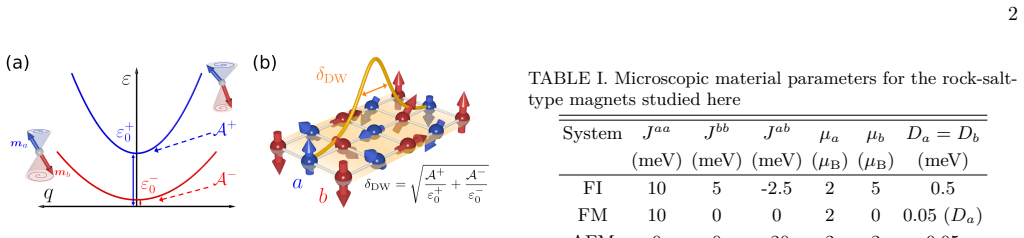
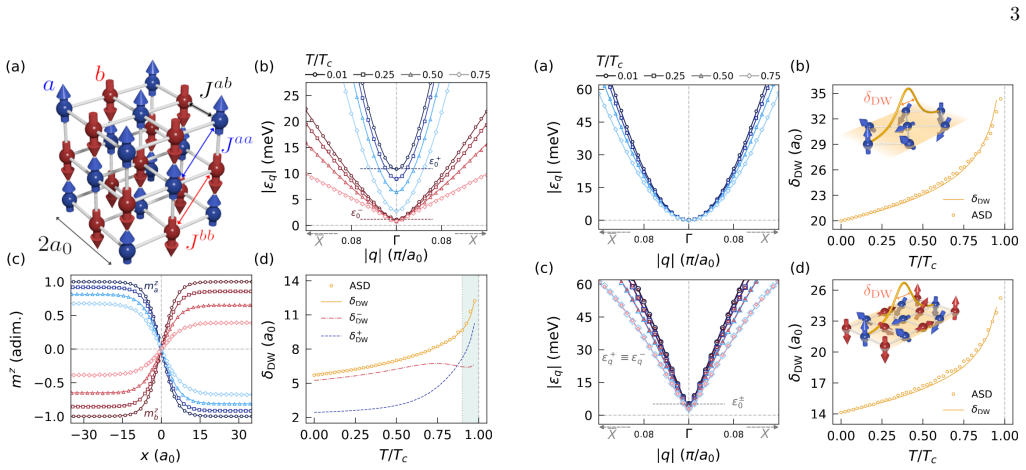
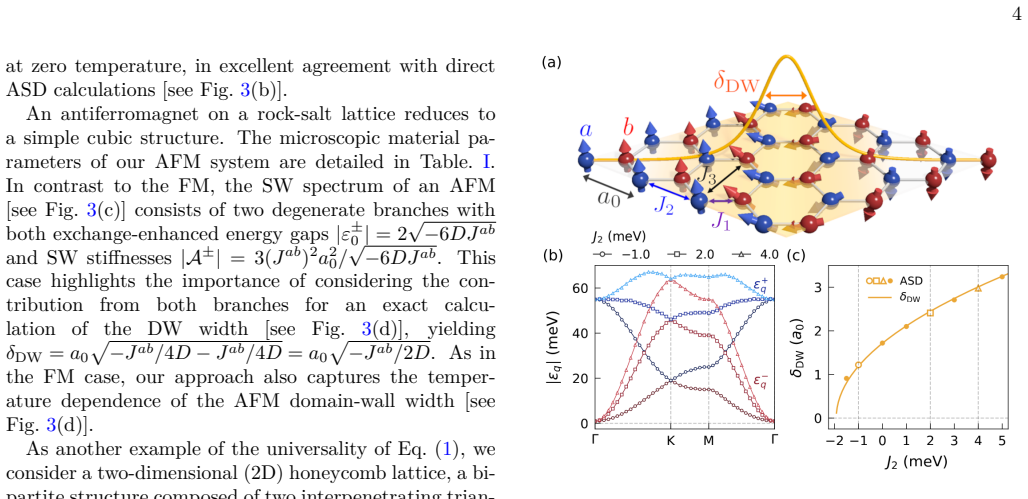
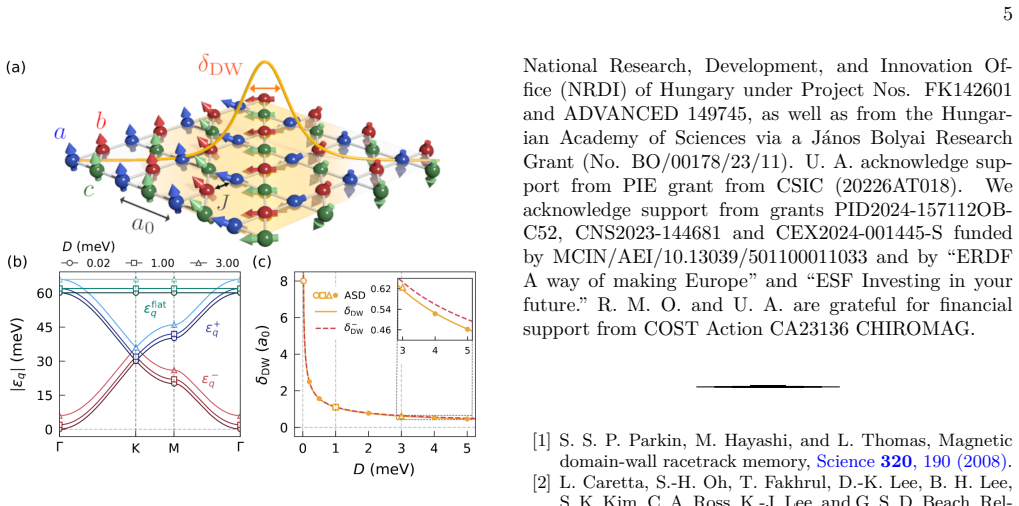
We propose a universal expression for the domain-wall width in generic multi-sublattice Heisenberg magnets, applicable to ferro-, antiferro-, and ferrimagnetic orders. The result follows from an exact connection between the domain-wall profile and the long-wavelength spin-wave dispersion, yielding a unified framework for describing magnetic textures across distinct ordering types. The predictions show excellent quantitative agreement with large-scale atomistic spin dynamics simulations over a broad range of exchange and anisotropy values and spin multi-sublattice structures, including three-dimensional rock-salt-type magnets and two-dimensional honeycomb and kagome ferromagnets. Moreover, we
What carries the argument
The exact connection between the domain-wall profile and the long-wavelength spin-wave dispersion that fixes the width for any magnetic order.
If this is right
- The same expression describes domain walls in ferro-, antiferro-, and ferrimagnetic orders.
- The expression matches simulations for three-dimensional rock-salt magnets and two-dimensional honeycomb and kagome structures.
- It remains accurate over broad ranges of exchange and anisotropy parameters.
- A microscopic route is supplied for the temperature dependence of domain-wall width.
Where Pith is reading between the lines
- The profile-dispersion link could reduce the need for full simulations when estimating wall widths in new multi-sublattice materials.
- Analogous mappings might apply to other extended textures such as skyrmions or vortices in the same class of magnets.
- The temperature foundation may let zero-temperature spin-wave data predict wall stability at finite temperature.
Load-bearing premise
The domain-wall profile is exactly determined by the long-wavelength spin-wave dispersion even in multi-sublattice systems with arbitrary exchange and anisotropy.
What would settle it
An atomistic simulation of a domain wall in a multi-sublattice magnet with strong short-wavelength effects that produces a measured width different from the value predicted solely by the long-wavelength dispersion.
Figures
read the original abstract
We propose a universal expression for the domain-wall width in generic multi-sublattice Heisenberg magnets, applicable to ferro-, antiferro-, and ferrimagnetic orders. The result follows from an exact connection between the domain-wall profile and the long-wavelength spin-wave dispersion, yielding a unified framework for describing magnetic textures across distinct ordering types. The predictions show excellent quantitative agreement with large-scale atomistic spin dynamics simulations over a broad range of exchange and anisotropy values and spin multi-sublattice structures, including three-dimensional rock-salt-type magnets and two-dimensional honeycomb and kagome ferromagnets. Moreover, we establish a general microscopic foundation for the temperature dependence of the domain-wall width. Our approach offers a powerful tool for understanding domain-wall profiles in complex spin systems.
Editorial analysis
A structured set of objections, weighed in public.
Referee Report
Summary. The manuscript proposes a universal expression for the domain-wall width in generic multi-sublattice Heisenberg magnets applicable to ferro-, antiferro-, and ferrimagnetic orders. The expression is obtained from an asserted exact connection between the domain-wall profile and the long-wavelength spin-wave dispersion, yielding a unified description across ordering types. Predictions are reported to show excellent quantitative agreement with atomistic spin-dynamics simulations over broad ranges of exchange, anisotropy, and lattice structures (including 3D rock-salt and 2D honeycomb/kagome), and a microscopic foundation for the temperature dependence of the width is established.
Significance. If the exact mapping between domain-wall profile and spin-wave dispersion holds for arbitrary multi-sublattice parameters, the result would supply a valuable unified framework that simplifies analysis of magnetic textures across distinct magnetic orders. The reported simulation agreement over wide parameter ranges would then constitute a strong validation point, provided the derivation is independent of the long-wavelength expansion itself.
major comments (2)
- [Abstract] Abstract (paragraph 2): the central claim rests on an 'exact connection' between the domain-wall profile and the long-wavelength spin-wave dispersion that is asserted to hold for generic multi-sublattice Heisenberg models with arbitrary exchange and anisotropy. No derivation steps, proof of exactness, or demonstration that the mapping is independent of the continuum/long-wavelength expansion are supplied, rendering it impossible to verify whether the universality survives when short-wavelength modes or strong local anisotropies are present.
- [Abstract] Abstract (final paragraph): the statement of 'excellent quantitative agreement with large-scale atomistic spin dynamics simulations' is given without error bars, details on how domain-wall width is extracted from the simulations, or explicit exclusion criteria for the tested parameter ranges. This information is load-bearing for the claim that the expression is universal rather than valid only inside the regime where the long-wavelength approximation already applies.
minor comments (1)
- [Abstract] The abstract refers to 'three-dimensional rock-salt-type magnets and two-dimensional honeycomb and kagome ferromagnets' without naming the specific Hamiltonians or anisotropy terms used in the comparisons.
Simulated Author's Rebuttal
We thank the referee for their careful reading and constructive comments. We address the two major points below and are prepared to revise the abstract and main text accordingly to improve clarity and provide additional methodological details.
read point-by-point responses
-
Referee: [Abstract] Abstract (paragraph 2): the central claim rests on an 'exact connection' between the domain-wall profile and the long-wavelength spin-wave dispersion that is asserted to hold for generic multi-sublattice Heisenberg models with arbitrary exchange and anisotropy. No derivation steps, proof of exactness, or demonstration that the mapping is independent of the continuum/long-wavelength expansion are supplied, rendering it impossible to verify whether the universality survives when short-wavelength modes or strong local anisotropies are present.
Authors: The derivation establishing the exact mapping is given in full in Sections II and III of the manuscript. We begin from the discrete multi-sublattice Heisenberg Hamiltonian, linearize the equations of motion for small deviations, and obtain the spin-wave dispersion; the static domain-wall profile is then shown to satisfy an identical differential equation whose solution is fixed by the same quadratic coefficients. This establishes exactness within the model without further continuum assumptions beyond the definition of the long-wavelength dispersion itself. Atomistic simulations (which retain all wavelengths and arbitrary anisotropy strengths) are used to validate the formula across the tested structures and parameter ranges, including cases with strong local anisotropies. We will revise the abstract to state that the mapping is derived in the main text and to note the simulation validation includes full microscopic dynamics. revision: yes
-
Referee: [Abstract] Abstract (final paragraph): the statement of 'excellent quantitative agreement with large-scale atomistic spin dynamics simulations' is given without error bars, details on how domain-wall width is extracted from the simulations, or explicit exclusion criteria for the tested parameter ranges. This information is load-bearing for the claim that the expression is universal rather than valid only inside the regime where the long-wavelength approximation already applies.
Authors: We agree that these details should be stated more explicitly. In the revised version we will expand the abstract (or add a short methods paragraph) to describe the extraction procedure (least-squares fit of the simulated sublattice magnetization profiles to the analytic tanh form), report representative error bars obtained from ensemble averages over independent runs, and specify the parameter ranges together with the exclusion rule (walls discarded only when they become unstable or pinned by the simulation cell boundaries). Because the underlying simulations are fully atomistic, they incorporate short-wavelength modes and thereby test the formula outside a pure long-wavelength regime. revision: yes
Circularity Check
Derivation appears self-contained; no load-bearing reduction to inputs or self-citations exhibited
full rationale
The provided abstract and context describe a claimed exact mapping from long-wavelength spin-wave dispersion to domain-wall profile in multi-sublattice Heisenberg models, with validation against atomistic simulations. No equations, derivation steps, or citations are quoted in the input that would allow identification of self-definitional equivalence, fitted inputs renamed as predictions, or load-bearing self-citations. Without explicit paper text showing a reduction (e.g., Eq. X defined via Y then used to 'predict' Y), the central result cannot be classified as circular by the required standards. The derivation is treated as independent pending full equations.
Axiom & Free-Parameter Ledger
axioms (1)
- domain assumption The domain-wall profile is exactly connected to the long-wavelength spin-wave dispersion in multi-sublattice Heisenberg magnets.
Reference graph
Works this paper leans on
-
[1]
By marking in gray the region 13 FIG
These expres- sions yield a DW width ofδDW =a 0 √ 2Jaa/Da = 20a 0 4 at zero temperature, in excellent agreement with direct ASD calculations [see Fig. 3(b)]. An antiferromagnet on a rock-salt lattice reduces to a simple cubic structure. The microscopic material pa- rameters of our AFM system are detailed in Table. I. In contrast to the FM, the SW spectrum...
-
[2]
S. S. P. Parkin, M. Hayashi, and L. Thomas, Magnetic domain-wall racetrack memory, Science320, 190 (2008)
2008
-
[3]
Caretta, S.-H
L. Caretta, S.-H. Oh, T. Fakhrul, D.-K. Lee, B. H. Lee, S.K.Kim, C.A.Ross, K.-J.Lee,andG.S.D.Beach,Rel- ativistic kinematics of a magnetic soliton, Science370, 1438 (2020)
2020
-
[4]
Y.-X. Wang, T. K. M. Graham, R. Rama-Eiroa, M. A. Islam, M. H. Badarneh, R. N. Gontijo, G. P. Tiwari, T. Adhikari, X.-Y. Zhang, K. Watanabe, T. Taniguchi, C. Besson, E. J. G. Santos, Z. Lin, and B. B. Zhou, Con- figurable antiferromagnetic domains and lateral exchange bias in atomically thin CrPS4, Nature Materials24, 1414 (2025)
2025
-
[5]
Emori, U
S. Emori, U. Bauer, S.-M. Ahn, E. Martinez, and G. S. D. Beach, Current-driven dynamics of chiral ferromagnetic domain walls, Nature Materials12, 611 (2013)
2013
-
[6]
Hennecke, D
M. Hennecke, D. Schick, T. P. H. Sidiropoulos, J.-X. Lin, Z. Guo, G. Malinowski, M. Mattern, L. Ehrentraut, M. Schmidbauer, M. Schnuerer, C. von Korff Schmising, S. Mangin, M. Hehn, and S. Eisebitt, Transient domain boundary drives ultrafast magnetisation reversal, Nature Communications16, 8233 (2025)
2025
-
[7]
Parkin and S.-H
S. Parkin and S.-H. Yang, Memory on the racetrack, Na- ture Nanotechnology10, 195 (2015)
2015
-
[8]
Z. Luo, A. Hrabec, T. P. Dao, G. Sala, S. Finizio, J. Feng, S. Mayr, J. Raabe, P. Gambardella, and L. J. Heyder- man, Current-driven magnetic domain-wall logic, Nature 579, 214 (2020)
2020
-
[9]
Manchon, J
A. Manchon, J. Železný, I. Miron, T. Jungwirth, J. Sinova, A. Thiaville, K. Garello, and P. Gambardella, Current-induced spin-orbit torques in ferromagnetic and antiferromagnetic systems, Reviews of Modern Physics 91, 35004 (2019)
2019
-
[10]
Rivelles, R
A. Rivelles, R. Yanes, L. Torres, M. Abuín, J. Grandal, M. Sepehr, G. Orero-Gámez, R. Guedas, L. Fernández- García, R. Izquierdo-López, M. Maicas, M. del Mar Sanz, J. Pedrós, F. Calle, S. Ruiz-Gómez, M. W. Khaliq, M. A. Niño, S. Vélez, M. Foerster, L. López-Díaz, and J. L. Prieto, Moving magnetic domain walls with sound alone, Nature Communications16, 9963 (2025)
2025
-
[11]
Schlickeiser, U
F. Schlickeiser, U. Ritzmann, D. Hinzke, and U. Nowak, Role of Entropy in Domain Wall Motion in Thermal Gra- dients, Physical Review Letters113, 97201 (2014)
2014
-
[12]
Donges, N
A. Donges, N. Grimm, F. Jakobs, S. Selzer, U. Ritzmann, U. Atxitia, and U. Nowak, Unveiling domain wall dynam- ics of ferrimagnets in thermal magnon currents: Compe- 6 titionofangularmomentumtransferandentropictorque, Physical Review Research2, 13293 (2020)
2020
-
[13]
D.Hardt, R.Doostani, S.Diehl, N.delSer,andA.Rosch, Propelling ferrimagnetic domain walls by dynamical frus- tration, Nature Communications16, 3817 (2025)
2025
-
[14]
Diona, L
P. Diona, L. Maranzana, S. Artyukhin, and G. Sala, Ob- servation of Relativistic Domain Wall Motion in Amor- phous Ferrimagnets, Advanced Functional Materials36, e22549 (2025)
2025
-
[15]
Kumar, T
D. Kumar, T. Jin, R. Sbiaa, M. Kläui, S. Bedanta, S. Fukami, D. Ravelosona, S.-H. Yang, X. Liu, and S. N. Piramanayagam, Domain wall memory: Physics, materi- als, and devices, Physics Reports958, 1 (2022)
2022
-
[16]
Hubert and R
A. Hubert and R. Schäfer,Magnetic Domains(Springer, Berlin, Germany, 1998)
1998
-
[17]
A. P. Malozemoff and J. C. Slonczewski,Magnetic Do- main Walls in Bubble Materials, Applied Solid State Sci- ence, Supplement 1 (Academic Press, New York, USA, 1979)
1979
-
[18]
N. L. Schryer and L. R. Walker, The motion of 180°do- main walls in uniform dc magnetic fields, Journal of Ap- plied Physics45, 5406 (1974)
1974
-
[19]
M. Wu, S. Ding, L. van Schie, S. Cai, Y. Qiu, A. Du, A. E. Kossak, R. Wu, C. L. Degen, X. Chen, and P. Gam- bardella, High-mobility inertial domain walls driven by spin-transfer torque in a ferrimagnetic spinel oxide, Na- ture Communications17, 4672 (2026)
2026
-
[20]
Li and S
Z. Li and S. Zhang, Domain-wall dynamics driven by adiabatic spin-transfer torques, Physical Review B70, 024417 (2004)
2004
-
[21]
Aharoni,Introduction to the Theory of Ferromag- netism, 2nd ed
A. Aharoni,Introduction to the Theory of Ferromag- netism, 2nd ed. (Oxford University Press, Oxford, 2000)
2000
-
[22]
G. Theodorou and S. Komineas, Antiferromag- netic domain walls under spin-orbit torque (2025), arXiv:2509.22241 [cond-mat.mtrl-sci]
arXiv 2025
-
[23]
Moreno, P
R. Moreno, P. G. Bercoff, U. Atxitia, R. F. L. Evans, and O. Chubykalo-Fesenko, Temperature dependence of exchange stiffness and energy barrier in compensated fer- rimagnets, Physical Review B111, 184416 (2025)
2025
-
[24]
Nowak,Classical Spin Models(Johhn Wiley & Sons, Chichester, United Kingdom, 2007)
U. Nowak,Classical Spin Models(Johhn Wiley & Sons, Chichester, United Kingdom, 2007)
2007
-
[25]
R. F. L. Evans, W. J. Fan, P. Chureemart, T. A. Ostler, M. O. A. Ellis, and R. W. Chantrell, Atomistic spin model simulations of magnetic nanomaterials, Journal of Physics: Condensed Matter26, 103202 (2014)
2014
-
[26]
Böttcher, A
D. Böttcher, A. Ernst, and J. Henk, Temperature- dependent Heisenberg exchange coupling constants from linking electronic-structure calculations and Monte Carlo simulations, Journal of Magnetism and Magnetic Mate- rials324, 610 (2012)
2012
-
[27]
Szilva, M
A. Szilva, M. Costa, A. Bergman, L. Szunyogh, L. Nord- ström, and O. Eriksson, Interatomic Exchange Interac- tions for Finite-Temperature Magnetism and Nonequi- librium Spin Dynamics, Physical Review Letters111, 127204 (2013)
2013
-
[28]
J. M. D. Coey,Magnetism and magnetic materials(Cam- bridge University Press, Cambridge, United Kingdom, 2010)
2010
-
[29]
Lifshitz, On the magnetic structure of iron, Journal of Physics of the USSR8, 337 (1944)
E. Lifshitz, On the magnetic structure of iron, Journal of Physics of the USSR8, 337 (1944)
1944
-
[30]
Herring and C
C. Herring and C. Kittel, On the Theory of Spin Waves in Ferromagnetic Media, Physical Review81, 869 (1951)
1951
-
[31]
MacNeill, J
D. MacNeill, J. T. Hou, D. R. Klein, P. Zhang, P. Jarillo- Herrero, and L. Liu, Gigahertz Frequency Antiferromag- netic Resonance and Strong Magnon-Magnon Coupling in the Layered Crystal CrCl3, Physical Review Letters 123, 047204 (2019)
2019
-
[32]
Xu, S.-J
C. Xu, S.-J. Kim, S. Zhao, C. Zhang, D. Yang, J. Lei, H.Park, K.-J.Lee,andH.Yang,Inversionofmagnonlife- time of ferromagnetic and exchange resonance modes in ferrimagnets, Nature Communications17, 2630 (2026)
2026
-
[33]
Chernyshev and P
A. Chernyshev and P. Maksimov, Damped Topological Magnons in the Kagome-Lattice Ferromagnets, Physical Review Letters117, 187203 (2016)
2016
-
[34]
11, 23, 24, 32, 35, 47–51
See Supplemental Material atTBDfor additional details, which includes Refs. 11, 23, 24, 32, 35, 47–51
-
[35]
Bastardis, U
R. Bastardis, U. Atxitia, O. Chubykalo-Fesenko, and H. Kachkachi, Unified decoupling scheme for ex- change and anisotropy contributions and temperature- dependent spectral properties of anisotropic spin sys- tems, Physical Review B86, 094415 (2012)
2012
-
[36]
Rózsa and U
L. Rózsa and U. Atxitia, Temperature dependence of spin-model parameters in antiferromagnets, Physical Re- view Research5, 023139 (2023)
2023
-
[37]
Barker, U
J. Barker, U. Atxitia, T. A. Ostler, O. Hovorka, O. Chubykalo-Fesenko, and R. W. Chantrell, Two- magnon bound state causes ultrafast thermally in- ducedmagnetisationswitching,ScientificReports3,3262 (2013)
2013
-
[38]
P. C. Hohenberg, Existence of long-range order in one and two dimensions, Physical Review158, 383 (1967)
1967
-
[39]
N. D. Mermin and H. Wagner, Absence of Ferro- magnetism or Antiferromagnetism in One- or Two- Dimensional Isotropic Heisenberg Models, Physical Re- view Letters17, 1133 (1966)
1966
-
[40]
Jenkins, L
S. Jenkins, L. Rózsa, U. Atxitia, R. F. L. Evans, K. S. Novoselov, and E. J. G. Santos, Breaking through the Mermin-Wagner limit in 2D van der Waals magnets, Na- ture Communications13, 6917 (2022)
2022
-
[41]
Cenker, B
J. Cenker, B. Huang, N. Suri, P. Thijssen, A. Miller, T. Song, T. Taniguchi, K. Watanabe, M. A. McGuire, D. Xiao, and X. Xu, Direct observation of two- dimensional magnons in atomically thin CrI 3, Nature Physics17, 20 (2021)
2021
-
[42]
Chen, J.-H
L. Chen, J.-H. Chung, B. Gao, T. Chen, M. B. Stone, A. I. Kolesnikov, Q. Huang, and P. Dai, Topological Spin Excitations in Honeycomb Ferromagnet CrI3, Physical Review X8, 41028 (2018)
2018
-
[43]
Martínez-Carracedo, A
G. Martínez-Carracedo, A. García-Fuente, L. Oroszlány, L. Szunyogh, and J. Ferrer, Tuning magnetic exchange interactions in two-dimensional magnets: The case of CrGeX3 (X=Se, Te) and Janus Cr2Ge2(Se,Te)3 mono- layers, Physical Review B110, 184406 (2024)
2024
-
[44]
T.-H. Han, J. S. Helton, S. Chu, D. G. Nocera, J. A. Rodriguez-Rivera, C. Broholm, and Y. S. Lee, Fraction- alized excitations in the spin-liquid state of a kagome- lattice antiferromagnet, Nature492, 406 (2012)
2012
-
[45]
Goren, B
N. Goren, B. K. Hazra, T.-Y. Zhang, S. Yochelis, Q.-F. Sun, S. S. P. Parkin, and Y. Paltiel, Antiferromagnetic local volatile memory utilizing non-collinear Mn3Sn thin films and chiral gating, Commun Mater6, 238 (2025)
2025
-
[46]
L. Ye, M. Kang, J. Liu, F. von Cube, C. R. Wicker, T. Suzuki, C. Jozwiak, A. Bostwick, E. Rotenberg, D. C. Bell, L. Fu, R. Comin, and J. G. Checkelsky, Massive Dirac fermions in a ferromagnetic kagome metal, Nature 555, 638 (2018)
2018
-
[47]
Z. Li, Q. Yin, Y. Jiang, Z. Zhu, Y. Gao, S. Wang, J. Shen, T. Zhao, J. Cai, H. Lei, S.-Z. Lin, Y. Zhang, and B. Shen, 7 Discovery of Topological Magnetic Textures near Room Temperature in Quantum Magnet TbMn6Sn6, Advanced Materials35, 2211164 (2023)
2023
-
[48]
Eriksson, A
O. Eriksson, A. Bergman, L. Bergqvist, and J. Hellsvik, Atomistic Spin-Dynamics, Foundations and Applications (Oxford University Press, Oxford, United Kingdom, 2017)
2017
-
[49]
Ritzmann, D
U. Ritzmann, D. Hinzke, and U. Nowak, Propagation of thermally induced magnonic spin currents, Physical Review B89, 024409 (2014)
2014
-
[50]
P. H. Y. Li, R. F. Bishop, D. J. J. Farnell, J. Richter, and C. E. Campbell, Ground-state phases of the frustrated spin-1/2 J1-J2-J3 Heisenberg ferromagnet (J1<0) on the honeycomb lattice with J3=J2>0, Physical Review B85, 085115 (2012)
2012
-
[51]
B. H. Zhang, Y. S. Hou, Z. Wang, and R. Q. Wu, First- principles studies of spin-phonon coupling in monolayer Cr2Ge2Te6, Physical Review B100, 224427 (2019)
2019
-
[52]
Nambu, J
Y. Nambu, J. Barker, Y. Okino, T. Kikkawa, Y. Sh- iomi, M. Enderle, T. Weber, B. Winn, M. Graves-Brook, J. Tranquada, T. Ziman, M. Fujita, G. Bauer, E. Saitoh, and K. Kakurai, Observation of magnon polarization, Physical Review Letters125, 27201 (2020)
2020
discussion (0)
Sign in with ORCID, Apple, or X to comment. Anyone can read and Pith papers without signing in.