Boulder Lectures on Thermal Dynamics and Hydrodynamic EFTs
Pith reviewed 2026-06-28 13:34 UTC · model grok-4.3
The pith
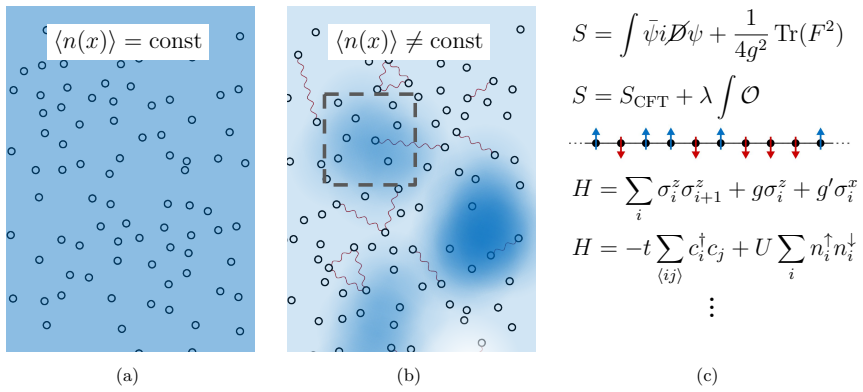
Fluctuating hydrodynamics emerges in nearly all local many-body systems at finite temperature through effective field theories organized by strong-to-weak spontaneous symmetry breaking.
A machine-rendered reading of the paper's core claim, the machinery that carries it, and where it could break.
Core claim
Fluctuating hydrodynamics emerges in essentially any local many-body system at nonzero temperature, and modern EFT constructions frame this emergence through the lens of strong-to-weak spontaneous symmetry breaking, enabling quantitative study of late-time observables in systems with generalized symmetries or 't Hooft anomalies while yielding UV/IR constraints on transport parameters both in the continuum and on the lattice.
What carries the argument
strong-to-weak spontaneous symmetry breaking, the organizing principle that constructs the hydrodynamic EFT by breaking symmetries from strong (UV) to weak (IR) form.
If this is right
- Late-time observables become calculable in a controlled way for spin chains, relativistic QFTs, and models with generalized symmetries or anomalies.
- Transport parameters obey specific UV/IR relations that hold both in continuum theories and on the lattice.
- The same EFT construction supplies quantitative predictions for out-of-equilibrium dynamics in thermalizing systems.
- Wilson coefficients of the hydrodynamic EFT can be constrained by matching to microscopic UV data.
Where Pith is reading between the lines
- The framework could be used to derive hydrodynamic descriptions for systems whose symmetries are not yet fully classified.
- Lattice simulations of spin chains could directly test the predicted relations among transport coefficients.
- Extensions to systems with explicit breaking or to lower dimensions might reveal where the strong-to-weak paradigm requires additional terms.
Load-bearing premise
The strong-to-weak spontaneous symmetry breaking supplies a controlled and uniform framework that works for all the listed systems without extra uncontrolled approximations.
What would settle it
A concrete local many-body system at nonzero temperature in which late-time observables cannot be captured by any EFT built on strong-to-weak symmetry breaking, or in which the predicted UV/IR relations among transport coefficients are violated.
Figures

read the original abstract
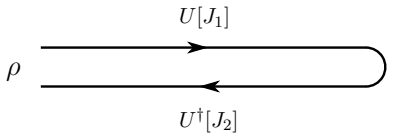
Fluctuating hydrodynamics emerges in essentially any local many-body system at nonzero temperature. Effective field theory (EFT) approaches enable the quantitative study of this emergence, providing a controlled framework to capture late-time observables. These lectures introduce the organizing principles behind equilibrium and out-of-equilibrium dynamics in these thermalizing systems. A central focus is the modern construction of these EFTs, which frames fluctuating hydrodynamics through the lens of "strong-to-weak" spontaneous symmetry breaking. Drawing examples from both high-energy and condensed matter physics, we show how this paradigm adapts to systems ranging from spin chains to relativistic quantum field theories, including models with generalized symmetries or symmetries with 't Hooft anomalies. Finally, we discuss UV/IR constraints on transport parameters -- viewed as the Wilson coefficients of hydrodynamic EFTs -- both in continuum and on the lattice.
Editorial analysis
A structured set of objections, weighed in public.
Referee Report
Summary. The manuscript consists of lecture notes introducing the organizing principles of equilibrium and out-of-equilibrium dynamics in thermalizing many-body systems at nonzero temperature. It centers on constructing effective field theories for fluctuating hydrodynamics through the strong-to-weak spontaneous symmetry breaking paradigm, with examples drawn from spin chains, relativistic quantum field theories, systems with generalized symmetries, and those exhibiting 't Hooft anomalies. The notes conclude by discussing UV/IR constraints on transport parameters, treated as Wilson coefficients of the hydrodynamic EFTs.
Significance. If the exposition is accurate and accessible, these lectures could provide a useful synthesis of the strong-to-weak SSB framework for hydrodynamic EFTs, helping researchers connect concepts across high-energy and condensed-matter contexts. The emphasis on adaptability to generalized symmetries and anomalies, together with the treatment of transport coefficients as EFT Wilson coefficients, offers a coherent organizing perspective on late-time observables without introducing new theorems or quantitative predictions.
minor comments (2)
- The abstract refers to 'modern construction' of the EFTs but does not specify which sections contain the explicit symmetry-breaking pattern or the mapping to hydrodynamic variables; adding a short roadmap paragraph after the introduction would improve navigability for readers.
- When discussing lattice versus continuum UV/IR constraints, the notes should explicitly note whether any example calculations are provided or whether the discussion remains at the level of general principles.
Simulated Author's Rebuttal
We thank the referee for their positive assessment of the manuscript and their recommendation to accept. We are pleased that the lectures are viewed as providing a useful synthesis of the strong-to-weak SSB framework across high-energy and condensed-matter contexts.
Circularity Check
No significant circularity; expository review of existing framework
full rationale
The document is a set of lecture notes that organizes and reviews the strong-to-weak spontaneous symmetry breaking construction for hydrodynamic EFTs, drawing on prior literature across spin chains, relativistic QFTs, and systems with generalized symmetries. No new central derivation, theorem, or quantitative prediction is advanced whose validity would reduce to a fitted parameter, self-citation chain, or definitional equivalence within the text itself. All load-bearing steps are presented as summaries of independently established results rather than as self-contained derivations that collapse by construction. The paper therefore remains self-contained against external benchmarks and receives the default non-circularity finding.
Axiom & Free-Parameter Ledger
axioms (1)
- domain assumption Spontaneous symmetry breaking can be applied in the strong-to-weak sense to describe the emergence of hydrodynamics in thermal systems.
Forward citations
Cited by 1 Pith paper
-
Hydrodynamic tails in chaotic spin chains with quantum group symmetry
Quantum group symmetry enables superdiffusive hydrodynamic tails for transverse spin operators in chaotic XXZ-like models despite lacking local quantum group charges.
Reference graph
Works this paper leans on
-
[1]
J. Polchinski, Effective field theory and the Fermi surface, inTheoretical Advanced Study Institute (TASI 92): From Black Holes and Strings to Particles, pp. 0235–276, 1992. [arXiv:hep-th/9210046]
Pith/arXiv arXiv 1992
-
[2]
Penco, An Introduction to Effective Field Theories, 2020, [arXiv:2006.16285 [hep-th]]
R. Penco, An Introduction to Effective Field Theories, 2020, [arXiv:2006.16285 [hep-th]]
arXiv 2020
-
[3]
Forster,Hydrodynamic Fluctuations, Broken Symmetry, and Correlation Functions, vol
D. Forster,Hydrodynamic Fluctuations, Broken Symmetry, and Correlation Functions, vol. 47 ofFrontiers in Physics. W. A. Benjamin, Inc., Reading, Massachusetts, 1975
1975
-
[4]
P. M. Chaikin, T. C. Lubensky and T. A. Witten,Principles of condensed matter physics, vol. 10. Cambridge university press Cambridge, 1995
1995
-
[5]
S. A. Hartnoll, A. Lucas and S. Sachdev,Holographic quantum matter, MIT Press, 2018, [arXiv:1612.07324]
Pith/arXiv arXiv 2018
-
[6]
Kovtun, Lectures on hydrodynamic fluctuations in relativistic theories, J
P. Kovtun, Lectures on hydrodynamic fluctuations in relativistic theories, J. Phys. A45, 473001, 2012, [arXiv:1205.5040 [hep-th]]
Pith/arXiv arXiv 2012
-
[7]
H. Liu and P. Glorioso, Lectures on non-equilibrium effective field theories and fluctuating hydrodynamics, PoSTASI2017, 008, 2018, [arXiv:1805.09331 [hep-th]]
Pith/arXiv arXiv 2018
-
[8]
L. M. Sieberer, M. Buchhold, J. Marino and S. Diehl, Universality in driven open quantum matter, 2023, [arXiv:2312.03073 [cond-mat.stat-mech]]
Pith/arXiv arXiv 2023
-
[9]
P. C. Hohenberg and B. I. Halperin, Theory of Dynamic Critical Phenomena, Rev. Mod. Phys. 49, 435–479, 1977
1977
-
[10]
N. Chai, S. Chaudhuri, C. Choi, Z. Komargodski, E. Rabinovici and M. Smolkin, Thermal Order in Conformal Theories, Phys. Rev. D102, 065014, 2020, [arXiv:2005.03676 [hep-th]]
arXiv 2020
-
[11]
K. Jensen, M. Kaminski, P. Kovtun, R. Meyer, A. Ritz and A. Yarom, Towards hydrodynamics without an entropy current, Phys. Rev. Lett.109, 101601, 2012, [arXiv:1203.3556 [hep-th]]
Pith/arXiv arXiv 2012
-
[12]
N. Banerjee, J. Bhattacharya, S. Bhattacharyya, S. Jain, S. Minwalla and T. Sharma, Constraints on Fluid Dynamics from Equilibrium Partition Functions, JHEP09, 046, 2012, [arXiv:1203.3544 [hep-th]]
Pith/arXiv arXiv 2012
-
[13]
R. Baier, P. Romatschke, D. T. Son, A. O. Starinets and M. A. Stephanov, Relativistic viscous hydrodynamics, conformal invariance, and holography, JHEP04, 100, 2008, [arXiv:0712.2451 [hep-th]]
Pith/arXiv arXiv 2008
-
[14]
N. Benjamin, J. Lee, H. Ooguri and D. Simmons-Duffin, Universal asymptotics for high energy CFT data, JHEP03, 115, 2024, [arXiv:2306.08031 [hep-th]]
arXiv 2024
-
[15]
P. Romatschke and D. T. Son, Spectral sum rules for the quark-gluon plasma, Phys. Rev. D 80, 065021, 2009, [arXiv:0903.3946 [hep-ph]]. 52
Pith/arXiv arXiv 2009
-
[16]
A. Adams, N. Arkani-Hamed, S. Dubovsky, A. Nicolis and R. Rattazzi, Causality, analyticity and an IR obstruction to UV completion, JHEP10, 014, 2006, [arXiv:hep-th/0602178]
Pith/arXiv arXiv 2006
-
[17]
L. V. Delacretaz, A. L. Fitzpatrick, E. Katz and M. T. Walters, Thermalization and hydrodynamics of two-dimensional quantum field theories, SciPost Phys.12, 119, 2022, [arXiv:2105.02229 [hep-th]]
arXiv 2022
-
[18]
Sachdev, Polylogarithm identities in a conformal field theory in three-dimensions, Phys
S. Sachdev, Polylogarithm identities in a conformal field theory in three-dimensions, Phys. Lett. B309, 285–288, 1993, [arXiv:hep-th/9305131]
Pith/arXiv arXiv 1993
-
[19]
G. Policastro, D. T. Son and A. O. Starinets, From AdS / CFT correspondence to hydrodynamics. 2. Sound waves, JHEP12, 054, 2002, [arXiv:hep-th/0210220]
Pith/arXiv arXiv 2002
-
[20]
A. D. Linde, Infrared Problem in Thermodynamics of the Yang-Mills Gas, Phys. Lett. B96, 289–292, 1980
1980
-
[21]
Braaten and R
E. Braaten and R. D. Pisarski, Soft Amplitudes in Hot Gauge Theories: A General Analysis, Nucl. Phys. B337, 569–634, 1990
1990
-
[22]
J. I. Kapusta and C. Gale,Finite-temperature field theory: Principles and applications. Cambridge university press, 2007
2007
-
[23]
Braaten, Solution to the perturbative infrared catastrophe of hot gauge theories, Phys
E. Braaten, Solution to the perturbative infrared catastrophe of hot gauge theories, Phys. Rev. Lett.74, 2164–2167, 1995, [arXiv:hep-ph/9409434]
Pith/arXiv arXiv 1995
-
[24]
Z. Komargodski and F. K. Popov, Temperature-Resistant Order in 2+1 Dimensions, 2024, [arXiv:2412.09459 [hep-th]]
Pith/arXiv arXiv 2024
-
[25]
T. Hartman, S. Jain and S. Kundu, Causality Constraints in Conformal Field Theory, JHEP 05, 099, 2016, [arXiv:1509.00014 [hep-th]]
Pith/arXiv arXiv 2016
-
[26]
A. A. Abrikosov, L. P. Gorkov and I. E. Dzyaloshinski,Methods of quantum field theory in statistical physics. Prentice-Hall, Englewood Cliffs, NJ, 1963
1963
-
[27]
A. V. Chubukov and D. L. Maslov, Nonanalytic corrections to the fermi-liquid behavior, Phys. Rev. B68, 155113, 2003, [arXiv:cond-mat/0305022]
Pith/arXiv arXiv 2003
-
[28]
L. M. Sieberer, A. Chiocchetta, A. Gambassi, U. C. T¨ auber and S. Diehl, Thermodynamic Equilibrium as a Symmetry of the Schwinger-Keldysh Action, Phys. Rev. B92, 134307, 2015, [arXiv:1505.00912 [cond-mat.stat-mech]]
Pith/arXiv arXiv 2015
-
[29]
S. Caron-Huot and G. D. Moore, Heavy quark diffusion in QCD and N=4 SYM at next-to-leading order, JHEP02, 081, 2008, [arXiv:0801.2173 [hep-ph]]
Pith/arXiv arXiv 2008
-
[30]
P. Gao, P. Glorioso and H. Liu, Ghostbusters: Unitarity and Causality of Non-equilibrium Effective Field Theories, JHEP03, 040, 2020, [arXiv:1803.10778 [hep-th]]
Pith/arXiv arXiv 2020
- [31]
-
[32]
S. R. Coleman, J. Wess and B. Zumino, Structure of phenomenological Lagrangians. 1., Phys.Rev.177, 2239–2247, 1969
1969
-
[33]
Callan, Curtis G., S
J. Callan, Curtis G., S. R. Coleman, J. Wess and B. Zumino, Structure of phenomenological Lagrangians. 2., Phys.Rev.177, 2247–2250, 1969
1969
-
[34]
P. C. Martin, E. D. Siggia and H. A. Rose, Statistical Dynamics of Classical Systems, Phys. Rev. A8, 423–437, 1973
1973
-
[35]
C. d. Dominicis, Techniques de renormalisation de la th´ eorie des champs et dynamique des ph´ enomenes critiques, 1976
1976
-
[36]
Janssen, On a Lagrangean for classical field dynamics and renormalization group calculations of dynamical critical properties, Z
H.-K. Janssen, On a Lagrangean for classical field dynamics and renormalization group calculations of dynamical critical properties, Z. Phys. B23, 377–380, 1976
1976
-
[37]
F. M. Haehl, R. Loganayagam and M. Rangamani, The Fluid Manifesto: Emergent symmetries, hydrodynamics, and black holes, JHEP01, 184, 2016, [arXiv:1510.02494 [hep-th]]
Pith/arXiv arXiv 2016
-
[38]
M. Crossley, P. Glorioso and H. Liu, Effective field theory of dissipative fluids, JHEP09, 095, 2017, [arXiv:1511.03646 [hep-th]]
Pith/arXiv arXiv 2017
-
[39]
K. Jensen, R. Marjieh, N. Pinzani-Fokeeva and A. Yarom, A panoply of Schwinger-Keldysh transport, SciPost Phys.5, 053, 2018, [arXiv:1804.04654 [hep-th]]
Pith/arXiv arXiv 2018
-
[40]
O. Ogunnaike, J. Feldmeier and J. Y. Lee, Unifying Emergent Hydrodynamics and Lindbladian Low-Energy Spectra across Symmetries, Constraints, and Long-Range Interactions, Phys. Rev. Lett.131, 220403, 2023, [arXiv:2304.13028 [cond-mat.str-el]]
arXiv 2023
-
[41]
C. O. Akyuz, G. Goon and R. Penco, The Schwinger-Keldysh coset construction, JHEP06, 004, 2024, [arXiv:2306.17232 [hep-th]]
arXiv 2024
-
[42]
B. Buca and T. Prosen, A note on symmetry reductions of the Lindblad equation: Transport in constrained open spin chains, New J. Phys.14, 073007, 2012, [arXiv:1203.0943 [quant-ph]]
Pith/arXiv arXiv 2012
-
[43]
D. Manzano, A short introduction to the lindblad master equation,10, AIP Advances, 2020, [arXiv:1906.04478 [quant-ph]]
arXiv 2020
-
[44]
D. Gu, Z. Wang and Z. Wang, Spontaneous symmetry breaking in open quantum systems: strong, weak, and strong-to-weak, 2024, [arXiv:2406.19381 [quant-ph]]
Pith/arXiv arXiv 2024
- [45]
- [46]
-
[47]
L. A. Lessa, R. Ma, J.-H. Zhang, Z. Bi, M. Cheng and C. Wang, Strong-to-Weak Spontaneous Symmetry Breaking in Mixed Quantum States, PRX Quantum6, 010344, 2025, [arXiv:2405.03639 [quant-ph]]
arXiv 2025
- [48]
-
[49]
S.-T. Zhou, M. Cheng, T. Rakovszky, C. von Keyserlingk and T. D. Ellison, Finite-Temperature Quantum Topological Order in Three Dimensions, Phys. Rev. Lett.135, 040402, 2025, [arXiv:2503.02928 [cond-mat.str-el]]
arXiv 2025
-
[50]
E. Firat, A. Gomes, F. Nardi, R. Penco and R. Rattazzi, Schwinger-Keldysh effective theory of charge transport: redundancies and systematicω/T expansion, JHEP05, 079, 2026, [arXiv:2508.18346 [hep-th]]
Pith/arXiv arXiv 2026
-
[51]
P. Glorioso, M. Crossley and H. Liu, Effective field theory of dissipative fluids (II): classical limit, dynamical KMS symmetry and entropy current, JHEP09, 096, 2017, [arXiv:1701.07817 [hep-th]]
Pith/arXiv arXiv 2017
-
[52]
M. Bucca, A. Jain, M. Mezei and A. Milekhin, All-order fluctuating hydrodynamics of the SYK lattice, 2026, [arXiv:2604.18675 [hep-th]]
Pith/arXiv arXiv 2026
-
[53]
L. V. Delacretaz and R. Mishra, Nonlinear response in diffusive systems, SciPost Phys.16, 047, 2024, [arXiv:2304.03236 [cond-mat.str-el]]
arXiv 2024
-
[54]
B. J. Alder and T. E. Wainwright, Decay of the Velocity Autocorrelation Function, Phys. Rev. A1, 18–21, 1970
1970
-
[55]
Forster, D
D. Forster, D. R. Nelson and M. J. Stephen, Large-distance and long-time properties of a randomly stirred fluid, Phys. Rev. A16, 732–749, 1977
1977
-
[56]
P. Kovtun and L. G. Yaffe, Hydrodynamic fluctuations, long time tails, and supersymmetry, Phys. Rev. D68, 025007, 2003, [arXiv:hep-th/0303010]
Pith/arXiv arXiv 2003
-
[57]
P. Kovtun, G. D. Moore and P. Romatschke, The stickiness of sound: An absolute lower limit on viscosity and the breakdown of second order relativistic hydrodynamics, Phys. Rev. D84, 025006, 2011, [arXiv:1104.1586 [hep-ph]]
Pith/arXiv arXiv 2011
-
[58]
S. Caron-Huot and O. Saremi, Hydrodynamic Long-Time tails From Anti de Sitter Space, JHEP11, 013, 2010, [arXiv:0909.4525 [hep-th]]
Pith/arXiv arXiv 2010
-
[59]
A. A. Michailidis, D. A. Abanin and L. V. Delacr´ etaz, Corrections to Diffusion in Interacting Quantum Systems, Phys. Rev. X14, 031020, 2024, [arXiv:2310.10564 [cond-mat.stat-mech]]
arXiv 2024
-
[60]
A. Jain, P. Kovtun, A. Ritz and A. Shukla, Hydrodynamic effective field theory and the analyticity of hydrostatic correlators, JHEP02, 200, 2021, [arXiv:2011.03691 [hep-th]]. 55
arXiv 2021
-
[61]
X. Chen-Lin, L. V. Delacr´ etaz and S. A. Hartnoll, Theory of diffusive fluctuations, Phys. Rev. Lett.122, 091602, 2019, [arXiv:1811.12540 [hep-th]]
arXiv 2019
-
[62]
L. V. Delacretaz, Heavy Operators and Hydrodynamic Tails, SciPost Phys.9, 034, 2020, [arXiv:2006.01139 [hep-th]]
arXiv 2020
-
[63]
A. Raj, P. Glorioso, S. Gopalakrishnan and V. Oganesyan, Diffusion cascade in a model of interacting random walkers, 2024, [arXiv:2412.05222 [cond-mat.stat-mech]]
arXiv 2024
-
[64]
M. Winer and B. Swingle, Hydrodynamic Theory of the Connected Spectral form Factor, Phys. Rev. X12, 021009, 2022, [arXiv:2012.01436 [cond-mat.stat-mech]]
arXiv 2022
-
[65]
A. J. Friedman, A. Chan, A. De Luca and J. T. Chalker, Spectral statistics and many-body quantum chaos with conserved charge, Phys. Rev. Lett.123, 210603, 2019, [arXiv:1906.07736 [cond-mat.stat-mech]]
arXiv 2019
-
[66]
T. Rakovszky, F. Pollmann and C. W. von Keyserlingk, Diffusive hydrodynamics of out-of-time-ordered correlators with charge conservation, Phys. Rev. X8, 031058, 2018, [arXiv:1710.09827 [cond-mat.stat-mech]]
Pith/arXiv arXiv 2018
-
[67]
V. Khemani, A. Vishwanath and D. A. Huse, Operator spreading and the emergence of dissipation in unitary dynamics with conservation laws, Phys. Rev. X8, 031057, 2018, [arXiv:1710.09835 [cond-mat.stat-mech]]
Pith/arXiv arXiv 2018
-
[68]
T. Rakovszky, F. Pollmann and C. W. von Keyserlingk, Sub-ballistic Growth of R´ enyi Entropies due to Diffusion, Phys. Rev. Lett.122, 250602, 2019, [arXiv:1901.10502 [cond-mat.str-el]]
Pith/arXiv arXiv 2019
-
[69]
Y. Chen, V. Ivo and J. Maldacena, Comments on the double cone wormhole, JHEP04, 124, 2024, [arXiv:2310.11617 [hep-th]]
arXiv 2024
-
[70]
S. Chaudhuri and R. Loganayagam, Probing Out-of-Time-Order Correlators, JHEP07, 006, 2019, [arXiv:1807.09731 [hep-th]]
arXiv 2019
-
[71]
C. Eling, Y. Neiman and Y. Oz, Holographic Non-Abelian Charged Hydrodynamics from the Dynamics of Null Horizons, JHEP12, 086, 2010, [arXiv:1010.1290 [hep-th]]
Pith/arXiv arXiv 2010
-
[72]
P. Glorioso, L. V. Delacr´ etaz, X. Chen, R. M. Nandkishore and A. Lucas, Hydrodynamics in lattice models with continuous non-Abelian symmetries, SciPost Phys.10, 015, 2021, [arXiv:2007.13753 [cond-mat.stat-mech]]
arXiv 2021
-
[73]
R. A. Davison, B. Gout´ eraux and S. A. Hartnoll, Incoherent transport in clean quantum critical metals, JHEP10, 112, 2015, [arXiv:1507.07137 [hep-th]]
Pith/arXiv arXiv 2015
-
[74]
S. Grozdanov, A. Lucas and N. Poovuttikul, Holography and hydrodynamics with weakly broken symmetries, Phys. Rev. D99, 086012, 2019, [arXiv:1810.10016 [hep-th]]. 56
Pith/arXiv arXiv 2019
-
[75]
L. V. Delacr´ etaz, B. Gout´ eraux and V. Ziogas, Damping of Pseudo-Goldstone Fields, Phys. Rev. Lett.128, 141601, 2022, [arXiv:2111.13459 [hep-th]]
arXiv 2022
-
[76]
J. M. Torres-Rincon and D. Teaney, Kinetics of hydrodynamic pions in chiral perturbation theory, Phys. Rev. D106, 056012, 2022, [arXiv:2201.10495 [hep-ph]]
arXiv 2022
-
[77]
M. Stephanov and Y. Yin, Hydrodynamics with parametric slowing down and fluctuations near the critical point, Phys. Rev. D98, 036006, 2018, [arXiv:1712.10305 [nucl-th]]
Pith/arXiv arXiv 2018
-
[78]
D. T. Son and M. A. Stephanov, Real time pion propagation in finite temperature QCD, Phys. Rev. D66, 076011, 2002, [arXiv:hep-ph/0204226]
Pith/arXiv arXiv 2002
- [79]
-
[80]
P. Ledwith, H. Guo and L. Levitov, Angular Superdiffusion and Directional Memory in Two-Dimensional Electron Fluids, 2017, [arXiv:1708.01915 [cond-mat.mes-hall]]
arXiv 2017
discussion (0)
Sign in with ORCID, Apple, or X to comment. Anyone can read and Pith papers without signing in.