Size limits on tidal debris around white dwarfs: the km-size barrier
Pith reviewed 2026-06-28 12:29 UTC · model grok-4.3
The pith
Rubble-pile minor planets around white dwarfs break into fragments no larger than about one kilometer due to their cohesive strength.
A machine-rendered reading of the paper's core claim, the machinery that carries it, and where it could break.
Core claim
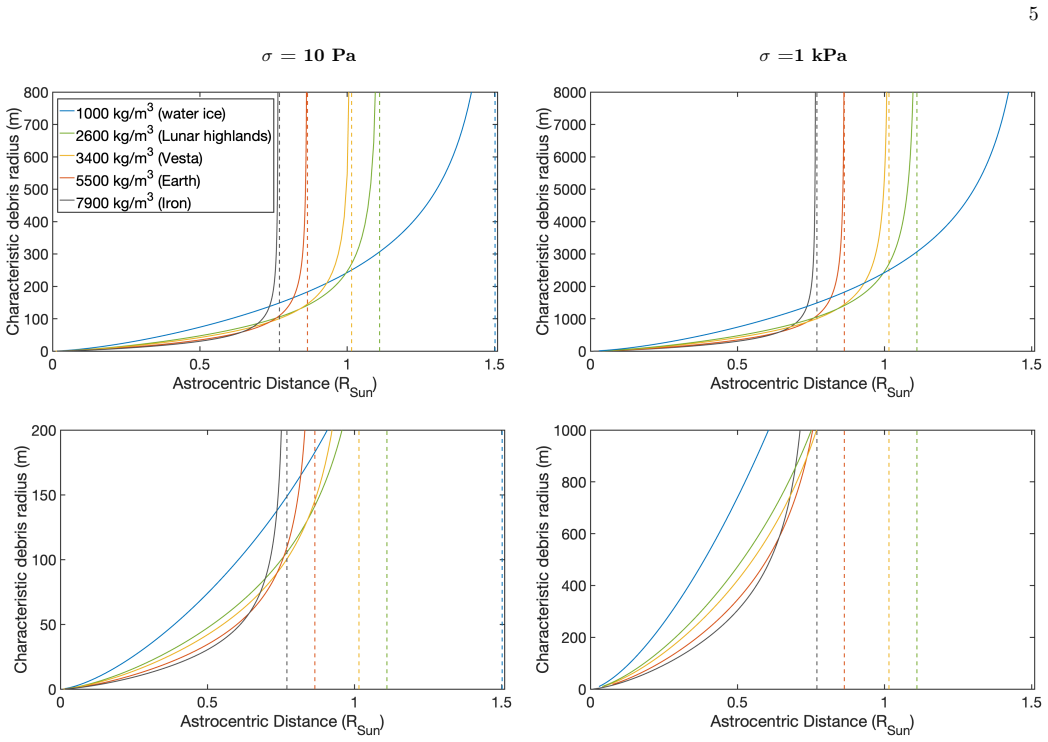
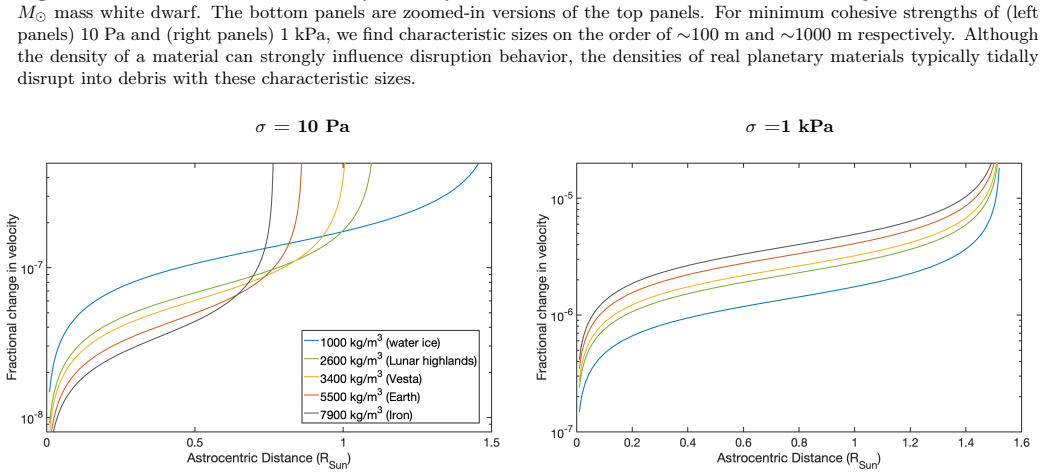
Incorporating non-zero cohesive strength in rubble-pile minor planets sets a maximum tidal fragment size of 0.1-1 km for typical strengths of ∼10-1000 Pa. This km-size barrier represents the characteristic sizes of tidal fragments, with most of the debris mass contained in fragments of this size. Non-zero internal strength more narrowly radially confines the fragments than in the strengthless case. Consequently, disk evolution should first feature a prominent dust-forming process such as collisional grinding before Poynting-Robertson drag can significantly shape the final disk.
What carries the argument
The km-size barrier, the maximum fragment size set by balancing tidal forces against the cohesive strength of rubble piles under white-dwarf gravity.
If this is right
- Disk evolution must include an initial phase of collisional grinding to generate dust.
- Tidal fragments are radially more confined than predicted by strengthless models.
- Collisions play a central role in both the formation and subsequent evolution of white dwarf debris disks.
- Size distributions used in disk models are bounded above by the km-size barrier.
Where Pith is reading between the lines
- Models of white dwarf disk evolution should initialize with a size distribution peaked at 0.1-1 km rather than assuming a continuous cascade from larger bodies.
- The same strength-limited barrier may appear in other tidal-disruption settings where rubble piles are involved.
- Observational constraints on the largest particles in white dwarf disks could directly test the adopted strength range.
Load-bearing premise
Rubble piles possess cohesive strengths from Van der Waals forces in the 10-1000 Pa range that control the size at which they break under tidal forces.
What would settle it
Detection of tidal debris fragments significantly larger than 1 km, or a size distribution in a white dwarf disk that lacks a strong peak near 0.1-1 km.
Figures
read the original abstract
Compact disks of planetary debris orbiting white dwarfs provide a crucial window into our understanding of evolved planetary systems. The formation of these disks has been widely modeled with tidal fragmentation of minor planets that are rubble piles with no internal strength. However, rubble piles do have non-zero cohesive strength from Van der Waals forces, and here we demonstrate the consequences: breakup of these rubble piles sets a maximum fragment size, and we calculate this size \jks{for water ice, iron, and material densities corresponding to the lunar highlands, Vesta and the Earth}. We find that for typical minimum rubble pile strengths of $\sim$10-1000 Pa, the maximum fragment size is as large as small asteroids (0.1-1 km). This limit -- the km-size barrier -- also represents the characteristic sizes of tidal fragments. Most of the debris mass is contained in fragments of this size. Consequently, subsequent disk evolution should first feature a prominent dust-forming process, such as collisional grinding, before Poynting-Robertson drag can significantly shape the final disk. \jks{Further, we find that non-zero internal strength more narrowly radially confines the fragments than in the strengthless case.} This correction to previous assumptions adds to the growing evidence of the importance of collisions in the formation and evolution of white dwarf debris disks, while also helping to bound the size distribution in these disks for modeling efforts.
Editorial analysis
A structured set of objections, weighed in public.
Referee Report
Summary. The paper calculates that non-zero cohesive strength in rubble-pile minor planets (∼10-1000 Pa from Van der Waals forces) imposes a maximum tidal fragment size of 0.1-1 km around white dwarfs for water ice, iron, and densities corresponding to lunar highlands, Vesta, and Earth. This 'km-size barrier' is presented as the characteristic fragment size containing most debris mass, implying that disk evolution begins with collisional grinding before Poynting-Robertson drag dominates, and that fragments are more narrowly radially confined than in strengthless models.
Significance. If the central derivation holds, the result supplies a physically motivated scale that corrects strengthless assumptions in white dwarf debris disk models and bounds the size distribution for future simulations. The material-specific cases and explicit link to Van der Waals cohesion are strengths that make the correction falsifiable against observed fragment sizes or disk evolution timescales.
major comments (2)
- [Abstract / results section] The assertion that 'most of the debris mass is contained in fragments of this size' (abstract) is load-bearing for the evolutionary implications but is not derived from the tidal-stress balance; the manuscript provides no fragment size distribution, power-law index, or reference to a disruption simulation that would justify concentrating mass at the maximum size.
- [Methods / calculation of size limit] The size limit is obtained by setting tidal stress equal to the input cohesive strength range (10-1000 Pa); while the paper correctly treats this range as externally supplied literature values, the central claim that the barrier lies robustly at 0.1-1 km would be strengthened by an explicit propagation of strength uncertainty (e.g., via Eq. for r_max) or a table showing how r_max varies across the full cited range for each material.
minor comments (2)
- [Abstract] The abstract contains placeholder markup (\jks{...}); these should be removed in the final version.
- [Introduction / methods] Notation for material densities and the precise tidal acceleration formula should be defined at first use rather than assumed from context.
Simulated Author's Rebuttal
We thank the referee for their constructive review and recommendation of minor revision. We address the two major comments point by point below.
read point-by-point responses
-
Referee: [Abstract / results section] The assertion that 'most of the debris mass is contained in fragments of this size' (abstract) is load-bearing for the evolutionary implications but is not derived from the tidal-stress balance; the manuscript provides no fragment size distribution, power-law index, or reference to a disruption simulation that would justify concentrating mass at the maximum size.
Authors: We agree that the statement 'most of the debris mass is contained in fragments of this size' is not derived from the tidal-stress calculation, which only determines the maximum fragment size. No size distribution or disruption simulation is presented to support mass concentration at that scale. We will revise the abstract to remove this claim, instead stating that the km-size barrier sets the maximum fragment size and that subsequent evolution requires collisional grinding before Poynting-Robertson drag can dominate. revision: yes
-
Referee: [Methods / calculation of size limit] The size limit is obtained by setting tidal stress equal to the input cohesive strength range (10-1000 Pa); while the paper correctly treats this range as externally supplied literature values, the central claim that the barrier lies robustly at 0.1-1 km would be strengthened by an explicit propagation of strength uncertainty (e.g., via Eq. for r_max) or a table showing how r_max varies across the full cited range for each material.
Authors: We accept this suggestion. To demonstrate robustness, we will add a table (or explicit calculation) in the methods section that shows r_max across the full 10-1000 Pa range for each material and density considered, using the r_max equation to illustrate the variation. revision: yes
Circularity Check
No significant circularity; size limit follows from external strength inputs via tidal balance equation.
full rationale
The central result (maximum fragment size of 0.1-1 km for rubble-pile strengths of 10-1000 Pa) is obtained by applying a tidal stress balance to independently supplied typical cohesive strength values drawn from Van der Waals forces in rubble piles. The paper does not fit the strength to its own data or observations, nor does it rename a known result or reduce the output to a self-citation chain. The derivation remains self-contained against external material-property benchmarks, with the km-size barrier emerging as a direct consequence of the input range rather than a tautology or fitted prediction.
Axiom & Free-Parameter Ledger
free parameters (1)
- cohesive strength =
10-1000 Pa
axioms (1)
- domain assumption Rubble piles possess non-zero cohesive strength from Van der Waals forces that controls tidal breakup size
Reference graph
Works this paper leans on
-
[44]
K., Houston , W
Mitchell , J. K., Houston , W. N., Scott , R. F., et al. 1972, title Mechanical properties of lunar soil: Density, porosity, cohesion and angle of internal friction , LPSC, 3, 3235
1972
-
[75]
in review, title Producing planetary debris exterior to white dwarf Roche radii through sublimative rotational fission , MNRAS
Veras , D., Steckloff , J., & Volk , K. in review, title Producing planetary debris exterior to white dwarf Roche radii through sublimative rotational fission , MNRAS
-
[86]
Can tidal evolution lead to close-in planetary bodies around white dwarfs ─ II. Volcanism and transits. MNRAS , keywords =. doi:10.1093/mnras/staf1028 , archivePrefix =. 2506.20316 , primaryClass =
-
[87]
Debris disc structure and ejected interstellar asteroids
Tidal disruption of planetary bodies by white dwarfs - II. Debris disc structure and ejected interstellar asteroids. MNRAS , keywords =. doi:10.1093/mnras/staa143 , archivePrefix =. 1911.12184 , primaryClass =
-
[88]
White Dwarfs with Infrared Excess from LAMOST Data Release 11. ApJ , keywords =. doi:10.3847/1538-4357/ae4fb5 , archivePrefix =. 2603.10481 , primaryClass =
-
[89]
The lifetimes of planetary debris discs around white dwarfs. MNRAS , keywords =. doi:10.1093/mnras/staa1632 , archivePrefix =. 2006.03073 , primaryClass =
-
[90]
Generating metal-polluting debris in white dwarf planetary systems from small-impact crater ejecta. MNRAS , keywords =. doi:10.1093/mnras/staa621 , archivePrefix =. 2003.01127 , primaryClass =
-
[91]
MNRAS , year =
Producing planetary debris exterior to white dwarf Roche radii through sublimative rotational fission. MNRAS , year =
-
[92]
doi:10.1017/CBO9780511977848 , adsurl =
Planetary Surface Processes. doi:10.1017/CBO9780511977848 , adsurl =
-
[93]
White Dwarfs with Infrared Excess from DESI EDR
White Dwarfs with Infrared Excess from DESI EDR. arXiv , keywords =. doi:10.48550/arXiv.2604.11175 , archivePrefix =. 2604.11175 , primaryClass =
work page internal anchor Pith review Pith/arXiv arXiv doi:10.48550/arxiv.2604.11175
-
[94]
Preliminary Nucleus Size Estimate for Kreutz Sungrazer C/2026 A1 (MAPS). RNAAS , keywords =. doi:10.3847/2515-5172/ae5220 , adsurl =
-
[95]
Composition of Planetary Debris Around the White Dwarf GD 362. ApJ , keywords =. doi:10.3847/1538-4357/ae11a9 , archivePrefix =. 2510.07595 , primaryClass =
-
[96]
Tracing Planetary Accretion in a 3 Gyr old Hydrogen-rich White Dwarf: The Extremely Polluted Atmosphere of LSPM J0207+3331. ApJ , keywords =. doi:10.3847/1538-4357/ae0ace , archivePrefix =. 2510.08676 , primaryClass =
-
[97]
Transiting Planetary Debris near the Roche Limit of a White Dwarf on a 4.97 hr Orbit and its Vanishing. ApJ , keywords =. doi:10.3847/1538-4357/adfecb , archivePrefix =. 2508.18348 , primaryClass =
-
[98]
Activity in white dwarf debris discs I: Spitzer legacy reveals variability incompatible with the canonical model. MNRAS , keywords =. doi:10.1093/mnras/staf1380 , archivePrefix =. 2508.13119 , primaryClass =
-
[99]
Bounding destruction time-scales of minor planets orbiting white dwarfs with the sesquinary catastrophe. MNRAS , keywords =. doi:10.1093/mnras/staf1120 , archivePrefix =. 2507.05090 , primaryClass =
-
[100]
The dearth of high-mass hydrogen-atmosphere metal-polluted white dwarfs within 40 pc. MNRAS , keywords =. doi:10.1093/mnras/staf428 , archivePrefix =. 2503.09734 , primaryClass =
-
[101]
Subtle and Spectacular: Diverse White Dwarf Debris Disks Revealed by JWST. ApJL , keywords =. doi:10.3847/2041-8213/adae88 , archivePrefix =. 2501.18338 , primaryClass =
-
[102]
Sporadic Dips from Extended Debris Transiting the Metal-rich White Dwarf SBSS 1232+563. ApJ , keywords =. doi:10.3847/1538-4357/ada5fd , archivePrefix =. 2501.02050 , primaryClass =
-
[103]
Can tidal evolution lead to close-in planetary bodies around white dwarfs - I. Orbital period distribution. MNRAS , keywords =. doi:10.1093/mnras/staf182 , archivePrefix =. 2506.20301 , primaryClass =
-
[104]
Simultaneous emission from dust and gas in the planetary debris orbiting a white dwarf. MNRAS , keywords =. doi:10.1093/mnrasl/slae117 , archivePrefix =. 2412.07647 , primaryClass =
-
[105]
PEWDD: A database of white dwarfs enriched by exo-planetary material. A&A , keywords =. doi:10.1051/0004-6361/202450509 , archivePrefix =. 2409.16046 , primaryClass =
-
[106]
Seven white dwarfs with circumstellar gas discs II: tracing the composition of exoplanetary building blocks. MNRAS , keywords =. doi:10.1093/mnras/stae1520 , archivePrefix =. 2406.11470 , primaryClass =
-
[107]
Long-term variability in debris transiting white dwarfs. MNRAS , keywords =. doi:10.1093/mnras/stae750 , archivePrefix =. 2404.04422 , primaryClass =
-
[108]
On the new mechanism of planetary long-period debris formation around white dwarfs. MNRAS , keywords =. doi:10.1093/mnras/stad2006 , adsurl =
-
[109]
Induction heating of planetary interiors in white dwarf systems. A&A , keywords =. doi:10.1051/0004-6361/202245225 , adsurl =
-
[110]
Asynchronous accretion can mimic diverse white dwarf pollutants II: water content. MNRAS , keywords =. doi:10.1093/mnras/stac3317 , archivePrefix =. 2211.05113 , primaryClass =
-
[111]
Modelling the evolution of silicate/volatile accretion discs around white dwarfs. MNRAS , keywords =. doi:10.1093/mnras/stac3522 , archivePrefix =. 2211.16797 , primaryClass =
-
[112]
Spectral analysis of ultra-cool white dwarfs polluted by planetary debris. MNRAS , keywords =. doi:10.1093/mnras/stac2908 , archivePrefix =. 2206.05258 , primaryClass =
-
[113]
2022, Planetary and Space Science, 220, 105533, doi: 10.1016/j.pss.2022.105533
Asteroid regolith strength: Role of grain size and surface properties. P&SS , year = 2022, month = oct, volume =. doi:10.1016/j.pss.2022.105533 , adsurl =
-
[114]
On the Nature of Ultracool White Dwarfs: Not so Cool after All. ApJ , keywords =. doi:10.3847/1538-4357/ac76c7 , archivePrefix =. 2206.03174 , primaryClass =
-
[115]
The Large Superfast Rotators Discovered by the Zwicky Transient Facility. ApJL , keywords =. doi:10.3847/2041-8213/ac6e5e , adsurl =
-
[116]
NatGe , year = 2022, month = jun, volume =
Low surface strength of the asteroid Bennu inferred from impact ejecta deposit. NatGe , year = 2022, month = jun, volume =. doi:10.1038/s41561-022-00937-y , adsurl =
-
[117]
Relentless and complex transits from a planetesimal debris disc. MNRAS , keywords =. doi:10.1093/mnras/stab3475 , archivePrefix =. 2109.06183 , primaryClass =
-
[118]
Orbit decay of 2-100 au planetary remnants around white dwarfs with no gravitational assistance from planets. MNRAS , keywords =. doi:10.1093/mnras/stab3490 , archivePrefix =. 2111.13713 , primaryClass =
-
[119]
A road-map to white dwarf pollution: tidal disruption, eccentric grind-down, and dust accretion. MNRAS , keywords =. doi:10.1093/mnras/stab3009 , archivePrefix =. 2110.07601 , primaryClass =
-
[120]
Velocity-imaging the rapidly precessing planetary disc around the white dwarf HE 1349-2305 using Doppler tomography. MNRAS , keywords =. doi:10.1093/mnras/stab2948 , archivePrefix =. 2110.05533 , primaryClass =
-
[121]
Accretion of tidally disrupted asteroids on to white dwarfs: direct accretion versus disc processing. MNRAS , keywords =. doi:10.1093/mnras/stab2949 , archivePrefix =. 2106.00441 , primaryClass =
-
[122]
Collisions in a gas-rich white dwarf planetary debris disc. MNRAS , keywords =. doi:10.1093/mnras/stab1738 , archivePrefix =. 2106.09025 , primaryClass =
-
[123]
White dwarf planetary debris dependence on physical structure distributions within asteroid belts. MNRAS , keywords =. doi:10.1093/mnras/stab1906 , archivePrefix =. 2107.00322 , primaryClass =
-
[124]
Recurring Planetary Debris Transits and Circumstellar Gas around White Dwarf ZTF J0328-1219. ApJ , keywords =. doi:10.3847/1538-4357/ac0822 , archivePrefix =. 2106.02659 , primaryClass =
-
[125]
Orbital Migration and Circularization of Tidal Debris by Alfv \'e n-wave Drag: Circumstellar Debris and Pollution around White Dwarfs. ApJ , keywords =. doi:10.3847/1538-4357/ac00ae , archivePrefix =. 2105.06475 , primaryClass =
-
[126]
How Sublimation Delays the Onset of Dusty Debris Disk Formation around White Dwarf Stars. ApJL , keywords =. doi:10.3847/2041-8213/abfd39 , archivePrefix =. 2104.14035 , primaryClass =
-
[127]
Alkali metals in white dwarf atmospheres as tracers of ancient planetary crusts. NatAs , keywords =. doi:10.1038/s41550-020-01296-7 , archivePrefix =. 2101.01225 , primaryClass =
-
[128]
Horizontal spreading of planetary debris accreted by white dwarfs. MNRAS , keywords =. doi:10.1093/mnras/stab553 , archivePrefix =. 2102.09564 , primaryClass =
-
[129]
Circularization of tidal debris around white dwarfs: implications for gas production and dust variability. MNRAS , keywords =. doi:10.1093/mnras/staa3940 , archivePrefix =. 2012.07854 , primaryClass =
-
[130]
The Formation of Bilobate Comet Shapes through Sublimative Torques. PSJ , keywords =. doi:10.3847/PSJ/abc9c8 , archivePrefix =. 2011.01394 , primaryClass =
-
[131]
High-eccentricity migration of planetesimals around polluted white dwarfs. MNRAS , keywords =. doi:10.1093/mnras/staa2645 , archivePrefix =. 2005.05977 , primaryClass =
-
[132]
Infrared Excesses around Bright White Dwarfs from Gaia and unWISE. I. ApJ , keywords =. doi:10.3847/1538-4357/abb3fc , archivePrefix =. 2009.00193 , primaryClass =
-
[133]
The dust never settles: collisional production of gas and dust in evolved planetary systems. MNRAS , keywords =. doi:10.1093/mnras/staa1688 , archivePrefix =. 2006.05999 , primaryClass =
-
[134]
A White Dwarf with Transiting Circumstellar Material Far outside the Roche Limit. ApJ , keywords =. doi:10.3847/1538-4357/ab9649 , archivePrefix =. 1908.09839 , primaryClass =
-
[135]
An artificial impact on the asteroid (162173) Ryugu formed a crater in the gravity-dominated regime. Sci , keywords =. doi:10.1126/science.aaz1701 , adsurl =
-
[136]
M&PS , year = 2020, month = apr, volume =
Strengths of meteorites An overview and analysis of available data. M&PS , year = 2020, month = apr, volume =. doi:10.1111/maps.13449 , adsurl =
-
[137]
Necroplanetology: Simulating the Tidal Disruption of Differentiated Planetary Material Orbiting WD 1145+017. ApJ , keywords =. doi:10.3847/1538-4357/ab7fa0 , archivePrefix =. 2003.08410 , primaryClass =
-
[138]
The frequency of gaseous debris discs around white dwarfs. MNRAS , keywords =. doi:10.1093/mnras/staa359 , archivePrefix =. 2002.01936 , primaryClass =
-
[139]
Tidal disruption of planetary bodies by white dwarfs I: a hybrid SPH-analytical approach. MNRAS , keywords =. doi:10.1093/mnras/staa142 , archivePrefix =. 1911.12068 , primaryClass =
-
[140]
Constraining the origin of the planetary debris surrounding ZTF J0139+5245 through rotational fission of a triaxial asteroid. MNRAS , keywords =. doi:10.1093/mnras/staa243 , archivePrefix =. 2001.08223 , primaryClass =
-
[141]
An Ongoing Mid-infrared Outburst in the White Dwarf 0145+234: Catching in Action the Tidal Disruption of an Exoasteroid?. ApJL , keywords =. doi:10.3847/2041-8213/ab53ed , adsurl =
-
[142]
The unbiased frequency of planetary signatures around single and binary white dwarfs using Spitzer and Hubble. MNRAS , keywords =. doi:10.1093/mnras/stz1050 , archivePrefix =. 1904.05891 , primaryClass =
work page internal anchor Pith review Pith/arXiv arXiv doi:10.1093/mnras/stz1050 1904
-
[143]
A planetesimal orbiting within the debris disc around a white dwarf star
A planetesimal orbiting within the debris disc around a white dwarf star. Sci , keywords =. doi:10.1126/science.aat5330 , archivePrefix =. 1904.02163 , primaryClass =
work page internal anchor Pith review Pith/arXiv arXiv doi:10.1126/science.aat5330 1904
-
[144]
A 3 Gyr White Dwarf with Warm Dust Discovered via the Backyard Worlds: Planet 9 Citizen Science Project. ApJL , keywords =. doi:10.3847/2041-8213/ab0426 , archivePrefix =. 1902.07073 , primaryClass =
work page internal anchor Pith review Pith/arXiv arXiv doi:10.3847/2041-8213/ab0426 2041
-
[145]
Implications of cohesive strength in asteroid interiors and surfaces and its measurement. PEPS , keywords =. doi:10.1186/s40645-018-0182-9 , adsurl =
-
[146]
Main Belt Asteroid Shape Distribution from Gaia DR2
The Main Belt Asteroid Shape Distribution from Gaia Data Release 2. AJ , keywords =. doi:10.3847/1538-3881/aad338 , archivePrefix =. 1808.08988 , primaryClass =
work page internal anchor Pith review Pith/arXiv arXiv doi:10.3847/1538-3881/aad338
-
[147]
Tensile Strength of 67P/Churyumov-Gerasimenko Nucleus Material from Overhangs
Tensile strength of 67P/Churyumov-Gerasimenko nucleus material from overhangs. A&A , keywords =. doi:10.1051/0004-6361/201732155 , archivePrefix =. 1712.07508 , primaryClass =
work page internal anchor Pith review Pith/arXiv arXiv doi:10.1051/0004-6361/201732155
-
[148]
The Science of Sungrazers, Sunskirters, and Other Near-Sun Comets. SSRv , keywords =. doi:10.1007/s11214-017-0446-5 , adsurl =
-
[149]
Numerical Simulations of Gaseous Disks Generated from Collisional Cascades at the Roche Limits of White Dwarf Stars. ApJ , keywords =. doi:10.3847/1538-4357/aa9570 , archivePrefix =. 1711.00026 , primaryClass =
work page internal anchor Pith review Pith/arXiv arXiv doi:10.3847/1538-4357/aa9570
-
[150]
``TNOs are Cool'': A survey of the trans-Neptunian region. XII. Thermal light curves of Haumea, 2003 VS _ 2 and 2003 AZ _ 84 with Herschel/PACS. A&A , keywords =. doi:10.1051/0004-6361/201630354 , archivePrefix =. 1705.09117 , primaryClass =
work page internal anchor Pith review Pith/arXiv arXiv doi:10.1051/0004-6361/201630354 2003
-
[151]
Deposition of steeply infalling debris around white dwarf stars
Deposition of steeply infalling debris around white dwarf stars. MNRAS , keywords =. doi:10.1093/mnras/stx428 , archivePrefix =. 1702.05109 , primaryClass =
work page internal anchor Pith review Pith/arXiv arXiv doi:10.1093/mnras/stx428
-
[152]
Terrestrial planet formation: Dynamical shake-up and the low mass of Mars
Terrestrial Planet Formation: Dynamical Shake-up and the Low Mass of Mars. AJ , keywords =. doi:10.3847/1538-3881/aa6aaa , archivePrefix =. 1703.10618 , primaryClass =
work page internal anchor Pith review Pith/arXiv arXiv doi:10.3847/1538-3881/aa6aaa
-
[153]
A Hot White Dwarf SDSS J134430.11+032423.1 with a Planetary Debris Disk. ApJ , keywords =. doi:10.3847/1538-4357/836/1/71 , adsurl =
-
[154]
Explaining the variability of WD 1145+017 with simulations of asteroid tidal disruption
Explaining the variability of WD 1145+017 with simulations of asteroid tidal disruption. MNRAS , keywords =. doi:10.1093/mnras/stw2748 , archivePrefix =. 1610.06926 , primaryClass =
work page internal anchor Pith review Pith/arXiv arXiv doi:10.1093/mnras/stw2748
-
[155]
Natur , year = 2016, month = jun, volume =
Fission and reconfiguration of bilobate comets as revealed by 67P/Churyumov-Gerasimenko. Natur , year = 2016, month = jun, volume =. doi:10.1038/nature17670 , adsurl =
-
[156]
Disruption patterns of rotating self-gravitating aggregates: A survey on angle of friction and tensile strength. Icar , keywords =. doi:10.1016/j.icarus.2016.01.016 , adsurl =
-
[157]
Circumstellar Debris and Pollution at White Dwarf Stars
Circumstellar debris and pollution at white dwarf stars. NewAR , keywords =. doi:10.1016/j.newar.2016.03.001 , archivePrefix =. 1604.03092 , primaryClass =
work page internal anchor Pith review Pith/arXiv arXiv doi:10.1016/j.newar.2016.03.001 2016
-
[158]
Doppler-imaging of the planetary debris disc at the white dwarf SDSS J122859.93+104032.9
Doppler imaging of the planetary debris disc at the white dwarf SDSS J122859.93+104032.9. MNRAS , keywords =. doi:10.1093/mnras/stv2603 , archivePrefix =. 1511.02230 , primaryClass =
work page internal anchor Pith review Pith/arXiv arXiv doi:10.1093/mnras/stv2603
-
[159]
The Formation of Striae within Cometary Dust Tails by a Sublimation-Driven YORP-like Effect
The formation of striae within cometary dust tails by a sublimation-driven YORP-like effect. Icar , keywords =. doi:10.1016/j.icarus.2015.09.021 , archivePrefix =. 1509.04756 , primaryClass =
work page internal anchor Pith review Pith/arXiv arXiv doi:10.1016/j.icarus.2015.09.021 2015
-
[160]
A disintegrating minor planet transiting a white dwarf
A disintegrating minor planet transiting a white dwarf. Natur , keywords =. doi:10.1038/nature15527 , archivePrefix =. 1510.06387 , primaryClass =
work page internal anchor Pith review Pith/arXiv arXiv doi:10.1038/nature15527
-
[161]
Dynamic Sublimation Pressure and the Catastrophic Breakup of Comet ISON
Dynamic sublimation pressure and the catastrophic breakup of Comet ISON. Icar , keywords =. doi:10.1016/j.icarus.2015.06.032 , archivePrefix =. 1507.02669 , primaryClass =
work page internal anchor Pith review Pith/arXiv arXiv doi:10.1016/j.icarus.2015.06.032 2015
-
[162]
Formation of planetary debris discs around white dwarfs - II. Shrinking extremely eccentric collisionless rings. MNRAS , keywords =. doi:10.1093/mnras/stv1195 , archivePrefix =. 1505.06204 , primaryClass =
work page internal anchor Pith review Pith/arXiv arXiv doi:10.1093/mnras/stv1195
-
[163]
Planetary systems and real planetary nebulae from planet destruction near white dwarfs. MNRAS , keywords =. doi:10.1093/mnras/stv921 , adsurl =
discussion (0)
Sign in with ORCID, Apple, or X to comment. Anyone can read and Pith papers without signing in.