REVIEW 3 major objections 5 minor 37 references
IntraShuffler: A Privacy Preserving Framework for Heterogeneous DP Federated Learning
T0 review · 3 major / 5 minor · reviewed 2026-07-14 · grok-4.5
Pith's one-line read Heterogeneous private federated learning still leaks client traits through gradient structure; IntraShuffler breaks that structure without killing ε-aware aggregation.
desk verdict Solid middleware fix for a real HDP-FL leakage path: privacy-compatible buckets + parameter-level shuffle that keeps ε-aware aggregation, with clean empirics and only the usual trusted-shuffler caveat. read the letter →
The pith
A machine-rendered reading of the paper's core claim, the machinery that carries it, and where it could break.
The reading
What carries the argument
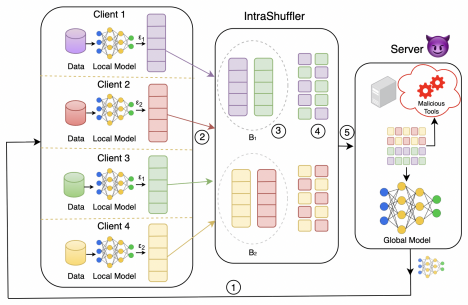
IntraShuffler: a middleware that first forms adaptive privacy-compatible buckets (merging under-populated adjacent ε groups to enforce a minimum anonymity size) then applies independent random permutations to every parameter coordinate inside each bucket, so each forwarded vector is a parameter-wise mixture rather than a coherent client gradient.
What would settle it
Run the same ε-aware denoiser-plus-surrogate pipeline on IntraShuffler outputs for high-ε clients under realistic non-IID partitions and check whether surrogate accuracy or top-1 cross-round linkage rises well above chance (e.g., above 0.5) while model utility stays comparable; sustained high attack success would refute the central claim.
Extended reading notes
Core claim
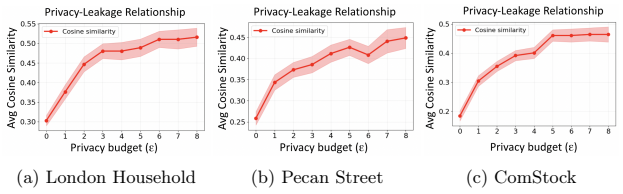
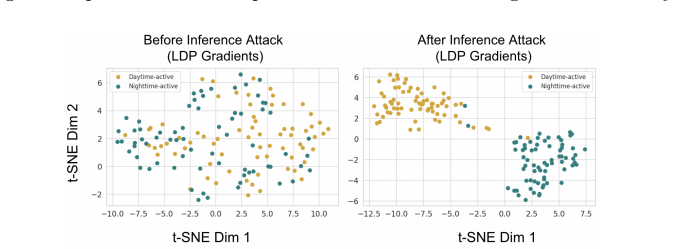
Privacy leakage in heterogeneous-DP federated learning is driven by persistent, client-specific gradient structure that survives local noise and becomes more exploitable once the server sees each update’s privacy tier. A server that denoise-conditions on those tiers and feeds the recovered directions into a surrogate model can infer distributional attributes and re-identify clients across rounds. IntraShuffler stops the attack by privacy-compatible bucketing plus parameter-level mixing inside each bucket, which exponentially enlarges the recombination space while leaving the weighted sum needed for ε-aware aggregation intact.
Load-bearing premise
The shuffler is trusted and never colludes with the server; if it does, the extra anonymity disappears and only ordinary local differential privacy remains.
Editorial extensions
If this is right
- HDP-FL systems that keep ε-aware re-weighting can still obtain meaningful source anonymity without rewriting client training or server optimizers.
- High-ε clients, previously the most exposed, lose their disproportionate vulnerability once parameter-level mixing is applied inside buckets.
- Message-level shuffle defenses are insufficient whenever aggregation must condition on privacy tiers; parameter-level mixing becomes the necessary granularity.
- The recombination search space grows as n_k^d, rendering exhaustive reconstruction of a coherent client update computationally infeasible for ordinary model sizes and modest bucket populations.
Reading between the lines
- Any future HDP protocol that exposes per-update noise scales will face the same structural-leakage channel unless it also randomizes coordinate-to-client assignment.
- Adaptive bucketing that jointly considers system heterogeneity (compute, participation frequency) could further enlarge anonymity sets when privacy budgets alone produce tiny buckets.
- The same parameter-mixing idea may transfer to other weighted aggregation schemes beyond DP, such as quality- or reliability-weighted federated updates.
Editorial analysis
A structured set of objections, weighed in public.
Referee Report
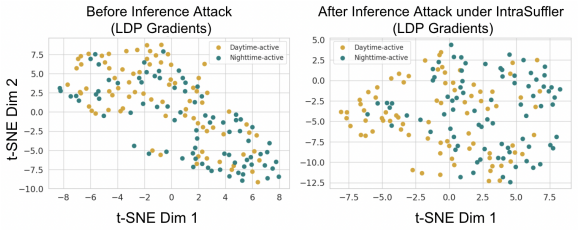
Summary. The paper studies privacy leakage in heterogeneous differential privacy federated learning (HDP-FL) under ε-aware server aggregation. It shows that an honest-but-curious server can exploit non-IID gradient structure via ε-aware denoising and surrogate modeling to recover distributional attributes and link client updates across rounds. Existing message-level shuffle defenses are argued to be incompatible with ε-aware aggregation. The authors propose IntraShuffler, a middleware that forms privacy-compatible buckets (with adaptive merging under a minimum population n_min) and applies parameter-level shuffling within each bucket, preserving bucket-level weighted sums for aggregation. Empirically, across four datasets and multiple aggregators (FedAvg, FedProx, FedOpt), IntraShuffler reduces cosine recoverability by >60%, drops surrogate inference accuracy from 0.78 to 0.33, and drives cross-round linkage near random while matching Shuffle-DP utility. Theoretical support is limited to post-processing of local DP and multiset/recombination-space arguments.
Significance. If the results hold under the stated threat model, the paper identifies a concrete, previously under-emphasized leakage channel in practical HDP-FL: persistent client-specific gradient geometry that survives LDP and is amplified by server-visible privacy tiers. The defense is architecturally attractive because it is middleware-only, preserves ε-aware aggregation, and remains compatible with standard FL optimizers without changing client training. The evaluation is multi-dataset (energy forecasting and CIFAR-10), multi-model, and multi-metric (cosine recovery, linkage, ARI, bucket-level attack rates, utility), which strengthens the empirical claim. The main practical caveat is the trusted non-colluding shuffler assumption, which the authors themselves document; under that assumption the contribution is a useful systems-level fix for a real deployment tension between HDP utility and unlinkability.
major comments (3)
- [Threat Model / Appendix B] Threat Model and Appendix B: the central privacy claim depends on a trusted, non-colluding shuffler. The paper correctly states that collusion collapses protection to baseline LDP, but the abstract and introduction still present IntraShuffler as a general HDP-FL defense without quantifying residual risk under partial compromise or weaker trust (e.g., distributed shuffle with one malicious party). For a systems privacy paper this is load-bearing; the manuscript should either (i) elevate the assumption more prominently in the abstract/claims, or (ii) add a short residual-risk analysis (what the server still learns from bucket labels and ε-aware weights alone).
- [Section 5 / Tables 1-2] Section 5 Stage 1 and Tables 1–2: the attack strength rests on an ε-conditioned learned denoiser trained on synthetic clean/noisy pairs generated from the known DP mechanism. The paper does not report how sensitive the 0.78 o0.33 drop is to denoiser misspecification (wrong C, wrong noise calibration, domain shift between synthetic and real gradients). Because the headline privacy numbers are measured after this denoising step, a short ablation on denoiser quality / knowledge mismatch is needed to show that the attack is not an artifact of an unrealistically strong offline denoiser.
- [Definition 1 / Algorithm 1 / Section 9] Definition 1, Algorithm 1, and Section 9: adaptive merging under n_min can mix heterogeneous ε values, which both weakens fine-grained ε-aware reweighting and can create small or singleton buckets when participation is sparse and ε values are diverse. Table 4 shows bucketing helps utility, and Table 5 shows bucket-level attack rates, but there is no systematic report of realized bucket sizes, merge frequency, or attack/utility as functions of n_min and the ε distribution. Without that, it is hard to judge whether the >60% recoverability reduction holds in the sparse-participation regimes the limitations section itself flags as fundamental.
minor comments (5)
- [Section 2] Related Work: the comparison to Athanasiou et al. (ICLR’26) is important; please make the threat-model differences (client-side LDP present vs. absent; prior knowledge of target distribution) more explicit in a short table or bullet list so readers can place the recombination argument of Proposition 2.
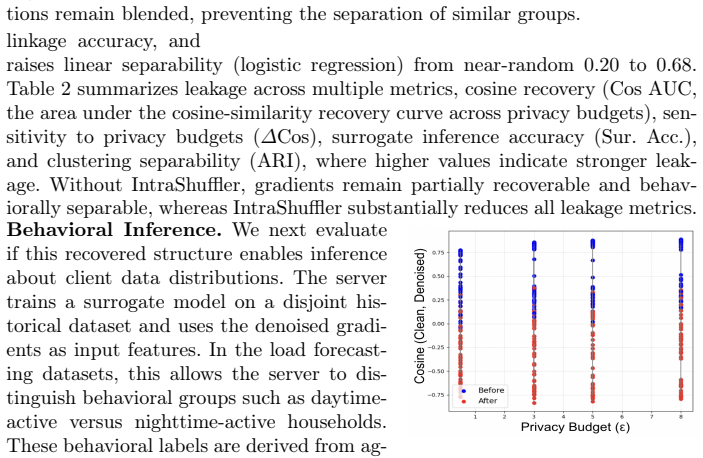
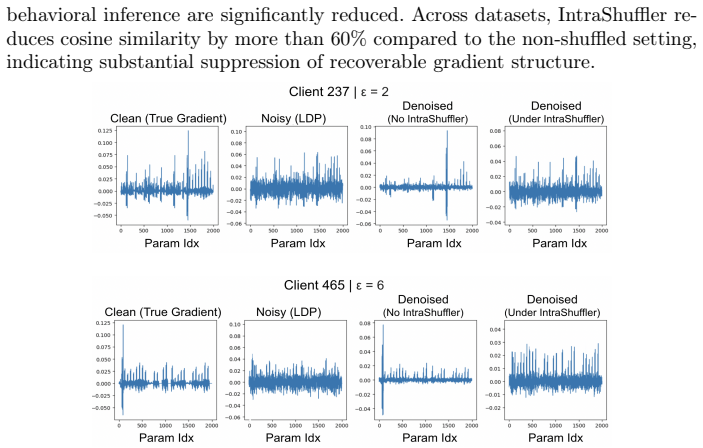
- [Figures 2 and 5] Figure 2 vs. Figure 5: axis scales and client sampling differ slightly across panels; a common y-scale and explicit statement of which clients/rounds are plotted would improve readability of the “>60% reduction” claim.
- [Section 3 / Experimental Setup] Notation: ε is sometimes written as the per-round privacy parameter and sometimes as a client budget without composition discussion; a one-sentence clarification of the accounting horizon would help.
- [Table 6] Table 6: the recombination runtime column assumes 1 eval/sec; stating that this is a lower-bound illustration rather than a measured wall-clock would avoid over-interpretation.
- [Abstract / Introduction] Minor typos and formatting: missing spaces after periods in the abstract PDF text; “Inthis work” / “Wepropose” style concatenations appear in the introduction; fix for camera-ready.
Circularity Check
No significant circularity: empirical defense evaluation and standard post-processing arguments are self-contained against external baselines.
full rationale
The paper's central claims are (1) an empirical Privacy Inference Attack that recovers structure via an ε-aware denoiser and surrogate model trained on synthetic/auxiliary data, and (2) IntraShuffler (privacy-compatible bucketing + parameter-level shuffling) that reduces measured recoverability, surrogate accuracy, and cross-round linkage while preserving ε-aware aggregation utility. These are evaluated against held-out clean gradients, historical auxiliary sets, and standard FL baselines (Plain FL-DP, Shuffle-DP) on four datasets; the reported numbers (cosine drop >60%, surrogate accuracy 0.78 o0.33, near-random linkage, RMSE/accuracy parity) are not forced by construction from fitted inputs. Theorem 1 is ordinary DP post-processing; Propositions 1–2 are elementary multiset/combinatorial facts. No self-definitional loop, no fitted parameter re-labeled as prediction, no load-bearing uniqueness theorem imported from the authors, and no ansatz smuggled via self-citation. The trusted non-colluding shuffler is an explicit threat-model assumption (not a circular derivation). Score 0 is therefore the correct finding.
Assumptions & free parameters
free parameters (3)
- n_min (minimum bucket population)
- privacy budget set {ε}
- clipping norm C and δ=1e-5
assumptions (4)
- standard math Post-processing property of differential privacy: any (possibly randomized) function of an (ε,δ)-DP output remains (ε,δ)-DP.
- domain assumption The shuffler is trusted and non-colluding with the server.
- domain assumption Non-IID client data induce persistent, client-specific expected gradient directions that survive local Gaussian noise sufficiently for denoising and linkage.
- domain assumption Server knows the DP mechanism (C, δ) and the privacy tier of each received update, enabling ε-aware denoising.
invented entities (1)
-
IntraShuffler middleware (privacy-compatible buckets + parameter-level shuffle)
Cite this review
Pith. "Pith review of IntraShuffler: A Privacy Preserving Framework for Heterogeneous DP Federated Learning." pith.science (2026). https://pith.science/paper/JJPS6GTX
@misc{pith2026260602563,
  author       = {Pith},
  title        = {Pith review of: IntraShuffler: A Privacy Preserving Framework for Heterogeneous DP Federated Learning},
  year         = {2026},
  howpublished = {\url{https://pith.science/paper/JJPS6GTX}},
  note         = {Machine review of arXiv:2606.02563}
}
abstract
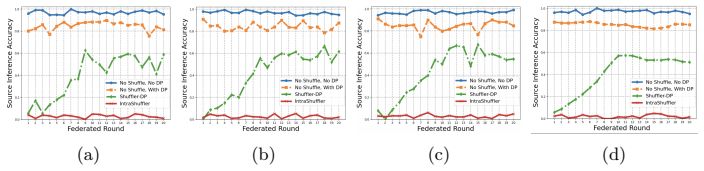
Heterogeneous Differential Privacy (HDP) in Federated Learning (FL) allows clients to select individual privacy budgets ($\varepsilon_i$) according to institutional policies and data sensitivity. In practice, many HDP-FL systems employ $\varepsilon$-aware server aggregation to improve model utility by re-weighting client updates according to their declared privacy budgets. However, gradient updates in FL retain structural patterns induced by non-independent and identically-distributed (non-IID) data, and these additional signals exposed by $\varepsilon$-aware aggregation create new opportunities for inference by an honest-but-curious server. In this work, we first show that a server equipped with gradient denoising and surrogate modeling can mount a \emph{Privacy Inference Attack} that infers distributional attributes of clients and links updates from the same client across training rounds, measured via surrogate inference accuracy and linkage success, under realistic knowledge constraints. The Shuffle-Model has been widely studied as a defense against such inference risks by anonymizing update sources, but it is fundamentally incompatible with HDP-FL $\varepsilon$-aware aggregation. To address this challenge, we propose \textbf{IntraShuffler}, a middleware defense framework designed for HDP-FL systems. IntraShuffler introduces a privacy-aware shuffling mechanism that groups clients into privacy-compatible buckets and performs parameter-level shuffling within each bucket to disrupt persistent gradient structure while preserving $\varepsilon$-aware aggregation. Experiments across four different datasets show that IntraShuffler reduces gradient recoverability by over 60% and decreases surrogate inference accuracy from 0.78 to 0.33 while maintaining comparable model utility across multiple FL aggregation rules.
Figures
Figures from the paper (4 more)
Reference graph
Works this paper leans on
-
[1]
A survey on federated learning,
C. Zhang, Y. Xie, H. Bai, B. Yu, W. Li, and Y. Gao, “A survey on federated learning,”Knowledge-Based Systems, vol. 216, p. 106775, 2021
2021
-
[2]
Federated learning: Opportunities and challenges,
P. M. Mammen, “Federated learning: Opportunities and challenges,”arXiv preprint arXiv:2101.05428, 2021
arXiv 2021
-
[3]
Exploiting unintended feature leakage in collaborative learning,
L. Melis, C. Song, E. De Cristofaro, and V. Shmatikov, “Exploiting unintended feature leakage in collaborative learning,” in2019 IEEE symposium on security and privacy (SP). IEEE, 2019, pp. 691–706
2019
-
[4]
Inverting gradients – how easy is it to break privacy in federated learning?
J. Geiping, H. Bauermeister, J. Drögemüller, and M. Moeller, “Inverting gradients – how easy is it to break privacy in federated learning?” inNeurIPS, 2020. 16
2020
-
[5]
Deep learning with differential privacy,
M. Abadi, A. Chu, I. Goodfellow, H. B. McMahan, I. Mironov, K. Talwar, and L. Zhang, “Deep learning with differential privacy,” inProceedings of the 2016 ACM SIGSAC conference on computer and communications security, 2016
2016
-
[6]
Federated learning with differential privacy: Algorithms and performance analysis,
K.Wei,J.Li,M.Ding,C.Ma,H.H.Yang,F.Farokhi,S.Jin,T.Q.Quek,andH.V. Poor, “Federated learning with differential privacy: Algorithms and performance analysis,”IEEE transactions on information forensics and security, vol. 15, pp. 3454–3469, 2020
2020
-
[8]
Efficient federated learning privacy preservation method with heterogeneous differential privacy,
J. Ling, J. Zheng, and J. Chen, “Efficient federated learning privacy preservation method with heterogeneous differential privacy,”Computers & Security, vol. 139, p. 103715, 2024
2024
-
[9]
Distributed differential privacy via shuffling,
A. Cheu, A. Smith, J. Ullman, D. Zeber, and M. Zhilyaev, “Distributed differential privacy via shuffling,” inAdvances in Cryptology – EUROCRYPT 2019, ser. LNCS, vol. 11476. Springer, 2019, pp. 375–403
2019
Show all 37 references
-
[10]
Amplification by shuffling: From local to central differential privacy via anonymity,
Ú. Erlingsson, V. Feldman, I. Mironov, A. Raghunathan, K. Talwar, and A. Thakurta, “Amplification by shuffling: From local to central differential privacy via anonymity,” inProceedings of the Thirtieth Annual ACM-SIAM Symposium on Discrete Algorithms (SODA), 2019, pp. 2468–2479
2019
-
[11]
Prochlo: Strong privacy for an- alytics in the crowd,
A. Bittau, U. Erlingsson, P. Maniatis, I. Mironov, A. Raghunathan, D. Lie, M. Rudominer, U. Kode, J. Tinnes, and B. Seefeld, “Prochlo: Strong privacy for an- alytics in the crowd,” inProceedings of the 26th Symposium on Operating Systems Principles, ser. SOSP ’17. Association ...
2017
-
[12]
Projected federated averaging with heterogeneous differential privacy,
J. Liu, J. Lou, L. Xiong, J. Liu, and X. Meng, “Projected federated averaging with heterogeneous differential privacy,”Proceedings of the VLDB Endowment, vol. 15
-
[13]
The power of bias: Optimizing client selection in federated learning with heterogeneous differential privacy,
J. Ma, Y. Zhou, Q. Li, Q. Z. Sheng, L. Cui, and J. Liu, “The power of bias: Optimizing client selection in federated learning with heterogeneous differential privacy,”IEEE Transactions on Dependable and Secure Computing, 2025
2025
-
[14]
Optimal client sampling in federated learning with client-level heterogeneous differential privacy,
J. Xu, R. Hu, and O. Kotevska, “Optimal client sampling in federated learning with client-level heterogeneous differential privacy,”IEEE Internet of Things, 2026
2026
-
[15]
Deep leakage from gradients,
L. Zhu, Z. Liu, and S. Han, “Deep leakage from gradients,” inNeurIPS, 2019
2019
-
[16]
Comprehensive privacy analysis of deep learning: Passive and active white-box inference attacks against centralized and federated learning,
M. Nasr, R. Shokri, and A. Houmansadr, “Comprehensive privacy analysis of deep learning: Passive and active white-box inference attacks against centralized and federated learning,” in2019 IEEE symposium on security and privacy (SP). IEEE, 2019, pp. 739–753
2019
-
[17]
Source inference attacks in federated learning,
H. Hu, Z. Salcic, L. Sun, G. Dobbie, and X. Zhang, “Source inference attacks in federated learning,” in2021 IEEE International Conference on Data Mining (ICDM). IEEE, 2021, pp. 1102–1107
2021
-
[18]
Source infer- ence attacks: Beyond membership inference attacks in federated learning,
H. Hu, X. Zhang, Z. Salcic, L. Sun, K.-K. R. Choo, and G. Dobbie, “Source infer- ence attacks: Beyond membership inference attacks in federated learning,”IEEE Transactions on Dependable and Secure Computing, vol. 21, pp. 3012–3029, 2023
2023
-
[19]
Tor: The second-generation onion router,
R. Dingledine, N. Mathewson, and P. Syverson, “Tor: The second-generation onion router,” inProceedings of the 13th USENIX Security Symposium. USENIX, 2004, pp. 303–320
2004
-
[20]
Practical veri- fiable mix nets,
S. Hohenberger, M. Kohlweiss, A. Lysyanskaya, and H. Shacham, “Practical veri- fiable mix nets,” inIEEE Symposium on Security and Privacy, 2014, pp. 123–137
2014
-
[21]
Riposte:Ananonymousmessaging system handling millions of users,
H.Corrigan-Gibbs,D.Boneh,andD.Mazieres,“Riposte:Ananonymousmessaging system handling millions of users,” inIEEE Symposium on Security and Privacy, 2015, pp. 321–338. 17
2015
-
[22]
Secure multi-party shuffling for privacy- preserving data aggregation,
S. Lu, R. Ostrovsky, and V. Zikas, “Secure multi-party shuffling for privacy- preserving data aggregation,” inAdvances in Cryptology – EUROCRYPT, 2019
2019
-
[23]
Scalable secure shuffling via multi-party computa- tion,
I. Abraham, G. Asharovet al., “Scalable secure shuffling via multi-party computa- tion,” inProceedings of the ACM Conference on Computer and Communications Security (CCS), 2020
2020
-
[24]
Rafls: Rdp-based adaptive federated learning with shuffle model,
S. Wang, K. Gai, J. Yu, L. Zhu, H. Wu, C. Wei, Y. Yan, H. Zhang, and K.-K. R. Choo, “Rafls: Rdp-based adaptive federated learning with shuffle model,”IEEE Transactions on Dependable and Secure Computing, vol. 22, pp. 1181–1194, 2025
2025
-
[25]
Secure shuffling for federated learning,
R. Sunet al., “Secure shuffling for federated learning,” inNeurIPS Workshop, 2020
2020
-
[26]
Privacy amplification in federated learning via shuffle mecha- nisms,
M. Lebrunet al., “Privacy amplification in federated learning via shuffle mecha- nisms,”arXiv preprint, 2022
2022
-
[27]
Shufflefl: Improving privacy in federated learning via shuffling,
Z. Yanget al., “Shufflefl: Improving privacy in federated learning via shuffling,” arXiv preprint, 2023
2023
-
[28]
Flame: Differentially private federated learning in the shuffle model,
R. Liu, Y. Cao, H. Chen, R. Guo, and M. Yoshikawa, “Flame: Differentially private federated learning in the shuffle model,” inAAAI, 2021, pp. 8686–8694
2021
-
[29]
Conservative or liberal? personalized dif- ferential privacy,
Z. Jorgensen, T. Yu, and G. Cormode, “Conservative or liberal? personalized dif- ferential privacy,” inICDE, 2015
2015
-
[30]
Heterogeneous differential- private federated learning: Trading privacy for utility truthfully,
X. Lin, J. Wu, J. Li, C. Sang, S. Hu, and M. J. Deen, “Heterogeneous differential- private federated learning: Trading privacy for utility truthfully,”IEEE Transac- tions on Dependable and Secure Computing, vol. 20, no. 6, pp. 5113–5129, 2023
2023
-
[31]
Tight bounds for privacy amplification by shuffling,
V. Balceret al., “Tight bounds for privacy amplification by shuffling,”arXiv preprint, 2022
2022
-
[32]
Echo of neighbors: Privacy amplification for personalized private federated learning with shuffle model,
Y. Liu, S. Zhao, L. Xiong, Y. Liu, and H. Chen, “Echo of neighbors: Privacy amplification for personalized private federated learning with shuffle model,” in Proceedings of the AAAI Conference on Artificial Intelligence (AAAI), 2023
2023
-
[33]
Clustered federated learning with adaptive local differential privacy on heterogeneous iot data,
Z. He, L. Wang, and Z. Cai, “Clustered federated learning with adaptive local differential privacy on heterogeneous iot data,”IEEE Internet of Things Journal, vol. 11, no. 1, pp. 137–146, 2023
2023
-
[34]
Protection against source infer- ence attacks in federated learning,
A. Athanasiou, K. Jung, and C. Palamidessi, “Protection against source infer- ence attacks in federated learning,” inThe fourteenth International Conference on Learning Representations (ICLR), 2026
2026
-
[35]
Federated learning with hetero- geneous differential privacy,
T. Li, A. K. Sahu, A. Talwalkar, and V. Smith, “Federated learning with hetero- geneous differential privacy,” inInternational Conference on Artificial Intelligence and Statistics (AISTATS), 2022
2022
-
[36]
Differential privacy in the shuffle model: A survey of separations,
A. Cheu, “Differential privacy in the shuffle model: A survey of separations,” 2022. [Online]. Available: https://arxiv.org/abs/2107.11839
2022 arXiv
-
[37]
Im- proving utility and security of the shuffler-based differential privacy,
T. Wang, B. Ding, M. Xu, Z. Huang, C. Hong, J. Zhou, N. Li, and S. Jha, “Im- proving utility and security of the shuffler-based differential privacy,”Proc. VLDB Endow., vol. 13, no. 13, p. 3545–3558, 2020. Acknowledgment This material is based upon work supported by the U.S. D...
2020
-
[38]
In theIID case, clients receive balanced class mix- tures, while in thenon-IIDcase, clients exhibit class-skew with imbalanced label distributions
Both settings use the same number of clients and samples per client. In theIID case, clients receive balanced class mix- tures, while in thenon-IIDcase, clients exhibit class-skew with imbalanced label distributions. Partition Plain Shuffle Intra IID ≈1/n t ≈1/n t ≈1/n t Non-I...
Reviewed July 14, 2026 · model on record in the stance chip above.
Discussion (0). Sign in to comment.