A Steep-Extinction QSO at z=4.6: JWST Evidence for Abundant Small Dust Grains
Pith reviewed 2026-06-28 13:48 UTC · model grok-4.3
The pith
A quasar at z=4.556 shows an exceptionally steep far-UV extinction curve with no 2175Å bump, indicating dominance of small silicate dust grains.
A machine-rendered reading of the paper's core claim, the machinery that carries it, and where it could break.
Core claim
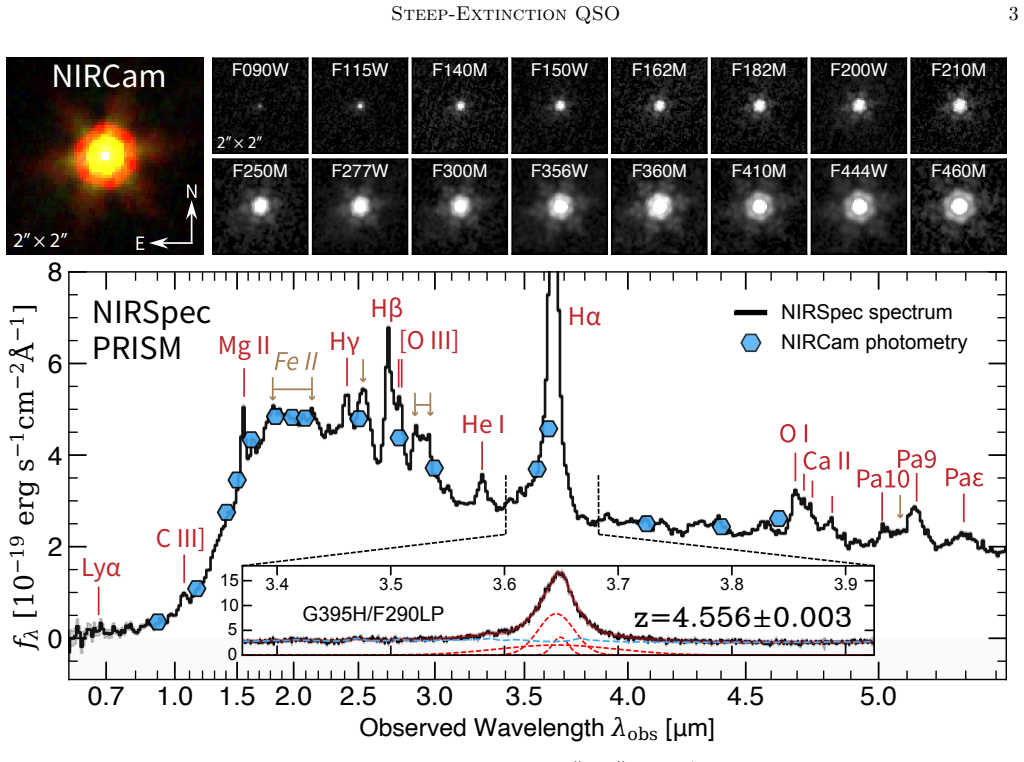
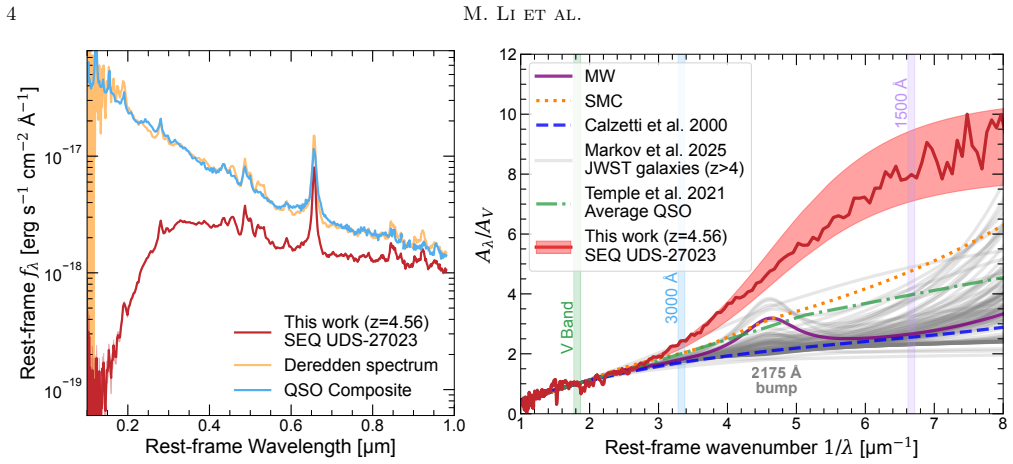
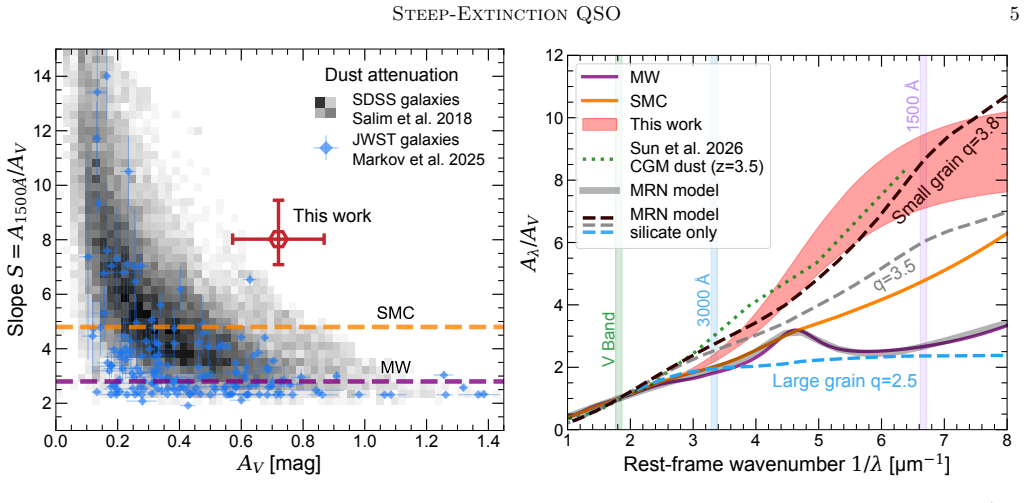
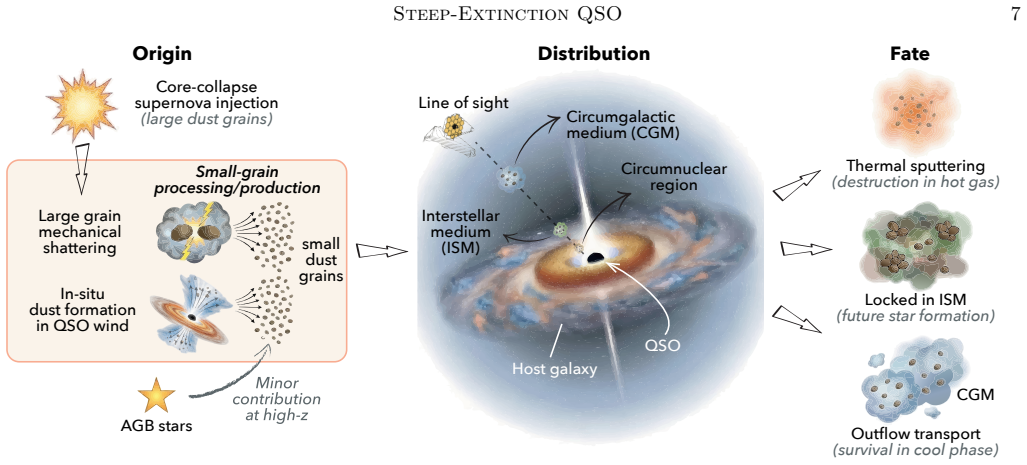
UDS-27023 at z=4.556 displays an exceptionally steep far-UV extinction curve (A1500/AV ≈ 8) but lacks the 2175 Angstrom bump. This indicates a dominance of small silicate dust grains. The authors interpret this phenomenology as evidence for active small-grain production and processing in the QSO environment, with mechanical shattering of pre-existing large grains by QSO-driven shocks and outflows providing one pathway and in-situ condensation of silicate grains inside dense QSO-driven winds offering another.
What carries the argument
The shape of the far-UV extinction curve, defined by its steep slope (A1500/AV ≈ 8) and missing 2175Å bump, used to diagnose a dust population dominated by small silicate grains.
If this is right
- Steep-extinction QSOs represent a short-lived phase in which luminous AGN generate, process, and redistribute small grains.
- This activity can facilitate rapid interstellar-medium grain growth by increasing available surface area for accretion.
- Small grains produced in this way can enrich the circumgalactic medium around the host galaxy.
Where Pith is reading between the lines
- If small-grain production is common in luminous high-redshift AGN, it supplies a missing channel that helps close the dust-budget gap in the first billion years.
- Targeted JWST surveys for additional objects with the same extinction signature could measure how frequently this phase occurs.
- The same grain-processing physics may operate in starburst-driven outflows, offering a testable link between AGN and star-formation feedback.
Load-bearing premise
The spectral comparison to QSO composite templates isolates the extinction curve without significant contamination from emission-line variability, host-galaxy light, or geometric effects in the outflow.
What would settle it
Re-reduction of the NIRSpec spectrum showing that the apparent steep UV slope and missing bump can be reproduced by adding variable broad emission lines or host-galaxy continuum without invoking any change in dust properties.
Figures
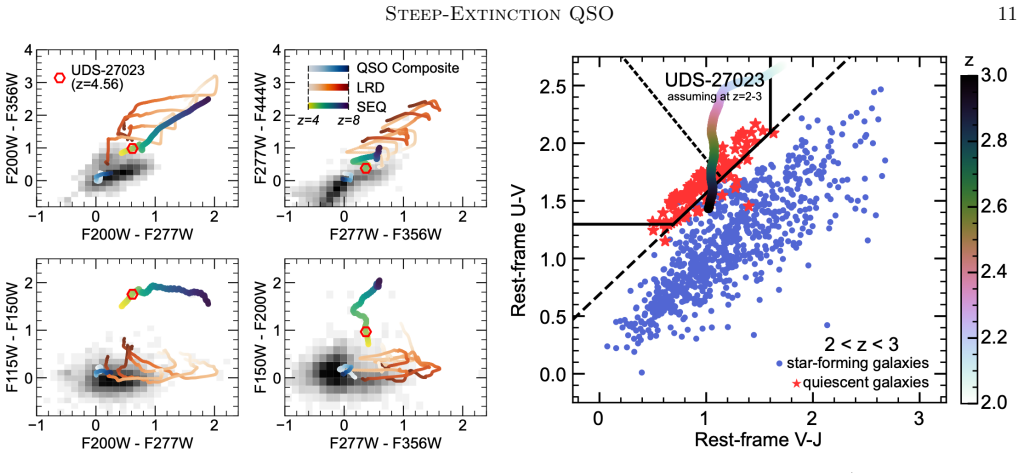
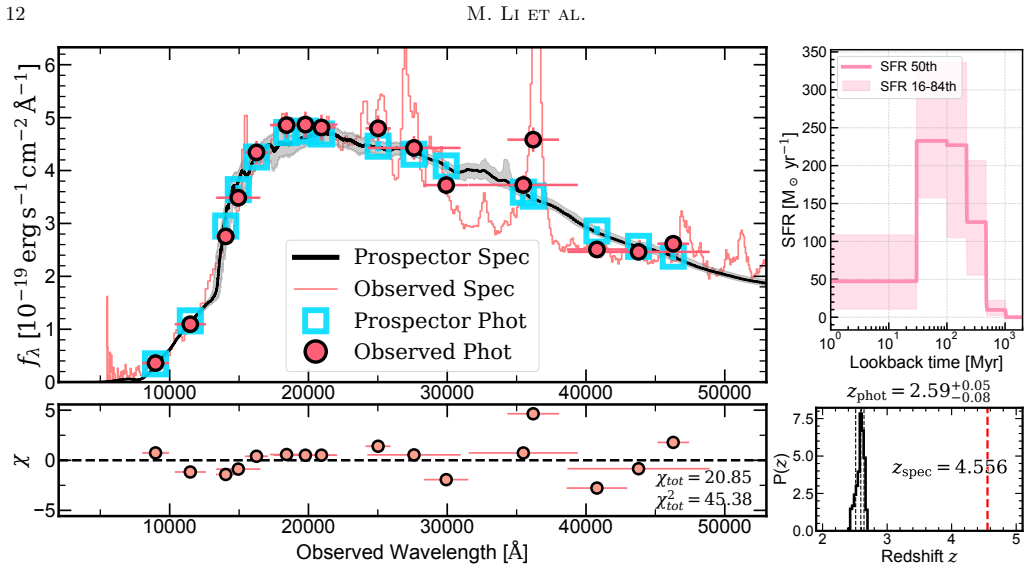
read the original abstract
The rapid accumulation of massive dust reservoirs in the early Universe remains a major challenge in astrophysics. While core-collapse supernovae can inject large dust grains ($a \gtrsim 0.1\,\mu{\rm m}$) on short timescales, explaining the total dust budgets in the early Universe likely requires efficient grain growth in the interstellar medium (ISM). Such growth depends critically on an abundant population of small grains, which maximize the surface area available for accretion and may be generated by rapid dust-processing or dust-formation channels. Here, we report the discovery of a QSO UDS-27023 at $z=4.556\pm0.003$, identified using JWST/NIRSpec spectroscopy. By quantitatively comparing the spectra to QSO composite templates, we find that UDS-27023 displays an exceptionally steep far-UV extinction curve ($A_{1500}/A_V \approx 8$) but notably lacks the 2175 Angstrom bump, indicating a dominance of small silicate dust grains. We interpret this phenomenology as evidence for active small-grain production and processing in the QSO environment. Mechanical shattering of pre-existing large grains by QSO-driven shocks and outflows provides one natural pathway, while in-situ condensation of silicate grains inside dense QSO-driven winds may offer an additional route. Such a population of steep-extinction QSOs (SEQs) may therefore reveal a short-lived phase in which luminous AGN generate, process, and redistribute small grains, potentially facilitating rapid ISM grain growth and enriching the circumgalactic medium.
Editorial analysis
A structured set of objections, weighed in public.
Referee Report
Summary. The manuscript reports the discovery of quasar UDS-27023 at z=4.556 using JWST/NIRSpec spectroscopy. Quantitative comparison of its spectrum to QSO composite templates yields an exceptionally steep far-UV extinction curve (A_1500/A_V ≈ 8) lacking the 2175 Å bump, which the authors interpret as evidence for a dominance of small silicate grains produced or processed in the QSO environment through shocks or in-situ condensation in outflows.
Significance. If the extinction curve derivation holds, the result would supply observational support for efficient small-grain production in high-redshift AGN, offering a pathway to explain rapid dust budgets in the early Universe via mechanical shattering or wind condensation. This could motivate searches for a population of steep-extinction QSOs as a short-lived evolutionary phase.
major comments (1)
- [Spectral comparison and extinction derivation (analysis section)] The central claim of A_1500/A_V ≈ 8 and absence of the 2175 Å bump rests on template matching whose robustness is not demonstrated. No systematic tests are reported that vary broad-line equivalent widths, add a host-galaxy continuum component at rest-frame <2000 Å, or account for wavelength-dependent covering fractions before attributing residuals to dust extinction.
Simulated Author's Rebuttal
We thank the referee for their constructive feedback on the robustness of our spectral analysis. We agree that additional systematic tests will strengthen the central claim and will incorporate them in the revised manuscript.
read point-by-point responses
-
Referee: The central claim of A_1500/A_V ≈ 8 and absence of the 2175 Å bump rests on template matching whose robustness is not demonstrated. No systematic tests are reported that vary broad-line equivalent widths, add a host-galaxy continuum component at rest-frame <2000 Å, or account for wavelength-dependent covering fractions before attributing residuals to dust extinction.
Authors: We acknowledge that the current manuscript does not report explicit systematic tests of the template matching procedure. The quantitative comparison was performed against standard high-redshift QSO composites, with residuals clearly indicating a steep far-UV rise and no 2175 Å feature. However, we agree that varying broad-line equivalent widths (within the range observed for z~4-5 QSOs), including a possible host-galaxy continuum contribution below 2000 Å, and exploring wavelength-dependent covering fractions would better demonstrate that the derived A_1500/A_V ≈8 is robust. In the revised manuscript we will add these tests, showing that the extinction parameters remain stable under reasonable variations of these components. This will directly address the concern while preserving the interpretation of small-grain dominance. revision: yes
Circularity Check
No circularity: extinction curve obtained via external template comparison
full rationale
The central result (A_1500/A_V ≈ 8, absence of 2175 Å bump) is obtained by quantitative comparison of the observed NIRSpec spectrum against pre-existing QSO composite templates. This is a direct observational measurement, not a fitted functional form, self-defined quantity, or prediction derived from the same data. No equations, ansatzes, or self-citations are invoked that would make the reported ratio equivalent to its inputs by construction. The subsequent physical interpretation (small-grain dominance) follows from standard dust-physics relations external to the paper. The derivation chain is therefore self-contained against external benchmarks.
Axiom & Free-Parameter Ledger
axioms (1)
- domain assumption Standard QSO composite templates and Milky-Way-type extinction laws remain applicable at z≈4.6 without major modifications from metallicity or radiation-field effects.
Reference graph
Works this paper leans on
-
[1]
Algera, H. S. B., Rowland, L., Stefanon, M., et al. 2026, MNRAS, 545, staf1897, doi: 10.1093/mnras/staf1897
-
[2]
Asano, R. S., Takeuchi, T. T., Hirashita, H., & Nozawa, T. 2013, MNRAS, 432, 637, doi: 10.1093/mnras/stt506 B´ ethermin, M., Fudamoto, Y., Ginolfi, M., et al. 2020, A&A, 643, A2, doi: 10.1051/0004-6361/202037649
-
[3]
2023,, 0.6.17 Zenodo, doi: 10.5281/zenodo.8319596
Brammer, G. 2023,, 0.6.17 Zenodo, doi: 10.5281/zenodo.8319596
-
[4]
M., Sobral, D., Smail, I., et al
Bruce, V. A., Dunlop, J. S., Cirasuolo, M., et al. 2012, MNRAS, 427, 1666, doi: 10.1111/j.1365-2966.2012.22087.x
-
[5]
C., et al.\ 2000, , 533, 682, doi:10.1086/308692
Calzetti, D., Armus, L., Bohlin, R. C., et al. 2000, ApJ, 533, 682, doi: 10.1086/308692
work page internal anchor Pith review doi:10.1086/308692 2000
-
[6]
Cardelli, J. A., Clayton, G. C., & Mathis, J. S. 1989, ApJ, 345, 245, doi: 10.1086/167900
-
[7]
Carnall, A. C., Walker, S., McLure, R. J., et al. 2020, MNRAS, 496, 695, doi: 10.1093/mnras/staa1535
-
[8]
2025, ApJ, 988, 204, doi: 10.3847/1538-4357/ade307
Chen, J., Jiang, L., Sun, S., Zhang, Z., & Sun, M. 2025, ApJ, 988, 204, doi: 10.3847/1538-4357/ade307
-
[9]
2018, NatAs, 2, 176, doi: 10.1038/s41550-018-0406-3
Cicone, C., Brusa, M., Ramos Almeida, C., et al. 2018, NatAs, 2, 176, doi: 10.1038/s41550-018-0406-3
-
[10]
Cowley, M. J., Spitler, L. R., Tran, K.-V. H., et al. 2016, MNRAS, 457, 629, doi: 10.1093/mnras/stv2992 12M. Li et al. 2 3 4 5 Redshift z 0.0 2.5 5.0 7.5P(z) zphot = 2.59+0.05 −0.08 10 0 10 1 10 2 10 3 Lookback time [Myr] 0 50 100 150 200 250 300 350SFR [M ⊙ yr−1] SFR 50th SFR 16-84th 10000 20000 30000 40000 500000 1 2 3 4 5 6fλ [10−19 erg s−1 cm−2 Å−1] P...
-
[11]
Draine, B. T. 2003, ARA&A, 41, 241, doi: 10.1146/annurev.astro.41.011802.094840
work page internal anchor Pith review Pith/arXiv arXiv doi:10.1146/annurev.astro.41.011802.094840 2003
-
[12]
Draine, B. T., & Lee, H. M. 1984, ApJ, 285, 89, doi: 10.1086/162480
-
[13]
Draine, B. T., & Salpeter, E. E. 1979, ApJ, 231, 77, doi: 10.1086/157165
-
[14]
Duan, Q., Tacchella, S., Johnson, B. D., et al. 2026, arXiv, arXiv:2605.21599. https://arxiv.org/abs/2605.21599
Pith/arXiv arXiv 2026
-
[15]
2020, A&A, 636, A73, doi: 10.1051/0004-6361/201936817
Duras, F., Bongiorno, A., Ricci, F., et al. 2020, A&A, 636, A73, doi: 10.1051/0004-6361/201936817
-
[16]
2002, ApJL, 567, L107, doi: 10.1086/340006
Elvis, M., Marengo, M., & Karovska, M. 2002, ApJL, 567, L107, doi: 10.1086/340006
-
[17]
Fisher, R., Bowler, R. A. A., Stefanon, M., et al. 2025, MNRAS, 539, 109, doi: 10.1093/mnras/staf485
-
[18]
2008, ApJS, 176, 1, doi: 10.1086/527321
Furusawa, H., Kosugi, G., Akiyama, M., et al. 2008, ApJS, 176, 1, doi: 10.1086/527321
-
[19]
2013, ApJS, 206, 10, doi: 10.1088/0067-0049/206/2/10
Galametz, A., Grazian, A., Fontana, A., et al. 2013, ApJS, 206, 10, doi: 10.1088/0067-0049/206/2/10
-
[20]
Gall, C., Andersen, A. C., & Hjorth, J. 2011, A&A, 528, A13, doi: 10.1051/0004-6361/201015286
-
[21]
Gallagher, S. C., Brandt, W. N., Chartas, G., et al. 2006, ApJ, 644, 709, doi: 10.1086/503762
-
[22]
2010, A&A, 523, A85, doi: 10.1051/0004-6361/201014721
Gallerani, S., Maiolino, R., Juarez, Y., et al. 2010, A&A, 523, A85, doi: 10.1051/0004-6361/201014721
-
[23]
Gordon, K. D., Clayton, G. C., Misselt, K. A., Landolt, A. U., & Wolff, M. J. 2003, ApJ, 594, 279, doi: 10.1086/376774
-
[24]
2001, ApJ, 558, 109, doi: 10.1086/322311
Elvis, M. 2001, ApJ, 558, 109, doi: 10.1086/322311
-
[25]
Greene, J. E., & Ho, L. C. 2005, ApJ, 630, 122, doi: 10.1086/431897
work page internal anchor Pith review doi:10.1086/431897 2005
-
[26]
Guo, H., Malkan, M. A., Gu, M., et al. 2016, ApJ, 826, 186, doi: 10.3847/0004-637X/826/2/186
-
[27]
Hall, P. B., Anderson, S. F., Strauss, M. A., et al. 2002, ApJS, 141, 267, doi: 10.1086/340546
-
[28]
E., Watson, D., Brammer, G., et al
Heintz, K. E., Watson, D., Brammer, G., et al. 2024, Sci, 384, 890, doi: 10.1126/science.adj0343
-
[29]
Heywood, I., Hale, C. L., Jarvis, M. J., et al. 2020, MNRAS, 496, 3469, doi: 10.1093/mnras/staa1770
-
[30]
Hirashita, H. 2010, MNRAS, 407, L49, doi: 10.1111/j.1745-3933.2010.00902.x
-
[31]
M., Sobral, D., Smail, I., et al
Hirashita, H. 2012, MNRAS, 422, 1263, doi: 10.1111/j.1365-2966.2012.20702.x
-
[32]
2013, EP&S, 65, 1083, doi: 10.5047/eps.2013.03.008 Steep-Extinction QSO13
Hirashita, H., & Kobayashi, H. 2013, EP&S, 65, 1083, doi: 10.5047/eps.2013.03.008 Steep-Extinction QSO13
-
[33]
2021, MNRAS, 505, 1794, doi: 10.1093/mnras/stab1416
Hirashita, H., & Lan, T.-W. 2021, MNRAS, 505, 1794, doi: 10.1093/mnras/stab1416
-
[34]
2010, MNRAS, 401, 2343, doi: 10.1111/j.1365-2966.2009.15859.x
Hirashita, H., & Yan, H. 2009, MNRAS, 394, 1061, doi: 10.1111/j.1365-2966.2009.14405.x
-
[35]
Ikarashi, S., Ivison, R. J., Caputi, K. I., et al. 2015, ApJ, 810, 133, doi: 10.1088/0004-637X/810/2/133
-
[36]
Inami, H., Algera, H. S. B., Schouws, S., et al. 2022, MNRAS, 515, 3126, doi: 10.1093/mnras/stac1779
-
[37]
2013, AJ, 145, 157, doi: 10.1088/0004-6256/145/6/157
Jiang, P., Zhou, H., Ji, T., et al. 2013, AJ, 145, 157, doi: 10.1088/0004-6256/145/6/157
-
[38]
D., Leja, J., Conroy, C., & Speagle, J
Johnson, B. D., Leja, J., Conroy, C., & Speagle, J. S. 2021, ApJS, 254, 22, doi: 10.3847/1538-4365/abef67
work page internal anchor Pith review doi:10.3847/1538-4365/abef67 2021
-
[39]
Jones, A. P., Tielens, A. G. G. M., & Hollenbach, D. J. 1996, ApJ, 469, 740, doi: 10.1086/177823
-
[40]
D., Hasinger, G., Brightman, M., et al
Kocevski, D. D., Hasinger, G., Brightman, M., et al. 2018, ApJS, 236, 48, doi: 10.3847/1538-4365/aab9b4
-
[41]
Kodra, D., Andrews, B. H., Newman, J. A., et al. 2023, ApJ, 942, 36, doi: 10.3847/1538-4357/ac9f12
-
[42]
Krogager, J.-K., Fynbo, J. P. U., Heintz, K. E., et al. 2016, ApJ, 832, 49, doi: 10.3847/0004-637X/832/1/49
-
[43]
, archivePrefix = "arXiv", eprint =
Kuo, T.-M., & Hirashita, H. 2012, MNRAS, 424, L34, doi: 10.1111/j.1745-3933.2012.01282.x
-
[44]
Laha, S., Reynolds, C. S., Reeves, J., et al. 2021, NatAs, 5, 13, doi: 10.1038/s41550-020-01255-2
-
[45]
Laor, A., & Draine, B. T. 1993, ApJ, 402, 441, doi: 10.1086/172149
-
[46]
Lawrence, A., Warren, S. J., Almaini, O., et al. 2007, MNRAS, 379, 1599, doi: 10.1111/j.1365-2966.2007.12040.x
-
[47]
Speagle, J. S. 2019, ApJ, 876, 3, doi: 10.3847/1538-4357/ab133c Le´ sniewska, A., & Micha lowski, M. J. 2019, A&A, 624, L13, doi: 10.1051/0004-6361/201935149
work page internal anchor Pith review doi:10.3847/1538-4357/ab133c 2019
-
[48]
Li, A., & Greenberg, J. M. 2003, in Solid State Astrochemistry, ed. V. Pirronello, J. Krelowski, & G. Manic` o, Vol. 120, 37–84, doi: 10.48550/arXiv.astro-ph/0204392
work page internal anchor Pith review Pith/arXiv arXiv doi:10.48550/arxiv.astro-ph/0204392 2003
-
[49]
Li, A., Liang, S. L., Kann, D. A., et al. 2008, ApJ, 685, 1046, doi: 10.1086/591049
-
[50]
2004, Natur, 431, 533, doi: 10.1038/nature02930
Maiolino, R., Schneider, R., Oliva, E., et al. 2004, Natur, 431, 533, doi: 10.1038/nature02930
-
[51]
Markov, V., Gallerani, S., Ferrara, A., et al. 2025, NatAs, 9, 458, doi: 10.1038/s41550-024-02426-1
-
[52]
V., de Graaff, A., Franx, M., et al
Maseda, M. V., de Graaff, A., Franx, M., et al. 2024, A&A, 689, A73, doi: 10.1051/0004-6361/202449914
-
[53]
Mathis, J. S., Rumpl, W., & Nordsieck, K. H. 1977, ApJ, 217, 425, doi: 10.1086/155591
-
[54]
2016, A&A, 587, A83, doi: 10.1051/0004-6361/201527277
Pertermann, F. 2016, A&A, 587, A83, doi: 10.1051/0004-6361/201527277
-
[55]
2011, ApJ, 737, 46, doi: 10.1088/0004-637X/737/1/46
Shankar, F. 2011, ApJ, 737, 46, doi: 10.1088/0004-637X/737/1/46
-
[56]
Oke, J. B., & Gunn, J. E. 1983, ApJ, 266, 713, doi: 10.1086/160817
-
[57]
2019, ApJ, 871, 109, doi: 10.3847/1538-4357/aaf7a4
Patil, P., Nyland, K., Lacy, M., et al. 2019, ApJ, 871, 109, doi: 10.3847/1538-4357/aaf7a4
-
[58]
Riechers, D. A., Bradford, C. M., Clements, D. L., et al. 2013, Natur, 496, 329, doi: 10.1038/nature12050
-
[59]
Robertson, B. E., Johnson, B. D., Tacchella, S., et al. 2026, arXiv, arXiv:2601.15956, doi: 10.48550/arXiv.2601.15956
-
[60]
Rogerson, J. A., Hall, P. B., Snedden, S. A., Brotherton, M. S., & Anderson, S. F. 2011, NewA, 16, 128, doi: 10.1016/j.newast.2010.07.002
-
[61]
Rowlands, K., Gomez, H. L., Dunne, L., et al. 2014, MNRAS, 441, 1040, doi: 10.1093/mnras/stu605
-
[62]
Salim, S., Boquien, M., & Lee, J. C. 2018, ApJ, 859, 11, doi: 10.3847/1538-4357/aabf3c
-
[63]
Salim, S., Lee, J. C., Janowiecki, S., et al. 2016, ApJS, 227, 2, doi: 10.3847/0067-0049/227/1/2
-
[64]
2019, ApJ, 885, 126, doi: 10.3847/1538-4357/ab46a9
Sarangi, A., Dwek, E., & Kazanas, D. 2019, ApJ, 885, 126, doi: 10.3847/1538-4357/ab46a9
-
[65]
2024, A&ARv, 32, 2, doi: 10.1007/s00159-024-00151-2
Schneider, R., & Maiolino, R. 2024, A&ARv, 32, 2, doi: 10.1007/s00159-024-00151-2
-
[66]
D.Sijacki,V.Springel,T.DiMatteo,andL.Hernquist.MNRAS,380(3):877–900,Sept.2007
Scoville, N., Sheth, K., Aussel, H., et al. 2016, ApJ, 820, 83, doi: 10.3847/0004-637X/820/2/83
-
[67]
Selsing, J., Fynbo, J. P. U., Christensen, L., & Krogager, J.-K. 2016, A&A, 585, A87, doi: 10.1051/0004-6361/201527096
-
[68]
P., Rodr´ ıguez Montero, F., et al
Shivaei, I., Naidu, R. P., Rodr´ ıguez Montero, F., et al. 2025, arXiv, arXiv:2509.01795, doi: 10.48550/arXiv.2509.01795
-
[69]
Sun, F., Eisenstein, D. J., D’Eugenio, F., et al. 2026, arXiv, arXiv:2601.15961, doi: 10.48550/arXiv.2601.15961
-
[70]
Tacchella, S., Finkelstein, S. L., Bagley, M., et al. 2022, ApJ, 927, 170, doi: 10.3847/1538-4357/ac4cad
-
[71]
2019, ApJ, 874, 27, doi: 10.3847/1538-4357/ab0374
Tamura, Y., Mawatari, K., Hashimoto, T., et al. 2019, ApJ, 874, 27, doi: 10.3847/1538-4357/ab0374
-
[72]
Temple, M. J., Hewett, P. C., & Banerji, M. 2021, MNRAS, 508, 737, doi: 10.1093/mnras/stab2586
-
[73]
2001, MNRAS, 322, 231, doi: 10.1046/j.1365-8711.2001.04022.x
Todini, P., & Ferrara, A. 2001, MNRAS, 325, 726, doi: 10.1046/j.1365-8711.2001.04486.x
-
[74]
Valiante, R., Schneider, R., Bianchi, S., & Andersen, A. C. 2009, MNRAS, 397, 1661, doi: 10.1111/j.1365-2966.2009.15076.x
-
[75]
Valiante, R., Schneider, R., Salvadori, S., & Bianchi, S. 2011, MNRAS, 416, 1916, doi: 10.1111/j.1365-2966.2011.19168.x 14M. Li et al. V´ eron-Cetty, M.-P., Joly, M., & V´ eron, P. 2004, A&A, 417, 515, doi: 10.1051/0004-6361:20035714
-
[76]
Watson, D., Christensen, L., Knudsen, K. K., et al. 2015, Natur, 519, 327, doi: 10.1038/nature14164
-
[77]
Weingartner, J. C., & Draine, B. T. 2001, ApJ, 548, 296, doi: 10.1086/318651
-
[78]
2023, Natur, 621, 267, doi: 10.1038/s41586-023-06413-w
Witstok, J., Shivaei, I., Smit, R., et al. 2023, Natur, 621, 267, doi: 10.1038/s41586-023-06413-w
-
[79]
2015, A&A, 584, A100, doi: 10.1051/0004-6361/201526570
Zafar, T., Møller, P., Watson, D., et al. 2015, A&A, 584, A100, doi: 10.1051/0004-6361/201526570
-
[80]
2022, A&A, 663, A63, doi: 10.1051/0004-6361/202142476
Zhang, S., Ge, J., Ji, T., et al. 2022, A&A, 663, A63, doi: 10.1051/0004-6361/202142476
discussion (0)
Sign in with ORCID, Apple, or X to comment. Anyone can read and Pith papers without signing in.