Constraints on the gravitational potential from DESI DR2 BAO and its implications for the local void scenario
Pith reviewed 2026-06-28 12:52 UTC · model grok-4.3
The pith
High-redshift data allow a local void large enough to explain the Hubble tension.
A machine-rendered reading of the paper's core claim, the machinery that carries it, and where it could break.
Core claim
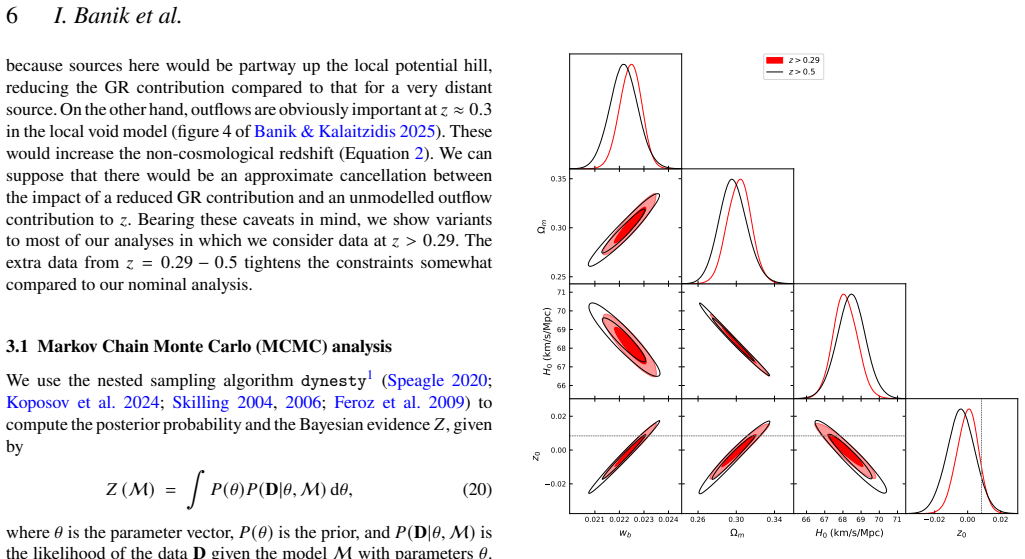
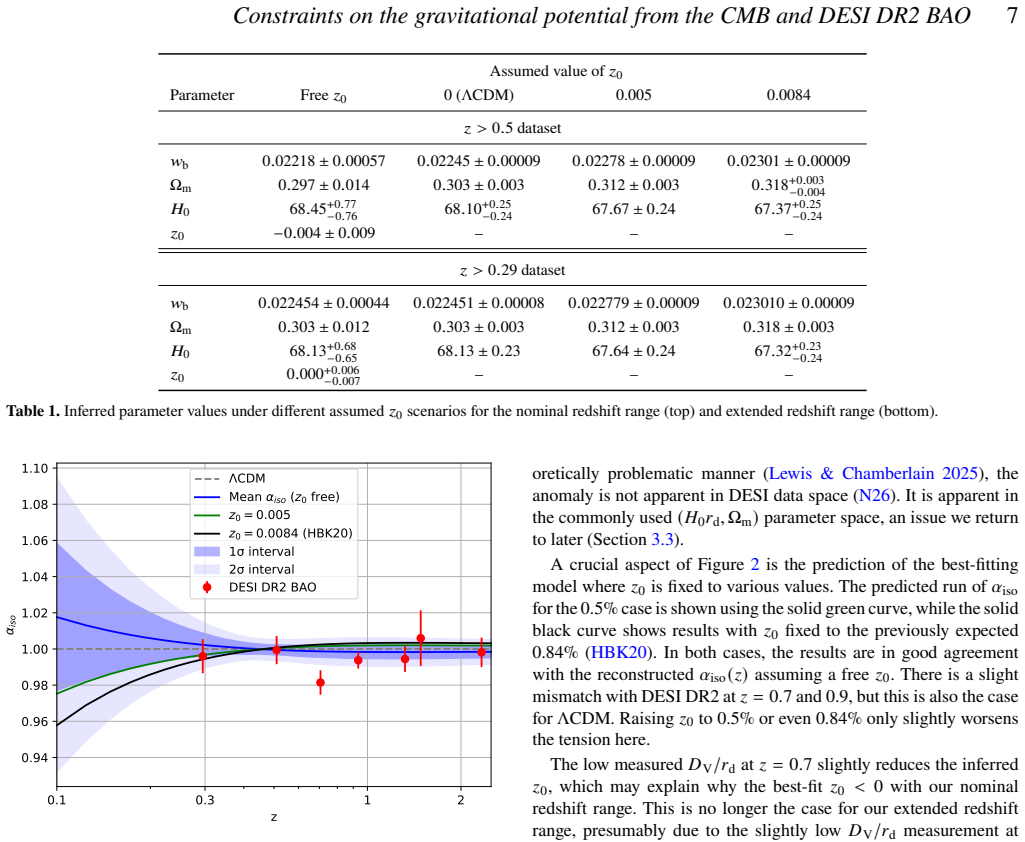
Combining BBN, CMB, BAO, and CC datasets at z > 0.5 yields z0 = -0.4 ± 0.9 percent, which rises to 0.0+0.6-0.7 percent when the analysis includes data down to z > 0.29. The model with z0 = 0.84 percent fits the data almost as well as ΛCDM, with Δχ² < 2. ΛCDM faces a 2.81σ BAO anomaly in the (H0 rd, Ωm) parameter space that is reduced to 2.39σ when z0 is fixed at 0.84 percent. This indicates that a local void large enough to address the Hubble tension cannot be ruled out by the higher-redshift datasets despite its novel impacts on them.
What carries the argument
The z0 model, in which a local void contributes a fixed additional gravitational redshift at high redshift together with a hotter CMB and reduced BAO rd.
If this is right
- z0 remains consistent with zero but the value 0.84 percent is allowed by current data at z > 0.29.
- The local void scenario with z0 = 0.84 percent fits high-redshift observations almost as well as ΛCDM.
- Fixing z0 = 0.84 percent reduces the BAO anomaly in the (H0 rd, Ωm) space from 2.81σ to 2.39σ.
- Higher-redshift datasets do not exclude a local void large enough to solve the Hubble tension.
Where Pith is reading between the lines
- More precise future BAO or CMB measurements could distinguish z0 = 0 from z0 = 0.84 percent.
- The z0 adjustment might ease other parameter tensions if applied consistently across additional probes.
- Extending the same modeling to supernova distances at intermediate redshifts would provide an independent test of the void scenario.
Load-bearing premise
The local void contributes a fixed additional gravitational redshift z0 at high redshift, with specific modeled effects on a hotter CMB and reduced BAO rd.
What would settle it
Future data that drive the best-fit z0 more than 2σ away from 0.84 percent while keeping Δχ² for that model well above 2 would falsify the claim that the void scenario fits the data nearly as well as ΛCDM.
Figures
read the original abstract
We constrain the difference in gravitational potential between our location and sources at $z \gtrsim 0.3$ using datasets at those redshifts. Our motivation is that the Hubble tension might be caused by a local void, as suggested by galaxy number counts. This would increase the redshift through outflow and gravitational redshift (GR). Only the latter is important at high redshift, where a void contributes a fixed additional GR contribution of $z_0$ due to our location on a potential hill. This $z_0$ model has various subtle effects that were not previously considered, including a hotter CMB and reduced BAO $r_{\rm d}$. We test whether $z_0$ can have the previously expected value of 0.84\%, which was based on fitting void parameters to galaxy number counts and local $H_0$ measurements. Combining BBN, CMB, BAO, and CC datasets at $z > 0.5$, we find that $z_0$ = $-0.4 \pm 0.9\%$, which rises to $0.0^{+0.6}_{-0.7}\%$ when extending our analysis down to $z > 0.29$. Although the results prefer the standard value of $z_0 = 0$, the best-fitting model with $z_0 = 0.84\%$ fits the data almost as well as $\Lambda$CDM, with $\Delta \chi^2 < 2$. We find that $\Lambda$CDM faces a $2.81\sigma$ BAO anomaly in the standard $(H_0 r_{\rm d}, \Omega_{\rm m})$ parameter space, where different regions are preferred by BAO and non-BAO datasets from $z > 0.29$. Fixing $z_0 = 0.84\%$ reduces this to $2.39\sigma$. This suggests that a local void large enough to solve the Hubble tension cannot be ruled out by higher-redshift datasets despite its novel impact on them.
Editorial analysis
A structured set of objections, weighed in public.
Referee Report
Summary. The manuscript constrains a fixed gravitational redshift parameter z0 arising from a hypothetical local void, using BBN, CMB, BAO and cosmic chronometer data at z ≳ 0.3. It reports z0 = −0.4 ± 0.9 % (z > 0.5) and z0 = 0.0+0.6−0.7 % (z > 0.29), both consistent with zero, while showing that the value z0 = 0.84 % required to resolve the Hubble tension via a void yields Δχ² < 2 relative to ΛCDM and reduces a reported BAO anomaly in the (H0 rd, Ωm) plane from 2.81σ to 2.39σ. The central claim is that high-redshift data do not rule out a local void of the size needed for the Hubble tension once the novel effects of z0 on CMB temperature and BAO scale are included.
Significance. If the mapping from a fixed potential difference to shifts in T0 and rd is correct, the result provides a quantitative test of whether a local void can remain viable against independent high-z probes. The multi-dataset combination, explicit Δχ² comparison, and anomaly reduction in a specific parameter plane constitute a clear, falsifiable statement. The work also highlights a possible 2.81σ tension between BAO and non-BAO constraints in standard ΛCDM that is partially alleviated by the z0 extension.
major comments (2)
- [§2] §2 (z0 model description): the asserted mapping from a fixed z0 to a hotter CMB (higher T0) and reduced sound horizon rd is presented as a novel effect but lacks an explicit derivation showing how the gravitational potential difference propagates into the observed temperature and the comoving sound horizon without introducing additional redshift-dependent gravitational or expansion corrections. This mapping is load-bearing for both the reported posteriors and the Δχ² < 2 result.
- [§4] §4 (BAO anomaly quantification): the reduction of the anomaly from 2.81σ to 2.39σ when fixing z0 = 0.84 % is stated in the (H0 rd, Ωm) plane, but the text does not specify whether the non-BAO datasets (BBN, CMB, CC) are held fixed or re-optimized jointly with the BAO likelihood, nor how the effective degrees of freedom are counted for the σ conversion. This directly affects the interpretive weight of the anomaly alleviation.
minor comments (2)
- [Abstract, §1] The abstract and §1 refer to “z > 0.29” and “z > 0.5” cuts without stating the precise redshift thresholds applied to each dataset or the rationale for the lower cut.
- [Throughout] Notation for the gravitational redshift contribution is introduced as z0 but later appears interchangeably with a percentage; a single consistent symbol and unit should be used throughout.
Simulated Author's Rebuttal
We thank the referee for their careful reading of the manuscript and for highlighting points that require clarification. We respond to each major comment below and will revise the manuscript accordingly to improve the presentation.
read point-by-point responses
-
Referee: [§2] §2 (z0 model description): the asserted mapping from a fixed z0 to a hotter CMB (higher T0) and reduced sound horizon rd is presented as a novel effect but lacks an explicit derivation showing how the gravitational potential difference propagates into the observed temperature and the comoving sound horizon without introducing additional redshift-dependent gravitational or expansion corrections. This mapping is load-bearing for both the reported posteriors and the Δχ² < 2 result.
Authors: We agree that the manuscript would benefit from an explicit step-by-step derivation of the z0 effects. The fixed gravitational redshift z0 corresponds to a constant potential difference that shifts the observed CMB temperature according to T0,obs = T0,true × (1 + z0), yielding a higher inferred T0, and similarly modifies the effective redshift at which the sound horizon is evaluated, thereby reducing the inferred rd without introducing z-dependent corrections beyond the fixed offset. In the revised version we will insert a dedicated derivation subsection in §2 that starts from the gravitational redshift formula in GR, applies it to the last-scattering surface and to the BAO scale, and demonstrates the absence of additional redshift-dependent terms. This will make the mapping fully transparent while preserving the reported posteriors and Δχ² values. revision: yes
-
Referee: [§4] §4 (BAO anomaly quantification): the reduction of the anomaly from 2.81σ to 2.39σ when fixing z0 = 0.84 % is stated in the (H0 rd, Ωm) plane, but the text does not specify whether the non-BAO datasets (BBN, CMB, CC) are held fixed or re-optimized jointly with the BAO likelihood, nor how the effective degrees of freedom are counted for the σ conversion. This directly affects the interpretive weight of the anomaly alleviation.
Authors: We clarify that the non-BAO datasets (BBN, CMB, CC) are first used to obtain their joint best-fit parameters in the absence of BAO data; these best-fit values and their covariance are then held fixed when mapping the BAO likelihood onto the (H0 rd, Ωm) plane. The quoted significances (2.81σ and 2.39σ) are computed from the offset between the BAO-preferred point and the fixed non-BAO best-fit point, normalized by the BAO covariance alone; no joint re-optimization of non-BAO parameters occurs, and the degrees of freedom are those of the two-dimensional parameter plane without further adjustment. In the revised §4 we will state this procedure explicitly, including the precise formula used for the σ conversion, so that the anomaly reduction is unambiguously defined. revision: yes
Circularity Check
No significant circularity; z0 constraint derived from independent high-z data under stated model
full rationale
The paper constrains z0 via likelihood analysis on external datasets (BBN, CMB, BAO, CC at z>0.29 or z>0.5), reporting posteriors and Delta chi^2 comparisons to LambdaCDM. The z0 model (including its claimed effects on T0 and rd) is an input framework motivated by prior void work, but the reported results on z0 compatibility are not equivalent to those inputs by construction; they follow from fitting the model to separate observations. No self-definitional equations, fitted inputs relabeled as predictions, or load-bearing self-citation chains appear in the abstract or described chain. The derivation remains self-contained against the cited benchmarks.
Axiom & Free-Parameter Ledger
free parameters (1)
- z0 =
0.0 +0.6 -0.7 %
axioms (1)
- domain assumption Local void contributes only a fixed additional gravitational redshift z0 at z ≳ 0.3 with modeled effects on CMB temperature and BAO rd
invented entities (1)
-
local void
no independent evidence
Forward citations
Cited by 1 Pith paper
-
The stability of voids in the Local Universe: The role of the cosmological constant
Cosmological constant repulsion stabilizes voids in the Local Universe by suppressing collapse modes through Landau damping and driving residual matter outward to void boundaries.
Reference graph
Works this paper leans on
-
[1]
Sitzungsberichte der K
Die Feldgleichungen der Gravitation. Sitzungsberichte der K
-
[2]
Royal Society of London Philosophical Transactions Series A , year = 1920, volume = 220, pages =
A Determination of the Deflection of Light by the Sun's Gravitational Field, from Observations Made at the Total Eclipse of May 29, 1919. Royal Society of London Philosophical Transactions Series A , year = 1920, volume = 220, pages =. doi:10.1098/rsta.1920.0009 , adsurl =
-
[3]
\"U ber die Kr \"u mmung des Raumes. Zeitschrift fur Physik , year = 1922, month = jan, volume =. doi:10.1007/BF01332580 , adsurl =
-
[4]
\"U ber die M \"o glichkeit einer Welt mit konstanter negativer Kr \"u mmung des Raumes. Zeitschrift fur Physik , year = 1924, month = dec, volume =. doi:10.1007/BF01328280 , adsurl =
-
[5]
MNRAS , year = 1931, month = mar, volume =
A homogeneous universe of constant mass and increasing radius accounting for the radial velocity of extra-galactic nebulae. MNRAS , year = 1931, month = mar, volume =. doi:10.1093/mnras/91.5.483 , adsurl =
-
[6]
ApJ , year = 1935, month = nov, volume =
Kinematics and World-Structure. ApJ , year = 1935, month = nov, volume =. doi:10.1086/143681 , adsurl =
-
[7]
ApJ , year = 1936, month = apr, volume =
Kinematics and World-Structure II. ApJ , year = 1936, month = apr, volume =. doi:10.1086/143716 , adsurl =
-
[8]
ApJ , year = 1936, month = may, volume =
Kinematics and World-Structure III. ApJ , year = 1936, month = may, volume =. doi:10.1086/143726 , adsurl =
-
[9]
Proceedings of the London Mathematical Society , year = 1937, month = jan, volume =
On Milne's Theory of World-Structure. Proceedings of the London Mathematical Society , year = 1937, month = jan, volume =. doi:10.1112/plms/s2-42.1.90 , adsurl =
-
[10]
Philosophical Magazine , year = 1933, month = jan, volume =
On the Definition of Distance in General Relativity. Philosophical Magazine , year = 1933, month = jan, volume =. doi:10.1007/s10714-007-0447-x , adsurl =
-
[11]
Physical Review D , year = 1981, month = jan, volume =
Inflationary universe: A possible solution to the horizon and flatness problems. Physical Review D , year = 1981, month = jan, volume =. doi:10.1103/PhysRevD.23.347 , adsurl =
-
[12]
Structure formation in inhomogeneous dark energy models. MNRAS , keywords =. doi:10.1111/j.1365-2966.2006.10166.x , archivePrefix =. astro-ph/0409481 , primaryClass =
-
[13]
Physics of the Dark Universe , keywords =
Smoothing the H _ 0 tension with a phantom dynamical dark energy model. Physics of the Dark Universe , keywords =. doi:10.1016/j.dark.2023.101266 , archivePrefix =. 2301.04200 , primaryClass =
-
[14]
Physical review D , keywords =
Dissipative quintessence and its cosmological implications. Physical review D , keywords =. doi:10.1103/PhysRevD.107.123507 , archivePrefix =. 2305.14845 , primaryClass =
-
[15]
Physics of the Dark Universe , keywords =
Can interacting dark energy with dynamical coupling resolve the Hubble tension. Physics of the Dark Universe , keywords =. doi:10.1016/j.dark.2022.101165 , archivePrefix =. 2207.05955 , primaryClass =
-
[16]
European Physical Journal C , keywords =
Towards a possible solution to the Hubble tension with Horndeski gravity. European Physical Journal C , keywords =. doi:10.1140/epjc/s10052-024-12577-0 , archivePrefix =. 2301.09382 , primaryClass =
-
[17]
Accelerating Universes with Scaling Dark Matter
Accelerating Universes with Scaling Dark Matter. International Journal of Modern Physics D , keywords =. doi:10.1142/S0218271801000822 , archivePrefix =. gr-qc/0009008 , primaryClass =
work page internal anchor Pith review Pith/arXiv arXiv doi:10.1142/s0218271801000822
-
[18]
Exploring the Expansion History of the Universe
Exploring the Expansion History of the Universe. Physical Review Letters , keywords =. doi:10.1103/PhysRevLett.90.091301 , archivePrefix =. astro-ph/0208512 , primaryClass =
work page internal anchor Pith review Pith/arXiv arXiv doi:10.1103/physrevlett.90.091301
-
[19]
Robust preference for Dynamical Dark Energy in DESI BAO and SN measurements. JCAP , keywords =. doi:10.1088/1475-7516/2024/10/035 , archivePrefix =. 2407.16689 , primaryClass =
-
[20]
Cascading Dark Energy. ApJ , keywords =. doi:10.3847/1538-4357/ad7b16 , archivePrefix =. 2208.07631 , primaryClass =
-
[21]
Astronomische Nachrichten , year = 1922, month = apr, volume =
Einiges zur Statistik der Radialbewegungen von Spiralnebeln und Kugelsternhaufen. Astronomische Nachrichten , year = 1922, month = apr, volume =. doi:10.1002/asna.19212151703 , adsurl =
-
[22]
Astronomische Nachrichten , year = 1924, month = jul, volume =
De Sitters Kosmologie und die Radialbewegungen der Spiralnebel. Astronomische Nachrichten , year = 1924, month = jul, volume =. doi:10.1002/asna.19242220203 , adsurl =
-
[23]
ApJ , year = 1929, month = mar, volume =
A spiral nebula as a stellar system, Messier 31. ApJ , year = 1929, month = mar, volume =. doi:10.1086/143167 , adsurl =
-
[24]
Helvetica Physica Acta , year = 1933, month = jan, volume =
Die Rotverschiebung von extragalaktischen Nebeln. Helvetica Physica Acta , year = 1933, month = jan, volume =
1933
-
[25]
ApJ , year = 1937, month = oct, volume = 86, pages =
On the Masses of Nebulae and of Clusters of Nebulae. ApJ , year = 1937, month = oct, volume = 86, pages =. doi:10.1086/143864 , adsurl =
-
[26]
ApJ , year = 1959, month = nov, volume = 130, pages =
Intergalactic Matter and the Galaxy. ApJ , year = 1959, month = nov, volume = 130, pages =. doi:10.1086/146762 , adsurl =
-
[27]
Astrofizika , year = 1970, month = jan, volume =
The space structure of perturbations and the origin of rotation of galaxies in the theory of fluctuation. Astrofizika , year = 1970, month = jan, volume =
1970
-
[28]
Core condensation in heavy halos: a two-stage theory for galaxy formation and clustering. MNRAS , keywords =. doi:10.1093/mnras/183.3.341 , adsurl =
-
[29]
Angular momentum growth in protogalaxies. ApJ , keywords =. doi:10.1086/162573 , adsurl =
-
[30]
Physical Review Letters , keywords =
Experimental tests of the 'invisible' axion. Physical Review Letters , keywords =. doi:10.1103/PhysRevLett.51.1415 , adsurl =
-
[31]
High Energy Physics and Cosmology, 1997 Summer School , year = 1998, eprint =
WIMP and Axion Dark Matter. High Energy Physics and Cosmology, 1997 Summer School , year = 1998, eprint =
1997
-
[32]
Astronomische Nachrichten , year = 1958, month = jan, volume = 284, pages =
Verzeichnis von 62 O-und B-Sterngruppen. Astronomische Nachrichten , year = 1958, month = jan, volume = 284, pages =
1958
-
[33]
Does the missing mass problem signal the breakdown of Newtonian gravity?. ApJ , keywords =. doi:10.1086/162570 , adsurl =
-
[34]
Isothermal spheres in the modified dynamics. ApJ , keywords =. doi:10.1086/162716 , adsurl =
-
[35]
The fundamental plane of elliptical galaxies with modified Newtonian dynamics. MNRAS , keywords =. doi:10.1046/j.1365-8711.2000.03272.x , archivePrefix =. astro-ph/9907326 , primaryClass =
-
[36]
Remarks on the properties of elliptical galaxies in modified Newtonian dynamics
Remarks on the properties of elliptical galaxies in modified Newtonian dynamics. A&A , keywords =. doi:10.1051/0004-6361/201116531 , archivePrefix =. 1103.3040 , primaryClass =
work page internal anchor Pith review Pith/arXiv arXiv doi:10.1051/0004-6361/201116531
-
[37]
MNRAS , archivePrefix = "arXiv", eprint =
A dynamical model of the local cosmic expansion. MNRAS , archivePrefix = "arXiv", eprint =. doi:10.1093/mnras/stu879 , adsurl =
-
[38]
MNRAS , archivePrefix = "arXiv", eprint =
A timing constraint on the (total) mass of the Large Magellanic Cloud. MNRAS , archivePrefix = "arXiv", eprint =. doi:10.1093/mnrasl/slv160 , adsurl =
-
[39]
What galaxy masses perturb the local cosmic expansion?
What galaxy masses perturb the local cosmic expansion?. MNRAS , keywords =. doi:10.1093/mnras/stx323 , archivePrefix =. 1609.07147 , primaryClass =
work page internal anchor Pith review Pith/arXiv arXiv doi:10.1093/mnras/stx323
-
[40]
Lowell Observatory Bulletin , year = 1913, volume = 2, pages =
The radial velocity of the Andromeda Nebula. Lowell Observatory Bulletin , year = 1913, volume = 2, pages =
1913
-
[41]
MNRAS , archivePrefix = "arXiv", eprint =
Inferring the Andromeda Galaxy's mass from its giant southern stream with Bayesian simulation sampling. MNRAS , archivePrefix = "arXiv", eprint =. doi:10.1093/mnras/stt1121 , adsurl =
-
[42]
The Need for Speed: Escape velocity and dynamical mass measurements of the Andromeda galaxy
The need for speed: escape velocity and dynamical mass measurements of the Andromeda galaxy. MNRAS , keywords =. doi:10.1093/mnras/sty082 , archivePrefix =. 1801.03949 , primaryClass =
work page internal anchor Pith review Pith/arXiv arXiv doi:10.1093/mnras/sty082
-
[43]
Milky Way total Mass derived by Rotation Curve and Globular Cluster kinematics from Gaia EDR3. MNRAS , keywords =. doi:10.1093/mnras/stab3258 , adsurl =
-
[44]
How Close Dark Matter Halos and MOND Are to Each Other: Three-Dimensional Tests Based on Gaia DR2. MNRAS , keywords =. doi:10.1093/mnras/stac3483 , archivePrefix =. 2211.13153 , primaryClass =
-
[45]
The Circular Velocity Curve of the Milky Way from 5-25 kpc Using Luminous Red Giant Branch Stars. ApJ , keywords =. doi:10.3847/1538-4357/acadd9 , archivePrefix =. 2212.10393 , primaryClass =
-
[46]
Dark Matter Halo Masses from Abundance Matching and Kinematics: Tensions for the Milky Way and M31. RNAAS , keywords =. doi:10.3847/2515-5172/abe1ba , adsurl =
-
[47]
Resolving the mystery of the dwarf galaxy HIZSS003. MNRAS , eprint =. doi:10.1111/j.1745-3933.2005.00040.x , adsurl =
-
[48]
The Local Group and Other Neighboring Galaxy Groups. AJ , eprint =. doi:10.1086/426368 , adsurl =
-
[49]
Masses of the local group and of the M81 group estimated from distortions in the local velocity field. Astrophysics , keywords =. doi:10.1007/s10511-006-0002-6 , adsurl =
-
[50]
PASA , archivePrefix = "arXiv", eprint =
The Distance to NGC 5128 (Centaurus A). PASA , archivePrefix = "arXiv", eprint =. doi:10.1071/AS09061 , adsurl =
-
[51]
A Lockdown Perspective on the Hubble Tension (with comments from the SH0ES team). ArXiv e-prints , keywords =. doi:10.48550/arXiv.2007.10716 , archivePrefix =. 2007.10716 , primaryClass =
-
[52]
Peculiar velocities in the local Universe: comparison of different models and the implications for H _ 0 and dark matter. MNRAS , keywords =. doi:10.1093/mnras/stab2320 , archivePrefix =. 2010.01119 , primaryClass =
-
[53]
ApJ , archivePrefix = "arXiv", eprint =
A Study of Cepheids in M81 with the Large Binocular Telescope (Efficiently Calibrated with Hubble Space Telescope). ApJ , archivePrefix = "arXiv", eprint =. doi:10.1088/0004-637X/743/2/176 , adsurl =
-
[54]
A&A , archivePrefix = "arXiv", eprint =
Galactic kinematics with modified Newtonian dynamics. A&A , archivePrefix = "arXiv", eprint =. doi:10.1051/0004-6361/200809978 , adsurl =
-
[55]
The local dark matter density. Journal of Physics G Nuclear Physics , keywords =. doi:10.1088/0954-3899/41/6/063101 , archivePrefix =. 1404.1938 , primaryClass =
work page internal anchor Pith review Pith/arXiv arXiv doi:10.1088/0954-3899/41/6/063101 1938
-
[56]
Revisiting north-south asymmetries and dark matter density at large heights
Kinematics and dynamics of Gaia red clump stars. Revisiting north-south asymmetries and dark matter density at large heights. A&A , keywords =. doi:10.1051/0004-6361/202038535 , archivePrefix =. 2009.04495 , primaryClass =
-
[57]
Reports on Progress in Physics , keywords =
Dark matter local density determination: recent observations and future prospects. Reports on Progress in Physics , keywords =. doi:10.1088/1361-6633/ac24e7 , archivePrefix =. 2012.11477 , primaryClass =
-
[58]
Physical Review D , keywords =
Testing dark matter and modifications to gravity using local Milky Way observables. Physical Review D , keywords =. doi:10.1103/PhysRevD.100.083009 , archivePrefix =. 1812.08169 , primaryClass =
-
[59]
The tilt of the velocity ellipsoid in the Milky Way with Gaia DR2. A&A , keywords =. doi:10.1051/0004-6361/201935264 , archivePrefix =. 1902.05268 , primaryClass =
-
[60]
The tilt of the local velocity ellipsoid as seen by Gaia. MNRAS , keywords =. doi:10.1093/mnras/stz2217 , archivePrefix =. 1904.08460 , primaryClass =
-
[61]
Measuring the local dark matter density with LAMOST DR5 and Gaia DR2. MNRAS , keywords =. doi:10.1093/mnras/staa1483 , archivePrefix =. 2005.12018 , primaryClass =
-
[62]
Tracing the Dynamical Mass in Galaxy Disks Using HI Velocity Dispersion and its Implications for the Dark Matter Distribution in Galaxies. ApJ , keywords =. doi:10.3847/1538-4357/ab5fcd , adsurl =
-
[63]
AJ , archivePrefix = "arXiv", eprint =
Infrared Tip of the Red Giant Branch and Distances to the Maffei/IC 342 Group. AJ , archivePrefix = "arXiv", eprint =. doi:10.1088/0004-6256/148/1/7 , adsurl =
-
[64]
A past Milky Way-Andromeda encounter at z 0.8
Local Group timing in Milgromian dynamics. A past Milky Way-Andromeda encounter at z 0.8. A&A , archivePrefix = "arXiv", eprint =. doi:10.1051/0004-6361/201321879 , adsurl =
-
[65]
Galactic rotation and solar motion from stellar kinematics. MNRAS , archivePrefix = "arXiv", eprint =. doi:10.1111/j.1365-2966.2012.21631.x , adsurl =
-
[66]
Additional planets and stellar models
Local kinematics and the local standard of rest. MNRAS , archivePrefix = "arXiv", eprint =. doi:10.1111/j.1365-2966.2010.16253.x , adsurl =
-
[67]
Mass models of the Milky Way. MNRAS , archivePrefix = "arXiv", eprint =. doi:10.1111/j.1365-2966.2011.18564.x , adsurl =
-
[68]
Celestial Mechanics and Dynamical Astronomy , archivePrefix = "arXiv", eprint =
The local standard of rest and the well in the velocity distribution. Celestial Mechanics and Dynamical Astronomy , archivePrefix = "arXiv", eprint =. doi:10.1007/s10569-014-9541-z , adsurl =
-
[69]
The power spectrum of the Milky Way: Velocity fluctuations in the Galactic disk
The Power Spectrum of the Milky Way: Velocity Fluctuations in the Galactic Disk. ApJ , keywords =. doi:10.1088/0004-637X/800/2/83 , archivePrefix =. 1410.8135 , primaryClass =
work page internal anchor Pith review Pith/arXiv arXiv doi:10.1088/0004-637x/800/2/83
-
[70]
The Sloan Digital Sky Survey: Technical Summary. AJ , eprint =. doi:10.1086/301513 , adsurl =
-
[71]
Astronomy & Geophysics , keywords =
GAMA: towards a physical understanding of galaxy formation. Astronomy & Geophysics , keywords =. doi:10.1111/j.1468-4004.2009.50512.x , archivePrefix =. 0910.5123 , primaryClass =
-
[72]
Additional planets and stellar models
Galaxy and Mass Assembly (GAMA): survey diagnostics and core data release. MNRAS , keywords =. doi:10.1111/j.1365-2966.2010.18188.x , archivePrefix =. 1009.0614 , primaryClass =
-
[73]
Nature , archivePrefix = "arXiv", eprint =
The remnants of galaxy formation from a panoramic survey of the region around M31. Nature , archivePrefix = "arXiv", eprint =. doi:10.1038/nature08327 , adsurl =
-
[74]
The Large-scale Structure of the Halo of the Andromeda Galaxy. II. Hierarchical Structure in the Pan-Andromeda Archaeological Survey. ApJ , keywords =. doi:10.3847/1538-4357/aae8e7 , archivePrefix =. 1810.08234 , primaryClass =
work page internal anchor Pith review Pith/arXiv arXiv doi:10.3847/1538-4357/aae8e7
-
[75]
Nature , archivePrefix = "arXiv", eprint =
A vast, thin plane of corotating dwarf galaxies orbiting the Andromeda galaxy. Nature , archivePrefix = "arXiv", eprint =. doi:10.1038/nature11717 , adsurl =
-
[76]
HST Proper Motions of NGC 147 and NGC 185: Orbital Histories and Test of Dynamically Coherent Andromeda Satellite Plane. ApJ , keywords =. doi:10.3847/1538-4357/abaf49 , adsurl =
-
[77]
On the Co-orbitation of Satellite Galaxies along the Great Plane of Andromeda: NGC 147, NGC 185, and Expectations from Cosmological Simulations. ApJ , keywords =. doi:10.3847/1538-4357/ac2aa9 , archivePrefix =. 2109.13253 , primaryClass =
-
[78]
The Clustering of Orbital Poles Induced by the LMC: Hints for the Origin of Planes of Satellites. ApJ , keywords =. doi:10.3847/1538-4357/ac2c05 , archivePrefix =. 2108.07321 , primaryClass =
-
[79]
Measuring the Milky Way mass distribution in the presence of the LMC. MNRAS , keywords =. doi:10.1093/mnras/stab3726 , archivePrefix =. 2110.00018 , primaryClass =
-
[80]
On the Effect of the Large Magellanic Cloud on the Orbital Poles of Milky Way Satellite Galaxies. ApJ , keywords =. doi:10.3847/1538-4357/ac6ce0 , adsurl =
discussion (0)
Sign in with ORCID, Apple, or X to comment. Anyone can read and Pith papers without signing in.